A Good Idea Will Only Get You...Fleas, Maybe
I like cats. I have some. I have kids, too, who also like the cats, so when I Was the Cat came across the ole blotter, I was really excited. The premise is great: a (talking) cat who is on the last of his nine lives hires a reporter to ghostwrite a memoir about his multiple incarnations here on Earth. There were some off-putting things right at the start — like the reporter character being unbelievably named "Allison Breaking," and her successful blog called "Breaking News," and Allison's roommate? friend? lover? Reggie being absolutely insufferable — but I was still hopeful. There were some really nice moments early on, too, like finding out that Burma, the eponymous cat, is a multimillionaire living in a posh London home, attended by a butler. It's cute.
Then we get into some of Burma's previous lives. It was a neat idea to space them out, so that his nine lives weren't lived consecutively over some 70 years, but instead reach all the way back to ancient Egypt. Other adventures were also well-chosen, such as an interlude in Victorian England with Jonathan Wild, a shady, Dickensian underworld figure I wasn't previously acquainted with, and the revelation that Burma had a crush on Audrey Hepburn and was the cat in Breakfast at Tiffany's. But the thread that holds them all together, and holds together the action in the present, as well, is that in each of his lives, Burma has been trying to take over the world. I don't disagree that the story needed a narrative drive, rather than stringing nine vignettes together, but this device did two things: 1) it just kept reminding me of Pinky and the Brain, and 2) it opened the door for a surprising amount of sex and violence, as we see Burma's enemies murdered in a number of bloody cases, and frolicking in the sack in several other cases. This seemed oddly out-of-place in a kids' comic about a talking cat.
On the whole, it's this incongruity that plagues the book. I guess in Hollywood you'd call it "tone problems," but I was never sure how seriously to take the book, or how funny writer Paul Tobin was trying to be. If you want funnier animals trying to take over the world, watch Pinky and the Brain, or if you want better social commentary about the corrupting influence of money in today's society, read Matt Taibbi's The Divide: American Injustice in the Age of the Wealth Gap. And unless you want to start explaining sex to your seven-year-old, you may want to opt for Batman '66 or something similar for your young outlandish-action-fan at home.
Tobin, Paul and Benjamin Dewey. I Was the Cat [Oni Press, 2014].
The Math
Baseline Assessment: 7/10
Bonuses: +1 for Audrey Hepburn; +1 for the historical milieus used for Burma's lives
Penalties: -2 for a female lead character (and reporter, no less) who has no agency, character development, or awareness of what's going on all around her; -1 for its remarkably uneven tone; -1 for awkwardly utilized social themes
Nerd Coefficient: 5/10. Equal parts good and bad.
Posted by — Vance K, daily cat litter scooper-outer, owner of two movies with Cat People in the title, and Nerds of a Feather contributor since 2012.
- Reviews
- _Book reviews
- _Film and TV Reviews
- _Game Reviews
- _Thursday Morning Superhero
- _Short Fiction Reviews
- Lists
- _New Books Spotlight
- _6 Books Posts
- _We Rank 'Ems
- Features
- _Interviews and Blogtables
- _Talking About Books
- _The Hugo Awards
- _Mini-Projects
- Projects
- _Nerds on Tour (2020)
- _The Hugo Initiative (2019)
- _Feminist Futures (2018)
- _Dystopian Visions (2017)
- Meet the Flock
- Review Policy
- Home
Wednesday, September 10, 2014
Tuesday, September 9, 2014
The Six Weirdest Post-Apocalyptic Movies New(ish) to Netflix Instant Streaming
Casting around for something good to watch on Netflix Instant, but can't decide between two equally horrible-sounding choices? Here are my mini-reviews of six of Netflix's stranger offerings--the good, the bad, and the poopy! If even these mini-reviews are too long, skip to the Too Long, Didn't Read one-word summations at the end!
![]() |
Goodbye World (2013): More like 'goodbye 100 minutes I'll
never get back.' A bunch of charisma-less, infuriatingly annoying eggheads
happen to be vacationing in a solar-powered, well-stocked cottage when The End
of Civilization comes. Pretty much all the couples' relationships unravel, or I
should say finish unraveling, before they so much as meet their first serious
challenge. It's a movie about shockingly unlikeable characters who do nothing
but talk talk talk--that and make shockingly selfish decisions. It's enough to make one start to wish they'd all get hit by a meteor or something...
TLDR: Yuck.
Day Watch (2006): It's not really new to Netflix, nor is it a post-apocalyptic movie
so much as a sort of 'ongoing threat of looming apocalypse' movie, but that's
good enough for Nerd work! This sequel to Timur
Bekmambetov's 2004 Night Watch, itself a pretty entertaining ride, felt far
superior to that maiden effort. The comic touch, as well as the romance of regret (the all-important
quest to unmake the critical Bad Mistake that started the whole mess in the
first place), are finely done, and everything from the dialogue (or its subtitles, in any case) to the character development feel more convincing here than in Night Watch.
TLDR: отлично! ('excellent')
TLDR: Middelmatig ('Meh').
After the Dark (2013): What a weird, irritatingly
inconsistent movie! It's got plenty of eye candy in the lush visuals of nuclear
apocalypse and so forth, and the thought experiment of visualizing a thought experiment,if you will, was interesting, but it's thoroughly sunk by a
stupid love triangle angle and a leading lady utterly lacking in charisma.
Plus, why Indonesia? And who made a bunch of entitled expatriates the masters
of the universe, anyway? If someone told me, "Quick! You can only save ten
people from among these twenty snotty whiners...who will it be?", the
choice would be easy—I'd save none of them. I'd rather spend a year utterly alone than have to endure any one of them, especially in the feel-good hippie version.
TLDR: Argh!
TLDR: Hilarious!
Zombie Ass: Toilet of the Dead (2011): Wow. Just...wow. A major bummer. This movie is doubtless a
dream come true for all you lovers of toilet humor, poop, and generally bum-centered
humor/horror. For the rest of us...
TLDR: 糞 ('Crap')
TLDR: Unknown!
This has been a public service announcement of what's loopy and what's poopy in Netflix Instant streaming's rather uneven selection of post-apocalyptic movies, brought to you by Zhaoyun, sf/f lover and crap-hater here at Nerds of a Feather since 2013.
Monday, September 8, 2014
Microreview [book]: Pushing Ice by Alastair Reynolds
Time Problems
One day I read the news with my morning coffee, and found it all a bit too much to handle. Iraq, Syria, Gaza, Ebola--suddenly consuming violent media for fun just didn't feel right. And this got me to thinking about how dependent science fiction and fantasy are on violence and war. But it doesn't have to be, right? Science fiction certainly has its non-violent traditions, or at least, books where violence is at the least tangential to the main narrative. So I decided to look for that kind of thing, and ended up with Pushing Ice, the second novel for me by British astronomer-turned-novelist Alastair Reynolds. I wasn't a huge fan of Revelation Space (hence why I didn't continue with the series), but I also noted the its merits--creative energy, solid prose and world-building centered on plausible, thought-provoking speculative science.
Pushing Ice, as it happens, is quite a different novel from Revelation Space, which is fairly emblematic of the New Space Opera. Actually Pushing Ice is better described as two linked novels in sequence: the first a 1980s American-style "hard SF" tale of comet miners facing material crisis in the outer reaches of the solar system; and the second a space opera of interstellar travel, alien contact and the utopian project of rebuilding human society beyond Earth. They involve the same characters, mostly, and some of the central conflicts carry over--primarily the dispute over who runs the human colony--but in other respects the novel's two halves feel almost disconnected.
The basic plot is this: the Rockhopper is a commercial mining ship captained by one Bella Lind. She receives a message from home indicating that Janus, a moon of Saturn, has just broken orbit and is now heading towards an odd, clearly artificial structure in the Spica system. The Rockhopper is asked to rendezvous with Janus and make contact. But an accident reveals that the Rockhopper has less fuel than initially suspected, rendering a return to Earth questionable. A conflict emerges between Lind and chief engineer Svetlana Borghesian over what to do: first, whether to continue on to Janus (Bella) or turn back (Svetlana); and later, over whether to try turning back under worsening odds (Svetlana) or use the remaining fuel to survive on Janus (Bella). We are told that Bella and Svetlana have an unusually close friendship, and that the emerging rivalry--which continues on to the book's conclusion--is an outgrowth of that closeness. That's part one.
Part two centers on what happens once Janus reaches its destination, with its humans in tow. Alien contact is made, wondrous new technologies are discovered, stunning revelations occur and the rivalry between Svetlana and Bella continues to be the main--and only, really--thing of any consequence from the large human contingent.
And that's where the novel's problems arise. Though Reynolds presents sophisticated treatments of alien contact and sentience, the humans just don't feel right. There are too many characters, for one, and not enough character development. Consequently, most are entirely forgettable. Worse, every one of them passively acquiesces to the power struggle between Bella and Svetlana, who essentially take turns being the authoritarian ruler of the human colony. Is this seriously how humans behave? I can see maintaining military rank for a while, but over decades? And in the absence of any discernible mechanism of coercion? I'm not saying that all new human societies have to be democratic (they most certainly do not), but imposing authoritarian leadership usually requires a method of enforcing sanctions. And attempts to change leadership are almost inevitable--yet they are absent in the narrative.
This speaks to a broader problem: we are told that events take place over decades of subjective time (and centuries of Earth time), but none of them act as if years, let alone decades, have passed. The only difference, really, is the infodumping-through-dialogue, which explains to us that lots of important things have happened, even if the characters never really act as if they have. The human conflict just doesn't make sense over a long time horizon and would have been a lot more plausible if we had been talking months rather than years.
So yeah, you could say I had some issues with Pushing Ice. But there's still a lot to recommend it: it's a fast-paced book that makes you think, and though there is a bit of violence near the end, for the most part it manages to be compelling for other reasons. Plus it easily passes the Bechdel Test, which should be a lot more common than it is. I guess in the end, though, this is a book I appreciated more than liked.
The Math
Baseline Assessment: 6/10
Bonuses: +1 for fascinating exploration of alien contact; +1 for providing "sensawunda" without the violence; +1 for passing the Bechdel Test with ease.
Penalties: -1 for undercharacterized characters; -1 for implausible politics; -1 for time horizon issues; -1 for egregious infodumping-by-dialogue.
Nerd Coefficient: 5/10. Equal parts good and bad.
***
POSTED BY: The G--purveyor of nerdliness, genre fanatic and Nerds of a
Feather founder/administrator, since 2012.
Reference: Reynolds, Alastair. Pushing Ice [Gollancz/Ace, 2005].
One day I read the news with my morning coffee, and found it all a bit too much to handle. Iraq, Syria, Gaza, Ebola--suddenly consuming violent media for fun just didn't feel right. And this got me to thinking about how dependent science fiction and fantasy are on violence and war. But it doesn't have to be, right? Science fiction certainly has its non-violent traditions, or at least, books where violence is at the least tangential to the main narrative. So I decided to look for that kind of thing, and ended up with Pushing Ice, the second novel for me by British astronomer-turned-novelist Alastair Reynolds. I wasn't a huge fan of Revelation Space (hence why I didn't continue with the series), but I also noted the its merits--creative energy, solid prose and world-building centered on plausible, thought-provoking speculative science.
Pushing Ice, as it happens, is quite a different novel from Revelation Space, which is fairly emblematic of the New Space Opera. Actually Pushing Ice is better described as two linked novels in sequence: the first a 1980s American-style "hard SF" tale of comet miners facing material crisis in the outer reaches of the solar system; and the second a space opera of interstellar travel, alien contact and the utopian project of rebuilding human society beyond Earth. They involve the same characters, mostly, and some of the central conflicts carry over--primarily the dispute over who runs the human colony--but in other respects the novel's two halves feel almost disconnected.
Warning! Spoilers Ahead!
The basic plot is this: the Rockhopper is a commercial mining ship captained by one Bella Lind. She receives a message from home indicating that Janus, a moon of Saturn, has just broken orbit and is now heading towards an odd, clearly artificial structure in the Spica system. The Rockhopper is asked to rendezvous with Janus and make contact. But an accident reveals that the Rockhopper has less fuel than initially suspected, rendering a return to Earth questionable. A conflict emerges between Lind and chief engineer Svetlana Borghesian over what to do: first, whether to continue on to Janus (Bella) or turn back (Svetlana); and later, over whether to try turning back under worsening odds (Svetlana) or use the remaining fuel to survive on Janus (Bella). We are told that Bella and Svetlana have an unusually close friendship, and that the emerging rivalry--which continues on to the book's conclusion--is an outgrowth of that closeness. That's part one.
Part two centers on what happens once Janus reaches its destination, with its humans in tow. Alien contact is made, wondrous new technologies are discovered, stunning revelations occur and the rivalry between Svetlana and Bella continues to be the main--and only, really--thing of any consequence from the large human contingent.
And that's where the novel's problems arise. Though Reynolds presents sophisticated treatments of alien contact and sentience, the humans just don't feel right. There are too many characters, for one, and not enough character development. Consequently, most are entirely forgettable. Worse, every one of them passively acquiesces to the power struggle between Bella and Svetlana, who essentially take turns being the authoritarian ruler of the human colony. Is this seriously how humans behave? I can see maintaining military rank for a while, but over decades? And in the absence of any discernible mechanism of coercion? I'm not saying that all new human societies have to be democratic (they most certainly do not), but imposing authoritarian leadership usually requires a method of enforcing sanctions. And attempts to change leadership are almost inevitable--yet they are absent in the narrative.
This speaks to a broader problem: we are told that events take place over decades of subjective time (and centuries of Earth time), but none of them act as if years, let alone decades, have passed. The only difference, really, is the infodumping-through-dialogue, which explains to us that lots of important things have happened, even if the characters never really act as if they have. The human conflict just doesn't make sense over a long time horizon and would have been a lot more plausible if we had been talking months rather than years.
So yeah, you could say I had some issues with Pushing Ice. But there's still a lot to recommend it: it's a fast-paced book that makes you think, and though there is a bit of violence near the end, for the most part it manages to be compelling for other reasons. Plus it easily passes the Bechdel Test, which should be a lot more common than it is. I guess in the end, though, this is a book I appreciated more than liked.
The Math
Baseline Assessment: 6/10
Bonuses: +1 for fascinating exploration of alien contact; +1 for providing "sensawunda" without the violence; +1 for passing the Bechdel Test with ease.
Penalties: -1 for undercharacterized characters; -1 for implausible politics; -1 for time horizon issues; -1 for egregious infodumping-by-dialogue.
Nerd Coefficient: 5/10. Equal parts good and bad.
***
POSTED BY: The G--purveyor of nerdliness, genre fanatic and Nerds of a
Feather founder/administrator, since 2012.
Reference: Reynolds, Alastair. Pushing Ice [Gollancz/Ace, 2005].
Labels:
aliens,
books,
hard SF,
science fiction,
space opera
Friday, September 5, 2014
Contrast
[Contrast, Compulsion Games, Focus Home Interactive, 2014]
Like Nothing Else
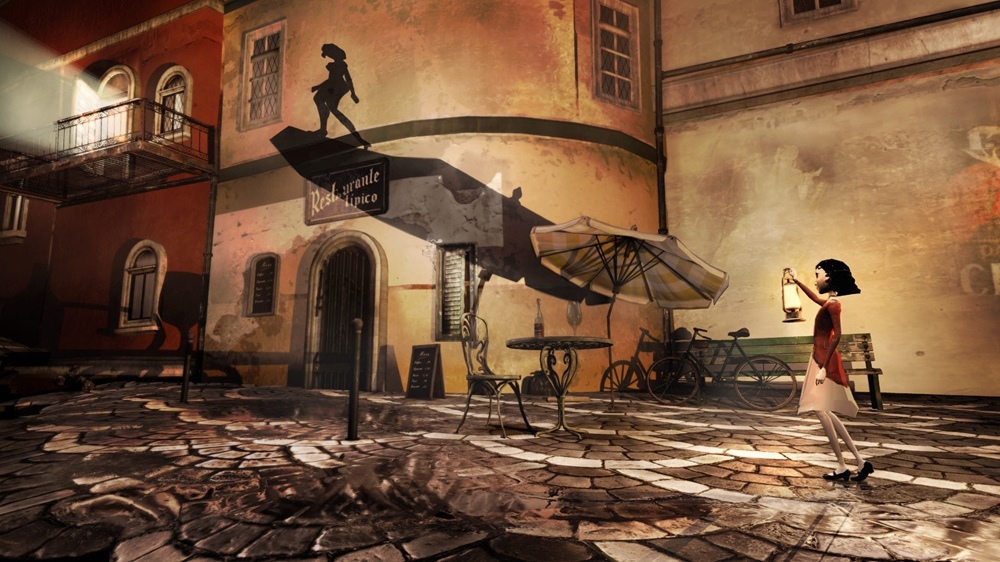
As the heading implies, Contrast is like nothing you've ever played before. Of course, there are elements of the game that resemble titles you have in your library, but it manages to introduce a totally new dimension in gameplay that has never been previously attempted. The film noir aspects and the idea of a broken family are nothing new. However, the use of light and shadow as a means to get around the setting, tell the story, and solve puzzles is an entirely new mechanic in gaming. It is somewhat difficult to explain, so I'll just show you. Take a look at this video and you'll see what I mean. Dawn, the protagonist and playable character, can "shift" into and out of shadows. She can (and must) manipulate light sources in order to create shadows and complete levels. The Story
As I said before, you play as Dawn, the sexy yet silent "imaginary" friend of Didi. Didi is a young girl of 7 or 8 whose mother is a lounge singer and aspiring star named Kat. Her father, Johnny, has been kicked out of the house for perpetrating one too many offenses against his family in the form of cons, schemes, and various other less-than-successful sketchy ventures.
I won't get too in-depth as the story is one place that this game really shines. I will just say that Didi enlists Dawn and her ability to "shift" between the three-dimensional world of color and the dark versus light, two-dimensional world of the shadows to ensure that Johnny's most recent plan doesn't falter and their family can become a single functioning unit once again.
One thing I will say is that I especially liked the ideas that were introduced about the multiverse and the possibility that either Didi, Dawn, or maybe even all of the characters exist in different dimensions. This fascinating theory was furthered by the fact that the entire game takes place in a sort of floating city like that found in BioShock: Infinite. Although it was never really explained why you were walking around in a town that was surrounded by places you could easily fall off of without so much as a hint of a guardrail or other protective apparatus, that only added to the sense that you were operating in another dimension than the one we all inhabit.
Gameplay
Didi and Dawn are the only two characters that appear in three dimensions in the game. All of the other characters only appear as shadows, even though Didi responds to them as though they were three-dimensional flesh-and-blood people. This also serves to increase the player's sense that they are playing in an environment that exists between dimensions, or at least one that is alternate from our own.
Most of the actual game centers around Dawn's ability to "shift" between two and three dimensions. At times she walks the streets and alleys like any normal character would in a game. At other times, she is flattened into a shadow and must navigate using only other shadows as one would use a sidewalk for transportation, walking thirty feet up along walls as though they were solid ground. At times, Dawn must manipulate light sources in the third dimension in order to navigate the second. Other times, she uses existing character's shadows to move around the world of Contrast. Much of this navigation is done as part of a puzzle that must be solved to further the story. It is an extremely creative, if a little hard to grasp, method of maneuvering about the environment.
Control Scheme
This was one place where I really felt that this game fell short. The controls were as squirrelly as they could be. If Grand Theft Auto is like trying to drive a tank, this is like herding cats. Getting Dawn to go where you wanted her to could be an exercise in futility. I died dozens of times when she simply fell to her death due to poor controls. Getting Dawn to do exactly what you wanted her to do often required repeated attempts and sometimes the simplest of movements were maddeningly difficult.
Conclusives
While this game has its flaws, they are easily out-shined by its unique approach to gameplay and the new methods it uses to the traditional platforming puzzle game. The story draws you in and you actually care about Didi and her family, becoming fascinated by their lives and emotionally attached to the outcome. The mystery contained in the world of Contrast is one that still has me considering all the possibilities it presents with regard to multiple universes and dimensions. Multiverse theory is one that has always intrigued me and this game does a wonderful job of presenting some of its details while maintaining a plausible and heart-warming plot at its core.
The Math
Baseline Assessment: 7/10
Bonuses: +1 for creating a new type of gameplay mechanic that is unique and original.
Penalties: -1 for game controls that had me cursing like a sailor at times.
Nerd Coefficient: 7/10 - A mostly enjoyable experience.
Thursday, September 4, 2014
Thursday Morning Superhero
Another new comics book day has passed and another large haul from my LCS. When I approached the shelf to pick up this week's titles, it dawned on me that this was quite the big week for Marvel. The much hyped Death of Wolverine began (with a great issue!) and we enjoyed the conclusion of Original Sin. I quite enjoyed this event and hope it has a lasting impact on the Marvel Universe. Not to be outdone, DC began its Futures End push complete with lenticular covers. I picked up the Batman Detective one shot and might add more to the collection next week.
Legendary Star Lord #3 - While not the deepest or most compelling story of this week's haul, Legendary Star Lord sure has been a fun ride. Any issue that includes lyrics from the Aquabats and has Kitty Pryde dressed up in a banana suit can't be that bad. The humor, when it hits, is quite good, but there are some times it feels like it's reaching. Despite the jokes that miss, Sam Humphries has a quality title on his hands and I look forward to seeing where the story goes. It seems he has put some pieces into place that could pay huge dividends moving forward.
Original Sin #8 - We finally know who killed the Watcher! Original Sin came to its conclusion this week and I must say that I enjoyed this event. While I feel it didn't deliver as much in the end as I initially hoped, it was a quality event that will hopefully have some lasting effects. Some of its immediate impact were felt at the conclusion, but I am curious how long Marvel will stick to them. My favorite thing about the final issue is that a secret is kept from someone at the end. I thought it was very fitting to end an event that was about having secrets revealed with the start of a new cycle of deception. After all, sometimes secrets are best kept secret.
Batman: Detective Comics #1 - Nice one-shot that any fan of Batman will enjoy. It had a fun twist at the end and was an overall enjoyable read. It mentioned some facts that should come to light in Futures End so it was a nice tease. Lenticular covers normally don't do much for me, but this one is very impressive.
God Hates Astronauts #1 - I have no idea what I just read. I am certain that Image is the only publisher that would run with a title like this and am fond of the character Admiral Tiger Eating a Cheeseburger. Turns out that his name is extremely literal and he is the son of King Tiger Eating a Cheeseburger. 3-D Cowboy (who is a ghost?) narrates this bizarre title. I think I am intrigued enough to return for the second issue as King Tiger Eating a Cheeseburger has declared war. The appeal of this book, aside from how absolutely insane it is, might be the idea that it inspires hope that I may have an idea for a comic that is better than this one.
POSTED BY MIKE N. -- comic guy, proudly raising nerdy kids, and Nerds of a Feather contributor since 2012.
Pick of the Week:
Nailbiter #5 - I enjoy this series more with each passing issue. Joshua Williamson has spun quite the complex web in the town of Buckaroo, Oregon. The shocking reveal that Agent Carroll was alive last issue has turned the investigation up on its head. Some of the pieces aren't quite fitting together properly as if Finch and Shannon, the two currently on the case, are having their strings pulled. One thing I love about the characters in this book is that they are neither completely good or completely evil. It reminds me of the characters in Miyazaki films. Even the villains have their redeeming qualities and are far from being one-note. Here's hoping they collect the first arc into a deluxe trade with lots of extras.
Death of Wolverine #1 - Even though it set me back $4.99, this title was simply breathtaking. The artistic team of Steve McNiven, Jay Leisten and Justin Ponsor really produced a beautiful book and Marvel went the extra distance with the glossy cover and the bonus features in the back. Normally when a book has the extra pages and costs more I am not too pleased, but was happy Marvel included this. In terms of the story, I had my doubts about this one, but Charles Soule (who I shouldn't have doubted) delivered and I am looking forward to issue #2. I am just curious how long Logan will remain dead.
Legendary Star Lord #3 - While not the deepest or most compelling story of this week's haul, Legendary Star Lord sure has been a fun ride. Any issue that includes lyrics from the Aquabats and has Kitty Pryde dressed up in a banana suit can't be that bad. The humor, when it hits, is quite good, but there are some times it feels like it's reaching. Despite the jokes that miss, Sam Humphries has a quality title on his hands and I look forward to seeing where the story goes. It seems he has put some pieces into place that could pay huge dividends moving forward.Original Sin #8 - We finally know who killed the Watcher! Original Sin came to its conclusion this week and I must say that I enjoyed this event. While I feel it didn't deliver as much in the end as I initially hoped, it was a quality event that will hopefully have some lasting effects. Some of its immediate impact were felt at the conclusion, but I am curious how long Marvel will stick to them. My favorite thing about the final issue is that a secret is kept from someone at the end. I thought it was very fitting to end an event that was about having secrets revealed with the start of a new cycle of deception. After all, sometimes secrets are best kept secret.
Batman: Detective Comics #1 - Nice one-shot that any fan of Batman will enjoy. It had a fun twist at the end and was an overall enjoyable read. It mentioned some facts that should come to light in Futures End so it was a nice tease. Lenticular covers normally don't do much for me, but this one is very impressive.
God Hates Astronauts #1 - I have no idea what I just read. I am certain that Image is the only publisher that would run with a title like this and am fond of the character Admiral Tiger Eating a Cheeseburger. Turns out that his name is extremely literal and he is the son of King Tiger Eating a Cheeseburger. 3-D Cowboy (who is a ghost?) narrates this bizarre title. I think I am intrigued enough to return for the second issue as King Tiger Eating a Cheeseburger has declared war. The appeal of this book, aside from how absolutely insane it is, might be the idea that it inspires hope that I may have an idea for a comic that is better than this one.POSTED BY MIKE N. -- comic guy, proudly raising nerdy kids, and Nerds of a Feather contributor since 2012.
Wednesday, September 3, 2014
Microreview [book]: The Widow's House by Daniel Abraham
Epic Fantasy with Something to Say
Daniel Abraham's The Dagger & The Coin is one of my favorite on-going epic fantasy series (previous reviews of vols. one, two and three). It is briskly paced, elegantly written, full of memorable characters and features some innovative world-building. In other words, it's very easy to like and very difficult not to get sucked into. Plus unlike, say, the Malazan series, this one has a gentle learning curve, making it a superb recommendation for newcomers looking to branch out after reading George R. R. Martin.
Book #3, The Tyrant's Law, has been my favorite to date, in large part because of how it tackled genocide and ethnic cleansing. (Read the book now, in light of the atrocities committed by ISIS in Iraq and Syria, and you see how Abraham got it right.) But also because of the way Abraham cuts the heaviness with good old fashioned questing fun. In sum, it's an easy-breezy book and a smart/weighty book at the same time--without being trite about the heavy stuff.
The Widow's House picks up where we left off, with Antea's victorious armies still on the move but getting stretched thinner and are beginning to crack. Dawson Kalliam's son Jorey has been named Lord Marshall by his "friend," the tyrant Geder Palliako, and ordered to march on Porte Oliva, where Cithrin has escaped to after fleeing the conquered Timzinae city of Suddapal (and Geder's romantic advances). Marcus and Master Kit, meanwhile, now face the daunting task of convincing Inys, the final dragon, to fight on their side against Geder and the Spider Priests.
To call this a fast-paced adventure would be to do the term a disservice. Usually I'm the kind of reader who sits down for an hour or two, then puts the book down and does something else (but repeats the process regularly everyday). But in this case I was physically unable to stop myself from reading "just...one...more...chapter." And then another. It takes a special kind of story to transform me from my usual plodding self into a binge-reader like Jemmy; this is certainly that kind of story, and The Widow's House even more than previous volumes.
At times, though, it feels as if Abraham is pushing the pedal down a bit too hard. I've noted the elegance of Abraham's writing style in the past, and that's still generally the case here. But the prose feels a bit stripped down in comparison to previous volumes, and dialogue overly reliant on witty banter (a stylistic trope of fantasy writing if there ever was one). And the uneveness among the perspective characters that mars the first three volumes is still present: the Marcus and Cithrin chapters are still much better than the Clara ones, though her character has improved over the course of the series.
This time, however, it was the Geder chapters that dragged: he's one of the most interesting and unique characters in the series--a likable Stalin, if you will. But the problem of what makes him tick feels even more glaring now than it did the last time around, because whereas Antea was invincible in The Tyrant's Law, basically everyone is screwed in The Widow's House. Antean armies, backed by the persuasive oratory of the Spider Priests, cannot lose; but now, being of limited number and having committed all sorts of atrocities, they can't really keep the territory either. Rebellions pop up everywhere and are especially fierce where Timzinae fight to avenge their massacred and enslaved fellows. Meanwhile, the Spider Priesthood has also fractured, with an "apostate" seizing control of an Antean city and declaring High Priest Basrahip the "true apostate." Basrahip, for his part, thinks this is great. The setup *should* be a great opportunity to develop Geder's character beyond "awkward nerd feels slighted by girl/commits genocide." Alas, the opportunity is missed.
(And it's not just Geder: Clara and her son Jorey also do things that don't quite make sense, knowing what we do about them and their circumstances.)
At the same time, the setup does work to illuminate the major sociopolitical theme of the book: the self-destructive nature of zealotry, which turns in upon itself as inevitably as it infects the those looking for easy, all-encompassing answers. Abraham literalizes the metaphor through the spiders that infect the blood of the priests; we're told that the spiders sow discord through unwavering belief, to the point where "the tainted" will use any excuse to fight the "unbelievers." It's not subtle, but neither is zealotry. Case in point: human history.
That's pretty dark, right? Maybe grim-dark, even? Yes and no. Much has been made about the gritty or "grimdark" turn in fantasy, with battle lines drawn. In two essays (first one, second one), I've suggested the problem isn't in the concept but in execution--that gritty/grimdark fantasy can be very good but often isn't, and that it needs to tackle the meaning and consequences of violence, not just use it to paint in the background. The Dagger & The Coin is, in a sense, both emblematic of the gritty turn in fantasy and anathema to what most people (supporters and detractors alike) think of when they hear the term. It's not gory at all--most violence happens off-stage or is left to the imagination. But the causes and consequences are fundamental to the story being told. It is a gritty story, but told in a purposefully not gritty way. The success of Abraham's approach and execution, I think, marks the series as unique among what's currently being published in fantasy.
So it's a good book--a very good book, even. And even though it doesn't quite address the flaws of the series, it does introduce some new wrinkles, while reminding you why you fell in love with this world in the first place.
One final thing: Abraham introduces a potential solution to the problem of the Spider Priests at the end of the book. I won't spoil it here, but I will tell you that it traces back to late Medieval/early Renaissance banking (a running theme of the series, and Cithrin's vocation). It's...quite odd. Maybe the next installment will make things clearer, but at present I'm scratching my head a bit, wondering where things are going. Suffice to say, how that develops might impact my feelings about The Widow's House ex post facto. For now, though, I'm willing to assume Abraham knows what he's doing, even if I don't.
The Math
Baseline Assessment: 8/10.
Bonuses: +1 for being ultra-fast-paced, well-written fantasy adventure; +1 for taking a substantive/non-splatterpornographic approach to dark and disturbing thematic matter.
Penalties: -1 for Geder motivation issues; -1 for getting a bit too literal with the metaphors.
Nerd Coefficient: 8/10. "Well worth your time and attention."
***
POSTED BY: The G--purveyor of nerdliness, genre fanatic and Nerds of a
Feather founder/administrator (2012).
Reference: Abraham, Daniel. The Widow's House [Orbit, 2014]
Daniel Abraham's The Dagger & The Coin is one of my favorite on-going epic fantasy series (previous reviews of vols. one, two and three). It is briskly paced, elegantly written, full of memorable characters and features some innovative world-building. In other words, it's very easy to like and very difficult not to get sucked into. Plus unlike, say, the Malazan series, this one has a gentle learning curve, making it a superb recommendation for newcomers looking to branch out after reading George R. R. Martin.
Book #3, The Tyrant's Law, has been my favorite to date, in large part because of how it tackled genocide and ethnic cleansing. (Read the book now, in light of the atrocities committed by ISIS in Iraq and Syria, and you see how Abraham got it right.) But also because of the way Abraham cuts the heaviness with good old fashioned questing fun. In sum, it's an easy-breezy book and a smart/weighty book at the same time--without being trite about the heavy stuff.
Warning: Spoilers for The Tyrant's Law and The Widow's House Follow!
The Widow's House picks up where we left off, with Antea's victorious armies still on the move but getting stretched thinner and are beginning to crack. Dawson Kalliam's son Jorey has been named Lord Marshall by his "friend," the tyrant Geder Palliako, and ordered to march on Porte Oliva, where Cithrin has escaped to after fleeing the conquered Timzinae city of Suddapal (and Geder's romantic advances). Marcus and Master Kit, meanwhile, now face the daunting task of convincing Inys, the final dragon, to fight on their side against Geder and the Spider Priests.
To call this a fast-paced adventure would be to do the term a disservice. Usually I'm the kind of reader who sits down for an hour or two, then puts the book down and does something else (but repeats the process regularly everyday). But in this case I was physically unable to stop myself from reading "just...one...more...chapter." And then another. It takes a special kind of story to transform me from my usual plodding self into a binge-reader like Jemmy; this is certainly that kind of story, and The Widow's House even more than previous volumes.
At times, though, it feels as if Abraham is pushing the pedal down a bit too hard. I've noted the elegance of Abraham's writing style in the past, and that's still generally the case here. But the prose feels a bit stripped down in comparison to previous volumes, and dialogue overly reliant on witty banter (a stylistic trope of fantasy writing if there ever was one). And the uneveness among the perspective characters that mars the first three volumes is still present: the Marcus and Cithrin chapters are still much better than the Clara ones, though her character has improved over the course of the series.
This time, however, it was the Geder chapters that dragged: he's one of the most interesting and unique characters in the series--a likable Stalin, if you will. But the problem of what makes him tick feels even more glaring now than it did the last time around, because whereas Antea was invincible in The Tyrant's Law, basically everyone is screwed in The Widow's House. Antean armies, backed by the persuasive oratory of the Spider Priests, cannot lose; but now, being of limited number and having committed all sorts of atrocities, they can't really keep the territory either. Rebellions pop up everywhere and are especially fierce where Timzinae fight to avenge their massacred and enslaved fellows. Meanwhile, the Spider Priesthood has also fractured, with an "apostate" seizing control of an Antean city and declaring High Priest Basrahip the "true apostate." Basrahip, for his part, thinks this is great. The setup *should* be a great opportunity to develop Geder's character beyond "awkward nerd feels slighted by girl/commits genocide." Alas, the opportunity is missed.
(And it's not just Geder: Clara and her son Jorey also do things that don't quite make sense, knowing what we do about them and their circumstances.)
At the same time, the setup does work to illuminate the major sociopolitical theme of the book: the self-destructive nature of zealotry, which turns in upon itself as inevitably as it infects the those looking for easy, all-encompassing answers. Abraham literalizes the metaphor through the spiders that infect the blood of the priests; we're told that the spiders sow discord through unwavering belief, to the point where "the tainted" will use any excuse to fight the "unbelievers." It's not subtle, but neither is zealotry. Case in point: human history.
![]() |
| Nothing beats a good purge |
So it's a good book--a very good book, even. And even though it doesn't quite address the flaws of the series, it does introduce some new wrinkles, while reminding you why you fell in love with this world in the first place.
One final thing: Abraham introduces a potential solution to the problem of the Spider Priests at the end of the book. I won't spoil it here, but I will tell you that it traces back to late Medieval/early Renaissance banking (a running theme of the series, and Cithrin's vocation). It's...quite odd. Maybe the next installment will make things clearer, but at present I'm scratching my head a bit, wondering where things are going. Suffice to say, how that develops might impact my feelings about The Widow's House ex post facto. For now, though, I'm willing to assume Abraham knows what he's doing, even if I don't.
The Math
Baseline Assessment: 8/10.
Bonuses: +1 for being ultra-fast-paced, well-written fantasy adventure; +1 for taking a substantive/non-splatterpornographic approach to dark and disturbing thematic matter.
Penalties: -1 for Geder motivation issues; -1 for getting a bit too literal with the metaphors.
Nerd Coefficient: 8/10. "Well worth your time and attention."
***
POSTED BY: The G--purveyor of nerdliness, genre fanatic and Nerds of a
Feather founder/administrator (2012).
Reference: Abraham, Daniel. The Widow's House [Orbit, 2014]
Labels:
books,
Daniel Abraham,
epic fantasy,
fantasy,
grimdark
Tuesday, September 2, 2014
Microreview [film]: Angry Video Game Nerd: The Movie
A Successful YouTube Channel Struggles to Make the Jump to a Feature
Some background (this is all true): In 1982, hoping to capitalize on the runaway popularity of E.T., Atari negotiated the rights to adapt the film into a video game. These negotiations took so long, however, that it left only 5 weeks to actually develop and code the game. The result was one of the worst video games — if not the single worst — ever made, leaving hundreds of thousands of copies unsold, nearly bankrupting Atari, crashing the entire video game industry, and launching a persistent urban legend that the unsold copies were dumped in a New Mexico landfill. Earlier this year, this legend was proven true.
Before this film showed up, I knew the E.T. story, but had not been aware of the Angry Video Game Nerd series on YouTube. Their top posts get somewhere north of 2 million hits, though, so clearly a lot of people are fans. The format is that a guy known as the, yep, Angry Video Game Nerd (AVGN for short) plays and reviews old video games from his youth, going back to the Atari 2600. When Angry Video Game Nerd: The Movie begins, we're inside a corporate boardroom where a young game executive lays out her plan to make the worst video game of all time in order to keep costs low, but get it covered vitriolically by the AVGN, thus ensuring it has a high profile on release and racks up a bunch of sales. The game? A sequel to 1982's fateful E.T., which is also the most requested game review from fans of the AVGN, but he has steadfastly refused to review it.
Here's where things get tricky for me in reviewing this movie. Look at the above paragraph. You can see a great set-up somewhere in there. A nerdy guy who has achieved some Internet fame sets out to prove or disprove a 30-year-old urban legend to try to find this game. I could totally get on board with that. Unfortunately, the other part of the paragraph, the whole boardroom thing, doesn't make sense. And it's that direction that the movie takes. Yes, they look for the E.T. landfill, but they do so with the video game exec alongside, posing as a game nerd, and pursued by a crazy general who misunderstands the whole E.T. thing and thinks they're trying to break into Area 51. There are pieces of so many other movies in here, so many cliches, but they're never transcended, so it never reaches the level of effective satire. Ultimately, it feels like the team behind a successful YouTube channel wanted to make a movie, but didn't really know what story to tell, and instead tried to tell the story of every other movie.
I don't want to dump on this movie. It was evidently a labor of love by independent filmmakers who should be celebrated for pulling together hundreds of fans from around the world to realize their vision. That's awesome. But in terms of storytelling on an indie budget, it can't hold a candle to other, similarly situated films I've reviewed here, such as the excellent Cinema Six. That said, if you are a fan of the web series, I'm sure it's worth your time to take a look. Angry Video Game Nerd: The Movie is available on VOD today.
The Math:
Baseline Assessment: 5/10
Bonuses: +1 for the score by the fantastic Bear McCreary, who I met once when we were both in college; +1 for hanging a plot on a very cool, real-life video game story
Penalties: -1 for being two hours long; -1 for squandering what might've been a great movie idea; -1 for getting beaten to the punch by real life, which found the E.T. landfill in April
Cult Film Coefficient: 4/10. Problematic, but has its redeeming qualities. Read about our non-inflated scoring system here.
Posted by Vance K -- unapologetic lover of terrible movies (well, many of them), cult film and Southern California beer enthusiast, and Nerds of a Feather contributor since 2012.
Some background (this is all true): In 1982, hoping to capitalize on the runaway popularity of E.T., Atari negotiated the rights to adapt the film into a video game. These negotiations took so long, however, that it left only 5 weeks to actually develop and code the game. The result was one of the worst video games — if not the single worst — ever made, leaving hundreds of thousands of copies unsold, nearly bankrupting Atari, crashing the entire video game industry, and launching a persistent urban legend that the unsold copies were dumped in a New Mexico landfill. Earlier this year, this legend was proven true.
Before this film showed up, I knew the E.T. story, but had not been aware of the Angry Video Game Nerd series on YouTube. Their top posts get somewhere north of 2 million hits, though, so clearly a lot of people are fans. The format is that a guy known as the, yep, Angry Video Game Nerd (AVGN for short) plays and reviews old video games from his youth, going back to the Atari 2600. When Angry Video Game Nerd: The Movie begins, we're inside a corporate boardroom where a young game executive lays out her plan to make the worst video game of all time in order to keep costs low, but get it covered vitriolically by the AVGN, thus ensuring it has a high profile on release and racks up a bunch of sales. The game? A sequel to 1982's fateful E.T., which is also the most requested game review from fans of the AVGN, but he has steadfastly refused to review it.
Here's where things get tricky for me in reviewing this movie. Look at the above paragraph. You can see a great set-up somewhere in there. A nerdy guy who has achieved some Internet fame sets out to prove or disprove a 30-year-old urban legend to try to find this game. I could totally get on board with that. Unfortunately, the other part of the paragraph, the whole boardroom thing, doesn't make sense. And it's that direction that the movie takes. Yes, they look for the E.T. landfill, but they do so with the video game exec alongside, posing as a game nerd, and pursued by a crazy general who misunderstands the whole E.T. thing and thinks they're trying to break into Area 51. There are pieces of so many other movies in here, so many cliches, but they're never transcended, so it never reaches the level of effective satire. Ultimately, it feels like the team behind a successful YouTube channel wanted to make a movie, but didn't really know what story to tell, and instead tried to tell the story of every other movie.
I don't want to dump on this movie. It was evidently a labor of love by independent filmmakers who should be celebrated for pulling together hundreds of fans from around the world to realize their vision. That's awesome. But in terms of storytelling on an indie budget, it can't hold a candle to other, similarly situated films I've reviewed here, such as the excellent Cinema Six. That said, if you are a fan of the web series, I'm sure it's worth your time to take a look. Angry Video Game Nerd: The Movie is available on VOD today.
The Math:
Baseline Assessment: 5/10
Bonuses: +1 for the score by the fantastic Bear McCreary, who I met once when we were both in college; +1 for hanging a plot on a very cool, real-life video game story
Penalties: -1 for being two hours long; -1 for squandering what might've been a great movie idea; -1 for getting beaten to the punch by real life, which found the E.T. landfill in April
Cult Film Coefficient: 4/10. Problematic, but has its redeeming qualities. Read about our non-inflated scoring system here.
Posted by Vance K -- unapologetic lover of terrible movies (well, many of them), cult film and Southern California beer enthusiast, and Nerds of a Feather contributor since 2012.
Subscribe to:
Posts (Atom)


.jpg)