Thursday, February 7, 2013

Thursday Morning Superhero

Not a bad book in the bunch this week.  For the first time on this blog I delve into a new Monkeybrain Comic that is a great deal of fun and was treated to three new projects from three of my favorite creators.  Needless to say I had a smile on my face as I read this week's haul.


Pick of the Week:

Snapshot #1 - When Andy Diggle and Jock work together on a project, I will happily blindly throw my money at them.  Snapshot had me hooked very quickly and managed to leave me absolutely begging for more.  A comic book store employee finds himself in the middle of a murder plot simply by finding a cell phone on his bike ride to work.  For whatever reason, the killer sees value in him, but we will have to wait for issue #2 to see what is in store for Jake.  Diggle's brisk pace and knack for moving a complicated story forward with ease paired up with Jock's unmatched visual style and stunning use of black and white put this book on another level.  Not surprised my LCS was sold out and I had go the digital route with this one.

Runner-up:
Red Team #1 - Not surprisingly, Garth Ennis has created a franchise that is original and likely to be gripping and disturbing.  Red Team is a group of detectives that are very good at what they do, but like many crime stories, the drug lord that they want to take down is above the law.  It seems every time a witness is ready to testify they disappear or that his attorney gets him off with a technicality.  The Red Team does what you want the police to do in this situation, murder him.  Told through the perspective of a team member confessing his crimes, this book is smartly written and really sets the stage for what seems like a great new endeavor.


The Rest:
Phabula #1 - This week we are treated to a new title from Monkeybrain Comics, Phabula.  Written, drawn, colored, and lettered by Dalton Rose, Phabula is an exciting tale about a young sorceress who appears to be questing to rid herself of a deadly curse.  In issue one, filled with buckets of blood, she slaughters a horde of demons and Ogai, child of Gods, in her attempt to locate a map.  Rose's unique whimsical art creates a juxtaposition to the violence that is taking place on the page.  Throw in a dash of humor and you are left with a one-of-a-kind book that is sure to be highly entertaining.  Go buy it now on ComiXology for the low price of $.99!

Fearless Defenders #1 - Anyone who reads this blog knows that I greatly enjoy the writing of Cullen Bunn and the Fearless Defenders continues this tradition.  On the surface you are treated to a comic that feels like a summer blockbuster full of good looking women who kick a lot of ass.  Asgardian artifacts are stolen, vikings rise from the dead and Misty Knight, a bionic bad-ass, knocks out countless teeth.  When you dig a little deeper you see a story involving the destiny of Valkyrie and the return of the Doommaidens. With Bunn's skillful hand with wit and action and the phenomenal art of Will Sliney, Fearless Defenders should be quickly added to your pull list at your LCS.


Batman Detective Comics #17 - John Layman wraps up his Merrymaker plot as Batman uncovers the truth behind who the Merrymaker is and what his motivations were.  Layman's sense of humor shines through and his ability to script some of the most punishing panels is evident.  Reading almost like a standalone, the overarching plot involving Emperor Penguin is moved forward slightly.  I would guess that issue #18 would be a great leaping on point, but this one is enjoyable on its own accord.

Wednesday, February 6, 2013

Microreview [comic]: Hip Hop Family Tree


The Meat

Full disclosure: I don't like hip hop. Time and again, people have tried their damnedest to get me listening to hip hop. Buddies, girlfriends, enemies. I have been given mixtapes and forwarded playlists, all to no avail. This isn't to say that I don't respect hip hop. This isn't to say that I cannot recognize the genius of Straight Outta Compton or The Low End Theory.

But Ed Piskor's Hip Hop Family Tree did something that none of my people have ever before managed: it got me to actually sit down and listen to the music.

Hip Hop Family Tree is, of course, not a history of rap alone. As those familiar with the genre can attest, it's difficult to separate the music from other elements of the "culture" -- b-boying, graffiti, lingo, style. Piskor demonstrates an affectionate respect for the interrelations between these phenomenon, telling a story of a culture, rather than a musical genre. He begins with Cool Herc's parties and, as of this writing, has reached the point in which downtown punk and uptown hip hop first come into contact. For one fleeting moment, American music was poised to go into an odd direction.

Like a good social historian, Piskor focuses on the human relationships that drove hip hop's development -- from antagonistic competition to opportunistic collaboration -- giving the reader an insight into the haphazardness of cultural development. Of course, history is made by people, but not always under the conditions of their own choosing. And events are random on a level that human interaction can never attain. That's why a city-wide blackout lead to the expansion of DJ culture throughout New York, allowing kids to emulate their heroes and, eventually, one-upping them.

This is history, nonfiction. But Piskor manages to tell the story dynamically, moving between events quickly. Sometime, almost haphazardly. On some pages, events are jumbled together. On others, the transition from one event to another happens too abruptly -- the first event either left unresolved or its significance to the page's second event is unclear. This, however, is just an occasional nuisance that takes nothing away from the overall reading experience.

Though the writing -- and the very idea of a comic history of hip hop -- is great, the art is remarkable. Piskor's style has often been compared to underground luminaries like Crumb, but Hip Hop Family Tree seems to draw as well on Marvel's house style from the seventies. Piskor's art is nostalgic without being derivative. The coloring complements the old school pencil-and-ink, demonstrating how comic art can itself evoke history.

There's more. Hip Hop Family Tree doesn't read like a web comic. It is rather a comic book on the internet. Which means Ed Piskor has drawn pages. This isn't four panels on Tumblr, but actual pages from a comic book, pages that an artist spent time on. Yellowed pages that look like old comic book pages looked. There's thought at work here.

Oh, but I have a gripe. Not an insignificant one, either. Fortunately I can lay this one entirely at BoingBoing's feet. Hip Hop Family Tree isn't easy to read. To begin at the beginning, you'll need to go to the fairly useless index and scroll down -- and down -- until you get to the first installment. Which, of course, is not clearly identified as such on the website. How about a "start with part one" button?

Or we can simply wait until September when Fantagraphics will release a trade of Hip Hop Family Tree and we can read Ed Piskor's pages as it was meant to be read. Pages.

Here's the link once more: http://boingboing.net/tag/hip-hop-family-tree


The Math
Objective Score: F*ck it, 10/10

Bonuses: +1 for pages

Penalties: -1 for BoingBoing dropping the ball on reader-friendliness

Nerd Coefficient: 10/10

Tuesday, February 5, 2013

Microreview [book]: Dinosaur Thunder by James F. David


The Meat

Dinosaur Thunder continues James F. David's adventured-filled series that links the past and the present, bringing Cretaceous-era dinosaurs into the modern age. Eighteen years ago (in one of the earlier volumes), the planet was swept by time waves that intermixed the Cretaceous period with the modern era. Whole cities disappeared, people were lost, and large swaths of globe became replaced by dinosaur-infested forests. In the end, humanity survived, and learned to live with the dinosaurs. However, a new crisis looms on the horizon. New dinosaurs have inexplicably appeared. And new time passages appear linking the modern era to the Cretaceous, where humans still fight to survive. Making things even stranger, a Tyrannosaurus Rex has been spotted on the moon, trapped within a block of orgonic matter (as opposed to "organic" matter?). It is up to our old friend, Nick Paulson, the director of the Office of Security Science, and his motley group fellow time travelers, to figure out what is going on.

Making matters worse, Nick Paulson finds himself and a number of his motley crew transported back to the Cretaceous Period, 65 million years ago, as the comet that wiped out the dinosaurs speeds toward Earth. And he is astonished to discover humans struggling to survive against another sentient species (called the Inhumans by the locals), a species that nobody knew existed. As Nick and crew struggle to get back home, other members of the Office of Security Science find themselves in a race to make sure that the impending comet crash does not affect the present.  

Despite the fact that this book is a continuation of David's broader series, it is not necessary to have read his earlier books. David provides a neat, easy summary in the beginning, and sprinkles reminders of what happened in earlier books throughout the course of the story. So I never felt lost as I read the book.    

Overall, Dinosaur Thunder never lacks for interesting twists, and David's strength as a writer lies in his ability to conjure up interesting plot lines. Those who like dinosaurs, conspiracies surrounding the dinosauroids, time-travel, and those who are unfazed by unlikely pseudo-science will find much to enjoy in this book.

Objectively speaking, however, this book is not very good. Readers who enjoy character-driven stories will be sorely disappointed with Dinosaur Thunder. The good characters are good; the bad characters are bad. There is little in-between. Some characters, notably Wynooski, are so patently annoying that you can't wait for them to be killed off or written off the page. Only one character, the Reverend, goes through any character development during the course of the novel. Furthermore, women are at times characterized rather poorly. Granted, the book features intelligent and strong women, women who are able to get the job done just as well as their male counterparts. But at multiple points they appear more interested in how perky their breasts are than in their overall predicament of being sent to the Cretaceous Era (or, at one point, Mars). 

More importantly, Dinosaur Thunder also lacks any sense of tension. Only at one point in the book did I feel a sense of tension. Otherwise, I never worried about what was going to happen to the main characters. Nor did I care much. This, no doubt, stems from the lack of attention to overall character building throughout the book.

Dinosaur Thunder also is in dire need of another round of editing. To give but one example, at one point a velociraptor bites down on a main character's leg. Then, in the middle of the same paragraph, the reader finds that very same velociraptor biting on a different person's leg... <sigh>. Mistakes like this should have been caught by proofreaders or the editorial staff. 

Despite all these problems, and despite the fact that it is not an objectively good book, we still give Dinosaur Thunder two thumbs up. It is nerd-tastic. Nerd-gasmic. David does so much right that we not only forgive the fact that this is not a very good book, we embrace it. First, he sends Portland, OR, into the Cretaceous Era. What type of genius is that! Portland! Just as the city thought it couldn't get any more eco-friendly, it gets sent back to the Cretaceous Era. Second, he has an awesome opening scene, where men in spacesuits witness a live Tyrannosaurus Rex struggling to break free of its rocky prison on the moon. Dinosaurs in space -- what could be more nerdy than that? Third, David actually has an ingenious take on the conspiracy theories surrounding the dinosauroids, a take that he fleshes out in this book in broader detail. These very points, added to the fact that this book is really about time-traveling and space-traveling dinosaurs, make Dinosaur Thunder pure genius, a must read for nerds of all shapes and sizes.    

The Math

Baseline Assessment: 4/10

Penalties: -1 for annoying characters; -1 for bad editing; -1 for a lack of tension throughout the book.

Bonuses: +3 for dinosaurs on the moon and time-traveling dinosaurs; +2 for sending Portland into the Cretaceous Era; and +2 for an interesting take on the sentient dinosauroids.

Nerd Coefficient: 8/10. "Well worth your time and attention"

Read about our scoring system, in which average is a 5/10, here.

Monday, February 4, 2013

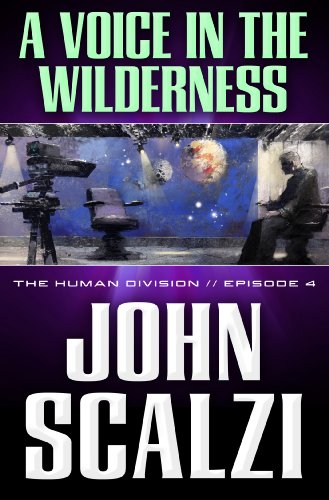
Scalzi, The Human Division Episode 4: A Voice in the Wilderness


Another Interlude

Yes, that's right: we won't be following Wilson, Schmidt and Abumwe this week. Rather, we take a detour to Earth and get a peek into the life of one Albert Birnbaum, an AM radio-style shock jock (think Rush Limbaugh meets Howard Stern) whose career is currently in free fall. That is, until he's approached by a suited gentleman with a proposition from a (not-at-all obvious) mystery client. He asks Birnbaum to advocate for a cause, and promises that if he does, all his problems will magically disappear. But at what cost?

Good, but...

All the usual  praise for Scalzi's writing applies here again: the snappy dialogue, the economical but effective descriptive prose, the engaging characters, the brisk pace. I enjoyed the read while I was reading it, to be sure, but I also couldn't quite figure out why I should really care that much. True, the episode exists to set some plot pieces in motion, and it does accomplish that, but Scalzi could have stripped this down to be a section of a more fully-formed episode, and done so at very little cost.

And there is a cost to the longer format, in the sense that it highlights one of the weirder and unrealistic aspects of the OMW universe. As we're told multiple times in episodes 1-3, the Colonial Union "held Earth back 200 years" so it could be used as a breeding ground for colonists and soldiers. If this were real world history, the terms "held back" and "200 years" would be meant figuratively, not literally--i.e. that the colonial power has suppressed the ability of colonial subjects to become technological or socio-political equals to the citizens of the metropole. Put another way, colonial powers were suppressing the development of their subject colonies in relative, not absolute terms. As it happens, real historical colonial powers usually hastened technological development and imposed new social and political institutions on their colonial subjects--not out of the goodness of their hearts, but because it made exploitation more efficient. So it would stand to reason that, if the Colonial Union were to efficiently exploit Earth, it would need to alter the infrastructural and institutional landscape of the home planet. In A Voice from the Wilderness, though, Earth appears virtually unchanged from our year of 2013. I could sort of handle this setup as long as it was vague and peripheral, but this interlude on Earth really makes the incongruity hard to ignore.

Hopefully we get back to business next week.

Score

6/10. "Still enjoyable, but the flaws are hard to ignore.

Cumulative Score (Eps 1-4)

7.5


Saturday, February 2, 2013

We Rank 'Em: Best Moments of 30 Rock

Liz Lemon. Almost any scene with Liz. That would be a cop out. Plus internet people like lists. So, as if there weren't enough of these floating around, we here at Nerds of a Feather proudly present (or at least I do, the guy came up with this at the last moments -- excuses like grant applications, academic writing, work, drawing pictures of me as an Old West gunslinger):

Yet another 30 Rock list.


12. Jenna's Kids


11. Alfie and Abner


10. Dr Leo Spaceman's Love Storm (Apologies for the video but it has to be on the list)


9. Banks likes Cold Pizza


8. Werewolf Bar Mitzvah


7. Liz Lemon Party


6. This Moi!


5. Tracy (and Jack) in Therapy


4. Liz Dancing


3. Johnny Mountain Does the Weather


2. Liz Sex Chat Line Commercial


1. Two Ears and a Heart


Friday, February 1, 2013

ANNOUNCEMENT: Score Modifications

Hey regular readers, just want to let you know we've updated our scoring scale. Now something truly execrable can earn the coveted zero! Get your nominations in for our first ever today!

DmC: Devil May Cry

Devil May Cry - The Reboot


This is the fifth installment of the Devil May Cry series, but it doesn't follow in chronological order from the previous four. It's a re-boot of sorts, taking place in a similar but alternate universe. You play as Dante, a loner who has spent most of his life drinking and sleeping around as he searched in vain for his true calling. As it turns out, that calling is to save all of mankind from demons in the never-ending battle between heaven and hell.

Dante's mother and father were involved in a classic Romeo and Juliet love story, except his father was a demon and his mother an angel. When he was a child, his parents were killed by a demon king named Mundus. In a move that recalls Luke and Leia's hiding from Darth Vader, Dante and his brother, Vergil, were spirited away from the demon king in order to keep them breathing. And just like Star Wars, Dante is not-so-blissfully unaware of the existence of his sibling. The unholy coupling of demon and angel created what the game referred to as "nephilim". Dante and Vergil, as nephilim, are the only ones that can kill Mundus and release mankind from his control. 


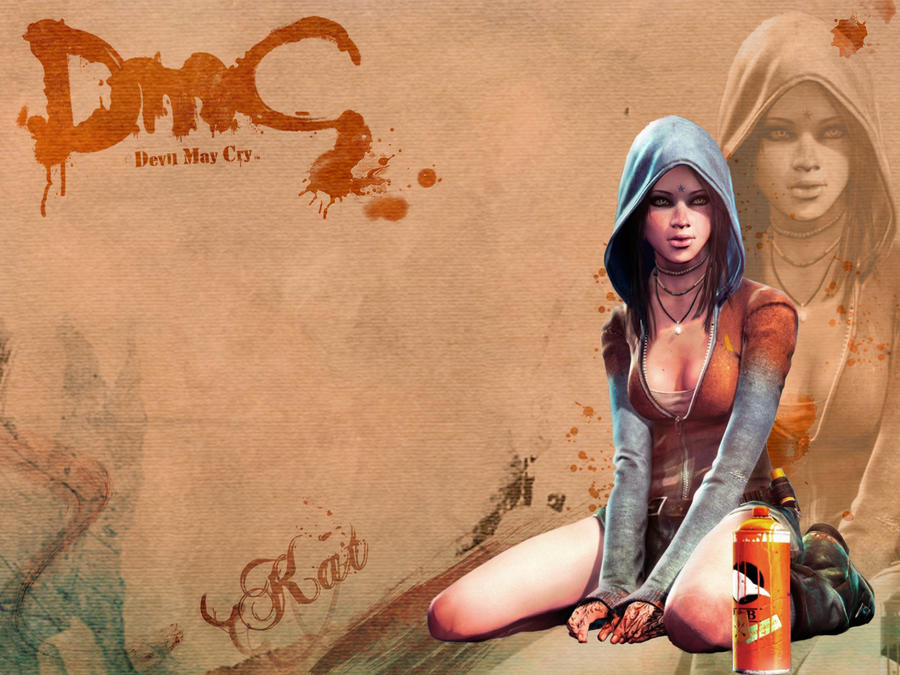
Dante is aided in his quest of self-discovery by a human girl named Kat. She suffered some sort of trauma in her younger years that's never really discussed, but Dante's brother Vergil has helped her see the world for what it is in much the same way that Morpheus opened Neo's eyes in The Matrix. Kat introduces Dante to his brother and together they all begin the battle for the fate of mankind against Mundus and his demon allies. All of the actual fighting takes place in Limbo, travel to which is a bit of a hazy point in the plot. The story is spotty in several places, but that's not really what this game is all about. It's about oodles and oodles of action!

Rated M for a Reason

This game is rated M because it deserves it. Aside from the prolific cursing and massive amounts of violence, there is also the subject matter to take into account. The game is about the battle between heaven and hell and, suffice it to say, the demons aren't very family-friendly. At one point in the game Vergil kills Mundus' unborn child. At another cut scene we watch Mundus eat Dante's mother's heart. There are plenty of scenes that take place in Hell and it doesn't look like the guests are all that happy to be there. The game has enough fire and brimstone in it to make a Southern Baptist preacher jealous. It is definitely not for children and some non-desensitized adults might even find it a bit nightmare-inducing. 

But how was the game?


As I've said before on this blog, I prefer a game with a well-written story to one with massive amounts of action and explosions. The amount of plot holes and corny writing in DmC could fill a tractor trailer. I was never really clear on how the whole "Limbo" thing worked. Somehow Kat would spray paint a design on the floor and that allowed Dante to travel to Hell's waiting room to fight demons. At other times Dante would be "pulled" into Limbo through some demonic interference by Mundus. If you're a gamer that needs to understand exactly what's going on, DmC might bother you quite a bit. You have to be able to suspend your disbelief in order to really enjoy it. 

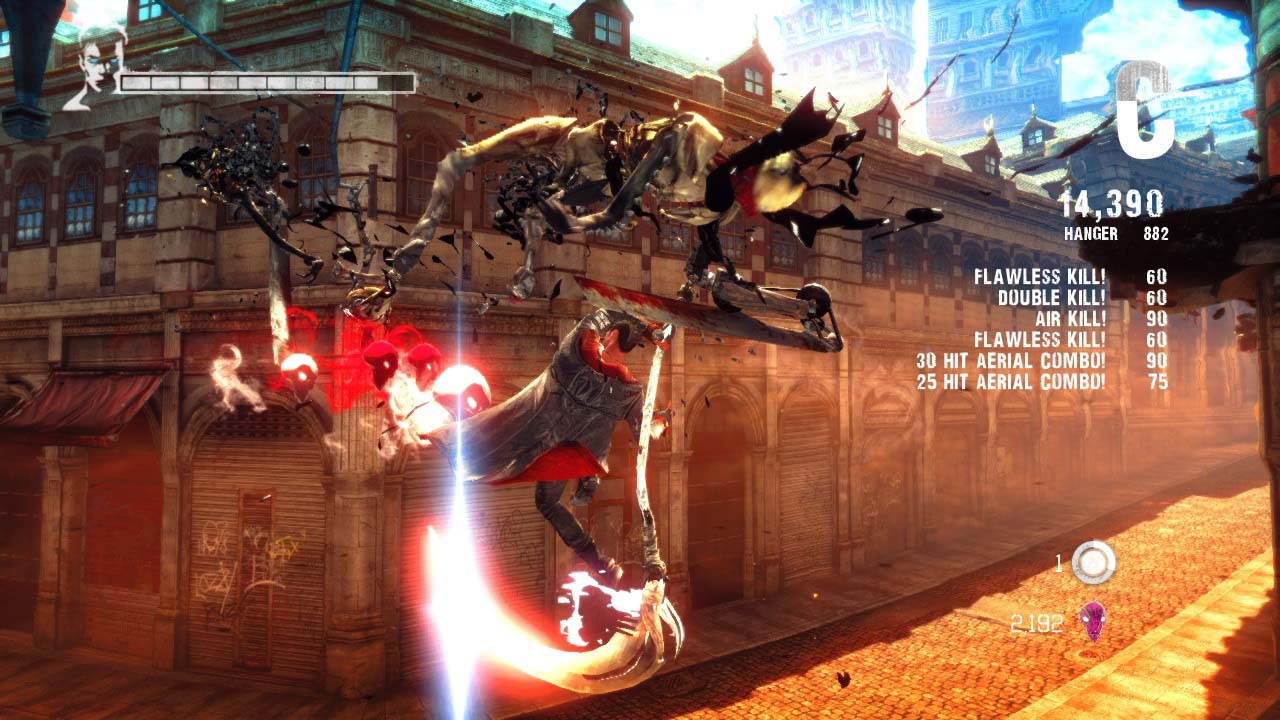
That said, the beautiful design and flawless combat mechanics are hard to top. Of all the games I've played this year, only Arkham City has a comparable fighting system. Skyrim is the only game in the same ballpark in terms of gorgeous environments. The writers may have been handcuffed by the constraints put upon them by the previous Devil May Cry games and the universe they inhabit, but the designers got every last ounce they could out of the graphics and gameplay. It's visually stunning and the fighting makes you feel like you're a well-trained ninja. 


The vast array of weapons makes it hard to master them all. I generally used two throughout most of the game, but eventually became fairly proficient with most of them. You gain style points for more creative attacks using multiple weapons on a single enemy. These style points encourage proficiency with all weapon types and moves. The more different attacks you use on an enemy, the more style points you get, which can lead to more weapon and ability upgrades. They designed it so that it's to your advantage to get creative with your attacks. There is no one move that can be used to spam enemies over and over again. You must become at least decently familiar with all of the weapons if you want to beat the game. 

Summary

While I don't see DmC: Devil May Cry winning many game of the year awards, it was a nice distraction from the host of seemingly never-ending RPGs I've been playing most of the year (Borderlands 2, Skyrim, Mass Effect 3). It is what it is: a hack-and-slash action game. When measured by that bar, it does quite well. While the story left a lot to be desired, the action and game design were second-to-none. If you're looking for a fun game that doesn't make you think too hard and barely gives you time to blink, DmC is for you. If you're a stickler for a deeper gaming experience with literary storytelling and character development, you should probably skip this one. Personally, I found it to be a pleasant diversion from most of the previous year's offerings. 

The Math

Objective score: 7/10

Bonuses: +1 for the beautiful design and stellar fight mechanics.

Penalties: -1 for the sometimes confusing and swiss cheese hole-filled plot.

Nerd Coefficient: 7/10. An enjoyable experience but not without its flaws. 

Read about our scoring system, in which average is a 5/10 here.