Showing posts with label The Human Division. Show all posts

Tuesday, April 23, 2013

Scalzi, The Human Division, Eps 11-13 and Final Thoughts

Welcome to the latest, greatest and, sadly, final installment of my serialized review of John Scalzi's serialized novel The Human Division. In case you are just getting on board, here are my reviews for Episode 1Episode 2Episode 3Episode 4Episodes 5-7 and Episodes 8-10. So far the book is smart, fun and at times very funny, but I've worried about the pace of storytelling and, at times, overdosed on the witty repartee. Through 10 chapters, the book has a cumulative score of 7.40/10. 

Since this is the last installment in this review series, I'll cover the chapters at hand and then give some final thoughts and issue final bonuses/penalties before giving you that all-encompassing score of scores. 

The Meats and the Maths


Episode 11: A Problem of Proportion

A lot of stuff happens in this episode, or more accurately, a lot of stuff gets discussed in this episode. Perhaps the heavy emphasis on dialogue is unsurprising in a novel about diplomats, but your enjoyment of this one will depend entirely on your tolerance for story exposition achieved almost exclusively through conversation. As I've said before, I tend to like Scalzi's dialogue until it passes my tolerance threshold for winks and nudges. And in this case, unfortunately, Scalzi does pass that threshold, most egregiously when Harry Wilson goes on an away mission with some aliens who, despite being from presumably vastly different worlds and cultures, waste no time in yukking it up with Wilson in the exact same manner one of Scalzi's quick-witted humans would.

That said, a lot does happen, and it is definitely interesting. The Colonial Union and Conclave, you see, have arranged for a secret meeting to discuss all the ships that have gone missing under mysterious circumstances, and whose disappearances inevitably implicate the other side. Only, when they arrive, there's a third ship and it's shooting missiles in both directions. It then gets curiouser and curiouser...

Generally speaking, and occasional overload on wit aside, this is a pretty good episode, and does more to move the plot forward than the last 3 or 4 combined. So big kudos for that. At the same time, it also made me realize what's been bothering me about The Human Division this whole time--it's not just that everyone is so damned witty, but that everyone is just too damned nice as well. Even the characters who come off as gruff and tough early on, like Abumwe and Coloma, have by now reveled themselves as serious softies. Sure the villains are still lurking in the shadows, but even the torturer we met in Episode 8 was polite. This book is in dire need of some assholes.

[INPUT 8/10 (+1 for the palpable sense of mystery; -1 for why is everyone so nice?) OUTPUT 8/10]


Episode 12: The Gentle Art of Cracking Heads

Another excessively talky episode, but like A Problem of Proportion, that's mitigated by the fact that it helps move the plot along in meaningful ways. We're back on Earth with potential Wilson love interest Danielle Lowen as she investigates the murder of diplomat Liu Cong. Unfortunately, I can't reveal more without ruining the episode for you, so consider my lips sealed on that front. I will, however, say that the way it ends is pretty compelling. Still, I can't really figure why this kind of episode--slow, talky and centering on someone who has been a bit character up to now (and who doesn't figure to level up to "secondary protag" status until Season 2)--hits us just before the grand finale. It's more appropriate as Act One material, and in that sense underscores the degree to which we've meandered to our current position in Act Three. I mean, was there even an Act Two?

[INPUT 7/10 (+1 for plot progression; -1 for OMG stop talking) OUTPUT 7/10]


Episode 13: Earth Below, Sky Above

This. This is what I've been waiting for--action, tension, concern for characters I've come to like and relate to, fear for their well-being and the feeling of having a stake in the outcome. It's all here in spades, in what is without any doubt the best and most compelling episode of The Human Division. Sure there are snippets of over-snark, and one egregious infodump smack dab in the middle, but I don't care. Not really; not when it's this good...

Action begins with the Clarke en route to a peace conference of sorts, where the Colonial Union hopes to mend fences with Earth and get that pipeline of soldiers and colonists going again. Abumwe, Wilson and the gang have point, given that they are now officially specialists in pulling off the near impossible. The problem is, there are plenty of folks in the galaxy who might not want this to work out. Unbeknownst to her fellows, Captain Coloma has been tasked with making sure that doesn't happen. But in the absence of any real military deterrent, what could she and her ancient ship actually do in the event of an attack?

The thing that makes Earth Below, Sky Above work so well is the pacing. The episode starts slow but then picks up bit by bit until it's raging forward at warp speed. And it doesn't sacrifice the wit and snappy dialogue Scalzi is renowned for either. In short, it's a microcosm of what made the original Old Man's War trilogy so good. On the other hand, it's also a microcosm of what The Human Division as a whole could have been, but isn't quite. Earth Below, Sky Above, you are so rich and tantalizing--why did you have to remind me of the fact that I don't have as much of you as I wish I did?

[INPUT 9/10 (+1 for pace and action; +1 for this is what I was waiting for; -1 for this is what it could have been like the whole time) OUTPUT 10/10]

Final Thoughts

Now that I've come to the end, I can say without reservation that The Human Division is a fun, breezy read with memorable characters and a whole lot of well-written dialogue. On the other hand, I can say without reservation that it takes too long to warm up, goes on too many unnecessary tangents and doesn't quite give the reader enough of the best it has to offer. In short, it's a good book that doesn't ever quite evolve into the great one it clearly could have been. Imagine, assuming you eat meat, that you're going to this one super awesome steakhouse thinking you're going to get the 12oz/350g ribeye they're famous for, but instead they keep giving you lots of tasty but distracting side dishes--salads, potatoes, shrimp cocktail and so on. You like all these things, but that's not why you chose this particular restaurant. And when the steak actually comes, it's a 4oz/125g filet. A good filet, to be sure, but you walk away feeling unsatisfied. (Vegetarians/vegans: imagine the same thing but with a perfect portobello mushroom in place of the steak.)

This sets up an ultimate choice for the reader: do you walk away or come back for more? And the bottom line is that I'll be back for more. See, that 4oz/125 filet of space operatic whodunit did whet my appetite, just like a season-ending cliffhanger does on a TV show. And as much as I've complained about the proverbial side dishes of tangents and filler material taking the place of main dish type stuff, I'll be damned if they weren't just charming enough to defuse any righteous NERD RAGE anger I might have pointed in the direction of another author. So yes, The Human Division is fun, funny and smart, and it's worth reading for all the other reasons I've mentioned in the course of this epic review as well.

That Whole Serialization Thing

...and that brings me to the question of how well the serialization worked. For me, at least, I think it's fair to say that it worked pretty well, but not perfectly. The good part is that I never had trouble getting back into things after a week off, and was always happy and excited to sit down with a new episode. The bad part--well, it's not so much "bad" as "not as good as it could have been"--is that there was often too little urgency involved. I had hoped reading episodes of The Human Division would feel like watching the early seasons of Lost or the middle seasons of BSG, the kind of serialized fun that leaves you hungry, clawing at the walls, scouring the internet for scraps of information and constructing ever-crazier theories. I never felt that way. Instead, reaching the end of each episode felt more like reaching the end of an episode of Farscape, leaving me just with a kind of "okay, cool, see you next week" feeling. There's nothing wrong with that, but it also strikes me as a missed opportunity. Here's hoping Season 2 picks things up a bit...

The Final Math

Cumulative Episodic Score: 7.62/10

Final Bonuses: +1 for leaving me hungry for more.

Final Penalties: -1 for leaving me hungry.

Final Nerd Coefficient: 7.62/10. Somewhere between "a mostly enjoyable experience" and "well worth your time and attention."

Monday, March 25, 2013

Scalzi, The Human Division Eps 8-10

Welcome to the latest installment of reviews for John Scalzi's serialized novel The Human Division. In case you are just getting on board, here are my reviews for Episode 1, Episode 2, Episode 3Episode 4 and Episodes 5-8. To summarize, "book good/interludes growing on me/generally quite funny but with occasional snark overload." Through eight chapters, the book has a cumulative score of 7.57/10. So how are the next three?

The Meats and the Maths


Episode 8: The Sound of Rebellion

Episodes 6 and 7 sort of inverted my prior feeling that stories featuring the central characters are inherently better than the interludes in which they don't figure, and The Sound of Rebellion continues that trend. True, there's no Harry Wilson, Ambassador Abumwe, Captain Coloma or Hart Schmidt here, but there is a very interesting story about kidnapped CDF soldiers suffering "enhanced interrogation techniques," to use the Cheneyspeak euphamism for torture. Regular readers of this blog will know by now how I feel about excessive cruelty in SF/F, and may wonder if a story about torture can manage to be compelling without falling into the grimdark pattern of moar moar blood plz. So let's all give Scalzi a hand for proving that it can be done, and done well. Plus we get some cool insights into the things that make CDF soldiers special without the dreaded infodumps most genre writers can't seem to live without, and some hints about the conspiracy at the heart of The Human Division while we're at it. Top shelf stuff, if ebooks could be put on shelves.

[INPUT 8/10 (+1 for doing torture without the bloodporn; +1 for showing not telling; -1 for it's another interlude, and even if they are getting better, there are a whole lot of them) OUTPUT 9/10]


Episode 9: The Observers

Of course, on the flipside of the interlude episodes' improving fortunes lie diminishing returns for the chapters featuring the flagship characters. The Observers, in which the Clarke plays host to a set of dignitaries from Earth only to find some black ops at play, isn't bad--far from it. But we have kinda sorta already been down this road in Episode 5, and for my money, that one did it better. Plus the scenes in which Wilson interacts with his potential love interest Danielle Lowen are too zippy by half. Though Scalzi is generally great with dialogue, at times he veers into the kind of excess quotability Charlie Jane Anders warned us about

[INPUT 7/10 (+1 for returning to the main story; -1 for being at least 40% retread; -1 for excess zip and snark) OUTPUT 6/10]


Episode 10: This Must Be The Place

This Must Be The Place focuses on Hart Schmidt, who to date has primarily served as Ambassador Abumwe's affable assistant and Harry Wilson's only real friend on the Clarke. Now we find out he's the wayward scion of the major political family on the Phoenix colony. Dad wants Hart to come home and follow in his footsteps, only Hart prefers making his own way in the CU's Department of State. You'll recognize this plot from a lot of TV shows, but it's generally well done, if still relatively light filler material. Did I enjoy reading this one? Sure. Did I love it? No. Scalzi, for the record, seems to have anticipated this kind of reaction. Who knows--maybe this one ends up more vital to the plot than it seems like it is right now?

[INPUT 6/10 (+1 for focusing on Schmidt, a very likable character; -1 for being filler material that doesn't seem to advance the plot much) OUTPUT 6/10]

Cumulative Score - Episodes 1-10: 7.40

Monday, February 25, 2013

Scalzi, The Human Division Eps 5-7

Hello! This is my first entry since switching from the once-a-week to once-every-three-weeks format, so bear with me. In case you are just getting on board, here are my reviews for Episode 1, Episode 2, Episode 3 and Episode 4. To summarize, "book good/interludes kind of annoying" for a cumulate score of 7.5/10. So how are the next three?

The Meats and the Maths


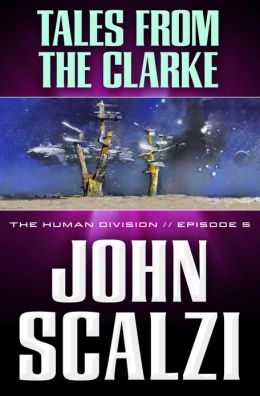
Episode 5Tales from the Clarke

Remember Captain Coloma from way back in Episode 1? That would be the gruff-but-caring Captain who's all righteous but really cares most about her crew. If you recognize that characterization, then it's because you read it in my review of Leviathan Wakes, and recall the phrase as criticism of that book's reliance of stock characters. Only, Captain Coloma isn't a stock character. Or maybe she sort of is, but it doesn't really matter because she's interesting! That's right--a female authority figure who is actually interesting! The fact that this excites me shows how low the bar is set for gender relations in science fiction and fantasy, but credit Scalzi with taking the obvious stock character, making her a woman and then making that an asset. Basically any scene with Coloma is gold, and here we get a whole chapter--a whole chapter whose plot is convoluted and full of irritating America-in-space-isms, but which is rendered compelling by the fact that it's about Coloma. Fingers crossed that we get at least one more chapter from her perspective.

[INPUT 8/10 (+1 for Coloma; -1 for baseball...really?) OUTPUT 8/10]


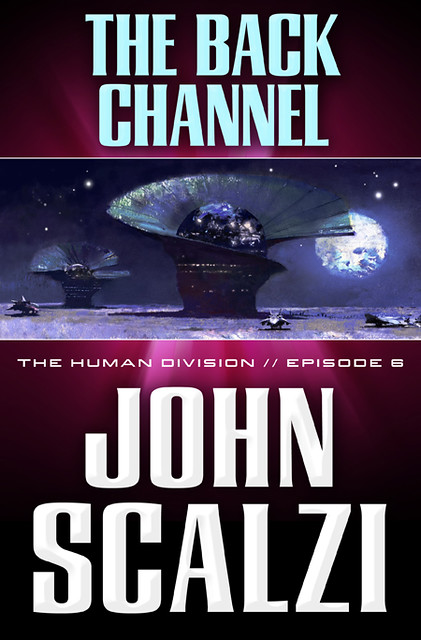
Episode 6: The Back Channel

At this point I'm giving up on the whole "this is like a serialized TV show" idea, because it's just not. Why? Because in six episodes to date, three are interludes that don't feature any of the central characters. And that does create problems for The Human Division specifically as a serialized novel (there is, after all, a very good reason why TV shows don't really do this). But unlike the frustrating interlude we get in Episode 4, this one is a total blast to read. It's definitely the funniest entry so far, and introduces a great character in Hafte Sorvalh--advisor to Conclave leader General Gau and lover of churros. You can really feel Scalzi hitting his stride at this point.

[INPUT 8/10 (+1 for Sorvalh and the churros; +1 for space neo-nazi douchebags being just as fun to shit on as regular neo-nazi douchebags; -1 for it's another interlude) OUTPUT 9/10]


Episode 7: The Dog King

Now this one's just silly. And centers on a little dog wearing a crown. I won't say anymore, because then I might spoil the episode for you, and that wouldn't be any fun, would it. Suffice to say, Wilson, Schmidt and the rest get into a mess, hijinks ensue, diplomatic relations are threatened and a wacky solution emerges that just might solve everyone's problems in one fell swoop. Does that sound like your kind of thing? Sometimes it is my kind of thing, like when I'm sleep deprived and watching The Big Bang Theory because it's easy and kind of funny and I know exactly what to expect. Or Psych because it's silly and full of references to things no one remembers unless their approximately my age, like Terence Trent D'arby. But I ask more from books than television, and prefer Scalzi's writing when the humor isn't quite so upfront and center. So yeah, this one is funny, but kind of unsatisfying as well.

[INPUT 6/10 (+1 for yes, it is genuinely funny; -1 for but I was expecting a bit more than just wacky comedy) OUTPUT 6/10]

Cumulative Score - Episodes 1-7: 7.57


Monday, February 4, 2013

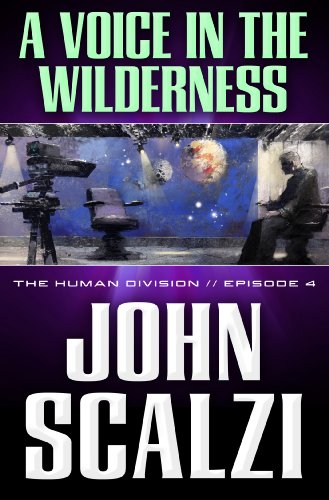
Scalzi, The Human Division Episode 4: A Voice in the Wilderness


Another Interlude

Yes, that's right: we won't be following Wilson, Schmidt and Abumwe this week. Rather, we take a detour to Earth and get a peek into the life of one Albert Birnbaum, an AM radio-style shock jock (think Rush Limbaugh meets Howard Stern) whose career is currently in free fall. That is, until he's approached by a suited gentleman with a proposition from a (not-at-all obvious) mystery client. He asks Birnbaum to advocate for a cause, and promises that if he does, all his problems will magically disappear. But at what cost?

Good, but...

All the usual  praise for Scalzi's writing applies here again: the snappy dialogue, the economical but effective descriptive prose, the engaging characters, the brisk pace. I enjoyed the read while I was reading it, to be sure, but I also couldn't quite figure out why I should really care that much. True, the episode exists to set some plot pieces in motion, and it does accomplish that, but Scalzi could have stripped this down to be a section of a more fully-formed episode, and done so at very little cost.

And there is a cost to the longer format, in the sense that it highlights one of the weirder and unrealistic aspects of the OMW universe. As we're told multiple times in episodes 1-3, the Colonial Union "held Earth back 200 years" so it could be used as a breeding ground for colonists and soldiers. If this were real world history, the terms "held back" and "200 years" would be meant figuratively, not literally--i.e. that the colonial power has suppressed the ability of colonial subjects to become technological or socio-political equals to the citizens of the metropole. Put another way, colonial powers were suppressing the development of their subject colonies in relative, not absolute terms. As it happens, real historical colonial powers usually hastened technological development and imposed new social and political institutions on their colonial subjects--not out of the goodness of their hearts, but because it made exploitation more efficient. So it would stand to reason that, if the Colonial Union were to efficiently exploit Earth, it would need to alter the infrastructural and institutional landscape of the home planet. In A Voice from the Wilderness, though, Earth appears virtually unchanged from our year of 2013. I could sort of handle this setup as long as it was vague and peripheral, but this interlude on Earth really makes the incongruity hard to ignore.

Hopefully we get back to business next week.

Score

6/10. "Still enjoyable, but the flaws are hard to ignore.

Cumulative Score (Eps 1-4)

7.5


Monday, January 28, 2013

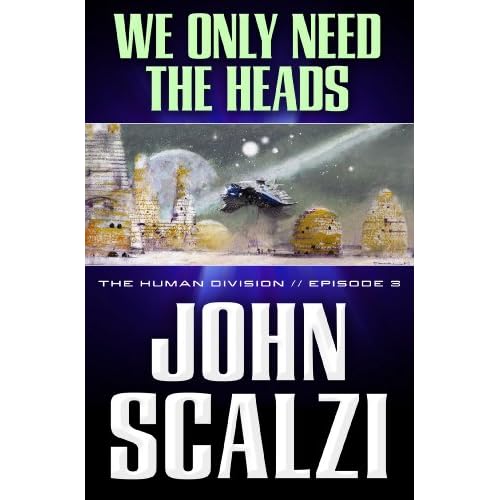
Scalzi, The Human Division Episode 3: We Only Need the Heads

Background

In case you missed the first two reviews in this series, I thought The B-Team (episode 1) was awesome, and that it was pretty much everything a "pilot" should be. Walk the Plank (episode 2) was entertaining, but it was a bit of a let-down nonetheless. It established a couple major plot points but its experimental, teleplay-style form meant that it didn't quite work so well as a standalone episode. What's more, the absence of any of our central characters struck me as strange. Science fiction TV shows sometimes have non-sequiter episodes, for example when the security chief of a space station located in the midst of a burgeoning civil war takes some time off the impending crisis to solve a murder mystery and drink a bunch of space whiskey. But it's rare for a science fiction TV show to completely abandon the credited cast to focus on another group of humans altogether, and even rarer to see it happen immediately after the pilot.


We Only Need the Heads puts us back in touch with Harry Wilson, Hart Schmidt, Ambassador Abumwe and the rest. Abumwe has been given another assignment, this time to settle some outstanding trade and tourism issues as part of a broader peace deal between the Colonial Union and the Bula, a tough-nut alien species that has occasionally mixed it up with the Colonial Defense Forces. Seems pretty laid-back, right? Wrong. Unfortunately for Abumwe, some idiot humans have set up a wildcat colony on a planet claimed by the Bula and recognized as Bula territory by the big and scary alien consortium known as the Conclave.

The wildcat colony in question, as it happens, is the one we visited in Walk the Plank. CDF sends a ship to deal with it, and hopefully get the colonists off world before the Bula find out they are there. And Harry Wilson has been sent along in an advisory capacity (exactly why isn't explained). When the mission gets there, though, they find something something terrible, which could put the whole Colonial Union in a bit of a sticky situation...

So How Was It?

After the jarring interlude that was Walk the Plank, I'm happy to say that We Only Need the Heads works as a fully-formed follow-up to The B-Team. It's a well-paced and exciting episode, with engaging characters acting, for the most part, in believable ways. And, of course, the pages are positively dripping with the sarcasm and dark humor that made the Old Man's War books such a big deal in SF. That's generally a good thing, but as I observed with The B-Team, there's an occasional overabundance of smirk and snark. For example:

Wilson wandered toward the officers mess to get a cup of coffee. As he did so, he pinged his BrainPal's message queue and found there was a message there from Hart Schmidt. Wilson smiled and prepared for a delightful dose of Schmidt's special brand of wan neuroticism.

Or

Wilson turned away from Lee and Jefferson's truly compelling discussion and wandered further into the hut.

I get what Scalzi is going for here, but let's be frank: no one thinks in these kinds of terms. Cynicism is a state of mind, and thus can take place internally, but sarcasm is a fundamentally performative act. To put it another way, it's not something you think, it's something you say, and doesn't make sense outside the context of social interaction.

And, for that matter, when was the last time you saw an email or facebook post and thought "ah, here's a delightful dose of this person's special brand of wan neuroticism?" It might seem nit-picky to fixate on a couple errant sentences, but these moments of overwriting can snap the bubble of suspended disbelief and catapult you back into a state of detachment from the text. (Now how's that for overwriting?) Thankfully, they are the exception rather than the rule, and for the most part Scalzi does a good job balancing seriousness and humor. I do wish he'd dial back a bit from time to time, though.

The second issue I had with We Only Need the Heads is more structural to the plotting of the episode. I apologize in advance if I get overly cryptic here, but Scalzi has strong opinions on spoilers, and I respect that--even if it does make my job a bit harder to do. So if you are very spoiler-sensitive, please skip past the colored text.

!Mild Spoilers Ahoy!

So Abumwe needs to drag out her negotiations with the Bula so Wilson and the CDF crew have enough time to extract the colonists and destroy evidence of the wildcat colony. Only, the CDF has withheld vital information about the colony from both the diplomats and the cleanup crew. Now, I understand that military complexes are inherently secretive--at times to a fault. I also understand that command does not entail competence. But withholding this information, at least from the soldiers tasked with dismantling the colony, pretty much ensures that the only way they could do their job effectively would be if they stumbled into that information by chance, which is exactly what happens. Maybe this will make more sense later on, but right now it looks suspiciously like a plot hole.

!Spoilers Ended!

I'm willing to give Scalzi the benefit of the doubt on this for the time being, and it bears repeating that We Only Need the Heads is a well-crafted and gripping episode that left me itching to push further into the book. Must...resist...tempation!

Score

8/10

[Given that I'm doing one of these/chapter, I'm dispensing with the usual bonuses and penalties.] 


Monday, January 21, 2013

Scalzi, The Human Division Episode 2: Walk the Plank


Last week I reviewed the first "episode" in John Scalzi's serialized novel The Human Division. I liked it. A lot. In fact, I liked it so much that, in the days after finishing it, I had to resist the incessant urge to just keep going. But that would have made it impossible to assess how well the serialized format of the novel works, so I didn't.

As those days separating the finishing of The B-Team and the starting of Walk the Plank unfolded, I began to have some doubts. You see, I'm the type of person who reads in small doses, but everyday. I'm not used to taking a multiple day pause in-between chapters of a book, and it soon became apparent that I couldn't quite remember everything that had happened in The B-Team. Never fear, I thought, the fact that The Human Division was conceived of as a sort of prose television series surely meant that there'd be a "last week on The Human Division" style synopsis at the beginning, right? Wrong.

However, as I dove into Walk the Plank, most of the important stuff came back to me. There's a mystery from The B-Team that wasn't resolved (and if you haven't read it, I won't spoil it for you), but for the most part, the first episode serves as a set up--Wilson, Schmidt, Abumwe and the crew of the Clarke, having shown their mettle in one crisis, have been chosen as a "fire team" for future crises. Why? Not only because they're good at it, but also because they'd also make convenient fall guys if it all went to pot.

Walk the Plank leaves our heroes for the moment, and instead focuses on strange happenings at a wildcat colony (i.e. a private, unsanctioned settlement). It's written like an audio transcript, which is presumably what it is supposed to be. It also looks like a teleplay, and knowing Scalzi's penchant for self-referential meta-humor, this resemblance was probably not coincidental.

Does it work? To a degree, the answer is "yes." The narrative is easy enough to follow and, if my interpretation is correct, helps set up a couple central plot points. Plus Scalzi has a gift for dialogue. There are two mysteries--one that concerns the colonists and another that feels like a clue to the broader mystery presented in The B-Team. It's nicely done, and I admire Scalzi's restrained approach to revealing the book's central mystery. Plus I'm curious to see how the wildcat colony will figure into the main narrative as the book unfolds.

On the other hand, I'm not sure how much the teleplay format adds that the conventional prose narration utilized in The B-Team (and the rest of the OMW series) couldn't have done as well or better. Teleplays, after all, are written for actors we see with our eyes, located on sets or locations we also see with our eyes. Absent those critical ingredients, there's an unfortunate featureless-ness to Walk the Plank.

Then there's the length. At 90+ pages, The B-Team was the equivalent of a super-meaty two-hour premiere. That's a little much to expect from a typical episode, but the 24-page Walk the Plank feels like a jarring transition from from feature to sitcom-length. A small quibble, perhaps, but it did leave me wondering if I'd been sent all the pages (I was).

That said, I'm still very much on board and excited for Episode 3. The Human Division is shaping up nicely, and I'm keen to get back to Wilson, Schmidt and the rest of the gang.

The Math

Baseline Assessment: 7/10

Bonuses: +1 for the sharp dialogue; +1 for the way Scalzi is revealing the central mystery, piece by piece.

Penalties: -1 for the teleplay format, which didn't really do it for me; -1 for being too short.

Nerd Coefficient: 7/10.