Wednesday, July 4, 2012

Microreview [Film]: Cat People (1942)


Val Lewton was in charge of the "horror unit" at RKO Studios in the early 1940s. He produced nearly a dozen genre-defining movies, saving the studio from financial collapse, launching the careers of several directors, and resurrecting (pun intended) the career of Boris Karloff in the process.

The Meat

If you are a fan of psychological horror movies that leave most of the scares where they are the most frightening (in your brain) than I cannot recommend highly enough the movies Val Lewton produced for RKO Studios -- the "Little Engine that (Sometimes) Could" among movie studios. The first of these films was Cat People.

Born in czarist Russia and emigrating to the States as a child, Lewton had been a newspaper reporter and pulp novelist before getting into the picture business. At RKO, he was given meagre budgets, salacious titles, and permission to use sets left over from other films, then mostly left alone. So one day, the studio handed him a Ziploc bag full of nickles and a title -- Cat People! -- and told him to go off and make something that would keep the studio out of the looming bankruptcy brought on by Orson Welles rolling cigars in $100 bills from the RKO coffers, and smoking as many as he could while down in Brazil and laughing maniacally. By rights, the result of this gamble on Lewton should've been utterly asinine (it's called Cat People, for God's sake. Cat. People.), but instead, it is an unsettling, and almost heartbreaking parable about the fear of commitment and sex, drenched in atmosphere and Eastern European folklore.

The film tells the story of Irena, a Serbian woman living in New York, played by the utterly feline Simone Simon, who believes herself descended from a cursed race of outcasts that developed the power to transform into giant cats through witchcraft and idolatry. She falls in love with a guy named Oliver, but is terrified of what she'll do to her new husband if she allows herself to lose control. This aloofness unwittingly drives Oliver into the arms of Alice, a woman he works with, and boy, if Irena thinks its hard to stay on top of lust, it turns out it might be even harder to stay on top of jealousy...so watch out, Alice.

The Math
Objective Quality: 7/10

Bonuses: +1 for overcoming its B-movie budget through the moody and evocative direction of Jacques Tourneur, who later directed the ultimate film noir, Out of the Past; +1 for its pioneering use of jump scares; +1 for introducing psychological horror to the movies; +1 for forming the basis of the Kirk Douglas character, based on Lewton and the Cat People production, in The Bad and the Beautiful.

Penalties: -1 for what is essentially a soap opera plotline; -1 for a relatively show start, given its 73-minute runtime.

Cult Movie Coefficient: 9/10, for an impossible-to-quantify influence on the genre and remaining an effective horror movie even after 70 years

[See explanation of our non-inflated scores here.]

An Avengers short, alien weaponry, and Lizzy Caplan

The last part of this post's title is definitely my favorite. It's also my favorite thing about the photo below.


Lizzy Caplan will be starring in a short film, ITEM 47, to be released in September in time for the DVD/blu-ray release of The Avengers in September. The story is about a down-on-their-luck couple who stumble across some alien tech featured in the film (I still haven't seen it) and decide to rob some banks. A perfectly reasonable plan of action.

Caplan -- for those of you who don't know and probably are lame since you don't know -- co-starred in the awesome but woefully short-lived Starz series Party Down. She was also in some show about vampires and a Godzilla remake. And she is awesome.

Source: JoBlo.

Higgs Boson Explained via Animation

In case you wanted to know what all the hubbub is about...

Tuesday, July 3, 2012

[Flow Chart] Pulp Fiction in Chronological Order


CONVERSATION: Big Summer Comic Events IV

In the first nerds-feather roundtable (albeit with only two participants and without any physical table, let along one that is round), Philippe and the G are going to discuss those big, splashy summer events Marvel and DC love so much, and talk about what works and what doesn't. Earlier entries are herehere, and here.


At the outset, I should inform my gentle reader that the criticisms below are directed largely at Marvel crossover events. I have read the main DC crossovers -- Crisis on Infinite Earths, Identity Crisis, Infinite Crisis -- but, asI have never been much of a DC fan, they left little impression on me. I was a Marvel fan as a nerdy lad, and I continue to be one as an adult nerd.

This post draws largely on three particular Marvel events of the last decade: Civil War, World War Hulk, and Secret Invasion. I focus on these three for two reasons. First, these storylines both brought me back into reading superhero comics after a decade-long hiatus and they turned me off of them for the next couple of years. Second, I reread them last week.

Finally, I am purposely not addressing the X-comic events, which have a very different dynamic and history. Plus, House of M was pretty good.

In this post, I want to focus on three rather annoying aspects of crossover events: the fight-centric storylines; the resulting inconsequential deaths; and poor endings.


FIGHT!

The basic plot of a crossover mini-series is as follows. Something happens to force the superheroes to either turn against one another or to unite. Then there’s a big fight scene which ends without resolution. The superheroes retreat and lick their wounds. Some marginal development occurs. This is followed by the big fight. Then it all ends -- which I’ll deal with below.

The problem with these big fight scenes is that they never live up to expectations. The idea of all the superheroes and supervillains in a massive brawl sounds awesome. But it almost never is. What we usually get is a lot of splash pages with heroes and villains grimacing, posing, throwing punches, firing blasts, etc. All to little effect. No one really gets hurt, no one is felled by a blow or by an optic blast. They just pose and grimace some more. And Spidey says something that's not very funny.

In these huge battles, there’s often little attention paid to the dynamic of the fight. Actual action sequences are sacrificed in order to fill pages of the book with as many characters as possible. So, we’re left with a mess, sometimes an artistically pleasing mess, but almost never enjoyable as an action sequence.

Posers

We shouldn’t necessarily blame the writers and artists for this. Given the limited number of pages they have and the large number of heroes they’re expected to include, it would take a genius on the level of an Alan Moore-Will Eisner love child to pull off a fight sequence on this scale. 


Inconsequential Deaths

Yes, Captain America “died” in the aftermath of Civil War. And yes, the Hulk was seemingly no more at the end of World War Hulk. But we all knew they'd be back. No superhero really ever dies. (Heroes Reborn, anybody?)

Well, some superheroes do die. The crappy ones. Goliath died. The Wasp died. And nobody cared. Because these characters don’t matter in the grand scheme of things.

“Hold on”, you say. “The Wasp was a founding member of the Avengers.” So what? She never got her own series. Hell, she never even got a signature costume.

The point is that you can kill off a superhero in a crossover, so long as they are a minor player or someone who hasn’t done much since the seventies.

Even in comics, the black guy dies first

Under these conditions, deaths are still rare. Consider all the terrible heroes from the seventies that Brian Michael Bendis resurrected during the last decade. Civil War could have been a massacre! They could’ve killed off Spider-Woman or the Iron Fist and no one would have cared. Well, no one except for Bendis. And, since he was writing many of these crossover stories -- and apparently had significant influence over the Marvel editorial division -- he didn’t kill them off. 

The unwillingness to kill heroes is the main reason why World War Hulk sucked. Since the Hulk was targeting the big names of the Marvel Universe there was no real drama or tension in the story. The reader never worried about whether or not Reed Richards and Tony Stark would die. The only question was: How are they not going to die?


Deus Ex Machina

There’s a mighty narrative imbalance inherent to crossover events: Huge premises, weak resolutions. A couple of civilians tackle Captain America so he gives up the war. Tony Stark uses a satellite laser to disable the Hulk. Reed Richards invents a gizmo that can tell Skrull from human. Fin.

I call bullshit. Why didn’t Stark use his nifty satellite weaponry before the Hulk kicked the crap out of the heroes and leveled much of Manhattan? Can’t use a nuke against the Hulk because it will only make him madder. But a laser fired from space? Sure why not.

And Reed Richards comes out of a torture-induced coma and immediately devises the ultimate in anti-Skrull tech. Just in the nick of time! It takes me an hour to recover from a nice nap. Then again, no one calls me Mr. Fantastic.

And the Civil War’s ending just sucked. Terribly.

Save Iron Man! He's the only one making good movies!

‘Nuff said, bitches.

Monday, July 2, 2012

Rob Liefeld's Levis 501 Commercial

I cannot believe that I don't remember this commercial. I must have seen this: I was an obsessive comic nerd and I owned a TV at the time...well, my parents owned a TV at the time. Granted I hated Rob Liefeld -- more of a Jim Lee fan -- so there's a chance that I blocked this out of my memory. And I did spend most of the '90s stoned. 


"So Rob, have you had any formal art training?" No. And the evidence is here. And here.


This commercial was still better than Girl 6

Sunday, July 1, 2012

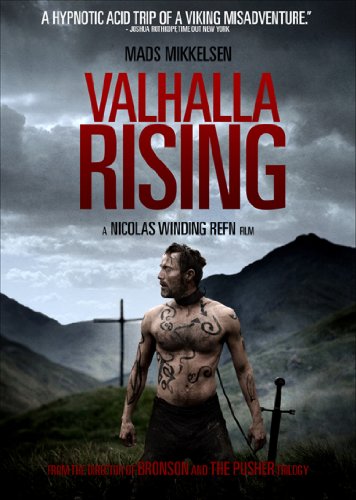
Microreview [film]: Valhalla Rising


The Meat

If you read my review of THE REEF, you'll know that I lament the distinct lack of good shark movies out there. Well, you can put good viking movies up there as well, because there are basically none. Rather, us fans of Norse mayhem have had to endure such indignities as THE THIRTEENTH WARRIOR over the years, quietly waiting for a film that does vikings justice. In steps Nicolas Winding Refn's VALHALLA RISING.

The story follows mute killer One-Eye, who at the beginning is some sort of fighting slave. Then he escapes and kills everyone, save for a boy he talks through. They fall in with some shady crusaders headed to Jerusalem, only they get stuck in this weird mist and end up in North America (yes, I know and no, it's not well explained). And then things really go wrong.

Oh, did I mention that One-Eye can see the future? Because he can. Or maybe he sees it as his past, which is his future, because vikings understood time as cyclical. Not entirely clear, and the lack of dialogue and exposition in the film leaves things like this open to interpretation.

In the end, that openness is one of the main strengths of VALHALLA RISING. It's a highly atmospheric, very slow and totally surreal film, with a great score and cinematography that recollects Bergman and Fellini. It's very, very artsy. But then it's also ridiculously gory. I won't get into specifics, but if you are in any way, shape or form put off by violence in film, you should avoid this one. Violence in VALHALLA RISING is intimate, cruel and over-the-top. To be frank, I had a hard time dealing with it myself, and felt that it added little beyond shock value. There are also a few inconsistencies in the story and in character motivation that, openness to interpretation notwithstanding, are still a bit hard to get past.

That said, I pretty much liked everything else about the film, and especially liked how much story Refn was able to tell with so little dialogue.

The Math

Objective quality: 8/10

Bonuses: +1 for OMG it's about vikings and it's actually good; +1 for awesome music and cinematography; +1 for Mikkelsen's affecting, dialogue-free performance

Penalties: -1 for excessive goriness that cheapened things for me; -1 for a few serious issues with plot/character motivation

Cult film coefficient: 9/10. If you can handle the violence, then this is a pretty damned good film. If you can't, though, you should avoid it like a viking invasion.