Showing posts with label memory. Show all posts

Wednesday, December 3, 2025

Realm of the Elderlings Project: The Rain Wild Chronicles, book 3: City of Dragons

Memory defines dragons and Elderlings, but humans need less of it

When last we left our intrepid band of misfits, they had finally arrived at the lost city of Kelsingra. The dragons have needed to put aside their ideas of what makes a traditional dragon in order to recover the core of what draconic characteristics remain to them. No more can they rely on dignity and inherited memory if they want to fly. They must work, human-like, to develop abilities that once came effortlessly to them as their birthright. Like humans, what they become is a function of what they, as individuals, put into it, not what their ancestors, as dragons, have bequeathed them in inherited memories.

But if the first two books follow the dragons’ journeys to learn human skills and develop a more cooperative, human-like society, City of Dragons allows humans the opposite opportunity. Kelsingra is an intact Elderling city, and one key component of such cities is the heavy use of memory stone to save or record the thoughts and experiences of the inhabitants. Some of this is useful: it’s nice to know how to work the hot baths and lighting. But a lot more than functional infrastructure is recorded in these memory pillars, and not all those recordings are safe for humans to experience. Those former lives are glamourous and addictive, and too much indulgence can overwhelm a person’s identity, leaving them more like a ghost of the original bearer of the memory than their own person. Such is the case of Rapskal, whose own identity of a cheerful, dopey, optimistic, childlike teenager becomes entirely erased and replaced by an arrogant, martial Elderling whose memories ensnare him beyond his ability—or conscious desire—to resist.

For dragons, these ancestral memories form a core part of their identities, Without them, they are less draconic than they should be. But for humans, these ancestral memories are a threat to their own individual identities. It is not an accident that it is only Elderlings—those humans who have been changed by close association with dragons—are the ones who indulge in memory stone. This component of Elderling magic is not arbitrary. It is a reflection of dragons’ tendency to make their Elderlings like them. We see this tendency on the small scale with Sintara and Thymara. Sintara transforms Thymara into an Elderling with wings, but the wings are purely decorative, an expression of art rather than function. Sintara claims that this was the intention the entire time, but surely it’s no accident that Thymara’s wings remain purely decorative as long as Sintara herself is earthbound. One of Rapskal’s last acts as his own identity is encouraging Thymara to try to fly anyway. She has wings. Wings are for flying. He got Heeby to fly, and he is confident that he can do the same for Thymara.

So, as with decorative or functional wings, so it is with memory: dragons remake Elderlings in their image, and a core part of what they are is stored and shared ancestral memories. And this fundamental artificiality of what Elderlings are—where “artificial” means both not natural, and also a work of artifice, of intentional art—does dampen, somewhat, the glory of Elderlings that we’ve been taught to revere as something lost and wonderful throughout this entire series. Even the images of Kelsingra at its former height cannot be properly mourned as a vanished heritage, because there are hints that, even when the Elderlings and dragons were at their grandest, Kelsingra was still a city of memories. It was never full of bustling magic, alive and magnificent. It was always half-populated by ghosts; its wonders were always just a veneer of lives laid over memories of other lives. The apparent richness came from the layering, not reality.

It’s tempting to make a simple dichotomy here: with dragons, losing ancestral memories and being forced to develop individual identities human-like is a catastrophic loss. With humans, gaining ancestral memories at the expense of individual identity is equally bad. And certainly, watching Rapskal’s gentle dopiness become overwritten by an alien, long-dead personality feels like a similar loss. It is a loss. But Hobb would never let something as simple as good-for-dragons-but-bad-for-humans structure her plot. The loss for the dragons tempers their arrogance, and forces their partnership with humans into something slightly more equitable than it had been previously. In parallel, gaining those memories allows Rapskal and Thymara to access the skills that came with those memories. To jump ahead into the last book for just a moment, Rapskal’s acquired ability to lead military attack is useful in an encounter with Chalced (sooner or later, there is always war with Chalced), and Thymara’s acquired memory of Kelsingra’s infrastructure maintenance allows her to restore the well of Skill that is so vital for the dragons’ well-being. In moderation, then, the cross-pollination of humans and dragons can build greatness.

I will still always mourn, however, the realization that the Elderlings themselves relied on a palimpsest of ghosts.

Reference: Hobb, Robin. City of Dragons [Harper Voyager, 2012].

CLARA COHEN lives in Scotland in a creaky old building with pipes for gas lighting still lurking under her floorboards. She is an experimental linguist by profession, and calligrapher and Islamic geometric artist by vocation. During figure skating season she does blather on a bit about figure skating. She is on Mastodon at wandering.shop/@ergative, and on Bluesky at https://bsky.app/profile/ergative-abs.bsky.social

Thursday, August 31, 2023

Review: Mammoths at the Gates by Nghi Vo

A story about the remembrance of the dead, through a lens of the complicated legacies they leave behind.

Alyssa Winans' cover art continues to stun

CW: Death, grief

The stories Nghi Vo has told in the Singing Hills novellas have all had a conceit, a neat little framing device that shapes the story into something a little more than just a story. It's one of the best things about the series, and means I go into each new one excited not just to know what happens, but how it's told. In the first, it was framed around found objects, the second a story told by different tellers, the third had unconnected tales that turned out to be connected by the people in them. In Mammoths at the Gates, the fourth in the series, it's stories of a person told by the different people who knew them at their funeral, stories from those who loved them, who think of them fondly, their fellow clerics, their companion and their granddaughters, who knew them only as the best they were... and one that isn't quite so flattering, but no less true.

I read this book one week after my grandmother died.

Normally, I'm not so keen to put quite so much of myself into my reviews as this, but the resonance between the story and what has happened so recently in my own life was impossible to ignore. 

My grandmother was... a complicated woman. Rarely a nice one, though more often to people who didn't know her well. The legacy she left us, when she passed, was no less complex. Her will makes plain that she cared very much about lifting some of those who survived her above others, showing her favour and her disdain in equal parts. No matter how much one knows about this when the person is alive, it becomes harder to bear when you realise it's the last thing they leave in the world, the message they want to be seen after they've gone, their last word. As I say, complicated. But part of dealing with that complexity is the family that gathers at the passing, who tell their own stories about her. I haven't seen my aunt - who lives abroad - in years, but we sat in the emptiness of my grandmother's house, her and my mother and me, and naturally, what grew out of that emptiness was stories. Stories the others may not have known, or that saw a complex woman from another side than the one the listener had in their mind, or that revealed hurts she caused that the rest of us simply never knew about.

My mother asked me yesterday, did I want to speak at her funeral? I declined. I don't know how I'd even begin to frame that complexity into something appropriate for speaking publically.

Nghi Vo did. 

She begins the funeral with the expected stories, the ones that praised the deceased for the things most prized by the speaker. Patience, compassion, cunning, by turns. They reveal the different sides of the person, as person in the world and later as a cleric, to the surprise of those who only knew one part of them. But the greater surprise comes in the story that is not the best but the worst of their life. The listeners all had to then reframe their knowledge of the deceased, around the discovery that they weren't, as everyone had thought, always quite so wonderful.

That sort of story is so rare, in life and in books. We do not speak ill of the dead. We certainly do not speak ill of the fondly-remembered dead, or those who were good and bad in parts*. But as Vo shows, there is incredible power in remembering the truth of a person, the good and the bad together, an emotional impact that cannot be achieved by simply speaking the kind words, the ones that everyone expects to hear. It was an impact I did not realise I would appreciate quite so much, but I felt it all the way down to my bones as I read it. It hurt, and it helped, to have a story reminding me that we can have complex feelings for our dead, in a time when I needed just that. From a personal perspective, I might even say this is the best of the stories in the series, simply because it has hit me so intimately in my own unsettled emotions.

But even if I step outside this personal impact, it's a story whose themes are bittersweet and beautifully crafted. As well as those of death and mourning and the memories of a person left behind - themes made all the more poignant in a setting full of characters whose entire purpose is their perfect recall - it is also a story of how people change, how parting and returning may bring you back to a different person than the one you left behind. And that in discovering that, you realise you too are different from the person who left. All the Singing Hills books are deeply, inexorably rooted in people and their relationships, but Mammoths at the Gates doubly so. We follow Chih, our cleric protagonist, as they return to the Singing Hills Abbey after their travels, hoping to see again their neixin companion who returned before them, as well as their familiar fellow clerics and old tutors. But they find their best friend suddenly serious and grown up, their neixin now a mother of a fledgling, and much of the abbey gone to a nearby situation that requires their attention. Their home is almost empty, and they have to reckon with the changes against the backdrop of a very present threat - the eponymous mammoths at the gate - whose title drop within a few pages of the opening of the story I particularly appreciated.

But like all the other stories, it isn't really a story about Chih, no matter that we continue to learn about (and love) them through how they approach the stories of other people. And it is no different here - we learn about Chih through how they cope with the changes they bear witness to in their erstwhile best friend, and the stories they hear and react to during the funeral. They are the conduit through which we receive the stories, and like any good medium, they bring with them their own personality to the message. For only novellas, for stories that always spotlight other people, Nghi Vo has done an amazing job of giving us such an insight to the person on the fringes of all those stories, a wry, cheerful, thoughtful, ever so slightly rebellious but ultimately dedicated cleric, one who truly yearns to hear what people tell them, and believes in their duty to keep those stories safe, because the things that happen to the people in their world, even the little things, ultimately matter.

We likewise get those tantalising little glimpses into the world, and as in all the books, we continue to dwell particularly on food. In a book about homecoming and comfort, it feels all the more important to have that there, all the more true to life. Cleric Chih has always been quick to describe what they eat - or want to eat - in all the novellas, and so getting back to the green onion buns, the rice and mustard greens, the salted plums of their home, the things that comfort them against the world, makes you yearn for those foods too, even if you've never tried them yourself. Because they're not described in the way food sometimes is, as vivid sensory experiences, full of taste and smell and almost sensual aesthetics. Instead, food reverts to its emotional self - rice as a balm for the soul, a green onion bun or milk candies as nostalgia, a salted plum as a rare treat. We understand food, as we understand much of the story, through the lens of Chih's experience. Whether or not I would like salted plums, here, they are likeable, and that positioning in the story is, for the moment, more important than my own imaginings of what a salted plum might taste like.

If I were to be fanciful, I might say that all the Singing Hills books are a thesis on the importance of bias for the narrator in a story. Because they would not be what they are - which is wonderful - if they weren't constantly coloured by the perspective from which we see them. Whether it is Chih and their experiences, or the framing devices that shift from book to book, each of these stories is as much the medium as the message, the two woven so thoroughly together that extraction would make each meaningless except as part of the whole. And Mammoths at the Gates is no different in that.

But likewise, for me, it is also now inextricable from my own experiences, and my own bias. I cannot but view it through the lens of my own mourning, I cannot but find myself in the story, and be comforted. I declined to speak at my grandmother's funeral, and ultimately, so does Chih decline to speak at their mentor's. I find a form of fellowship in that; I feel seen. And it is a testament to how well the story is told that such resonance is so easy to grasp, and so poignant.

*On twitter, we quite frequently speak ill of the terrible dead, but twitter is its own little microcosm, and I don't want to use it as a pattern for society at large. God no.

--

The Math

Highlights: A continued dedication to great framing devices, emotional resonance so substantial you could make buns out of it, bittersweet friendship

Nerd Coefficient: 10/10

Reference: Nghi Vo, Mammoths at the Gates, [Tordotcom, 2023]

POSTED BY: Roseanna Pendlebury, the humble servant of a very loud cat. @chloroform_tea

Friday, September 3, 2021

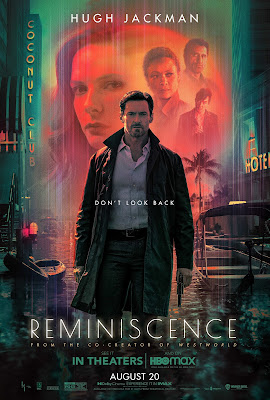
In Reminiscence, nostalgia is a sweet poison

There are layers of warning in the movie's mantra, "it's us who haunt the past"

It is a cruel irony that the way Reminiscence will be remembered will probably focus on the accusation that it redoes earlier movies. Yes, it brings to mind Total Recall and The Cell. Yes, one of its producers is the writer of Memento. Yes, it draws from decades of noir detective tradition. But Reminiscence uses these callbacks with a very deliberate intention. It's not just about "hey, do you remember when that other movie played with memory?" or "do you remember when that other movie had a jaded detective trying to save his girlfriend?" or "let me remind you of all these movies that also had global warming." It's more about "be careful with how you budget your attention, because bigger things are happening than you currently bother to look at."

In the future shown in Reminiscence, the seas have risen and swallowed coastal cities around the world. Via shady real estate tactics, the super rich have retreated to high ground while the rest are left to sink or swim in flooded slums. International war has come and gone, and what remains is a hopeless people whose main form of entertainment is to close their eyes in a water tank and relive their best memories.

This choice of worldbuilding throws a punch you don't see coming: it's literally set in our future, but its inhabitants don't believe there's a future. They'd rather retreat to a better time, which from their position would correspond to our time. But if we take an honest look at ourselves, we have to admit we're guilty of the same vice. The most heated discussion happening right now in 21st century media revolves around our unhealthy obsession with revisiting the media of our childhood. What Reminiscence invites you to do is to see the problem from the other end of the equation. It's difficult to grasp the corrosive effect of nostalgia until you see the people of the future do it to you.

Dreaming of an idealized past while the world breaks down around you is almost a too perfect metaphor for life during a pandemic. But the movie includes a few twists that make the viewer rethink what the metaphor is saying. The machine that extracts memories turns them into movies that can be watched, replayed, and rewound at leisure. Instead of the uniquely personal aggregation of sensations that we understand as memories, they're treated as already edited and polished for public viewing.

The rules of memory travel make it clear that focusing on the past too much can render you permanently stuck, incapable of perceiving the present. This can be read as a way of representing the risks of untreated PTSD flashbacks, which fits the plot on the most literal level because many of its lead characters are war veterans, but the fact that it can also be read as a symbolic mirror for our media consumption habits raises a necessary question to complete the analogy: is our nostalgic binge caused by collective trauma, by a real present that is too painful to experience directly?

We are a generation statistically predicted to have a worse economic future than our parents. The effects of global warming are all around us while our elected leaders sit on their hands. Rabid nationalism is showing its ugly head on the open, and inequality is only growing more obscene. No wonder we're exhausted all the time. No wonder many of us feel we've had too much of reality. No wonder we spend our days tuning in to reruns of Friends and getting mad when Star Wars dares attempt something different. We take refuge in comforting memories because life is just too much, but that doesn't stop life from going on, and awful things are going on while we complete our binge rewatch.

This is why it's no accident that Reminiscence interweaves its personal-level drama with a larger plot about societal unrest brewing beneath the surface. As the protagonist chases clues, trying to make sense of a lost love he refuses to let go, we follow him across the semisubmerged ruins of what used to be Miami. The former luxury destination for young vacationers has become a dilapidated abode of climate refugees. The Sunshine State has switched to a nocturnal work schedule because the heat of the day is unlivable. Only the 1% get to make plans for their descendants. In Reminiscence, the future is closed off by design.

The ending has our hero expose the corruption of a rich landowner family, and thus we get brief glimpses of an imminent revolution, but we don't see how it ends. This is a protagonist who doesn't believe in happy endings, and the destination he chooses for his journey is a loop reel of his life's greatest hits. But it's not obvious that the movie as a whole shares this stance. It's precisely by the hero's refusal to let go of the past that he ends up unmasking a conspiracy of lies and giving his community the push to fight back against evildoers. But he shares no part in the reward for his obsession. He's the hero of the story, but he's not a model that the movie offers for us to follow. He's a perpetually doomed Orpheus, always descending into hell to rescue his Eurydice, always paying for the sin of looking back. How the rest of society rearranges itself into a better shape is left for us to imagine.

A recurrent motif in this movie is the need to choose where to end a story before it gets too sad. That's the protagonist's excuse for his final choice of permanent disconnection from the world. But ending a story in the middle won't do if we are to build a future. The advice to end a story at the middle is seductive, but poisonous. We are at the middle of our historic trajectory, and the worst thing we could do is stop right where we are. Even if we were to agree that all endings are sad, the answer cannot be to refuse to let our journey continue. If all endings are sad, the answer is to continue for as long as we have strength to go on. This is the alternate road that our hero fails to see, and that's his curse. But the future he lives in is only a possibility, one of many, when seen from where we stand. The rest of us still have the option to take our eyes out of our cozy recollections, look forward, and take a less horrible road.

The Math

Baseline Assessment: 7/10

Bonuses: +1 for the gust of fresh air that is the visual language of brutal violence viewed through the lens of a female director, +1 for Thandiwe Newton's acting, +1 for some shining gems of dialogue ("people like us don't fall in love [...] love is the thing we climb to").

Penalties: −1 for incomplete worldbuilding, −1 for relying too much on voiceover exposition, −1 for too many neat plot coincidences, −1 for ending the social side of the story in the middle.

Nerd Coefficient: 6/10

POSTED BY: Arturo Serrano, multiclass Trekkie/Whovian/Moonie/Miraculer, accumulating experience points for still more obsessions.

Wednesday, October 28, 2020

Microreview [Book]: Architects of Memory by Karen Osborne

 A story that throws a lot of things at you, almost all of them good.


Architects of Memory
is a good kind of paradox. Its story links a degrading sense of self, the greed and depravity of humanity, and lofty misunderstanding to create a fiery conflict. Things don’t go well for the characters when multiple concepts are intertwined in that world. But on a craft level, the novel intertwines space opera tropes, a few inventive twists, fully-formed characters, and a perfectly paced structure to create a glowing achievement. If only the characters' travails mirrored the writerly utopia that transpires when Karen Osborne’s typing away.

In Architects of Memory, Ash Jackson is indentured to a massive corporation, and she must work to attain freedom. Upon her work, while on a spaceship with a motley crew, she encounters a mysterious object that has to do with her dark past and humanity’s conflict against an alien race. To compound matters, she also has an illness that could cost her freedom and impair her abilities. And to escalate the situation further, she’s in a secret relationship with a member of her crew.  

The beginning of the novel mostly takes its time organically sliding in worldbuilding and pieces of the plot. To those new to sci-fi, it may be jarring with the amount of information it throws at you right away, as well as putting you in the middle of the action with relationships preestablished, expecting the reader to catch on. Things do click into place, and it’s well worth the effort.

Upon the one-quarter mark, the story swivels directions, goes into lightspeed, and propels through twists and action, mostly knowing when to momentarily hit the brakes and give you a breather. Reading the novel is like riding a spaceship piloted by an apt daredevil. Even the times in the ride when the story hits a wall of exposition, I never felt like I was mired in boring, sludgy plotting because the afterglow of the thrilling scenes that preceded it left me at a high. With that said, feelings are subjective, and those averse to any blatant scenes of the expository variety might feel different.

The most singular talent of Architects of Memory is finding a new bent on a space opera story—a genre that’s been well-trodden so thoroughly and covered in footprints that it can seem impossible to find a patch of your own. And while Karen Osborne does steps on patches that have been stepped on by seemingly every sci-fi author, there are idiosyncrasies to characters and twists regarding alien life that more than make it fresh. While characterization isn’t at the top of the novel’s mind, it does do a much-more-than-serviceable job of establishing believable motivations and ample depth to keep you caring.

But the greatest joy of Architects of Memory lies in its plot and the themes they develop. Whether it tackles individuality and collectivity, the belligerent survival instincts of humanity, or relationships in secrecy, it lays the foundation for those themes and builds upon them, never leaving them underdeveloped along the way. The most intriguing theme is how memory is so tied up with our sense of self. We’re a collection of the knowledge we accrue and the relationships we build, but without memory, those things slip through our fingers like sand. Love can change from everlasting to a brief sensation. Familial bonds that we preoccupy ourselves with if the world around us is rotten becomes lost if our memory – our personal storage locker that tethers all our meaning – is gone.  

Space operas can sometimes be so unwilling to take risks and stray from conventions that they’re forgettable. Stories that have edifying substance don’t matter if they immediately leave our memory. The best way to counteract that is to have original characters, and hard-hitting themes despite how well-trodden some story beats are. Architects of Memory does that. Its craft, emotional intelligence, and smooth writing style work to create a gem that will be at the top of my mind for a long time.

The Math

Baseline Score: 7/10

Bonuses: +1 For expert pacing, especially in the wonderfully frenetic latter half.
+1 For a great portrayal of an alien race.

Negatives:
-1 For an ending that could be a little better.

Nerd Coefficient: 8/10

POSTED BY: Sean Dowie - Screenwriter, stand-up comedian, lover of all books that make him nod his head and say, "Neat!

 Osborne, Karen. Architects of Memory [Tor Books, 2020]