Showing posts with label crime tv. Show all posts

Thursday, May 26, 2016

About that Castle finale...

I finally got around to watching the series finale of Castle last night, and feel the need to vent a bit.

First, let me admit that I've watched a lot of Castle over the years. But I didn't watch it out of any conviction that it's good. It wasn't. Rather, I watched it because it was simple fun. At its best, the show took a familiar formula (the police procedural), approached it with an appealing balance of drama and comedy and then let its charismatic leads (Nathan Fillion and Stana Katić) carry the show. All in all, that made for an enjoyable, if somewhat forgettable, hour long diversion.

Sure there was the ongoing story about an increasingly convoluted and opaque conspiracy, as well as the love story between Castle and Beckett, but at its heart Castle was an episodic show. And now that it's gone, I realize how few watchable episodic dramas are left on TV.

Which brings me to the finale...

As soon as it was over, my wife turned to me and said "Poochie died on the way back to his home planet."

Let me explain the reference. In 1997, an episode of The Simpsons aired called "The Itchy & Scratchy & Poochie Show." The marketing executives in charge of the network decided that Itchy & Scratchy wasn't "current enough," so they created a new character to appeal to the youth of the day. The result was Poochie, an amalgam of hackneyed '90s marketing cliches (i.e. "the Kung Fu Hippie from Gangsta City.") Unsurprisingly, everyone hated Poochie, so the network decided to kill him off.

Here's how they did it:


Over the years, "Poochie died on the way back to his home planet" has become a sort of code between the two of us for any illogical, tacked on resolution to an on-going plot. And that's exactly what we get at the end of Castle: a bizarre 30-second scene showing Castle and Beckett's domestic bliss seven years later--this after both are shot in the chest and clearly dying.

My best guess is that the season was supposed to end on a "will they/won't they survive" cliffhanger--until there wasn't a 9th season in the works anymore. So instead of shooting a new ending, or perhaps because it was no longer economically possible to do so, the show runners decided to just throw in whatever closure they could come up with on short notice.

I recognize that the producers and writers were put in an impossible situation by the network, and this was probably the best we were going to get. But it was nevertheless a deeply unsatisfying way to end an eight-year time commitment.

Turns out Poochie was an alien after all.

***

POSTED BY: The G--purveyor of nerdliness, genre fanatic and Nerds of aFeather founder/administrator, since 2012. 


Monday, December 22, 2014

2014 Holiday Gift Guide: The G

Hard to top all the excellent gift ideas my fellow nerds of a feather have already suggested, but in case you need some last-minute ideas, here goes...

-The G 

1. Kindle Voyage/Paperwhite or Kobo Aura


At $99, the Paperwhite is an incredible value. The Voyage, meanwhile, is arguably just a dressed up Paperwhite at twice the price. However, the higher resolution and better backlighting do make a difference to those who, like me, suffer from chronic headaches/migraines. I mean, that’s why I bought a dedicated e-reader in the first place—to be easier on the eyes—so if that’s a priority, and you plan to use the thing a lot, it makes sense to spend a little more to get the one that best fits your needs. For those wary of getting sucked into the Amazon ecosystem, the Kobo Aura also has a great reputation. 


2. True Detective: Season One Blu-Ray

The Best Show Ever, says two random guys you should definitely listen to. And at under $20, the DVD edition is practically a steal (you'll spend a bit more for the blu-ray). Sit back, relax and mainline the secret truth of the universe.

Buy: True Detective: Season One Blu-ray or DVD.

3. LEGO Bricks & More Creative Bucket (607 pieces)

Have kids? Don’t have kids but wish you could recapture the creative wonder of childhood? Well, look no further than this big ol’ bucket of Legos! Note these are just the colored blocks—no themes, no branding, just your imagination and 607 pieces to build whatever you can think of.

Wednesday, September 24, 2014

Nanoreview [TV]: Gotham, Episode 1


So I just watched Gotham, the new pre-Batman TV drama starring Benjamin McKenzie as Detective Jim Gordon, Donal Logue as his corrupt partner and Jada Pinkett-Smith as an ambitious mobster looking to supplant boss Carmine Falcone (played by John Doman, aka Lieutenant Rawls from The Wire!). Did I like it? Sure, I liked it. Was it a home-run? Not quite.

The meta-plot is: Gotham is an urban hellhole run by the mob and its partners in city government, and Gordon wants to "clean it up from the inside." Decades of Batman comics and films suggest he didn't do a very good job, but the show keeps your interest by exploring how this time period spawned many of the most famous of Bat-villains (as well as Batman himself). The pilot, at least, suggests that their rise is an inherent result of the criminality and corruption Gordon is trying to fight. Poison Ivy and the Penguin, for example, are both victims of the current order in their way (though Penguin does also quite clearly bring it on himself). It's not subtle, but it's done well enough.

Overall it's easy to conclude that, as far as superhero spinoffs centered on non-costumed protagonists go, Gotham is miles better than the unflavored Agents of Shield. That said, the pilot does exhibit a few symptoms of pilotitis. There is no evident chemistry between McKenzie and Logue, and their repartee is stilted and full of awkward pauses. Pinkett-Smith and Doman are better in more limited roles, however, and Robin Taylor is perfectly cast as the sniveling, sadistic lowlife who will eventually become the Penguin. But my personal favorite casting decision has to be Sean Pertwee--son of Third Doctor, John Pertwee--as Alfred. He brings a streetwise toughness to the role, a creative departure that I suspect will stick in the Bat-canon.

And my gripes may just be a function of said pilotitis; after all, I remember how terrible the Psyche pilot was, yet that turned into a hell of a good show. Now where'd I park the Blueberry?

Score: 7/10.

Tuesday, March 11, 2014

True Detective Conquers All

Today Philippe and I mourn the passing of True Detective, a show that will return but in fundamentally different form. We present our eulogies, point-counterpoint style, though in truth we agree far more than we disagree. WARNING: some heavy-duty spoilers, so don't continue if you haven't finished the series yet.


The G - Remember when people used to argue over whether The Wire or Breaking Bad was the best American TV show of all-time? Yeah, fuck that. Sure, I still haven't gotten around to Breaking Bad (I know, I know), but here's the thing: True Detective isn't just the best TV show I've ever seen, it's pretty much the best TV show I can imagine ever seeing.

Now, I could cite any number of things as proof of its greatness: the acting, the dialogue, the depth of characterization. But plenty of other Golden Age of Television shows have these things as well. And it's not the deep social commentary either. The Wire is, in essence, a literary ethnography of the American inner-city and its on-going decay; Breaking Bad, I've heard, does the same for the suburban middle-class; The Sopranos for the American family; etc. True Detective has that kind of stuff too, though its philosophical musings are a bit more abstracted.

It is worth lingering on the acting for a minute, though. It's a thing now for well-regarded film actors move to the small screen, but most of them, frankly, kinda blow. I mean, that Christian Slater/Steve Zahn bullshit ABC is currently trying to smear on the walls? Come on. Matthew McConaughey's portrayal of the idiosyncratic pessimist philosopher/cop Rust Cohle, on the other hand, is a revelation--a portrayal so focused and purposive that, for each 60 minute episode, it positively annihilates any memory of Dazed and Confused. For 60 minutes, McConaughey is Rust Cohle. And as the show progresses, it dawns upon you that Woody Harrelson's meat-and-potatoes cop Marty Hart may in fact be the more complex character. It's a subtle portrayal, which McConaughey's Rust is not, and that's partially attributable to the writing and direction, but it's also testament to how fucking good these actors are in these roles.

And then there's Michele Monaghan's Maggie Hart. She's has gotten some flak for her "vindictiveness" from some, and written off as a plot device by others, but those are shallow readings in my book. Maggie is a good mother and wife driven to the edge by her philandering drunk of a husband, and who, when she reaches that point of no return, stands up to Marty and refuses to back down--even when he threatens violence. This is a scene about consequences (for both Marty and Maggie) of the choices we make, and about agency--Maggie's agency. To the degree that it is about Marty and Rust, it exists to outline the uncomfortable relationship between Marty's personal misogyny and the gendered violence he and Rust confront during the course of their work as detectives.

It is also worth lingering on that confrontation scene, because in fact no violence comes. And for a show centered on the serial murder of women and girls, True Detective for the most part eschews the exploitative, sexualized and festishized violence that plague this category of show, and resists splatterpornography. True Detective lingers on the threat or intimation of violence, not the cheap thrills of graphic cruelty and gore. 

And I could go on about how True Detective, more than any other show I've seen, manages to be both highly critical of religious power and deeply respectful of religious beliefs and religious people.

But while of these things are unambiguously good, if I were to identify the elements of this show that are near unprecedented, the things that set it apart from just about anything ever made or anything that will ever be made for the small screen, American or otherwise, it would be two things and two things only.

No American show has ever had such a clear artistic vision

This is art, the way Ingmar Bergman and Andrei Tarkovski films are art. Plenty of Golden Age shows have great dialogue, memorable characters and heady atmosphere. But True Detective is the first show I've seen since Twin Peaks that cares--I mean, really, really cares--about what image and sound can actually do. But Twin Peaks was only really good in that way when David Lynch was in the director's chair. Cary Joji Fukunaga, by contrast, directs all eight episodes. True Detective has a distinct, consistent and incredibly well-implemented artistic vision. It's slow, ponderous, abstracted and careful, the way The Seventh Seal or Solyaris are slow, ponderous, abstracted and careful.

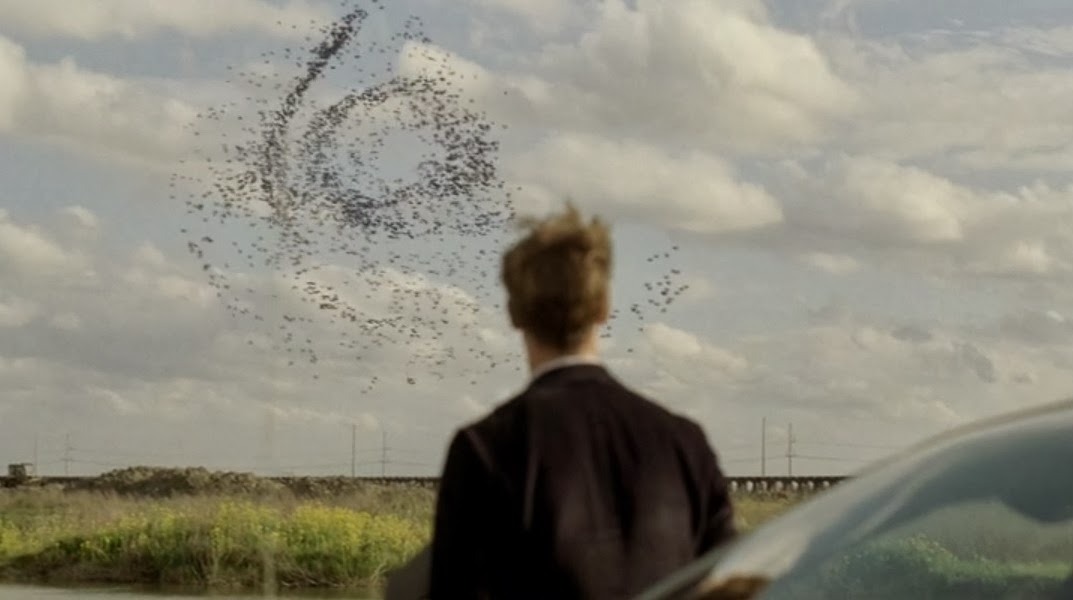
There are so many little moments of wonder in True Detective, from the cultish death scene that opens the premiere to the quasi-Lovecraftian horror of Childress' Carcosa, from the overhead shots of Rust's pickup on the freeway to the panoramic views of Louisiana--its foreboding jungles, swamps and the evidence of humanity's decline. And they fit the script as well as you could imagine. As James Poniewozik writes, on one of my absolute favorite moments in the series:

Streetlights streak like heavenly bolts; clouds on the horizon take on an apocalyptic glow; the swamp and backwoods seem haunted. “The visions—there were times that I was convinced that I’d lost it,” Rust says. “There were other times I thought I was mainlining the secret truth of the universe,” and that hits home with a striking visual at the end of the episode, when a flock of birds seems to briefly resolve itself into an intelligible pattern before Cohle’s eyes and ours.

This is the heart of genre darkness

Shows that contain mysteries about the nature of the mystery (Twin Peaks, Lost, BSG, etc.) tend to produce an awkward discourse between writers and fans, where writers drop clues and red herrings, fans develop theories, and writers struggle to create a solution that both satisfies the investigators and still manages to surprise everyone.

The result is almost inevitably disappointing to at least some corners--and True Detective is no different. Sure, True Detective came in familiar packaging--the police procedural, the hardboiled detective story, the hunt for a serial killer, etc. But it kept hinting that it would metamorphose into full-blown horror. There were the little hints sprinkled throughout the season--the recurring patterns, the more-than-coincidental names, the literary references, the signposting. The Yellow King! Carcosa! We grew certain of such things.

But in truth, True Detective used the symbolism and iconography of horror to establish its apocalytptic atmosphere. This is noir, pure and simple, a small-scale holocaust of the human soul--Lovecraft without the tentacled bodies; Revelations without the horsemen.

At heart, True Detective is noir, real noir the way Raymond Chandler wrote it. Not the crapsack pessimism of James M. Cain or Jim Thompson, but the deep anguish of Marlowe's world, where the good take punch after punch and still get up and come back for more; where victories are small but meaningful.

The series ends on an optimistic note, as if to argue that it isn't all meaningless. “Well," Rust says as he looks to the stars. "Once there was only dark. You ask me, the light’s winning.” 

With Fukunaga leaving and the show reverting to direction-by-committee, True Detective may never scale these heights again. Perhaps no TV show ever will. I'm fine with that.


***

Philippe: There was never a King in Yellow. No Carcosa, no black stars, no Hastur emerging from the bayou.

Your disappointment was intentional. There were never going to be any revelations or resolutions, nothing that would make sense of it all. It was just murder. Creepy fucking murders that we all overanalyzed. Like Rust, we frantically sought meaning in True Detective, though we feared, perhaps unconsciously, that there was nothing there there. And there wasn’t.

Nic Pizolatto did something brilliant: he’s made manifest the madness that Robert W. Chambers associated with the The King in Yellow.

The play at the center of The King in Yellow not only drives its readers insane, but it provokes obsession, fervent speculation, and endless theorizing among the masses. Did Pizzolatto intend for True Detective to provoke a similar outcome, to cause us to ponder every possible angle, to fall into an online rabbit hole, Googling “Carcosa” and “the Yellow Sign”? Did Pizzolatto seek to make real the madness Chambers imagined?

I want to say yes. Perhaps I am giving him too much credit. Perhaps our collective obsession was simply a typical reaction to such a symbolically dense work of art.


There’s no need to rehash the theories and speculations—we’ve all been proven wrong. There is a larger conspiracy that remains unsolved. As the anchor revealed, Errol Childress’s relation to the Tuttle clan was denied. Maybe there was witchcraft, bayou voodoo meshed with medieval Catholic folklore. Or maybe the Tuttles are a bunch of sadistic psychos whose pageantry was intended to instill terror in their victims.

The pessimistic season finale would certainly have pleased Rust. There’s no resolution in life, no bigger picture, no hidden meanings. There’s flesh and murder. Pain, suffering, and senselessness. Nietzsche, Lovecraft, and Camus knew this. Rusyy knows it. Some of us have accepted this fact, though most of us cling franticly to mythologies and empty platitudes that prevent us from seeing the world in all its meaningless and chaotic glory. “Everything happens for a reason.” Sorry, things just happen. Like murder.

So, in case you didn’t listen to Rust’s pontificating this season, the finale was there to remind you: there’s no fucking point to all.

The philosophy of True Detective has been criticized by philosophers. I am a philosophical layman, but I feel that this criticism is misplaced. The haters have called out Rust for being a rather shallow and superficial philosophers. But what exactly is wrong with his philosophy? Life is a pointless circle from which we cannot escape. As anyone who has struggled with addiction or bad relationships knows all too well, this is how the world works. This may go against out Protestant American individualist penchant for self-improvement. It’s certainly possible, but few of us ever become better people. We remain who we are. And we keep smoking.

This isn’t Satre’s analytical acrobatics, 50,000 words to make a simple point. This is Camus’s directness, bashing us over the head with the simple and seemingly cruel absurdity of it all. There’s no need to read Being and Nothingness, at least not for most of us. The Stranger and True Detective have the same message: It’s all pointless. (Read this for someone smarter than me making a better argument. I’m a sociologist, after all.)

 Of course, Rust doesn’t live by his own philosophy. He is seeking meaning through solving the case, the paying the debt he and Marty owe. And that’s the point: we all seek meaning, because the chaos of it all is terrifying. Plus, it’s a cop show. That we got any philosophy from it is a considerable accomplishment.

Last point: I absolutely loved the show’s last scene. Rust and Marty finally got to be buddies. Buddies are the best.

***

Sunday, October 27, 2013

Justified and Suspension of Disbelief in Television

One peculiar strength of literature and film is its ability to provoke suspension of disbelief. While reading (or watching), you can exit the reality of your daily life and enter the reality of the book or film. In theory TV has the same ability, but the fact is that I rarely suspend disbelief while watching TV.

Lots of things can intervene to ruin the illusion, thus keeping the viewer in this world--the use of obviously fake sets (see, for example, "New York" in Castle), the casting of overly attractive (and thus not terribly believable) actors as ordinary people, the prevalence of poor acting, hokey dialogue, wink-at-the-audience moments, and so forth. It isn't that these things are unique to TV, or that they (or their analogues) don't exist elsewhere, but just that they are prevalent in TV--almost to the point of ubiquity.

"New York City"
Problems of narration pose another set of hurdles to the suspension of disbelief. Advertizing breaks are one egregious issue in American network TV, but it isn't only that corporate marketing pitches wrench you out of your fantasy world--after all, ads are defeatable via Netflix, DVD or other viewing options. Rather, it's the structuring of episodes to fit these artificial breaks in the action, where a 45-minute drama has four or five moments where it has to present something compelling enough to keep you from changing the channel. Other issues are specific to the narrative format of the show in question, where on the one hand you have the mundane, static predictability of episodic programming, and on the other the tendency of serialized TV to value melodramatic cliffhangers over tangible character development. Again, these are not foreign to literature and film--far from it. But there are a lot of books and a lot of films that aren't like this at all. TV, more than any other narrative medium, thrives on this kind of cheapness.

The HBO Model


Premium cable outlet HBO did not invent good television drama, but it has arguably done more to promote the idea that TV can be "serious" than anyone else, and that it is not necessary to sacrifice "entertainment value" in order to do so. The push started with The Sopranos and Six Feet Under--concurrently running dramas organized around typical Hollywood conceits: a show about a mob boss with mental health issues and another about a quirky family that runs a funeral home. Both shows evinced narrative flaws over the long-term, perhaps because their producers never expected them to be as popular as they became. They were nevertheless revolutionary, in the sense that they were not really about these conceits, but instead used them as springboards to tell rather literary stories about how relatable characters try--and often fail--to navigate the challenges, pitfalls and circumstances of everyday life.

The Wire, which has been called the best television drama ever produced, constitutes the high point of the "HBO Model." What began as a character-driven police procedural eventually grew into something more--a sustained, powerful critique of the "War on Drugs" and an extended commentary on the decline of the American inner-city. But at its core, The Wire's success hinges upon the fact that it humanizes all its characters and presents them as flawed individuals trying to make good choices while constrained by oppressive social conditions. Like real human beings, they often make poor choices and then struggle to come to grips with the consequences. The world is so thoroughly convincing that, during each 60-minute episode of The Wire, I was completely mesmerized, enveloped in the tragic world of the West Baltimore's drug war.

The HBO Model has since spread to multiple US cable networks where it has mutated, from Showtime's cheeseball variant to AMC's approximation-with-ads. But very few programs have managed to achieve The Wire's or even The Sopranos' narrative success. That very much includes HBO's more recent dramas, which often seem to value "watercooler moments" over the character-based sophistication of the last decade's marquee fare. It is as if it no longer suffices for a narrative to produce such moments organically. Rather, they must be imposed. Watercooler moments have become an expectation, a defining feature of HBO Model drama. Unfortunately, when not produced organically by the narrative, watercooler moments come off as cheap, sensationalistic and affected.

Justified: The Rare Gem


Now, I haven't watched Breaking Bad, but I have it on good authority that it bucks this trend and even approaches The Wire in narrative quality. So before you pillory me for complaining about the low-quality of even high-brow television drama when there's stuff like Breaking Bad that I (admittedly) haven't seen yet, keep in mind that I'm making a general argument, not a comprehensive one. Plus I'm not even really here to complain about how bad television is. Rather, I'd like to talk about the first show in years that has me suspending disbelief like The Wire--FX's Justified.

This is the third FX drama I've watched. First came The Shield. Though some have absurdly compared it to Shakespeare, The Shield is more reminiscent of Oz, HBO's pre-Sopranos jailsploitation melodrama--a grimy show that isn't so much "good" as "difficult to stop watching." Like heroin, I guess. Or meth. Let's go with that, since the act of watching either show inevitably makes you feel ugly from the inside.

The second FX show I tried was the The Americans, a tense drama about KGB agents posing as ordinary suburbanites in 1980s Washington D.C. Though only one season in, The Americans is already a considerable step up from The Shield, and is on balance a pretty damned good show. But as adventurous and thrilling as it is, it's difficult to look past the conceit long enough to think of its characters as real people living real lives. I like the show, but I never stop thinking of it as a show.

At some point, I started noticing the ads for Justified that played during commercial breaks. They had a really Shield-y feel to them, though, and since I remained scarred by that earlier experience, it just seemed like it was going to be The Shield all over again. So I ignored the several friends telling me that, as a sociologically-interested crime fiction buff, I was nuts to skip out on Justified.

Enter four long-haul flights on an airline whose on-demand entertainment system magically included all of Justified: Season 4. I decided to give it a try. First episode? Not bad. Kind of fun. Good enough to keep me going. Second episode? Better. Easy to pick up without prior knowledge of the characters, but hinting at considerable depth. Building towards something. Third episode? Totally hooked. By the end of the last flight, I'd completed the season, and promptly started watching from the beginning.   

Justified shares a lot of conceits with The Wire. It's about a cop-who-doesn't-play-by-the-rules, a familiar trope of police procedurals. But whereas Jimmy McNulty ignores the chain of command and generally does things the wrong way in ruthless pursuit of a case, Raylan Givens is just sort of too lazy to do things by the book. In both cases, though, the "cowboy cop" thing is really just a front. Deep down these are deeply unhappy people.


The Harlan County, Kentucky setting is also nearly as well-realized as The Wire's West Baltimore. Whereas The Wire parsed America's urban blight, Justified does the same for its rural blight, though both share a preoccupation with the peculiar role drugs, guns, incarceration and the rest of the "War on Drugs" plays in sustaining and reproducing inequality. There's also a neat, thought-provoking subtext of the corrosive, enduring effects of foreign wars on the impoverished communities that disproportionately contribute to America's volunteer military. So yeah, it's smart and socially conscious too.

This isn't to pretend that Justified is the second coming of The Wire--it's not quite on that level. But it is a clever, well-written and character-based drama that does all the things good drama should do, and none of the things bad TV drama tends to do. Plus it's got great narrative structure. Some stories are told within a single episode, while others resolve in a few--others still take a full season to come to a head.

And it's funny. Not in the way a sitcom is funny--there are few laugh-out-loud moments--but rather in the way everyday people are funny. You laugh with them sometimes, but more often you laugh later, when you think about them and their quirks. Raylan, Boyd, Ava, and the rest all feel like real people. Walton Goggins' Boyd Crowder--the slow-talking, cheeky and long-winded villain of the show--is one of the best and most dynamic bad guys I've ever seen on television. Nearly any scene with Boyd--or fellow villain Wynn Duffy (played by Jere Burns from 1980s network sitcom Dear John)--is pure gold.


...and the best part? For 45-minutes, I forget that it's TV.

Friday, September 6, 2013

Watching Low Winter Sun While White

Enough with the white thugs, Hollywood.

I grew up in Bakersfield, California, a place white thugs (“peckerwoods”) actually exist, a by-product of the Okie migration. A sleep-deprived skinny white dude with “suicidal” tattooed on his forehead is a scary thing. There are lily-white neighborhoods in northwest Bakersfield that I have never—and will never—venture into, day or night.

Bakerfield’s white thug has fictional analogues: Justified’s hillbilly mobsters and the  Nazis who’ll cause Walt to buy that M60 on Breaking Bad. And I’m sure that this white thug exists in every part of America. You just don’t see them often in the movies because they are “white trash,” one of the many thoroughly misrepresented and ridiculed groups on film or in print.

But you see a lot of the other white thug in crime fiction and film. He usually has hair thoroughly greased, a weasely goatee, and wearing a leather jacket over a hoodie. He’s usually Irish Catholic, or at least vaguely ethnic. (Though not Italian. They got their own movies.) And he’s usually from Boston. On FX’s new cop drama Low Winter Sun, he lives in Detroit.

Low Winter Sun takes place in Detroit. And the thugs are white.

The Show is essentially a cop story, and a pretty good one so far. (Is anyone surprised that it’s a remake of a British show?) For my purposes here, I’m only interested in the subplot about a group of skinny white kids who are starting up a drug-and-prostitution business.

That in and of itself doesn’t bother me. Except for the fact that I read a lot of crime fiction and watch a lot of crime films. And, nine times out of ten, the characters are mostly white. Like in fiction and film generally. But I’m not writing about legitimate art. I’m writing about crime.

Before we get to far into this, let me state unequivocally that I don’t for an instant disagree with the fact that in our media, African-American men are depicted overwhelmingly in a negative way. But that’s the news, political discourse, and, disturbingly, Twitter feeds. In the world of seems to me that we don’t see a lot of young black male criminals unless it’s a work marketed as “urban.” Or the black thug is simply there to be arrested, usually by a white, sometimes along with his black partner.

For those films and books for a more “general” audience, expect white criminals.

Granted, white people commit most of the crime in this country. While black and Latino men fill our prisons, this is more a cause of racially-targeted policing, prosecuting, and sentencing practice than of who is actually committing crimes. So, if we want an accurate portrayal of a “criminal,” a white guy isn’t that far off.

But here’s the thing about crime fiction: it often causes us sympathize with the criminal. We identify with him or her, we understand why they do what they do. Even if we’re sure or hope we wouldn’t do the same. And when it dovetails with actually existing social issues—especially race and poverty—crime stories can expose aspects of America that rarely merit the establishment media’s coverage.

Crime fiction has the potential to expose middle class white America to realities never experienced. It doesn’t always have to do so—and it doesn’t have to. Sometimes, most times, I want something fun. But, why not teach me something once in a while?

This is why The Wire was such an important show. For five seasons, it portrayed the reality of black inner city neighborhoods, a stark and sustained examination of the power of the drug economy in poor black communities. For many—myself included—this brutality and desolation was shocking.

How many white people would have watched The Wire had it not been a cops-and-drug-dealer show? Had it been a drama, would people be calling it “the best show ever”?

Justified does the same thing: exposes the drug economy of a poor community, only this one is mainly white. Like west Baltimore, Harlan County is a forgotten community. In many ways, places like Harlan receive even less attention than the inner-city, given our media’s urban and bicoastal biases. I would imagine that many people learned about the pill epidemic in white rural America.

Again not every show has to do this. But, sometimes…

Low Winter Sun’s white thugs seem to me to be more common. (I don’t have any statistics to offer, mainly because I didn’t bother looking.) There’s the whole Boston Irish genre of movies: The Departed, The Town, Mystic River, The Boondock Saints, and other I don’t care to write out. (I’m not happy about having written that last title.) Even Veronica Mars—which I’ve only recently begun watching—has the FitzPatrick brothers. There are Irish Catholic thugs in Balboa County? It gets a pass because the whole show is pretty silly. And good.

Hollywood loves the Irish Catholic or “vaguely-ethnic” thug. It gives handsome white actors who can’t play Italian a chance to portray “real” characters, i.e. urban working class whites. Of course, Hollywood doesn’t make movies about the working class, white or otherwise, unless it’s a movie about a union…or a crime film.

Ray Donovan, in addition to not being very interesting, is Hollywood’s Irish Catholic thug fascination at its most egregious. They finally figured out a way to make a story about Boston Irish criminals, without actually having to go to Boston. Set it in LA!

So, the ball is dropped, Low Winter Sun. You had the opportunity to use a crime story to expose the poverty and desperation of post-industrial black inner-city Detroit. Instead, I get vaguely “ethnic” white guys.


I’ll watch the new episode later tonight.