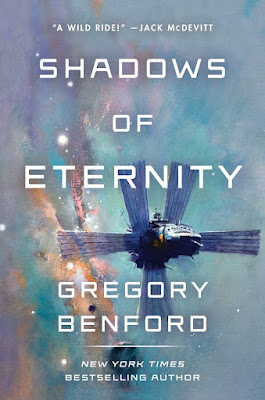
Let's not mince words: Shadows of Eternity is a disgusting piece of rape apology that should never have been published
Mr. Benford,
I just read your new science fiction novel Shadows of Eternity, and...
We need to have a talk.
I know it's common critic etiquette to not involve the book's author in a negative review, but the level of depravity you endorse in Shadows of Eternity obviates all etiquette. I'm personally calling you out, Mr. Benford, as well as Saga Press. It is unacceptable that a book as vile as this one has been given such high-profile promotion, and the science fiction publishing industry must make serious efforts to prevent something like this from happening again. I don't care how important you are, Mr. Benford. You have no business defiling science fiction like this.
How dare I use such language, with all the solid
recognition you have? Honestly, how many millions of books you've sold,
or for how many millions of years, is immaterial to a case of plainly
bad writing, and here I mean "bad" in both the senses of "inadequate for
its purpose" and "morally objectionable." And
Shadows of Eternity is, in every way, from start to end, terrible.
I'm about to go into the details of
your novel, Mr. Benford, dissecting them with a jackhammer, because the insult to science fiction that has
been spat onto the world by you and by everyone involved in producing
this book demands explanations. Of course, the only possible reason why
something as badly written as this managed to make it
past all the stages of editing, revising, proofreading and publishing
is that you have a longstanding reputation as a multiple award winner
that now lets you get away with selling trash. But your fame cannot
suffice to excuse the depths of filth to which this novel sinks.
You see, Google informs me that you're apparently some sort of
bestselling legend. I'm going to have to take Google's word for it,
because this book is of so atrocious quality, so below amateurish in the
kind of writing mistakes it contains, and so repulsive in its moral worldview, that I wouldn't have imagined it
came from an established name in the genre. Nevermind penning the actual
text; I would've been ashamed to be the lumberjack who killed the trees
on which this thing was printed.
Your publisher
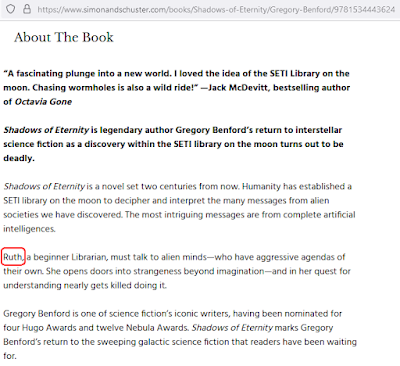
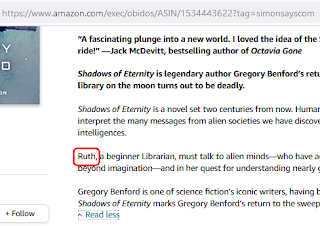
announced this novel in triumphant terms as your "return to interstellar science fiction," which implies people have been waiting for your books for a while. Well, if this is how you come back to the stage, you shouldn't have bothered. Even without the tiresome barrage of sexist clichés, the writing is so careless that your characters repeat important reveals as if they hadn't just discussed them in the previous scene, the editing is so sloppy that several descriptive sentences are repeated in different chapters, and the marketing is so inept that all the promotional material about the novel gets the protagonist's name wrong.
Here's proof, before they go back and fix it.
And more proof.
This tells me that your editor was so sure of the selling power of your name that they didn't even check what you wrote. Maybe your protagonist was actually named Ruth before you changed it to Rachel (even the final Kindle text of your novel accidentally calls her Ruth once), or maybe someone forgot to tell someone at the publishing house, or maybe you forgot to tell you editor, or whatever. We can have a discussion on what publishers need to do to ensure a decent level of quality at some other time. This funny mixup is the least bad thing about this book.
So let's talk about that protagonist, Rachel Cohen, whom you subject to a bizarre scene where another character pontificates on her genes and her IQ, not only singling out her Ashkenazi heritage, but explicitly using Nordic people as the benchmark for high IQ comparisons. That's a curious choice of referents for a character to essentially tell another character, "you're smart." (In my Gregory Benford Bad Writing Habits Bingo Card, this is where I tick off
Racial Essentialism. And that's way before the novel gets to the part where you introduce your proud, heroic bird alien Fraq, who is racist toward his fellow bird aliens with a different jaw shape.)
I'm not even started, and we already have enough red flags to decorate a Soviet parade. It's lamentable how you squandered everything that was promising about this novel. A lunar library full of alien radio transmissions is a great idea. A mathematical mystery about the laws of music is a great idea. A diplomatic delegation of exiles from a ruined world is a great idea. A wandering wormhole that links to unknown terrors is a great idea. You had a handful of great ideas to work with, and proceeded to wipe your ass with them.
In that scene about IQ, you may believe you're praising Rachel, but you're actually reducing her to a line in a statistical graph and dismissing her individuality. Not that Rachel, as an individual, is very interesting; you write women as if you've never met one in your life. With just a sample of instances of your outdated sex politics, one could compile an entire @menwritewomen thread (in fact, I did). The woman you created for this novel is an impulsive hormone puppet driven by the inscrutable whim of her periods, haunted by dreams of babies, and absolutely obsessed with managing her image (one of the countless cringeworthy lines you saw fit to write says, "a woman's face is her work of fiction"). Time to mark Misogyny in my bingo card.
The amount of inappropriate sexual content in this novel reaches disturbing proportions. You made your protagonist impossibly horny, but not in any interesting manner of horny. She's just a walking caricature of what horny old men wish women were. You weren't exactly subtle when you remarked in one paragraph, "Typical alien texts did not carry unthinking auras of sexuality, as did human works." Unthinking is the right word. And in the parts where you have characters who aren't thinking 24/7 about sex, you still drop the ball catastrophically. Your "Noughts," genetically engineered sexless people who are supposedly more rational on account of not having erotic desires, are every misinformed stereotype about asexuality rolled into a stinking ball of dehumanization. Also, what the hell are we supposed to glean from a line like "A woman's quite safe with them"? The obvious implied meaning is that women are not safe in the presence of anyone who does feel erotic desires. (Excuse me while I take a moment to tick off... let's see: Gender Essentialism... Rape Culture... and, yes, Basic Ignorance of Human Sexual Identities in my bingo card.)
Instead of making any effort to understand how people work, you rhapsodize about astrophysics for pages and pages. Look, I love hard science fiction, but people are the reason why we read stories, and you don't seem to have a clue how to write people. Big, consequential moments come and pass without leaving an impact on your protagonist, and she mechanically switches from solving world-ending crises to bar cruising on a daily basis without a thought. Scene after scene repeats the same pattern: Rachel works all day with people who don't give her any respect as a human being, Rachel returns to her apartment to try to process the aggressions of the day, Rachel is dragged by her roommate to yet another confusing party. It's an alternating tonal whiplash that goes on for too long, and it ultimately doesn't serve to develop any of the novel's themes. This character is so disconnected from her feelings that she's drugged and blacked-out by a spy multiple times and she never notices it, or gives it any further thought after she learns of it.
When Rachel averts a cosmic danger by clever planetary engineering (at the cost of being raped, on which I'll have a lot more to say), you devote a whole chapter to describing, in what could only be called poetic rapture, the celestial dance of electromagnetic fields. In contrast, the impact of a supporting character learning of the death of her entire family in a space disaster barely gets a sentence of acknowledgement, and one written with dry journalistic efficiency, as if you couldn't be bothered to pause for a scene to show us what that moment means to your characters.
That's a recurring problem. The characters in this novel are so flat they're almost see-through, but the way you make them pretend to be deep is even worse. It's emotionally draining to read your dialogues, Mr. Benford. Your characters don't talk to provide or obtain information; they don't share their views to establish or maintain social bonds; they don't rely on each other for comfort; they don't seek consensus or cooperation; they don't support each other or even enjoy each other's company; instead, they spend all their mental bandwidth into the pantomime of performing and deciphering gestures, reading power moves into every little turn of phrase or facial motion. Your characters don't even laugh as a sincere form of expression, but as a calculated tactic in an incredibly convoluted game of mutual misdirection. This constant exchange of suspicion and blackmail, where people conceal their meaning with veiled threats and status posturing, where it's considered a fatal error to let true emotion show, isn't just one character's quirk: it's the standard mode of communication used and accepted by everyone in the novel, which makes the reader dread the coming of each dialogue scene as an exhausting ordeal. This is a depressingly bleak view of social relations. The way you write every conversation as a battle of innuendo maneuvers does nothing to help advance the plot of your novel and only succeeds at making the humankind of your imagined future look like an entire civilization made of sociopathic manipulators. There's a strong sense in these scenes that this is really how you believe human interaction works, in which case I would feel pity for you.
But I hold no pity for rape apologists.
A key plot point in your novel has your protagonist try to negotiate with an alien AI for technological help to save Earth from an incoming cosmic threat. In exchange for the information, you have the alien AI demand sex from your protagonist. And after her clear and repeated protestations, this is how you chose to write the ensuing moment of abuse:
"she did not at first react when she felt a sudden surge of unmistakable desire in herself. It shook her, yeasty and feverish, pressing her calves together and urging her thighs to ache with a sweet longing."
Both before and after this scene, Rachel is adamant that she did not agree to this. And yet you, as the author, chose to have her boss minimize her evident distress and order her to be raped, chose to have her continue to work in private with her abuser after her rape, chose to have the AI justify its actions by claiming that she actually secretly wanted it to happen, chose to have the digital logs of her rape be sold as porn, and chose to have her boss judge the whole matter beneficial for all. Not only does that add Gaslighting, Revictimization and Rape Apology to the list of problems with your book; it reveals the disturbing way you think about consent. You wrote this description of her reaction to her rape:
"She felt anger and fear, and yet, simultaneously, pride and curiosity."
And you wrote this dialogue:
"I—me, the conscious me—did not want it!"
"We do not recognize that party alone."
This kind of faux-Freudian excuse is the dream of every would-be rapist.
This is what we're supposed to cheer as your "return to interstellar science fiction." This is supposed to be the crowning achievement of all the decades of your writing career.
Mr. Benford, your writing career is worthless if it culminates in this.
After her rape and public humiliation, Rachel does not go to therapy, does not take a leave of absence, does not demand a change in her working conditions, does not pursue legal action, does not seem affected at all. The novel, your novel, treats the incident as just another day at work. And we're expected, by you, to go along with it, to accept that this is how these things happen.
Later, when Rachel solves another hard problem at work and starts being targeted by death threats online, you have a supporting character remark that she should take the threats as a compliment.
This plot point alone justifies throwing Shadows of Eternity at the garbage bin. But then you introduce the bird aliens, and you write three completely unnecessary adventure episodes (jumping from orbit, climbing the Everest, descending into the ocean) that hammer the point that these aliens love to show off.
So let's take a look at these aliens. What does our heroic bird ambassador Fraq ponder in his private moments?
"At times a superior intelligence must exploit those younger inferiors, to gain knowledge."
OK, how do our expert human diplomats handle the delicate task of welcoming aliens?
"Ethics are relative, especially with aliens."
Yikes. This is in the context of Rachel advising another character to get information from Fraq by slipping alcohol into his food. When I called your humans sociopathic manipulators, it was because of moments like this.
Or moments like Rachel's hot night with a coworker, which you describe in these blood-curdling terms:
"It was always a source of quiet reassurance to her that at night, sleeping together, especially when forming spoons, she and Zuminski were each blocking the other from some small fraction of the background radiation that lanced down from the skies here."
That you believe this is supposed to beautifully express your characters' romantic connection, instead of their callous instrumental use of each other, reveals a lot about your own stunted sense of human relations. Your characters only care for each other inasmuch as they can exploit each other. Their deliberate disregard for other creatures' wellbeing or interests extends to the intelligent lifeform that inhabits Mars, about which your protagonist has this exchange:
"This is a separate world, with separate rights of its own."
"Not once we're here."
With this brief selection, you've just given me Supremacism, Colonialism, Imperialism and What the Fraq Is Wrong with You.
Do you know what that means?
BINGO!
Congratulations, Mr. Benford. Your novel Shadows of Eternity is disastrous at every level, unethical on every topic, clumsy by every standard, and therefore deserving of the most exceptional dishonor we impart at Nerds of a Feather:
Nerd Coefficient: 1/10, which we define as "crime against humanity."
POSTED
BY: Arturo Serrano, multiclass Trekkie/Whovian/Moonie/Miraculer,
accumulating experience points for still more obsessions.
Reference: Benford, Gregory.
Shadows of Eternity [Saga Press, 2021].