Showing posts with label armored suits. Show all posts

Tuesday, April 1, 2014

Microreview [book]: Heaven's Queen, by Rachel Bach


Bach, Rachel. Heaven's Queen [Orbit, 2014]


Endings are almost impossible to do well. Suppose you have a trilogy, the first two installments of which are brilliant, to the point that you find yourself falling in love with the world, the characters, and so forth. Any attempted end to that story faces two serious and, worse yet, rather contradictory problems: a) the deep-seated desire for high-stakes closure, or resolution, common to all melodrama (and let's face it, most of what we all like is melodrama through and through) and b) the instinctive horror we all feel at the thought that something we love will end.

Problem b) has no real solution, of course, since everything ends and that fact undoubtedly sucks. But that doesn't mean all non-solutions to problem b) were created equal. Probably the best is the cascading ending: we need only watch Return of the King (or read the book) to see a shining example. The focus is on letting the audience down from the emotional high of problem a) gently—and gradually.

Many commented after watching said movie, or noted while reading the extended falling action sequences at the end of the book that the movie skips or streamlines (Sharkey, anyone?), that it "feels like there's more than one ending." And it's true, because each storyline, each major character demands a unique resolution, which solves problem a). But in order for us to weather the emotional trauma of problem b), that elemental force which, as (for example) Frozen is ending, makes three-year-olds scream and wail that they want to stay in the movie theater (and thus the film world) forever, we need time to recover from each individual shock of resolution, and if they come too abruptly, even we adults might just find ourselves wiping away a tear or two (or several Kleenex's worth for me!) as the beloved movie thunders to its conclusion. On the other hand, there's such a thing as too gradual, so as with all things (ευχαριστώ for the Golden Mean idea, Aristotle!) balance is key.

How did Rachel Bach (a.k.a. Rachel Aaron) handle this thorny problem? Was she able to deliver a sufficiently satisfying resolution for each of the main characters and plotlines while managing to avoid the trauma of a too-sudden finish or, alternatively, an endless end? The coy response would be that you should read the book to find out, but I'll just tell you the answer's a resounding yes! The themes introduced in Fortune's Pawn and then developed in Honor's Knight come to supremely satisfying conclusion in Heaven's Queen (and even the title to this volume has an additional layer of meaning beyond the ongoing and somewhat tired chess metaphor). The mystery of the phantoms is revealed, and our favorite spunky armored mercenary Devi(ana) Morris kicks the stuffing out of pretty much the entire universe. Bach maintained the pace very well in this final volume, with plenty of action on both huge fleet-sized and on an individual tactical level. Some characters die, as is only fitting in melodrama (since it only enhances the perceived value of the resolution when ultimate victory comes at very high cost—just ask the Weasley twin who took one for the Harry Potter team).

One of the only false notes in Heaven's Queen was a rather anticlimactic showdown near the end of Devi's mad gamble. For this sort of action-y melodrama to provoke the strongest possible emotional response, it is necessary for the prowess of the villain to be tremendous indeed; a too-easy victory by the hero(ine) leaves one with a vague sense of disappointment, as it deprives the audience of seeing (so to speak) the heroine reach new heretofore unimaginable heights of awesomeness.

Of course, in one sense Bach is to be commended for declining to follow every convention of the genre, instead spicing things up a bit with what, in an action comedy, would potentially be a very amusing case of sabotaging the audience by building up expectations only to subvert them with an easy win for our heroine. But personally, I think it would have been more effective, especially with the anti-utilitarian themes developed in book two, to have the figure of the ultimate utilitarian be her greatest challenge(r) yet. I'm being so cryptic, incidentally, because I a) think people should definitely read this book/series, and b) still believe spoilers kind of spoil things, despite what these guys are saying.

In any case, read it: you won't regret it! (After all, be honest—who can't get behind the idea of a "all out of bubble gum" kind of tough girl like Devi?)

The Math

Objective assessment: 7/10

Bonuses: +1 for managing to bring everything together in a cataclysmic denouement, +1 for handling the falling action final chapters very well

Penalties: -1 for having one of the series' most mysterious figures be such a pushover in the end

Nerd coefficient: 8/10 "Well worth your time and attention" [8/10 is actually awesome: see here.]

This review brought to you by Zhaoyun, sf/f book and movie aficionado and main cast member of Nerds of a Feather since early 2013. 

Monday, March 24, 2014

Titanfall

[Titanfall, Respawn Entertainment, Electronic Arts, 2014]

Can it save the Xbox One?

Microsoft is banking on Titanfall, big time. This is the first truly fresh release on their new flagship console with expectations that couldn't be higher. Forza 5, Call of Duty, and Assassin's Creed are all either ports from the 360 versions and/or extensions of existing series. The next Halo won't be out until Christmas and Gears of War is at least two years out. The Xbox One has been lagging in sales compared to the PS4 of late and the kids at Bill Gates' house are REALLY hoping this game turns things around. It may not be the complete game-changer that Microsoft is looking for, but it's definitely a step in the right direction. 


What it gets right, it gets very right!


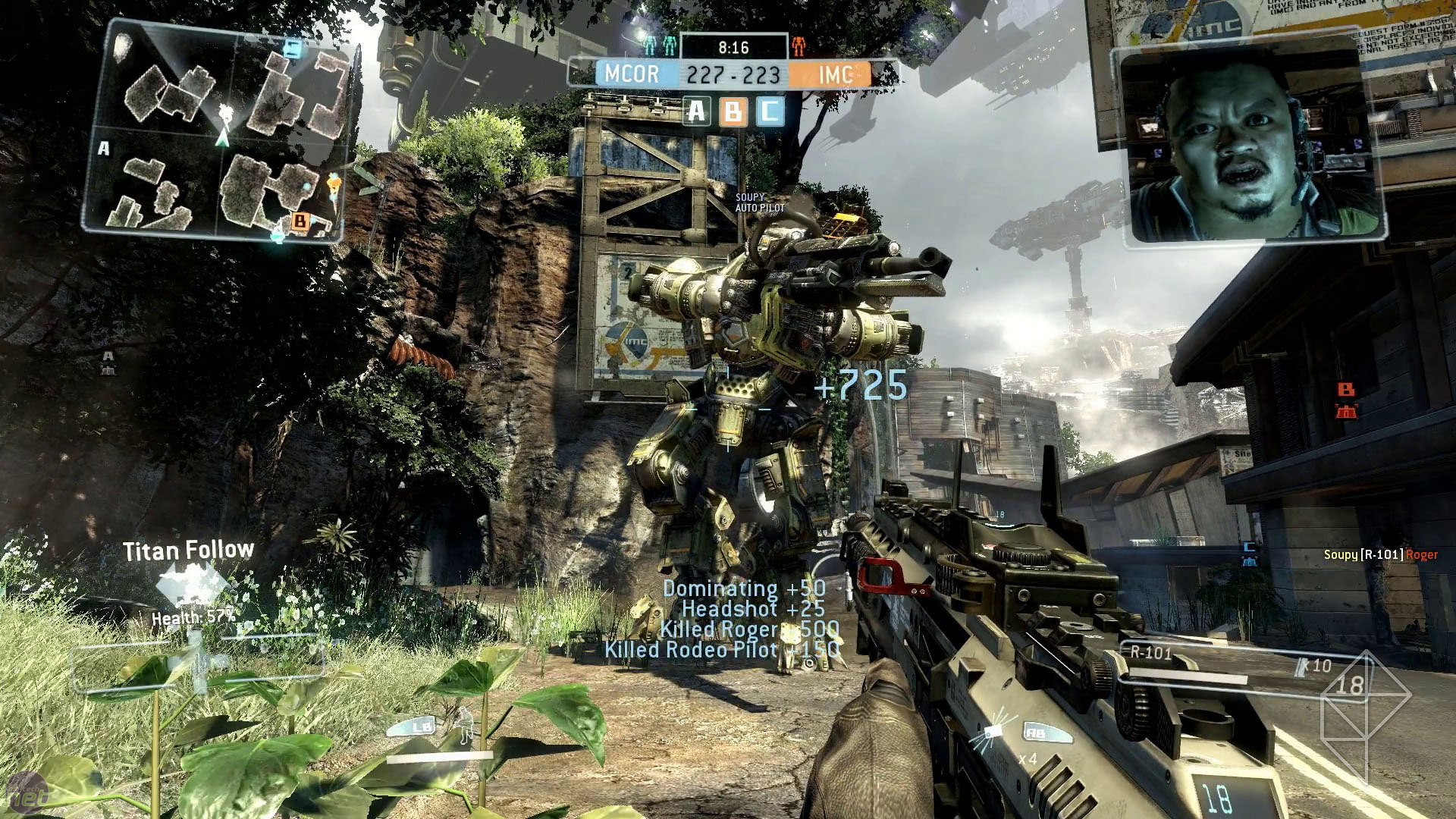
This game is REALLY fun. Don't get me wrong. I've been completely addicted to it despite some drawbacks. The gameplay is totally new, and that's tough to do in today's world of a plethora of developers and distribution companies. Everybody is looking for the next big thing...and Microsoft found it. The standard FPS portion is a bit like Call of Duty mixed with Halo and given a healthy dose of steroids. Your character's ability to wall-walk combined with his or her mini-jetpack help create entirely ways to move around the map. Add to that the Titans and this is clearly different from anything that has come before it. 


For the uninitiated, Titanfall is a first-person shooter that takes place in the future. The IMC is the government entity being challenged by rebels called the Militia. First, you play through the campaign from the side of the IMC. There are nine maps. Once you've finished those, you switch and play the same nine maps from the Militia side. The only real difference between the "campaign" and "classic" multiplayer game types are voiceovers that precede each mission and some short cutscenes. As an IMC pilot, you are fighting for Vice Admiral Graves. He's your standard military man looking to put down the rebellion whose control is taken over early on in the game by former IMC mutineer James MacAllen. He and Graves used to fight side-by-side before he went rogue. There really wasn't much to the story, to be honest. That's pretty much it. They had little bylines for each map, like taking down a fuel depot or destroying a spaceship while it was in dock, but the gist of the plot line can be summed up in a few sentences.


Gameplay

The best part of Titanfall is easy to identify...it's the gameplay. Movement is like a combination of parkour with jetpacks. You can run on walls, jump off, land and run on opposing walls, then fly through the air using your booster pack to get 30-40 feet up in the air. It's an entirely new type of mechanic unlike anything I've ever played before. Then there are the Titans... 


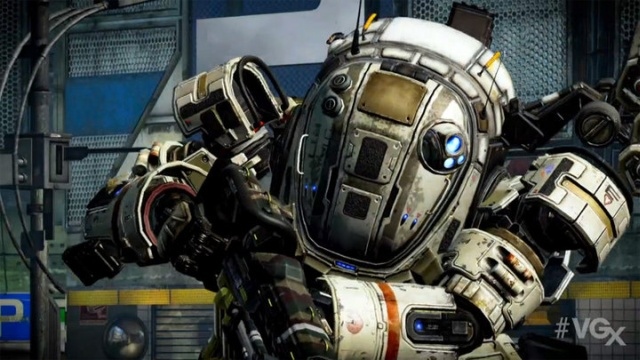
There are three types: the Atlas being a middle-of-the-road mech, the Stryder that is more nimble but can take less damage, and the Ogre that serves as a tank with massive protection. Every three minutes you are blessed from above with one of these giant killing machines, literally. The are deployed from space and come falling down from the sky, thus the game's name. You can climb into the huge robot and take personal control or choose "follow" or "guard" mode where AI takes over for the Titan and it will either follow and protect you or engage the enemy on its own, garnering you substantial XP as long as it survives. Personally, I've played about half the game each way. Sometimes I'm on a hot streak with my pilot and I just let my Titan wander off on its own to kill at will. Other times I prefer to climb in and put my personal touch on the giant's attacks. 

There are some missing components

My main complaint with Titanfall is the lack of a single player campaign. I guess I'm stuck expecting the standard format like Call of Duty and Mass Effect 3 where there are both single player campaign and multiplayer choices for the gamer. Here, there's not much difference between the two except for the voiceovers before you start a mission. The voiceovers could have used a little help from Bioware because they leave a lot to be desired. They aren't terrible, but they aren't as good as they should be, especially considering the relatively small number required for the so-called "campaign" mode. 


Not only that, but your success or failure in a mission has no bearing on the outcome of the game. Win or lose the match, the game continues on with the missions as if you were successful. I guess that taking into account the fact that the whole campaign is just a modified multiplayer game this makes sense because it could take a while to finish the campaign if you were dependent upon your teammates' abilities to clear a level, but it draws away from the sense of accomplishment you get when normally finishing a level.


Break it on down!

Despite my complaints, this really is a treat to play. I tend to lean toward story-driven games so the bare bones campaign left me feeling somewhat empty, but the fantastic mechanics and graphics more than make up for it. I hope that this, like many series before it, grow into a full-fledged, multiple-game epic in the same vein as Halo or Metal Gear. I absolutely love playing it. I was just looking for a bit more, to be honest. Maybe all of the hype and buildup led me to believe this would be the next Gears (or God) of War. It certainly has the potential to become everything those games are and more, but it needs a bigger, better backstory. One of the reasons Halo has been so successful is the completeness of the universe. I hope that Titanfall 2 builds on the skeleton of a plot that this game provides. It already has the gameplay down perfectly. Now it just needs a universe to inhabit. 


The Math

Objective Score: 8/10. It would've been a 9 if it just had even the most slightly serviceable story. 

Bonuses: +1 for the biggest improvement in unique and fluid gameplay mechanics I've seen since Nintendo went from a two-button layout to the six-button SNES controller.

Penalties: -1 for a nearly complete lack of plot. I almost would have preferred they simply leave out the Graves/MacAllen story and just include a few more multiplayer modes. 

Nerd Coefficient: 8/10. Well worth your time and attention. 

Tuesday, March 4, 2014

Microreview [book]: Honor's Knight, by Rachel Bach


Bach, Rachel. Honor's Knight. Orbit Books, 2014 (last week!).
Buy it here .

Honor's Knight: Or, the Rom-Act Grows a Conscience

The Meat 

Recently I've been rather curmudgeonly about second installments (in trilogies or longer series), pointing out that almost none manage to equal, and astonishingly few surpass, the 'original' work from the first installment. How many Empire Strikes Back-level sequels have there really been, after all? But as various songs would have it, "This is it!" Rachel Bach (a.k.a. Rachel Aaron) charts a thrilling ride for Devi Morris and the reader, bringing her and us several giant steps closer to the clearly apocalyptic denouement looming just over the horizon (in book three if not beyond). She's managed to improve on the already excellent foundations laid in book one, ramping up both action and a sense of emotional engagement between characters (and between the characters and the readers) to dizzying new heights.

Bach also delves deeper into the mechanics, so to speak, of the various races and their physical (and more ethereal) attributes, treating the reader to a fascinating and fully fleshed out rendering of their capabilities. And she's also brought a new level of attention to the possibility of shifting loyalties and alliances, even for Devi (who by her Paradoxian upbringing is a bit of a samurai, "Death before dishonor or betrayal" kind of loyalist). She finds new allies in the unlikeliest of figures, and friends turn into enemies and then into the intermediate limbo of frenemies with breathtaking speed. Yet Bach handles such situations with considerable care, ensuring the reader can follow such rapid changes in alignments without any difficulty accepting their plausibility.

In fact, Bach even raises the philosophical level of her tale from relatively harmless rom-act (romantic action) in book one to a more serious "At what price (individual/species/universe) survival?" It is this greater level of nuance, more than anything, that humanizes both allies and frenemies alike, because as readers we instinctively sympathize on an emotional level with the romantics who insist some prices are too high to be worth paying even as intellectually we are forced to concede the logic of the utilitarians who insist that for the survival of the many, a few must be sacrificed...in short, there are no Voldemorts or Dumbledores, no simple paragons of good and evil, in this tale.

That said, Honor's Knight never risks becoming too gloomy in tone or losing its (or, one might imagine, Devi's own) irrepressible sense of optimism, that classical Hollywood-esque feeling that everything not only might, it surely will turn out all right in the end. Whether you approve of this sunny quality will depend, of course, on whether you think the world is getting better or getting worse (let me just say, for all you committed pessimists out there: what evidence can you possibly have that the world is getting worse? And don't you dare say "because it's more violent/dangerous," because invasion of the Ukraine notwithstanding, humankind has never enjoyed such relative freedom from violence, on such a (nearly total) global scale, in all of recorded history!) And speaking of violence, Devi brings the goods: Honor's Knight contains plenty of good old fashioned awesomeness in the form of Devi using her fancy armor to devastating effect against a host of different enemies.

What isn't there to like about this sequel, in short? I can only think of one thing, and that's the on again, off again romance between now frenemies Devi and Rupert. Naturally we can all appreciate why a man would fall for Devi—she's pretty amazing, after all—but why would she keep doting on this guy (even leaving aside for a second the difficulty I have with the seriously uncool name "Rupert") after all the crap he's put her through, and more importantly, after she figures out his deal? Perhaps the title should be "White Knight", because she's definitely got the syndrome, wanting to save him from his own crappiness...

Be that as it may, however, Bach really delivered in this volume, and she's got at least one reader who can't wait to read book three! Will Devi uncover the mystery of the phantoms? Discover how to restore the Daughters to themselves? Or just die in a blaze of (cool but ultimately ineffectual) glory? Given the inexorability of a happy ending, something tells me it won't be the latter!


The Math


Baseline assessment: 7/10

Bonuses: +1 for graying the story and characters up, and rising above a Harry Potter-style simplistic view of good and evil... and +1 for doing so without losing the essential action-packed awesomeness at the heart of book one

Penalties: -1 for still not quite selling the Devi-Rupert "love conquers all" plotline


Nerd coefficient: 8/10 "Well worth your time and attention"

For more info on our scoring system--and thus, why an 8 is a fantastic score--see here!