Showing posts with label amazon. Show all posts

Friday, May 5, 2023

The Writer's Guild of America is on Strike

This week, for the first time in 15 years, the Writers Guild of America (WGA) called a strike against the major Hollywood studios. Pencils down. Unlike 15 years ago, however, the "major Hollywood studios" now include names like Apple, Amazon, and Netflix.

A lot of the reporting I've seen this week has been...not great. Not biased or misleading, necessarily, but incomplete, lacking crucial context, and subject to the routine both-sides-ism of many mainstream news reports. So to the best of my ability, I'd like to walk readers who are interested through what this strike is about, how we got here, and why the Guild position that this is a strike about an existential threat to the profession of writing for film and television is in no way a hyperbole.

Full disclosure, while I do belong to a Union, I am not a WGA member. I recently participated in negotiations for my Union and helped achieve a pay raise for other film and video professionals represented by my bargaining unit, and I lived through the 2007-2008 WGA strike. In many ways, that strike cost me a burgeoning screenwriting career. I'll address that later, but the point is that writers are going into this work stoppage with eyes open, aware that there will be personal costs, and yet they go in — in service of the greater good of all writers, and future generations of writers. While I acknowledge the familiar trope of the "Hollywood elite" and the popular characterization of professional artists as entitled or ungrateful or what-have-you, I reject that. This work stoppage underscores why we have Unions at all — this is fundamental E pluribus unum shit.

Let's take a walk together.

This is not about “wages”

Much of the reporting I've seen around the WGA strike has said something along the lines of "Writers are asking for increased compensation." To my mind, this is a meaningless sentence. No Union I'm aware of has an agreement that ties employee compensation to the Consumer Price Index (CPI), so every Union, during every bargaining cycle, will ask for increased compensation to, at the very least, keep up with inflation. In my experience, even during economic downturns Unions will usually get an annual pay bump or contract bonus. This is basic, basic Union stuff. So while the WGA proposal does include a raise to writer minimums, this is not the issue.

There are two core issues behind this strike: 1) The studios have engaged in systematized practices of eliciting free/discounted work from writers while their own profits have ballooned, and 2) the advent and proliferation of streaming services has irrevocably changed the nature of filmed entertainment. This is crucial to understand. We are on a new planet, and while the studios may feel that, sure, the oxygen content is different but everybody who keels over can be replaced, the Union would like to acknowledge that yes, we are on a new planet, but no, writers are not interchangeable cogs to be worn out and tossed away. The difference is that stark, and almost that literal when it comes to the integration of AI.

For context, the last time the WGA contract expired was in 2020. Streaming had advanced out of its infancy, but because of the pandemic, all of the Hollywood guilds decided to punt on contract negotiations and mostly extend the previous contracts. This was entirely justified. Nobody wants to go public with demands for more money for prestigious jobs when millions of Americans are out of work and locked at home. But the reality was that the landscape had already, irrevocably changed from when the previous contract had been negotiated in 2017. So 2023 is a reckoning that has been brewing for essentially the entire lifetime of streaming television.

Free Work

In 2018, the WGA rolled out an initiative called "No Writing Left Behind." At issue was the practice of studios bringing in multiple writers or writing teams to pitch on "open writing assignments." This means the studio bought the rights to, say, Slinky, they want to make a Slinky movie, and they bring in 20 writers to give them detailed breakdowns of what the beginning, middle, and end of a Slinky movie might be, and who the characters are. Young writers would routinely spend 4-6 weeks preparing a detailed pitch and presentation, and after they gave it in person for a studio or producer, they would leave behind a written summary. In practice, many studios and producers would know in advance that they were never going to hire any of these writers. They would instead sift all of their pitches into their ideal Slinky movie, and then hire an A-list writer to write the actual movie, using the unpaid work of all of the job candidates as a backbone. Sounds insane, right? It was regular practice. This exchange from a 2018 episode of the Scriptnotes podcast highlights the issue.


Imagine working 4-6 weeks for free. And then a year later seeing the work you did show up in a movie that makes a billion dollars at the box office. Seriously.

Before the 2007-2008 strike, I was a young feature writer, and the spec market for original screenplays still kind of existed. But without representation, I didn’t have the ability to send a script out to the entire town. Instead, through word of mouth and relationships, I wound up with a number of screenplays in development with some serious production companies, including some with offices on studio lots, run by people who used to run studios. Including with people who went on to win Best Picture Oscars. But the deal was always the same for me: we love this script, it’s almost there, we’d love to bring it in and get it set up, but we’d like you to make a few changes first. For one company, I did 12 rewrites on a feature screenplay. That’s a lot of work for no pay.

This kind of thing happens even with represented writers whose scripts have been acquired by studios, under the guise of what’s called a “producer’s pass.” A studio contract to write a feature film will have one or more “steps” in it, and each step has a definition and a dollar amount attached. Many deals are a “one-step” deal, which means you turn in the first draft of a script, and that’s it. The studio can offer you more to do a re-write, but once the script is turned in, that’s the end of the contractual obligation. So you write your script, hand it to the producer (who isn’t the studio — they are different entities), and the producer says it’s great, change this-this-and-this, and we’ll hand it in. That second pass the writer does through the script is a producer’s pass. You want to hand in the best possible script, the script that’s most likely to get you the opportunity to do the re-write, the one that’s most likely to get the studio’s greenlight, so you polish it up. Or fully rewrite it, you know, depending on the producer’s notes. Or do that 12 times before the producer is willing to turn in that “first draft” to the studio.

At one point, I was doing that on four different original scripts with four different production companies. I was writing full-time, even had a borrowed office that I went to, and I wasn’t getting paid. I was not alone. With the recent shift of original feature films largely to streaming platforms, I’m not sure how prevalent this remains today, but it happens, and at the time it was common practice.

Writing Teams

The other practice that I don't see mentioned anywhere, but was a big problem for a long time, is the idea of "paper teams." Under WGA agreements, a writing team was treated like an individual. So if you and Sharon, who you grew up with, dreaming of making movies or TV shows together, decided to work together as writers, you would count as a single writer. If the WGA minimum for a 60-minute episode of TV was $40,000, you and Sharon would both get $20,000 instead of the $40,000 you'd get if you worked individually.

Fine. That's not tyrannical. It sucks, but you opted to work together, etc. It's not the best, but you buy the ticket, you take the ride. It's important to note here that you two don't actually get that $40,000. You will have an agent (who got you into the room to even be considered for the job), who gets 10%. You will have a lawyer (who made sure your contract wasn't full of termites), who gets 5%. These days, you'll probably also have a manager, who isn't regulated by any governmental agency, and will take maybe 5% or maybe 10%. So from the jump, the two of you are making at best 80% of that writing fee. And then you pay taxes, which we'll peg at maybe 35%. 

 
You are now at $20,800. For the two of you, that's $10,400 each, for however long you worked on that project. You sold a script. It's going to be on television. You are living the dream!

And if that's all you sell this year, you are living below the Federal poverty level.

But it's cool. You get hired onto the show as a Staff Writer, and you get a weekly rate in addition to your episode fee. So that's a little better. But now imagine that there's no Sharon. It's just you, and you've been busting your ass for years to get your first TV job. Everything goes well, and a producer for a successful TV show tells you, "Look, we love your writing. We think you're perfect for the show. We want to bring you in. But there's another writer we love just as much. Are you cool if we say you two are a team? That way both of you get hired, you're both on the successful show, and you both have an on-ramp to the TV career you've always dreamt of?" If you say "yes," you are now working for half of the industry minimum scale rate. But you're on a hit show??

Many writers had to settle for this. They were a team with another writer on paper only, and got paid half of the WGA minimums for episodes, rates, and residuals. (Writers get residuals when their episodes are re-aired, and if the show is sold into syndication. So if TBS buys the rights to re-air the Slinky TV Hour, which was originally produced by Warner Bros. TV, those writers would also get a residual based on the licensing fee.)

So with broadcast and cable television, writers are paid for 1) writing the episode, 2) being staffed on the show, 3) a residual for every time the episode re-airs, and 4) a residual based on the license fee when the show is sold to syndicated TV. You could have a good run with Slinky — work on it for a few years, about 40 weeks a year, with the ability to develop projects of your own during the 12 weeks or so of hiatus, waiting for the next season. As a writer you generally go to set to shepherd the episodes you’ve written through production. You learn how to talk to the crew, to directors, and to get the thing you saw in your head, and wrote on paper, up onto the screen through production and post-production. It's not trivial — it is a difficult skill to master, and it generally takes a number of tries.

Between the open writing assignment pitches and the paper teams, the studios had exhausted a ton of credibility over the last few years, with the WGA stepping in with efforts like No Writing Left Behind and negotiating for the end of paper teams. Then came mini-rooms.

Mini-Rooms

With a few exceptions, TV shows are written by a bunch of folks in a writer’s room. Standard network TV orders were generally somewhere around 22 episodes. It’s just way too much for a single person to write, or even five people. So the writers would work under the direction of the showrunner, who’s also usually credited as the Executive Producer, and that person’s the last say before something would go to the network. In film, since the emergence of the auteur theory in the 1950s, the director is seen as the top creative on a project. In TV, it’s the showrunner, who is also a writer.

These 22 episodes would keep the writing staff busy for about 40 weeks a year, as I’ve mentioned, because the show is still being written even while it’s in production. The writer’s room will assemble, they’ll break major beats of the season, a bunch of story ideas, character arcs, all that, and get some scripts written before cameras roll on the first episode, but from that point on, both operations will run simultaneously. Writers traditionally cycle out of the room to guide their episode on set and through post-production, and then cycle back into the room.

Shows for streaming platforms, as we are all aware, have much smaller orders. Somewhere between six and 13 episodes now constitute a full season or limited series. So when you work in streaming, you no longer have 40 weeks of employment for the year, if you get staffed. And to be clear, just because you work one season on a show, even if it gets renewed, there’s not a guarantee you’ll be asked back for the next season. So even with the network model, there’s a ton of uncertainty and turnover. But writers would often be placed on exclusivity agreements while the future of their show was decided by the network, so they couldn’t take another job, and would just have to wait to see if they were offered the next season.

In previous WGA negotiations in 2014, the terms of those unpaid holds were re-evaluated for the streaming era, because you might have a writer who works twelve weeks on a Netflix show, which premieres a year or more later because the room and the set aren’t running in tandem — the whole show is written before cameras roll — but the writers would be on a hold pending a decision on the series’ renewal, and can’t go find more work. There were writers who found themselves in situations where they wrote for a show that was becoming a huge hit, but were prohibited from going out and finding more work for months and months. In 2020, the WGA negotiated limits to those exclusivity provisions, and established that writers employed in mini-rooms of less than 8 weeks duration cannot be subject to holds of this kind.

Not many people can make ends meet by working eight weeks and then being forced to sit at home for the next few months. And even with the protections now in place, having to go out an try to score your next gig while working your current gig is tough. When I started my video production business twenty-some years ago, I was spending half of my time doing work, and half of my time looking for the next work. It’s not the kind of situation you would expect card-carrying Union members to find themselves in, let alone many members, all the time. But an acquaintance of mine, who is one of the workingest TV writers in town, started out on a network show, and I remember when that series ended, they wound up working on three different shows for two different networks the following year. And they were lucky (and good…very, very good and in-demand).

But the companies are not only totally fine with this arrangement, they want to make it more prevalent. Two common practices today: mini-rooms of low-level writers doing the heavy lifting on breaking seasons and episodes, before a streamer has decided if they are going to move forward with the show, and streamers wrapping the room and sending all the writers, except the showrunner, home before physical production starts.

In the first scenario, the studios get to read what a show will be, how the season will go, and have a good idea about the entire arc of it thanks to the work of junior writers who got paid for just a few weeks. But they didn’t write episodes, so they won’t get any episode fees or residuals if the show does get picked up, nor are they guaranteed a spot in any eventual writer’s room if the network decides to move forward with the show. It’s like the open writing assignments issue all over again, with only a nominal fee paid upfront. So as a young writer, you’re being forced to bounce from show, to show, to show with no kind of stability and no ability to plan, which affects every life decision from where you live to if you will try to start a family. This is not a sustainable model.

And that leads to the second scenario, where only the showrunner is left for the actual production. The showrunner’s job is massive. There are reasons individual writers would take the helm on individual episodes. There are very, very few people in this business who can shoulder all of the responsibilities of a showrunner on a show in production without any additional creative support. It is a recipe for creative and professional burnout, or even worse outcomes. And the industry forecloses its own training ground for the next generation of creators and showrunners. A common refrain I have heard from writers over the last few weeks is that it’s not uncommon for a writer to have been on staff on three shows, and have never been to set, let alone through post-production. Again, this is not a sustainable model. You will have an entire generation of show creators and showrunners who have no experience beyond the writer’s room, and the quality of programming will suffer, subscriber bases will erode, and the pursuit of profits today, as we see in so many other areas, will close the door to long-term success.

This is in many ways par for the course for the new breed of studio: Apple, Amazon, Netflix, etc. I recognize that no matter what sector they may operate in, every public corporation in America is actually in the same business — paying dividends to shareholders. But these companies in the streaming space bring with them a number of particular, specific worries.

Tech Companies and AI

First of all, the tech sector is famously Union-averse. So they’d rather the WGA just go ahead and fuck all they way off. They are also not in the TV business, they are in the technology money business. So they will find ways to pay writers less, and they will engineer structural systems to ensure that they can continue driving down the cost of using people to generate content. They will cry poverty as their rationale. The WGA estimates that their entire package of demands will cost the studios somewhere around $450 million. To put that in perspective, the CEO of Warner Bros. Discovery, David Zaslav, made nearly $250 million in 2021 through salary, stock, and other compensation. Apple is the most valuable company in the world, with somewhere between $50 billion and $900 billion in cash-on-hand alone and a total market cap of almost $3 trillion. Amazon is worth over $1 trillion, as well (and for what it's worth, Amazon's initial foray into entertainment creation was to ask aspiring writers to send in scripts for a "contest," and the grand prize would be -- not money, no -- Amazon would produce your script and monetize it for themselves). We’ve probably all heard that Netflix has been losing subscribers and value, but they also have earned a reputation for throwing tons of money at stupid projects. They have also earned a reputation for hiding their metrics.

You now have a situation where the residual rate for streaming is a fraction of the rates for traditional broadcast and cable television, no way to verify how many people are actually watching anything (I guess we just have to take their words for it…), vertically integrated employers who both produce and distribute the content, so no more licensing fees and residuals, business practices designed to employ the fewest number of people for the shortest period of time, like Uber drivers for “streaming content,” no more pipeline for professional development, and employers who also happen to be developing AI tools designed to write things. This all adds up to an environment, just like the WGA has said publicly, that aims to make the profession of writing for film and television a gig economy.

If you don’t think the studios will try replacing a mini-room with ChatGPT, and then giving whatever it spits out and the executives sift through for their preferred iteration to a small team to actually produce the scripts, or even just to a showrunner to lead it through production, then I think you haven’t been paying attention. Remember famous tech start-up Napster? Their entire business model was facilitating the transfer of art they didn't pay for, millions of times a day. This is tech's jam. I mean, check out the companies' response to the Guild’s proposal on AI:


An annual briefing on how they're going to be eliminating more writing responsibilities? Nah.

So be wary when you hear the kind of “one side says this, the other side says this” reporting like in this NPR excerpt:


And be wary when you see phrases like “the Guild also complained…” where the verb choice is doing a lot of work, none of it benefitting the writers:


Consider, instead, this LA Times roundtable quote from Liz Tigelaar, showrunner of Little Fires Everywhere:


"Every single writer." This is, in fact, an existential crisis for the future of professional writing in filmed entertainment. Media framing that suggests otherwise is misleading at best. And…might be worse than that.

For my own story, what happened to me after the 2007-2008 strike? I had bad luck. I had gotten a manager right before the strike at a boutique management company, and it went under during the strike. My new manager was also out of work. Three projects of mine were at companies that also went under, or downsized the executives I was working with during the strike, so those projects no longer had homes. The fourth project was at a big company that was no longer seen as a solid investment for its corporate parent, and was shuttered a few months later. I tried to get some of the projects set up again, but in the end, I just ran out of time. When the strike was called, my first child was about nine months old. I had a family, rent was going up, and we ran out of runway. I had to pivot back to the kind of production work I was doing before I moved to LA, and that was kind of that for screenwriting.

That’s the future the Guild and its members are trying to fend off for everybody. A future where the only people who can write, the only voices that make it to our screens, are those of people who can afford to not work, who won’t run out of runway, or people that don’t have families and can commit to working 16-20 hour days as the showrunner on a limited series with no other support.

That’s a future none of us should want.


Posted by Vance K — Emmy-winning producer and Hugo Award-winning co-founder of nerds of a feather, flock together. Union member.

Thursday, July 11, 2019

Thursday Morning Superhero - SDCC Offsite Edition

If you ever find yourself in San Diego during SDCC and are not fortunate enough to have a badge to the convention center, there is plenty to do without a badge as the Gaslamp is transformed during SDCC.  Some of the activation require a badge, but most are available to the public and a lot of fun. Be prepared to wait, but if you can brave the crowds and the long lines there is a lot to do.  Here are five offsite events that I hope to partake in this year.

Amazon Prime Experience:
Amazon is building its own offsite experience to highlight The Boys, Carnival Row, and The Expanse. This massive activation is across the street from the convention center and allows fans to enlist in a UN peacekeeping mission for The Expanse, team up with some vigilantes to cover up a crime scene for The Boys, or visit a Victorian lounge as you find a safe haven from Carnival Row.  I have seen some pictures of the ongoing construction for this offsite and it is impressive. Fans can check it out Thursday through Sunday at SDCC.


Conan:
Conan is bringing his show for the sixth straight year and I am hoping to make it to at least one show.  In addition to hosting his show for four nights, the Team Coco House is returning to highlight some of the talented writers from his show and tickets are already sold out.  Conan remains a hot ticket at SDCC and there is no mystery as to why.  His show is wildly entertaining and his activities always pack some amazing swag.  I remember a great potholder I got at an art activation many moons ago.


Pennyworth:
Warner Bros. is promoting its new series that follows Batman's butler as he gallivants around 1960's London.  If there is one thing I love, it is figuring out a password to gain access to a secret location. Running Thursday through Sunday, fans will have to discover a password to gain access to the Velvet Rope. Inside they can play blackjack, enjoy drag and cabaret performances, and learn more about the world this series is set.  I am very intrigued by the premise of this show and hope I can figure out the password!


Detective Pikachu:
With the pending release of Detective Pikachu on digital video, Ryme City is getting the Comic Con treatment and an immersive offsite event will open on Wednesday during preview night outside the Omni Hotel.  The event will run through Sunday and participants will get to explore Ryme City, check out prop displays from the film.  As a big Pokemon fan I am very much looking forward to immersing myself in Ryme City with my son.


Funko Fundays:
This year's theme for Funko Fundays is Freaky Tiki Fundays and I am extremely fortunate to return for my sixth Fundays and get to take my son to his second. I am looking forward to the entertaining show that Funko always provides along with some food, drink, and exclusive Funko swag. This event blew my son's mind last year and he has been anticipating returning to this the entire year.

POSTED BY MIKE N. aka Victor Domashev -- comic guy, proudly raising nerdy kids, and Nerds of a Feather contributor since 2012.


Friday, December 1, 2017

Microreview [TV]: Lore

Trying to serve two masters, or...?


I haven't listened to the Lore podcast, so going into the Amazon TV adaptation, I had a totally open mind and very few expectations. But it sounded like something that would be right up my alley — a look at the true stories and origins of a wide variety of horrors and beliefs, many of which were held in the shockingly recent past. I'm the kind of person who enjoys reading about the real Vlad Dracula more than I enjoy Bram Stoker's tedious novel, and the kind of person who generally enjoys The Crucible more than, say, The Witch and other tales hinting at supernatural evils in the forest. From the description provided by Amazon, I thought this was going to be a look at the real monsters (hint: it's us!) behind many of the misdeeds attributed to made-up monsters.

In form, Lore is pretty interesting. It's probably about as faithful an adaptation of a podcast as you could make for TV. In each episode, a combination of strong visual design and graphics underneath narration from the show's creator and host, Aaron Mahnke, is paired with a live action re-creation of some singular story relating to the topic. As a rule, I found the narrated portions more involving than the re-creations, even though there are some great actors involved, and — it must be said — portions that are legitimately hard to watch, even without being particularly gory. Campbell Scott, for instance, must watch his daughter be exhumed and her chest cracked so that her heart and liver can be extracted and burned. That's pretty grim. Colm Fiore plays Dr. Walter Freeman, who gives patients — including children! — ice pick lobotomies in his comfortable office. It's hard to watch, but I never found it engaging. I couldn't put my finger on why, exactly, until I got to the episode "The Beast Within," about werewolves.

At the end of the Campbell Scott episode, "They Made a Tonic," the show absurdly suggests that the death and exhumation of Mercy Brown was the inspiration for Stoker's Dracula novel. I've read that some people suggest Stoker may have loosely based the character of Lucy on Mercy, but who knows? The claim the show made felt way, way overblown, and kind of put me back on my heels. By the time I got to "The Beast Within," I had started to think that type of overreach was a feature, not a bug, of the show. In the werewolf episode, the re-enactment focuses on the story of Peter Stubbe, a 16th century German farmer publicly executed for his crimes committed as a werewolf. While it's impossible to know what really happened in the German village of Bedburg over 400 years ago, and it's possible that Peter Stubbe actually was a killer, and not simply a vessel for superstitious people and power-hungry religious leaders during a time of war and political upheaval to pour their suffering into, he certainly wasn't a werewolf. His Wikipedia page is more interesting than the re-creation presented in Lore, in which Stubbe isn't a farmer, but some type of town elder, who is apparently crazy and has been waiting a dozen years to kill the daughter of one of the townspeople and just biding his time. The result is a weak, not-scary twenty-minute period horror movie, that bears only a passing resemblance to the real-world events. And that, I thought, was the hook of the show. looking at the real-world events that have passed into, well, lore.

So it left me flat. I felt like it was somehow trying to be scholarly (or pseudo-scholarly) and also exploitative or titillating, and it wound up not doing either one particularly well.

The Math

Baseline Assessment: 6/10

Bonuses: +1 for the graphical elements in the most podcast-y parts; +1 for trying something new

Penalties: -1 making the real life stories less interesting; -1 for dubious claims of sweeping significance; -1 for I-really-wanted-to-like-it-but-couldn't

Nerd Coefficient: 5/10, equal parts good and bad

Posted by Vance K — cult film reviewer and co-editor of Nerds of a Feather since 2012, and person who will one day, really, write that vampire and werewolf story he's been stewing over forever.

Tuesday, November 25, 2014

Microreview [film]: Under the Skin

A real, real slow exploration of Scarlett Johansson driving a van.


Amazon sent me an email the other day telling me that based on my sci-fi-leaning taste profile they thought I'd enjoy Under the Skin, which was now available on Amazon Prime. I thought nothing of it. When I launched the app to watch something else a day or so later, Under the Skin was the first thing I saw in the app, front-page promotional prime real estate. I thought "Man, they are pushing this thing hard."* So I read the synopsis. Scarlett Johansson is an alien that uses her sexy wiles to lure men to their doom. Ok, sure, Friday night, I'll give it a go. Why not?

Now, I'm not a guy who is scared away by a slow, inscrutable movie. I own Last Year at Marienbad, for Pete's sake. But man. Under the Skin really gave me a run for my money. Allow me to summarize the movie by halves: First Half: Scarlett drives a van, talks to guys on the street, if they appear to have no meaningful human connections in their immediate goings-on (aren't late for a meeting, say), then she picks them up, takes them back to her apartment/all-black void, where they both get undressed, and the guys disappear into a black lake of nothingness. Second Half: Scarlett tries to eat cake, but fails, falls into a mopey, silent, crippling depression, and then goes for a hike. Why the change between the two halves? Not sure.

The Internet is apparently of two minds on this film. One camp holds that this is vibrant, revelatory filmmaking that is unsettling, deeply moving, and a prime example of "film-as-art." The other camp holds that this is just some goddamn boring nonsense. I fall somewhere in between. Something about the movie fascinated me, and after finishing it I went back and re-watched the first 20 minutes to try to make more sense of what came after. It helped only slightly. On the other hand, I just think the filmmakers fundamentally missed the mark. Under the Skin gives us almost literally nothing in terms of character motivation, inner life, narrative drive, or the like to grab onto. In fact, the entire film seems to be building to the revelation that Scarlett is actually an alien, which is coincidentally disclosed in the summary and all marketing materials for the film. It's like in Yor, Hunter from the Future, where the big revelation is that Yor the Hunter is actually...yep, from the future. Or it would be like the description for <i>The Sixth Sense</i> reading "A ghost who doesn't know he's dead befriends a small boy who is able to speak with the spirit world." If the film had owned early on that Scarlett's an alien, and illuminated her struggle to fit in as a human (which I think is what's happening here), it feels like this could've been a much stronger movie. A few months ago, I talked about Shane Carruth's Upstream Color as a near masterpiece, and I feel like that movie — which is in many ways very similar to this film — hit every note perfectly that Under the Skin missed. So maybe opt for that one, instead.

Unless you're just dying to see Scarlett Johansson naked. In that case, by all means please watch this movie rather than trolling the Internet for stolen cell phone photos.

The Math

Baseline Assessment: 5/10

Bonuses: +1 for so many Scottish accents!; +1 for absolutely beautiful cinematography

Penalties: -1 for total narrative obscurity; -1 for needing a spoiler alert in the movie's one-sentence description; -1 for a lack of character development/revelation

Cult Film Coefficient: 4/10, problematic, but has redeeming qualities.

Posted by — Vance K, resident lover of both good movies and unintentionally terrible ones, and Nerds of a Feather contributor since 2012.

*I kept asking myself why Amazon is putting so much muscle behind such a strange, idiosyncratic movie, so I did some digging. Amazon signed an exclusive distribution deal with distributor A24 for the Amazon Prime streaming service, so whatever A24 releases (Spring Breakers, The Spectacular Now, The Bling Ring), expect Amazon to put front-and-center, regardless of objective quality or potential commercial appeal. Word to the wise.

Monday, June 23, 2014

AiIP: Raising the Hachette

At first blush, the Amazon/Hachette flap has little bearing on the world of indie publishing. After all, they're one of the BIG FIVE that the independent author seeks to be, well, independent of. And surely, as that Guardian article points out, it's not as if Hachette is without resources, whereas your run-of-the-mill indie author is pretty much a one person show.

So where's the connection? It ties back to my whole anti-Amazon thing lately. I don't actually believe that Amazon is evil in and of themselves- I believe they are trying to make money, and are going to do what makes them (or what they believe will) the most money. While bookselling is a pretty noble profession, there's a reason they're not just given away- we're all trying to make a living here. Where it crosses the line for Amazon, as it does for anyone, is when it ends up being greedy and all-consuming.

Kindle is not the only E-reader out there
That this is going to happen is a reality of business. But, again, the author-publisher is trying to make a living as well, and Amazon has catered to that in a way that can ensnare all of us in a net. Amazon- along with (at least very nearly) every other ebookseller out there- offers the author publisher a 70% cut of a sale. You don't have to be an accountant or industry expert to know this is pretty damn good. There's not even a lot of fine print a bait-and-switch; it is what it says it is. So what's the problem?

It comes in the form of what is happening with Hachette- if Amazon controls the market, it holds all the cards, and why on earth will they give away money when they don't have to? To the point at hand, if everyone registered on KDP received an email stating that in 30 days, that cut would change from 70% to 50% or 30%, what recourse would the indie community have to protect themselves? As one would expect, it is stated in the Terms & Conditions (yes, I read them) that they may be changed at any time, and as regards royalties and grants:

2 Agreement Amendment. The Program will change over time and the terms of this Agreement will need to change over time as well. We reserve the right to change the terms of this Agreement at any time in our sole discretion. We will give you notice of the changes by posting new terms in place of the old at http://kdp.amazon.com/ and http://kdp.amazon.co.jp/ with a revision date indicated at the top or by sending an email to the email address then registered for your Program account. Here are the rules for when changes will be effective and binding on you:

2.1 Changes to Agreement Terms Other than Those in Sections 5.4.1 (Royalties) and 5.5 (Grant of Rights). Changes to terms of this Agreement other than those contained in Section 5.4.1 (Royalties) and 5.5 (Grant of Rights) will be effective on the date we post them, unless we otherwise provide at the time we post the changes. You are responsible for checking for updates and your continued use of the Program after we post changes will constitute your acceptance of the changes. If you do not agree to the changes, you must withdraw your Digital Books from further distribution through the Program and terminate your use of the Program.

2.2 Changes to the Terms of Sections 5.4.1 (Royalties) and 5.5 (Grant of Rights). Changes to terms of this Agreement contained in Sections 5.4.1 (Royalties) and 5.5 (Grant of Rights) will be effective and binding on you on the date 30 days from posting or on the date you accept the changes, whichever first occurs. You accept the changes by either (a) clicking agree or accept where you're given the option to do so or (b) by using the Program to make additional Digital Books available through the Program. Changes to the terms of Sections 5.4.1 and 5.5 will only apply prospectively with respect to Digital Books sold after the date thirty days from our posting of the changes, unless you accept the changes as provided above. If you do not accept the changes, you must withdraw your Digital Books from further distribution through the Program and terminate your use of the Program prior to the date thirty days from our posting of the changes. Note that we may make acceptance of changes a condition to continued use of the Program.
This is, in a nutshell, why I would like to see both consumers and authors diversify when it comes to bookselling, and see indie bookstores find a way to have happier marriage of the two (and for a lot of self-published authors to, you know, suck less). If people are buying books other places, and authors are going get a bigger cut other places if the bottom drops, Amazon will not have the leverage to drop royalties. As the caption to the image in that Guardian article referenced earlier states, selling Hachette titles is one of the things that has made Amazon the bookseller it is. Indie authors are another- but unlike with Hachette, Amazon has all the cards.

-DESR

Dean is the author of 3024AD and other stories, engineer, and geek about many things. He lives and writes in the Pacific Northwest. You can listen to him ramble on Twitter and muse on his blog.

Monday, May 19, 2014

Is Amazon Engaging in Predatory Behavior?

In light of both its legal victories and underwhelming earnings reports, it should come as no surprise that retail giant Amazon would seek to increase revenue and profit in its core bookselling business. One element of that has been to negotiate a better deal from publishers. Yet it has, just as predictably, faced resistance from major publishers—most of which have their own financial problems. Recently, an impasse in negotiations between Amazon and Hachette has apparently led the former to sanction the latter.

This has created a firestorm. The great bulk of commentary has blamed Amazon for employing “bully” tactics. Writers in particular have been up in arms, alleging that Amazon’s tactics target them unfairly. But how predatory is Amazon being? I’ll break down its individual practices and assess each one as either “fair practice” or “predatory,” and score appropriately.

Moreover, in the spirit of our “math-based” analysis, I’ll add scores for how fair or how predatory each practice is, according to the following scale:

1.00: Completely Fair
0.75 – 0.99: Highly Fair
0.50 – 0.74: Fair
0.25 – 0.49: Predatory
0.01 – 0.24: Highly Predatory
0.00: Completely Predatory


The Individual Practices

1. Eliminating discounts on Hachette titles

Assessment: Fair/predatory: 0.75

Reason: Amazon is not obliged to discount anything. It does so to spur sales, but at the expense of profit per unit sold. If it doesn’t discount new releases, well, that just puts its prices on par with those you might find at the local bookshop. While Hachette books may lose sales relative to those from other publishers, all Amazon is doing here is selling them at the price recommended by Hachette.

Suggesting customers look at books sold at a lower price instead (from rival publishers) is a bit below the belt, but it’s not all that different from a bricks-and-mortar store having a special display shelf for discounted books. A bit different, but not completely different.

2. Making customers wait 1-4 weeks before shipping Hachette books

Assessment: Fair/predatory: 0.33

Reason: Amazon has claimed to at least one author that this is Hachette’s fault, but I don’t believe that for a second. After all, Hachette is more dependent on Amazon than Amazon is on Hachette. It’s far more likely that Amazon is just not making the same effort to get Hachette books into customers’ hands as they would with, say, Macmillan.

In one sense, this is just as fair as eliminating discounts—after all, Amazon doesn’t have to get you books quickly; you just expect them to, because they usually do. On the other hand, this practice is hurting authors, as well as customers in areas that aren’t well serviced by bricks-and-mortar shops.

3. Click-baiting customers seeking Hachette titles only to present them with #s 1 and 2

Assessment: Fair/predatory: 0.00

Reason: Say you want to buy Michael Sullivan’s Theft of Swords. Google it and guess who turns up as search result #1? That may be innocuous in and of itself, but at one point, if you clicked, you'd come to an Amazon page that promptly asked if you'd prefer to buy something discounted. And published by someone other than Hachette. The banners appear to have been taken down now, which is a good thing. But who knows for how long...

To be fair, Amazon does have its defenders on this front, most notably author and self-publishing evangelist Hugh Howey, who argues that Amazon is behaving no differently from other companies embroiled in contractual negotations, citing a Barnes & Noble directing to cease stocking Simon & Schuster products (Howey’s publisher).

But as David Strietwell writes in the New York Times:

There is, however, a big difference between those earlier incidents and what is happening now. Independent bookstores broke with tradition in 2012 and decided not to sell books published by Amazon. That was their choice. And if customers chose as a result not to shop there, that was their choice. It’s a free country.

But Amazon is not saying it is dropping all Hachette books. Instead, it’s as if Barnes & Noble had run ads for Mr. Howey’s “Wool” last spring and then, when an eager customer came in to buy it, said there were no copies available but how about a copy of Philip K. Dick’s “The Penultimate Truth” — another dystopia about a community living underground — instead?

That sounds like bait and switch, something the Federal Trade Commission frowns on as deceptive.

Final Tally

Fair/Predatory Quotient: 0.36.
Conclusion: Predatory.

There’s no doubt in my mind—Amazon appears to be engaging in predatory behavior. And it’s not the first time or the only area in which they act that way. As our indie publishing columnist Dean pointed out last year, Amazon can be as difficult to deal with for independent authors as those published by conglomerates Amazon has disputes with.

Besides, there’s no doubt it hurts authors more than anyone. When I asked popular fantasy author Michael Sullivan (published by Hachette imprint Orbit Books) how he felt about the whole situation, he had this to say:

Of course I wish it wasn't going on, it's not good for anyone—Amazon, Hachette, the readers, or myself. The hard facts are Amazon bullies the publishers, and the publishers bully the author...it's all about who has the power, and the end result is the author always gets the short end of the stick. While there is a lot of speculation about what is at stake, I'm afraid that ebook royalty share is probably one of the things on the table. If this is true, I'm looking at a pay cut if Amazon negotiates a better margin (ebook royalties are based on net paid to the publishers, whereas print royalties are based on list price). I wish the ecosystem were structured to reward the content creator, but that's just not going to happen. The big boys will always take the lion's share, and the authors will always get the leftover crumbs. We (authors) are just caught in the middle and powerless in such situations. The only thing we can control is how our future books will be released. For books already signed, we just have to sit and wait to figure out what our new cut will be...I fear it will be lower.

In a sense, this incident is an almost inevitable result of the U.S. Department of Justice siding with the category-killing behemoth over the financially vulnerable cartel that is Big Publishing (something I warned about way back when). I mean, why not force your supplies to tow the line if you have the means at your disposal?

Anti-trust legislation is supposed to disincentivize that kind of thing, and once the DOJ took sides all those disincentives went out the proverbial window. This incident is just an unfriendly reminder of what Amazon’s unchecked growth in market share means for the publishing industry. But you can’t really blame Amazon for wanting to keep growing, and to do so with the fewest encumbrances possible. That’s what profit-seeking entities do.

That just serves to remind why it’s so important that competitors—independent booksellers, Powell's, Barnes & Noble, Waterstones and ebook venders like iBooks, Kobo, Weightless and Smashwords, among others—remain financially viable. A monopolized market is an unhealthy market for everyone other than the monopolizing entity, where terms can be set exclusively by it and everyone either goes along or suffers. And if the DOJ is really committed to ensuring healthy competition, it might just want to take a closer look at what's happening right now, which does kinda sorta look at an anti-trust problem. 

So as much as I love Amazon Prime—and I do—I’m pretty disgusted by their role in this affair, and like most others who want publishing to remain financially viable, call on Amazon to disavow predatory tactics and seek leverage in less destructive ways.


UPDATE (5/23/14): From the NYT:


[Amazon] began refusing orders late Thursday for coming Hachette books, including J.K. Rowling’s new novel. The paperback edition of Brad Stone’s “The Everything Store: Jeff Bezos and the Age of Amazon” — a book Amazon disliked so much it denounced it — is suddenly listed as “unavailable.”

In some cases, even the pages promoting the books have disappeared. Anne Rivers Siddons’s new novel, “The Girls of August,” coming in July, no longer has a page for the physical book or even the Kindle edition. Only the audio edition is still being sold (for more than $60). Otherwise it is as if it did not exist.

Friday, March 14, 2014

Microreview [film]: Cinema Six


The Meat

Cinema Six is the kind of movie you hope for when you take a chance on a movie starring nobody you've ever heard of. I love independent movies – good ones, flawed ones, and really, really bad ones – but the really good ones have a special kind of magic that are totally unique. At festivals over the years, I've seen a small handful of indies that legitimately moved me and stuck with me, and as recently as only five or so years ago, sadly if those movies didn't come out of the festival circuit with a distributor, that was it and they'd missed their window. It was like an awful, winner-take-all pilot season for the film world, except all of the money was being poured in by poor artists with big dreams, not studios who could absorb the production costs and then afford to shelve the final product. Thankfully, through the rise of video-on-demand, gems like Cinema Six have the potential to reach a much, much larger audience. So three cheers to an Internet technology that the NSA hasn't yet turned into a way to spy on us!

There's a lot to love about this little movie, so I'll try to hit the high points quickly and adhere to the spirit of the "microreview." The plot is easily summed up by saying a group of employees at a small-town movie theater, all at different stages of their lives, each wrestle with maturity. One of the wonderful choices co-writers/directors Mark Potts and Cole Selix made in the script was to have each of the three central characters – Mason, Dennis, and Gabe – at different stages of their lives, which enables the film to deal with each of them facing their own, idiosyncratically frightening next steps. I vastly prefer this approach to what I'd consider the Apatow-standard, where all the characters are pretty much in the same zone, and the central character is the one individual allowed to rise up out of his own muck. Which brings me to point number two, which is that while this is (verbally, certainly) within the "raunchy comedy" genre, and much of the dialogue is VERY funny, it's never at the expense of character, which I am on record as saying was something I responded to in the Amazon series Betas as well. Third, the actors are all uniformly strong, with John Merriman and Brand Rackley displaying enough charisma to easily build an entire film around, an area where I find a lot of indie films wind up falling short. I liked Brand Rackley so much, that after watching this I tracked him down and cast him in a project I was working on, too. Finally, it was just really cool as a film nerd to see so many scenes set in the projection rooms, storage closets, and other out-of-the-way corners of a working movie theater that for all the time we've spent in cinemas, we've never really been invited into.

Watch Cinema Six at Amazon here. Warning: Trailer contains NSFW language

The Math

Baseline Assessment: 7/10

Bonuses: +1 for Kerri Lendo's filthy and stunningly deadpan performance in a walk-on scene; +1 for a high-profile cameo I think the filmmakers would rather I not mention

Penalties: None

Nerd Coefficient: 9/10. Very high quality/standout in its category

Posted by Vance K - Resident cult film aficionado, unapologetic lover of bad movies, and Nerds of a Feather contributor since 2012.

In the interest of full disclosure, I should say I have worked in the past with this film's editor, Don Swaynos. Here is a hypnotic and wonderful short film he made while cutting
Cinema Six.:

Tuesday, February 18, 2014

Interview: Evan Endicott & Josh Stoddard, Creators of Amazon's BETAS


Amazon Studios - Betas
 Amazon's foray into original programming just wrapped up it's inaugural season. Evan Endicott and Josh Stoddard, creators of BETAS, one of Amazon's two comedy offerings, talked with Nerds of a Feather about the entire process. To watch BETAS (first three episodes are free without Amazon Prime membership), go here.

NF: Congratulations on a successful first season of BETAS, which helped launch the inaugural season of Amazon Prime's original programming. How did you wind up getting involved with Amazon, as opposed to a network?

EVAN: Thanks! Success is all relative, of course, but we're happy with how the show turned out and where it's going. And the people who've seen it seem to be responding positively, which is really satisfying-- we'd love to make more!

Getting involved with Amazon was our producer Michael London's idea. He heard Amazon was getting in the original content game and met with them to discuss their vision for the new network. After speaking with Joe Lewis, Amazon's head of Scripted Comedy, Michael thought Betas, which we'd been developing as a more network-y show up to that point, would be a great fit.

We pitched Amazon the show and they agreed-- although we all decided to take it in a more serial, cable-type direction as opposed to the wacky sitcom we'd originally concocted. It's worth adding that we pitched more traditional outlets as well-- F/X, HBO, Showtime-- but that Amazon responded very strongly to the idea and the creative team behind it. Perhaps because they're from the tech world the show inhabits, the idea made sense to them from the get-go-- they didn't need us to walk them through the ins and outs of start-up culture or explain why it was a rich setting for comedy.

Amazon Studios
NF: Having created some controversy with its first attempts at getting involved in film, there were a lot of eyes on Amazon, and on you, when Amazon premiered its pilots and opened them up for fan voting. What was that process like for you, and when did you know BETAS had gotten picked up?

JOSH: It was thrilling, fascinating and occasionally brutal. Users' reactions were popping up in real time-- offering opinions, insults, praise... I couldn't tear my eyes away from the screen the entire month the pilots were up. It was like TV Thunderdome, streaming live for the world to watch. And although we were told we weren't in competition with any of the other shows, it sure felt like we were. And once the month was over and Amazon quietly, painstakingly, collected all their data and measured all their metrics, we were notified that we made the cut. We couldn't believe it -- not because we didn't think we made a great show -- but because they only chose TWO of us (out of eight) to go to series (Alpha House being the other). I couldn't understand how we survived while some really high profile, high quality projects were back-burnered. A strange, humbling and mysterious experience all around. We feel very lucky.

NF: Both BETAS and ALPHA HOUSE are TV-MA. Were you aware of a conscious decision from Amazon to embrace more risk-taking in its comedies, or is that just how the fan voting shook out?

EVAN: I think it's a conscious decision on their part, although it also reflects what viewers expect from premium content. Since network TV is free to all, offering shows similar to what's available on those channels (but charging for it) doesn't make a whole lot of sense. Amazon wants to set themselves apart, to deliver something viewers will seek out and join Prime for, and that tends to means more "mature" offerings. Betas is a part of that package. So are their new dramas. And I'm sure they'll keep expanding to offer a range of content that reflects the diversity of their viewership.

NF: Can you talk about how your roles evolved on the show from the pilot to the season actually being in production? I know TV veterans Alan Cohen and Alan Freedland are the showrunners, so how do you the four of you work to create a consistent vision?

JOSH: A lot of the pilot process consisted of the four of us (Evan, myself and the Alans) getting to know each other, our visions for the show, our different sensibilities, different backgrounds (theirs being more network and animated comedy, ours being more indie film) and finding the best ways to synergize it all into a cohesive voice. And although, personally, I thought it would be a hard process, full of starts and stops, the Alans were great, gracious facilitators and collaborators. There was much more overlap in our vision for BETAS than there were bridges to build.

Once we went to series and the Alans began to trust us a bit more creatively, they really let us take the reigns and run. They protected us, protected our time, fought for our crazy ideas and made our less inspired ideas better. I don't always like to be gut-checked creatively and I can be a bit precious with my stuff, but having someone there to make sure you aren't crapping the bed, is really really valuable. The Alans changed our sheets more than once. They helped create an environment that allowed us to come into our own as creators. It wasn't always easy, but it was worth it.
Amazon Studios - Betas

NF: One of the things I most admired about the season was how -- despite the TV-MA rating and potential for abusing racy, over-the-top humor -- you kept things grounded in character, very much like a cable drama. I mean, you had a guy carrying around an embalmed cat for weeks and when he finally...ahem, got rid of it...I felt a legitimate pang of regret for him. Were there times in the writing that you consciously cut jokes to save that real estate for honest character moments?

EVAN: First of all, thanks for saying that. Josh and I strive to keep our writing grounded and to mine our characters for humor rather than writing to punchlines-- so it's nice to hear it worked, at least some of the time. And to answer your last question: Absolutely! Any time you have a writer's room, there's a temptation to cram every script with jokes, and we had a ton of funny people pitching hilarious shit left and right. But we tried to be ruthless and determine what jokes actually made sense for our characters and the overall tone of the show, rather than throwing in whatever made us laugh in the room.

Since we don't strive to be a joke machine, we have to dig a little deeper and find the pathos and the vulnerable, human aspects of these characters. Hobbes's tragic arc with Ray Catzweil is a perfect example of that-- something that started as a one-off joke became a metaphor for his relationship with his ex-wife, and then his inability to let go of the past. And when we saw the first cut of Episode 6 (with the infamous, ahem, "bit" you refer to above) we didn't think Hobbes's emotional arc was really working so we wrote a new scene (Hobbes in the bathroom with Ray, drunk and weeping) and shot it during another episode so we'd have that connective tissue. And even though it's just a brief scene, it adds a lot to the cumulative emotional effect... while still being hilarious, at least to us. So yeah, we work hard to keep our characters honest and real, no matter how outlandish the situations get.

NF: After you had firmly established the world of the show a few episodes in, the episodes seemed to begin focusing on a single character. You had a Nash episode, a Mikki episode, a Hobbes episode, and so on, while the season's longer arc played out behind them. Was that originally your plan, or a natural evolution of having a fantastic cast, or did I just read too much into what I was seeing?

EVAN: I think that's a legit observation, and the result of a couple different factors. First and foremost, any time you launch a show, you have to introduce a world and a group of characters very quickly. As a result, you rely on stereotypes and shorthand-- Mitchell is the immature geek who can't talk to girls, Hobbes is the grizzled vet/jester who's always causing chaos, Nash is the uptight stress case, Trey is the cool, ambitious leader, etc etc. But if you know and love your characters, you have ambitions way beyond that-- backstories and flaws and nuances you can't wait to dig into-- and the later episodes provide an opportunity to pull back the layers and reveal who they really are.

It's a tricky balancing act, 'cause you want them to feel unique enough early on that viewers will want to watch them, but you sort of have to cheat and give viewers something familiar too, as a gateway into the world. There was so much to establish in those early episodes, especially the particulars of Silicon Valley, which can be a bit arcane-- we just hoped viewers would stick around to see what else these characters had to offer beyond their superficial "type."

So anyway, that's the main thing-- but what you suggest about having a fantastic cast is also true. Like, we knew early on we wanted Mikki's mom (played by the incredible Sandra Oh) to show up during the season, but if Maya Erskine hadn't turned out to be such a phenomenal actress, that episode would have been scripted very differently. But after working with Maya for awhile, we knew we could push the envelope dramatically and that she would deliver, which allowed us to show parts of Mikki's character that weren't apparent from the first few episodes, where she was the dry, wise-cracking tomboy. We lucked out with an amazing cast, and feel like each of them could carry an episode that way-- hell, I'd watch an entire season that was just Dashawn and Trevor working the graveyard shift at Game Go-- so we look forward to coming up with more dimensions to these characters as time goes on.

NF: Do you know when you'll hear about whether we have a Season 2 in our future (Amazon doesn't have upfronts, after all), and what kinds of things might be in store for your Silicon Valley denizens?

JOSH: We're hoping to hear something by early March. That's the word on the street at least. Amazon likes to keep their decision making process farily hush-hush, so all I know is what trickles down. We know they like the show and are happy with it, whether or not we did enough to warrant another season is anybody's guess... Fingers crossed. Obviously we'd jump at the chance to do more.

That said, it's not too late to influence Amazon's decision! We need eyeballs on the show! We need people to talk, Tweet, favorite, spread the word, yell from the rooftops, review on amazon, imdb, etc... Amazon Instant Video is an exciting new way to watch original content, but its still very much a new way, people may need some help finding our underdog show about underdog app developers. We need all the homegrown, grassroots support we can get.

The good news is, there's no shortage of ideas for Season Two. The tech industry is so full of wonderful, too-crazy-to-be-true material, I feel like we could go for ten seasons and still have stories to tell. We'll continue to build on the seeds we've already planted in Season One; BrB vs. Zach Casper's social juggernaut, Trey & Nash's friendship, The Murch's fight to reestablish his good name, Hobbes' debauched (but earnest) misadventures, Mikki having to experience life in Mitchell's "friend zone." We've got some new characters in mind, a few peripheral ones who will play surprising roles in the BrB universe. Mostly though, we just want to get to know these characters even better, watch them thrive and falter, grow up and grow apart -- have them continue to make us laugh. We've got a great cast -- full of brilliant actors that are game for anything. That's an exciting prospect for any writer. It makes us work harder, dig deeper.

NF: Finally, whose idea was the "All Your Beers Are Belong to Us" banner at the bar? I kinda want that for my kitchen.

JOSH: That was all Evan - a brilliant gag, by a brilliant man, designed for a very small (but hopefully appreciative) audience. We try to sprinkle as many niche references in there as possible. It makes us laugh and hopefully will make a few other folks chuckle as well.

To watch BETAS (first three episodes are free without Amazon Prime membership), go here.

Posted by: Vance K, cult film aficionado, unapologetic lover of terrible movies, and Nerds of a Feather contributor since 2012.

Wednesday, January 15, 2014

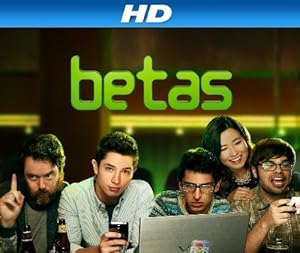
Microreview [TV]: Betas


The Meat

No, no, Betas isn't a sequel or spin-off of the defunct SyFy Channel show Alphas, although you'd be forgiven for not knowing otherwise. Instead, Betas is one of the two inaugural series from Amazon Studios (along with the Congressional satire Alpha House), in the web mega-colossus' attempt to get in on some of that yummy, yummy Netflix original programming business. Since it'll take a minute to get back to the show itself, let me just say for now that it's surprisingly, tremendously, good.

Backing up: you may remember that in April of 2013, Amazon posted 14 pilots online and asked the site's visitors to watch and review them, thereby determining which would be greenlit for an entire season. To me, it seemed like a dumb way to do things, and the whole Amazon Studios model made a lot of people nervous. The "studio" had begun by soliciting scripts from non-professional writers and encouraging them to more-or-less sign their rights away in a nebulous quagmire of "collaboration" where other writers or site users could suggest and even make changes to a writer's work. They got in trouble for this, and were pressured to change how they went about doing things. So when they announced their pilots, I and many others didn't have high expectations. Plus, I figured the fix was in anyway for high-profile projects like the TV spin-off of box-office winner Zombieland.

But then Zombieland didn't make the cut. And two shows that seemed interchangeable on paper — Betas and Browsers — felt like Amazon was making the same mistake the networks did a couple of years ago with their glut of shows about "guys learning to be more like men," but this time it was "if we make enough shows about twentysomethings and technology, one is bound to stick." Thankfully, Betas was the one that made the cut, because it has risen above even the most generous of expectations.

The show centers around the small team behind a start-up dating app in Silicon Valley. The pilot introduced us to the character types the show staked out — the straitlaced main character and team leader, his quirky, awkward best friend, the pudgy, inappropriate guy, and the girl that hangs out with them. Not thrilling stuff, but competent. Excellent TV comedies will begin with such character types, and slowly reveal more and more humanity in the characters. Over a few seasons, they begin to feel real, and we begin to care about them beyond how often they make us laugh. Think of the evolution of someone like Michael Scott on the American The Office or Marshall on How I Met Your Mother, who got to experience real emotions and tragedy inside a relatively safe sitcom. What's remarkable about Betas is how stunningly fast the show's creators have been able to get their characters to that point. By episode six or so, each character had been given a central role in a particular episode, and none of the characters or the actors portraying them squandered their opportunities. The tech setting is interesting and the evolution of the team's business is an engaging part of the show, but the deft character exploration is really where it shines. There is no sitcom in memory that has made me feel for and root for its characters as quickly as this show has.

You can only watch Betas if you're an Amazon Prime subscriber. Is it (to keep the Silicon Valley motif going) the killer app for this service? Not yet. But if you are a subscriber already, you should be watching. It's no-holds-barred sitcomedy against a backdrop of safe and banal network comedies that would never dream of challenging the rules and formulas Betas gleefully and confidently undermines.

The Math

Objective Quality: 7/10

Bonuses: +1 for not shying away from the human drama between characters; +1 for introducing and then disposing of characters network shows would've kept around for six seasons; +1 for the blase manner it deals with themes other shows would (and have) spent a lot of time congratulating themselves for addressing at all, like a character struggling with his sexual identity

Penalties: -1 for being maybe a little too hipster; -1 as insurance against the rest of the season (which has yet to be released at the time of this writing) not living up to the promise of the first part

Nerd Coefficient: 8/10. As good or better than anything on a network

To find out why a Nerds of a Feather "8" would be even higher on other sites, check out our scoring system here.

Friday, November 15, 2013

AiIP: Amazon Strikes Back

In what I can only assume* is in response to my boycott of Amazon in favor of pursuing sales through indie bookstores and other avenues, the sales giant and new face of publishing announced that indie bookstores can now sell Kindles and get a 10% cut of ebook sales.

Booksellers responded, in internet parlance, LOL.

And who can blame them? Even if at first blush it seems like something designed to partner up with brick-and-mortars, as a few booksellers point out in there: Amazon has never really done anything to help anyone but Amazon. This certainly fits that- 10% of the five bucks or so most ebooks cost isn't paying anyone's bills, and after two years even that goes away. To be fair, it is at least similar to the model that Kobo uses (I love Chuck from Village Books being super blunt in there). But in the end, the customer ends up at Amazon- or, like many people I have talked to- turned off to the bookstore for throwing in with Amazon.

That same Village Books blog has an excellent post about why it's better to link to a brick and mortar store (who probably sell online and can ship anywhere) than to Amazon (hint: Amazon doesn't care), but that hardly solves the ebook problem.

Which leads to the problem within the problem, namely that Amazon isn't even reinventing the wheel- they're just copying the already-flawed wheel. It's square, it's clunky and it doesn't work. Because if someone is buying an ebook, they're not going to go to a bookstore for it, are they? The overall model of bookselling needs to change in order for this to work.

The first dang thing that needs to happen is every copy of a physical book needs to come with a digital option, one way or another. Be it a code in the hardcopy, or something, just... make this happen. Please.

Secondly, there needs to be a way for those brick and mortar stores to sell directly, not through Amazon or even Kobo. Some indie version of the Nook (how it relates to a chain of bookstores, not how crappy and irrelevant it is). But those titles need to be available for download off that stores website, where that store gets a much larger cut than 10%.

And finally, the Mexican standoff of Amazon vs indie bookstores vs indie publishers needs to stop. Amazon is satiated by the above steps, but it still leaves indie publishers without a way to get their books into book stores. A lot of this is because printing costs can be prohibitive, but I would like to see indie bookstores be more inviting. If nothing else, by selling ebooks on their sites, but even better to have a process in place for purchasing books from indie authors.

I have harped on quality from day one, and I think this would help, since an author who has gone through the process of getting a book to print vs just uploading one to Amazon is likely better and more careful. With more and more authors going the indie route, it only makes sense for bookstores to include them.

I hope you're enjoying this little sojourn with me- I know it's a bit of a deviation from what this space usually is, but I feel this is important and want to highlight it. In any case, I have but one more piece on the subject for next month, along with some (hopefully) exciting announcements, which will put a bow on this whole thing. When I first talked to The G about this, and what it would contain, he suggested the 'Adventures in Indie Publishing' title. It's an adventure, for sure, and I hope you enjoy reading about it.

-DESR

*this assumption is incorrect.

Monday, September 16, 2013

AiIP: The Further Adverntures of an Indie Publisher

This is a post I have been sitting on for a while- or, at least, the idea of it. But here's the thing:

I really, really dislike Amazon.

Aimed directly at your wallet.
There, I said it. I'm not even one of those big bad corporation is big and bad type of people. I get it- they want to make money, and they are good at it. Hell, I want to make money (feel free to help that cause along). Really what I dislike (besides the fact that Amazon feels like the digital equivalent of Wal-Mart) is that Amazon's way allows for no middle ground. It is take-no-prisoners market domination.

Again, I get it. If somehow I had to choose between dominating the sci-fi market and not, I'd take the former, and so would anyone else. But despite the waxing of self-published poster boy Hugh Howey, Amazon is not really that cool, nor good for literature. Amazon is good for selling books. Amazon is the new face of publishing (which, incidentally, is not dying- just changing).

And that's as it may be. I don't like it, but I sure can't change it. The Amazon's and Wal-Mart's will always exist (heck, that's a central theme to my own writing), but how beholden to them are we? To few authors explore other options, such as Kobo, or even print, and every time someone uses the term 'Kindle Best Seller', I cringe.

The fact is that Amazon is industry standard, and as long as bored housewives keep reading 50 Shades of Grey on Kindle, they'll keep getting away with tax evasions, employee abuses and late payments (cough cough).

So the million dollar question is, can one succeed separate from Amazon? Can an indie author live in the shadow of the giant, and garner the support of the alternate e-readers and indie bookstores?

I'm going to find out.

As of as soon as Amazon updates (one day to a month or so-ish), I'm not selling there anymore. If you want to read my book digitally, head over to Kobo. Over the next couple weeks, I'll be doing a lot of legwork to establish partnerships with brick-and-mortar bookstores. If you have one in your area, please send me their info (deanfortythree at gmail), and hopefully I can get physical copies in your area.


So here's to the new chapter in this adventure.

-D.E.S. Richard

Monday, July 15, 2013

AiIP: Support Your Local Bookstore (even if you buy digitally)


Last month, I reviewed Planks by S.C. Harrison, and the tagline for the book fits this post- surely we have done more good than we will do evil- fits this post nicely. Before I dig into what I mean by that, let me give you a little background.

If you've been following my musing in this space for any amount of time, you know that I am frequently vexed by- I will try to say this politely- a significant lack of quality from the self-publishing community. This is to say, un- or poorly edited works, cover art that is only art in the loosest sense and generally stories that are just plain bad. I won't rehash my first post here, aside from saying this is due to a lack of traditional gatekeepers (which I have also touched on).

But, on the plus side, there are a lot of fine works out there, including a lot of unique stuff that traditional publishers would be unwilling to take a chance on. This, I feel (and I'm sure you agree), is a good thing. Amazon was the first to really make this a viable option, and certainly remains the mainstay for self-publishers.

This is where the opening quote comes into play- how much good has Amazon done? Obviously ebooks were inevitable- no one will even bother to debate that, not even the most hardened I-only-wanna-read-physical-books traditionalist. But the harm is obvious- indie bookstores are the most glaring case. Many have adapted (I've mentioned my local hangout, Village Books, several times as a case-in-point of a bookstore that has adapted). But Amazon certainly hasn't done them any favors.

Compare that to Kobo (if you're Canadian, you are already rolling your eyes- "catch up, Dean, we've been using them for years"), who really goes out of their way to work, even in a small way, dollar-wise, with indie bookstores. They make themselves much more open and accessible to authors and publishers than Amazon does.

Why does this matter, to you as a reader or even to the authors?  For one thing, I see a lot of authors buying into the Amazon-or-nothing thinking. Amazon has anointed Hugh Howey as the king of self-publishing for his Wool series, including his comments in such places as their GoodReads acquisition press release, wherein he compares Amazon to 'the cool guy next door marrying your mom'. And look at the comments on that post- people follow him because he's Mister Self Publishing Success Story (and good for him). But why at the exclusion of everything else? What possible benefit does that have for the author, the reader or the literary community?

Nook is, for all intents and purposes, dead (and B&N probably not far behind). Kobo is on the rise, and certainly has my support over Amazon at this point. This article is spot-on for authors- why are we even linking to Amazon at all (if you click one link in this post, click that one)? Bookstores provide a lot more value to the community than simply being a place to buy books. They should get the support of authors and readers alike.

Odds & Ends:

 Speaking of the literary community, I did a reading the other day with S.C. Barrus at his Kickstarter launch party. He is funding for his upcoming Steampunk novel, Discovering Aberration. It is equal parts adventure and witty.

Joining us was Zachary Bonelli, who has written a really cool series called Voyage, with some elements of Sliders, what with all manner of alternate Earths. I enjoyed what he read, and am digging into the rest now.

Prime books now has a digital imprint, called Masque Books. E.C. Tobler has her Rings of Anubis series coming out through them, and I am about halfway through the first book, Gold & Glass, and if you enjoy steampunk adventure, you'll like this (I am not really much of a steampunk guy, so don't ask me why it's in here twice now).

I took last week off from blogging, but interviewed both E.C. Tobler and S.C. Barrus on my blog, so if you want to know more about them & their work, head over there.

In conclusion, my own book, 3024AD: Short Stories Series One is $2.99 for the month of July, so if you don't have it yet, now is the time to grab it! It's out for Kindle, Kobo and Nook