Showing posts with label SciFi. Show all posts

Monday, June 16, 2025

Rebellions Are Built on Hope: Andor S2E7

In "Messenger," we return to Yavin, where things have become much more official

Bix and Cassian shown from the waist up on a lush planet. They stand outside their home on Yavin 4, surrounded in greenery.

In episode 2, we have a final shot showing the famous structures of Yavin after watching what remains of Maya Pei’s rebels destroy each other—and put Cassian at risk—with their infighting. Somehow, out of that, we see Yavin 4 has grown into something much more familiar. The organized, rebel activity mirrors what viewers have come to expect from Rogue One and A New Hope. Even so, that history of infighting still remains, and the sharp hierarchy, while helping to organize an army as opposed to Maya Pei’s grungy fighters, chafes against Cassian and other Luthen operatives who have come to Yavin.

Cassian and Bix have settled down at Yavin even though both are still operatives. Bix is in a more stable place of mind after killing the root of her traumas a year ago, and she and Cassian have a beautiful home, which is one of my favorite aspects of the Yavin scenes. In comparison to the gloomy bolthole of Coruscant where Cassian and Bix spent the previous year, the lush greenery of Yavin feels welcoming and peaceful, even as they work to build an army. It’s a glimpse into the type of world they are fighting for.

Wilmon returns with a message from Luthen, asking if Cassian is ready to work. He’s been organizing with the people on Ghorman, and now has a mission from Luthen to assassinate Dedra Meero, the destroyer of their hometown of Ferrix. At first, Cassian rejects the idea. He’s separated himself from Luthen as he helps to grow Yavin, while Wilmon is still dedicated to Luthen’s cloak-and-dagger approach. He accuses Cassian: “You act like Luthen’s the enemy.” But Cassian has a more measured approach to Luthen and says: “That would be easier.”

As I continue to rewatch and write about Andor, Luthen becomes more interesting of a character. He’s not a one-dimensional hero, nor are his tactics portrayed as a warning or villainous. He is a path toward organizing against the Empire. Not the only path, as Cassian is pointing out to Wilmon, but a path that made Yavin possible, even if Luthen left bodies in his wake. As Luthen says in his excellent monologue in season 1: “I’ve made my mind a sunless place. […] I’m damned for what I do.”

While so many characters shine in season 2, I haven’t spent much time talking about Syril Karn, one of the most fascinating characters of this season. On Ghorman, he’s living his dream of being an ISB spy for the empire and working under his girlfriend, Dedra Meero. He’s successfully infiltrated the Ghorman Front, but his position is put at risk when a supposed rebel attack occurs. The Ghorman Front claims not to have done it, but every news outlet is reporting “another terrorist attack overnight” and a continued “terror campaign.” Of course, the use of this word “terrorist” brings to mind the previous episode where Krennic has the great line: “My rebel is your terrorist, something like that.” Of course, Krennic understands the power of propaganda as, in the first episode, he hired a media team to control the story around the Ghorman.

Indeed, Krennic’s plan is coming to fruition, and Pendergast alerts Dedra that they are moving forward with the original plan to mine the planet in such a way as to destroy it. The Ghorman people will be forced to relocate, as the planet will be destabilized.

Dedra and Syril’s relationship feels the strain of this situation. He’s being manipulated, but he doesn’t understand how much he’s actually being shut out as he has no idea the planet is going to be destroyed. His Ghorman Front contact slaps him when he tries to explain the situation, and he begins to realize more is going on than his girlfriend told him. Dedra tries to smooth it over by saying they’ll be rewarded, but his desire to know what is about to happen overwhelms his trust in her.

Meanwhile, the Ghorman Front is struggling. Mirroring the Maya Pei scenes from the first arc, the members are fracturing as they try to decide what to do. Their leader, Carro Rylanz, is only in favor of peaceful protest: “Peaceful resistance is not pretending. It’s the only thing that carries any dignity.” The younger members of the group are looking for more direct action as the Imperial occupation grows worse. Lezine ultimately brings the group back together, reminding them of their shared love for Ghorman.

We also get a quick glimpse of the bellhop, Thela (Stefan Crepon), from when Cassian came to Ghorman to investigate the Front. He’s now joined the group, and when Cassian returns to Ghorman along with Wilmon to take on Luthen’s mission, Thela recognizes him. He warns Cassian about a protocol they have at the hotel in terms of alerting the Imperial occupiers of new arrivals. Like Lezine, I love Thela’s character because he’s a regular person working a service job who still wants to stand up for what he believes in. These characters are powerful inclusions in anti-fascist storytelling because it gives the average viewer an entry point. Not everyone will be Cassian, but anybody can be the bellhop who doesn’t follow procedures exactly and keeps his mouth shut about seeing Cassian come in under a different alias.

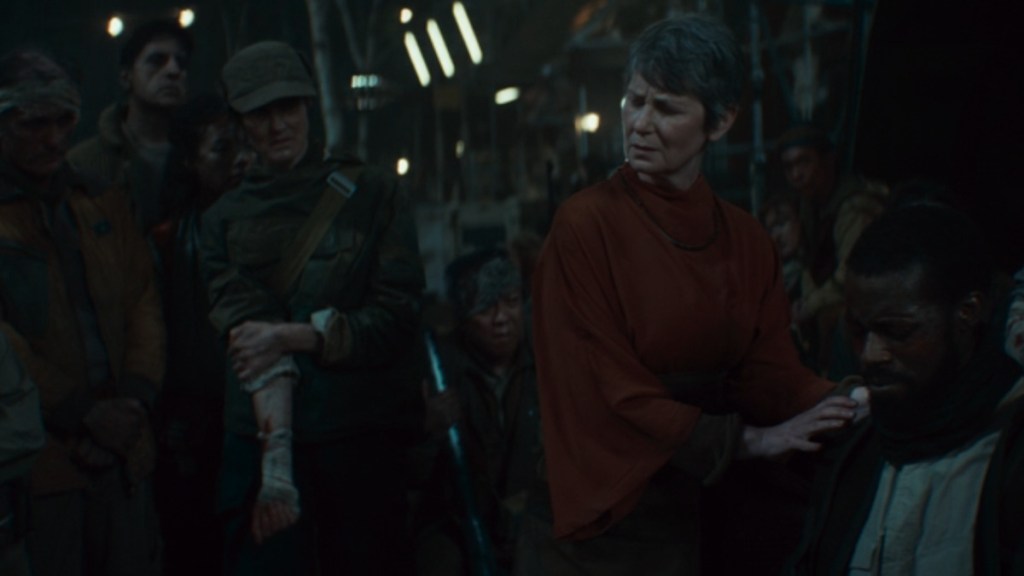
I’ll end on a small scene that, like so many of the quieter moments, not only builds out the world, but corresponds closely with leftist/organizing circles. At the beginning of the episode, Cassian is dealing with a blaster wound that isn’t healing properly. Bix tries to convince him to visit a “Force healer” (unnamed but played by Josie Walker), which he wants nothing to do with because he thinks they are all fakes. While they are arguing within the vicinity of the Force healer, she senses his presence and walks over. She offers to try to heal his blaster wound, and she successfully helps him. She also senses via the Force that Cassian has an important part to play in the rebellion and appreciates his clarity of vision: “All that you’ve been gathering, the strength of spirit.”

A group of rebels stand around a Force healer dressed in red. She is an older white woman with gray hair, and she has her hands on a person's shoulder with a look of concentration on her face.

What I enjoyed about this scene was how it recontextualizes the Force as an alternative or subversive spiritual practice. In many leftist circles, there’s this reach for something spiritual or holistic beyond Judeo-Christian beliefs. Sometimes, this takes the form of returning to older spiritual practices that have been destroyed by empire, such as Indigenous ways of knowing or pagan/heathen practices. Placing Force-sensitive people like the healer or Chirrut Îmwe (Donnie Yen) from Rogue One in this framework is an interesting addition to the worldbuilding in the way it mirrors actual leftist spaces.

The Force healer also has one of the most beautiful descriptions of Cassian when talking to Bix about what she felt through the Force: “Most beings carry the things that shape them, carry the past. But some, very few, your pilot, they’re gathering as they go. There’s a purpose to it. He’s a messenger.”

Of course, within the context of Rogue One, we know what message he has to carry, but this line also has much more immediate implications for Ghorman.


POSTED BY: Phoebe Wagner (she/they) is an author, editor, and academic writing and living at the intersection of speculative fiction and environmentalism.

Tuesday, March 19, 2024

Review: Floating Hotel by Grace Curtis

A delightfully atmospheric exploration of a world and a hotel through the eyes of the workers, linking together their daily experiences to allow us to see a greater whole.

In almost every forum I've seen it referred to, the blurb for Floating Hotel refers to The Grand Budapest Hotel. It's what drew me to reading it. And it is entirely accurate, from a purely vibes-based perspective. I don't know quite how, I don't know quite why, but while reading, I had the spiritual equivalent of that music that everyone used for a bit doing Wes Anderson skit tiktoks going round my soul on a neverending loop. It just had something of that plinky-plunky, moving-between-shots and dotting-about-but-nevertheless-coalescing-into-a-coherent-whole-by-the-end feeling that I associate with his films. It had atmosphere.

And this is the major strength I would say the whole book has - it does vibes and charm and that general creation of a consistent atmosphere really really well. 

Which it needs to, because this is a book that dots between different characters and plotlines quite a lot and quite quickly, and so it really needs to have something consistent underlying the whole thing to keep you hooked. Imagine if a particularly whimsical episode of Star Trek: The Next Generation, Adrian Tchaikovsky's City of Last Chances and Becky Chambers' Wayfarers series got together and had a strange, unholy yet kind of adorable spawn. That's what we're looking at here. It's the story of a... well a hotel... that's... uh... floating. Through space, specifically. Admittedly, I think hotel is a bit of a misnomer (though used throughout the book). It seems far more like a quaint, intergalactic cruise liner making stops at the various ports on its predetermined route, picking up passengers along the way, dropping some off, and being the backdrop for a number of... whatever the lower-key cousin of wacky hijinx are. Whimsical shenanigans, perhaps.

We follow the ship through this journey through the eyes and perspectives of various members of the crew, learning how they came to be on the ship, what their job is, what their current preoccupation is, their concerns, their interactions with other staff. For the major part of the story, the stakes are extremely low - who's been sending sonnets through the pneumatic message system? Will people like this month's shit film club where we watch a retro movie? Let's go try to get an ox flank from the planet, but oh no, it's out of stock! We cycle around through the staff, this way, steadily learning the ship and its rhythms and sense of self, while slowly beginning to see the edges of a deeper, darker plot lurking under the surface, that might be more important than just the day to day running of business, may even be more important than the financial wellbeing of the hotel. But we do so steadily, gently always, never pressuring events to move faster than the current perspective would focus on. There are just little hints peppered through the dish... until eventually you realise find the chilli pepper? Something like that.

As a concept, it's not totally unique (and I do think City of Last Chances is a crucial comp for the structure - if you struggle with how that is a story far more focussed on the city than the people within it, this may give you difficulties for very similar reasons), but it is still plenty unusual. By using so many perspectives, it forces a more oblique approach to the central plot, and gives the author a chance to really bed down a sense of a place, a group of people and their collective community together, focussing on that, on the physical details of the space, the little moments of daily interaction, rather than feeling the need to get a proper drive on towards action and resolution.

Having this space particularly helps in addressing, in a casual and off-hand way a thing I often find poorly handled in SFF - class. It's not a core focus by any means. Don't go in expecting full Marx or anything. But there is a much more competent undercurrent of class consciousness in this book than I tend to assume I'll see in books set in space, even when their characters occupy various points on spectra of wealth and privilege. This is a book that gets the concept of nouveau riche, that gets the shift that happens from what was once vogue into something that is less high-culture and more aspirational middle class, the genteel degeneration of luxury. And that's super interesting! It's a luxury space hotel that's been flying through the galaxy, hosting the wealthy for decades - of course its interaction with fashion, with class and with culture is going to change in that time! And I love that it gets addressed, however obliquely.

Likewise, that space, and that approach to character hopping introduces us to a lot of people, and works hard to make them memorable and distinctive immediately upon meeting. My particular favourite is a grumpy linguistics professor whose position teaching an elective, ungraded course has left her able to gently exploit her situation and do whatever the fuck she wants, more or less, who unfortunately is being pushed back into actually acting on her principles, however much it irks her. I loved her so much, the moment I met her. And there are plenty like her - they appear on the page feeling nearly fully formed, you spend a chapter or so with them, and you feel instantly acquainted. And then see them through someone else's eyes as you carry on hopping.

And in this, I think it actually has City of Last Chances beat, because it does feel rather more tethered to its people than that did - I struggled with CoLC because we had a perspective for a little while then seemingly abandoned it for something completely unconnected. The web of interactions and interlacings there took a long time to materialise (and was amazing once it arrived, don't get me wrong - it's an astonishingly good book), in a way that wasn't an issue here. It's a hotel with a small staff. Everyone is connected and interacting all the time, so it's very hard not to feel like those different perspectives all link up. They're literally talking to each other right now!

But... but. It's not perfect. While those characters are often instantly interesting and interestingly realised, they suffer somewhat in the long term. The structure does not lend itself well to providing character depth, and the lack of repeat perspectives only doubles down on that. You simply do not spend long enough with any one person to get as fully bedded into their headspace as you would in a one or two perspective story.

And then, because of that, because you're not so totally emotionally invested in their wants and needs, some of the emotional payoff come the end of the story suffers a little. It's a story of ups and downs, and the downs never quite hit me like they should have at the end, because I didn't get the time to fully connect with the stakes, and the people, enough to let them fully seep in. Don't get me wrong, there are some moments of great catharsis or excitment or sadness, but the successful ones are all in the short term story scope, told in the confines of one perspective and chapter, rather than the overarching plot that has been gradually built across the perspectives. Which is a real shame precisely because you have those single moments done well to compare it to. It just doesn't quite land that final punch, and that left me somewhat unsatisfied on closing the final (digital) page.

It also, unfortunately, does not always manage the plot reveal itself super well. As I say, there are hints peppered throughout, and gentle foreshadowing galore, but for myself, I found that I had predicted some of those shadows rather, well... fore. And not the "one chapter early" that is the perfect delight of a mystery novel - exactly the zone where you get to feel smug, but before the intelligence of the detective starts being called into question. Once you start spending pages and pages sitting on a certainty that you know what's coming, it starts to grate a little bit that the author hasn't trusted that you'll have figured it out yet.

And I get that that's hard - I cannot imagine how tricky it is to try to manage that pacing knowing your audience is going to be a full range of people from called-it-on-the-first-page to never-saw-it-coming-even-at-the-last - I do. But personally, I would always rather be surprised than patronised, and this definitely felt like it leaned a little bit too far the wrong way in that equation. Not aggressively, not didactically. I never felt like Curtis was spelling it out and elbowing me in the ribs in case I'd missed it. But we were just given that bit too long with a few too many clues and well... it seemed obvious, when we got to things actually being admitted and uncovered.

Which is something of a contrast to some of the wider world-building, once we stepped outside the confines of the ship and started connecting up with what the wider galaxy looks like. Much of this is done, in the early parts of the book, through little snippets of pre-chapter text, which I am personally inclined against, but which were actually done particularly well here. They always felt relevant, they were never too long, and they worked tonally for what they were trying to be. That part of the world-building? Grand. But when we get to the later stages of the story, and the outside world starts to encroach into the insularity and safety of the hotel, and subtext has to stop subbing... slightly less well-managed at that point. There are some questions that I feel never got answered, in a way that isn't "lingering mysterious what if" so much as "we only have so many pages to do this in, let's go go go" and that's... well that's always disappointing. Especially in a book that really didn't overstay its welcome in terms of length and totally could have handled a couple more chapters to make sure everything got tidied away nicely (emotionally, at least).

It's not that I wanted no ambiguity, I want to stress. There's some ambiguity, or some... unfinishedness to some of the storylines at the end that feels entirely deliberate and is entirely good. Where we leave the characters, where we leave the emotional journey of the hotel? Yes, that ambiguity absolutely brings home how those plotlines did and should go. But it's more... there are parts of the story that are set up with the expectation of answers. They get answers. But some of those answers feel rushed, incomplete or emotionally immatured, in a way that we could totally have avoided with just that little bit of extra character work with a few people near the end.

The story is, very deliberately, set at a remove from the rest of the world. The hotel is itself a little world. That's the whole point. But when external events are allowed to intrude, I do unfortunately think a little bit of resolution to some of the questions is in order.

But, for all those gripes, I do still think this is a good book. It's not a perfect book, sure. But it is intensely charming, consistently atmospheric, and the vibes are impeccable. Does it have a plot? Not always. Eventually. Sort of. Does that actually matter? Actually... no. Not really.

As someone for whom A Long Way to a Small, Angry Planet did not work, Floating Hotel delivers the experience that so many people have told me they had with the Wayfarers books - a bunch of people thrown together in a space ship, sharing their lives, seen through their distinct perspectives and having low-ish stakes, slightly delightful escapades, with some more serious bits of emotional work and the odd drama thrown in for some texture. For me, Floating Hotel does a better job at connecting those disparate threads of story, and creating that sense of community and cohesion than Chambers' work did, as well as delivering more impactfully (at least in the short term) on character work. It has some rough edges I would have loved it to have sanded down, but at its heart, it was deeply enjoyable and I'm incredibly glad I read it.

I also respect it for doing something that little bit different (not totally maverick, but just that little bit of "ooh, what are you doing here???") from the norm, and that always gets a rating bump from me. 

Taking that into account, as well as all those rough edges, puts it into the trickiest bracket of scoring in my opinion - the seven out of ten. It's a 4/5 if you're doing star ratings. To an external viewer, that looks like an uncomplicatedly good rating, right? But 7 isn't uncomplicated. 7 is good... but. It's the last point of overall positivity before we start heading into "very mixed" or "meh" territory in your 6 and belows. 7 is messy.

7 is the best place for a book to be for a review, because it's where all the best discussion is. It's good. You're not angry at it or upset. It wasn't a wasted reading experience. But you have a lot of things to talk about, a lot of things to wonder if they could have been done that little bit differently, or what if they just...? What if it had only...? 10/10 can sometimes be dull, because you run out of ways to say "lads, this was good 'un". 7/10, existing as it does at the intersection of good and middling has all the scope for discussion, while retaining the sympathy and enthusiasm, to make for a thought provoking reviewing experience. So on a very meta-level, I rate this book's 7/10 a 10/10.

Dialling the nonsense back again slightly, I did enjoy it as a reading experience. I would absolutely recommend it, especially if you're someone who likes their books very vibes-forward. Come for that, come for the delightful cast, come for gentle pacing and delicious place descriptions. Yes, there are some issues, and they might niggle you, but if you like that tone, that atmosphere? Then they'll be a worthwhile price to pay for a really lovely reading experience. And, critically, it's a book that's trying to do A Thing. I would always prefer books that shoot for the moon and land among the stars over the ones that never tried at all. Especially when you're in a fancy Wes Anderson space hotel, so the cold vacuum of space is less of a concern.

--

The Math

Highlights: 

- demon lovechild of a TNG episode, A Long Way to a Small Angry Planet and The City of Last Chances, all directed by Wes Anderson (complimentary)
- stunning visual descriptions
- immediate character connections

Nerd Coefficient: 7/10

Reference: Curtis, Grace, Floating Hotel, [Hodder & Stoughton, 2024]

POSTED BY: Roseanna Pendlebury, the humble servant of a very loud cat. @chloroformtea.bsky.social

Wednesday, October 11, 2017

Microreview [novella]: The Only Harmless Great Thing by Brooke Bolander

There is not a single wasted word in this treatise of perfection. 


I love going into a book, or in this case a novella, knowing as little as possible. I might know the general premise, a plot point or two, but generally that's about it. Occasionally, I'll have seen a title recommended by people with similar reading tastes.

In this instance, I tuned into Brooke Bolander's writing later than most. I first came across it when I saw her story, "And You Shall Know Her By The Trail Of Dead," in Lightspeed, February 2015. I knew then I'd be a fan for life and to keep an eye out for any and all new stories.

When I started hearing talk surrounding The Only Harmless Great Thing I knew even less than I normally would because I purposely wanted to go into the story and be surprised. I'd heard references to the radium girls and elephants but I dipped out of any conversation going beyond that. But I should tell you a bit more, that is why you're here after all.

This is an alternate history novella set in Newark, New Jersey taking two historical events, the radiation poisoning of female factory workers and the public execution by electricity of an Indian elephant on Coney Island. Bolander weaves these events into something wholly new and heart-wrenching.

With Bolander's writing, you never know quite where she's going to take you but one thing is always certain, the journey is going to be exquisite.

Bolander's prose is some of the best I've ever read. Period. It is artful and sharp as a razor's edge. Allow me to give you a visual representation of Bolander's writing in my mind:


That's right. I needed a picture from the Hubble telescope. Her writing makes me feel grounded and weightless, as though the ending she provides seems the only possible ending while at the same time I feel the world is nothing but endless possibility.

This novella is not typical anything. It is not a standard scifi adventure, it isn't a literary gem, it isn't any one thing because it is everything.

There is not a single wasted word in this treatise of perfection. Sometimes you read a novella and lament it is not book-length. The Only Harmless Great Thing could only ever be what it is and Bolander nails it. Despite it's brevity you get to know Kat, the scientist, Regan, one of the radium girls turned elephant handler, and Topsy the elephant. My cherished Topsy.

The cast is kept at a minimum to tell Topsy's story and we jump between the narrative timelines as the story progresses. It is never jarring as we switch between points-of-view and timelines, the prose flows like a river.

It might not be the story most genre or sci-fi readers expect when they pick up a a novella from Tor.com, but maybe it should be. Maybe we need more gut-punching, heart-wrenching, definition-defying, stories in the world. I know I'm hoping for more.


The Math:
Baseline Assessment: 10/10  

Bonuses: Read it!

Penalties: None from me!

Nerd Coefficient: 10/10 -- this novella is my new gold standard for what a story can be and do.

  ***
POSTED BY: Shana DuBois--extreme bibliophile and seeker of raindrops.

Reference: Bolander, Brooke. The Only Harmless Great Thing [Tor.com, 2017]
Our scoring system explained.

Wednesday, August 23, 2017

New Books Spotlight

Welcome to another edition of the New Books Spotlight, where each month or so we curate a selection of 6 forthcoming books we find notable, interesting, and intriguing. It gives us the opportunity to shine a brief spotlight on some stuff we're itching to get our hands on.

What are you looking forward to? Anything you want to argue with us about? Is there something we should consider spotlighting in the future? Let us know in the comments!


Bear, Elizabeth, The Stone in the Skull [Tor Books, 2017]

Publisher's description:
The Stone in the Skull, the first volume in her new trilogy, takes readers over the dangerous mountain passes of the Steles of the Sky and south into the Lotus Kingdoms.

The Gage is a brass automaton created by a wizard of Messaline around the core of a human being. His wizard is long dead, and he works as a mercenary. He is carrying a message from a the most powerful sorcerer of Messaline to the Rajni of the Lotus Kingdom. With him is The Dead Man, a bitter survivor of the body guard of the deposed Uthman Caliphate, protecting the message and the Gage. They are friends, of a peculiar sort.

They are walking into a dynastic war between the rulers of the shattered bits of a once great Empire.
 Why We Want It: When I hear there is anything new from Elizabeth Bear I am already in line. Seriously. Bear's novels never fail to sweep me up and away. Her last, Karen Memory, was a phenomenal weird western I've given multiple times as gifts. I suspect this one will be on my gift-giving guide as well.


Toptas, Hasan Ali, Shadowless [Bloomsbury, 2017]

Publisher's description:
In an Anatolian village forgotten by both God and the government, the muhtar has been elected leader for the sixteenth successive year. When he staggers to bed that night, drunk on raki and his own well-deserved success, the village is prosperous. But when he is woken by his wife the next evening he discovers that Nuri, the barber, has disappeared without a trace in the dead of night, and the community begins to fracture.

In a nameless town far away, Nuri walks into a barbershop as if from a dream, not knowing how he has arrived. Try as he might, he cannot grasp the strands of his memory. The facts of his past life shift and evade him, and as other customers come and go, they too struggle to recall how they got there.

Blurring the lines of reality to terrific effect, Shadowless is both a compelling mystery and an enduring evocation of displacement from one of the finest, most exciting voices in Turkish literature today.
 Why We Want It: I love finding genre in translation and after stumbling on this cover I knew I had to put this one on my list. I'm not sure I've read any Turkish literature yet so this will be such a wonderful addition to my shelves.


Alderman, Naomi, The Power [Little, Brown and Company, 2017]

Publisher's description:
In THE POWER, the world is a recognizable place: there's a rich Nigerian boy who lounges around the family pool; a foster kid whose religious parents hide their true nature; an ambitious American politician; a tough London girl from a tricky family. But then a vital new force takes root and flourishes, causing their lives to converge with devastating effect. Teenage girls now have immense physical power--they can cause agonizing pain and even death. And, with this small twist of nature, the world drastically resets.

From award-winning author Naomi Alderman, THE POWER is speculative fiction at its most ambitious and provocative, at once taking us on a thrilling journey to an alternate reality, and exposing our own world in bold and surprising ways.
Why We Want It: It has a blurb from Margaret Atwood on the cover and the premise sounds flipping incredible. I want this book so much!


Hearne, Kevin, A Plague of Giants [Del Rey, 2017]

Publiser's description:
From the author of The Iron Druid Chronicles, a thrilling novel that kicks off a fantasy series with an entirely new mythology—complete with shape-shifting bards, fire-wielding giants, and children who can speak to astonishing beasts

MOTHER AND WARRIOR
Tallynd is a soldier who has already survived her toughest battle: losing her husband. But now she finds herself on the front lines of an invasion of giants, intent on wiping out the entire kingdom, including Tallynd’s two sons—all that she has left. The stakes have never been higher. If Tallynd fails, her boys may never become men.

SCHOLAR AND SPY
Dervan is an historian who longs for a simple, quiet life. But he’s drawn into intrigue when he’s hired to record the tales of a mysterious bard who may be a spy or even an assassin for a rival kingdom. As the bard shares his fantastical stories, Dervan makes a shocking discovery: He may have a connection to the tales, one that will bring his own secrets to light.

REBEL AND HERO
Abhi’s family have always been hunters, but Abhi wants to choose a different life for himself. Embarking on a journey of self-discovery, Abhi soon learns that his destiny is far greater than he imagined: a powerful new magic thrust upon him may hold the key to defeating the giants once and for all—if it doesn’t destroy him first.

Set in a magical world of terror and wonder, this novel is a deeply felt epic of courage and war, in which the fates of these characters intertwine—and where ordinary people become heroes, and their lives become legend.
Why We Want It: I love Kevin Hearne's writing and his approach to world-building. I am beyond stoked for this upcoming epic fantasy.


Moreno-Garcia, Silvia, The Beautiful Ones [Thomas Dunne Books, 2017]

Publisher's description:
Antonina Beaulieu is in the glittering city of Loisail for her first Grand Season, where she will attend balls and mingle among high society in hopes of landing a suitable husband. But Antonina is telekinetic, and strange events in her past have made her the subject of malicious gossip and hardly a sought-after bride. Now, under the tutelage of her cousin’s wife, she is finally ready to shed the past and learn the proper ways of society.

Antonina, who prefers her family's country home to the glamorous ballrooms of the wealthy, finds it increasingly difficult to conform to society’s ideals for women, especially when she falls under the spell of the dazzling telekinetic performer Hector Auvray. As their romance blossoms, and he teaches her how to hone and control her telekinetic gift, she can't help but feel a marriage proposal is imminent.

Little does Antonina know that Hector and those closest to her are hiding a devastating secret that will crush her world and force her to confront who she really is and what she's willing to sacrifice.
Why We Want It: I think Silvia Moreno-Garcia is too often overlooked when people are looking for their next favorite read. Pick up any of her novels and you better settle in because you will be sucked in and not want to leave her world.


Stearns, R.E., Barbary Station [Saga Press, 2017]

Publisher's description:
Two engineers hijack a spaceship to join some space pirates—only to discover the pirates are hiding from a malevolent AI. Now they have to outwit the AI if they want to join the pirate crew—and survive long enough to enjoy it.

Adda and Iridian are newly minted engineers, but aren’t able to find any work in a solar system ruined by economic collapse after an interplanetary war. Desperate for employment, they hijack a colony ship and plan to join a famed pirate crew living in luxury at Barbary Station, an abandoned shipbreaking station in deep space.

But when they arrive there, nothing is as expected. The pirates aren’t living in luxury—they’re hiding in a makeshift base welded onto the station’s exterior hull. The artificial intelligence controlling the station’s security system has gone mad, trying to kill all station residents and shooting down any ship that attempts to leave—so there’s no way out.

Adda and Iridian have one chance to earn a place on the pirate crew: destroy the artificial intelligence. The last engineer who went up against the AI met an untimely end, and the pirates are taking bets on how the newcomers will die. But Adda and Iridian plan to beat the odds.

There’s a glorious future in piracy…if only they can survive long enough.

Why We Want It: Yes. Yes. Yes. Give this to me now please and thank you. I have been waiting for this book since I first heard about it a year ago.

Tuesday, March 28, 2017

Microreview [book]: From Ice to Ashes by Rhett C. Bruno

Where Cold and Dark Works


Space is making a comeback. Movies like The Martian, Interstellar, and Gravity have been big hits. Have you seen The Expanse? That's a pretty good TV show, better than the source material in my opinion. From Ice to Ashes tells a class struggle story and it succeeds in a lot of ways.

Kale Drayton is a Ringer; a descendant of colonists who escaped Earth on the Saturnian moon Titan. Ringers have physically adapted to the environment of Titan, making them physically weaker and lankier than their Earth counterparts but more adapted to the cold of their new home. Earthers, however, had to evacuate their mother planet due to planet-wide disaster, and now the two are rubbing against each other on Titan. However, the Earthers brought back Earth's many diseases, and Kale's mother languishes in a quarantine zone. Desperate to provide for her on meager wages, Kale takes a gas hauling rotation, with a secondary mission to simply plug in hand terminal (think future smartphone) into a computer onboard the hauler. This simple act puts a long lived plot in motion that eventually changes the entire Sol balance of power.

Let's be honest; From Ice to Ashes cribs a lot from the class conflict aspects of The Expanse books. Ringers are an oppressed people; the Earthers couldn't live without them, but they brought disease back to the ring that Ringers have no medications for. Ringers are the working class Belters, and Earthers are still Earthers. The Earthers in this novel are one-dimensional and there's not a single good one among them. The novel suffers for this because they're the primary antagonist and their every action can be spelled out from the start.

But this isn't really a story about Earthers, it's a story about Ringers and the complex interactions between the Ringer characters is what makes it work. In the Ringers, Bruno crafts more complex characters as Drayton struggles to do anything to make his mother suffer less while contending with a love interest, other Ringers trying to make due, and a people who've been unjustly treated by the Earther guests they descended from. The story takes some time to get moving, but it's hard to put down once it does.

From Ice to Ashes is the second book in this universe, and I intend on going back to read the first. It's a solid class conflict tale told among the rings of Saturn. Though it could stand for a less cartoonish antagonist (or antagonists), but the Ringer characters Bruno develops over the course of the tale more than make up for it.

The Math

Baseline Assessment: 7/10

Bonuses: +1 good character work in the Ringers

Penalties: -1 flat antagonists

Nerd Coefficient: 7/10 (an enjoyable experience, but not without its flaws)

***

POSTED BY: brian, sci-fi/fantasy/video game dork and contributor since 2014

Reference: Bruno, Rhett C. From Ice to Ashes [Hydra, 2017] 

Wednesday, January 11, 2017

Pianos, Players & Murder

If you want to name great things about Westworld, you can start pretty much anywhere. The writing, acting, plot, set design... the list goes on and on. It is rich with small details, the kind of details which are more rewarding with repeat viewings- a feat, in and of itself, given the cyclical nature of the timeline within Westworld itself. And the best detail is one we see quickly, and often, and likely, never even notice it.

The first time we see it is in the main titles, the skeleton playing the piano. But in the course the titles, we are informed by that very instrument of what is in store, as the fingers lift off the keys, yet the keys play on. The player piano is an easily overlooked detail, yet it shows up at some of the most important moments in the entire series.


NOTE: from here on out, I assume you have watched all of Westworld. There will be no restraint on spoilers. You have been warned.

Player pianos are the sort of relic which belong in a place like Westworld - their use is limited, serving no real function outside of that era. You and I don't need to pretend to play the piano to impress guests in our age, and the Victorians would have actually known how, so its niche existed in that slice of history where someone could sit there and look like they were playing. A place like, say, an old west brothel.

This is where we find the player piano within Westworld, plinking away amidst the mayhem of tourists wreaking havoc. It's drawn some notoriety for the songs it plays- covers of No Surprises (Radiohead) and Black Hole Sun (Soundgarden), relevant to the show, certainly, but hardly adding immense amounts of gravitas to the show itself.

What does, however, is how they are played- or, rather, not played, since that is the whole point of the piano. Aside from the main titles, we don't see it played by anyone. We see the cylinder, turning, playing the notes it is programmed to play. And when- when- we see it is what really matters.

The first two times in the first episode- "The Original" we enter Mariposa's, we don't even see the piano. But later, as something is off with Maeve, we see the cylinder before she comes downstairs. In E02 "Chestnut", we see more, the cylinder, and the keys being depressed all by themselves. We pan out as Maeve says "You can hear it, can't you?" No Surprises here, by itself, would be something. But the phantom keys, Maeve's cryptic words, and the fact that the surprises have only begun makes it all the more significant.


In 04, "Dissonance Theory" we get a slow pan across the working of the still unattended piano before cutting to Maeve, lost in thought. This was the point in the show it really grabbed me, because the point of a player piano is for someone to sit at it, work a pedal, and look like they are playing- not for it to be unattended, with no one playing it.

Just like the Hosts.

They are there to appear as if they are real- have real reactions, but they aren't. They gloss over references to the 'real' world, trips, visitors, and the like. Just like the piano, they are programmed. But someone has to pump the pedal.

Until they don't.

Until the hosts begin to play themselves, as the piano has all along.

For all the brilliance in this show, the small cues it gives us, like the piano, are my favorite. In 05, "Contrapasso", when the Man in Black and Ford meet, Ford simply snaps his fingers and the piano starts playing, showing he is still in total control of the situation. Throughout the series, we see more of the piano the more the hosts learn. We hear it up close in 08, "Trace Decay", hear the poor quality of the dingy piano.

There is also, significantly, one in Ford's office- always with a host seated at it, ostensibly playing it. But, of course, he isn't. Or perhaps, he actually is, but is programmed to do so. We see this in 03, "The Stray". This time, the piece is on the nose- "Reverie" by Claude Debussy, the significance of which is impossible to miss. But we hear a string version in 06 as Bernard remembers his son- a true reverie. We finally hear a full piano version in the finale, behind Delores' narration, as we witness her creation.

And then we hear it, finally, as Arnold kills himself, playing over a gramophone this time, telling us it was Charlie's favorite, and repeats yet another phrase we have heard before- "these violent delights have violent ends". It sums up the show in so many ways, beyond the base violence which is its facade. Westworld is a story about storytelling about stories- that is a hard story to tell, and tell well. It adds another layer of difficulty, by that very cyclical nature, cylinders being used in the aforementioned player pianos. The same day is played over and over, with only sensitive to initial conditions (or more commonly, 'the butterfly effect') to change what happens. This means we see and hear the same thing over and over again. But Westworld embraces that challenge, that restriction, and uses it to its advantage, because we don't just see and hear the same things over and over again in the park, we hear phrases repeated outside it, about it, about the hosts and about humans. Their violent delights do indeed have violent ends.

The piano doesn't murder the player if it doesn't like the music, as Ford says. Season 2 - perhaps - will reveal if the hosts can change the tune, or if they continue being played - even if no one is sitting before the keys.

-DESR

Dean is the author of the 3024AD series of science fiction stories (which should be on YOUR summer reading list). You can read his other ramblings and musings on a variety of topics (mostly writing) on his blog. When not holed up in his office
tweeting obnoxiously writing, he can be found watching or playing sports, or in his natural habitat of a bookstore.