Showing posts with label Max Gladstone. Show all posts

Wednesday, March 9, 2022

Microreview: Last Exit by Max Gladstone

A multiverse SFF story about the bonds and bounds of a group of friends, and what they owe to each other.
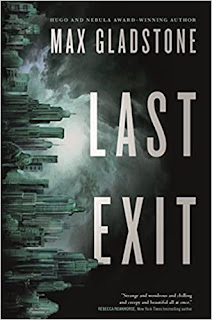
Zelda has a problem. For the last ten years, she has been traveling the United States, using her gift to heal the cracks in the world to try and keep together a 21st century US that seemingly is on the brink of falling apart. Ten years ago, she and her friends, including her love, Sal, made a daring journey into alternate worlds. That journey ended in disaster. 

But now Zelda needs to get the band back together, to journey back into the alternate worlds. But her friends have moved on from traveling the dangerous alternate worlds. But with Sal’s young cousin June, who has unusual powers of her own, the need to find Sal is stronger than ever before. But what forces are chasing them across the real and alternate worlds?  And what precisely happened to Sal?

These are the big questions at the heart of Max Gladstone’s Last Exit.

Portal fantasies are something that go in and out of fashion in SFF. Until a few years ago, Portal fantasies had been fallow, taking a backseat to subgenres like Grimdark, the prominence of the Martin/Abercrombie/Erikson style of fantasy, and so on. With authors like Seanan McGuire, Alix Harrow, and Foz Meadows, multiversal fantasy has seen a resurgence. Much of this new crop of multiversal fantasy has been sui generis, or reaching through to fairy tales, or to epic fantasy. Works really in conversation with earlier generations of multiverse fantasy are thinner on the ground, much less taking them apart.

Enter Last Exit. Last Exit has many parents, but the ones you will see immediately are both from the pen of Roger Zelazny. Roadmarks and The Chronicles of Amber. 

Let me tackle the second one first, since it is the weaker influence. In many ways this story is a “take that” at the Chronicles of Amber. In that series, it is an upper crust of nobles from one (two if you count the Courts) families who walk a Pattern/Logrus and are the only “real people” in a world of shadows who can travel between worlds. And as commonly depicted, these people are very much mostly white men having the balance of power in Amber. 

My contrast, Gladstone’s travelers across the “alts” are ordinary people from a variety of backgrounds on Earth (the diversity of them on all axes is stark compared to the Barimen family). Their control of their powers is not as assured as Corwin, Fiona and company (I kept thinking of their powers in terms of a Second Amber Series “Broken Pattern”, especially given the alts and situations they keep falling into). There is, as it so happens, a Princess and a Castle in the novel, and are quite a central point to the resolution to the story. 

But Roadmarks, I think, is an even better fit for an inspiration for Gladstone, even if Roadmarks itself is not *quite* a multiverse story, but is at its heart a time travel/alternate history  novel. Roadmarks is the story of Red Dorakeen, who is trying to get to a place he can’t quite remember. Red is eventually joined on the road by his son Randy, who is new to the Road, the path that he can and does take along the flow of history. Red’s twisting relationship is with Leila, with a narrative and storyline that only becomes clear in the end. Red is running from forces he is not quite sure of the origin or provenance of. Each of these has a cognate within Last Exit, the parallels are clear to a reader of both.  One thing that Roadmarks lacks, but Last Exit has, is the space for all this. Roadmarks is a short novel and the ideas and scenes stuff the novel to bursting, with some of what is introduced getting short shrift. Last Exit has much more space in order to let his environment and ideas thrive. I think it makes an interesting “response” to Roadmarks and I encourage readers to read both.

Gladstone’s idea of the alts, is difficult to talk about, because there is a central mystery to the alts that you don’t quite realize is a mystery until the author points at an aspect of them that the reader takes for granted for a bunch of the novel. Gladstone’s penchant for description and evocation of the worlds next to ours is top notch, and immersive. His story is not one of tourism of these alternate worlds. Frankly, traveling these worlds is not a glorious pilgrimage along the road, but very much a labor. This is not the kind of multiverse fantasy where Gladstone will dazzle you with wonderful places they visit. No, not at all. The alts are dark, twisted, broken, apocalyptic. His road is not one I’d want to go off running onto, Camera in hand. No indeed.

Even more so, no surprise for those who have read his previous work, is that he gives some thought to the limits, and abilities and consequences of the powers the protagonists, including young June, possess. Like Amber, there is enough of a quasi hemi demi science fictional consideration of a fantasy concept to make the novel much more of a science fantasy sort of work, and I am here for that. There is enough of the numinous mystery of how it all works, including to the protagonists, to keep readers wondering and thinking and being drawn forward by that rope, as well as the other strands of the narrative.

But as much as Gladstone sets up all of this worldbuilding and thinking about multiversal fantasy and being in conversation with the older generation of multiversal fantasy, this is not, in the end, a story about those powers, about traveling lots of alternate world, of seeing wondrous (even darkly wondrous vistas).  No, this is the story of Zelda, and how her relationship with Sal went wrong. Of how she and the other travelers came together, and fell apart, and how they come back again to get the band back together, to try and finish what they began. Of how June, Sal’s cousin, fits into this found family on the road. Of how time, and circumstance, and life, have changed these individuals, what they have done after leaving their company, of how they have tried to make their way in the world, and how they try to fit back together for this one additional attempt to make it all work, and make what they once had, work. 

In many ways this is a book that is a punch in the gut to read. Not only the state of the world, as depicted in it...this is firmly a book of our times, our place, that could not have been effectively written in the 20th century. It’s also how relationships form, are messy, how they fall apart, and how the attempts to rebuild or restore things is far far more difficult than any movie or book can imagine. How trying to protect a small corner of the world, even a few people, can be an act of heroism as great as trying to save the world. The book is not blunderous, it is sharp, it cuts like a monofilament blade, fillets your heart, but in the end all makes sense and you stand at the end of the Road, glad that you have taken a harsh, unforgiving, but rewarding and immersive journey. Going into this book, I was expecting an immersive Gladstone book that might especially be good in audio form for one of my road trips. Instead, I got an experience very different, and vastly more rewarding than I imagined.

---

The Math

Baseline Assessment: 8/10.

Bonuses: +1 for very strong characters and fraught and messy relationships between them. For a world with multiverse travel, it is the characters more than the landscapes and locations which ultimately sing the best.

+1 for not being the book that I was expecting--for being something deeper, and more, than I imagined going on.

Penalties: -1 The book may well not be what all readers are expecting...this is a two edged strength and weakness to the novel.

Nerd Coefficient: 9/10

Reference: Gladstone, Max. Last Exit  [Tor, 2022]

Paul Weimer. Ubiquitous in Shadow, but I’m just this guy, you know? @princejvstin.


Friday, September 20, 2019

Microreview [book]: Empress of Forever, by Max Gladstone

Empress of Forever is a rollicking, audacious, technicolor space fantasy opera that fully embodies its aesthetic and ethos while providing an over the top adventure.


Max Gladstone’s  novel begins with Vivian Liao. Vivian is a Elon Musk type tech billionaire who has made far too many enemies among various governments. So, a retrench and reboot and a plan to come back stronger are in order. But in the course of her escape, Vivian is captured and brought to a far future (or is it just far away in space) in a universe with strange monks, killer robots, pilots who can bond with their ships, space pirates and much more. Including, and most importantly, the titular Empress of Forever.

After that measured beginning, setting up Vivian on Earth briefly enough to rip her away from it, Vivian’s plunge into an outer space world is a wild ride from the moment she lands on the Mirrorfaith ship and meets Hong, one of the other main characters of the novel. From being under attack by robots, to freeing an extremely dangerous space pirate  who has been locked up for a very long time, Vivian goes down the rabbit hole fast. Her goals are straightforward at first--to find the Empress who has brought her to this time and space, and find a way to get back home. In entangling herself with Hong, and  Zanj (the aforementioned very dangerous space pirate), Vivian’s path, if not goals,  go off course almost immediately. In that tangled new course, Vivian meets new allies, new enemies and in the end, finds out the truth of the Empire and why the Empress has brought her here in the first place.

For all of the technobabble that the novel has, from the start as we learn about Vivian’s life on Earth in a couple of short set up characters, through the major facets of her universe, like the hyperspace Cloud, there is a definite science fantasy feel to all of the proceedings. Not only is it technology indistinguishable from magic (which the novel has in plenty) but there are whole portions of the novel that feel like they are even more closer to the fantasy section of the spectrum. Vivian and her friends, for example, landing on the ruined planet of Orn, find themselves in a post-apocalypse society and a problem that, as the author handwaves with Vivian’s thoughts, straight out of Beowulf. Later in the novel, as the author cranks things up to 11, the science as magic really does feel more and more like magic. The science fantasy nature of the novel reaches its zenith.

And on that way, we get a space opera/space fantasy universe that is full of sights, sounds, impressions, set pieces and environments.  Overall, I could see how Empress of Forever could and would play out on a screen--but as an animated feature, i think. This novel would bust the budget of any studio with trying to do practical effects and CGI with human actors. (Think Jupiter Ascending, to a square or cube power). Between the environments, the cinematic writing at the end, the larger than life characters, and the sheer inventiveness that the author brings means that this novel really works well for visual readers. If you are the kind of reader who relishes in those details, sights, sounds and experiences in your head as you read, Empress of Forever, after that early portion on Earth is done and Vivian is on the Mirrorfaith ship, the novel is most definitely for you.

That said, however, the novel, like many of the author’s novels, lives and grows on the strength of the cast. Taking the aforementioned Vivian, and Hong, and Zanj (space pirate for the win!), we have characters like Xiara, a preternaturally good space pilot and Gray, a graygoo creature, to fill out Vivian’s found family/team. They squabble, they fight, they come together and all have interesting character arcs, developments and growth. In a sense, I think Vivian, even though she is our Earth viewpoint character who we can relate to the most, is not even quite the most interesting character in the book. Given Hong (who feels in a sense to be the author’s most beloved character, since he gets to say a phrase that I’ve heard the author say himself in real life), Zanj (Space Pirate!) and Xiara (space pilot from a post apocalyptic world), the novel is rich with protagonists whose stories and personalities resonate. They are the heroes of their own stories.

And then there is the titular Empress herself. Most of the novel is experiencing and reacting to her from various points of view, various reactions, impressions, and even legends and myths for what people think of her. This gives her a larger than life quality that reminds me of the hints we get about Thanos in the early Avengers movies, until he actually starts to take action himself. The Empress’ goals, enemies and motivations are, to remain as non spoilery as possible, extremely grounded and well thought out. Even as Vivian and her friends oppose her and all of her works, what the Empress is really after, once it becomes clear, is logical and makes sense. She IS the hero of her own story, too.

The author keeps us mainly in Vivian’s point of view, but we get sections with the other characters, giving us a very good understanding of who they are, what they are about, and why as a reader we should care enough to follow their stories. In the last portion of the novel, as all actions and moves go to a conclusion, the author tries a little more cinematic of a technique, cutting between points of view to show us different portions of a wide ranging conflict.

The major thing again to keep in mind about Empress of Forever and deciding if it is for you really ties back into the expectations of the novel. This is not the hard space opera that you might be expecting or wanting. It’s side step into more fantastical realms, putting it in more the mind of space opera-science fantasy. However, this does not always quite work. The novel goes sideways phantasmagorical at times with an over the top world that the author is trying to describe, and sometimes, the author does exceed his grasp in that regard. Early on in the novel, before things get truly and utterly weird, the novel is on point, beat perfect and flawless. As the novel progresses, and as we get a sense as to what really is going on, and the universe becomes more defined, the action and events, paradoxically become just a tad fuzzier than I’d like. It’s minor, but it was noticeable for me.

That said, however, Empress of Forever is what you get if you decided to marry a traditional Space Opera narrative with Flash Gordon, Journey to the West, numerous Anime properties, Farscape, Jupiter Ascending, and most centrally, I think, Guardians of the Galaxy. When it works, Empress of Forever is  one of the best novels I have ever read. When it slips from that exalted mark, it is “merely” one of the very best books I’ve read this year.

---
The Math

Baseline Assessment: 8/10.

Bonuses: +1 for excellent and inventive worldbuilding, a unique and interesting verse
+1 for an intriguing and varied set of main characters. 

Penalties: -1 for not always hitting the science fantasy mark.

Nerd Coefficient: 9/10 very high quality/standout in its category


Reference:  Gladstone, Max  The Empress of Forever  [Tor, 2019]


Paul Weimer. Ubiquitous in Shadow, but I’m just this guy, you know? @princejvstin.

Friday, September 13, 2019

Microreview [book]: This is How You Lose the Time War, by Amal El-Mohtar and Max Gladstone

This is how you lose the Time War is a moving story of a professional rivalry a love story, and a meeting of perspectives told through world-changing time travelers’ letters


The idea was inevitable, and originated relatively early in the history of time travel narratives. If one person can invent a time machine, and if history can be changed, then more than one person is going to invent a time machine, and the goals of those forces are going to not be congruent. From Jack Williamson and Fritz Leiber to The Terminator, to recent novellas like Alasdair Reynolds’ Permafrost  and Kate Heartfield’s Alice Payne Arrives, there is a lot of mileage to the idea of a Changewar, where different time traveling factions seek to change history

Max Gladstone and Amal El-Mohtar’s This is How You Lose the Time War takes this subgenre of a subgenre in a new direction by telling the story of two agents from opposite sides, who find something in each other, greater than the causes they separately serve..That in itself would be an interesting enough concept to pin down a novella, but the authors have an additional, dellightful wrinkle: The agents do not meet, but rather communicate in letters to each other.

In a world of twitter, and direct messages, and texts, and instant social media, long form letters are a delightful retro technology and form. Epistolary novels and stories, never the most common of forms even when letters were dominant as a means of communication, are exceedingly distinctive just by their format in this day and age. It’s a bold choice by the authors to have the two agents, Red (from a technological end state utopia) and Blue (from a biological super consciousness utopia) to start their correspondence and to have their letters (which take increasingly unusual forms as described in the narrative) be the backbone of the action. Every chapter has one of the principals in action, and a letter from the other principals, giving a harmonic balance for the reader as far as perspective. But it is within the letters themselves that the novella truly sings and shows its power.

Those letters, those perspectives, the shift from adversarial relationship to something more, as the two best time agents in all of history find in each other something more in common than in their own sides, Agency and Garden, that this novels runs on. I was half expecting, going in, a narrative more like Leiber or Anderson, or the like, where jonbar points are displayed and fought over, and changed back and forth as the two sides change history. And there is some of that but it is in the most general of senses, with lots of references to alternate strands and timelines. The worlds that were and what might be,and could be are really just smoke and reflections, pale ghosts compared to how Red and Blue bare their souls and hearts to each other. So this is not a story for deep explorations of how saving Archduke Ferdinand or giving Genghis Khan a longer life might change the timelines. Sure, there are handwaves in the direction of changing things here and there, but those are not the point. The novella is not really oriented toward pulse pounding action, either, although there is a culminating sequence toward the end of the novella where the style does change a bit to allow for it.

What this novella provides, and the target readers, are an extremely literary focus. There are clever bits with wordplay, allusions, references, and even a book recommendation mixed in with that. The letters, starting as boasting and admonitions that each side is going to win, slowly change and evolve, as the adversarial relationship finally turns to respect, and then love. The power and the strength of the letters become richer and richer as the novella continues, as Red and Blue really start to really understand each other, and themselves, that the novella truly shines with the full power of the writers. The seamlessness of the two writers writing is also noteworthy--I can make a guess as to which writer might have written which side more predominantly but I cannot possibly be sure of that. Like Red and Blue themselves, the two sides blend into each other, and while I may slightly prefer the letters of Blue to Red, the beauty and poetry of both sides’ letters, especially in the latter portion, is magical.I was moved deeply by the slow burn love story that unfolds in the words in their letters.

My only real quibble is something that I have tried to make clear in this review, this novella being difficult to capture in words, like a letter being consumed in flame even as you write it. My quibble and it is not really for myself but for others is that it is an extremely narrow and specific kind of story that is going to appeal to a particularly stratum of readers, and probably be of absolute no interest to many more. Even if you are a big fan of time travel and Changewar stories, if you are expecting something like a cold or hot war of temporal changes and conflict (again, something I wondered if we would see in the novella, and we do not), you are going to come away disappointed. This is a character focused story, a love story between two women who are opposing agents in a time war. It's heartbreakingly, movingly good at what it does, but that thing is a narrow interest.

There is a line in one of the letters, “All good stories travel from the outside in”, and This is How You Lose the Time War fulfills that promise for me as a reader.
---

The Math


Baseline Assessment: 8/10.

Bonuses: +1 for heartbreakingly excellent prose

Penalties: -1 for a style and format that may not be appreciated by every reader.

Nerd Coefficient: 8/10 well worth your time and attention


Reference: El-Mohtar, Amal and Gladstone, Max, This is How You Lose the Time War [Saga Press, 2019]


POSTED BY: Paul Weimer. Ubiquitous in Shadow, but I’m just this guy, you know? @princejvstin.

Friday, June 7, 2019

Summer Reading List 2019: Paul

While winter is for reading and trying to stay warm in the Great White North when the Ice Giants and the White Dragons roam the wastelands of Minnesota, summer is for getting out there and enjoying the all too brief warm weather. That hardly means, however, that reading comes to an end, far from it. It does mean that reading time on weekends is while having lunch somewhere on the North Shore, or even more distant destinations, and audiobooks consumed to eat up the miles driving on the highways and byways in search of photographic subjects. So here, find a list of six of the books I am looking forward to getting to before Summer turns to Fall, and green shifts to hues of red, gold, and orange before a clattering change to brown.

I read five out of the six on my 2018 list. Let’s see how 2019 stacks up!


1. Priest of Lies, Peter McLean.

I was favorably impressed with McLean’s debut novel, Priest of Bones, which worked very well as a cross between The Godfather and The Prince, set in a Renaissance fantasy world. There were hints of a greater and wider scope in store for the characters and the world by the end of the first volume, and I am looking forward to the fulfillment of that in the second book of the series.


2. Empress of Forever, Max Gladstone.

I came about a year late to the start of Gladstone’s Craft sequence, and have been rapidly playing catch up ever since. The high concept, an Elon Musk like character who is catapulted into the future and becomes a central figure against a tyrannical Empire, seems to foreground themes of freedom and justice that Gladstone puts in all his works, and I look forward to seeing what  his deft hand with worldbuilding can do.


3. Gideon the Ninth, Tamsyn Muir.

I’ve heard nothing but good things about this debut novel, which has, as one of its pitches as “Lesbian Necromancers in Space”. That sort of peanut butter and chocolate mixiing of science fiction and fantasy tropes is, quite frankly, catnip to me, and I am very curious as to where that concept will lead the author.


4. The Outside, Ada Hoffman.

Another debut author, this novel has been pitched as AI Gods force a scientist to hunt post-human angels on their behalf after one of her experiments badly warps reality. It sounds a bit like the gonzo work of Hannu Rajaniemi, combined with something of a Lovecraftian mentality.


5.The Gossamer Mage, Julie Czerneda.

Czenerda is one of the small select group of authors that, after years of buying and reading her stuff, is now on my auto-buiy list, even if its in a subgenre she is not known particularly for. While most of her work is SF in genre, the author has written a couple of fantasy novels, and this, The Gossamer Mage, looks to be a new world and a new series in that tradition. Mage vs tyrannical Goddess with heavy consequences if the Mage succeeds? Yes, please and thank you!


6. A Sword Named Truth, Sherwood Smith.

Smith’s fantasy novels are set in a complex and intricate world with realistic politics, strong characters and intriguing situations into which she dumps her protagonists. She loves to put young, wet behind the ears protagonists into the deep end, and this forthcoming novel, which sets a number of untested rulers against an enemy arrayed against them. Misunderstandings, inexperience and a lack of trust between the young rulers makes it sound like it will be a tough row to hoe for  the protagonists.


POSTED BY: Paul Weimer. Ubiquitous in Shadow, but I’m just this guy, you know? @princejvstin.