Showing posts with label Juliette Wade. Show all posts

Friday, April 29, 2022

Centireview: Inheritors of Power by Juliette Wade

The third book in the Varin sequence, brings the series to bear in its central problems and themes.
Juliette Wade’s previous Varin novels, Mazes of Power and Trangressions of Power, introduced us to the very human, but also very alien, human societies of the Varin. The Varin are an extremely caste-stratified society that primarily lives underground due to the threats on the surface, primarily the will-o-wisp like Wysps. Over the last couple of decades, as seen in those two novels, the society of the Varin have faced challenges, and a flawed and paranoid tyrant, Nekantor, has achieved the ultimate power in their society and done much to cement that power, even as his very siblings work to try and curb it. But the problems the entirety of the Varin face are not going away. 

Inheritors of Power continues the story of the Varin, but from new perspectives, and a sharp heightening of the central problems the Varin face.

Inheritors of Power’s weakness, and its strength, is that it absolutely cannot be understood on anything more than a superficial level if one has not read and grokked the previous two novels. Wade does an excellent job in making readers new to the Varin as comfortable as possible- using the classic technique of having one of our viewpoint characters (Akrabitti Meetis) be from a perspective she herself has not explored and so does a lot of heavy lifting for herself and for readers both old and new readers familiar with a slice of Varin life we’ve just never seen before. Our other primary viewpoint, Imbati Catin, is a viewpoint we’ve seen before in a secondary capacity, but we get a lot more of the Imbati perspective than we’ve seen in the previous two novels.

That all said, however, as much as Wade can prepare a reader new to the world to the complexities of the Varin and their very alien human society, this is a novel that really relies on knowledge of the previous two books, both on a high worldbuilding and also on a character level to really succeed. With the basis of that two novels, though, it is clear to me here, that this is a rich and deep and complex story that I get the feeling Wade has wanted to tell from the beginning, and from this point. 

There is a theory in writing that one of the keys to writing any work of fiction is to know where the story begins and to start the story at that point,. In some ways, the rich story of this novel, of which I will speak shortly, seems to be the story that Wade has wanted to tell since the beginning of Mazes of Power. In Wade’s case, however, and for the readers, this story only really can work as a story if you have the background of the first two novels in order to get the full force and impact of what happens here. 

In the first two Varin novels, Wade’s focus has been on the top two castes of society, The aristocratic Grobal and the militaristic Arissen. Mazes of Power introduced us to the world and society of the Varin from that elite, aristocratic perspective, Mazes of Power is in the end the story of how Nekantor gains power and becomes the head of society. We get to know him and his brother Tagaret, and see how manipulations, maneuvers and desperate gambits result in Nekantor’s ascension to Heir.  And yet the seeds that show not all is well in the world of the Varin, the deadly plague particularly is wreaking havoc on the Grobal, even as it has a much lighter touch on the rest of the population. (although the book was not written in the age of vaccine denial, I can’t help but now think of the Omicron variant of Covid and how it affects the unvaccinated versus the vaccinated). There are also hints that there are other cracks in society as well.  

In Transgressions of Power, we get to see the inflexibility of Varin society and see the smallest of safety valves--the Fall, whereupon a member of a caste can forever drop in caste to a lower caste. (the reverse *never* happens).  Pyaras story in his Fall, and why he feels that it is his own option to become an Arissen work hand in hand with Tagaret’s (and his partner Della)’s story in seeking other and new ways for the Grobal, and working toward that goal. And, then there is the “shadow” story in how Nekantor seeks to cement his power among the Grobal by jumping from Heir to Eminence, and what he is willing to do in order to do that. And then there is Adon, Tagaret’s and Nekantor’s youngest brother, and the dread secret of his true identity and nature.

All of this is necessary backstory, foundation and support to understand the plotting, maneuvering and the state of affairs here in Inheritors of Power. This carefully constructed edifice, and the plight of the Varin comes to the fore, and comes to challenge. As mentioned above, Wade does her best in setting this up for a new reader, but this book relies on the previous two novels in a fundamental way.  

Let’s take Imbati Catin for an example. Bright star of the Academy, she is recruited into a scheme to become the next servant for Adon, as a way to support him and put a check on Nekantor...or is it to put a check on Nekantor’s own servant, Xinta? Nekantor’s penchant for secrecy and power mean that what is really going on in the Eminence’s household is a black box, and the strains on the already strained Varin society are beginning to show. Something Must Be Done, and so Catin finds herself in a web of plots and power as she tries to be a loyal and well working Imbati for Adon, and yet fulfill her objectives. The strain on Catin, given her caste, given her training, are a reflection and a contrast that work best if you’ve already read Mazes of Power and have encountered Aloran and so can understand Catin much better. Having that grounding in the Imbati not only helps understand Catin’s story, but also Xinta’s. 

Xinta, as Nekantor’s servant, gets a few point of view chapters himself. In fact, Wade does a most clever thing in running sets of chapters in succession in switching points of view and following different characters and points of view, providing a good treadmill to carry the reader through the narrative. This technique means that a couple of points, we need to get into Xinta’s head, into Xinta’s point of view. Thus, we as a reader understand the whole of the Varin and what is going on much much better than any individual character, and it provides a rich tapestry. But, again, understanding Xinta and what he does without bogging down the narrative relies on having the background on Nekantor for the last two novels. There is also a subplot in this novel involving one of Tagaret’s children that only makes sense if you know about Nekantor’s disability, as seen in the first novel.  

And then there is the fragile nature of Varin society. A major theme of this novel is when the lights literally start to go out, when things fall apart and cannot be easily repaired, how does one carry on and what does it say about a society that is just trying to keep things running, and trying to stay one step ahead of entropy? Having leadership like Nekantor, having an inflexible society as developed in the first two novels only makes the problem more acute. Society is suffering both on a tangible and a sociological level. This sort of exploration is Wade’s jam and she makes a lot of good hay out of it.

Having Akrabitti characters, Corbinan and particularly our major viewpoint character of Meetis. show us the lowest rung of Varin society, one barely even mentioned in the pages of the first two novels, as focused as we were on the top three castes. The Akrabitti are an undercaste of undercastes. Even the merchant Melumalai caste, ostensibly the caste just above them, are an unapproachable gulf of power, authority and rights above the Akrabitti. We’ve seen Melumalai before, and we see here how much they are below the other castes in rank. As far below the Grobal, 5 castes above them, the Melumalai are, the Akrabitti are below the Merchants. Although we’ve seen how the Castes work in the previous two novels, having Akrabitti characters really shows the Castes and how they work. 

In addition, continuing that worldbuilding theme, we get to see how the “rest of society” gets on, society between the exalted Grobal and the low Akrabitti. This novel is the most successful yet in showing the entire spectrum of Varin society by giving us the perspectives of poor Corbinan, and more to the point, Meetis.. We’ve changed our tight lens on the top of society and their concerns, a perspective that has given us deep insight into Grobal and Imbati (and to a lesser extent, the Arissen) and now see much of the society and how it gets on--and how it, too is fraying. The sense of entropy in the Varin world, both in terms of the center cannot hold, and the weaknesses of the caste system itself, really comes to the fore from a “ground level perspective”. 

And then there is the ‘secret’.  I’ve had vague ideas about the secret for the last two novels, but only in the sense of wondering about the worldbuilding of the entire world.  (Recall, Wade’s interest in Worldbuilding is deep and abiding, having had a long running show on the subject). In this novel, a secret of that worldbuilding is revealed, a reveal that is only shocking and really has an impact if one has been immersed in this world for two and a half novels. It's an extremely tricky thing that Wade tries here, but I think in terms of the whole Varin narrative, this is the place in the sequence where that reveal makes the most sense to do it, if one is going to do it, because it really is a pivot point for the entire future of the Varin to have the revelation, here. The thing that Wade does here that requires two and a half novels to really get is not to spring this revelation on the readers, but to also spring it on the characters who discover the secret. Frankly, the power of the revelation really would not be there for the characters as filtered into the readers and how the characters deal with it, if this was the first novel in the sequence. And yet, looking back and seeing how Wade has seeded things, this revelation is what Wade has had under wraps ever since Tagaret mused about music in the first line of Mazes of Power. 

And so that is where this book sits. Wade finally reveals her ace in the hole, after two and a half books of buildup. It is, though, a reveal that only works in full if you’ve read those book, and if you haven’t, it is going to land without its full impact. 

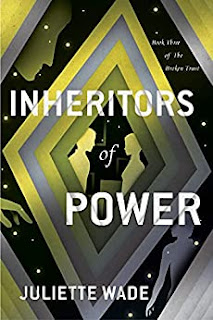
Three books in, I find that I get the themes of the entire first three novels (and dare I say, perhaps the entire sequence), now. It’s a grand tapestry of theme and exploration of that theme that runs across characters and events in the three novels. We see it with Aloran in the first novel, in the second novel with Pyaras’ story, and the start of what Tagaret and Della are doing, and we see it here in the third novel, with Catin, Adon, and Meetis. The boundaries of caste, how levels of society are never as firm as one thinks, and what happens when those Boundaries of Power are Transgressed, from the Mazes to the Inheritors. It’s a grand theme that DOES take multiple perspectives and novels to express and I look forward to how Wade continues it in the next book. The cover artist for the three novels, Adam Auerbach, clearly gets this as well and the unity of cover art for the first three novels leans into this quite effectively.


So I find myself in the very strange position in this review of recommending not the book I read, but Mazes of Power. Things being as they are, if you’ve read Mazes of Power and Transgressions of Power, all you need to know from me is that the novel holds up those two novels and builds upon them and you hopefully preordered it already. In Nerds of a Feather terms, that’s not a Microreview, or even a Nanoreview, that’s a Femtoreview. But I think the entire Varin sequence is one of the most intriguing and important sociological SF series out there today, and I want less people to sleep on it. Inheritors of Power proves and provides Wade’s skill at bringing her world to life, and what those characters, that world has to say about its own world and our own is important and very much worth your time. 

The heart that is valiant triumphs over all.

---

The Math

Baseline Assessment: 7/10.

Bonuses: +1 for “The Secret”. 

+1 for a strong leveling up in showing how Varin society works, top to bottom

+1 for strong thematic resonances and continuances from the first two novels.

Penalties: -1 A couple of revelations and subplots are a bit too subtle. 

Nerd Coefficient: 9/10

Reference:  Wade, Juliette. Inheritors of Power [Daw, 2022]

Paul Weimer. Ubiquitous in Shadow, but I’m just this guy, you know? @princejvstin.


Thursday, February 4, 2021

Microreview [book]: Trangressions of Power by Juliette Wade

Juliette Wade’s Transgressions of Power effectively tells the story of a 1st Global Family in an alien human alternate world of underground cities, strict caste systems, and a civilization slowly crumbling.

Juliette Wade’s Mazes of Power introduced us to the Varin .They are as human as you and I, in a different world where humans live mostly in underground cities. The surface world is a dangerous, scary place full of dangers and so it is better to live underground, even if Pelismara and the other cities of the Varin are strict, caste based cities, where the city and society are starting to fray, and where power politics and ambition are threatening to reshape a society on the edge. Transgressions of Power continues that story, more than a dozen years after the first novel, and with new points of view to develop the worldbuilding and characters.


Some things are still the same. Target is still the central character and central point of view. He is the heart of the previous book and this book, although this book feels more of a power sharing arrangement with the other characters. A dozen years or so with his younger brother as Heir, and powerful in the government of the Grobal caste of the Varin have changed Tagaret into someone looking for escapes, be it the boundaries of caste (see the title of the novel) or just to find a berth or a position outside of the city of Pelismara itself to get away from the pernicious influence of Nekantor. We get Della as a point of view here, for the first time, and we see things from a different perspective. The time since the first book have not been good for Della even with her marriage to Tagaret. She has failed repeatedly to carry a child to term, a heavy burden on her in a world where the Decline of the Grobal caste is a front and center concern. Even with Tagaret’s attempts to combat the disease that inflicts his caste, the Grobal Decline is a very real thing, and the burden of expectations weighs heavily on her. 


 Also burdens of expectation weigh heavily on the newest and youngest brother to Tagaret and Nekantor, Adon. Adon is now of an age that Nekantor was in the first book, and with just the right push Adon could be used by Nekantor to cement his power for an additional generation. Adon wants none of this and we get a one way escape option for the Grobal through his eyes. Adon’s attempts to rise to the challenges surrounding him are an echo and call back of the same themes we saw with Tagaret in the first book, complete with being opposed to Nekantor’s plans for him. Nekantor is not a point of view character in this book, however, and so he comes off, quite deliberately I think, as a villain through and through. Oh I understand and any reader will understand what he is doing and why he is doing it. This is not a villain who does things “for the lolz”, Nekantor, as they say, Has a Plan. With the Grobal and the Varin in general in such straits, Nekantor has definitely ideas and plans on what that Plan should be, and the Gods help you if you are in their way. 


And this brings us to Pyaras. Cousin to Nekantor and Tagaret, we got a look at him in Mazes of Power, but here he is “promoted to titles” and given a large section of the point of view. Pyaras comes off for a lot of the book as “upper class twit” in a textbook example of the form. His story is about learning better, and eventually doing better. I was dubious about him at the beginning of the book, but he does go on a journey of character that redeems and strengthens him by the ed of the novel. 


So as in the previous novel we also get a look at a caste and a point of view from that cast. This brings us to Melin, of the Arissen, Officer Caste. Her story intersects with Pyaras, of course, and Melin learns quickly that getting caught up in the affairs of the Grobal is a pretty hazardous line of work. Given that her main job of guarding plantations on the surface from attack by dangerous lifeforms, which she loves (perhaps irrationally for a culture preferring the underground) , this is saying quite a lot. Her story and arc is one of discovery and learning about how the people who run her society really are and what they do. There is more action scenes in this book than in the first, and Melin is in the center of most of them, including a tense set piece of trying to hustle someone across the city while assassins are on the hunt.


The world building and the plot come from the characters here. The author is not for ten pages of world infodumping, it is using the characters and their actions to bring aspects of the world into play. We find out, for example, a lot about how paper works in this society, how precious it is and how nearly every character in the book is connected to its manufacture or its sale and distribution. Just how paper could work in a society mainly living underground is a question that appears to have fascinated the author, and that fascination infuses the book. 


My major criticism of the book is that despite attempts to do so, especially with the time jump, the book doesn’t quite stand on its own for new readers. Readers who are new to the Varin world are going to miss some key aspects that aren’t recapitulated for new readers directly. A lot is, mind and there is enough catch up in terms of plot that you can follow what happened in the first book pretty easily (plot being relatively straightforward and not, for me the reason for reading these books--setting and character are). There is an interesting bit of remove, seeing the plot from a dozen years in the future, and how the characters think on those events and how they have been shaped by them (as especially seen in Pyaras above). 


Still, this is a book nearly equal to the splendid nature of the first, and readers of the first novel (and you really should) will find much to love here, in terms of characters, world, and setting. The plot as in the first one is not the strength of these novels, it is an emergent property of the characters and their motivations, hopes, desires, and very importantly in this book, fears. 


---

The Math

Baseline Score: 8/10

Bonuses: +1 for strong character driven drama and worldbuilding, a real strength of this author.

Penalties: -1 The novel does not stand alone, despite its efforts to do so.

Nerd Coefficient: 8/10: Well worth your time and attention

POSTED BY: Paul Weimer. Ubiquitous in Shadow, but I’m just this guy, you know? @princejvstin.

Reference: Wade, Juliette. Transgressions of Power  [DAW, 2021] 


Friday, February 7, 2020

Microreview [Book]: Mazes of Power by Juliette Wade

Mazes of Power is a thought provoking and immersive  work of sociological science fiction in the tradition of genre luminaries like Ursula K. Le Guin, Doris Lessing, Jack Vance, and Eleanor Arnason.


In a world where humanity developed along some very different lines, and now, in a spiral of slowly decaying technology lives almost entirely in underground cities, such as Pelismara. The surface world is dangerous, alien, not to be visited if at all possible. In a stratified world riven by class and social status, the conflict over the succession to high office envelops the Grobal Caste, the nobles of this world. Disease, intrigue and assassination are thread to those scions might ascend to that role, as well as the young man who has pledged himself as a servant to that family. The entirety of the Varin, aqll the seven castes, not just the Grobal, not just the servant Imbati, all of them, are on the edge of a knife, and the actions of Tagaret, Nekantor and Aloran will decide which way they will fall.

This is the story of Juliette Wade’s debut as a novelist, Mazes of Power.

Sociological science fiction is a tricky business, especially when you are building a world from scratch with no connection to our own. Building up a unique human society in such a way in a novel, and keep the story moving at the same time, is no mean feat. Wade’s training and previous work is at short story length, and I found those skills served her well here, as she uses careful writing and information density to try and convey the important, plot and character relevant aspects of her world to the reader. The dense reading makes this a slow novel to read, to unfold everything that the author is sharing. Skimming this novel is a good way to miss the richness of the book, or worse, be confused as to what’s going one. This starts at the very first sentence. The very first line of the novel gives us a character beat and tells us something physically fundamental about the world and how it is different than ours. The novel as a whole uses this strategy.

And what a world. A class and race-riven society in a slowly decaying world underground, where the ruling caste struggles from power within, and keeps in mind those who are without. A disease, deadly to the vulnerable ruling class, a horror of contagion and sickness that is positively Victorian. A deep look at social relations, with servants bonded to their masters, and houses and even the city aligned in terms of social roles and standing. The novel’s world feels like Jack Vance decided to team up with Ursula K LeGuin and the result is wonderful. And I didn’t even mention the ornate and clever use of language in the novel. There is an invented language in the novel and the use of language, between social classes and within social classes, also blends into the world that Wade creates here.

There is a lot more than the world here to love. There are the characters and the story. The story centers around two brothers, the reticent seventeen year old Tagaret, who really doesn’t want to get involved in the family’s game of politics. He contrasts with his antagonist and brother Nekantor, younger, more ambitious and definitely interested in promoting the First Family’s bid to become Heir to the Throne. They are a study in contrasts, strengths, weaknesses, and flaws, especially Nekantor. I felt for Nekantor, given Wade’s very careful revelation of his disability and how it is handled is nuanced and skillfully done.

The third of the major characters is the Imbati Aloran, who in a way provides us with the closest thing we have to being the newbie point of view role to help explicate the world. This is only to a limited extent, since its to help build and develop the family and its social circle. Even so, he is far more than just a straight up exposition piece, as his relationship with Tamelera (mother to the brother) is an extremely interesting one. It is here that Wade seems to have the most fun in developing how a different society would work and the nuances, expectations and defied expectations of that society.

Given the iceberg rule, I can’t imagine just how much of the world Wade has that is only inferred and infused into the work indirectly and supports the stuff above the surface and it feeds into these three characters. The characters are passionate, driven and significantly larger than life, and in a good way, one can call them operatic in that full vividness in how they love, hate, strive and act. Readers worried that they will be buried underneath the seas of the world building will find that the character beats not only keep them afloat, they zoom across those seas until the novel’s conclusion. The novel is the start of a series, but it does end at an important pivot point with a resolution that if you wanted to one and done the series, you could. I for one most certainly do not and want to see more with the characters and the world Juliette has created.

The novel’s themes of class and social stratification, and society under stress and what the characters within can or should do resonate very well indeed. If all SF is really about the present instead of the future it depicts, this novel definitely delivers in that regard. It is easier to see our own riven  society, with power and wealth being concentrated into ever fewer hands, with the Varin and their society which formalizes and reifies that sort of thinking and society. Reflected in the world of Aloran, Tagaret and Nekantor...is our own world.

Mazes of Power is a powerful work of sociological science fiction that looks at us, through the lens of a society that is alien, and different, and yet the characters are unmistakably human.


---

The Math

Baseline Assessment: 7/10.

Bonuses: +1 for worldbuilding firmly in the wheelhouse of an author known for worldbuilding classes and interviews, +1 for passionate, almost operatic characters

Penalties: -1 for a little bit of roughness in the plotting

Nerd Coefficient: 8/10: Well worth your time and attention


Reference:  Wade, Juliette. Mazes of Power [DAW, 2020]


Paul Weimer. Ubiquitous in Shadow, but I’m just this guy, you know? @princejvstin.

Wednesday, February 5, 2020

6 Books with Juliette Wade


Juliette Wade never outgrew of the habit of asking "why" about everything. This path led her to study foreign languages and to complete degrees in both anthropology and linguistics. Combining these with a fascination for worldbuilding and psychology, she creates multifaceted science fiction. The author of short fiction in magazines including Analog, Clarkesworld, and Fantasy & Science Fiction, she lives in the San Francisco Bay Area with her Aussie husband and her two sons, who support and inspire her.


Today she shares her Six Books with Us...


1. What book are you currently reading? 

I've just started reading Arabella of Mars by David D. Levine. I'm really enjoying it, especially the way that he grounds the setting in his use of language. He mixes the linguistic flavors of British Empire, steampunk, and science fiction wonderfully.


2. What upcoming book are you really excited about?

I'm looking forward to The Worst of All Possible Worlds by Alex White, the conclusion to their series that began with A Big Ship at the Edge of the Universe. I think they've done something really cool with the mash-up of space opera and magic, but the really outstanding thing about the series, to me, is the characters. I'm a particular fan of Boots, Nilah, and Orna. I'm keen to see how Alex ties this all up in a magnificent space-magical bow.


3. Is there a book you’re currently itching to re-read? 

I found myself talking at a holiday party this year about Ancillary Justice by Ann Leckie. I love that book because it satisfies both intellectually and emotionally. The linguistic choices make me happy; the sad parts make me cry. Breq is the kind of nuanced character I just love. (Now I want to go pick it up.)


4. How about a book you’ve changed your mind about – either positively or negatively?

 I have found it fascinating, as I have become a writer, how my engagement with this field has changed my impressions of the books I read. I don't think it's fair to say that my impressions changed negatively, but they've evolved. It does make it harder for me to become immersed rather than read analytically. For example, when I first read Lord Valentine's Castle by Robert Silverberg when I was fifteen, I was totally captivated by it. When I went back and read it years later, I found I still appreciated its grand scope, but I had a great many critiques of the social worldbuilding, and I wished I could feel closer to the characters. I'm really glad when I can go back and do a critical reading, because such readings give me a ton of ideas for tuning my own work.


5. What’s one book, which you read as a child or a young adult, that has had a lasting influence on your writing? 

I was in college when I first read The Left Hand of Darkness by Ursula K. LeGuin. Since then, I've read it at least five times. I find new things in it every time. It has blown my mind in so many ways, and really inspired me to challenge worldbuilding elements that I had always taken for granted. I really love the way the book uses both researcher and character points of view. It's one of the works that really got me to pay close attention to the kinds of drive and conflict that point of view changes can create.


6. And speaking of that, what’s your latest book, and why is it awesome?

Mazes of Power, my debut novel of sociological science fiction, which came out yesterday on February 4th, 2020. This is a book about a power struggle in an underground city, and two brothers who end up being thrown into a competition for Heir to the throne. It deals with compulsion, contagion, assassins, sexual politics and forbidden loves. It examines how human characters cope with technology and change, and reflects on social issues from our own world by examining them in the twisted mirror of a unique caste society in decline.


---
POSTED BY: Paul Weimer.
Ubiquitous in Shadow, but I’m just this guy, you know? @princejvstin.