Showing posts with label JoeD. Show all posts

Monday, April 10, 2023

MicroReview [Movie]: The Super Mario Bros. Movie

Let's-A-Go (see this movie)!


The Super Mario Bros. Movie is Nintendo’s second attempt to bring the world’s favorite Italian plumber —and brother—to the big screen. This time they wisely went with an animated approach to bring the mustachioed duo to life. Considering the Mario series of games have always been rather bland in story but rich in gameplay, I wondered how they would transition this to a feature-length film. Everyone knows the “our princess is in another castle” device that’s synonymous with the franchise, but besides the main focal point of saving the princess, what else is there?

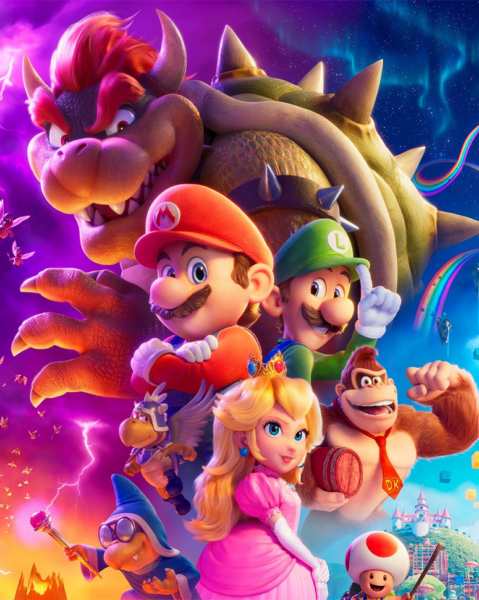
The Super Mario Bros. Movie immediately scraps the old story device, instead making Princess Peach (Anya Taylor-Joy) assist Mario (Chris Pratt) in rescuing his brother, Luigi (Charlie Day) while also defending the Mushroom Kingdom. Peach peacefully rules her obeying Toad subjects and commands with enthusiasm, a far cry from the perpetually captured princess in the video games. Bowser (Jack Black) has been taking over the other kingdoms, and with the Super Star, he now has what he needs to propose to Princess Peach.

Bowser’s desire for Peach leads to some comical scenes that allow Jack Black to shine in the role. In addition, Pratt, Day, Keegan-Michael Key (Toad), and Fred Armisen (Cranky Kong) do well in their respective roles, bringing life to an already colorful movie. Seth Rogen, on the other hand, delivers a rather bland performance, though sometimes the writing sand line delivery saves him. Charles Martinet has a cameo that will instantly be recognizable to fans of the games, and I’m thankful that they went with someone else for the voice of Mario. For all the backlash from fans, Pratt does a good job adapting the character to a feature film. It works well, as mentioned earlier, along with all the other characters.

Illumination’s animation looks beautiful, truly bringing the Mushroom Kingdom to life. The bright, colorful Toads and vibrant jungles of Kong country contrast with Bowser’s Dark Lands to encompass much of what the Mario games dream of. I would love to see an upcoming Mario game with even a fraction of the quality of this film. It nails the aesthetic, and any Mario fan will appreciate the respect paid to the source material in this aspect.

But what of other aspects? References are laid throughout the film, filled to the brim and bursting. Some are cleverly included, small details that fans of the games will appreciate (like the little speed boost after Mario hits a nice drift on Rainbow Road). While others are forced in, making a point to jab the game’s inside jokes toward the long-time fan. While the first few welcome chuckles, the movie’s constant reliance on them gets old quickly. The score is, as expected, delightful and nostalgia inducing.

Despite the movie being filled with obvious, contrived puns (some of which land, mind you), the overall story is simple, yet effective. Even if it all feels a bit rushed. The movie has a better story than any Mario game I’ve played (though I haven't played them all), and they keep the viewer at a breakneck pace as they introduce new characters and obstacles. Foes become allies in no time at all and the plot resolves itself in a quick hour and thirty-five minutes. I believe this is a strength in some ways, as most movies don't need to run for two-plus hours. The issue here is the over-reliance on its references. It feels as if they want to make sure they include something from almost every Mario game ever—as if this will be the last chance they have to do something like this (and if early numbers are indicative of future success, there will certainly be a sequel). They could have used the time showing some of those hidden Mario gems to tighten up the plot a bit. Despite this, the movie doesn't overstay its welcome and manages to cater well to both fans and young audiences.

As I took in the vibrant world created by Illumination, I did my best to absorb as much of the inclusion of Mario lore as I could. At times, the references became overwhelming to the point that I couldn't keep track, but it still works. Watching Mario fail repeatedly on an obstacle course from Peach kept me entertained, paying tribute to the numerous times I (and every other player) died to Bullet Bill and Fire Bars. The hesitation Mario shows before making the wrong move is directly reflective of player interaction with the games. I greatly respected this attention to detail throughout the film when done properly.

In the end, The Super Mario Bros. Movie tries to do too much, but it still works well at being what it needs to be: an entertaining film that attracts both fans and newcomers that sets up future installments. And even if you don't love it, it doesn’t force you to sit there for too long. It holds plenty of promise that will hopefully be honed in a sequel.


The Math

Objective Assessment: 7/10

Bonus: +1 for respect to the video gamer's expereince. +1 for amazing visuals and animations. +1 for vocal performances/casting.

Penalties: -1 for too many references. -1 for forced puns. -1 feeling rushed.

Nerd Coefficient: 7/10

Posted by: Joe DelFranco - Fiction writer and lover of most things video games. On most days you can find him writing at his favorite spot in the little state of Rhode Island.

Monday, October 3, 2022

Microreview [Book]: Fight, Magic, Items: The History of Final Fantasy, Dragon Quest, and the Rise of Japanese RPGs in the West by Aidan Moher

A must buy for any JRPG fan.


There's something special about starting up a new Japanese role-playing game (JRPG). Whether it’s the promise of adventure, the camaraderie between party members, the excitement of discovering some long-forgotten magic, or the comfort of finding an endearing town to rest your head—JRPGs have been delivering players formative experiences for decades. In the sub-genre, one will discover indelible stories that trigger nostalgia, soundtracks that raise the hair on the back of your neck preparing you for the journey to come, and best of all, an experience to share with friends. Thankfully for us, Aidan Moher was one such recipient of many of the formative experiences that JRPGs had on offer.

Fight, Magic, Items is a confluence of the history of JRPGs and their expansion west alongside Moher’s personal journey with the sub-genre. The book homes in on Enix and Square, and more specifically, Dragon Quest and Final Fantasy—the two biggest heavyweights in the sub-genre. From the humble beginnings of Yuji Horii and Hironobu Sakaguchi, the creators of both series respectively, to their commercial and critical successes and missteps, Fight, Magic, Items covers three and a half decades of struggle, drama, and perseverance for some of the most well-respected game developers, and franchises, in history. And, as an accompaniment to the historical aspect, we live through a young Moher as he hotly anticipates more news and information from his favorite developers.

Moher keeps fantastic pacing throughout most of the book, making it easy to lose yourself in the read. Fight, Magic, Items is filled with so many appealing tidbits of JRPG history. From what kind of pre-established media influenced the nascent JRPG developers’ decision to include western tropes in their games to which genres impacted their already established intellectual property, many things will click for any reader who has loosely followed the sub-genre over the years. Did you know that Call of Duty influenced some of the design choices for Final Fantasy XIII? That would explain it’s black sheep status.

For most people in the west, Final Fantasy is the name synonymous with JRPGs, but in Japan, Dragon Quest is king. Steeped in traditional genre tropes and honing its mechanics and systems to a sharp edge, Dragon Quest continues to do what it does best—with its next release (Dragon Quest XII: The Flames of Fate) hopefully out next year. Meanwhile, Final Fantasy ditched its turn-based combat years ago in favor of frenetic action-packed gameplay, a franchise that’s always shifting, and with their next release (Final Fantasy XVI) announced for 2023, both franchises are still going strong. But what happened between the original releases of both franchises in the late 80s and the upcoming release of both these JRPG juggernauts? Which games failed, and which pushed the sub-genre into the stratosphere? Which other JRPG franchises were influenced by these titans, and which were made despite them? Fight, Magic, Items has many of the answers and lays them out in a way that keeps engagement throughout.

Moher is enthusiastic about the subject matter, and it comes through in his voice. Every step of the journey is laid out with excitement and threaded perfectly through to the next chapter. I could feel the impact Final Fantasy VI’s big plot twist had on the author, not to mention VII’s main character send-off. I could relate to the decision a younger Moher had to make when choosing between a PlayStation and a Nintendo 64. Was he to follow the console of the company he had loved all along or follow the games that he wanted? Many kids, myself included, have been in such a situation and each retelling of his experience with JRPGs brings the conversation back to Fight, Magic, Items being such a relatable read, whether you're a fan of the sub-genre or video games in general.

While most of the book follows Dragon Quest/Final Fantasy and their developers, Moher brings other franchises to the discussion; Persona (4 Golden being my personal favorite), Super Mario RPG, Blue Dragon, Legend of Dragoon, Breath of Fire, and Baten Kaitos among others are all sprinkled throughout. I had a sincere appreciation for the mention of more obscure titles that didn't necessarily sell well but had an impact on the genre. I didn't know anyone else who had played Baten Kaitos—and in turn discovered the wonderful confectionary village, Paranasse—so it was refreshing to feel as though I was essentially sharing that experience with the author. Baten Kaitos was just one of many examples of this feeling throughout my time with the book.

Another of my favorite things I eagerly anticipated throughout the book were Moher’s asides. These would give a small description of a game’s synopsis, history, primary developers, release year, console, and publisher. This was not only informational but gives respect and shines the limelight on many of the people who worked on some of the sub-genre's greatest (and some not-so-great) games.

While most of the book has a solid loop of franchise-specific history, game industry and game development history, and Moher’s personal history with the genre, it eventually hits a bit of a snag. It’s through no fault of the author, but of the advancing technology of the time and the Japanese publishers’/developers’ archaic view toward game creation. Moher keeps it as interesting as possible, but the focus turns more toward specific games and less about the industry at large or his personal experiences. Though these things are still present, they feel inferior to the flow in the earlier chapters. What started as humble beginnings for these legendary JRPG developers evolved into such massive corporate projects with so many cogs that it was impossible to attribute the success to just a handful of people. Regardless of the flow, the information was still intriguing and engaging.

In my opening, I mentioned that JRPGs are formative. This sub-genre helped form many of the writers in the industry today and still has its hooks in many players—though I'm sure many of us wish we had more time for these epic adventures. But in addition to being formative, this sub-genre is also transformative, casting echoes throughout the video game industry and having an effect on games considered outside of its sphere, but also allowing other genres into its own. What defines a JRPG is now a bit different than it was in the 90s (I’m looking at you Soulsborne games), but nonetheless distinctive. Though my journey into the world of JRPGs is different from Moher’s, he creates an inviting umbrella that can be appreciated by all who have found comfort within this sub-genre of influential video games. As someone who doesn't find too many things nostalgic—hell, my favorite game is only from nine years ago—it was impressive to find that Moher’s words took the wheel and had me riding shotgun while I relived some of the best escapism from my youth. Even if I hadn't played the title he was discussing, I still felt a connection to the content. Moher’s appreciation and intent are infectious and well worth investing your time into. Fight, Magic, Items isn't just a history of some of the greats, but a celebration of an incredible sub-genre that has influenced people the world over.


Posted by: Joe DelFranco - Fiction writer and lover of most things video games. On most days you can find him writing at his favorite spot in the little state of Rhode Island.

Tuesday, September 6, 2022

Microreview [Video Game]: Cyberpunk 2077 by CD Projekt Red

Hackin' and Packin'.

It’s no secret that the launch of Cyberpunk 2077 was an abysmal mess. The console versions were unable to run on their native hardware. Constant crashes, massive game-breaking bugs, and wonky animations (among many other things) made the flame of day one adopters’ enthusiasm flicker, and their trust in the revered developer CD Projekt Red turn to ash in their mouths. Okay, maybe that was a bit much, but it’s fair to say a lot of people were upset. As a day one buyer, I knew I couldn’t play the game in its release state and instead waited for the promised next-gen patch (for PS5 and Series X). Fast forward one and a half years later. The game that was announced in 2012, delayed numerous times, and released in 2020 is finally playable in 2022! What a ride. I wanted to ensure I played the game at its best before giving it a go for two reasons; A) to witness the developer’s final vision, and B) because I wanted to enjoy the game (as I’d been highly anticipating it).

And enjoy it I did. Cyberpunk 2077 is a great game filled with lots of lore, plenty of gameplay options, and unique and interesting characters with well-written quests. Almost two years later, Cyberpunk 2077 is worth putting some time into.

Night City is a place of contrasts. It holds both beauty and hideousness. In some parts, it's bright and vivid, in others grime and filth are prominent. Slums surround hundred-story buildings that glisten in the sun’s shine. This is a place where high-class citizens intermingle frequently with the lowest of the low. Gang members make pacts with CEOs to get jobs done that need doing, while fixers send hired assassins to kill corpos who harmed some poor soul living in a hovel. In Night City, many are out to become a legend—to be remembered for their deeds. Most die in the process or fizzle out. But now it's V’s turn to shoot their shot. V is a mercenary who does jobs for her local fixer. Do enough gigs in Night City and you just might get noticed.
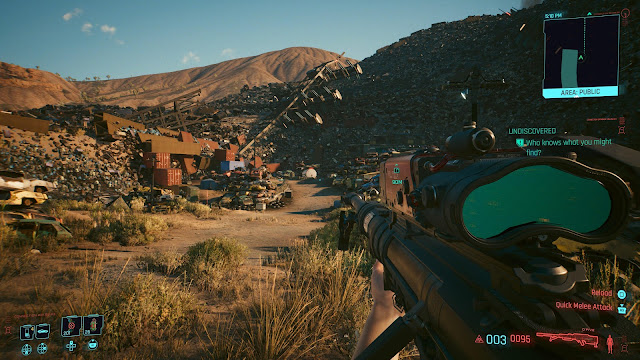

V is whoever the player wants them to be. For my review, I will refer to them as female, as that's how I built the character. The player is given many options to customize their V right from the start. They can alter how they present V’s gender as well as which gender V identifies as. The customization even allows for a choice of genitals (which are seen in some romance cutscenes). The player is also allowed to make their character look cybernetic or natural. There are only two options for voice, however.

While I didn’t get a chance to hear V’s masculine voice in action, I had plenty of time with the feminine one. At first, the voice actor (Cherami Leigh) would grate on my nerves, a mix of the dialogue and the actor’s portrayal of the character irritated me. Over time, I came to appreciate Leigh’s performance, even if there were a few lines here and there that seemed off (the character always sounds like they have a rough grittiness about them, even during sensitive line delivery). In the end, I think she was the right choice for the role and I'm glad I stuck with my decision.

What am I doing talking about voice actors and environments before actual gameplay? Well, Night City is not just a setting, it’s the impetus of every character’s actions. It forms their opinions and personalities. It’s one of the most realized game worlds since Rapture. In most games, the environment is a backdrop, a place for the player to traverse that takes a back seat to gameplay and/or narrative. But Night City is wound into every quest you do and the effects of the city and its inhabitants are with you every step of the way, there’s no way to talk about Cyberpunk 2077 without first mentioning what makes the game work. The city isn’t perfect, but it’s incredibly well done. Night City is the star, and V is just one of the many planets orbiting it. The game makes you feel special like you've got what it takes, but you don’t ever truly feel like a legend. There’s always something further to achieve, and I found that Cherami Leigh’s contribution in combination with the other VO performances and the ever-present Night City fully immerses the player in their quest to be remembered.
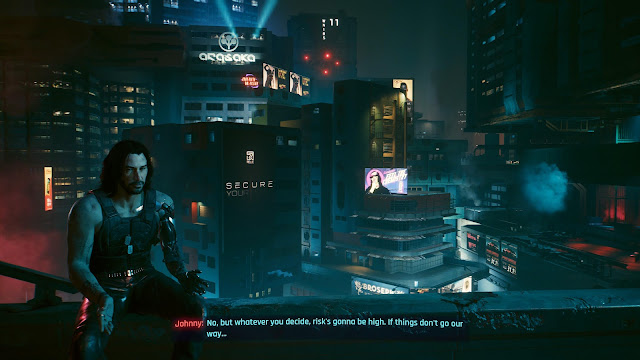

In the initial hours of the game, you’re offered a big job. A heist to be precise. What starts as an elaborate robbery somehow goes wrong and suddenly Keanu Reeves is in V’s consciousness and you spend the next seventy hours trying to get him out. I say Keanu Reeves because even though the character he portrays is rocker-boy terrorist Johnny Silverhand, it is still always Keanu Reeves (just go watch one of his movies if you don’t understand). It doesn't help that the character is modeled after him. This may work for some people, but for me, it was disengaging. His delivery was stiff and unnatural at most times. And though he came to irritate me less later in the game, Keanu never sold me. This wouldn't be a problem if the character was needed for a one-off side quest, but this isn't the case. He’s with you the entire game. I’m not saying Keanu’s not a great person, he is. His brand of acting, however, was one of the biggest hindrances to my enjoyment of Cyberpunk.

Despite Keanu’s overall performance, he does deliver a few good lines that made me chuckle. Not to mention, Johnny Silverhand plays into the plot quite well and it makes for good entertainment to see V engage with the construct in her head that’s slowly killing her. The main quest is pretty straightforward, but CD Projekt Red gives the player the ability to solve the issue in multiple ways. A multitude of endings are available for players who complete certain character’s side missions, and each one is distinctly different unlike some other—yes, I’m looking at you Mass Effect 3. I save-scummed for the multiple endings (I certainly wasn’t playing the game four times at eighty hours a pop). I was pleased by the detail that went into each ending, as each one has playable portions that could have easily been accomplished as a quick cutscene. And, depending on the players’ romance option in the game (Hi Judy, I miss you already), the ending may present that character for a final dialogue. This means that there are technically many more than four endings, though the template for them will be similar.


Many praise CD Projekt Red for their quest design on The Witcher 3, myself included. I’m happy to say that Cyberpunk 2077 doesn't disappoint. Whether I was chasing down a serial killer that keeps people locked up like farm animals, retrieving a set of lost vehicles—each with an individual personality—that were separated from their AI host, getting revenge on gang leaders for selling sex workers for spare parts, helping a convicted murderer to reenact the crucifixion of Christ, or if I was just assisting a sentient vending machine named Brendan, I appreciated the creativity and effort that went into the writing.

Everyone in Night City is looking for a good high. Whether that’s sexual or substance-induced comes down to the individual (though most frequently take advantage of both). Cyberpunk 2077 is rated M for Mature for a reason; every city block and every elevator has ads for a pleasure offering establishment. In the world of Cyberpunk, many opt to use a brain dance instead of going for the real deal. BDs, as they’re often referred to, record one’s experience and put it into a file that someone else can then participate in for their pleasure or a thrill. BDs are primarily used for pornographic purposes in the game’s world, but some main quests use a hacked BD that allows the player to become a detective of sorts. Going through someone else’s mind and using that to discover clues and create plans for upcoming quests was an enjoyable aspect of the game, even if solving the brain dances was quite simple.


The core gameplay is that of a first-person shooter. The game gives you many options when tackling your quests. You can use melee (either blunt or sharp, think spiked bat or katana), you can use guns, you can use stealth, or you can use your hacking skills. It’s possible to hack a camera so you can see things from a different angle, then hack enemies from the perspective of the camera. The game lets you play any way you want, and the gameplay is quite satisfying. You can slash someone up with a katana, knock them back ten feet with a heavy swing of your crowbar, blast their arm off with a shotgun, or simply use the short-circuit hack and fry them out. Whichever way I approached a situation, I consistently enjoyed the combat. I did have a few issues where the game had a bit of slowdown during intense engagements with lots of enemies, but not always. The music that accompanies combat can get irritating at times, but it doesn’t outweigh the enjoyment of the gameplay. Blasting my way through a stronghold with my double-barreled shotgun while hacking everything in my way always felt good, especially combined with my cybernetic enhancements. After all, who doesn't love a double jump?

The beauty of the gameplay is that not only do they give you the tools to use all of the skills, but they also allow you to solve most missions with them. There is always a way to sneak into/out of a building if you wish to focus on stealth. While there are a few missions you can’t sneak your way out of, they are never overwhelming or unbalanced (now I'm looking at you, Deus Ex: Human Revolution). Many times after blasting my way through a building (what can I say? It’s what I do), I would discover a back door or side window that I could have accessed had I wanted to use stealth, something I appreciate from a level design perspective.

There are five skills in the game, each with two to three sub-skills. To level up the sub-skills, the main skill must first be leveled up. Intelligence, Body, Cool, Reflexes, and Technical Ability are the skills that govern everything you do. Want to be able to hack turrets, craft the best items, and open tech-locked doors? Technical Ability is where you'd invest. Want to have a lot of HP, be able to tear doors off their hinges, and control the spread of shotguns and LMGs better? You want to put those points into Body (bet you couldn't guess I maxed out this skill). However you invest, each of the skill sets is fleshed out, with each sub-skill offering perks to tweak to your gameplay style.

Though most of the bugs had been ironed out by the time I finally got around to playing Cyberpunk 2077, a few remained. At one point, I was stuck in a tutorial for twenty minutes. I had to deflect an incoming attack and I couldn't understand what I was doing wrong. I eventually reloaded a save and discovered it was a glitch. Another time I found that when I fast-traveled out of an area before my previous “Quest Complete” marker popped up, I couldn't do anything. I couldn't hack, I couldn't pull out my guns, I couldn't climb. It was the weirdest thing and I essentially had to become a QA tester to figure out what was going on. Eventually, I figured it out, but it took over a half hour. I had about a dozen game crashes as well. Luckily the SSD booted the game back up quickly and my saves weren't corrupted. Even still, another minor irritation.

Unfortunately, Cyberpunk also suffers the plague of many other open-world games: too much padding. Many of the little extra missions are quite similar, especially the NCPD missions (which pretty much all have you stopping gang violence). The map is littered with so much to do, but as you go down the list, you find a lot of it is quite similar. But amidst the padding, the good stuff does shine.


Cyberpunk 2077
had me riding a motorcycle at one hundred-sixty miles per hour, speeding between traffic on the highway, and narrowly avoiding pedestrians—yes, I was that person. I would blame myself, but I believe that Night City brought it out of me. I went around hacking and shotgunning every gang-banger and corp-loving jerk in my way. In a world where corporations manipulate everything at the expense of the poor, what better way to make a name for yourself than to take the power into your hands? While CD Projekt Red doesn't always hit the notes they want with their vision for Cyberpunk 2077, when it does, it’s fantastic. And even when it doesn’t, it’s still an enjoyable game to play. It’s a shame it took so long to become playable. In the end, I'm glad I waited to play.

For those on the fence; put on your mercenary gear, update your cybernetic enhancements, and call your closest fixer. Night City awaits.

The Math

Objective Assessment: 8/10

Bonus: +1 for incorporating fluid sexuality seamlessly. +1 for a great dystopian open world. +1 for exciting gameplay. +1 for multiple fleshed out endings.

Penalties: -2  for technical issues. -1 for too much Keanu. -1 for too much padding.

Nerd Coefficient: 8/10

Posted by: Joe DelFranco - Fiction writer and lover of most things video games. On most days you can find him writing at his favorite spot in the little state of Rhode Island.
Wednesday, June 1, 2022

Review [Video Game]: Elden Ring by From Software

Come now, ye tarnished, to the Lands Between and earn your place as Elden Lord.


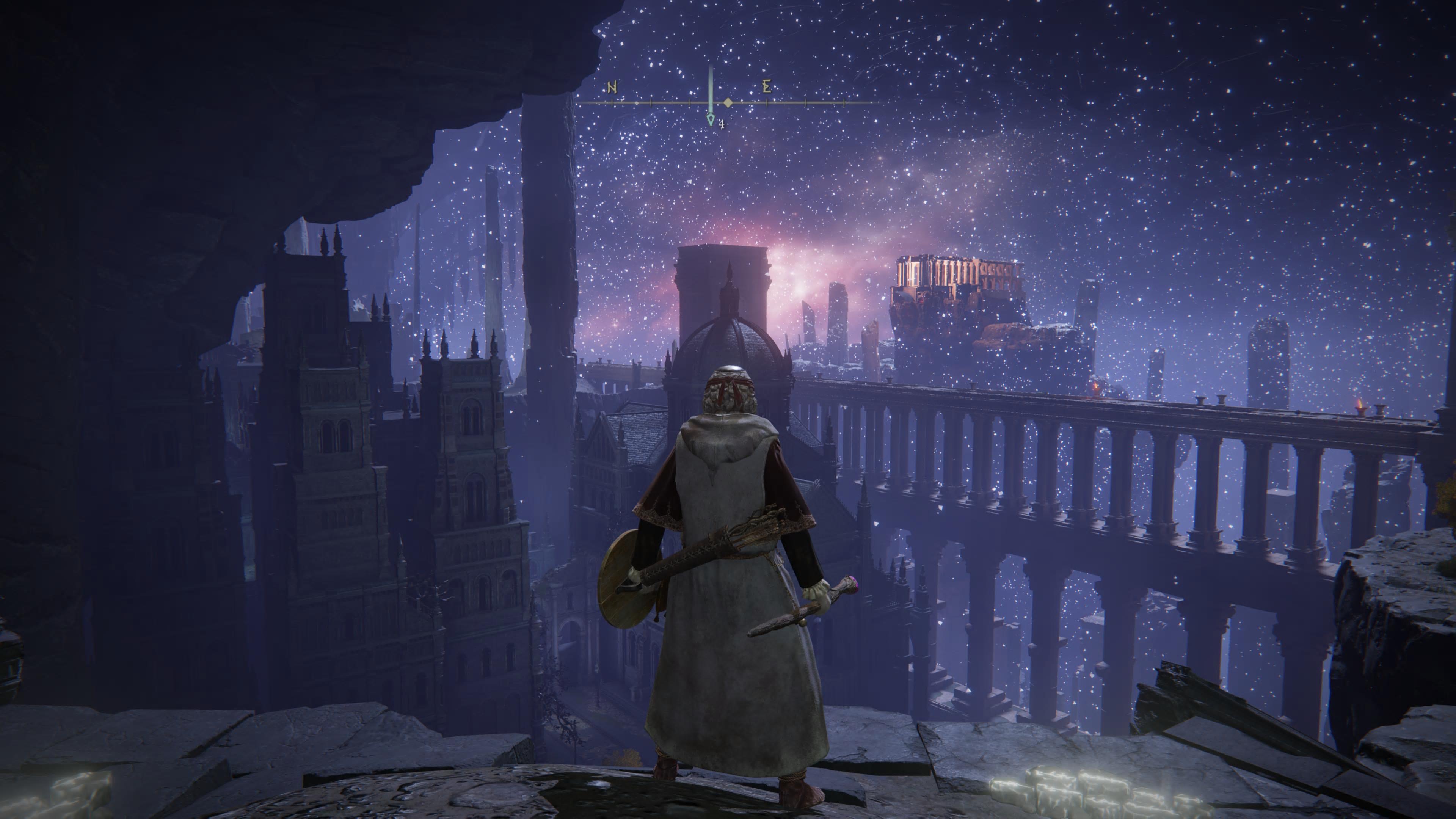
Elden Ring is a vast, seemingly endless experience, that delivers wonders and death at every turn. A hit in all spheres of the industry, loved by fans and journalists both, not just for its generous amount of content but for its ability to transport the player firmly into the Lands Between without loosening its grip for hours on end. From Software has delivered a game that lets the player go on the adventure that they wish without holding their hand, a rarity in video games nowadays; a risk that paid off.

From the moment I exited the catacombs at the start of the game and stepped out into Limgrave, I got the sense that I was in for quite the escapade. The vastness of the world didn't quite hit until about twenty hours into the game when I realized that the world kept expanding and that there were massive levels hidden underneath the standard map. Sometimes I took a random teleportation device and ended up clear on the other side of the game world. In any other game, I would have marked down the location of the teleporter and come back at a later time after I was done with whatever I was doing before, but in Elden Ring, there isn’t much of a forced incentive to keep you doing what you’re doing. You create your incentive and carve your experience in whichever way you choose.

The idea is to explore and keep going. I may have had it in my mind to fight a certain boss, but along the way, I’d find a catacomb or legendary tomb to explore that brought me to another area of the map. Elden Ring’s sense of discovery and ability to allow the player to lose themselves in its vast world is nearly unparalleled. They do this by severing the importance of a central narrative and instead ensuring that your choices, through the gameplay, are the primary story. Your discoveries and deeds are the impetus of Elden Ring, and any in-depth story would take away from that focus.

Though Elden Ring lets the player go on an adventure in any way they please, and though they give the player many tools to pave the way for an easier experience (compared to other games in the genre), this is still a From Software game through and through, and each enemy can still kill you with a few hits—even late in the game with a highly leveled character. This is not a game for everyone and should be researched before purchasing.


The primary difficulty differentiator between Elden Ring and every other From Software are the options given to the player at any given time, ensuring they get stuck less frequently. Instead of being beaten by the same few bosses over and over and unsure of what to do, Elden Ring allows the player to move on to something else until they are ready for that encounter. Pair that with spirit ashes and the game becomes manageable. If you are stuck on a boss and don’t necessarily care about beating them by yourself, you can always summon a friend to help, making the game far less challenging.

The sheer amount of content is staggering. From the vast open plains of Limgrave, to the mystical Liurnia of the Lakes, each area in Elden Ring is well fleshed out and holds many secrets. It is rare to be unrewarded when dropping into a secret hole or tip-toeing around a thin ledge. From Software knows its audience and appropriately ensures a payoff for them when taking an explorative risk, no matter how large or how small. The reward, however, is not simply the item or weapon that you discover, but the sensation of the discovery itself. Elden Ring consistently delivers this feeling through its entire runtime, an impressive feat by the development team. If Breath of the Wild was the king of this before, it is no longer.

The combat feels a bit dated, but it works well enough to feel satisfying when you stun and land a critical blow. Considering Sekiro had pushed the combat mechanics of From Software’s games forward, it was interesting to see them revert to the old Dark Souls formula. Though not the same, the game has the DNA of the slower moving From Software games (as opposed to Bloodborne and Sekiro). Some nice additions are the Ashes of War, which let you attach certain abilities to different weapons, as well the jump attack, which does heavy stagger damage to an opponent. These come in helpful for melee builds, so as a magic user, I didn't have a ton of use for them for most of the game.


Though the movement feels a bit slow at times, having your faithful steed-thing Torrent to bring you around the open world is a blessing. Combat on the horse doesn't feel fantastic when using melee, so I always resorted to switching to my staff. Unfortunately, I would always have to position my horse so it was facing forward or sideways (no backward spell casting for you!) while I cast, so it frequently felt uncomfortable, though not quite as bad as melee. Some of the fights on horseback were exhilarating though. Seeing a sword swipe miss me by inches would have my heart pounding as I pressed the sprint button to get to safety and reassess.

In addition to some mixed feelings about the combat, I felt similarly about the visuals. At some points, I came across sweeping vistas that looked like expressionist landscapes. Not quite clearly defined, but beautiful and eerie, as intended, and the developer had purposefully created a world that was meant to reflect its uncertainty in its messy, yet clearly defined art style. But then I would get closer to objects and NPCs and realize that some of them looked awful. It was like seeing a stunning painting, and then getting closer and realizing it only looked good from afar. Patches, our favorite trickster, looks like his character model could easily have been found in an early PS3/360 game. That’s not to say the whole game looks awful, but the juxtaposition between beauty and hideousness was quite jarring. Considering the Demon’s Souls remake was a stunning achievement, I had hoped that Elden Ring would follow suit in some aspect, but unfortunately, it doesn't measure up.


And all this would be fine and well if the game ran as well or better than Demon’s Souls on PS5, but it doesn’t. I ran the native PS5 version of Elden Ring which frequently stuttered and dropped frame rates. A big no-no for a game that requires split-second input. I am aware that Demon’s Souls is a PS5 exclusive remake and a smaller game than Elden Ring’s cross-generation/multiplatform vast open world. But considering I just played the visually stunning Horizon Forbidden West, which is also open world and cross-gen, I don't consider that an excuse. A game should run well on each platform that it’s released on.

In addition to the many frame rate dips, I ran into many bugs. Sometimes the game would ignore my input to heal, causing my death. Other times the game would glitch even after I had escaped a pit of scarlet rot, and instead of removing the rot, it would only increase the counter. I would become inflicted with a poison-like effect and die. This was earlier in the game when I was just trying to have fun exploring and didn't have the means to rid myself of the ailment. This rot (and also poison) buildup glitch happened many times throughout the game, including against bosses. In most games with simple checkpoint systems and no chance of currency loss, this would barely be a problem. This, however, is a From Software game where all the enemies respawn with every death and you have to make it back to where you last died to get your runes (currency) before you die again and lose them all.

And oh god, the platforming—Elden Ring has some of the worst platforming I've ever encountered. I can't count the number of times I became anxious when realizing I had to do a platforming segment. Not because I was nervous that I wasn't skilled enough, but because I didn't trust the game’s mechanics. After a while, when I found a dungeon that required platforming, I would leave without even attempting it.

One of the things Elden Ring’s best traits is its enemy variety. This includes not only the many smaller mobs you face but also the ridiculous amount of big baddies that you encounter throughout the massive adventure. From Software littered the map with bosses to the point where you’ll find one almost everywhere you go. Again, impressive. Some of them are reused at different points in the game, but for the most part, their reuse is spread out and isn't a cause for stagnation. There’s enough content here to feed lovers of boss battles from the first moment to the very last. Figuring out how to best the bosses in Elden Ring is one of the game’s highlights and something that it exceeds in, and the variety allows the player a fresh combat puzzle on each new encounter. Most of these bosses are challenging and unique, but not impossible. Most.

Toward the end of the game, I ran into a bit of a hurdle when I faced off against the boss Malenia. As I watched Melania, Blade of Miquella path around my character’s dead body chanting “I am Melenia, Blade of Miquella” for the fortieth time, I began to question my life choices, or at the least, my Elden Ring character build. As soon as I changed my character build, I was able to beat her within a few tries. The boss was poorly balanced for some builds and it was disappointing that I felt the need to change my entire character around to feel like I had a chance. In addition to Malenia, some of the enemies—both bosses and standard—attack as if you have more movement speed than you’re allowed.

Nothing in the game caused me as much trouble as Malenia, that is, besides the game’s camera. Some of the larger enemies make the camera go a bit wonky, never mind larger enemies in smaller rooms. Some of the quick-moving enemies would jerk the locked-on camera around, disorienting me. The camera led to much frustration and many unfair deaths. An issue I’ve had with every From Software game I’ve played. Unfortunately, it has yet to be addressed.

Elden Ring makes the final two areas separate from the open-world which makes for a very high difficulty spike. In the open-world segments, you regain some healing items for every group of enemies you kill and you’re also able to access your steed, Torrent. But in these last two areas, you find yourself with neither of these boons and find that the enemies are quite vicious and quick. In these last two areas, it sometimes felt as if all my progress had gone out the window.


That’s not to say most of the game is like that, just the end. Most of Elden Ring feels good when it comes to balancing (with a few outliers). Finding and upgrading a weapon or spirit ash you like has its intended effect of making you feel stronger, and finding a new, legendary spell makes you feel like a powerful sorcerer. There are so many weapons, ashes of war, sorceries, and sets of armor to try out that it’s worth checking every nook and cranny for whatever may be hidden there.

I mentioned earlier that to offer the player freedom, the central narrative takes a backseat. If you want the narrative, you have to search for it, take down notes, and pay very close attention. Unfortunately, the game is so massive and the hints so subtle at times, that I failed to make connections between characters and significant events. That’s not to say the lore isn't well fleshed out, it certainly is. I enjoyed my time reading the history of Elden Ring’s world on the wiki, but when it came to delivering an engrossing and entrancing storyline within the game, Elden Ring failed miserably for me. I watched three of the game’s multiple endings, and yet had barely any idea of what was happening in two of them. There's not much emphasis on what information is important and what isn't regarding the story, and most of the NPC characters felt flat and uninspired, so I found it difficult to invest emotionally. It didn’t help that many of the characters' names started with a G, R, or M (thanks to George R.R. Martin being cheeky). A character or item description may passively mention a character of relevance twenty hours of gameplay prior—which could equate to a few weeks in real-time for me—to my encounter with them, and I was expected to retain that information and piece it all together. I expected this, however, as this is how From Software games work, but I didn’t enjoy it. The storytelling is not for everyone, but there is a story there if you’re willing to do a bit of digging both in the game and on the Internet.

If Demon’s Souls remake has the best visuals of a From Software game, Sekiro the most fine-tuned combat, Bloodborne the best atmosphere, and if Dark Souls is the game that put the genre on the map, where does that leave Elden Ring? Well, it’s the game with the greatest volume of content, the grandest sense of freedom, the most massive scale, the best feeling of discovery, and the most immersive of them all, and it is quite possibly the best game from the studio.


Elden Ring is a great game. I will admit I was finished once I watched the credits roll—despite its incredible replay value—but my time with the game was worthwhile. I’d gladly recommend it to someone looking for a challenge, a sense of adventure without the need for a strong central narrative, and a yearning to feel like you’re uncovering something new wherever you go. Elden Ring lands many of the things that From Software intended it to do and the things that it doesn't don't ruin the overall experience, even if they do tarnish them a bit. The game’s flaws seem to melt away when you burrow into its depths. It’s easy to get lost in this game for over a hundred hours, so make sure you have some snacks and a notebook handy. You may have a lot of late nights with this one.

The Math

Objective Assessment: 9/10

Bonus: +1 for its best-in-class sense of discovery and adventure. +1 for massive scale. +1 for endless options and character builds.

Penalties: -1 for not connecting with the story. -1 for end-game balancing. -1 for poor optimization. -1 for the camera/some mechanics.

Nerd Coefficient: 8/10

Posted by: Joe DelFranco - Fiction writer and lover of most things video games. On most days you can find him writing at his favorite spot in the little state of Rhode Island.

Wednesday, March 30, 2022

Review [Video Game]: God of War by Santa Monica Studio

Be Better.


How do you craft a primary combat mechanic that remains as enjoyable after thirty hours of gameplay as it did after its first use? Ask Santa Monica Studio. How do you ensure that every side quest is weaved into the overarching plot, ensuring nothing feels superfluous or overstays its welcome? Ask Santa Monica Studio. How does one create a narrative that engages the player over its entire runtime, rarely ever skipping a beat? Sony’s Santa Monica Studio has the answer. How do you masterfully employ a single shot camera technique in a video game without having past games to reference? Again, Santa Monica Studio can tell you how. How do you take a broken god and help him overcome his generational trauma without ever making him break character? I think you know where I’m going with this.


God of War
(2018) elevates the franchise that began in 2005 by rebooting everything we knew about the old games and transitioning to adapt to the ever-evolving industry. The gameplay is one of the biggest deviations from the original series of games. The camera has switched from a fixed camera that changed with every encounter to a third-person single-shot camera that never leaves our hero (outside of cutscenes). This has made the game more intimate. Boss fights like the massive scale Cronos showdown in God of War III are a thing of the past, as the camera never zooms out during gameplay to show such a scale. That being said, there are some massive beasts and bosses to fight in God of War, and the new camera makes them feel all the more dangerous and exciting. The spectacle isn’t abandoned, but some of it is sacrificed for the sake of a more grounded experience. And it exceeds expectations.

The primary combat mechanic sees the player use Kratos’ Leviathan axe to dispatch foes. There are light axe swings, which are quick but do less damage. There are heavy attacks, which are slower but deal more damage. And then there's the axe throw, the most enjoyable mechanic in the game. The player can aim Kratos’ axe and send it flying at enemies, then recall it mid-flight to continue to use it in combination with other moves. Imbued with ice, the Leviathan axe can freeze foes as well. If Kratos charges his axe throw he can bury it into a foe, freezing them for a short time while he follows up with his fists or turns his attention toward another enemy. Throughout the game, new abilities are unlocked along with runic attacks that keep the gameplay fresh and the combos exhilarating.

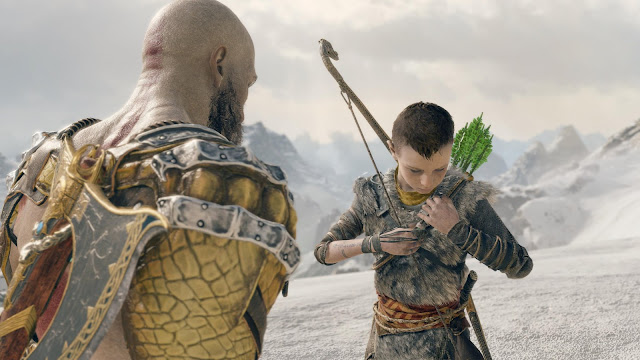
To add a layer of depth to the combat, Kratos’ son, Atreus, assists with his trusty bow. This mechanic is controlled by the player and allows for more strategy within each battle. Do you use Atreus’ shock arrows to do more damage to a group, or do you use his light arrows to stun one enemy and set them up for an instant finisher? Atreus can also summon ethereal beasts with his bow that take on the abilities of whichever bow type (shock or light) you have equipped. The game mechanics are seamless and enjoyable, even when the limits of player skill are tested. God of War bests its contemporaries in the gameplay space, this includes the famed FromSoft games.

The modified combat is a beautiful partner to the new camera. During gameplay, it follows Kratos closely, but outside, it’s a seamless single shot. There are no “cut-to” scenes in God of War which make the game all the more immersive, bringing every event closer to the player which creates no jarring transitions that we find in traditional cutscenes (which are necessary for scenes happening in other locations). To avoid the common camera, the game sticks with our main protagonists throughout the entire journey and it’s something special to see it employed so well à la 1917. It was a huge risk for Santa Monica Studio, but boy did it pay off.


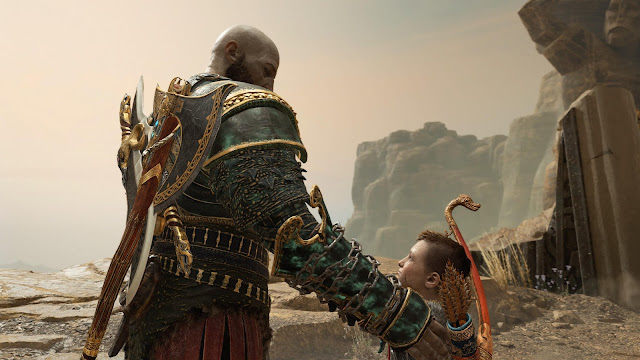
Settled and hidden in the Norse wilds, Kratos and Atreus have been tasked by the late Faye (wife and mother to our protagonists) to spread her ashes upon the highest mountain in all the realms. What proceeds is an emotional journey that spans many human issues, but at its core, never strays from the plot; the growth between a father and son. God of War’s laser focus on its themes intertwines into every aspect of the game, making every side quest and errand feel like a cohesive whole like I would have missed out on something important if I’d have skipped it. This is deftly done by employing smooth facial animations and natural dialogue between Kratos, Atreus, and Mimir, not to mention the occasional appearances of the Witch in the Woods, Brokk, and Sindri. Each character’s voice actors do a fantastic job of making these characters feel unique and lifelike. The performances cannot be overstated. The slightest shift in Kratos’ demeanor is monumental and praiseworthy, sometimes raising the hair on my arms or bringing a tear to my eye.


Kratos, abandoned by his father at birth, and later betrayed by said father employing a massive sword through the chest, doesn't quite have the best paternal figure to look up to when raising his son. The only thing he knows is that he won’t do to his son what his father did to him, but other than that, parenthood is a frightening unknown that he’s left to his wife, Faye, for most of Atreus’ life. Kratos would sooner kill gods than show vulnerability. Raised as a Spartan, Kratos was raised to know only fury, combat, chaos, and bloodlust but throughout God of War, we see him issue restraint, to be better than he was. To only use combat when necessary. His organic growth is perfectly paced and sprinkled throughout the narrative.

God of War’s pacing is yet another massive praise I have for Cory Barlog and Santa Monica Studio. In an open/hub world, it can be difficult to maintain a steady pace due to all the distractions a game throws at you, but this game sidesteps this problem. Main story missions will cut off side quests when urgency is needed to follow the path of the quest, despite being able to traverse the world.

Traversal is carried out in three ways; by foot, by boat, and through the Mystic Gateways (God of War’s fast travel method). Dialogue is written for all three of these traversal methods, especially via boat and gateways. Mimir fills these gaps in exciting gameplay with lore, keeping the player engaged and invested in the world. If the player exits the boat before Mimir is done telling a story, he simply resumes it the next time you jump in the boat with a “Where were we?” Mystic Gateways bring our protagonists across the map in a fraction of the time. To avoid putting the player through a loading screen, Sony Santa Monica takes our heroes through the roots of Yggdrasil and has Mimir tell them a tale. This fast travel area is a brilliant cover-up that distracts the player while the level loads. In doing this, Sony Santa Monica essentially eliminates load times throughout the games, with the player only ever having to look at a loading screen upon boot up and when reloading after a death.

While on foot, combat is accompanied by puzzles that range from timed axe throw sequences to finding hidden runes to unlock chests. The puzzles add a nice change of gameplay that never frustrates, but sometimes take a few moments to figure out leading to fun aha! moments. All of the written lore is also discovered on foot. Since Atreus is the only one capable of reading the runes, Kratos tasks him with keeping the journal, his youthful snark evident in the words. Jotnar shrines, lore markers, and scrolls are the main forms of lore delivery throughout the realms, unlocking some of these will prompt more stories from Mimir!

What would a God of War game be without intense, frenetic boss fights? Well, this entry has you covered. Each boss is unique and engaging, from the Stranger to the Valkyries, God of War never lets up. The Valkyries are optional bosses but are the most challenging in the game. Beating them all unlocks the ability to fight the queen Valkyrie, Sigrún, and is she a doozy. One of the most challenging fights I’ve experienced in a game, so make sure you bring your best armor. To upgrade gear in the end game, the player must travel to Niflheim and Muspelheim to have a chance against their toughest foes. Muspehlheim offers combat challenges issued by Surtr, while Niflheim offers a rogue-lite-esque timed challenge, but both realms offer more world lore revelations and welcome distractions from the main quest.

In addition to the masterful character animations, each realm is carefully crafted and oozes beauty and history. Alfheim is a sight to behold, the land of the elves is just as mystical and entrancing as the elves themselves. Helheim’s haunted frost can be felt upon entering its gates, with Hræsvelg looming ever so dauntingly in the background. The main gameplay area, Midgard, is a gorgeous place to explore, with The Lake of the Nine an excellent anchor for the game’s hub world. Years after its release, God of War is still one of the best-looking games thanks to the vision of its art team.

Toward the beginning of God of War, there is a moment where Atreus is tasked with shooting a deer. In his haste, he misses, frustrating Kratos and causing some tension between them. Atreus immediately apologizes, to which Kratos responds; “Do not be sorry, be better.” This game takes this mantra and expands on it, from Kratos’ personal growth to the abandonment of misogynistic tropes employed in the earlier entries. God of War doesn't apologize for its past. It accepts it and uses it to change both the franchise and its main character in a way that benefits the series, the player, and storytelling in the game industry as a whole.


It is rare to see a game like God of War in today’s video game industry: a micro-transaction and DLC free single-player narrative that doesn't overstay its welcome with superfluous padding. Four years ago, when I played God of War for the first time, I remember thinking that I wished more games were like it. Four years later that feeling remains. God of War isn’t just a phenomenal game. It’s a blueprint for the industry, a benchmark that developers have, and will look to embrace in the future in some aspect or another, and that’s quite an incredible thing to experience.

The Math

Objective Assessment: 10/10

Bonus: +1 for some of the best cinematic, engrossing boss fights. +1 for seamless use of single shot camera. +1 for excellent pacing. +1 for natural character development.

Penalties: If anything, I would say that the game could use more basic enemy types, but it never hindered my enjoyment of the game and was only ever an afterthought.

Nerd Coefficient: 10/10

Posted by: Joe DelFranco - Fiction writer and lover of most things video games. On most days you can find him writing at his favorite spot in the little state of Rhode Island.