Showing posts with label PlayStation. Show all posts

Thursday, September 26, 2024

Review [Video Game]: Astro Bot by Team Asobi

A beautifully-written love letter to fans of 3D platformers and of the PlayStation legacy

While anticipation for Astro Bot flew under the radar following its announcement, its reception has soared. Team Asobi may be new to the scene (originally a subsidiary of the now-defunct Japan Studio), spinning off in 2021 to become a standalone team. But from the release of their three Astro Bot titles, you would think they've been at this forever. As the first official Astro Bot for the core console (Astro Bot Rescue Mission being a VR title, Astro’s Playroom; a free download for PS5 to show off the Dualsense controller), Team Asobi has created an indelible game that excites and delights. As someone who usually gets bored halfway through platforming games, I found Astro Bot struck the perfect balance. Let’s get into it.

The opening scene sees the adorable little Astro and crew traversing the cosmos, partying in their PlayStation 5-shaped spaceship when they are waylaid by a fiendish green alien in a UFO. The alien pries open the PlayStation 5 spaceship, steals the CPU, and spreads the rest of the components and fellow bots across multiple planets. The spaceship crash lands on a desert planet where the player is given control. This cutscene is succinct, sharp, and adorable. This can be said for the rest of the game as well. While there is a story, Astro Bot doesn't weigh you down with expository nonsense for longer than necessary. What little is there, cooky or not, makes sense within the context of the story they’re trying to tell.

Astro Bot
is a treat for multiple senses. At first, Team Asobi treats your eyes and ears to the immaculate visuals and fantastic audio, then the haptic feedback hits and the sense of touch is activated. Anyone who played Astro’s Playroom knows what I’m talking about, but for those who don’t, Team Asobi are masters of the Dualsense controller’s haptics, making the game not only visual and auditory but tactile as well. Raindrops, clanking metal, tiny footsteps on glass, snow crunching underfoot, jumping off of a diving board into a pool, and so many other sensations are meticulously crafted and implemented into the game to add a third dimension to gameplay. The game feels satisfying. While the promise of the Dualsense has gone mostly underutilized throughout this generation, Astro Bot is the perfect example of what can be done with the tech, and how it elevates an already engrossing experience.

But let's get back to the visuals. Beautiful, simple, crisp. Astro Bot looks amazing on the PlayStation 5 from boot up and is maintained throughout. The game has a Pixar-like quality, and it is easily one of the best-looking games on the PS5. This extends to the visual effects as well. Water, snow, textures, and reflections all look fantastic. This is in no small part aided by the art direction and level design. From some of the more vibrant, cheery levels to the darker, more ominous ones, Astro Bot shines in the visuals department. For instance, the Creamy Canyon level is based on confections. The pastel-colored level reminds me of Easter but with ice cream sprinkles that can be kicked around (and felt with the controller). Other levels are more vibrantly saturated but are nonetheless visually balanced.

The sound design is fantastic. The soundtrack and sound effects both make this game pop. The sound is implemented into the level design, assisting players in finding hidden bots throughout the level (you can usually hear them struggling somewhere nearby (and yes, it’s adorable)) and in helping with the timing of obstacles. The music is easy to vibe to and fits whatever level it's in. But my favorite songs were the mash-ups with the PlayStation classic levels, which I will allow you to discover for yourself. I wouldn't put the music on the level of a
Mario game, but it stands on its own. Astro’s personal sound effects were adorable and didn't grate on my nerves like a certain Italian plumber I know. His sound effects are robotic, charming, cute, and quirky, just like Astro himself.

But what does Astro have to do? What is the player tasked with? Well, you have two tasks; rescue your fellow bots, and collect the missing pieces of the spaceship. You accomplish this via 3D platforming: jumping, hovering, punching, grabbing, and through the use of special items. The levels are straightforward and show you what you need to do. Most levels have seven bots to rescue and three puzzle pieces to find (some special levels have fewer). A few levels have some cleverly placed portals to secret levels in another galaxy, so be on the lookout. It’s easy to tell when you’ve missed a bot or puzzle piece because you’ll be notified on the UI which bot you’ve gathered, so you can always go back and recollect. If you’re having trouble, each level (after you’ve completed it at least once) allows you to pay two hundred coins to unlock a little bird that will follow you around and sniff out missing bots and puzzle pieces (though it isn't necessary in most cases). Astro Bot’s gameplay is inspired by the greats of the genre, especially the 3D Mario games, and it’s all the better for it.

One of my favorite aspects of Astro Bot is the pacing. Each level is short, mostly around ten minutes, some are two minutes, but none much longer than ten (not counting the challenge levels). This makes the game easily digestible. With every AAA game being sixty to one hundred hours nowadays, it's difficult to feel like you’ve accomplished something after ten minutes of game time. Astro Bot manages to do so repeatedly, all the while ensuring the game feels fresh. Every vista feels new, and every level creates new challenges and allows the player to feel like they're making progress in a short time. Not to mention, they don't overuse the supplemental items in the game. For instance, there is a robot bulldog that boosts Astro forward with a lot of force, damaging anything (almost anything) in your path. It’s used in a few levels here and there, but not to the point of exhaustion. And that’s the same with everything else. On some levels, Team Asobi uses a mechanic once and never again, which is refreshing. In addition, boss battles aren't repeated over and over. They use unique mechanics, despite being rather forgiving (Astro usually dies in one hit; versus bosses, he gets three). Each boss is one and done, and it’s a wonderful thing. I have to reiterate how much I loved the pacing: Astro Bot’s mechanics never overstay their welcome.

I mentioned the challenge levels a bit earlier, and there are quite a few. Some do put you to the test (curse you, rubber ducky lava level!), but for the most part, the game as a whole is quite easy. Exceptionally enjoyable, but easy. Now, I know difficulty is relative, but this is my personal experience, and I feel like the game could benefit from just a bit more challenge outside of the challenge levels (of which I would have gladly accepted more). Not only this, but I feel like it could have been enjoyable to hide some of the bots a bit better (some are brilliantly hidden, but most are easy to spot). The aforementioned rubber ducky got a bit frustrating at times because of its inconsistency when aiming, but other than that, I can’t think of anything else negative to say about the game. It’s that good.

One of the most special things about Astro Bot is that it’s a love letter to PlayStation fans, and to a larger extent, people who have played games that have existed on their platforms. Fans of The Last of Us, Ratchet and Clank, Horizon, and Parappa the Rappa will find Easter eggs here, but so too will fans of Tomb Raider, Resident Evil, and Yakuza. PlayStation has been around for over thirty years (and goodness knows what kind of mischief they’ve been up to recently), and the platform has been home to so many first and third-party games. Astro Bot shines a light on some of those IPs and does so in a humorous, heartwarming way. Also, this is probably the only place you'll see any attention given to the Bloodborne IP from a Sony studio (sorry, Bloodborne fans).

From the lovingly crafted levels to the intricate haptic feedback implementation, Astro Bot is an impressive title that, despite its ease, goes on to compete with the heavyweights of the industry. If you like inventive 3D platformers, if you like your non-speaking protagonist to endear and charm you, or if you like to run around with a robot-chicken-rocket strapped to your back propelling you upward to new heights, this is the game for you. If you are a fan of gaming, especially PlayStation, then this is a love letter for you folks. If you have kids, I highly recommend it. If you like your video games to make you smile in childlike glee, go pick up Astro Bot now.


The Math

Objective Assessment: 9.5/10.

Bonus: +.5 for perfect pacing. +.5 for art direction. +.5 for tactile feedback. +.5 for endless charm.

Penalties: -1.5 for overall lack of challenge. -.5 for a few brief experimental levels that, while good, weren't as good as the rest.

Nerd Coefficient: 9.5/10.

Posted by: Joe DelFranco - Fiction writer and lover of most things video games. On most days you can find him writing at his favorite spot in the little state of Rhode Island.

Thursday, March 23, 2023

Review: The Last of Us (HBO)

 Good adaptation, great show.


Adaptation. A dirty word in the world of video game fandom. How many times have fans been promised a television show or movie that would faithfully depict their beloved intellectual property, only to miss the entire soul of the game they love and bring some shoddy representation to a different medium? Book fans know the feeling and have been dealing with the struggle for a while, knowing how infrequently justice is done in depicting the source material. For video games, that struggle is even worse. A few recent exceptions like Cyberpunk: Edgerunners and Arcane: League of Legends are wonderful additions to the small list of great video game adaptations, and the legendary Pokemon anime is still going strong. But what of successful live-action adaptations? Well, HBO’s The Last of Us may be the best one yet.

As someone who still highly reveres the original The Last of Us title for its engaging, laser-focused narrative and memorable characters, I was instantly interested in the show. I’ve played every iteration of the game multiple times; The Last of Us (PS3), The Last of Us Remastered (PS4), and The Last of Us Part I (PS5). Normally, I would immediately dismiss the relevance of any video game adaptation due to the history that precedes them, but the more information I gleaned, the more interested I became. The perfect storm of Craig Mazin, Neil Druckmann, Playstation, HBO, and a wonderful cast of well-known actors was enough to give a fan hope. Not because The Last of Us needed an adaptation, but because it would be nice to see this world and these characters be brought to a new audience. The Last of Us is a highly cinematic franchise with over five hundred Game of the Year awards (the most for any modern franchise), so it wasn't too difficult to see how this could transition to a passive form of entertainment.

The Last of Us season sne does a lot of things right. The first two episodes are quite similar to the game's opening sequences. The first scene of the first epsiode portrays multiple men on a talk show discussing a potential fungus that could end the world if, god forbid, there was an increase in global temperature. An eerie silence washes over these men as they contemplate the possibilities of such abject destruction of modern society. What seemed a mere talking point becomes a feasible idea, one that makes the viewer and talk show participants pause. A harrowing moment to open the show’s first season, and a fantastic deviation from the source material.

To pull the player into Sarah and Joel’s relationship, they expand Sarah’s role and flesh out her story a bit. This helps create the initial bond needed to pack the show’s first punch. And it is done incredibly well. Considering The Last of Us has one of the best openings in a video game, it was a breath of fresh air to see it carefully recreated for the show. There’s an underlying sense of tension that sticks with the viewer throughout the entire episode, even in the calm moments. An impressive feat, and a reminder to the viewer that no one is ever safe in the post-apocalyptic world of The Last of Us. Admittedly, there was a ridiculous moment when an infected popped up from the ground in a silly and uncharacteristic way. A momentary break in immersion. However, before the credits rolled on the first episode and Depeche Mode’s Never Let Me Down Again plays to the view of the coming storm, I felt satisfied. Not only was I pleased with the deviations that did right by the source material, but by the show’s faithfulness to it, and to the overall quality. Joel and Tess received their cargo in the form of a fourteen-year-old girl named Ellie, and I was excited to see the next episode.

This feeling of satisfaction continues into the second episode. Again, the introduction of the episode diverges from the show, where we are introduced to a mycology professor (played by the wonderful Christine Hakim) in Jakarta, where the beginning of the outbreak occurred. And just like episode one, this sequence left me with chills. This is also the first episode where the viewer encounters Clickers (the most memorable enemy from the game) for the first time. All I can say is bravo. The costume work, the behaviors, and the sound effects (which are used in the game) work brilliantly and inspire a sense of fear and panic. Not to forget, the underlying tension from the first episode remains here. There’s a heightened fear of being in control of the character who can instantly die from a Clicker. Though a passive media, the show did the confrontation in the museum justice.

As Joel, Tess, and Ellie make their way through the ruins of what was once Boston, the characters unfold before the viewer; their intentions, their mannerisms, and their desire to be doing anything else. The ending of the episode changes from the main characters being surrounded by FEDRA soldiers and instead having a horde of infected come in to finish the job. In doing this, they introduce tendrils; a way for the Cordyceps fungus-infected individuals to communicate over long distances. By killing an infected near a tendril, the protagonists alarm a massive host of infected enemies to their location. There is an odd, rather uncharacteristic, invasive, and bizarre moment with Tess and an infected near the end of the episode that confused me. The scene was certainly horrifying, but also lore-breaking. The overall episode was terrific despite minor missteps and kept me excited for episode three.

Titled “Long, Long Time”, episode three is an interesting case. While the game focuses on Joel, Ellie, and others they meet along the way, the show deviates by taking time away from them to look in on other characters. Episode three is the largest departure from the source material. Instead of having the character Bill reluctantly assist Joel and Ellie on their journey, Craig Mazin and Neil Druckmann decided to take Bill’s story in another direction. In what is one of the finest hours of television I’ve seen, Nick Offerman and Murray Bartlett put on a beautiful performance of a gay couple surviving in the apocalypse. It’s strong, poignant, and reminiscent of the opening of Pixar’s Up. A tale of love, struggle, and acceptance. My issue then is that has nothing to do with what was going on in the previous two episodes. Episode three puts the plot at a standstill for over an hour. And while they eventually tie everything together, those ties aren't strong enough to justify an entire episode away from our protagonists. As a standalone episode, Long, Long Time may bring you to the verge of tears and consider your mortality, but in the overarching view, it’s just a beautiful bump on the road back to our protagonists.

With Joel and Ellie back in the driver’s seat, the show’s plot moves forward with episode four. This episode sees the protagonists sneaking their way through a rebel-infested Kansas City. A few important moments happen in this episode between Joel and Ellie, like the beginning moments of trust budding between them. This episode uses some of its time to show a departure from in-game Joel to Pedro Pascal’s version; he’s growing old and showing vulnerability. He can't hear as well and needs Ellie’s help to escape a hairy situation. He accepts how useful she can be with a gun and shows her how to use one properly. A big moment in the game, though slightly underwhelming in the show. The primary issue with this episode, and episode five for that matter, is the focus on the character Kathleen (played by Melanie Lynskey). The rebel leader that had overthrown the Kansas City QZ has too much time in the limelight. Every time that part of the plot appeared, I simply wanted to get back the main characters. The character was not a convincing leader and I had difficulty sympathizing with her.

As I got to episode five, and more and more time was spent on this Kathleen character, I realized how much time the viewer missed with Henry and Sam (the two newcomers to the show). A lengthy part of the game is spent with these characters, getting to know them, observing their relationship with the brothers, and the friendship that grows between them and the main protagonists. Instead of simply having two brothers trying to survive the apocalypse, the show tries to force the viewer into a sense of sympathy by making the younger brother (Sam) deaf, and eventually revealing that he had Leukemia. It’s a weight that doesn't need to be there. Sam being deaf wasn't much of an issue, but it made it difficult—with the amount of time given—for the viewer to bond with his character. Instead of sympathizing with him as a character, we are merely sympathizing with him for his plight, which I think is much weaker than what is presented in the game. Had less time been spent on Kathleen’s story, I feel like it could have been fleshed out better. That said, Keivon Woodard and Lamar Johnson (Sam and Henry’s actors) put on a great performance. The penultimate scene of this episode puts on a bit more dramatic flair than is necessary and creates a bit of a deus ex machina that is only briefly mentioned in the previous episode. The final scene, however, is spot on.

After a traumatic ending to episode five, episode six sees Joel and his brother Tommy (Gabriel Luna) reunited. This episode again, shows a more vulnerable Joel, speeding up much of his character development to ensure a connection with the viewer. I found this to be one of the weaker moments in the episode. The memorable scene between Joel and Ellie, however, is handled beautifully. It’s well-acted and takes lines from the game, word for word. The final scene leaves a bit to be desired compared the intense escape for survival portrayed in the game, but it leaves the episode on a cliffhanger…

Which isn't continued until episode eight. But before that, there’s episode seven. Which, like episode three, puts the main plot on freeze. Entitled “Left Behind”, episode three is a flashback to when Ellie got attacked by an infected. The episode itself is well done and explores the relationship between Ellie and her best friend Riley, but where the game hovers back and forth between its main narrative and the flashback, the show is wholly focused on the past. Leaving the viewer hungry for more, then dangling the present story in front of them while they tell another is an interesting tactic. Doing it two times in a season that has only nine episodes is rather foolish.

Once we get back to the present, we meet a new character David (Scott Shepherd). A leader of a local settlement who has more to him than is initially revealed. David reveals to Ellie that he is kind, yet violent. That he wants to lead, and he wants her beside him. A man in his fifties, and he's trying to court a fourteen-year-old girl. The entire sequence is unsettling, and Bella Ramsey (Ellie) counters Shepherd’s David perfectly for an entrancing episode. Without a doubt one of the season’s best. A return to form from the first two episodes.

The finale of The Last of Us is, unfortunately, the shortest one. It’s packed full of action and successfully wraps up the story between Joel and Ellie, even if it feels rushed at times. There’s a specific moment in the show where the show writers bludgeon the viewer with their messaging. In the game, Joel’s progress is easily noted in his actions and his shift of tone. He doesn't have to say, “You saved me,” because you feel each action takes the characters to where they are. The show also makes a point of showing that Joel’s decision is more justified in saving Ellie. The bloodbath that occurs close to the end of the episode leaves the viewer with a more solid perspective on Joel and his willingness to kill for what he wants. When the final lines of the show are uttered, they pack less of a punch than they do in the game, but they’re still powerful. Nine episodes spent (well, seven really) building trust between these two characters, all to end on a massive lie. One that needs to be swallowed by Ellie. And both Pedro Pascal and Bella Ramsey finish strong.

Some of the deviations enhance the story of The Last of Us, like the beginnings of episodes one and two, as well as the intro to episode nine, which sees Ashley Johnson (Ellie’s voice actress in the games) play Ellie’s mother. Some deviations, like episode three, bring an interesting perspective that enhances the lore but also damages the pacing. Then there are the bad deviations, like the Kathleen storyline in episodes four and five. Despite all the changes, the core of The Last of Us is here. As an adaptation, it does a great, though imperfect, job of representing the characters I’ve loved so much over the last ten years. As a tv show itself, it's fantastic. One of my favorites in recent years. Craig Mazin and Neil Druckmann did a terrific job adapting this project to television. And though I would have liked to have seen more infected encounters throughout the season, the overall character arcs and performances were handled well. Whenever they announce a season two, I eagerly await not only the show itself but the fan response to it. If they do as well with season two as they did with one, viewers are in for quite the spectacle (and quite the debate as well). The Last of Us is never bad, and frequenelty great. It’s weaker than its video game counterpoint at times. In some cases, it outshines the game, and that’s something to be applauded.


The Math

Objective Assessment: 8/10

Bonus: +1 for some clever, lore-buffing deviations. +1 fantastic performances. +1 for creating an underlying sense of dread and tension. +1 for Clickers.

Penalties: -2 for trying to manufacture sympathy. -1 for two pace halting episodes. -1 for Kathleen storyline/character.

Nerd Coefficient: 8/10

Posted by: Joe DelFranco - Fiction writer and lover of most things video games. On most days you can find him writing at his favorite spot in the little state of Rhode Island.

Tuesday, August 16, 2022

Nanoreviews: The Ascent, Hitman Trilogy, Guardians of the Galaxy

 I'm generally suspicious of subscription services, but decided to give Xbox Gamepass Ultimate a try - and I'm happy to report that it's been great. Aside from Halo Infinite, I've only picked winners so far. Here are 3 games that I thoroughly enjoyed, though they are all quite different from one another. Noting that The Ascent is Xbox/PC exclusive, while Hitman and Guardians of the Galaxy are also available for PS4/PS5 users. 

The Ascent by Neon Giant (2021)

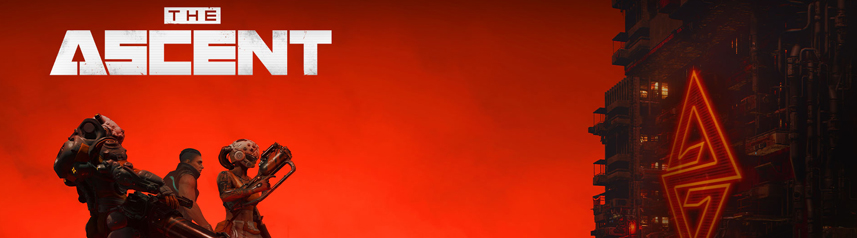
The Ascent is a stylish, isometric-view action game set in a rich cyberpunk world. It's big on mood, with bright neon colors and a killer soundtrack, but also a lot of fun to play. And it's quite challenging too, though never frustrating. Shows what a small team of dedicated developers with a clear vision can achieve. My only complaint is that they haven't added a New Game Plus feature yet. 

Score: 9/10. 

Hitman Trilogy by IO Interactive (2016-2021)

Hitman Trilogy collects volumes in the Square Enix series reboot. The results are...mostly but not uniformly good. The Hitman games are stealth, but each mission is a sandbox - with multiple, branding paths and a number of different ways to accomplish your goals. The missions in Hitman 1, though, are a bit bland and the solutions generally too easy to figure out. The games do improve - Hitman 2 is somewhat better and Hitman 3 is, well, a lot better. I'd go so far as to say it's the best stealth game I've played since Splinter Cell: Chaos Theory, back in the ancient days of 2005. 

Score(s): Hitman 1: 6/10, Hitman 2: 7/10, Hitman 3: 9/10. 


Guardians of the Galaxy by Eidos Montreal (2022)

I love the 2 Guardians films - along with Thor Ragnarok, they are far and away my favorite MCU films. Why? Really comes down to 3 things for me: mood, humor and the way the characters interact with each other. I'm happy to report that Guardians of the Galaxy, the game, captures all 3 in a fully original story (with some creative deviations from the films). At its heart, Guardians is a squad-based action-RPG where progress unlocks new powers and team-based combos. In that sense, it evokes the Mass Effect series, though the gameplay is quite different. Actually the gameplay is the weakest part of the game - its battles, too often, are overly long, repetitive button-mashing affairs. But what Guardians does well, it does exceptionally well. This is a narrative game, driven by plot and character development - and in that sense it's one of the best I've ever played. It really feels like an interactive movie, which captures the films' signature humor and features superb dialogue throughout. Story, which can often feel like an afterthought in games, takes center stage here - and packs a real emotional punch. 

Score: 8/10. 

Wednesday, March 30, 2022

Review [Video Game]: God of War by Santa Monica Studio

Be Better.


How do you craft a primary combat mechanic that remains as enjoyable after thirty hours of gameplay as it did after its first use? Ask Santa Monica Studio. How do you ensure that every side quest is weaved into the overarching plot, ensuring nothing feels superfluous or overstays its welcome? Ask Santa Monica Studio. How does one create a narrative that engages the player over its entire runtime, rarely ever skipping a beat? Sony’s Santa Monica Studio has the answer. How do you masterfully employ a single shot camera technique in a video game without having past games to reference? Again, Santa Monica Studio can tell you how. How do you take a broken god and help him overcome his generational trauma without ever making him break character? I think you know where I’m going with this.


God of War
(2018) elevates the franchise that began in 2005 by rebooting everything we knew about the old games and transitioning to adapt to the ever-evolving industry. The gameplay is one of the biggest deviations from the original series of games. The camera has switched from a fixed camera that changed with every encounter to a third-person single-shot camera that never leaves our hero (outside of cutscenes). This has made the game more intimate. Boss fights like the massive scale Cronos showdown in God of War III are a thing of the past, as the camera never zooms out during gameplay to show such a scale. That being said, there are some massive beasts and bosses to fight in God of War, and the new camera makes them feel all the more dangerous and exciting. The spectacle isn’t abandoned, but some of it is sacrificed for the sake of a more grounded experience. And it exceeds expectations.

The primary combat mechanic sees the player use Kratos’ Leviathan axe to dispatch foes. There are light axe swings, which are quick but do less damage. There are heavy attacks, which are slower but deal more damage. And then there's the axe throw, the most enjoyable mechanic in the game. The player can aim Kratos’ axe and send it flying at enemies, then recall it mid-flight to continue to use it in combination with other moves. Imbued with ice, the Leviathan axe can freeze foes as well. If Kratos charges his axe throw he can bury it into a foe, freezing them for a short time while he follows up with his fists or turns his attention toward another enemy. Throughout the game, new abilities are unlocked along with runic attacks that keep the gameplay fresh and the combos exhilarating.

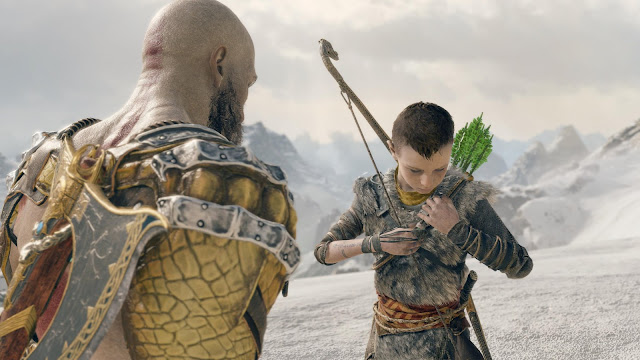
To add a layer of depth to the combat, Kratos’ son, Atreus, assists with his trusty bow. This mechanic is controlled by the player and allows for more strategy within each battle. Do you use Atreus’ shock arrows to do more damage to a group, or do you use his light arrows to stun one enemy and set them up for an instant finisher? Atreus can also summon ethereal beasts with his bow that take on the abilities of whichever bow type (shock or light) you have equipped. The game mechanics are seamless and enjoyable, even when the limits of player skill are tested. God of War bests its contemporaries in the gameplay space, this includes the famed FromSoft games.

The modified combat is a beautiful partner to the new camera. During gameplay, it follows Kratos closely, but outside, it’s a seamless single shot. There are no “cut-to” scenes in God of War which make the game all the more immersive, bringing every event closer to the player which creates no jarring transitions that we find in traditional cutscenes (which are necessary for scenes happening in other locations). To avoid the common camera, the game sticks with our main protagonists throughout the entire journey and it’s something special to see it employed so well à la 1917. It was a huge risk for Santa Monica Studio, but boy did it pay off.


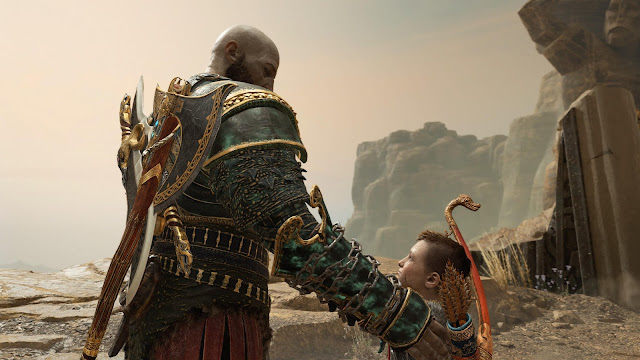
Settled and hidden in the Norse wilds, Kratos and Atreus have been tasked by the late Faye (wife and mother to our protagonists) to spread her ashes upon the highest mountain in all the realms. What proceeds is an emotional journey that spans many human issues, but at its core, never strays from the plot; the growth between a father and son. God of War’s laser focus on its themes intertwines into every aspect of the game, making every side quest and errand feel like a cohesive whole like I would have missed out on something important if I’d have skipped it. This is deftly done by employing smooth facial animations and natural dialogue between Kratos, Atreus, and Mimir, not to mention the occasional appearances of the Witch in the Woods, Brokk, and Sindri. Each character’s voice actors do a fantastic job of making these characters feel unique and lifelike. The performances cannot be overstated. The slightest shift in Kratos’ demeanor is monumental and praiseworthy, sometimes raising the hair on my arms or bringing a tear to my eye.


Kratos, abandoned by his father at birth, and later betrayed by said father employing a massive sword through the chest, doesn't quite have the best paternal figure to look up to when raising his son. The only thing he knows is that he won’t do to his son what his father did to him, but other than that, parenthood is a frightening unknown that he’s left to his wife, Faye, for most of Atreus’ life. Kratos would sooner kill gods than show vulnerability. Raised as a Spartan, Kratos was raised to know only fury, combat, chaos, and bloodlust but throughout God of War, we see him issue restraint, to be better than he was. To only use combat when necessary. His organic growth is perfectly paced and sprinkled throughout the narrative.

God of War’s pacing is yet another massive praise I have for Cory Barlog and Santa Monica Studio. In an open/hub world, it can be difficult to maintain a steady pace due to all the distractions a game throws at you, but this game sidesteps this problem. Main story missions will cut off side quests when urgency is needed to follow the path of the quest, despite being able to traverse the world.

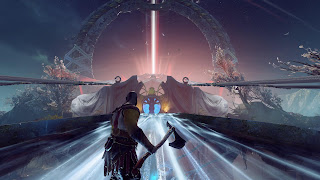
Traversal is carried out in three ways; by foot, by boat, and through the Mystic Gateways (God of War’s fast travel method). Dialogue is written for all three of these traversal methods, especially via boat and gateways. Mimir fills these gaps in exciting gameplay with lore, keeping the player engaged and invested in the world. If the player exits the boat before Mimir is done telling a story, he simply resumes it the next time you jump in the boat with a “Where were we?” Mystic Gateways bring our protagonists across the map in a fraction of the time. To avoid putting the player through a loading screen, Sony Santa Monica takes our heroes through the roots of Yggdrasil and has Mimir tell them a tale. This fast travel area is a brilliant cover-up that distracts the player while the level loads. In doing this, Sony Santa Monica essentially eliminates load times throughout the games, with the player only ever having to look at a loading screen upon boot up and when reloading after a death.

While on foot, combat is accompanied by puzzles that range from timed axe throw sequences to finding hidden runes to unlock chests. The puzzles add a nice change of gameplay that never frustrates, but sometimes take a few moments to figure out leading to fun aha! moments. All of the written lore is also discovered on foot. Since Atreus is the only one capable of reading the runes, Kratos tasks him with keeping the journal, his youthful snark evident in the words. Jotnar shrines, lore markers, and scrolls are the main forms of lore delivery throughout the realms, unlocking some of these will prompt more stories from Mimir!

What would a God of War game be without intense, frenetic boss fights? Well, this entry has you covered. Each boss is unique and engaging, from the Stranger to the Valkyries, God of War never lets up. The Valkyries are optional bosses but are the most challenging in the game. Beating them all unlocks the ability to fight the queen Valkyrie, Sigrún, and is she a doozy. One of the most challenging fights I’ve experienced in a game, so make sure you bring your best armor. To upgrade gear in the end game, the player must travel to Niflheim and Muspelheim to have a chance against their toughest foes. Muspehlheim offers combat challenges issued by Surtr, while Niflheim offers a rogue-lite-esque timed challenge, but both realms offer more world lore revelations and welcome distractions from the main quest.

In addition to the masterful character animations, each realm is carefully crafted and oozes beauty and history. Alfheim is a sight to behold, the land of the elves is just as mystical and entrancing as the elves themselves. Helheim’s haunted frost can be felt upon entering its gates, with Hræsvelg looming ever so dauntingly in the background. The main gameplay area, Midgard, is a gorgeous place to explore, with The Lake of the Nine an excellent anchor for the game’s hub world. Years after its release, God of War is still one of the best-looking games thanks to the vision of its art team.

Toward the beginning of God of War, there is a moment where Atreus is tasked with shooting a deer. In his haste, he misses, frustrating Kratos and causing some tension between them. Atreus immediately apologizes, to which Kratos responds; “Do not be sorry, be better.” This game takes this mantra and expands on it, from Kratos’ personal growth to the abandonment of misogynistic tropes employed in the earlier entries. God of War doesn't apologize for its past. It accepts it and uses it to change both the franchise and its main character in a way that benefits the series, the player, and storytelling in the game industry as a whole.


It is rare to see a game like God of War in today’s video game industry: a micro-transaction and DLC free single-player narrative that doesn't overstay its welcome with superfluous padding. Four years ago, when I played God of War for the first time, I remember thinking that I wished more games were like it. Four years later that feeling remains. God of War isn’t just a phenomenal game. It’s a blueprint for the industry, a benchmark that developers have, and will look to embrace in the future in some aspect or another, and that’s quite an incredible thing to experience.

The Math

Objective Assessment: 10/10

Bonus: +1 for some of the best cinematic, engrossing boss fights. +1 for seamless use of single shot camera. +1 for excellent pacing. +1 for natural character development.

Penalties: If anything, I would say that the game could use more basic enemy types, but it never hindered my enjoyment of the game and was only ever an afterthought.

Nerd Coefficient: 10/10

Posted by: Joe DelFranco - Fiction writer and lover of most things video games. On most days you can find him writing at his favorite spot in the little state of Rhode Island.


Wednesday, March 16, 2022

Microreview [Video Game]: Ratchet and Clank: Rift Apart by Insomniac Games

A new dimension for a new generation.


Armed with his trusted wrench and loaded to the teeth with crazy weaponry, Ratchet bursts onto the new generation of hardware in style. Hot on the heels of Insomniac Games’ recent release, Spider-Man: Miles Morales, the studio has put out yet another high-quality title in Ratchet and Clank: Rift Apart and this one is exclusive to current-gen hardware. Being the newest release in an almost two-decade-old franchise, Insomniac has achieved a delicate balance that brings new players into the fold and caters to longtime fans of the series. Marrying classic characters and gameplay elements with new faces and mechanics only possible on this generation of hardware makes Rift Apart feel fresh, yet familiar; a testament to Insomniac’s development prowess.

Insomniac’s meticulous level design in Rift Apart has near Pixar level quality that left me staring for moments on end, gawking at their graphical capabilities. The most impressive level was Blizar Prime. Once I jumped out of my ship, the vista before me was incredible: a spectrum of purples, light to dark, with destroyed pieces of planet scattered in the space around you, light reflecting off of any surface that would allow. The lighting effects and art style shone brightly and, in that instant, I realized that this was the best looking game with this style that I’d seen. And then it got better. With Rivet’s hammer, I smashed the Blizon Crystal before me and the entire level shifted to the same planet, but in a different dimension. What was once a ruined planet became whole, the level came to life. The somber purples of a destroyed Blizar Prime were replaced with a bright, vibrant planet. The transformation took place in less than a few seconds, a great example of the SSD’s speed.

Throughout Rift Apart, Insomniac takes advantage of the SSD, whether it’s Blizon Crystals, instant level shifts in boss battles, or dimensional rifts. These uses of the hardware are seamlessly incorporated and allow for greater immersion due to a lack of load times. This use of the SSD makes me excited for a potential Spider-Man multiverse shifting mechanic that they could employ in future titles. But the SSD isn't the only hardware that Insomniac takes advantage of. The overall power of the PS5 is used to great effect. The ray-traced reflections on every available surface make Rift Apart mesmerizing at times. The quality of the lighting dynamics in real-time gameplay is dazzling.

Even with all these technical qualities firing on all cylinders, the game keeps a steady frame rate. Switching between all the whacky guns and shifting between planets and dimensions flows with ease, making the overall experience smooth and enjoyable. Though I did encounter a few bugs, none of them was game-breaking (I had to test the game’s limits). For instance, on Blizar Prime, I repeatedly smashed the Blizar Crystal to see if it would affect the game. Sometimes my ship would disappear, sometimes my quest prompt would disappear when I did this. It was a simple fix though; I had to exit and reload the game (which doesn't take very long at all). There was a moment where I died and lost the ability to progress in a level because my prompt wouldn't load. Though it was momentarily frustrating, it had the same fix.


This wouldn't be a proper Ratchet review without discussing the weapons. There are a bunch of them (maybe too many?) and they're almost all great. Launching Mr. Fungi and listening to his silly commentary is chuckle provoking. The Topiary Sprinkler is a valuable tool that I employed in almost every battle. Having my enemies freeze in place and sprout grass all over allowed me to strategize with other weapons, or get in close for a more critical shot with my Pixelizer (which damages enemies and temporarily turns them into a pixelated version of themselves). The upgrade system is terrific, and one of the things I loved most about Ratchet and Clank: Tools of Destruction—my favorite game in the series. Each weapon can level up in two ways: through use and by spending in-game currency. Reaching level five with any weapon will transform its capability and make it even better. Using Raritanium can also tweak the weapon in many ways, minor and major. Seeing your weapons improve is one of the most enjoyable aspects of a Ratchet game, and Rift Apart is no slouch in this department. On subsequent play-throughs, you can even upgrade these weapons to their Omega version, making them even more powerful.

The characters who wield all these wacky weapons are well crafted. Rivet and KT-7461 add a great (and adorable) parallel to Ratchet and Clank in this multi-dimensional adventure. Rift Apart uses most of its time to focus on these two new characters, placing Ratchet in the backseat for a lot of the game. Rivet is affable, yet formidable, making the discovery of her backstory a treat. Though there were a few story beats in the game that felt rushed and a handful of touching moments that weren't given the appropriate spotlight, I felt like the game had solid pacing and an overall enjoyable story. Seeing parallels of many of the series’ staple characters was a joy (British Nefarious anyone?) and I look forward to seeing some of them again in future titles.

By assigning certain levels to Ratchet and others to Rivet, Insomniac allowed for a balanced focus for all characters. Though I felt Rivet had more attention, it was necessary to flesh out the character and I never felt overwhelmed by one or the other. In many games and television shows that alter between different character’s perspectives, I find myself drawn to one character’s storyline more than another, but this isn't the case in Rift Apart. And don’t worry, by ensuring both characters share the same bank account, any weapon you level up with either character carries over to the other. You won't have to upgrade anything multiple times.

Rift Apart is one of the best games in Insomniac’s long-running series. Though the game has a short runtime, giving some late-game weapons the short end of the stick (unless you do multiple runs), the content that is there is enjoyable and well crafted. All the unlocks, especially the Lombax lore, are enjoyable and not tedious to unlock. The extra outfits are great and all add increased performance—whether you have something equipped or not—and they’re all customizable, so you can rock out whichever colors you want while you beat bolts out of your enemies.


Though my time with Ratchet and Clank: Rift Apart was brief, the experience was a positive one. Insomniac has crafted yet another solid title for their portfolio that makes me eager to see what they have up their sleeve for their next release. If you’re a fan of the series, fun weaponry, or other games from this studio, you won’t want to miss this one.

The Math

Objective Assessment: 8/10

Bonus: +1 stunning pixar-like visuals. +1 for fun and creative weaponry.

Penalties: -1 for introducing some weapons late without much incentive for multiple playthroughs. -1 for some rushed story beats.

Nerd Coefficient: 8/10

Posted by: Joe DelFranco - Fiction writer and lover of most things video games. On most days you can find him writing at his favorite spot in the little state of Rhode Island.

Orignally posted at: https://josephdelfranco.wixsite.com/pforp/post/hades-review