Showing posts with label Jo Fletcher books. Show all posts

Friday, April 29, 2016

Microreview [book]: Knight's Shadow, by Sebastien de Castell

De Castell levels up with a ‘laughdark’ surpassquel!
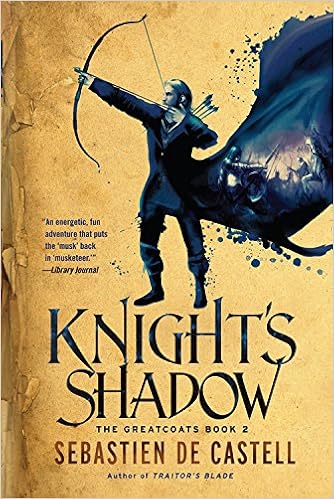
De Castell, Sebastien. Knight's Shadow. Jo Fletcher Books, 2015.

Buy it here.

Who’d have believed it—that’s two surpassquels in a row for this humble reviewer! I quite liked the mixture of witty banter and deathly serious plotting (and fighting) in Traitor’s Blade, and was trying to dial down my expectations for Knight’s Shadow, the second book in the Greatcoats series, figuring it was unlikely de Castell would quite manage to strike the right balance between humor and blood. Knight’s Shadow turned out to be a delightful surprise (until one too-visceral scene near the end, but then, that too was a surprise, albeit a less welcome one).

We’re back in the saddle with everyone’s favorite intrepid idealist, Falcio, and his stubborn devotion to principle in a world torn apart by Machiavellian/Game of Thrones-esque political intrigue is even more enticing a spectacle than it was in book one. A mystery disguised as a genre fantasy, it surpasses the first book—which was no slouch either!—in nearly every way, and certainly holds the reader’s attention, spurring one to wonder, with Falcio et al, what on earth could be happening, and what will result from all of it.

The only ‘falsio’ note (+5 for bad pun!) in all this is the grimmest of grim torture scenes near the end. (And in fact, it’s not a false note at all so much as a distressing if, I must reluctantly admit, logical turn.) Until this point, despite the worsening prognosis, I, like most readers presumably, remained confident there would be some sort of nick-of-time escape or clever stratagem to spare one of the protagonists such agony; but de Castell takes us right over that waterfall into pain-land. To his credit, he handles the scene with finesse, but as a reader not totally sold on the whole grimdark thing, I still felt this single scene threatened to leech the laughs out and leave us slumped over sniveling in the dark, rocking back and forth. That’s why I’ve dubbed this book a “laughdark”, as it starts out fairly light-hearted/optimistic in tone despite the enormous challenges facing our merry band of heroes, then dips down into pitch-black pessimism. I understand the reasons for this swan dive into the pit of torture-porn despair, but still suffered almost viscerally as I read it.

So the question before us is two-fold: a) does this bleak turn near the end of the book detract from the good times to be had in the rest? And b) can laughs be productively combined with grimdark? My answer to both questions, paradoxically, is yes. At least for this reader, the queasiness from reading said scene took a long time to abate, but upon reflection, I think the combination of humor and the willingness to go (grim)dark does indeed work well, overall.

This is all by way of saying that if you liked book one, you’ll surely like this book even more, the torture stuff notwithstanding; and if you haven’t read either one yet, why not? They’re great, and laughdark might just be a new mini-genre in its infancy!

 The Math:

Objective assessment: 7/10

Bonuses: +1 for creating a new mini-genre, ‘laughdark’; +1 for really working the mystery angle

Penalties: -1 for dip into dark as dark can be grimdark torture scene

Nerd coefficient: 8/10 “Totally worth your time and attention.”


[Just in case you think an 8 is too low given how much I obviously liked the book, check out our anti-grade inflation policy here.]


Zhaoyun, more of a laugher than a grimdarker, has been enjoying (yet getting a little queasy at) all manner of sci fi and fantasy books, light and dark, and reviewing them at Nerds of a Feather since 2013.

Monday, February 24, 2014

Microreview [book]: The Tower Broken, book three of the Knife & Tower trilogy by Mazarkis Williams

Williams, Mazarkis. The Tower Broken. Jo Fletcher Books, 2014. Buy starting June 3rd.

The Meat

Trilogies are kind of strange, when you think about it. They’re especially odd creations in light of the need for authors to wow the audience with the first installment. Ideally, installment two should at the very least sustain readers’ interest, and the final installment should blow their minds. In other words, books (or movies) one and three have to do all of the real work, with book one as the attention-grabber and book three as the stunning conclusion complete with melodrama galore. Comparatively little is asked of book two, in order to allow expectations for book three to rise stratospherically high.

Exceptions to this pattern certainly exist, but I’d argue such exceptions thrive precisely because our expectations for the middle installment are much lower than for the first or last installments. The primacy and recency effects also help ensure the middle installment is the most forgettable, but any time it greatly exceeds our low expectations, the middle installment can capture our imaginations the same way a good underdog story is irresistible to most of us. The Empire Strikes Back just feels sooo much better than either A New Hope or Return of the Jedi, to say nothing of the prequel trilogy (another exception to the trilogy pattern, thanks to all the installments being so uniformly unnecessary and, despite being visually magnificent, such poorly told and conceived stories, though here too some can be heard saying Attack of the Clones is ‘better than I expected’). Of course, part of the greatness of The Empire Strikes Back comes retroactively, comparing quite favorably to its sequel, since Return of the Jedi is far from satisfying in most ways.

This is all by way of saying that expectations for The Tower Broken, final installment in Mazarkis Williams’ Tower & Knife trilogy, were quite high despite the slight disappointment of book two. But if Williams’ book two was no Empire Strikes Back, The Tower Broken definitely manages to surpass the underwhelming bar set by the Return of the Jedi model of trilogy conclusions (apologies to those of you out there who are still laboring under the illusion that Return of the Jedi is a great movie).

"Admiral! We have enemy ships in sector 47!" "It's a trap!" The scintillating dialogue is just one of many reasons to find Return of the Jedi pretty silly...
I must confess I was deeply concerned by the direction Williams seemed to be taking her story, partly due to the childhood trauma of having read the Earthsea Trilogy and been quite taken with Ged, only to read Tehanu and find my hero emptied of all that made him heroic, transformed into an old man, depressingly ordinary. Would Williams drop-kick Sarmin, erstwhile pattern mage, down that same dark and hopeless hole into which Le Guin dropped Ged? Fortunately, the answer is ‘not really.’ True, Sarmin must struggle to face the ever-escalating threats assailing his empire without recourse to his own pattern magic, but Williams uses this power vacuum to explore another aspect of his world, namely elemental magic, and the result is impressive indeed. Moreover, about the Empress there had always been a certain promise of greatness, and Williams chooses this apocalyptic crisis as the moment to let Mesema shine. 

All in all, Williams manages to weave all the disparate elements of his story and his world into a very satisfactory conclusion, an effort worthy of the excellent first book and far surpassing the less impressive second installment. Would this reader have been even happier had Sarmin suddenly recovered his pattern-power and whipped up an intuitive solution to the crisis? Yes…but perhaps that’s just the unhealed wound of Ged’s magical emasculation reopening again.


The Math

Baseline assessment: 6/10

Bonuses: +1 for making elemental magic kind of awesome (though it all ends in a T.S. Eliot vein, without much of a bang), +1 for developing characters like Mesema into a position of greatness

Penalties: -1 for pulling a Le Guin-like trick on Sarmin (it’s bad, but not Tehanu-bad!)

Nerd Coefficient: 7/10   Which, as a score here at Nerds of a Feather, is 'a bit of all right', as my Australian friends say!

This review brought to you by Zhaoyun, sf/f book and movie aficionado and main cast member of Nerds of a Feather since early 2013. 

Tuesday, February 11, 2014

Microreview [book]: Knife-Sworn, book two of the Tower and Knife trilogy, by Mazarkis Williams


Williams, Mazarkis. Knife-Sworn. Jo Fletcher Books, 2012
Buy

The Meat
Let's talk about the sequel paradox. What is the sequel paradox, you might ask? It's the catch-22 at the heart of the entire enterprise of sequel-writing. Requirement one of the sequel paradox is that any sequel must be similar to, in the sense of being logically consistent with, the original. If, for example, we have a long-suffering, mostly ordinary protagonist in book (or movie, or whatever) one but in book two the same protagonist is suddenly a lasers-from-the-eyes kind of ubermensch, that will certainly jar the audience, as the basic premise of the original has been violated, as have our expectations—this is true, incidentally, even if the radically new framework is great.

But requirement two of the sequel paradox is that any sequel must be noticeably distinct, thematically and otherwise, from the original. This is necessary mostly for artistic reasons, but also partly just to avoid the charge of unoriginality or "cashing in" on an earlier book's success by releasing the same story rehashed. I almost hesitate to give specific examples, because the evaluation of books or any other kind of popular culture product is so subjective that someone out there is bound to be incredulous/apoplectic with fury that I would dare to mention _____ as an example of a cash-in, but I'll take the plunge anyway (sorry, Molly!). I think Ender's Shadow is the go-to example of a book that fails to fulfill requirement two; it is a 're-telling' of Card's original Ender's Game, and despite its frilly accoutrements, I felt nothing significant had been added—no new story had been told. This sort of rehashing is utterly unlike the reimagining of, say, the Battlestar Galactica world, which was so radically unlike the original that fans (in the entire world, are there seriously more than like five living fans of the unimpressive original series?) complained it was too different. Starbuck and Boomer are women? Whaaat? (But of course, it was awesome; if you don't believe me, go watch the dreary, formulaic original series.)

Obviously, the two requirements are not exactly in harmony with each other, and consequently, you'll probably agree that only rarely do sequels manage to equal—and by definition can almost never surpass—the original work. Books two thru six of the Harry Potter series are examples of sequels that manage, to a greater or lesser extent depending on a variety of factors (personal taste, mostly), to fulfill both requirements. They are all very similar in framework, etc. to the original, but advance certain aspects of a larger story and represent distinct iterations of the 'schoolyard drama' story.

Now, at last, we can turn to Mazarkis Williams' Knife-Sworn, the sequel to her excellent The Emperor's Knife (I quite agree with Jemmy's assessment of said volume, or if anything think it even better than he did). Does Williams manage to walk the tight-rope between similarity and originality in his sequel? The answer, I would suggest, is a qualified 'not exactly.'

To be sure, many of fans' favorite characters and story elements from book one 'reprise their roles', so to speak, in Knife-Sworn. Sarmin is back, facing an even greater threat, and he enlists the aid of his unlikely ally Grada along with many others. The same 'palace intrigue' web of deceit and shifting alliances reappears to dominate the Emperor's court.

At this point, you're probably expecting me to denounce the book for failing the originality requirement—being too similar to the original, in other words—but if anything, Williams leaned too far the other way. Certain elements present in the first installment of the series, it may be assumed, will be back, or even enhanced, for the sequel. As I mentioned above, Sarmin is back, but in book two he lacks the very quality that so dazzled readers in book one, namely a certain (je ne sais quoi!) pizzazz, that instinctive ability to unravel problems and ravel (this probably isn't a word, but it definitely should be!) solutions with his pattern-magic. What good is a brooding princeling, now emperor, who spends the entire book failing to understand either the threat he faces, o r what to do about it?

The key to the sequel tightrope is not to lean too far in either direction, maintaining balance somewhere in the middle between similarity and originality. Williams, in my view, departed too far from the original depiction of Sarmin, making him a less effective character around which to weave a story.

Lest we end up judging Williams over-harshly, let me say that he did much better, in this sequel, than most authors can hope to, since the vast majority of sequels are markedly worse than the first volumes. And only a tiny handful manage to equal their original effort (as I've mentioned here before, this is due to many factors, first and foremost the simple fact that many authors doubtless 'use up' most of their best ideas in their first books, the ones that establish their reputations and careers, revving their engines so much on book one that they end up slogging through the sequels on empty). So Williams is in the relatively rare second-best category, in my opinion: his sequel is a bit less impressive than his first book, but remains very entertaining indeed, a worthy if not stunning successor to the magic of book one. I confess myself worried about book three, however (to be reviewed here ere long), because of the The Farthest Shore --> Tehanu kind of direction, vis-a-vis Sarmin (equivalent to Ged, more or less) Williams seems to be going. Stay tuned!

The Math

Baseline assessment: 6/10

Bonuses: +1 for making Grada totally awesome

Penalties: -1 for making Sarmin kind of suck

Nerd coefficient: 6/10 "Still enjoyable, but the flaws are hard to ignore"

[You can find out more about our awesome scoring system here.]


This review brought to you by Zhaoyun (that's "Shining Cloud" for all you hoi polloi who don't know me personally/know Mandarin Chinese), sf/f book and movie aficionado and main cast member of Nerds of a Feather since early 2013.   

Wednesday, January 29, 2014

Microreview [book]: Traitor's Blade, by Sebastien De Castell

De Castell, Sebastien. Traitor's Blade. Jo Fletcher Books, March 2014
The Meat


  When you're making a sandwich, I think you'll agree that it's important to ensure relatively consistent quality among all the various ingredients. If, for example, you splurge and get the nicest tomatoes or whatever known to man, it really doesn't make much sense to slather the thing with Velveeta. You'd want a nice provolone, say, or something with enough oomph to support your investment in the tomatoes.
  As with sandwiches, so too with story-telling. Some stories can be first-rate in most areas and still fall apart, as an ensemble, over whichever element is Velveeta-quality, be it the protagonist, the dialogue, or the descriptions of the fighting.
  What makes De Castell's Traitor's Blade so delightful is that it's all provolone (so to speak). The story is very well crafted, from the dialogue to the fight scenes (I hear De Castell has worked as a fight choreographer!) and there's nary a hint of Velveeta to be found. Anybody can rally behind the much-abused Falcio as hero, especially because despite what the title might make you think, readers will almost immediately discover that this gold-hearted romantic, this ever so formidable warrior, is no traitor at all. Instead, he's been dumped on by everybody, Fates and Furies and everyone in between, and he's only got his blade(s) and his trusty Greatcoat (a half-magical coat which also functions as excellent armor, emergency cash reserve, bag of all tricks, and instant symbol of monarchy in, shall we say, a post-Charles I (but not at all Cromwellian) kind of world.
  Strictly speaking the tale De Castell tells has nothing to do with England, drawing its inspiration from late medieval/early modern Italy instead, but in any case, in the world De Castell shows us, it (to misquote Mel Brooks) is no longer at all good to be the king, nor to be his most trusted friend and compatriot, the aforementioned Falcio. The story is set up as a loose mystery, in which Falcio and his few remaining loyal companions must seek to clear their names/get away from the bad guys/right injustices everywhere/fulfill their king's last requests. So in the Abercrombie-esque, dog-not-only-eat-but-gleefully-tear-apart-dog world they're in, they've got their hands full, needless to say.
  De Castell is at his best as he periodically interjects flashbacks the better gradually to reveal more of the story's central relationship, that between the now (ahem) 'forcibly deposed' king and Falcio, who even years later remains totally loyal to his erstwhile monarch. We are offered a window deep into Falcio's interiority thanks to the first-person narration, even tempered as it is by the 'I write this little account years later' device, so we come to know what makes him tick, and what makes him go ballistic (or whatever the equivalent term is for rapiers—pointillistic, perhaps? Take that, Georges Seurat! That's too good a word to waste on boring quasi-impressionistic painting!).
  The story is captivating, and though many readers (even I figured it out!) will soon see through the king's cryptic assignment for Falcio, it's immensely satisfying to read. The only hint of Velveeta was in a third-act deus ex machina-esque appearance—and, soon, disappearance—of a sympathetic damsel who gives our broken-hearted Falcio one heck of a pick-me-up. The characterization of one particularly bloodthirsty duchy bothered me as well; I immediately thought of Riften from Skyrim, but like five billion times more lawless and dangerous. I mean, this place is like Frank Miller's Sin City bad.
True, random thieves appear to cause mayhem in Riften, but at least there isn't a week-long bloodbath!
  The duchy's tradition of a free-for-all general melee where anyone can be targeted within the time frame of the 'celebration' also immediately brought back memories of that creepy Ethan Hawke movie The Purge, which was certainly an intriguing premise for a sci fi/horror film, but fleshed out here in Traitor's Blade it teeters on the edge of being untenable as a premise. How could a city-state really indulge in such an elaborate orgy of violence at the whim of a despotic ruler and then continue to function normally—or at all—after it? So as interesting a place as it sounds, the uber-evil duchy felt like a melodramatic exaggeration of 'how bad things have gotten since our hero Falcio and his reformer king got screwed.' None of this is to suggest that the parts of the book devoted to describing that duchy are anything less than riveting, however!
  All in all, De Castell has produced a wonderfully inventive, thoroughly entertaining story and a fascinating world in which to set it. And I, for one, am excited to hear how Falcio will proceed in the remaining three volumes of the series! (I just hope he doesn't come down with a bad case of Robert Jordanism and end up writing four seven thirteen twenty thousand books in the series!)


The Math


Baseline Assessment: 7/10

Bonuses: +1 for creating a berserker with a heart of gold in Falcio, +1 for a story boasting such a consistently high level of quality throughout its many elements

Penalties: -1 for a hint of Velveeta in the deus ex machina of the woman near the end

Nerd coefficient: 8/10 "Well worth your time and attention"


[Here at Nerds of a Feather, we don't give out high scores like 8s lightly! See here for how our scoring system works.]