Showing posts with label Sebastien De Castell. Show all posts

Monday, June 26, 2017

6 Books with Sebastien De Castell

Photo Credit: Pink Monkey
Sebastien is the author of the acclaimed swashbuckling fantasy series, The Greatcoats. His debut novel, Traitor’s Blade, was shortlisted for both the 2014 Goodreads Choice Award for Best Fantasy and the Gemmell Morningstar Award for Best Debut. He lives in Vancouver, Canada with his lovely wife and two belligerent cats. 

Today he shares his six books with us...


1. What book are you currently reading?

I just picked up The Pearl Thief by Elizabeth Wein, author of the fabulous Code Name Verity – one of my favourite books of the last five years. The Pearl Thief is a mix of mystery and adventure set in Scotland in the years leading up to World War II. Wein's writing is always fluid and engaging and her protagonists full of with mixed with subtle pathos. This is one of those books you begin with complete confidence that you'll enjoy the ride.


2. What upcoming book you are really excited about? 

The first Book of Dust (which I believe is titled, “La Belle Sauvage.” When I heard Philip Pullman was revisiting the world of His Dark Materials, I became instantly curious as to where he'd take the story. It's hard to overstate how brilliant and daring Pullman's characters and themes come together. I can't wait to see what he does with The Book of Dust.


3. Is there a book you're currently itching to re-read? 

When We Were Orphans by Kazuo Ishiguro starts out as a kind of detective novel only to gradually slide into a meditation on memory and self-deception. I remember reading it almost seventeen years ago and being taken aback by Ishiguro's smooth transformation of his detective first into a hapless victim of the circumstances of war, and then into the prime suspect in the question of who's to blame for our intense uncertainty over what's true and what isn't in the story. However reviews from the time are more ambivalent about the novel, so now I'm keen to go back and see for myself whether Ishiguro's version of the unreliable narrator is as deep and thoughtful as I thought, or whether, like his protagonist, I've allowed nostalgia to shape my memories of the book.


4. How about a book you've changed your mind about over time--either positively or negatively? 

I was asked to write a review of Neil Gaiman and Terry Pratchett's Good Omens for some magazine or other recently. Going back over the book – which I primarily remembered as a relentless onslaught of hilarious characters and insights – I found myself entranced instead by its profoundly humanist point of view, articulated through its evisceration of those who seek to divide the world into “good” and “evil”. I'd read the book two or three times in the years when it first came out, but never picked up just how powerfully it makes the case against the very polarization that seems to characterize the twenty-first century.


5. What's one book, which you read as a child or young adult, that has had a lasting influence on your writing? 

Jhereg by Steven Brust was the first fantasy novel that showed me you could write a book set in an alternate world without making it sound like one of those Hollywood historical epics in which everyone – regardless of the country or time in which it's set – speaks in thees and thous with an anachronistic British accent. I loved that Brust's world seemed constructed as the perfect foil for his character, rather than trying to be a kind of extended Dungeons and Dragons campaign. Brust was, and I think continues to be, a big influence on my own writing style.


6. And speaking of that, what's *your* latest book, and why is it awesome? 

I have two books out right now: Tyrant's Throne, the final book in the Greatcoats Quartet. I think that if you like your swashbuckling adventure mixed with heartache and idealism, or if you ever thought The Princess Bride would be even better if there was just a bit more blood, then you'll enjoy the Greatcoats. As to why it's awesome? Simple: you finally get to find out not only how Falcio beat Kest to become the First Cantor of the Greatcoats, but also how Kest defeated the Saint of Swords with a dirty joke. My other book that just came out is Spellslinger – a young adult magical western full of tricks, traps, and a larcenous talking squirrel cat. Why is it awesome? Did you not hear me when I said, “and a larcenous talking squirrel cat”?


POSTED BY: Joe Sherry - Co-editor of Nerds of a Feather, 2017 Hugo Award Finalist for Best Fanzine. Writer / Editor of the mostly defunct Adventures in Reading since 2004. Minnesotan.

Friday, April 29, 2016

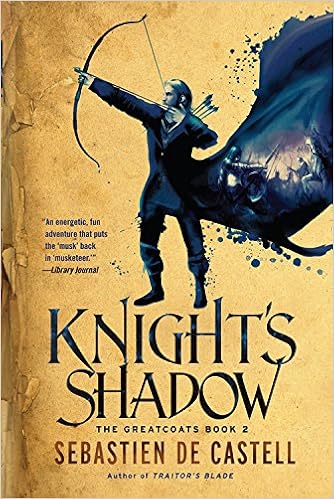
Microreview [book]: Knight's Shadow, by Sebastien de Castell

De Castell levels up with a ‘laughdark’ surpassquel!

De Castell, Sebastien. Knight's Shadow. Jo Fletcher Books, 2015.

Buy it here.

Who’d have believed it—that’s two surpassquels in a row for this humble reviewer! I quite liked the mixture of witty banter and deathly serious plotting (and fighting) in Traitor’s Blade, and was trying to dial down my expectations for Knight’s Shadow, the second book in the Greatcoats series, figuring it was unlikely de Castell would quite manage to strike the right balance between humor and blood. Knight’s Shadow turned out to be a delightful surprise (until one too-visceral scene near the end, but then, that too was a surprise, albeit a less welcome one).

We’re back in the saddle with everyone’s favorite intrepid idealist, Falcio, and his stubborn devotion to principle in a world torn apart by Machiavellian/Game of Thrones-esque political intrigue is even more enticing a spectacle than it was in book one. A mystery disguised as a genre fantasy, it surpasses the first book—which was no slouch either!—in nearly every way, and certainly holds the reader’s attention, spurring one to wonder, with Falcio et al, what on earth could be happening, and what will result from all of it.

The only ‘falsio’ note (+5 for bad pun!) in all this is the grimmest of grim torture scenes near the end. (And in fact, it’s not a false note at all so much as a distressing if, I must reluctantly admit, logical turn.) Until this point, despite the worsening prognosis, I, like most readers presumably, remained confident there would be some sort of nick-of-time escape or clever stratagem to spare one of the protagonists such agony; but de Castell takes us right over that waterfall into pain-land. To his credit, he handles the scene with finesse, but as a reader not totally sold on the whole grimdark thing, I still felt this single scene threatened to leech the laughs out and leave us slumped over sniveling in the dark, rocking back and forth. That’s why I’ve dubbed this book a “laughdark”, as it starts out fairly light-hearted/optimistic in tone despite the enormous challenges facing our merry band of heroes, then dips down into pitch-black pessimism. I understand the reasons for this swan dive into the pit of torture-porn despair, but still suffered almost viscerally as I read it.

So the question before us is two-fold: a) does this bleak turn near the end of the book detract from the good times to be had in the rest? And b) can laughs be productively combined with grimdark? My answer to both questions, paradoxically, is yes. At least for this reader, the queasiness from reading said scene took a long time to abate, but upon reflection, I think the combination of humor and the willingness to go (grim)dark does indeed work well, overall.

This is all by way of saying that if you liked book one, you’ll surely like this book even more, the torture stuff notwithstanding; and if you haven’t read either one yet, why not? They’re great, and laughdark might just be a new mini-genre in its infancy!

 The Math:

Objective assessment: 7/10

Bonuses: +1 for creating a new mini-genre, ‘laughdark’; +1 for really working the mystery angle

Penalties: -1 for dip into dark as dark can be grimdark torture scene

Nerd coefficient: 8/10 “Totally worth your time and attention.”


[Just in case you think an 8 is too low given how much I obviously liked the book, check out our anti-grade inflation policy here.]


Zhaoyun, more of a laugher than a grimdarker, has been enjoying (yet getting a little queasy at) all manner of sci fi and fantasy books, light and dark, and reviewing them at Nerds of a Feather since 2013.

Wednesday, January 29, 2014

Microreview [book]: Traitor's Blade, by Sebastien De Castell

De Castell, Sebastien. Traitor's Blade. Jo Fletcher Books, March 2014
The Meat


  When you're making a sandwich, I think you'll agree that it's important to ensure relatively consistent quality among all the various ingredients. If, for example, you splurge and get the nicest tomatoes or whatever known to man, it really doesn't make much sense to slather the thing with Velveeta. You'd want a nice provolone, say, or something with enough oomph to support your investment in the tomatoes.
  As with sandwiches, so too with story-telling. Some stories can be first-rate in most areas and still fall apart, as an ensemble, over whichever element is Velveeta-quality, be it the protagonist, the dialogue, or the descriptions of the fighting.
  What makes De Castell's Traitor's Blade so delightful is that it's all provolone (so to speak). The story is very well crafted, from the dialogue to the fight scenes (I hear De Castell has worked as a fight choreographer!) and there's nary a hint of Velveeta to be found. Anybody can rally behind the much-abused Falcio as hero, especially because despite what the title might make you think, readers will almost immediately discover that this gold-hearted romantic, this ever so formidable warrior, is no traitor at all. Instead, he's been dumped on by everybody, Fates and Furies and everyone in between, and he's only got his blade(s) and his trusty Greatcoat (a half-magical coat which also functions as excellent armor, emergency cash reserve, bag of all tricks, and instant symbol of monarchy in, shall we say, a post-Charles I (but not at all Cromwellian) kind of world.
  Strictly speaking the tale De Castell tells has nothing to do with England, drawing its inspiration from late medieval/early modern Italy instead, but in any case, in the world De Castell shows us, it (to misquote Mel Brooks) is no longer at all good to be the king, nor to be his most trusted friend and compatriot, the aforementioned Falcio. The story is set up as a loose mystery, in which Falcio and his few remaining loyal companions must seek to clear their names/get away from the bad guys/right injustices everywhere/fulfill their king's last requests. So in the Abercrombie-esque, dog-not-only-eat-but-gleefully-tear-apart-dog world they're in, they've got their hands full, needless to say.
  De Castell is at his best as he periodically interjects flashbacks the better gradually to reveal more of the story's central relationship, that between the now (ahem) 'forcibly deposed' king and Falcio, who even years later remains totally loyal to his erstwhile monarch. We are offered a window deep into Falcio's interiority thanks to the first-person narration, even tempered as it is by the 'I write this little account years later' device, so we come to know what makes him tick, and what makes him go ballistic (or whatever the equivalent term is for rapiers—pointillistic, perhaps? Take that, Georges Seurat! That's too good a word to waste on boring quasi-impressionistic painting!).
  The story is captivating, and though many readers (even I figured it out!) will soon see through the king's cryptic assignment for Falcio, it's immensely satisfying to read. The only hint of Velveeta was in a third-act deus ex machina-esque appearance—and, soon, disappearance—of a sympathetic damsel who gives our broken-hearted Falcio one heck of a pick-me-up. The characterization of one particularly bloodthirsty duchy bothered me as well; I immediately thought of Riften from Skyrim, but like five billion times more lawless and dangerous. I mean, this place is like Frank Miller's Sin City bad.
True, random thieves appear to cause mayhem in Riften, but at least there isn't a week-long bloodbath!
  The duchy's tradition of a free-for-all general melee where anyone can be targeted within the time frame of the 'celebration' also immediately brought back memories of that creepy Ethan Hawke movie The Purge, which was certainly an intriguing premise for a sci fi/horror film, but fleshed out here in Traitor's Blade it teeters on the edge of being untenable as a premise. How could a city-state really indulge in such an elaborate orgy of violence at the whim of a despotic ruler and then continue to function normally—or at all—after it? So as interesting a place as it sounds, the uber-evil duchy felt like a melodramatic exaggeration of 'how bad things have gotten since our hero Falcio and his reformer king got screwed.' None of this is to suggest that the parts of the book devoted to describing that duchy are anything less than riveting, however!
  All in all, De Castell has produced a wonderfully inventive, thoroughly entertaining story and a fascinating world in which to set it. And I, for one, am excited to hear how Falcio will proceed in the remaining three volumes of the series! (I just hope he doesn't come down with a bad case of Robert Jordanism and end up writing four seven thirteen twenty thousand books in the series!)


The Math


Baseline Assessment: 7/10

Bonuses: +1 for creating a berserker with a heart of gold in Falcio, +1 for a story boasting such a consistently high level of quality throughout its many elements

Penalties: -1 for a hint of Velveeta in the deus ex machina of the woman near the end

Nerd coefficient: 8/10 "Well worth your time and attention"


[Here at Nerds of a Feather, we don't give out high scores like 8s lightly! See here for how our scoring system works.]