Showing posts with label Clarkesworld. Show all posts

Wednesday, June 16, 2021

Short Fiction Round Up: May 2021

May was a pivotal month for German seasons; our days stretched long, our cold spring gave way to warmer moments, the swifts returned. I don't think it's a coincedence, then, that all my favorite stories of the month deal with our environments. These stories ask important questions: how we affect our environment, and how does our environment affect us. I loved the thoughtful, nuanced, and messy answers this selection provided. Please, enjoy!

To Hear Them Sing by Rebecca Burton (Fireside)
This story about a young magical practitioner taking her final exam to graduate into magic scholarship is tender, beautiful and well-crafted. The epic world-building on a small scale gives this story an excellent hook, and the language and pacing are excellent. Stories that tackle not how much we affect our environment, but how much our environment affects us always have a special place in my heart, and I highly recommend this one! 

Not all environments are natural; Chan’s tiny little flash story is told from the perspective of an automated house whose owner was taken away by the authorities in a technocratic dystopia. Again, Chan manages to render a whole world in the observations of a house; the third line of the story simply states “Most of the coffee sloshes over the jagged edges of the half-shattered mug.” The tone of the house -- factual, but revealing just enough cruel and unnecessary damage to establish an anti-Government façade – is the thing that makes the story. 

CL Clark writes the best contemporary military fantasy. This short story takes place in the middle of a revolution; the captain and the quartermaster of an army fall in, and out, of love over the course of a campaign. As always, this short story is precise, with elegantly complex characters and an emotional arc that makes sense, even as it feels tragic. 

Clocking in at about 450 words, this flash piece still manages to balance three separate levels: it details five rules of magic, it details the second person narrator’s first interaction with magic, and it details the second person’s narrator’s biggest interaction with magic. I was fascinated at the apparent-ease with which all three elements braided together. 

T Kingfisher’s newest short story, which is also featured in EscapePod’s Anthology, is about pregnancy, animals, feminism, and space. Like many Kingfisher stories, this story is hilarious, in large part because of how well Kingfisher can juggle a dozen character voices so well. The drama is high-stakes, the ending is happy: this story felt like an amazing episode of All Creatures, Great and Small but in spaaaaaace.

Thursday, February 4, 2021

Short Fiction Round Up: January 2021

Editor's note: Our second new contributor this week is Elisabeth R Moore, a writer who you may know as The Space Lesbian on Twitter and elsewhere! Elisabeth's profile will be landing next week but in the meantime we didn't want to keep you from her first set of short fiction recommendations for us:

Hello and welcome to my column covering short fiction! This month’s selection is inspired by all of the “Best of 2020” lists that December spawned, with me reviewing a story for the April 2020 issue of Clarkesworld, a September 2020 issue of EscapePod and the Autumn 2020 issue of Kaleidotrope. In terms of more recent fiction though, I loved Strange Horizon’s fiction this month - a strong start to the new year!

The Scholar of the Bamboo Flute by Aliette de Bodard (Silk and Steel)

The Scholar of the Bamboo Flute is a typical de Bodard story: the setting is a 19th Century Vietnamese-inspired fantasy school, the main character is a poor scholarship orphan and the love interest is -- it is later revealed -- a fantastical creature. At the heart of this story is a question every duelist must ask themself -- "what will I do to win?" In an elegant and deft twist on the familiar question, de Bodard explores what happens when the answer is "not that." The story builds slowly, but its final scene crashes over the reader like a metaphorical wave. While the romance itself lagged in the first part of the story, it came together beautifully in the end, offering a hopeful ending for both characters.


AirBody by Sameem Siddiqui (Clarkesworld)

In a near future where people can rent bodies remotely, a Karachi resident Meena Khan rents the body of Arsalan, a Washington DC resident. While Meena cooks, Arsalan grapples with his past as a member of Urdu diaspora, which ends up creating a wonderful camaraderie between him and Meena. Soon it becomes clear that this is not the story about one but two outcasts who are grappling with their position within their culture. Meena's and Arsalan’s one day together, inhabiting the same body, allows them to watch each other make the same kinds of mistakes. Both watch the other and think “this is not me,” even while they paradoxically are each other. The story is beautifully rendered, emotional, and a wonderfully sensuous read.


More than Simple Steel by Aimee Ogden (EscapePod)

A story about a pandemic that killed all the adults is a complicated thing to read in a pandemic that’s killing all of our grandparents. And yet Ogden pulls this story off with skill and style. A young boy named Micah lives with thirty other children in an abandoned school. When a newcomer with a baby and a gun shows up and threatens to ruin their home, how do they react? I loved this story; it was beautiful and heart-wrenching. It asked important questions about growing up, bravery, and how to be the person your family can be proud of. I cried at the end.


In The Garden of My Ancestors Statues by Marissa Lingen (Kaleidotrope)

Lingen’s signature style is stories that shine light in unexpected places. The mythical troll, usually the villain in the archetypal European fairy-tale, is rendered here as a tragic hero and an artistic outcast. In achingly simple language, Lingen evokes a fantasy setting in which trolls are being used and abuse by villagers -- hired for their amazing work in masonry, but then forced to work until sunrise so they turn into statues and don’t have to be paid. But the last of the trolls won’t stand for this, and hatches a daring plan. Kind and gentle, Lingen's prose always makes space for the outcast to shine.


Secrets of Kath by Fatima Taqvi (Strange Horizon)

Taqvi’s story about the wife of the village’s rich man, her son, and the local putliwallah is beautifully written. The trope of the storyteller -- in this case the puppeteer with the magic puppets -- who acts as the voice of the voiceless is used effectively and powerfully in this story. The opening paragraphs of the narrative are perfect: with deft and elegant strokes, Taqvi begins the story with the putliwallah entering the village, though the amorphous use of the first person plural implies early that this is a story of the collective, told through one man; not a lone hero’s undertaking. Throughout the story the pronoun play continues; the village’s rich man’s wife tells the story predominantly in the second person, watching her young son in the audience and addressing him repeatedly. And while I don’t want to spoil the ending, let me assure you: it’s perfect.

POSTED BY: Elisabeth R Moore is a writer, birder and grad student living in Germany. When she's not writing strange stories about scary plants, she can be found crocheting, hiking or biking. She tweets at @willowcabins.

Thursday, May 28, 2020

Questing in Shorts: May 2020

Well, I promised May would be a magazine-heavy month, and I've met my targets on that front, catching up with some of the 2019 issues I wanted to from my favourite publications and starting in on some 2020 backlog. With big resolutions, however, comes the pressure of living up to them, and I'm realising there's a point where I may have to shelve back issues in order to read the new stuff as it comes out instead. It's hard to give myself permission to just not read things which, in many cases, I've paid for, or otherwise feel I've made a commitment to by putting it on the e-reader, but accepting that one cannot read all the things, not even all of the things one is subscribed to, is a necessary part of being a reader stuck in linear time. Besides, it's not about what you don't have time to stuff into your eyeballs, but about the great things you do, and oh boy were there some awesome things this month:

Uncanny Magazine Issue 33

There's a running theme of memory, both ancestral and personal, and of self-actualisation in the face of overwhelming forces trying to drag the various protagonists down, in this issue of Uncanny Magazine. For one thing, the reprint is "Harvest", the Rebecca Roanhorse story about the Deer Woman myth originally published in the New Suns anthology, and just as powerful and raw the second time in its treatment of a dangerous, angry mythological creature whose complexity isn't addressed in stories that focus only on her role as a temptress. There's also the astonishingly good "The Sycamore and the Sybil", by Alix E. Harrow, a story told by a tree who used to be a woman and who is forced to watch as another young woman attempts to escape a predatory man in the woods. The story's reversal is, on one level, delightfully simple, but on another it turns every patriarchy and mythology driven assumption about who holds power on its head, and it ends with a powerful moment of hope and sisterhood which barely felt possible at the start of the story.

The rest of the story's issues are similarly strong, from the beautiful prose and worldbuilding of Christopher Caldwell's "If Salt Lose Its Savor" to the intriguing, increasingly weird breakdown of "Georgie in the Sun", Natalia Theodoridou's story of Dracula and his bride on a far future generation ship mission which starts to go bizarrely wrong. L. Tu's "If You Want to Erase Us, You Must Be Thorough" annoyed me during its midpoint for its notes of sexual exploitation, as a younger protagonist in a school run by her colonised deals with the ghost of one of her people out in the forbidden woods of her home. But when the extent of the atrocities perpetrated on her people become clear, protagonist Aida is offered - and takes - her own choices in retaliation for what is done, and it becomes something more powerful and bigger than any of its individual characters. I happened to read The Best of Uncanny Magazine collection this month and I could imagine any story in this particular issue within that collection - testament to the quality this publication brings to each and every edition.

The Grand Tour by E. Catherine Tobler


Tobler's latest Apex publication is a collection continuing the world explored in the novella The Kraken Sea - although, full disclosure, I have read but don't particularly remember the plot of that origin story, so this review is not going to provide any insight on that front. The stories exploring the various destinations and characters of Jackson's Unreal Circus and Mobile Marmalade - a carnival which appears to travel through both space and time, appearing to pick up some who benefit from its protection and others who certainly don't, and changing the lives of all who encounter it.

It may have been a quirk of my mood at the time of reading, but I found that the more hopeful stories landed more successfully with me than the forays into horror. "Blow the Moon Out", the collection's lengthy centrepiece, was a particularly enjoyable story for me, telling the weird journey of four girls to the circus, their meeting with a strange dog along the way, and the ways each finds what they need from their experiences at the circus. While each girl's self actualisation feels very much bound to that particular moment in time - their escapes from various forms of patriarchy, in particular, feel like they won't last beyond their return home - there's a feeling of timelessness within its conclusion that makes everything feel right in a brief, almost nostalgia-tinged sort of way. Homegoing is also the theme of the collection's first story, "Vanishing Act", in which a girl finds herself on the tracks in front of the train, is taken in by the circus, and attempts to find her way back to her distant home with the help of a man who can make things vanish, but not reappear.

I found less in the collection's more unpleasant and brutal stories, like the owned children of Maman Floss in "Artificial Nocturne" or the visceral, dark horrors of "We, As One, Trailing Embers", the story of conjoined cannibal twins who find ways to meet their needs while travelling in the circus - but the fact these stories come earlier in the collection, and others, like the tale of the circus' Marmalade maker Beth ("Lady Marmalade") are later - is a clever stroke, forcing us to accept the circus and the world around it in all its flaws before being invited to see more of its human angles and what it might offer. And the stories that go to truly strange places - like "Ebb Stung by the Flow", the body hopping narration of a disaster which seems to offer answers to how the circus gets to its many destinations, while also making things so much weirder - underscore what an interesting setting this is on multiple levels, with a feeling that there are so many more stories waiting with Jackson and the crew somewhere on the tracks.

Tor.com Fall collection


This set of Tor stories seems to be cliffhanger themed, with a ton of stories that set up and explore their idea but fade to black just as a narrative emerges. Regular readers of this column may have established that this is not my favourite story structure, no matter how effective it can be in driving home its message - and this is a Tor.com bindup, so you can be assured that all the stories land very effectively - so it did colour my overall enjoyment of the collection.

Included in this group is newly-minted Hugo finalist "As the Last I May Know" by S.L. Huang, a secondary world story set during a war which could be ended at any point using  weapons of mass destruction; however, following previous wars, the culture at the centre of the story has set it up so that the only method for the president to use these weapons is by murdering a ten-year-old girl, Nysa, who becomes part of his staff at inauguration. Huang explores that concept from multiple angles, juxtaposing the man from the Order which brought up Nysa and the president himself and their different methods of attempting to protect and/or own her, and Nysa's own complex self-realisation and articulation of her desires. Its a story that fits well into the canon of "The Ones Who Walk Away from Omelas" and other sacrifice stories, twisting the slightly-too-convenient setup into something that's very believable in how it deals with public opinion and the uncertainties of conflict. Even if you're not reading for the Hugos this year, this is one that's well worth checking out.

Firmly in the "I wish you hadn't ended it there but otherwise that was great" category, Greg Egan's novelette "Zeitgeber" involves a world where many of the young people (and some adults) become "free riders" in time, with an internal clock that moves differently to actual times of day, sending them out of sync with the world around them and with each other. It's a weird idea that becomes increasing compelling as Emma, the main child of the story, and her father, deal with well meaning but ultimately ignorant pressure from the rest of society about what is "best" for these children, and the passion and talent we are willing to sacrifice to achieve conformity. Brenda Peynado's post-apocalyptic pandemic story "The Touches", in which a woman living in a world that's been rendered uninhabitable outside of designated "clean" spaces and humans live completely isolated from each other in their own microbiomes rediscovers the concept of human touch in its terrifying, messy and comforting forms, is another delight. And while I haven't yet read Adrian Tchaikovsky's Made Things, the prequel story "Precious Little Things" in here makes me even more intrigued about this world of homonculi and their unknowable magical creator.

Clarkesworld Issue 159 (December 2019)


I'm still reading Clarkesworld at significantly less than the "one magazine per month" rate which would stop the backlog from growing in my unread magazines folder, and if anyone on the internet wants to give me permission to move some of the older issues out of my to-read-soon list and into my giant unread folder of death, that would be much appreciated. But anyway, here's December 2019's issue, as read by Adri in May 2020. We kick off with the haunting "Such Thoughts are Unproductive", a dystopian future America, where surveillance is used to push people into totalitarian conformity with anti-scientific opinions; the plot revolves around the video conversations the protagonist has with her mother in a rehabilitation camp, which she knows aren't real but can never fully disprove. "Annotated Setlist of the Mikaela Cole Jazz Quintet" is a story about musicians on a generation ship, which is a premise I'd be happy to read an entire anthology of someday. The story switches between the five members of the quintet (though it appears to be narrated by an "us" who is all of the members at once, which is an intriguing conceit) as it tells the story of their final performances, before their respective lives take them in different directions.

"Eclipse our Sins" by Tloto Tsamaase is another challenging story, whose take on a post-climate crisis earth and the wrathful-earth-worshipping religious society which evolves within it feels very quintessentially Clarkesworld,  Then there's this month's translated Korean story, "Symbiosis Theory", which is a bit of an odd one, going through an intriguing initial vignette into a story of scientists working on infant communication who discover the strange presence of an additional voice within young childrens' neurological patterns. It transpires that young humans may play host to another consciousness which in turn has uplifted the human species. it's a concept that could end up being pretty damn creepy, but author Cheoyop Kim plays it softer than that, turning it into a story about togetherness and connection which hit me particularly in the feels at current circumstances.

 Anathema Magazine Issue 10


This issue of Anathema contains plenty of gods and superpowers brushing up against mortal lives, in ways that are traumatic and transformative. S. Qiouyi Lu's "This House is Full of Faith" deals with a widow whose husband was killed when his body was taken over by an angel during the war they have been fighting, who is deeply sceptical of the new angel who turns up her doorstep claiming to have answered her daughter's prayers but who ends up letting this new woman into her family and beginning, slowly, to heal. In "Thunder Only Happens When It's Raining", a girl and her sister try to survive a viscerally sticky, bug-ridden summer alongside her older brother, who has returned from the school for "gifted" children he spends his year at; but he keeps bringing rain and lightning indoors and won't speak to his sisters and keeps stealing beer from the fridge, and its clear that his experiences at the school have been traumatic beyond anything the narrator can really comprehend. The claustrophobia of the story - embodied with a literal "itchiness" as the protagonist narrates her mosquito bites and the pain and pleasure of scratching, or not scratching, at various points - makes the silence of its central character even more excruciating, and it all adds up to something which, while not a pleasant read, is certainly an accomplished and atmospheric one. "The Future in Saltwater", by Tamara Jerée, also has Gods at its heart - this time, saltwater creatures which latch on and make a request of their bearers at a coming of age ceremony. Luo's God has asked them to take it to the ocean, despite their fears that their sick parent, Cheypa, wouldn't be looked after if they made such a long and treacherous journey. When Luo decides to defy their God, it leads to consequences and to an eventual reaffirmation of faith that causes loss and heartbreak but also a new role and a departure that, we hope, will not be as challenging as those which Luo and Cheypa have weathered before.

POSTED BY: Adri, Nerds of a Feather co-editor, is a semi-aquatic migratory mammal most often found in the UK. She has many opinions about SFF books, and is also partial to gaming, baking, interacting with dogs, and Asian-style karaoke. Find her on Twitter at @adrijjy.

Thursday, January 30, 2020

Questing in Shorts: January 2020

Hello, friends, and welcome to a new year of short fiction adventures! I'm back after a little unplanned hiatus at the end of next year, and ready to tackle what 2020 has in store - ready, that is, once I've finished with the desperate project of reading all the things for 2019. As a result, this roundup is going to mostly be a selection of stuff I've been reading to round out my experiences of last year's shorts, and having made a few sloooow novel choices recently (*glares at Black Leopard, Red Wolf*) I've found a lot of time to pick up magazines and anthologies in the time between, or in the middle of, longer works.

I'm expecting to jump into 2020 fiction with a vengeance next month, and to that end I'm in the process of mixing up my short fiction subscriptions for this year, partly for variety and partly to realign what I want to read and by whom. One big part of this is that I'm actively seeking out publications whose editorial staff are PoC and/or LGBTQIA+; if you have any favourites that you'd like to shout out, please do so in the comments below. I should note that I very rarely manage to read magazines that don't have some form of ebook available, so if you'd like me to check something out, that's sort of a prerequisite, but I have a few things on the radar that I'm going to attempt to make exceptions for.

Without further ado, let's get into the things:


FIYAH Literary Magazine, Issue 12: "Chains"


Of all the magazines I've kept up with over the last year, FIYAH delivers one of the most consistently enjoyable experiences, and this issue, "Chains", is another delight. As you'd expect, the issue takes a sensitive and resonant topic for Black speculative fiction and offers a quartet of stories which interpret it in  different and unexpected ways, with three short stories and a long novelette. Of the short stories, I very much enjoyed "The Midnight Hose", a creepy rural ghost story by Gregory Neil Harris in which two kids trying to take a shortcut through their weird neighbour's fields at night (what are you doing) come face to face with the legacy of sharecropping in a rather literal way. It takes all their adventurous resourcefulness to get themselves out, and to grapple with the ghosts of the farm's past (metaphorically and literally), in a story which brings a satisfying children's horror aesthetic and takes it to a more sophisticated level. Of equal note is "Reclaiming Tess", a more meditative story about a woman considering her family legacy after inheriting a bond with a minor god from her grandmother despite being considered the "weakest" candidate among her relatives (grandmother included). Tess' journey is heartbreaking, but the story does a brilliant job of showing us, in a relatively short space of time, where her true support network lies, while also painting the deeply complex emotions she has about the members of her family. "Corialis" - a story about exoplanet colonisation which deserves to be up there with "Semiosis" and "To Be Taught, If Fortunate" in the conversation about human adaptation for space - and "An Irrational Love", a retelling of the minotaur myth, round out the experience. I say it every time I review them, but: don't sleep on FIYAH, folks.

(Incidentally, I like to choose the first review based in part on which book or magazine cover I want showing up on our Twitter previews. Sometimes this is a tricky decision, sometimes an arbitrary one, but never have I been so sure about a choice than I am about putting Sophie Zarders' gloriously weird cover art for this issue. What on earth is going on there? I don't know, go with it)

GigaNotoSaurus: 2019 Selection


GigaNotoSaurus took a couple of breaks last year, but I've been slowly making my way through the six stories they published in 2019, and I'm halfway there. Of the three stories I've read so far, December's is particularly worthy of note: "The Devil Squid Apocalypse", by Alex Acks, tells the story of an elderly woman playing in a teen rock band when aliens happen to invade earth, destroying much of the population and leading the rest into internment camps. From its opening countdown - a device whose omniscient narration feels straight out of Douglas Adams or Terry Pratchett - this is a wild ride of a story, and Marcia, the character at its heart, is just wonderful. As an asexual Latina woman who has spent her entire life working hard for very little, Marcy has earned every last one of the fucks she doesn't give, and her post-retirement career as a rock guitarist comes about after an impromptu audition for her teen weed dealer's new band. The rest of the band, Cameron, Darnel, and Lang, all get their moments too, particularly once the invasion itself is over and they find themselves in an internment camp with a bunch of humans who have brought rather too much of the old order with them. Acks' story blends the terrifying, pulpy thrills of a hostile alien invasion with the very real social prejudices and hierarchies that come out when humans are under pressure, and distilling through the lens of a character who is bone tired of all of it makes for a tense, hilarious story that will keep you reading until the very end.

At the other end of the year, "Hand-Me-Downs" by Maria Haskins is a shorter-than-usual story for the publication, but it packs a huge punch into short story length. Tilda is a troll, the child of migrants who has grown up amongst humans who, while generally accepting, are all too keen to remind her of her differences even when ostensibly trying to help her celebrate her culture, and among whom she is warned that she can never practice her natural magic. As a talented dancer, Tilda is preparing to dance in a show which could be her gateway to a professional career, but everything about the performance she's being encouraged into feels stereotyped and wrong, and Tilda is caught between trying to pursue her passion at the expense of her integrity, or bowing to her father's demand that she stop dancing entirely in order to protect her dignity. As an audience, we're never in too much doubt about what Tilda's ultimate choice is going to be, but its still wonderful to watch her make it, and there are bonus points for a fabulous grandma who comes in at exactly the right time to help move things along.

Strange Horizons: Brazilian Special Issue (September 30)


Strange Horizons' Brazilian issue, developed as a 2018 Patreon reward, dropped at the end of September, but the magazine's ebook production has been a bit delayed recently and I've only just got hold of it in my preferred reading format. I thus spent quite a while admiring the slice of life scene depicted in the art for "Replacement" (story by Isa Prospero, art by Juliana Pinho) without knowing much about the story itself behind it. The heartbreak of these kids' story perhaps even had more impact thanks to my familiarity: Marcos and Jô are kids from the favelas of Sao Paolo, in a future where the poor often make ends meet by selling limbs and body parts to the wealthy. Its a circumstance that entrenches discrimination against them, as their replacement limbs mark their status, and while Jô  has more or less resigned himself to his life, Marcos has managed to avoid most replacements until circumstances make it impossible for him to stay away any longer. As an extension of the very real poverty traps which exist in our world today, its a plausible and challenging science fictional world, told through a pair of characters its impossible to not want the best for.

"Replacement" sets a high bar for the remainder of the issue, but its a strong one from start to finish. "Progression" by Heitor Zen and "Spider" by Sérgio Motta are both weird as hell and great for it, and "Ajé" by H. Pueyo offers an outwardly gentle but deeply challenging story of love and magic, both lost and found, with a father and son visiting an old friend of the father's only to discover that this friend has lost her connection to magic and gained an abusive relationship. In trying to find a way out for both her and her daughter, the story explores themes of connection, self-actualisation and intergenerational sacrifice, ultimately having its characters make choices that are both frustrating and sadly believable. The quiet heartbreak of "Ajé" is followed by the delightfully snarky flash piece "High Hopes" by Kali de los Santos, which offers a fast-forwarded look at the development of Brazilian society following the introduction of flying cars. Its a great way to tie up a really strong set of prose stories, and this is a collection of work that I'd certainly recommend to anyone looking to increase the geographical scope of their reading to include a scene that rarely gets much coverage in English-language publications.


Clarkesworld: Issue 157 (October 2019)


Most of Clarkesworld's October issue was underwhelming for me: there are several stories that end with final lines that skirt very close to "there was so much work to do", which is by far my least favourite trope in short fiction and guaranteed to make me very grumpy about the story that preceded it. Even the ones that don't, like "The National Center for the Preservation of Human Dignity" and "Song Xiuyun" end in some pretty depressing, final places, and while I appreciated the quiet, stoic desperation of these stories and their technologically advanced but emotionally stunted futures, both left me feeling pretty miserable. I persevered, however, and was rewarded at the end of the issue by the excellent "How Alike Are We", by Bo-Young Kim, Tr. Jihyun Park and Gord Sellar. This is a novella about a rescue mission to Titan which goes wrong when something ends up fragmenting the crew. What makes this novella compelling is that it's narrated by the ship's Crisis Management AI, which has been downloaded into a human body at its own request but, due to a memory fault, now can't remember why it would have made the request in the first place. The claustrophobia of the shipboard setting and the unsettling insistence of the AI that there's "something missing" from its understanding - something beyond the memory issue - add up to a tense mystery whose resolution, when it comes, is at once strikingly simple and surprisingly powerful. It's a story that has grown on me the more I think about it, and well worth the time - although it carries a content warning for attempted sexual assault.

POSTED BY: Adri, Nerds of a Feather co-editor, is a semi-aquatic migratory mammal most often found in the UK. She has many opinions about SFF books, and is also partial to gaming, baking, interacting with dogs, and Asian-style karaoke. Find her on Twitter at @adrijjy. 

Wednesday, October 30, 2019

Questing in Shorts: October 2019

Greetings and welcome back to Questing in Shorts! After a month off I'm back to bring you more highlights from my journeys in short fiction. For some reason, September and October were months for proliferation in my subscription ebook folder, and the situation got a bit intense in there for a while. I've now caught up but at the expense of having any hope of catching up with actually logging all the stories I've read from 2019 for Hugo purposes. There are two ways things could go from here: either I get really into reading admin for a few hours between now and December and spend it on that, or I just hopelessly flail at my nominations and recommendations as I have in previous years. I'm trying so hard for the former, friends, for all our sakes - but time will tell.

Anyway, on with the stories:

... and other disasters by Malka Older

Image result for and other disasters malka

Malka Older's first short fiction collection is a chapbook-length affair from Mason Jar Press, bringing together both fiction and poetry into one beautifully curated package. Older's work particularly appeals to me because we're in not-dissimilar careers, so she brings a lot of experience to her fiction that I recognising and find illuminating. This came through strongest for me in stories which lay bare the expectations and power dynamics which travellers to other cultures bring with them - "The Rupture", about a young woman coming to study on a dying earth despite the protestations of her family about how dangerous it is, and "Tear Tracks", about the first diplomatic visit to an alien culture and one traveller's attempt to match up her communication, her perceived role and the very different situation in which she finds herself. Both are stories which, despite living in the perspective of their transient visitor protagonists (and maintaining sympathy for them), avoid othering the cultures being visited, and the result is something beautiful. There are a couple of more on-the-nose political explorations here too, including "The Divided," a story in which the USA literally becomes surrounded by an impenetrable barrier and the impact it has on those left outside, and "The End of the Incarnation", a piece whose parts are scattered through the rest of the collection and chronicle the break-up of the United States and speculate on what might come next.

What I found challenging about the stories in this collection are the lack of recognisable endings to most stories; most of the time, the focus on putting forward an experience for a set of protagonists rather than delivering a neatly-wrapped storytelling experience. On a craft level its an understandable choice for the kinds of narratives these are, and I appreciate the resistance to easy story beats and the nuance this adds to the scenarios in many of the stories. Unfortunately, when put together in a collection where this keeps happening, the frustration does linger from piece to piece, and I suspect I'd have had a better time if I'd broken up my reading of individual stories with other writing styles. Regardless, ...and other disasters is a great achievement, and well worth picking up for anyone interested in Older's writing.

Rating: 8/10

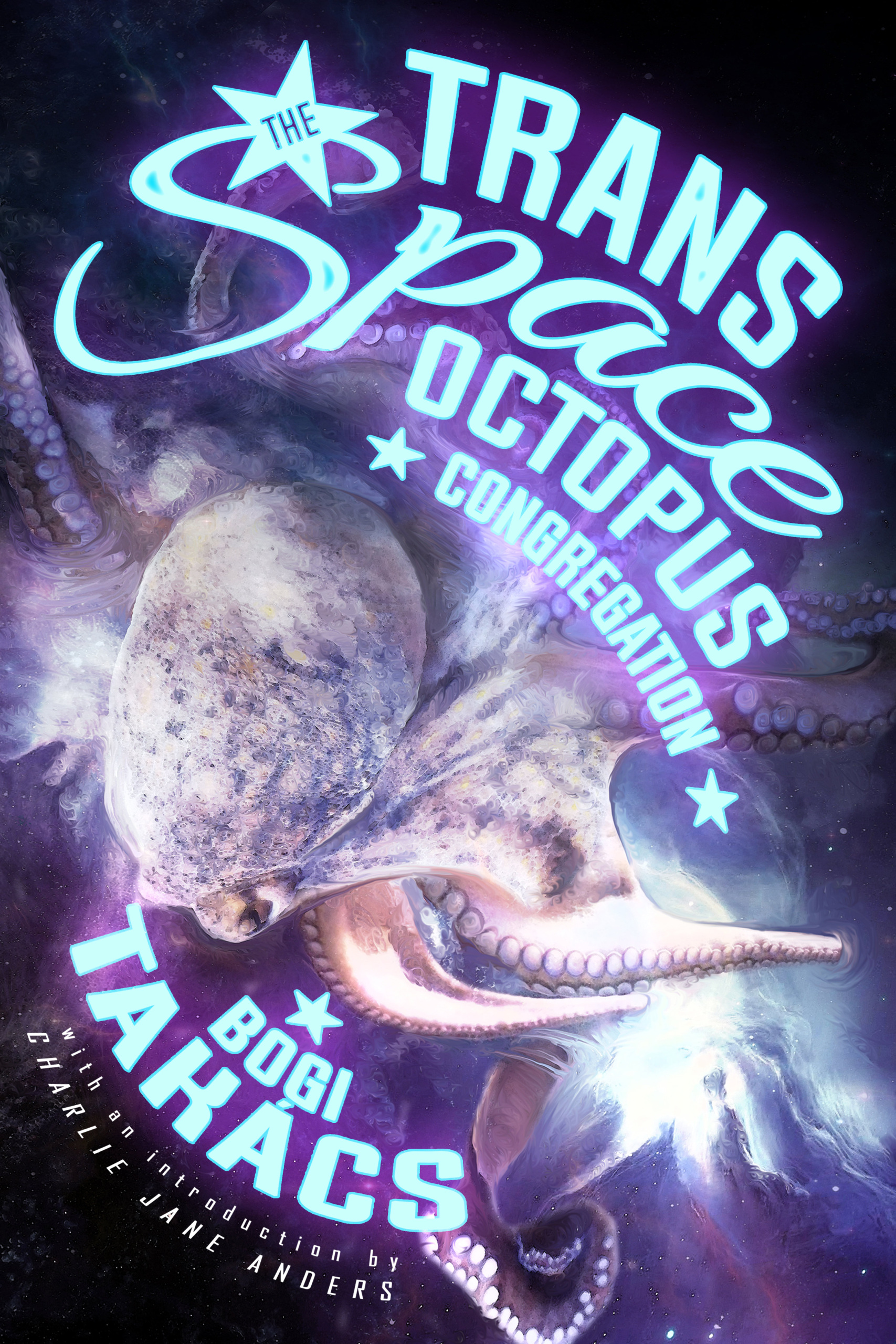
The Trans Space Octopus Congregation by Bogi Takács
Image result for the trans space octopus congregation

Let's get the obvious out of the way first: titles don't come much better than this. Takács' debut short fiction collection (I believe e has also released a poetry collection this year) is the very best kind of "does what it says on the tin": the kind where the tin has an exquisite purple octopus on the front and the word "space" in a cursive font and queerness front and centre in the title. Its a cover holding a dense and varied set of stories, ranging from near-future slice of life to magical space speculation, all wound through with some fascinating thematic resonance and centring characters whose nuanced identities require no explanation or excuse, regardless of whether the characters experience marginalisation in their own contexts (and often they do). Themes of marginalisation and difference in all their forms are ever present, whether they are front and centre of the narrative or just another consideration for characters to work in, and there's a nuanced treatment of how characters communicate across experiential divides, usually handled with sympathy though not always with success, that makes for some great interpersonal arcs packed into the small packages here.

Another theme that jumped out of me while reading was the many stories that deal with how people maintain community and tradition: whether it be the octopus protagonists of "Some Remarks on the Reproductive Strategy of the Common Octopus" or "A Superordinate Set of Principles", the deeply affecting refugee/alien invasion story of "Given Sufficient Desperation", or the many stories centring Jewish communities (spacefaring and otherwise). Takács makes an art form of offering up windows into worlds which don't feel the need to overexplain or overcomplicate their specific, nuanced traditions, while still ensuring that everything feels deliberate and well-placed within the story contexts. Particularly in more overtly science fictional stories, it feels like there's a deliberate rejection of the dichotomy between the behaviour of "rational" human behaviour and the traditions of myth, belief and ritual which often get left at the door as soon as there's a spaceship involved. It helps that the prose is so consistently beautiful, offering an otherworldly quality even to more straightforward tales. I came out of The Trans Space Octopus Congregation feeling like in many ways I'd only skated the surface of what Takács had to show me in this collection, and I'm keen to see what e comes out with next.

Rating: 9/10

Beneath Ceaseless Skies (284, 287)


Beneath Ceaseless' Skies "two stories every two weeks" format has been posing an unfortunate challenge to my particular review capacity - individual issues feel like there isn't enough to talk about, but by the time I reach critical mass I've forgotten what stories are in which issues, and probably fallen behind on individual issues as well. A couple of issues have stood out over the past couple of months, though, hence the slightly eclectic issue selection in this roundup.

Issue 284 brings together a pair of stories which work beautifully together: both are tales told through an academic lens of dubious interpretive value, dealing with narratives within narratives and the unreliability of mirrors. If those feel like quite specific similarities, what's even more impressive is how different each story feels within those constraints: "The Mirror Dialogues" by Jason S. Ridler is a series of fragments which cover the relationship between a "mirror scribe" and their sovereign, and the way the relationship between the two shapes the world around them. It's a story which keeps the reader guessing as to what's real and what's really going on, and the academic lens really allows that uncertainty to shine, letting us look back at a fictional history as uncertain as our own and to make our own judgements about the external interpretation and the events themselves. In contrast, M.E. Bronstein's "Elegy of a Lanthornist" offers up the story, in her own words, of Isabel Hayes-Reyna, a scholar herself who is recognised for a groundbreaking interpretation of an earlier text, whose dark magical elements she herself starts to experience, with grim and apparently tragic consequences. Of course, because we are engaged as readers of fantasy, we are far more inclined to take Isabel's path of discovery seriously than her contemporaries, whose dismissive and pitying attitudes towards her apparent disappearance come across more as condescending than as an interpretation to be taken equally seriously. An impressive pair made stronger by the pairing.

Of equal note is the double Issue 287, with four original stories - all quite long - for our reading pleasure. We start off with a darkly humorous entry from K.J. Parker, "Portrait of the Artist", about a young woman who has discovered a rather unpleasant way to try and raise the capital for an investment that should bring her feckless family out of (relative) destitution. Its a story whose protagonist is deeply engaging despite not exactly being sympathetic, and the recurring motif on the value of money - and other things - is darkly entertaining and also plays with our sympathies in interesting ways. The issue follows that up with "Sankalpa", a time-skipping reincarnation story from Marie Brennan, drawing on Indian myth to tell the story of a woman engineering a revenge that's lifetimes and huge wars in the making.

"One Found in a World of the Lost" weaves together the story of two very different twins, Pavitra and Gayatri, living in a community increasingly struggling to survive against the will of the ground they live on. When Gayatri, the far better hunter of the two, is killed unexpectedly, Pavitra has to deal with her loss and with her own feelings of self-worth and the skills she feels she lacks in comparison to her sister. Its a story that deals well with self-worth and coming into one's own in an intriguing setting. Finally, there's "The Witch of the Will" by Aaron Perry, about a witch who, having removed free will from a King, is asked to do the same thing by a young man who then forces her to deal with the consequences of his predictable actions. It's a story whose lighthearted, matter-of-fact tone hides a really dark core, and it packs a hefty punch into the decades of events it covers in its short length.

Rating: 8/10 for both of these standout issues.

The Dark, Issue 52

Image result for the dark issue 52

Three quarters of the stories in this issue of The Dark deal with women looking, in some way, for better lives, but that's basically the only thing they have in common. In "Brigid Was Hung By Her Hair From the Second Story Window" (original), Gillian Daniels tells the story of an immigrant from Ireland to Boston, who accepts an offer of marriage from the man who brought her over as a maid, only to have to give things up for a magical escape when his abuse becomes too much. She's given a second chance in the form of a better second marriage, but the feeling that there will be a reckoning for the "magic" which enabled her escape is borne out in a twisted way in the story's final words. The title is a great stylistic choice here, drawing attention to a turning point that otherwise could feel matter-of-fact in the everyday abuse of Brigid's first marriage, and underscoring her lack of agency and draws attention to the lengths she feels she has to go to in order to have even the most basic choices about her life. The issue's second story, "Our Town's Talent" (reprint), is told from the nameless collective perspective of a traditional modern town's wives, on the occasion of their childrens' school's annual talent show. After all the effort which goes into preparing their children to showcase their talents, a newcomer to the town rocks the boat by holding a show of her own in which a winner will be chosen, and upsets the balance of the town in a way that's unexpected and yet wholly fitting for a tale of this kind. Its a story which ends up being about agency, challenging our assumptions about the value of the undifferentiated feminine chorus at its heart and their complicity in their own mundane oppression. The result is something that, while not exactly uplifting, offers a form of escape that I found surprisingly satisfying.

Providing the second original story in this issue is Ruoxi Chen, with "The Price of Knives": a Chinese take on the Little Mermaid that ties elements of the myth to the historical practice of foot-binding. Its a story that could end badly for its mermaid protagonist, who makes a choice between giving up her voice or the sensation of walking on knives as the "price" for transformation (she chooses the price of song), only to discover a society on land that she has no chance of fitting in to, with a Prince whose professed affection for her ends up being as hollow as we'd expect. When foot binding takes away her autonomy and ability to walk, the mermaid finds an escape that will allow her to regain what she's lost, at a price that this time she's very willing to pay. Like "Our Town's Talent", the voice of the collective which tells this story is a great device, this time adding to the growing threat as we wonder who the second-person narrative, with all its asides about what the listener already knows, is aimed towards. Rounding out this month's offering is “All My Relations” by Bryan Kamaoli Kuwada (reprint), an own voices Hawai'ian story about how annoying disrespectful divers with cameras can be. I mean, no, it's not really about that, but I definitely relate to the "monster" here for that and many other reasons, and its a brilliant, dark story with teeth that made me add the anthology series its drawn from onto my Christmas list for this year.

Rating: 7/10

Clarkesworld Issues 155 and 156


I've had back issues of Clarkesworld piling up for the past few months as well, and in making the effort to catch up I read through August and September in quick succession. August turned out to be a great point at which to pick things back up, with some stories that run the gamut from fun slice-of-life (Harry Turtledove's scenes from an alternate-ice-age-Yorkshire vet employing an ingenious solution to a local mammoth's broken tusk) to heartbreaking human moments (Rachel Swirsky's "Your Face", about a mother visiting a "backup" of her daughter several years after her death). The story that took me most by surprise was Chen Qiufan's "In this Moment, We Are Happy", translated (seamlessly) by Rachel Kuang, which takes the form of a three-part documentary script on childbirth and technology over a period of decades. It's a surprisingly evocative format, and I found I could really follow along with not just the narratives themselves, but the descriptions of videography used in different scenes, the way things were cut together, all adding up to something that felt really tangible as the "intended" medium as well as the medium we actually have. In the three parts of the documentary, Chen weaves together a surrogate mother and a parent-to-be seeking to use a surrogate; followed by a man who has become pregnant for an artistic stunt and a same-sex female couple giving birth using only their genetic material; and finally a far-future fertility cult which is apparently developing a controversial transhumanist approach to a further-future reproductive crisis. Its all handled in a way that's deeply sympathetic to all of the characters, normalising queerness and offering agency and respect to characters from marginalised identities; even the male artist, whose motives are interrogated as selfish and bizarre, is offered a humanising arc, although it's the bluntest tool in a generally quite subtle toolbox. As is often the case in documentaries, there's no answers or single narrative line here - just windows into the lives of people whose different experience add up to something which resonates on a broader level. I found myself tearing up at the end of this story, having felt that I really had watched a window into these different peoples' lives through a camera lens.

Compared to August, September was slightly more subdued, although there's still some fun stuff here. "Dave's Head", by Suzanne Palmer, features a road trip with the titular object, who also happens to be a sentient animatronic dinosaur from an abandoned theme park. The story itself is just as weird and wonderful and surprisingly poignant as that sounds. I also greatly enjoyed the long novelette "To Catch All Sorts of Flying Things" by M.L. Clark, a mystery about interspecies cooperation and rights to life on a planet colonised by multiple species with more to it than initially meets the eye. While I struggle to keep up with Clarkesworld, and not all of their stories hit the spot for me, there's still a lot to enjoy in the kind of meaty short-form science fiction they publish, and the continued commitment to translated works is also a huge bonus.

Rating: 8/10 for August, 7/10 for September

POSTED BY: Adri Joy, Nerds of a Feather Co-editor, is a semi-aquatic migratory mammal most often found in the UK. She has many opinions about SFF books, and is also partial to gaming, baking, interacting with dogs, and Asian-style karaoke. Find her on Twitter at @adrijjy.

Wednesday, March 27, 2019

Adventures in Short Fiction: March 2019

March has been an interesting month on several fronts, and there have been more distractions than usual from reading - some good (i.e. involving dogs) and some less so. With the Hugo ballot deadline, awards shortlists starting to be announced, and a peak month for exciting novel releases in what's already feeling like an overwhelmingly good year, the habit of keeping an anthology or some stories going on the side has been trickier to maintain. Also, awkwardly for this column, for most of the month my go-to short fiction fix has been Worlds Seen in Passing, the enormous collection edited by Irene Gallo which collects many of the highlights of Tor.com's outputs over its first ten years. Around 75% of the stories are ones I haven't read before, and the quality is as high as you'd expect, but after over a month on the unicorn nightstand I'm still only just halfway through (it doesn't help that it's a 550-page doorstop hardcover that's impossible to read while commuting). Reviewing half an anthology is not the direction I want to take my life in just yet, but luckily I've also managed to put a few other things in my eyeballs between sled dog updates this March...

Beneath Ceaseless Skies Issues 270 - 272

I've been loving my Beneath Ceaseless Skies subscription so far, and these three issues - covering February and the first half of March - maintain the streak of stories which hit the right notes of worldbuilding, narrative and characterisation in a limited space, while always feeling like they're a window into so much more. Rating especially high on this front is Alix E. Harrow's "Do Not Look Back, My Lion" (Issue 470), in which Eefa, a woman who plays the stay-at-home husband role to her soldier wife struggles against the martial constraints of her society which threaten to destroy everyone else in her family. The casual reordering of family roles and decoupling from gender expectations reinforces the sense of an empire rich in its own history, tradition and bias which constrains Eefa and leads to her increasing desperation to try and protect those she loves. "Adrianna in Pomegranate", by Samantha Mills (Issue 471), also deals with families and grief, following a "calligromancer" in a world where written words hold power, and his attempts to overcome prejudice against his magic - as the ability of men to effectively practice calligromancy in this society is routinely called into question - and to recover his lost child. In both cases, the focus on small family dramas in a magical setting is also welcome, demonstrating that not every story in a sweeping fantasy setting needs to be a world-changing quest: the lives of ordinary people and families, away from dramatic events, are just as compelling.

In Issue 472, "The Boy Who Loved Drowning" is a fascinating story, about an apprentice to a diviner whose job is to dive to the bottom of a lake and capture true answers to questions. This method of divination is dangerous and antagonistic, with diviners trained to fight against the lake and its dangers to find their answers: at least, until Kal comes along. Unlike his master and her peers, Kal learns how to work cooperatively with the lake to find answers, but his ability is inevitably seen as a threat by the older generation and leads to the lake providing an answer that's as inevitable and fitting as it is brutal.

Rating: 8/10
Fireside Magazine, January - March 2019 (mostly) (read online)

This quarter of Fireside packs a big punch into its short-side-of-short fiction offerings. The vast majority of stories here are well under 1,000 words - the shortest don't even stretch two pages on my e-reader - but even when they're just fleeting images or brief moments between characters, these pieces often leave an impression that goes way beyond the space they take up.

Having said that, the story which stuck with me most from this selection is one of the longest: "By the End of the Week", a fabulously subversive magical girl story by Brandon O'Brien. O'Brien sets up expectations in his first section - a high-performing student forced to do a group project with a girl he sees as lazy and fixated on partying - and proceeds to completely turn the set-up on its head by revealing that Kelly is not lazy, but trying to save the world from aliens without compromising her secret identity or failing at school. It's a great piece of coming of age 2.0: a text that focuses on self-actualisation milestones like establishing self-worth and boundaries, and understanding when you need to let another person make their own choices about you and focus on doing what makes you satisfied rather than seeking approval from those not disposed to give it. Derek doesn't come around at all to Kelly by the end, and seems to learn nothing from the experience of working with her, but the narrative is nevertheless fairly gentle with his perspective even while it shows up the unreliable, limited perspective of his narration, and gives the ultimate victory - with just a hint of bittersweetness - to Kelly and her ability to make it through the week.

Of the flash fiction-length pieces, the first pair in March were particularly memorable: "Parasitismo", by Alberto Chimal and translated into English by Julia Rios, is a deeply unsettling take on the psychology of myth involving brain-eating mermaids, and "The Blanched Bones, the Tyrant Within" by Karen Osborne, a lush story about women sacrificed to a dragon who find something rather different in the cavern they are sent to find it. Special mention must also go to February's "Symphony for the Space between the Stars", about a spaceship trying to fulfil its directives and keep its crew happy long after the crew themselves have departed. The theme reminded me of the achingly creepy Soviet short film of "There Will Come Soft Rains" by Ray Bradbury, but it's nowhere near as hopeless, and the journey to understanding and connection which the ship takes is well-realised and delightful.

Finally, a bonus from the archives: since it became a Nebula finalist, I finally got around to reading "The Secret Lives of the Nine Negro Teeth of George Washington". P. Djeli Clark's story takes one line from a Mount Vernon historical record - the purchase of nine "negro teeth" for George Washington's dentures - and spins a myth of personhood and the subversion of control which takes place against an unfolding magical alternate history. As the tale of each tooth is told, the story goes from ascribing them to archetypes ("a blacksmith"; a "Bonny Lander") to offering up names, histories, hopes, dreams, alternate dimensions, and lives lived with as much humanity as possible under the constraints of slavery. In contrast, the famous wearer is given no agency or development and is a passive recipient of each tooth's strange magical powers. I had to revise my Hugo short story nominations after reading it, and you should certainly check it out too.

Rating: 8/10 (with a 9 for "The Secret Lives")

FIYAH literary magazine: Issue 9

This is the first unthemed issue of FIYAH and its stories weren't quite as memorable for me as those in the two preceding it, although there's still plenty of cool concepts, especially in the stories that focus on illness and death. This issue's novelette is by Nicky Drayden( a Nerds of a Feather favourite): called "The Rat King of Spanish Harlem", it dives deep into a concept combining body horror and societal change, through the eyes of Alicia, a woman working for a debt collection agency who wants the world to be a kinder place but isn't prepared for it to happen as a viral epidemic which she herself is resistant to. The disease, which affects people at work as well as her husband Javier, turns formerly mean people into kind, collaborative individuals (yay), then causes them to grow tails (hmm) which become intertwined with other infected people (nope) in ways which affect their identities and bodies still further (NOPE). For Alicia, watching this change happen from the outside, and particularly the way it affects her relationship with a husband who she was ready to leave before the infection, is a deeply complex experience: one which brings benefits and horrors in equal measure which she has no power to control. It's a weird, well-executed story with no easy answers.

Similarly good, though dealing with much darker and more difficult subject matter, is "Notes on the Plague" by Shamar Harriott, which tells of a world in which black men suddenly start coming down with a mysterious, fatal illness which only affects their group. It's a premise that draws as much on the AIDS epidemic as it is of the racist devaluing of black lives, particularly those of men, in our own societies, and the protagonist - a queer black man who watches his friends and lovers start to disappear - sits in a heartbreaking front seat to watch the devastation the epidemic causes with no compassionate response from the authorities.

Rating: 7/10
Clarkesworld Issue 150 (March 2019) (read online)


There's a hefty dose of death and decay and adaptation at extraordinary costs in Clarkesworld this month, including a reprint of Catherynne M. Valente's fantastic "The Future is Blue", set on a post-apocalyptic trash island, as well as a story of failed birth and hopeful exploration in D.A. Xiaolin Spires' "But, Still, I Smile", the slow death of a former astronaut in "When Home, No Need to Cry" by Erin K. Wagner, and a world so dystopian that the inhabitants have literally forgotten to laugh in Rich Larson's "Death of an Air Salesman". The last focuses on a pair of characters who both rent the same sleeping cubicle for a few hours a night, and their attempts to actually get to know each other like human beings in a world where such behaviour has been all but forgotten. It's impressive how the naively sweet romance between the protagonists is maintained despite the constant stream of small, awful details of their lives: the narrator has no cultural referents beyond gory cartoon images or hardcore pornography, and in their first experience of sex the two are unable to pay for the privacy settings necessary to not have their encounter filmed and, presumably, broadcast. Grim but rewarding.

"Treasure Diving", by Kai Hudson, also contains moments of hope within its precarious society, this time an aquatic people reliant on energy from a radioactive substance which kills their workers even as it keeps their homes alive. And then there's the gleeful carnage of "The Thing with Helmets", with its casual death-bringing aliens and accidental roller-derby inspired first contact and glitter-infused helmets of unimaginable power and corruption. Put together, it's not exactly an uplifting issue, but there's enough points of light to make it a great read even when you're caught in the midst of its miserable themes.

Rating 7/10
The Inconvenient God and The Lilies of Dawn (Annorlunda Press)


Annorlunda Press is a small independent publisher which releases standalone short fiction in both e-book and print form. In a shameless "judge a book by its cover" exercise, I treated myself to paperback copies of the two stories that come with cover art by Likhain: Vanessa Fogg's The Lilies of Dawn, from 2016, and The Inconvenient God by Francesca Forrest, published in 2018. Sure enough, both are gorgeous (if I'm being picky, The Inconvenient God's cover is a little darker than the screen version above, but it's still amazing and The Lilies of Dawn comes in such a fetching pink that it all balances out). Potential readers might like to know if these novelettes recommend themselves beyond the pretty covers, and I'm delighted to report that they very much do! 

This pair of stories are both about the mortal world's dealings with gods, though the similarities end there. The Inconvenient God begins with an official arriving at a university to "decommission" an annoying minor God of mischief: a process which usually ends up with the God becoming mortal, unless they already ascended from mortality to godhood in the first place. From there, it jumps off into a beautifully constructed tale of empire and assimilation, asking pointed questions through its narrative developments about how our institutions define and alter their own histories, and who gets to decide what is worth remembering. Like the stories in Beneath Ceaseless Skies mentioned above, there's a beautiful balance here between presenting a narrative that works at novelette length, while providing a window on a world that feels real and complex and full of untold potential.

The Lilies of Dawn
accomplishes a similar feat, although there's a core of sadness and loss here which, somehow, feels more irreparable than The Inconvenient God's matter-of-fact treatment of lost languages and forgotten pasts. The protagonist, Kai, is the daughter and heir of a woman tasked with looking after a beautiful, god-touched lily field, whose plants provide medicine and healing but are now under threat from an army of cranes. When a mysterious visitor shows up promising to save the flowers, Kai has to balance her hopes for the future of her family, her people and her now sick mother with caution about what this stranger represents - which, sure enough, turns out to be much more than he had initially told her, and somewhat less than he promised. It's a story which provides no answers to its conflicts even while it shows us the sympathetic side of everyone involved, and there's a tragic inevitability to its conclusion which hurts in the best possible way.

Ratings: 8/10

POSTED BY: Adri is a semi-aquatic migratory mammal most often found in the UK. She has many opinions about SFF books, and is also partial to gaming, baking, interacting with dogs, and Asian-style karaoke.

Wednesday, January 30, 2019

Adventures in Short Fiction: January 2019

As we wave goodbye to the first month of 2019 (I know, right? what even is time and why does it move so fast) I'm back with more thoughts on some recent short fiction, and I'm happy to announce that this is going to be a regular feature! At the end of each month, I will be taking some time to run through the rotating selection of mostly-recent magazines and anthologies that have recently crossed my eyeballs (and hopefully also my brain), and sharing some of the highlights and general impressions with you.

As I mentioned in my "pilot" roundup last month, short fiction is a new area for me and I'm still trying to establish how I can best engage with some of the amazing writers and publications in this space. I hope, therefore, that this monthly column will be useful not just for those interested in finding good stories, but especially for fellow readers who find themselves stuck in endless "I should read more short fiction but what and how" thoughts. I'm here for you, friends; let's do this together.

Without further ado, let's jump in to this month's stories:

A Thousand Beginnings and Endings ed. Ellen Oh and Elsie Chapman (2018).


This is an anthology of Asian fairytale retellings by Asian authors, bringing a range of folklore, legends and ghost stories from across the continent into new perspective. Most of the authors in this collection are new to me and while I was expecting variety in the myths and cultures represented ("Asia" encompasses over half the world's current population, after all), what I didn't anticipate was the even wider range of genre and angles of adaptation taken here. There's several straightforward retellings, which take place in recognisably "fairytale" settings even as they change the voice and agency of the story's characters ("The Crimson Cloak" by Cindy Pon leaps out here). However, there's also several stories that play with science fiction and speculative futures, including "Steel Skin" by Lori M. Lee with its take on artificial intelligence; urban fantasies like "Code of Honor" by Melissa de la Cruz with its melding of Aswang and western teen vampire stories; a take on time travel from a deeply mundane perspective in "Spear Carrier" by Rahul Kanakia; and even a spot of lovely female-friendship centred contemporary YA in "Girls Who Twirl and Other Dangers" by Preeti Chhibber.

There's also a strong thread of diaspora experience running through many of the stories, including Chhibber's tale mentioned above, as well as an interesting ghost story from Alyssa Wong, "Olivia's Table", which sees a woman taking on the mantle of her mother in catering to the needs of spirits congregating on an Arizona hotel. This category also includes my favourite story overall: "The Land of the Morning Calm" by E.C. Myers, which translates multiple narratives from Korean folklore, particularly the Chasa Bonpuli, into a tale of identity, loss and online gaming, as a young woman processes the death of her mother at a video game conference and the imminent shutdown of the server where her entire family used to immerse themselves in the world of the titular Land of the Morning Calm game. The speculative elements transition nicely between the real world and the world of the game, and there's a lot of interesting and complex emotional material here.

The stories are followed by short explanations talking about the original myth and the intention behind the adaptation, which is a feature I really like in anthologies. Here's it's helpful for really understanding the background and context to the adaptation; when the intention is to bring stories from outside mainstream western cultural consciousness to the attention of a wider audience, it's great to have space to really understand what the author intended to achieve and where it's coming from. Overall, this is a highly recommended collection (and one which, as a 2018 original anthology, is eligible for Hugo nominations now now now!)

Rating: 8/10

Strange Horizons: October and November 2018. (Read Online - Links Below)


I read Strange Horizons through their Patreon subscription issues, which are a handy way to get each month's content in an easy e-book format. Useful as this is, the drawback is that each month's "omnibus" only comes out partway through the following month, which means I am always quite far behind compared to the weekly output of new issues on the site. Also, this roundup doesn't include the fundraising drive stories which came over this period, which have been collected for backers in a separate ebook and are also available online. The silver lining to this delayed coverage is, of course, that all the original stories here are eligible for Hugo awards right now, should you wish to check them out (and also they didn't stop being good, relevant stories just because they were published three months ago.)

There are three original stories in the October edition, encompassing very different voices with strong sense of place and a running theme of death and loss. Fans of Aliette de Bodard's 2018 short novel In The Vanishers' Palace will find a rather different-feeling woman-dragon relationship in "The Palace of the Silver Dragon" by Y.M. Pang (1 Oct), a story which really leans into its protagonist's feelings of grief and frustrated lack of agency both in her present and in the memories of her past. The sea-dwelling slave-descended folk of "De MotherJumpers" by Celeste Rita Baker (15 Oct) - playing on a longstanding Afrofuturist concept similar to the society in Clipping's The Deep - provide background for a similarly dark and grief-heavy tale of loss and how it stretches ties within a community to breaking point. Isabel Yap's "Asphalt, Mother, River, Child" (8 Oct) deals, to devastating effect, with the deaths of innocents in the Philippines as a result of the country's destructive, discriminatory "war on drugs", bringing a fantastic sense of place and character (including use of Filipino vocabulary, for which the story provides a glossary at the end). After all that, the two reprints in the 29 October issue are a welcome shift into lighter storytelling, including the possibly-too-smutty-for-me-but-still-excellent "Fisherman" by Nalo Hopkinson.

November also brings some strong material to the table, including Chimedum Ohaegbu's weird fairytale, "Toothsome Things" (19 Nov), and the sweet "Missed Connections" by Alena Flick (12 Nov). However, it was "Some Personal Arguments in Support of the BetterYou (Based on Early Interactions)" by Debbie Urbanski (5 Nov) that most successfully broke my heart. It's the story of an asexual woman trapped within an unsupportive family, who is encouraged to create a better version of herself through technology in order to provide them with the love and attention they "deserve". The protagonist's attempts to communicate her wants and needs and to push back against the one-way expectations levelled at her are contrasted with the total resignation with which she starts and ends the story, a resignation which is framed as generational but more fundamentally asks "why shouldn't we just be someone easier for our loved ones to manage?" It's a question which, among progressive communities that encourage self-identification and acceptance, we're not supposed to ask in seriousness, but in presenting a speculative "solution" Urbanski drags that unspeakable doubt into the open, and forces us to confront it in a difficult but compelling way.

Rating: 7/10

Clarkesworld Issue 147 (December 2018) (Read Online)


Clarkesworld is a publication that's been on my radar with the occasional - usually excellent - story for a long time, and this year I've cemented my commitment to reading their work by taking out an ebook subscription. The first issue I got through this was actually the last of 2018, but it's a good place to start as it squeezes an extra new story in, with just a single reprint from the six overall pieces. It's a rollercoaster of interesting science fictional concepts, from the slightly skewed augmented reality tech of D.A. Xiaolin Spires' "Marshmallows", to the supposedly empathy-generating implants given to the young protagonist of "The Names and Motions" by Sheldon J. Pacotti, to the commodified air and its international impacts, told through a breakneck international conspiracy, of "Bringing Down the Sky" by Alan Bao. What these stories share is a sharp, effective focus on the speculative elements and the parts of the story (be it character, place or plot) that bring out the most interesting (and, in this issue, generally negative) implications. My personal favourite of the issue was "When We Find Our Voices" by Eleanna Castroianni, which deals with the relationship between "Sons of Man" - a group of all-male humans - and an "Adapted" race of bird-like people with three genders and complex, human-compatible reproductive abilities. At the point of the story, humans have managed to subjugate and exploit the Adapted. It's told through the relationship between two Adapted - a third-gendered "Etu" whose role in reproduction is to bring together genetic material from the other two partners (I had some strong Octavia Butler feels here), and their male partner, who is forced into a marriage (technically they both are) with a human man in order to give him a child. Both characters' increasing dissatisfaction and questioning of their society and the things they are forced to do plays out in different ways, and I could easily have read twice as much about these characters and the fascinating, if grim, world they inhabit.

As many readers will know, Clarkesworld has an ongoing focus on bringing Chinese science fiction in translation to the English-language market, and this issue brings “Master Zhao: The Tale of an Ordinary Time Traveler” by Zhang Ran, translated by Andy Dudak. I wasn't quite sure what to make of this one initially - it doesn't help that it's not a super smooth translation, although I'm confident it gets across the message of the original - but by the end I was very invested in the story of Zhao, who finds himself constantly travelling back to points in his own timeline - generally after disasters befalling either himself or his chronically ill wife - and can make different decisions to try to bring about a better outcome. Zhao's story is being told within the narrative to Zhang, an unemployed 30 year old living rent free in Beijing, and that framing is used to explore the practicalities of Zhao's ability (there are many diagrams involved). But I think the story's most compelling aspects lie in how it exposes the sense of inequality and hopelessness in which Zhao, a working class man in a country with no social safety net, is forced to repeatedly confront the limitations of his own position and his inability to find better support for his wife.

Rating: 8/10

Beneath Ceaseless Skies Issues 268 and 269, January 2019 (Read Online 1, 2)


I'm also new to Beneath Ceaseless Skies' subscription, but I've consistently enjoyed the fiction I have read from them and this pair of issues (they release two stories biweekly, I think?) was a great start to my more regular commitment. The first kicks off with "The Blighted Godling of Company Town H", by Beth Cato, in which an abandoned guardian struggles to protect her people from decay and destruction, in a world where the company that originally formed them is clearly long gone. "The Beast Weeps With One Eye" by Morgan Al-Moor is a story of ravens and havens. To be more specific, it's about people finding havens to save them from ravens. To be even more specific and perhaps a bit less flippant, it's a neatly situated fantasy story about the last of a tribe, the Bjebu, who have fled destruction only to find they need to make an offering of three sorrows to the Father of all Ravens. It's worth spending the time on, and as a debut author Morgan Al-Moor is one to add to your Campbell watchlists.

I liked "La Orpheline" by Jordan Taylor, a historical urban fantasy with an operatic setting, but the story that really struck me in Issue 269 was "The Deepest Notes of the Harp and Drum" by Marissa Lingen. What I love about this tale is how matter-of-factly amoral it is: the narrator tells us within the first page that she has killed her sister over what can only be described as dubious provocation, and the story is mostly about her and her new partner attempting to escape any repercussions from those past crimes. The women recount their struggles in a way which is so reflective of the way we expect wronged parties' troubles to be addressed in fairy tales that it's very hard not to root for them, and the "moral" that the creatures of the wider world have better things to do than pay attention to humans, even when they are murdering each other for fun and (maybe) profit, is neat on one level but introduces some real "wait... what?" moments on further consideration. It's fascinating to have the trappings of this kind of story used to tell "here's a couple of complicated but frankly Not Great people making peace with their consciences and getting away with murder", and assuming it was an intentional subversion, I really like the food for thought it brings.

Rating: 8/10

Uncanny Issue 26, January-February 2019. (Read Online)


The last couple of Uncanny Magazine issues have knocked it out of the park to the extent where it almost feels unfair to compare this issue to what's gone before. That said, I did struggle somewhat to connect with some of the fiction here, in which every story appears to be an involved family drama, or a quiet post-apocalyptic moment, or an involved family drama after the apocalypse. That might be my failure as a reader to give every story enough space to sink in as a distinct entity, but the only imagery that really stood out was Fran Wilde's story, "A Catalog of Storms", which brings her trademark skill at weird worldbuilding and applies it to a tale of sentient storms. It's safe to say I am a guaranteed customer for Wilde's future short story collection as and when it comes out, but even the story here didn't make a huge impression on me beyond the "hook". Beyond Wilde, I did like some of the other things in here too: "The Willows" by Delilah S. Dawson is a really creepy, claustrophobic tale of haunting in an isolated farmhouse, and Dustdaughter by Inda Lauryn recounts the story of a young girl coming into her power against her mother's wishes and is also pretty great. There's also a reprint of "The Duke of Riverside", an Ellen Kushner story which recounts a pivotal moment in the Tremontaine-Riverside saga. Overall, though, I came out of this feeling like the juxtaposition of this particular group of similar, quiet tales left me struggling to do justice to each story in turn - perhaps they'll work better for me on a revisit someday.

Rating: 6/10

POSTED BY: Adri is a semi-aquatic migratory mammal most often found in the UK. She has many opinions about SFF books, and is also partial to gaming, baking, interacting with dogs, and Asian-style karaoke.