Given last year's caustic battle over the Hugo Awards, as well as the generally caustic nature of U.S. politics in 2016, you might be forgiven for assuming that the 2016 Hugo Awards would be yet another battleground in the never-ending (and endlessly tiresome) culture wars. Only it isn't looking that way, in part because the Sad Puppies have followed up last year's politically partisan and highly divisive slate with a longlist of recommendations that…isn't partisan or divisive at all.
Sure, there are individual selections that might annoy those who are not political fellow travelers, but there are also a decent number of selections for or authored by progressives, liberals, public advocates for social justice, objects of past ire and outspoken critics of last year's slate--hell, there's even one for John Scalzi, and another for Ann Leckie. In other words, it doesn't seem like partisanship was the operative selection criteria for their voters. There's also considerable overlap with our longlist (parts one, two, three, four)--one or two selections in most of the categories.
Bottom line: Sad Puppies 4 isn't a slate, makes some good recommendations and abandons the antagonistic culture wars approach for an alternative that might build rather than burn bridges. I like it. In fact, I like it so much, I'm going to start checking out the other stuff on their list--the stuff I haven't read and probably never thought to read.
***
POSTED BY: The G--purveyor of nerdliness, genre fanatic and Nerds of a
Feather founder/administrator, since 2012.
- Reviews
- _Book reviews
- _Film and TV Reviews
- _Game Reviews
- _Thursday Morning Superhero
- _Short Fiction Reviews
- Lists
- _New Books Spotlight
- _6 Books Posts
- _We Rank 'Ems
- Features
- _Interviews and Blogtables
- _Talking About Books
- _The Hugo Awards
- _Mini-Projects
- Projects
- _Nerds on Tour (2020)
- _The Hugo Initiative (2019)
- _Feminist Futures (2018)
- _Dystopian Visions (2017)
- Meet the Flock
- Review Policy
- Home
Thursday, March 17, 2016
Thursday Morning Superhero
While I didn't get to enjoy the festivities due to work, there was a minor invasion from the comic book world this past week in my hometown of Austin. The big news, at least in my opinion, was the debut of the first issue of Preacher. Produced by Seth Rogan and airing on AMC, Preacher is an adaptation of Garth Ennis' comic published by Vertigo. While I heard it is not completely true to the comic in a literal sense, it maintains the dark tone of the comic and should appeal to even the hard core fans. Look for it on the airwaves this summer.
Pick of the Week:
Huck #5 - Huck and his mom have been captured and it doesn't look good for the pair. There will be some minor spoilers in this review so if you are concerned about that you should move on to the other books I read this week. If you haven't read this series then I highly recommend going back from the start. Mark Millar has once again delivered a truly stunning series. That should be enough of a buffer. In this issue we learn that Huck's mom had been held captive in an attempt to serve as a surrogate mother for a series of super soldiers. She has the ability to control what someone thinks if she touches them, and the two find themselves trapped behind reinforced glass. The new plan is for Huck to be a stud of an entire generation of super soldiers. This is setting up for an amazing finish for what has been a breathtaking series. Rafael Albuquerque and Dave McCaig really bring Millar's vision to life and we finally get to experience an angry Huck. I think I am going to enjoy this angry Huck.
The Rest:
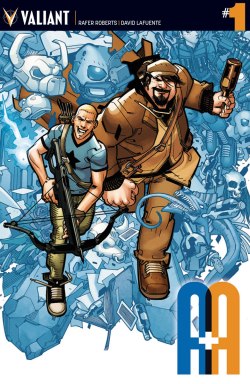
A&A: The Adventures of Archer and Armstrong #1 - If you aren't familiar with these Valiant characters, Armstrong is an immortal being, possibly the devil himself, who has spent the past 7,000 years drinking and partying with some of history's greatest figures. Archer is a teenage martial arts expert who has been raised to kill the devil incarnate. Fortunately for Armstrong, the two became friends. This new series opens as the duo takes a trip into Armstrong's magical bag. If that doesn't sound exciting enough, you should know that the bag is home to a library, a crew of goblins, trash monsters, a fully stocked bar, and much, much, more. I will be honest and state that I haven't read much of either of these characters, and immediately regret doing so. This series is packed with humor and insane action and was an absolute blast to read. I didn't even get into the details about Archer's sister Mary-Maria, head of the Ninja-Nun Assassins or Davey the Mackerel, some sort of sarcastic fish-man who resides in the bag. Really fun debut that has me searching for back issues of Archer and Armstrong to learn more about this duo.
Usagi Yojimbo #153 - This is a series that I am familiar with and one I have always been interested in, but for some reason have not read any of it. This issue marked a part 1 of an arc called Kyuri so I thought I would give it a read. Usagi is confronted by a savage Kappa who seeks to undo a truce that Usagi's people have made with the local Kappa population. Kappa's are part turtle, frog, and monkey and from what I gather have always been a nuisance to Usagi's people until the truce was reached. The comic has a vintage feel to it and was quick and to the point. Stan Sakai has been writing and drawing this series for many years and it is clear he knows his characters well. Definitely an enjoyable title and one that I will revisit down the road.POSTED BY MIKE N. aka Victor Domashev -- comic guy, proudly raising nerdy kids, and Nerds of a Feather contributor since 2012.
Wednesday, March 16, 2016
Microreview [book]: Eagle in Exile by Alan Smale
Lazy River
(Note: This is a review of the 2nd book in the Clash of Eagles trilogy. No particular care will be taken to avoid spoiling any parts of the first book, Clash of Eagles. My review of Clash of Eagles can be read here. The spoiler-free review of this book is that readers should continue to read the series through this transitory phase, even though it's a bit more meandering than I would've liked.)
Eagle in Exile picks up shortly after the ending of Clash of Eagles. The Cahokians are picking up the pieces after their battle with the Iroqua, and much of the blame is cast at Gaius Marcillinus's feet. Gaius, continuing to struggle between his Roman past and his Cahokian present, looks for ways to make himself more useful by preparing the Hesperians for the impending Roman invasion. He knows it's coming, and he does what he can to prevent all-out war between the two peoples, despite his very precipitous position within Cahokia.
Eagle in Exile functions a lot like a fish-out-of-water world tour, except the world is ancient America. Without throwing out much of the twists in the plot, Gaius finds himself traveling west, east, and south of Cahokia, meeting the people of those regions respectively. They're all given unique treatment, guided by the extensive research Smale has done. Gaius is often accompanied by translator or interpreters, so the language barrier is lower, and we get down to ideological differences faster than we do in Clash of Eagles. It works great to keep the story moving and not bogged down by the semantics of communicating with different people.
The story also continues the complicated relationship between Gaius and the Cahokians he holds most dear. The will-they or won't-they between him and Sintikala progresses significantly. The younger Cahokians also continue to gain and lose trust in Gaius as he shows himself to be a very human character. Sometimes he does things that don't make a lot of sense beside "It sounded like a good idea at the time".
While I generally enjoyed this back and forth, and the story is punctuated with frequent tension and conflict, the general plot doesn't come into focus until late in the story. It feels a quite meandering and the definition of a "middle book" story. It's just carrying us from the introduction to the (surely) large-scale conclusion. When I was getting toward the end, I finally determined that the current thing threatening Gaius was probably going to get resolved somehow, and it happened to be something that was referenced frequently throughout the rest of the story. There's a definite through-line from beginning to end, but it feels so small and far away at the start that it could've been the plot of the third novel.
Though Eagle in Exile suffers middle book syndrome, I'm still invested in this story and will see it through to the end. It continues to be a believable work of alternate history that weaves an interesting story, even if the plot is too blurry at the start to be particularly obvious. It ends on a note that makes the plot of the next book obvious from the start, and I want to see where it goes.
(Note: This is a review of the 2nd book in the Clash of Eagles trilogy. No particular care will be taken to avoid spoiling any parts of the first book, Clash of Eagles. My review of Clash of Eagles can be read here. The spoiler-free review of this book is that readers should continue to read the series through this transitory phase, even though it's a bit more meandering than I would've liked.)
Eagle in Exile picks up shortly after the ending of Clash of Eagles. The Cahokians are picking up the pieces after their battle with the Iroqua, and much of the blame is cast at Gaius Marcillinus's feet. Gaius, continuing to struggle between his Roman past and his Cahokian present, looks for ways to make himself more useful by preparing the Hesperians for the impending Roman invasion. He knows it's coming, and he does what he can to prevent all-out war between the two peoples, despite his very precipitous position within Cahokia.
Eagle in Exile functions a lot like a fish-out-of-water world tour, except the world is ancient America. Without throwing out much of the twists in the plot, Gaius finds himself traveling west, east, and south of Cahokia, meeting the people of those regions respectively. They're all given unique treatment, guided by the extensive research Smale has done. Gaius is often accompanied by translator or interpreters, so the language barrier is lower, and we get down to ideological differences faster than we do in Clash of Eagles. It works great to keep the story moving and not bogged down by the semantics of communicating with different people.
The story also continues the complicated relationship between Gaius and the Cahokians he holds most dear. The will-they or won't-they between him and Sintikala progresses significantly. The younger Cahokians also continue to gain and lose trust in Gaius as he shows himself to be a very human character. Sometimes he does things that don't make a lot of sense beside "It sounded like a good idea at the time".
While I generally enjoyed this back and forth, and the story is punctuated with frequent tension and conflict, the general plot doesn't come into focus until late in the story. It feels a quite meandering and the definition of a "middle book" story. It's just carrying us from the introduction to the (surely) large-scale conclusion. When I was getting toward the end, I finally determined that the current thing threatening Gaius was probably going to get resolved somehow, and it happened to be something that was referenced frequently throughout the rest of the story. There's a definite through-line from beginning to end, but it feels so small and far away at the start that it could've been the plot of the third novel.
Though Eagle in Exile suffers middle book syndrome, I'm still invested in this story and will see it through to the end. It continues to be a believable work of alternate history that weaves an interesting story, even if the plot is too blurry at the start to be particularly obvious. It ends on a note that makes the plot of the next book obvious from the start, and I want to see where it goes.
The Math
Baseline Assessment: 7/10
Bonuses: +1 provides a broader view of ancient American cultures
Penalties: -1 it's the middle book, and it shows
Nerd Coefficient: 7/10 (an enjoyable experience, but not without its flaws)
***
POSTED BY: brian, sci-fi/fantasy/video game dork and contributor since 2014
Reference: Smale, Alan. Eagle in Exile [Del Rey, 2016]
Tuesday, March 15, 2016
Reading The Deverry Cycle: Act One: Deverry
Welcome to the first installment in a series of four essays
focused on Katharine Kerr's Deverry Cycle. This is similar to the work
I'm doing on Kurtz's Deryni novels, except this is my first time reading
/ experiencing Deverry rather than revisiting my old Deryni friends. To
be completely upfront and honest about this, we shouldn't expect to
see the Act Two essay until this time next year at the earliest. It's
possible, but doubtful that I'll have read the four books of the
Westlands Saga by then. It should also be noted that because I'm talking
about and around the first four Deverry novels together, I will mention
how events from the first book resolve in the fourth.
To greatly simplify a powerfully complicated series of relationships and events, the inciting incident of Katharine Kerr's novel Daggerspell is this: Galrion (a prince) is betrothed to Brangwen. He loves her and she loves him. The only problem that Galrion sees is that what he really wants to do in life is study dwoemer (let's call it magic, shall we?). Dwoemer is his destiny, so even though Brangwen dearly loves Galrion (and has some potential for learning the dwoemer herself), Galrion chooses the dwoemer over Brangwen and is exiled by the King (also, his father).
But, before he leaves for exile, Galrion sets things up so that Brangwen can marry his best friend, Blaen. Blaen also loves Brangwen, who is now depressed and mourning Galrion. While Blaen struggles to convince Brangwen to love him, Brangwen's brother, Gerraent is trying to get his sister into bed with him and eventually succeeds. More depression and suicidal discussion is overwhelming Brangwen.
Gerraent, it should be noted hates Galrion, but is also friends with Blaen. It's a complicated small town circle of friendship and obsession. This is some dark and gloomy stuff, but it matters because what happens here sets up four hundred years of character and soul development for the rest of the series (or, at the very least, for the first four books).
Here's what happens next: Blaen and Gerreant are killed, Brangwen commits suicide, and the exiled Galrion, now known as Nevyn (meaning of name: no one). vows that he will not rest until he has made this right somehow. The gods listen. The gods grant him this. Nevyn will age (to a point), but he won't die until he untangles the wyrd (let's call it fate) for everyone involved in this sad, sad mess that Nevyn ultimately caused because he was selfish and both over and under thought the situation and wouldn't take Brangwen with him into his dwoemer studying exile.
Katharine Kerr has described her fifteen volume Deverry series as being "modeled on Celtic knotwork. That is, there are two main storylines that interweave." Kerr also notes on her website that
The concept of a character's wyrd is connected to the idea of the Celtic knot. Here, the concept of wyrd is that of an individual's fate. But, we're not talking about "fate" in the sense of an uncontrollable or unchangeable destiny. Brangwen's wyrd isn't to commit suicide on the banks of a river after a series of events which would have left Shakespeare appalled, but it happened anyway. Brangwen was meant for something different, for something better. That's what the wyrd is in the Deverry Cycle, someone's fate, their wyrd, is about an individual truly becoming who they were meant to be.
It is about the growth of a soul.
The shape of the series is set in Daggerspell, but we're not really just talking about Daggerspell. Katharine Kerr's Deverry Cycle is divided into four Acts which complete the larger Cycle of 15 volumes. For the sake of this article, and simply because I have only read the first four books of the Deverry Cycle, we're going to limit ourselves to Act One: Deverry.
Having finished The Dragon Revenant, the fourth of the volumes comprising the First Act, I can tell you that knowing there are 11 more novels seems baffling / superfluous because this seems to have so perfectly wrapped up the story began in Daggerspell. There are so many more lives left unexplored and a chart of the different aspects of the characters that shows so much while telling so little, but this feels complete. It feels like an ending (which it is, the ending of the first Act - of four).
Daggerspell, by virtue of being the first novel written in the series, serves as an introduction. We first get to meet the characters of Nevyn (Galrion), Jill (Brangwen), Rhodry (Blaen), and Cullyn (Gerraent), then we step back in time some four hundred years to meet their much earlier incarnations and it is in that earlier time that all of that nastiness I already wrote about began.
Throughout the Daggerspell, Darkspell, and The Bristling Wood, Katharine Kerr bounces the reader between what we, for now, should consider the "present" era of the Deverry Cycle - the years surrounding 1060 - and several other eras. Though I would argue that right now the actual years are not terribly important, the Galrion / Brangwen was set back in 643. Daggerspell gives us an era set 50 years after and we can see how the reborn souls of Brangwen, Blaen, and Gerraent have emphatically not dealt with what happened in that previous lifetime.
This is a series of so many opportunities for the souls of characters to get set onto the right path, the path they always should have been on if Galrion didn't help push them off of it. Remember the opening quote to this essay, of Nevyn telling Jill that it had been too many lives and too many years to get the two of them to the point that they might finally untangle their wyrd and set it straight.
It is how Kerr weaves these different eras together that is the true strength of the Deverry Cycle so far. The anger and disappointment and broken wrecks of soul that were left at the end of 643 go through a number of incarnations that ever so gradually reshape, and there is a strong sense that it would be oh so easy for characters like Gerraent / Tannyc to never become the man that Cullyn is four hundred years later. It is nothing so trite as to say "time heals", because while that can be true, it can be equally true that time allows wounds to fester. It is through time, but also Nevyn working to try to nudge these men and women on the right path, that truly allows us to see the changes. It's all one story, but at the same time - it isn't. Each era is very much its own story with distinct motivations and problems. But it builds the larger story into a cohesive whole.
The word "nudge" is important here when we're talking about Nevyn because what started all of this was that when he was known as Galrion, Nevyn denied Brangwen the choice to set her own path and thus chose for her, for Blaen, and for Gerraent. With that now restricted set of options, each of them made their own individual choices that also led their souls away from their respective wyrd. So Nevyn's wyrd is to help these three find their own wyrd and let them choose. Nevyn can't force Jill to choose to study the dwoemer, even though it is her wyrd to do so, she has to freely choose what she was not permitted to do four hundred years prior.
One of the things that has stuck with me from the first four volumes of the Deverry Cycle is the importance of choice, or, more specifically, the ability to choose.
When we get to The Dragon Revenant, Kerr changes how she presents the novel. Rather than telling the story from multiple timelines, this is the first time the story is only told from just one: the present. Kerr writes of Rhodry, Jill, and Nevyn. At this point, Rhodry has been taken captive, sold into slavery, and has had his memory wiped by magic and torture. We're glossing over three books worth of material to get us to this point, but the single era storytelling of The Dragon Revenant is slightly jarring after the first three volumes. We no longer get that overall progression of the soul and see how Brangwen of 643 shapes Lyssa of 696 shapes Gweniver of 773 shapes Jill of 1060, or how these souls are products both of their history as well as the situations into which they are born.
What we do get is a deep examination of how Rhodry's ability to choose the path for his life has been altered / eliminated because, at this point, Rhodry doesn't even know who he is or where he came from. Throughout the novel he gets glimpses, glimmers, of who he was. He knows that he is not a slave and should not be a slave. Meanwhile, through her journey to recover Rhodry, Jill (Brangwen) is learning about what it is that she wants / needs in her life. For three books she thought it was Rhodry, but she is coming to realize that it is more important to her that she studies dwoemer than it is for her to be Rhodry's woman, whether or not that role comes with a crown.
But, it is that singular narrative with which, for the first half of the book, I struggled to connect and engage. The characters of the "present" narrative have often felt more immediate than those of the various "past" narratives, but somehow that was lost when the entire novel is focused on this one time frame.
The second half of The Dragon Revenant, however, was deeply moving because it is the culmination of the previous three and a half books and finally resolves all of those issues which began in Daggerspell. It is also the point, as mentioned earlier, that I wonder where Kerr goes in the subsequent eleven books because the story feels done. Finished. Complete. Full circle and full stop. Instead, this is simply the end of the first Act. There are three more to complete the full Deverry Cycle.
As a side note, I'm curious as to who the narrator of the Deverry Cycle is and if it truly matters. There are comments sprinkled throughout the series like this one in The Dragon Revenant, "In Jill and Nevyn's time, the town was only a tiny farming village." This would suggest that much later, it isn't a tiny farming village anymore.
Kate Elliott points out, in her Daggerspell re-read with Aidan Moher, that "an entire little drama plays out quite amusingly tucked into the comments at the end of each volume's [pronunciation] guide" She further posits that this narrator, presumably the same one who wrote the pronunciation guide, is writing historical fiction based on her world's past. I'm not sure if I completely like that idea, but it's something to consider. Someone is telling this story.
POSTED BY: Joe Sherry - Writer / Editor at Adventures in Reading since 2004, Nerds of a Feather contributor since 2015. Minnesotan.
Postscript: This essay was written prior to Katharine Kerr's announcement that she had sold a new Deverry novel to HarperCollins UK. The expected publication date is late 2017 and she does not yet have a US publisher for the novel. Subsequent essays in this series, in particular the last one, will make note of the forthcoming volume. How this novel will fit in to the overall structure of the series, given that 2009's The Silver Mage was intended to be the final novel, remains to be seen.

"It was all a very long time ago," Jill said.
"It was."
"And how many lives have I lived since then?"
"So - you know the truth, do you?"
"I do." Jill turned from the fire to face him. "How many lives has it been?"
"In time you'll remember them all. Let's just say that it was too many, and too many years all told."
-The Dragon Revenant
To greatly simplify a powerfully complicated series of relationships and events, the inciting incident of Katharine Kerr's novel Daggerspell is this: Galrion (a prince) is betrothed to Brangwen. He loves her and she loves him. The only problem that Galrion sees is that what he really wants to do in life is study dwoemer (let's call it magic, shall we?). Dwoemer is his destiny, so even though Brangwen dearly loves Galrion (and has some potential for learning the dwoemer herself), Galrion chooses the dwoemer over Brangwen and is exiled by the King (also, his father).
But, before he leaves for exile, Galrion sets things up so that Brangwen can marry his best friend, Blaen. Blaen also loves Brangwen, who is now depressed and mourning Galrion. While Blaen struggles to convince Brangwen to love him, Brangwen's brother, Gerraent is trying to get his sister into bed with him and eventually succeeds. More depression and suicidal discussion is overwhelming Brangwen.
Gerraent, it should be noted hates Galrion, but is also friends with Blaen. It's a complicated small town circle of friendship and obsession. This is some dark and gloomy stuff, but it matters because what happens here sets up four hundred years of character and soul development for the rest of the series (or, at the very least, for the first four books).
Here's what happens next: Blaen and Gerreant are killed, Brangwen commits suicide, and the exiled Galrion, now known as Nevyn (meaning of name: no one). vows that he will not rest until he has made this right somehow. The gods listen. The gods grant him this. Nevyn will age (to a point), but he won't die until he untangles the wyrd (let's call it fate) for everyone involved in this sad, sad mess that Nevyn ultimately caused because he was selfish and both over and under thought the situation and wouldn't take Brangwen with him into his dwoemer studying exile.
Katharine Kerr has described her fifteen volume Deverry series as being "modeled on Celtic knotwork. That is, there are two main storylines that interweave." Kerr also notes on her website that
If you follow a single line, you’ll see that at some points it runs over the other lines and at other points, it runs under. The Past in Deverry is one line, and the Present, another.
If you follow the lines far enough you’ll realize that what appears to be two lines is actually only one, knotting round upon itself to form a pattern. What’s more, while each knot looks like a separate entity, it’s not merely connected to the whole — it’s formed by the whole.
The concept of a character's wyrd is connected to the idea of the Celtic knot. Here, the concept of wyrd is that of an individual's fate. But, we're not talking about "fate" in the sense of an uncontrollable or unchangeable destiny. Brangwen's wyrd isn't to commit suicide on the banks of a river after a series of events which would have left Shakespeare appalled, but it happened anyway. Brangwen was meant for something different, for something better. That's what the wyrd is in the Deverry Cycle, someone's fate, their wyrd, is about an individual truly becoming who they were meant to be.
It is about the growth of a soul.
The shape of the series is set in Daggerspell, but we're not really just talking about Daggerspell. Katharine Kerr's Deverry Cycle is divided into four Acts which complete the larger Cycle of 15 volumes. For the sake of this article, and simply because I have only read the first four books of the Deverry Cycle, we're going to limit ourselves to Act One: Deverry.
"Well, come along," Nevyn snapped. "No need to dawdle." - The Dragon Revenant
Having finished The Dragon Revenant, the fourth of the volumes comprising the First Act, I can tell you that knowing there are 11 more novels seems baffling / superfluous because this seems to have so perfectly wrapped up the story began in Daggerspell. There are so many more lives left unexplored and a chart of the different aspects of the characters that shows so much while telling so little, but this feels complete. It feels like an ending (which it is, the ending of the first Act - of four).
Daggerspell, by virtue of being the first novel written in the series, serves as an introduction. We first get to meet the characters of Nevyn (Galrion), Jill (Brangwen), Rhodry (Blaen), and Cullyn (Gerraent), then we step back in time some four hundred years to meet their much earlier incarnations and it is in that earlier time that all of that nastiness I already wrote about began.
Throughout the Daggerspell, Darkspell, and The Bristling Wood, Katharine Kerr bounces the reader between what we, for now, should consider the "present" era of the Deverry Cycle - the years surrounding 1060 - and several other eras. Though I would argue that right now the actual years are not terribly important, the Galrion / Brangwen was set back in 643. Daggerspell gives us an era set 50 years after and we can see how the reborn souls of Brangwen, Blaen, and Gerraent have emphatically not dealt with what happened in that previous lifetime.
This is a series of so many opportunities for the souls of characters to get set onto the right path, the path they always should have been on if Galrion didn't help push them off of it. Remember the opening quote to this essay, of Nevyn telling Jill that it had been too many lives and too many years to get the two of them to the point that they might finally untangle their wyrd and set it straight.
It is how Kerr weaves these different eras together that is the true strength of the Deverry Cycle so far. The anger and disappointment and broken wrecks of soul that were left at the end of 643 go through a number of incarnations that ever so gradually reshape, and there is a strong sense that it would be oh so easy for characters like Gerraent / Tannyc to never become the man that Cullyn is four hundred years later. It is nothing so trite as to say "time heals", because while that can be true, it can be equally true that time allows wounds to fester. It is through time, but also Nevyn working to try to nudge these men and women on the right path, that truly allows us to see the changes. It's all one story, but at the same time - it isn't. Each era is very much its own story with distinct motivations and problems. But it builds the larger story into a cohesive whole.
The word "nudge" is important here when we're talking about Nevyn because what started all of this was that when he was known as Galrion, Nevyn denied Brangwen the choice to set her own path and thus chose for her, for Blaen, and for Gerraent. With that now restricted set of options, each of them made their own individual choices that also led their souls away from their respective wyrd. So Nevyn's wyrd is to help these three find their own wyrd and let them choose. Nevyn can't force Jill to choose to study the dwoemer, even though it is her wyrd to do so, she has to freely choose what she was not permitted to do four hundred years prior.
One of the things that has stuck with me from the first four volumes of the Deverry Cycle is the importance of choice, or, more specifically, the ability to choose.
When we get to The Dragon Revenant, Kerr changes how she presents the novel. Rather than telling the story from multiple timelines, this is the first time the story is only told from just one: the present. Kerr writes of Rhodry, Jill, and Nevyn. At this point, Rhodry has been taken captive, sold into slavery, and has had his memory wiped by magic and torture. We're glossing over three books worth of material to get us to this point, but the single era storytelling of The Dragon Revenant is slightly jarring after the first three volumes. We no longer get that overall progression of the soul and see how Brangwen of 643 shapes Lyssa of 696 shapes Gweniver of 773 shapes Jill of 1060, or how these souls are products both of their history as well as the situations into which they are born.
What we do get is a deep examination of how Rhodry's ability to choose the path for his life has been altered / eliminated because, at this point, Rhodry doesn't even know who he is or where he came from. Throughout the novel he gets glimpses, glimmers, of who he was. He knows that he is not a slave and should not be a slave. Meanwhile, through her journey to recover Rhodry, Jill (Brangwen) is learning about what it is that she wants / needs in her life. For three books she thought it was Rhodry, but she is coming to realize that it is more important to her that she studies dwoemer than it is for her to be Rhodry's woman, whether or not that role comes with a crown.
But, it is that singular narrative with which, for the first half of the book, I struggled to connect and engage. The characters of the "present" narrative have often felt more immediate than those of the various "past" narratives, but somehow that was lost when the entire novel is focused on this one time frame.
"Brangwen?" he said at last. "Do you forgive me?"
-The Dragon Revenant
The second half of The Dragon Revenant, however, was deeply moving because it is the culmination of the previous three and a half books and finally resolves all of those issues which began in Daggerspell. It is also the point, as mentioned earlier, that I wonder where Kerr goes in the subsequent eleven books because the story feels done. Finished. Complete. Full circle and full stop. Instead, this is simply the end of the first Act. There are three more to complete the full Deverry Cycle.
As a side note, I'm curious as to who the narrator of the Deverry Cycle is and if it truly matters. There are comments sprinkled throughout the series like this one in The Dragon Revenant, "In Jill and Nevyn's time, the town was only a tiny farming village." This would suggest that much later, it isn't a tiny farming village anymore.
Kate Elliott points out, in her Daggerspell re-read with Aidan Moher, that "an entire little drama plays out quite amusingly tucked into the comments at the end of each volume's [pronunciation] guide" She further posits that this narrator, presumably the same one who wrote the pronunciation guide, is writing historical fiction based on her world's past. I'm not sure if I completely like that idea, but it's something to consider. Someone is telling this story.
POSTED BY: Joe Sherry - Writer / Editor at Adventures in Reading since 2004, Nerds of a Feather contributor since 2015. Minnesotan.
Postscript: This essay was written prior to Katharine Kerr's announcement that she had sold a new Deverry novel to HarperCollins UK. The expected publication date is late 2017 and she does not yet have a US publisher for the novel. Subsequent essays in this series, in particular the last one, will make note of the forthcoming volume. How this novel will fit in to the overall structure of the series, given that 2009's The Silver Mage was intended to be the final novel, remains to be seen.
Labels:
fantasy,
Joe,
Katharine Kerr
Microreview [book]: Serengeti, by J.B. Rockwell
Since you all hang on each and every word I say, you surely remember when I said that I wanted something better than the standard six or seven, something outstanding.
Ladies and Gentlemen, I give you Serengeti.
Because it is outstanding. The main character is not a human, or alien, but the ship itself. If that doesn't send you scrambling to buy it, I don't know what to tell you. I suppose I would say that the execution is essentially flawless, because while the main character is a spaceship is the surest way to get my money, it is not a terribly easy thing to pull off.
And that is where Rockwell and Serengeti succeed, and splendidly. AI is an awfully easy thing to execute poorly- too human and it is boring and lazily written, too cold and it is we can't relate to it. Serengeti pulls it off in a way that few have. Throughout, I was reminded of some of the things that drew me to SciFi in the first place- I, Robot and Do Androids Dream of Electric Sheep (Blade Runner, if you want to go there, but I read the book waaaaay before I saw the movie), in print, and Enemy Mine in film.
All of these have a common thread which, to me, is what SciFi is all about- looking at our humanity through a lens not human. Serengeti makes for an excellent lens. I recommend you take a look through it.
The Math:
Baseline assessment: 9/10: very high quality/standout in its category
Penalty: -1 The editing could have been a little better. I am nitpicking, there was nothing major, but a few things slipped through.
Bonus: +1 for being worthy of the comparisons above. I like to talk in these reviews- sorry if that's annoying, but reviews are opinions, and I want y'all to know why I hold them. I had this at an 8 up there, at first, with these same penalties. But my gut said nine, and I went back and re-read the first two chapters- and those first two chapters alone are that good. Maybe in 50 years, we're not talking about Serengeti the way we are those books, or maybe we are, but with where we are at, in the stream of time, in SciFi, it is outstanding, thus:
Nerd Coefficient:: 9/10: very high quality/standout in its category
[Scoring explained here]
Dean is the author of the 3024AD series of science fiction stories. You can read his other ramblings and musings on a variety of topics (mostly writing) on his blog. When not holed up in his office
Monday, March 14, 2016
Best Cinematic Comic Adaptation Tournament (Round 3)
And then there were eight. Or, seven really, since there are two Batmen (Batmans?) at this table.
I have to admit personally I'm very happy Hellboy has made it this far and fist-smashed Kick-Ass into the pavement. And handily. But we had some nailbiters, just like the last round. Nausicaa only just squeaked Ghost in the Shell, and Avengers and Guardians of the Galaxy apparently had a dance-off, which left Iron Man et al. going for shawarma and Star Lord et al. advancing to the next round. With the exception of the Indie/Imprint Region, everything else has gone all-chalk so far.
Next stop, the Final Four. We know Batman's going to be giving a Japanese cartoon character the stare-down, but the other half of the bracket is murkier. Will NoaF favorite Dredd overcome poor viewership and overcome a hellspawn only to get a faceful of vibranium? Time -- and your votes -- will tell.
Previous rounds here, here, and here.
I have to admit personally I'm very happy Hellboy has made it this far and fist-smashed Kick-Ass into the pavement. And handily. But we had some nailbiters, just like the last round. Nausicaa only just squeaked Ghost in the Shell, and Avengers and Guardians of the Galaxy apparently had a dance-off, which left Iron Man et al. going for shawarma and Star Lord et al. advancing to the next round. With the exception of the Indie/Imprint Region, everything else has gone all-chalk so far.
![]() |
| Click to Expand |
Previous rounds here, here, and here.
Marvel Region
Batman (DC) Region
Indie/Imprint Region
International Region
Potterverse Controversy: J.K. Rowling and Cultural Appropriation
J.K. Rowling accused of cultural appropriation and unfavorably compared to George Lucas
This whole controversy first started when J.K. Rowling announced some previously unidentified Wizarding schools around the globe. We already knew about Beauxbatons located somewhere in the Pyrenees and Durmstrang believed to be in far north of Europe, but we now have Mahoutokoro in Japan, Castelobruxo in Brazil, and Uagadou in Africa. Note Uagadou’s location and hence the controversy because Africa is not a country. It is a continent home to many diverse countries and cultures which, throughout Western literary history (in the least), has been lump-summed and othered. Since there is no reason to reinvent the wheel, a good explanation of why Uagadou’s location of simply ‘Africa’ is problematic, along with the public reaction to it can be found here. Also covered in that article is Rowling’s response, where she states that Uagadou is in fact in Uganda and the Pottermore website has since been updated to reflect that change.
Then, Rowling released a series of essays titled the History of Magic in North America as promotion and background information for her upcoming Potterverse film, which takes place in 1920’s New York. There is even a promo video for this history. The narrator advertises it as a series of stories by J.K. Rowling, but really it’s just a series of short essays segmented into different time periods.
I’m not going to pick this apart piece by piece. You can read every possible reason why an American could be offended by what she wrote here. Basically, the argument is that in the entirety of this History of Magic in North America, Rowling leans heavily on American cultural stereotypes. She talks about how immigrants were discriminated against and portrays early Americans as being brutal and power hungry, blatantly dismissing truth and using religious beliefs as a basis for hate:
Then, there’s this gem:
So, what is the difference between all of this and say, leprechauns being the mascot for the Irish Quiddich team, or characters with names like Cho Chang and Seamus Finnegan? The Harry Potter series relies heavily on stereotypes to establish familiarity (Weasley family, Dumbledore, British boarding school, etc.) but then develops them to a level of complexity that makes them no longer just stereotypes. Sure Dumbledore is a wizened, long-bearded wizard, but he also has a deep and tortured past. Same with Snape, the mean teacher who picks on our protagonist but turns out to be one of (if not the) most tragic and complex characters in the series. But Rowling dropped these new ‘historical’ tidbits without fleshing any of it out, so all we have are simple stereotypes, and at that superficial of a level people get offended. Unfortunately, many Americans (myself included sometimes) tend to turn a blind eye when other cultures are stereotyped (just look at the Beauxbatons and Durmstrang representation in the books and film), but now that it’s happening to us…it hurts.
This may have been the last straw for many Harry Potter fans who are getting tired of Rowling expanding the world by way of tweets and blog posts. All of this constantly manipulating the universe, especially after a long hiatus from it, has Rowling being unfavorable compared to George Lucas, with some wondering if it is time for her to give up the reigns completely. But since Rowling hasn't yet returned to her primary medium in full, I think it is a little premature to say that she should let other authors write Harry Potter books, which, for the record, is something she would never allow to happen. But I do agree that with every tweeted tweak and web-posted twinge she increases the risk of ruining the Harry Potter universe all together, and this recent controversy is a prime example.
What she is going for with this history would make a fantastic book. Just her description of the different American wand makers has me longing to read about a wizard who travels the Americas so I can get a taste of all the different magical cultures. Gosh, could you imagine what a Diagon Alley equivalent would be like in New Orleans?! But instead of real world building, all we get from Rowling is several superficial, seemingly half-assed promotional paragraphs.
It's sad because with this essay series, and the upcoming film and play, it seems like Rowling is doing everything in her power to NOT write another Potterverse book, when in truth, that’s all her fans really want.
This whole controversy first started when J.K. Rowling announced some previously unidentified Wizarding schools around the globe. We already knew about Beauxbatons located somewhere in the Pyrenees and Durmstrang believed to be in far north of Europe, but we now have Mahoutokoro in Japan, Castelobruxo in Brazil, and Uagadou in Africa. Note Uagadou’s location and hence the controversy because Africa is not a country. It is a continent home to many diverse countries and cultures which, throughout Western literary history (in the least), has been lump-summed and othered. Since there is no reason to reinvent the wheel, a good explanation of why Uagadou’s location of simply ‘Africa’ is problematic, along with the public reaction to it can be found here. Also covered in that article is Rowling’s response, where she states that Uagadou is in fact in Uganda and the Pottermore website has since been updated to reflect that change.
Then, Rowling released a series of essays titled the History of Magic in North America as promotion and background information for her upcoming Potterverse film, which takes place in 1920’s New York. There is even a promo video for this history. The narrator advertises it as a series of stories by J.K. Rowling, but really it’s just a series of short essays segmented into different time periods.
The present controversy begins with first essay, named Fourteenth Century—Seventeenth Century, where Rowling talks about Native American wizards (all italicized quotes here out are from the various essays in History of Magic in North America):
Backlash ensued, with Rowling being accused of claiming and taking “the living tradition of a marginalized people” and making it her own, which is pretty much the definition of cultural appropriation. But this isn’t the only reason for the Native American uproar. Much offense has been taken with her referring to Native Americans as a homogenous whole, rather than individual, diverse, complex populations (deja vu?), and many feel that her ‘native wizards’ are based off of uneducated and racist stereotypes. Coverage of this backlash has run the gamut from National Geographic to The Guardian to pop culture/fandom sites.
It continues:
Rowling has not yet responded to the Native American concerns.
The legend of the Native American ‘skin walker’ – an evil witch or wizard that can transform into an animal at will – has its basis in fact. A legend grew up around the Native American Animagi, that they had sacrificed close family members to gain their powers of transformation. In fact, the majority of Animagi assumed animal forms to escape persecution or to hunt for the tribe. Such derogatory rumours often originated with No-Maj medicine men, who were sometimes faking magical powers themselves, and fearful of exposure.
Backlash ensued, with Rowling being accused of claiming and taking “the living tradition of a marginalized people” and making it her own, which is pretty much the definition of cultural appropriation. But this isn’t the only reason for the Native American uproar. Much offense has been taken with her referring to Native Americans as a homogenous whole, rather than individual, diverse, complex populations (deja vu?), and many feel that her ‘native wizards’ are based off of uneducated and racist stereotypes. Coverage of this backlash has run the gamut from National Geographic to The Guardian to pop culture/fandom sites.
It continues:
The most glaring difference between magic practised by Native Americans and the wizards of Europe was the absence of a wand.
The magic wand originated in Europe. Wands channel magic so as to make its effects both more precise and more powerful, although it is generally held to be a mark of the very greatest witches and wizards that they have also been able to produce wandless magic of a very high quality. As the Native American Animagi and potion-makers demonstrated, wandless magic can attain great complexity, but Charms and Transfiguration are very difficult without one.To say the Native Americans may have been powerful wizards, but their magic was raw and unrefined without European intervention is colonialist mentality at its finest.
Rowling has not yet responded to the Native American concerns.
Okay, so that was Part 1 where she offended Native Americans. Now we move on to Parts 2-4 where Rowling offends Americans as a whole.
I’m not going to pick this apart piece by piece. You can read every possible reason why an American could be offended by what she wrote here. Basically, the argument is that in the entirety of this History of Magic in North America, Rowling leans heavily on American cultural stereotypes. She talks about how immigrants were discriminated against and portrays early Americans as being brutal and power hungry, blatantly dismissing truth and using religious beliefs as a basis for hate:
...the actions of their fellow No-Majs made the non-magical population of most wizards’ homelands look lovable. Not only had conflict developed between the immigrants and the Native American population, which struck a blow at the unity of the magical community, their religious beliefs made them deeply intolerant of any trace of magic. The Puritans were happy to accuse each other of occult activity on the slenderest evidence, and New World witches and wizards were right to be extremely wary of them.
Rowling goes on to discuss how the Salem Witch Trials were a pivotal moment in American Wizarding history, which strikes me as odd because I distinctly remember such things being dismissed as a pointless exercise in the books. In fact Harry wrote an essay on it in The Prisoner of Azkaban. Remember Wendelin the Weird who enjoyed being burned so much that she allowed herself to be caught no less than forty-seven times in various disguises?
Next, we get the character Dorcus Twelvetrees, an ‘oblivious’ girl who was ‘led on by her beau’s artless questions’ to divulge some of the American Wizarding community’s greatest secrets, causing a massive breach of the Statute of Secrecy. This resulted in a law requiring the Wizarding and No-Maj (the oh so American name for muggle) communities to be segregated. As we know, segregation = American stereotype.
Then, there’s this gem:
The memory of Dorcus Twelvetrees' catastrophic breach of the Statute of Secrecy had entered magical language, so that being ‘a Dorcus’ was slang for an idiot or inept person.An unsuspecting woman is lied to and manipulated and her name becomes synonymous with idiot. Thanks.
![]() |
| J.K. Rowling is put in time out (see here for context) |
Moving on:
And finally, in a statement on how the American Wizarding community did not comply with prohibition:
Oh, and notice how Rowling didn’t touch slavery with a ten-foot pole?
Legislation introduced at the end of the nineteenth century meant that every member of the magical community in America was required to carry a ‘wand permit’, a measure that was intended to keep tabs on all magical activity and identify the perpetrators by their wands.Guns (re: carry permits / firearm registration) = American stereotype
And finally, in a statement on how the American Wizarding community did not comply with prohibition:
...in one of her rare light-hearted moments, President Picquery was heard to say that being a wizard in America was already hard enough. ‘The Gigglewater’, as she famously told her Chief of Staff, ‘is non-negotiable.’This is the last line in the series, and serves to remind the reader what a harsh and unwelcome place America is.
Oh, and notice how Rowling didn’t touch slavery with a ten-foot pole?
So, what is the difference between all of this and say, leprechauns being the mascot for the Irish Quiddich team, or characters with names like Cho Chang and Seamus Finnegan? The Harry Potter series relies heavily on stereotypes to establish familiarity (Weasley family, Dumbledore, British boarding school, etc.) but then develops them to a level of complexity that makes them no longer just stereotypes. Sure Dumbledore is a wizened, long-bearded wizard, but he also has a deep and tortured past. Same with Snape, the mean teacher who picks on our protagonist but turns out to be one of (if not the) most tragic and complex characters in the series. But Rowling dropped these new ‘historical’ tidbits without fleshing any of it out, so all we have are simple stereotypes, and at that superficial of a level people get offended. Unfortunately, many Americans (myself included sometimes) tend to turn a blind eye when other cultures are stereotyped (just look at the Beauxbatons and Durmstrang representation in the books and film), but now that it’s happening to us…it hurts.
This may have been the last straw for many Harry Potter fans who are getting tired of Rowling expanding the world by way of tweets and blog posts. All of this constantly manipulating the universe, especially after a long hiatus from it, has Rowling being unfavorable compared to George Lucas, with some wondering if it is time for her to give up the reigns completely. But since Rowling hasn't yet returned to her primary medium in full, I think it is a little premature to say that she should let other authors write Harry Potter books, which, for the record, is something she would never allow to happen. But I do agree that with every tweeted tweak and web-posted twinge she increases the risk of ruining the Harry Potter universe all together, and this recent controversy is a prime example.
What she is going for with this history would make a fantastic book. Just her description of the different American wand makers has me longing to read about a wizard who travels the Americas so I can get a taste of all the different magical cultures. Gosh, could you imagine what a Diagon Alley equivalent would be like in New Orleans?! But instead of real world building, all we get from Rowling is several superficial, seemingly half-assed promotional paragraphs.
It's sad because with this essay series, and the upcoming film and play, it seems like Rowling is doing everything in her power to NOT write another Potterverse book, when in truth, that’s all her fans really want.
---
Posted by: Tia ...who will remain an avid Harry Potter fan until the wheels fall off, but who doesn't care for what is happening with the outer-book Potterverse and who sincerely hopes J.K. Rowling does not black eye this series and who secretly (or not so secretly) wishes Rowling would just let sleeping dogs lie.
Labels:
Harry Potter,
J.K. Rowling,
put in time out,
Tia
Subscribe to:
Posts (Atom)