Thursday, October 18, 2012

Thursday Morning Superhero


Marvel Now! Point One launched yet Hawkeye managed to steal its thunder this week and Sixth Gun and Walking Dead continue to dazzle.  I say it week after week, but it truly is a good time to be reading comics.  Without further ado here is this week’s Thursday Morning Superhero.  As always, hit me up at @newhousebailey with any comments or suggestions.

Pick of the Week:
Hawkeye #3 – Yeah Bro, if you are looking for a book that is simply a pleasure to read, filled with top-notch action sequences, humor, and is just plain fun to read then you need to be reading Matt Fraction’s Hawkeye.  The premise for this issue is that Clint Barton has done nine stupid things today.  He takes you through them, not in sequential order, while the final chase scene is taking place.  Throughout the day you learn about his trick arrows (putty arrow, boomerang arrow, net arrow, etc.), his attempt to get organized, and his current tryst.   This issue makes a great one-shot that is just flat out entertaining.  You will not be disappointed to picked this one up. Bro.


Runner-up:
Sixth Gun #26 – Hot off of a new deal with NBC, the Sixth Gun continues to deliver.  Drake and Becky attempt to take on the Wendigo, the creature that has them trapped in a mysterious snow storm and Gord, Kirby and the mummy Asher pursue the two for their own personal reasons.  The Sword of Abraham complicates things for the trio in pursuit of the gun and we learn from a flashback the type of devious creature the Wendigo truly is.  Cullen Bunn continues to deliver in one of the best books on the market today.


The Not as Good:
Marvel Zombies Halloween #1 – The original Marvel Zombies was an enjoyable concept mixed with humor and gore.  It was light, and an interesting twist to the Marvel Universe.  At this point the series feels like a gimmick that has stopped working.  While not terrible and without merit, I just don’t think we need to continue to go down this road.

The Rest:
The Walking Dead #103 – In what was an incredibly strong week for comics, this issue was just edged out of the top 2.  We finally meet the devious Negan and his bat Lucille and Rick begins his plan of pretending to throw in the towel with the Saviors to save everyone and learn their secrets.  Not the most exciting issue to date, but Kirkman is still putting out a phenomenal book and this issue featured the best final line in a comic for the week.

Marvel Now! Point One – Marvel’s latest attempt to draw in new readers featured a preview issue that introduces readers to some new titles on the horizon.  Of the six titles previewed in this issue, I am most intrigued by FF featuring Ant Man, Young Avengers and Cable and X-Force.  From what this book lays out, Marvel has some promising titles on the horizon.

Daredevil #19 – Foggy is still convinced that Daredevil isn’t right in the head so he finally seeks some help.  We learn that someone is causing Murdock to have the hallucinations that have severed his relationship with Foggy.  Foggy spills the beans to Kirsten McDuffie about Matt’s instability, and she has no choice but to use her resources to bring Murdock in.  On top of that, Daredevil realizes who is the culprit behind everything and seeks to stop him.   We learn that the Spot is back and has Daredevil in a rather compromising position at the conclusion of this issue.  Waid continues to demonstrate why he won the Eisner for this series.

Lookouts #2 – Jerry Holkins and Mike Krahulik of Penny Arcade continue their new comic with the second tale about a boy scout like tribe set in a fantasy world.  The humor and art have a very Penny Arcade feel which isn’t a bad thing.  The comic is light, humorous and may provide some depth later on.  Not my favorite book out there, but one that I enjoyed.

Peanuts #3 – When Kaboom! got the Peanuts license I was pretty excited.  Their Muppets is one of my favorites for kids and they have captured the spirit of the Charlie Brown I grew up with.  Lucy is still bossy, Linus is still four steps ahead of everyone else and Charlie Brown is still a loveable blockhead.  If you are a Peanuts fan you will enjoy this book.


What I should have read:
Saucer Country #8 – @Kristroffrable turned me on to this series, but sadly I haven’t started it yet. I picked up the first two issues on ComiXology and plan to read it, but haven’t started this tale of a presidential candidate with claims of alien abduction.  A new story arc begins this week in what, I have been told, is a great book.

Chew #29 – I decided to move to trades with Chew and should have probably stuck with single issues.  John Layman has introduced comic readers to an incredible world that everyone should read.  This week’s issue starts to conclude the Space Cakes story arc as this series begins to reach its final conclusion. 

Wednesday, October 17, 2012

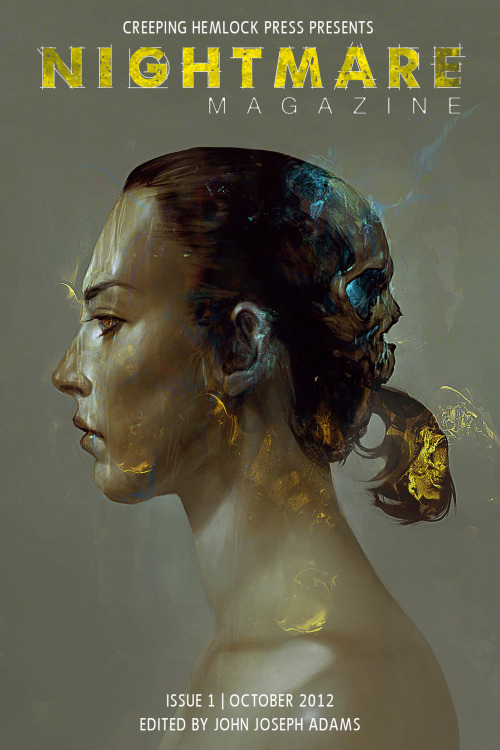
LAUNCH REVIEW: Nightmare #1


Fans of Lightspeed rejoice, for editor John Joseph Adams has launched a new horror and dark fantasy magazine that, well, looks and feels a lot like Lightspeed. For the uninitiated, Lightspeed is a relative newcomer to the world of SF/F short fiction, but one that has quickly risen to the top of the heap. Its success is attributable to: 1) a simple, professional delivery model (online and via inexpensive, well-made ebooks); 2) interviews and/or biographical sketches about the authors in addition to fiction and non-fiction features; and, most importantly, 3) consistently high-quality stories.

Nightmare replicates #1 and #2, and I hope that, in a year's time, I'll be able to say it replicates #3 as well. The debut issue hints at the possibility, but also highlights why it may be a more difficult task in horror than SF/F.

The opening story, Jonathan Maberry's "Property Condemned: A Story of Pine Deep,” is a haunted house story that attempts to replicate the coming-of-age nostalgia of the Stephen King classic The Body/Stand By Me. Though Maberry is a good writer, the story feels clunky, dated and not all that scary. Next up is Laird Barron's "Frontier Death Song," in which an unnamed protagonist finds himself the quarry for the Wild Hunt. I thought it was nicely paced, but again, I didn't find it all that scary or horrifying. 

The third story, Genevieve Valentine's "Good Fences," is my favorite--the tale of a man suffering from insomnia who suspects a horrible crime has been committed. Valentine's terse writing matches the Hitchcock-like premise beautifully. Finally, there's "Afterlife" by Sarah Langan, which I also liked. It's ostensibly a ghost story, but like the best short genre fiction, is really about relatable, real-life problems--in this case, the dysfunctional relationship between a daughter and her overbearing, hoarder mother.

All in all, the debut issue was, for me, a bit uneven. That said, it's hard not to have faith in Adams and his track record. Over the long-term, I expect Nightmare to deliver consistent quality. If anything, the problems in the debut issue probably have more to do with structural differences between the horror/dark fantasy and SF/F genres. Unlike SF/F, there really isn't the same kind of established market for short horror fiction--and by that I mean short SF/F's relatively large readership pool, consequently large pool of established and aspiring authors, institutional awards, and so on. While there are some great short-form horror writers, great dark stories in magazines like Shimmer, and certainly a lot of interest at the moment in vampires, ghosts, werewolves, zombies, etc.--I feel that Nightmare, as a consequence of these different market dynamics, represents more of a challenge for Adams than Lightspeed or Fantasy before it. That is, to expand a small market rather than rise to the top of a relatively large one. I wouldn't bet against him. 

Tuesday, October 16, 2012

INTERVIEW with Brian White of Fireside Magazine


Here at nerds_feather, we celebrate short fiction. To that end, for our latest interview, we "sat down" with Brian White, editor of new multi-genre short fiction magazine, Fireside. Though not limited to SF/F, in its first two issues Fireside has featured SF/F authors like Ken Liu and Kat Howard. We ask Brian what's next, and what makes Fireside unique.


Tell us a little about Fireside Magazine’s backstory. How did it come about? What does the ideal Fireside story “look” like?

Fireside kind of sprang fully formed out of a stew of ideas in my head late last year. I follow a lot of writing and publishing folk on Twitter, and I was reading a lot there about new publishing models and pay for writers and then, Kickstarter. And I thought, “Hey, I could start a fiction magazine.” We’d pay writers well above the going professional rate of 5 cents a word, and it would draw from all genres, like the Neil Gaiman and Al Sarrantonio anthology “Stories.” We’d also publish comics. I have only been reading comics for a few years, and I love the possibilities of comics. Our only criteria would be good storytelling. That’s the ideal, a story that keeps the reader turning pages and asking “what happens next?”

How do you see Fireside fitting into the world of short fiction—and given this site’s interests, specifically into the world of short science and fantasy fiction? How do you differentiate yourself—in terms of concept, scope or aesthetic—from the competition?

I think Fireside is different in its genreless approach and its inclusion of comics. Most magazines focus on a genre or theme, and very few have comics at all. Because we are looking for stories from any genre and only have four short stories per issue, the mix of genres in each issue is different. I definitely am keeping an eye out for good science fiction and fantasy, because that is my first love and what I’ve read all of my life. But I’m also pushing myself to broaden my reading to all the other genres out there.

You have an interesting model for compensating authors and for raising funds. Would you like to tell us how it works?

When I came up with the idea for Fireside, one of the things I had been reading a lot about was the pay rates that authors get for short fiction. The rate that is considered professional is 5 cents a word, and has been for years. That translates into $200 for a 4,000 word story, which is the upper limit we publish in Fireside.

Given that writing, editing, and revising even a short piece of fiction can take weeks (albeit not of continuous work), $200 isn’t really all that much. Fireside pays 12.5 cents a word, or $500 for a 4,000 word story, which we think is fair and can help writers make a living from their writing.

Of course, that money has to come from somewhere. (Plus we have to pay to actually produce the magazine!) I work a day job – well, a night job, actually, as a newspaper copy editor – and I don’t have a lot of money to throw at Fireside. By using Kickstarter to fund the issues, I am able to publish something that I’d never be able to pay for up front out of my own pocket.

If you’re not familiar with Kickstarter, here’s how it works. You create a project, describe what you are trying to do, and set a fundraising goal. You create rewards at different price points, and people can make a pledge to the project and choose a reward at or below that pledge level. If a project reaches enough pledges to hit its goal before the Kickstarter campaign ends, then at the end everyone’s credit cards are charged and the project creator gets the money. If the project doesn’t hit its goal, no one is charged. So I am assured that I have enough money to create the issue, and the backers don’t pay for something that only gets a portion of what it needs.

For Fireside, every reward we offer is a preorder of the magazine, either in eBook or print formats. We then offer a lot of extras at higher pledge levels, like autographed copies of the magazine or the chance to have your name used as a character in a story or your likeness used in the issue’s artwork.

How would you characterize your experience with kickstarter? What made you decide that this was the way to go, and what was it like building up a network? What have you learned from the experience?

Kickstarter has been great. It’s really easy to work with and learn. I chose Kickstarter over the other crowdfunding sites mostly based on name recognition. It is by far the most well-known, so I thought I could trust it and that potential backers would be more likely to trust it as well.

Building our network of supporters largely grew out of Twitter, where most of the promotion of our first Kickstarter happened. I had a decent-sized number of followers, as did the writers and artists who worked on Issue One. Something that Amanda Palmer said during her Kickstarter, that in order to crowdfund you have to have a crowd, really mirrors the experience I had. We were able to reach out to people who already were interested in what we had to say and that translated into some of them backing the project.

Do you think crowdfunding sites like kickstarter could transform the way fiction magazines operate? If so, in what ways? 

I still don’t know about that. I’ve been approaching our use of Kickstarter as a big experiment. It’s gone well for two issues, but I know there is a big danger of Kickstarter fatigue if I keep coming back every few months. I’d like to in our next Kickstarter to raise funds for at least two issues. Ideally we could do one a year.

The eventual goal would be to be supported through subscriptions, but to cover the cost of putting out the magazine, especially with our high pay rates, would take about 3,000 subscribers, and we have only a very small fraction of that now.

Design by Amy Houser

Going back to the magazine itself, I understand issue #3 is slated to be all speculative fiction. Can you tell us what, and whom, we can expect to see?

Well, I can’t say that Issue Three will be all speculative fiction. What we do have is three invited writers — Daniel Abraham, Elizabeth Bear, and Mary Robinette Kowal — who are all known for their speculative fiction. Their stories won’t be written until the Kickstarter is funded, and that’s part of the fun. The issue kind of takes shape over a few weeks, and the mix of stories has been very differnet so far. A few of the writers we’ve had have broken very sharply from what they are known for, and have come up with very good stuff.

Besides those three writers, we do have two things that will be speculative for sure. Rachel Deering and Christine Larsen are working on a horror comic, and we are also publishing the first story we bought through our submissions process: a steampunky story from Lucas J.W. Johnson.

There are some established names on that list—Daniel Abraham, for example, is someone we’ve written about extensively on this site. I assume you solicited a story from him, rather than the other way around? If so, is this the typical way Fireside obtains stories, or are you also taking submissions from writers who may not already be well known?

For our first two issues, all of the writers were invited, as were Daniel, Elizabeth, and Mary in Issue Three. In August, we held a monthlong open submissions period, and we ended up finding eight stories, including Lucas’s. Our plan at the moment is to split the future issues between invited writers and ones we find through open submissions.

Even though Fireside isn’t “just” an SF/F magazine, it seems to play a big part in what you’re trying to do, so I feel obliged to ask you how you reacted to Paul Kincaid’s statement (and his elaboration on our site) that short science and fantasy fiction is currently in a state of malaise, and fast approaching a state of “exhaustion.” Do you think that’s a correct assessment, and if so, how can things change to get short SF/F back on track? If you don’t think it’s a correct assessment, maybe you could speak to your experience as an editor and publisher, and what alternative view this has helped foster.

Well, I think I come at this issue form a very different place than Paul does. I've only been working in fiction publishing now for nine months, and I have been pretty excited by the things I have been reading, both the stories sent to me for Fireside and in the short fiction magazines I've started subscribing too. I think his argument is interesting, and certainly worth watching out for. But I think that the best thing I can do as an editor is to focus on Fireside's goal of finding good storytelling. If I do that, I think I will be serving our readers as best I can.
What’s next for Fireside after issue #3?

Well, as I said, we’re most likely going to try to do a Kickstarter for at least two issues, probably early in the new year. I’m also hoping to start publishing books, and have a few projects in various stages of Idea, but nothing concrete yet. I am having a ton of fun though, and I’m really enjoying all this experimentation!

Thanks for speaking with his, Brian! 

My pleasure. 

Monday, October 15, 2012

Microreview [film]: Curse of the Demon

The Meat

Dana Andrews doesn't seem to get enough credit, because he was a pretty dang good actor. I don't know if it's because his first name is "Dana" or because the best and best-known film he made -- The Best Years of Our Lives -- is similarly under-appreciated, but these days he's something of a forgotten gem. So when I saw his name pop up in the credits of a horror movie, I was intrigued, and assumed I was in for a pretty quality flick. I was not mistaken.

Curse of the Demon, or Night of the Demon in its native Britain, tells the story of John Holden, an American psychologist who debunks the paranormal and is in the UK for a conference. He runs afoul of Dr. Julian Karswell, a guy who seems to run a local consortium of occultists. Karswell informs Holden that he's placed a curse on him, and that Holden will die on October 28. What makes this movie's take on a familiar basic premise is that it lays its cards on the table right at the beginning of the film. It shows us that this is a world where the occult is real, the curse is real, and there's a very real, very toothy demon that will be coming for Holden at the appointed time.

Often in these films, the audience goes on a journey of discovery with the main character, both stumbling and groping toward what may or may not be waiting up ahead. But in Curse of the Demon, we know what's in store for Holden if he doesn't buy in and figure a way out of Karswell's curse. That knowledge adds an interesting dynamic to the mix, and it's handled expertly by the filmmakers.

The Math

Objective Quality: 7/10

Bonuses: +1 for the direction by Jacques Tourneur, of Cat People, Out of the Past, and many excellent Twilight Zones; +1 the demon.

Penalties: -1 for Dr. Karswell in clown makeup

Cult Movie Coefficient: 8/10. Well worth your time and attention.

[See explanation of our non-inflated scores here.]

Saturday, October 13, 2012

Microreview [Comic]: Saga


The first trade of Saga, written by the master Brian K. Vaughan and illustrated beautifully by Fiona Staples, dropped on Tuesday and if you haven't been reading this series then you need to.  Robert Kirkman tweeted that if you don't buy Saga, then you aren't his friend.  Well said.  Visit your LCS or get it on the cheap here.  You can also download the first issue for FREE at ComiXology here.


The story is about star-crossed lovers who are attempting to flee because their love and future child are in danger.  Not the most original idea, but Vaughan has this innate ability to complicate things in very interesting ways.  The world he created and the complex characters are what differentiate this story from pack.

Hazel, the future child of main characters Marko and Alana, narrates the tale and really draws you into the drama and the urgency of the situations at hand.  Marko is a former prisoner that was guarded by Alana and little has been revealed about how they became lovers.  I am hopeful that future issues will provide some of the backstory that has upset two communities at war.

Given the hatred between the two groups, it is not surprising to note that they are interesting in stopping Marko and Alana and examining this miracle child (other children born of both breeds died very quickly).   Alana’s people are utilizing Prince Robot IV’s services and Marko’s people are seeking multiple freelancers, including The Will and his Lying Cat and The Will’s ex, a spider like creature called The Stalk.  We learn that The Will is more than a bounty hunter and has a lot of good and decency in him on his visit to the planet Sextillion.

Prince Robot IV doing work


To complicate matters worse, the number of planets that Marko and Alana can flee to is very limited.  The war has been outsourced off of the planet and there are few places that they can escape to.

I don’t know if there is enough time to talk about how great of a job Staples has done with her illustration.  It is no easy task to draw the variety of characters, backdrops and action sequences that are central to this tale.  We open up with the birth of a child to start the book and quickly move to the dire situation in which the characters are thrust.


Staples delivers warmth and love on one panel and then switches to horror and violence on the next page seamlessly.  She captures the worlds that Vaughn has created with such charm and vigor that you can’t help but feel engrossed.

The Math

Objective Quality: 9/10

Bonuses: +1 for Staples’ art; +1 for Prince Robot IV

Penalties: -2 for the planet Sextillion burning images into my brain that I will never erase

Nerd Coefficient: 9/10. Very high quality/standout in its category.

[See explanation of our non-inflated scores here.]

Friday, October 12, 2012

Another Batman Game?!

Online Multiplayer FPS from XBox Live Arcade

I know, I know. I'm reviewing two Batman games back-to-back. Trust me, this is nothing like Arkham City. This is a 12-man first person shooter in the Modern Warfare multiplayer vein, but it takes itself much less seriously. The background story to this game is that the Dark Knight and the Joker aren't in Gotham at the moment, leaving their surrogates to wreak havoc. Remember poor Brian Douglas from The Dark Knight? He's a perfect example of what I'm talking about. 


In this game, their appearance is usually more comical than the ones in the movie (My tank wears blue briefs with a singing pink bird on the front). However, there are some pretty tough looking options for dressing out your character, too. They have five sizes of character that range from small, fast, and easily killed to gargantuan tanks that require five headshots to take down. When killed by one of these "heroes," they always spout a catch phrase. My particular favorite from one of the Batmen is, "Justice has undone you!"
The Joker has his surrogates, too. They've taken on a much more Joker-like appearance than the psychos he used in the movies (Remember the poor mental patient Harvey Dent was threatening to kill with a game of Russian Roulette?) These are some more real designs from the game. There is a wide array of optimization with character design. They can even speak German, French, or Japanese if you choose. The Jokers seem to have the market cornered on the catchy kill phrases. One of the best is, "You die like a sack of puppies, cute!"


But what about the guns and gadgets?!!

The game offers a wide array of weapons. It's no Borderlands, but there are plenty of options to keep the replay value up. There are 17 total weapons of six types including Rifles, Submachine Guns, Heavy Weapons, Sniper Weapons, Shotguns, Launchers, and Miscelaneous. It's this last group with which I take issue. There is an overpowered gun in the game called the "Witch Doctor" (Seen below). It required a $5 DLC purchase to unlock and it's much stronger than any other weapon in the game. Some weapons freeze or lock you in place. Others damage your life. This is the only weapon that does both by itself. It made the game unbalanced when first released, but now that nearly everyone has at least one on their team the playing field has been leveled somewhat. Each gun (you get two per character) comes with a Mod. Some of the most useful are the Silencer, Extended Magazine, and Body Odor Sniffer that notifies you of enemy locations via yellow stinklines.

There are also a plethora of fun gadgets that take this game beyond the average shooter. Each character is allowed one support item and one gadget. The support items include basics like Body Armor made out of a hubcap, but also have unique options like the Bear Trap or the Trap-in-a-Box, which is a mine in a jack-in-the-box, as if you couldn't guess from the name. Players can use gadgets like a grappling hook, glider wings, spring shoes, or my personal favorite, marking goggles. If you put on your goggles and focus on an opposing team's player for two seconds, they are marked and turn a bright orange for a short period of time. If you're able to get your entire team into a defensible position with one marker and one motivator (which heals nearby teammates and gives a defense bonus using a megaphone) it's nearly impossible for the other team to take you down. This game, as with most shooters, pays dividends to those who work as a team and perform their individual role. It also helps to know the maps well so you can all head to the same place quickly. Even when I know where I'm headed it often takes 3-5 tries to cross the map without being slaughtered. 


Game modes

Gotham City Imposters came with three game modes. It now has four. One thing I'll say for this game is that the developers have continued to add to the content without cost, aside from the overpowered Witch Doctor. Several free maps have been added since the debut along with the new game mode. Unlike Modern Warfare there is no "every man for himself" mode, although Bounty Hunter comes close. There is Team Deathmatch which we'll all recognize from Halo and other multiplayer shooters. There is also Psych Warfare where you must capture propaganda points to drive the other team mad. It's essentially capture the flag. Same goes for Fumigation in which your team must control two of three poison aerosol releasing machines. If you do so for long enough, the other team will be killed by the poison gas.


I've been playing this game with my regular Friday night crew for some months now (Shouting out to Therman, Ben, James, Perry, and Mike!). It's beaten out Left 4 Dead 2 and several other games for our time. We all got the new L4D2 DLC (Cold Stream), but we were back to Gotham City Imposters a week later because it's just more fun. If you enjoy shooters but are tired of being cursed at and murdered over and over again by 8-year-olds, this maybe the game for you. Even when I play alone there's a minimum of smack talk going on, something that can't be said for Modern Warfare 3 or its predecessors, a fact that drove me away from the game eventually. 

Gotham City Imposters isn't the greatest game of all time. It's not even the greatest shooter of all time. But for those of us who like to take our online multiplayers a little less seriously, this one's a winner. The sense of humor in the game makes it more fun to play and also helps bring up the replay value, much like Borderlands 2 (see my review two weeks past). If you're looking for some lighthearted fun with your online multiplayer FPS experience instead of deadly seriousness and foul-mouthed fourth graders, then give this one a look.


The Math

Objective score: 8/10

Bonuses: +1 for the sense of humor. I've never had a game make me happier to be shot in the face.

Penalties: -2 For the Witch Doctor, a paid-only weapon that is WAAAAY overpowered. The wide adoption of this gun has made the playing field more even, but that doesn't take away from the fact that they made a gun that unbalanced the game for profit. Weak, Monolith. Weak.

Nerd coefficient: 7/10. "An enjoyable experience, but not without its flaws."


Thursday, October 11, 2012

Thursday Morning Superhero


The two big publishers both dropped bombs on comic readers this week.  DC launched its Death in the Family crossover event and Marvel began its post Avengers vs. X-men with multiple titles, including the belle of the ball, the Uncanny Avengers.   My LCS had a small launch party for Uncanny Avengers but it wasn’t enough to propel it into the top 2 of the week.  Enjoy this week’s installment of Thursday Morning Superhero and drop me a line at @newhousebailey.

Pick of the Week:

Punk Rock Jesus #4 – Yet again this gem from Sean Murphy is my pick of the week.  This issue is rife with tragedy, but we see Jesus embrace rebellion and truly become the Punk Rock Jesus the title has been implying.  At times I felt that Murphy was a little preachy (get it?), but the gritty, black and white art invokes empathy with this tragic figure created by TV executives and his struggles.   Seeing Jesus grow emotionally and begin to be inspired and inspire others was very satisfying as a reader.  The ultraviolence is this in this issue as we learn more about Thomas and his IRA past and in a memorable scene in which Gwen attempts to rescue her son.   Murphy delivers on his ability to blend action, drama, and humor in what has been a delight to read.  My only complaint is that there are only two issues left.

Runner-up:
Batman #13 – The death in the family story line begins with the return of the Joker.  Scott Snyder continues his brilliant run at guiding the Batman ship.  Joker returns to the Gotham City Police Department to steal his face back and continue his assault on Gotham and ultimately Batman.  With over a year since anyone in Gotham has seen Joker, even Harley Quinn is concerned with how he is acting.  I won’t spoil the cliffhanger, but it is going to be hard to wait until issue #14 to see what transpires next.  Clearly the best DC title on the market today.

The Not as Good:
MacGyver #1 – When I saw that MacGyver was back, in comic form, I was stoked.  MacGyver dazzled me as a kid with his ability to create a bomb out of endless combinations of 3 or 4 items.  The book begins with a mysterious email from an old college professor who is in need of help from the Phoenix Foundation and MacGyver.  From there a pretty ho-hum tale about a seed that grows in saltwater, corporations wanting to profit instead of ending world hunger, and with MacGyver probably saving the day, I will have to miss on issues 2-5.  I was hopeful, but disappointed.  If they want me back on the series I want a photo variant cover featuring Richard Dean Anderson.  Issue 2 really needs a Jack Dalton cameo as well.


The Rest:
Uncanny Avengers #1 – The aftermath of the Avengers vs. X-men begins with the formation of the Uncanny Avengers.  In a book that featured the funeral of Charles Xavier and the emergence of Red Skull seeking to wipe out the mutant race, it seems that this series may make up for the lackluster Avengers vs. X-men event.

Morning Glories #22 – Oh what a complicated tale Nick Spencer can weave.  I wonder if he has binders and binders full of the backstory of all of the characters at Morning Glory Academy.  When you think he can’t push you further as a reader, he introduces time travel into the series and a major character is shot.  I need to go back and reread to keep everything in line, but it is an enjoyable read so I am happy to.  

What I should have read:
Transfusion #1 – IDW released a new series this week about a dystopian future in which both robots and vampires need human blood for survival.   It follows the remaining humans and their struggle to reclaim normalcy.  Intriguing plot + good initial reviews = my weekend read.

Hoax Hunters #4 – The Hoax Hunters discover real life monsters and such and then convince the world they are a hoax.  Not a bad premise, but nothing I was too interested in.  Turns out the book is a lot of fun with likable characters and good action.  It has been well reviewed from the get go, but from what I read about the conclusion of its first arc I will have to check it out.