Wednesday, June 6, 2012

Celebrating Ray Bradbury

Ray Bradbury came of age in a system that no longer exists, and by virtue of the idiosyncrasies of that system, a tireless work ethic, a long life, and a prodigious imagination, he wound up making an artistic contribution that we will likely never see equaled.

When he was born, sound had not yet come to movies, and King Kong had its premiere when Bradbury was 13. Five years later, his love of that movie and others like it led him to a friendship with Forrest J. Ackerman and Ray Harryhausen, who were each to become luminaries in the film (and film fandom) landscape. Bradbury published his first short story in 1938, when these things were true:
  • People read magazines
  • Magazines published short stories
  • People read short stories
  • Writers were routinely paid for writing
  • Not everyone on the planet wanted to be a writer
None of these things are true anymore, but Bradbury was able to amass a resume of published work, mostly in sci-fi magazines, and forge a novel from many of his related, Martian-themed short stories (The Martian Chronicles) before television had reached its infancy, so when TV arrived and began looking for writers, they found Ray. Still writing prose all the while, he contributed to TV movies, and beginning with It Came from Outer Space, theatrical films. He continued contributing TV scripts for imminently influential shows like The Twilight Zone and Alfred Hitchcock Presents.

He wrote every day. And to accomplish that amount of work, let alone that amount of quality work, he certainly had to. His ingenuity, dedication, and ability corresponded with, essentially, the advent of popular culture. Bradbury positioned himself across three (four, if you include radio) media outlets at the time when entertainment began taking shape as a commodity, and kids began stockpiling it in their bedrooms and imaginations. Kurt Vonnegut, Bradbury's contemporary and friend, came from journalism, segued into sci-fi short stories for magazines, and then departed for what I think most people would call "literature." But Bradbury stayed put, always a champion of speculative fiction, and always available to lend advice and/or encouragement to other writers, so his influence achieved an unprecedented breadth and depth. He was a drop of ink in the well of American entertainment, and his contribution is present for everyone who draws water from it today. If you've ever watched anything with "Star" in the title or enjoyed a Steven Spielberg movie, you can thank Ray Bradbury.

As The G mentioned earlier today, Ray Bradbury's loss has a special significance for those of us in Los Angeles, because Ray was one of us, and an active voice in the writing community here. His 90th birthday party was held at the Mystery and Imagination bookstore in Glendale, and I was very pleased to be able to take my little boy, who was three at the time. He still remembers it, and hopefully will for a very long time. He will not meet the likes of Ray Bradbury again. The world has moved on -- in many ways that Bradbury imagined it would -- and I can say in all seriousness, they just don't make 'em like that anymore. His life represented a happy intersection of a person, time, and place, and we are all the beneficiaries.

You'll be missed, Ray. But thank you for everything.

RIP Ray Bradbury


Today, the science fiction and fantasy world has lost one of its true originals. As per the LA Times:

Author of more than 27 novels and story collections — most famously “The Martian Chronicles,” “Fahrenheit 451,” “Dandelion Wine” and “Something Wicked This Way Comes” — and more than 600 short stories, Bradbury has frequently been credited with elevating the often maligned reputation of science fiction. Some say he singlehandedly helped to move the genre into the realm of literature.

NY Times:

By many estimations Mr. Bradbury was the writer most responsible for bringing modern science fiction into the literary mainstream. His name would appear near the top of any list of major science-fiction writers of the 20th century, beside those of Isaac Asimov, Arthur C. Clarke, Robert A. Heinlein and the Polish author Stanislaw Lem. 
In Mr. Bradbury’s lifetime more than eight million copies of his books were sold in 36 languages. They included the short-story collections “The Martian Chronicles,” “The Illustrated Man” and “The Golden Apples of the Sun,” and the novels “Fahrenheit 451” and “Something Wicked This Way Comes.” Though none won a Pulitzer Prize, Mr. Bradbury received a special Pulitzer citation in 2007 “for his distinguished, prolific and deeply influential career as an unmatched author of science fiction and fantasy.”

...and the WaPo:

Although slowed in recent years by a stroke that meant he had to use a wheelchair, Bradbury remained active into his 90s, turning out new novels, plays, screenplays and a volume of poetry. He wrote every day in the basement office of his home in the Cheviot Hills neighborhood of Los Angeles and appeared from time to time at bookstores, public library fundraisers and other literary events around Los Angeles. 
His writings ranged from horror and mystery to humor and sympathetic stories about the Irish, blacks and Mexican-Americans. Bradbury also scripted John Huston’s 1956 film version of “Moby Dick” and wrote for “The Twilight Zone” and other television programs, including “The Ray Bradbury Theater,” for which he adapted dozens of his works. “What I have always been is a hybrid author,” Bradbury said in 2009. “I am completely in love with movies, and I am completely in love with theater, and I am completely in love with libraries.”

For Angelinos like me, Bradbury's passing touches a personal nerve as well...he was a fixture at the annual LA Times Festival of Books and, even at 91, heavily involved in the city's literary life, and did much to maintain the literary heart of a city often overly focused on film and television. He was approachable, friendly and always willing to talk to a fan, of which there were many.

You'll be missed, Ray...


CONTRIBUTOR PROFILE: The G


In the second of our contributor profiles, The G tells us what's what. For comparison's sake, here's a link to our profile of Vance, who answered all of the same questions.


NAME: The G

SECRET UNDISCLOSED LOCATION: Hollywoodland

NERD SPECIALIZATION(S): Science Fiction and Fantasy, Books, Sci/Tech, Video Games

MY PET PEEVES IN NERD-DOM ARE: 

VAMPIRES, WEREWOLVES, ZOMBIES, ALIENS OR ROBOTS: Robots. Clunky, old-school patriotic robots that fight Communism and defend America

RIGHT NOW I'M READING: 1Q84 (Murakami); The Drowned Cities (Bacigalupi)

...AND A COUPLE BOOKS I RECENTLY FINISHED ARE: The Third Reich (BolaƱo); Throne of the Crescent Moon (Ahmed)

NEXT TWO ON QUEUE ARE: Redshirts (Scalzi); Kingdom Come (Ballard)

MY FAVORITE SUPERHERO AND SUPER-VILLAIN ARE: TIE between Silver Surfer and Hal Jordan Green Lantern; Magneto (despite the magenta)

IF I WERE A SUPERHERO/VILLAIN, MY POWER WOULD BE: Control over gravity. Seems like it would be pretty useful in a pinch.

THE BEST COMIC FILM OF THE PAST 6 YEARS IS: The Dark Knight

THE WORST COMIC FILM OF THE PAST 6 YEARS IS: The sound editing tragedy that is Green Lantern

I JUST WATCHED [FILM X] AND IT WAS AWESOME: Ugg...this just reminds me how few movies I watch these days. Prometheus can't come soon enough!

I JUST WATCHED [FILM Y] AND IT WAS TERRIBLE: Green Lantern. Be very afraid.

EVERYONE SHOULD SEE [FILM Z] BEFORE IT'S TOO LATE: The Warriors. 

BEST SCIENCE/SPECULATIVE FICTION SHOW OF THE PAST 12 YEARS: Firefly

WORSE ENDING--LOST OR BATTLESTAR GALACTICA: BSG. Lost's ending was way more realistic.

THE OFFICE--BRITISH OR AMERICAN VERSION: British. Nothing can match the sheer terror.

GAME OF THRONES--LIKE OR DISLIKE DEVIATIONS FROM THE BOOKS: Like a few, dislike most. 

Tuesday, June 5, 2012

Micro Review [film]: The X From Outer Space


The Meat

Look, I'll be honest, the only thing I really understand about this movie is that I love it. Starting with the swingin' 60s intro music that includes a spoken conversational break-down between a man and a woman that goes something like "Look, what's that up ahead? It's the future!" "Come on, everybody, let's embrace it!" to the fact that the name of the monster in this Japanese movie is filled with Ls, which are hard for Japanese folks to say, this movie is a masterpiece of oddity.

An entry in the Japanese kaiju genre (translation: "big friggin' monsters stompin' on stuff"), of which Godzilla is the most famous example, The X from Outer Space is about a group of Japanese astronauts (and one white girl) flying back and forth from Earth to Mars and the moon, maybe, while being regular 60s swingers. I think it takes them about a half hour to get to the moon, so when they return to Earth and figure out they forgot something, they just hop back on their ship and pop back to the moon real fast. On one of their trips, though, they get some gunk on their spaceship and it turns out to be an egg for a big monster that wants to get in on the action and step on Tokyo. Stepping on Tokyo is like the Super Bowl for giant alien/radioactive/mutated creatures. This particular monster's name is Guilala, and he's a giant space-chicken. Not kidding. Not one bit. He eats nuclear fuel, spits fireballs, and his only weakness is this foam that looks like fire extinguisher filler called "guilalanium," which causes him to shrink. This movie is bad in a very unique and magical way, and deserves to be more widely known. You could think of this as the Plan 9 from Outer Space of kaiju movies -- it's not "good" in any reasonable sense of the word, but there are definitely worse movies, and this one lives at the intersection of terrible and entertaining that makes it a truly rare bird of cult movies.

I caught this on TCM Underground a few years ago, and it's not on DVD. If you have a subscription, you can watch it on Hulu, thanks to their deal with Criterion.

The Math

Objective Quality: 5/10

Bonuses: +1 because the monster is a space chicken; +1 for the utter disregard for anything even approaching "science"; +1 for being so fundamentally Japanese; +1 for Guilala's recent and unexpected resurrection in a commercial for The Ladders job-seekers website:

Penalties: None. Like Billy the Kid vs. Dracula, if the description above sounds like a movie you'd enjoy, then there's no reason to dock it points for things like coherence, logic, or production value.

Cult Value Coefficient: 9/10

[See explanation of our non-inflated scores here.]

Monday, June 4, 2012

Summer Reading List: The G

This is the first in a series by all our contributors, where we discuss what's on our reading queue for the summer that just started day-before-yesterday. As usual, the list comes in multiples of 6. First up, The G:

As soon as the warm weather hits (or in the case of LA, as soon as the "moderately warmer/more humid than the rest of the year" weather hits), I hit the books. Must be a vestige of my childhood, when summers  promised endless sunny days at the beach, pool or porch. I consumed books voraciously, then as now; and summer for me has always been the time when I tore through the most, with the most pleasure and the deepest level of reflection.

My method for choosing summer reading has been to mix challenging, mind-bending "literature"(i.e. stuff accepted by the New Yorker/New York Review of Books crowd as "high art") with thought-provoking, high quality genre-fiction (i.e. stuff that, quality notwithstanding, the snooty crowd sticks in a genre-ghetto). Think J.G. Ballard and Roberto BolaƱo side-by-side with George R. R. Martin and John Scalzi.

The list of books I plan to read this summer reflects this approach. It's a little more SF/F heavy than in some other years, but if you ask me, that just reflects the strength of the genre right now. Will I read them all? Probably not. Will I read stuff not on the list? Definitely. But here's the first six books I plan to read...as soon as I finish 1Q84, that is!


The G's Summer Reading List

1. Redshirts by John Scalzi [Tor, hardcover]

Scalzi's long-anticipated return to space opera is also a paean to SF television, and Star Trek in particular (redshirts = away party cannon fodder). Advance reviews characterize it as a funny and clever spoof, but one that's much more affecting than that description implies. The Old Man's War series was a bit like that, though I expect the satire to come on a little heavier in this one. Should be a blast--this will be my first post-1Q84 read.


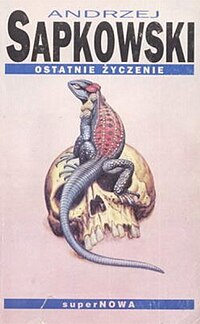
2. The Last Wish by Andrzej Sapkowski [Orbit, paperback]

This collection of linked short stories is the first of Sapkowski's Witcher books to be published in English. Though popular outside the Anglosphere since he emerged in Poland in the 1990s, Sapkowski's work was largely unknown to English readers until the Witcher video games introduced nerds to one of the richest fantasy worlds ever created. From all I've heard, The Last Wish is a must read for fantasy fans. So yeah...I'm eagerly anticipating this one.


3. Kingdom Come by J.G. Ballard [Liveright, hardcover]

Ballard has, over the years, provided some of my most memorable summer reading. Posthumously published Kingdom Come is, like every Ballard novel of the past two decades, a mystery novel. But like those, the mystery mostly serves as a vehicle for exploring the dark, frightening and revolutionary in mundane, middle-class social spaces. In Cocaine Nights it was the seaside resort; in Super-Cannes it was the gated community; in Kingdom Come, it's the suburban mall. As if I needed more prodding, the New York Times went ga-ga over it.


4. The Company by K.J. Parker [Orbit, ebook]

The pseudonymous Parker's novelette "Amor Vincit Omnia" was a revelation, and reason to delve into his/her full-length work. The Company is a magic-free fantasy about military veterans who, looking for a better life, settle on an abandoned island. Then stuff goes wrong. Sounds Ballardian, but in a medieval fantasy context and thematically focused on questions of what happens to warriors when the wars are over. Reader reviews have been mixed, but you can chalk that up to the fact that some people take marketing too literally.


5. Leviathan Wakes by James S.A. Corey [Orbit, ebook]

Corey is a pseudonym for the writing team of Daniel Abraham and Ty Franck. Abraham, an accomplished fantasy novelist and critic, is someone I've long wanted to check out. But I faced a dilemma: go for the solar-spanning space opera/detective story of Leviathan Wakes, or for the well-regarded epic fantasy The Dragon's Path? The kindle edition of Leviathan Wakes solves the problem for me, as it comes with a free copy of The Dragon's Path. Color me excited.


6. The Keep by Jennifer Egan [Anchor, paperback]

Egan's recent New Yorker story, "Black Box," filled my mind with thoughts like this is groundbreaking, followed by no wait, it's genre-smashing and then OMG THIS IS TEH BEST STORY EVAR! Naturally, the experience piqued my interest in Egan's novels. The Keep, which the New York Times describes (in a roundabout way) as a paranoid and macabre thriller set in a creepy-ass Eastern European castle, struck me as a good place to start. Should be suitably freaky.


Well, there you have it. Look forward to future installments in this series, both from The G and other nerds-feather contributors!

Friday, June 1, 2012

ALERT! Galaxy to Crash Into Other Galaxy

This just in: our galaxy, the Milky Way is set to crash into the neighboring Andromeda galaxy...in 4 billion years.
Over about 2 billion years, the two spiral galaxies would merge, forming a more globular, non-rotating galaxy known as an elliptical galaxy. The sun would probably get flung out farther from the Milky Way's center, but Earth would almost certainly remain undisturbed, relatively speaking: It’s extremely unlikely that any star would come close enough to our solar system for its gravity to disrupt our planet's position around the sun.
So we'll be fine, or at least, whatever post-human species lives on Earth 4 billion years from now will be. If we don't destroy everything first, that is! If not, our descendants will be treated to a night sky that might just look something like this:


Wednesday, May 30, 2012

Micro Review [film]: Hausu


The Meat

Sometimes it's possible to have high expectations for something, and then feel a little disappointed when you experience it and discover it was exactly what you expected. It didn't have that little extra tweak that puts you just enough off-balance to get swept away. That's how I feel about the 1977 Japanese horror movie Hausu. It's the story of a group of schoolgirls who decide to spend their vacation at their friend's aunt's house. The girls all have names like Gorgeous (or Angel), Sweet, Kung Fu, etc., based on their personalities, and the aunt may or may not be dead, or a witch, or a cannibal, or all of the above, or she may just be a manifestation of the evil house. It's not important. And also, I think someone turns into bananas at some point.

This movie is totally bonkers, and from the very first shot - which is super cool - probably very different from anything else you've ever seen. It delivers on the promise of the genre, if the genre is "insane Japanese haunted house slasher movie," but it reaches its peak of weirdness early, and plateaus, which is kinda too bad. It's definitely worth a look, though, and if you're hoping for a big, climactic bloodbath, boy are you going to get your wish.

The Math

Objective Quality: 6/10

Bonuses: +1 for its early mix of horror and comedy; +1 for the fact that the director also made this utterly amazing commercial with Charles Bronson:


Penalties: -1 for brief but squirm-inducing, not-sure-if-she's-18 nudity

Cult Coefficient Value: 7/10

[See explanation of our non-inflated scores here.]