Monday, October 16, 2023

INTRODUCING: Star Wars Subjectivities

No one ever gets what they want


No commercial property has ever meant as much to me as Star Wars. It is my first and still deepest cinematic love. Indeed, from the first time I saw that angled, yellow script crawl up the screen, I was totally and completely enthralled. I memorized the films to the point where I could put the soundtrack on and almost "watch" the films from memory. Friends and I would recreate Hoth in the snow, or Tatooine in the sand—dog-eared Hasbro action figures both re-enacting scenes from the films and new scenarios of our own imagining. 

Star Wars has, over the years, continued to capture my imagination in a way no other creative property has. Science fiction that's also fantasy. A messy, lived-in world with heroes and villains and plenty that fit somewhere in-between. A classic "hero's quest" backed by a fleshed-out mythology and plenty of deep lore. An exquisitely rendered late-70s art style, forward-thinking visual effects and arguably the best original film score(s) ever made. I could go on. 

I grew up with the Original Trilogy, because that's all there was. I had to fill in the gaps with novels and comics, the best of which were Timothy Zahn's Thrawn trilogy. Like a lot of hardcore fans, I wanted new films that told that story—or a variation on it. 

Then the Prequels came out, promising something else entirely: the tragedy of Darth Vader in 3 acts. I remember going to see The Phantom Menace in the theater; I came out convinced that it was almost as good as the originals. Then I went again the next day and realized just how awful it was. But I watched the rest of them anyway—an experience that would repeat some years later when the Disney franchise launched with The Force Awakens. First time? "This is great! Star Wars is back!" Second time? "Oh god, no—it really isn't actually any good, is it."

To me, the Original Trilogy is a masterpiece—three almost perfect films that I can watch endlessly (well, okay—Jedi isn't perfect, but it's still damned good). The Prequels? Full of great ideas and some thoughtful observations on the end of democracy and rise of despotism that are torpedoed by shoddy execution—stilted dialogue, wooden acting, corny CGI and some absolutely cringe characters (looking at you, Jar-Jar). The Disney films, to me, are the opposite: competently made films with nothing interesting to say.  

Then came The Mandalorian. The show was, in many ways, the embodiment of what I wanted the film sequels to be. It takes place at a moment when the New Republic hasn't fully established itself—and is more or less absent from the Outer Rim. The Empire is still hanging around but are now the insurgents, lacking the resources or leadership to take the Galaxy back from its new rulers but still plenty capable of wreaking havoc. It tells a different type of story, with different stakes, on a very different —smaller— scale. The shows that followed have been hit or miss, but the best of them (Mandalorian, Andor, Ahsoka) have demonstrated how many kinds of stories you can tell within this universe. Fake-ass Death Stars need not apply.

So now you know how I feel, but do you feel the same? Maybe. But there's an equally good chance you don't. Indeed, search around the internet and you'll find many a lengthy opinion piece on which Star Wars properties are good and which ones are bad. Some will be Original Trilogy fanatics like me, others will tell you how secretly great the Prequels are. Others still will opine on how The Last Jedi is really a Top 3 Star Wars film sandwiched between two cinematic commercials for Disney theme park rides. Who is right and who is wrong?

The short answer is: I'm right, of course! The longer answer is: so is everyone else, because we each approach Star Wars with our own subjectivities. How we were first introduced to the franchise and by whom. How old we were when we discovered Star Wars and what generational cohort we are a part of. Whether we like science fiction and/or fantasy or just bounce right off of it. Whether we like the mixing of science fiction and fantasy or are a purist for one or the other. Whether we grew up on CGI or yearn for the days when practical effects ruled. Whether we like big summer blockbusters or think they ruined Western culture. And on and on and on.

Ultimately, my strong opinions are probably not your strong opinions—and there is probably no amount of words I could put to page that would transform yours into mine. Nor should I even try—because, in the end, we all have our own understanding of what Star Wars is and should be. Because of this, we are all inevitably disappointed when it doesn't conform to those expectations. We are just disappointed by different things.


Arguing the merits of the Prequels with data

The Project

This project will follow a somewhat different format that our typical special modules. We will not be providing dossier-style reviews that present opinions with supporting evidence to make an argument that aspires to objectivity. Rather, we will lean into the subjectivity of our opinions with nakedly partisan feelpieces. Sometimes these will take the form of love letters or furious rants; sometimes they will be more measured. The point, ultimately, is just to be honest about how we feel, as individuals. 

As a group, we will also reflect on these takes—and the how's and why's behind them. We will gather around virtual tables imagined to be round, not to joust over who is right and who is wrong, but to unpack our subjectivities and understand why we are attracted to some things and reject others. We hope this different approach will contribute to the broader discourse on Star Wars in a meaningful and unique way. And, of course, we hope you will enjoy reading our thoughts—and providing yours as well.

Friday, October 13, 2023

Nanoreview: The Little Red Wolf by Amélie Fléchais

A small change to the tale makes all the difference

You know how it goes: there's a curious child, a worried mother, a meal to deliver to a frail grandmother. An errand through the forest. A chat with a stranger. And menace lurking. Except this time the curious child is the wolf, and the stranger in the forest is the girl, and the crux of the story is the mystery about who is more of a menace to whom.

But what does it all mean? The traditional versions of Little Red Riding Hood have given rise to all sorts of interpretations: a didactic fable about obeying your elders, a remnant of matriarchal initiation rites, a summarized model of heliolatrous cosmology, a Freudian dream of death and reemergence, an allegory of sexual assault. Amélie Fléchais, in her retelling The Little Red Wolf, recently translated into English by Jeremy Melloul, chooses to focus on the most salient theme that this story has always presented to young readers: the fear of untamed nature.

When the wolf loses his way in the forest and meets the little girl, she regales him with a song about the origin of the enmity between the hunter and the wolves. But the wolves remember a different song, one that completes the story and makes you want to reread the book and catch the visual clues that were there all along.

The illustrations fulfill this role outstandingly. "Show, don't tell" has always been a dubious rule, but if there's any art form where it would be wiser to follow it, it's graphic novels. In The Little Red Wolf, the text is precise and just sufficient, while the images are evocative of a deeper plot underneath what's said. The secrets hidden in the forest are heightened by ironic contrast with the gentle choice of palette. Both wolf and human faces eschew anatomic accuracy and go for pure emotion. With his huge eyes and tiny snout, the little wolf is a harmless creature that just wants to see everything the world has; with his overgrown beard and haughty expression, the hunter is a force of nature more fearsome than any beast.

Upon reading the promotional blurb, The Little Red Wolf might sound like your average fairy tale reversal. However, when the full backstory is revealed, the picture that emerges is more complex than just a switching of roles. Each party in this human-wolf conflict holds a portion of the truth, and few readings are more stimulating to the young mind than a tale told through conflicting versions none of which can be ignored. When you figure out that the reason this forest has a hunter of wolves is the same reason this wolf wears a red cape, your understanding of the plot goes full circle, and with that richer perspective, you'll want to go through the experience again.


Nerd Coefficient: 7/10.

POSTED BY: Arturo Serrano, multiclass Trekkie/Whovian/Moonie/Miraculer, accumulating experience points for still more obsessions.

Reference: Fléchais, Amélie and Melloul, Jeremy [translator]. The Little Red Wolf [Oni Press, 2023].

Thursday, October 12, 2023

Film review: The Creator

Nice America you got there—shame about your Asia

I became intent on seeing The Creator as soon as I saw that it was from the man who directed Rogue One, my favorite piece of media Disney Star Wars has produced. It certainly looked intriguing; a near-future science fiction story with a good deal of action? I’m all for that. Unfortunately, the end result is somewhat uneven, but overall worth seeing.

Twenty minutes into the future, an automated system nukes Los Angeles, turning the United States government against all forms of artificial intelligence. By the time of the actual plot, the only places willing to openly host AI are various cells in the vaguely defined superstate ‘New Asia,’ which a map seems to imply is a peculiar amalgam of Japan and the stretch of Southeast Asia from Myanmar to the Philippines. The action properly kicks off with US special operative Joshua Taylor (John David Washington) being sent on a raid against one of these AI cells, where he finds a robot child (Madeleine Yuna Voyles) eventually christened Alphie, who happens to know something he desperately wants. They then go on a wild goose chase all throughout New Asia to find what they both need, all the while pursued by the US government.

The best part of this film is the relationship between the two leads. They are both conflicted, on the run, and setting out to do something they had been told time and again not to do. They have a sort of teacher-student interaction where, as the best of these stories always have, the teacher learns as much as the student. They have to see both sides of American imperial power, both abroad and later domestically.

It is the portrayal of the US, a few decades in the future, where the worldbuilding in this film really shines. The Pentagon now carries a big stick that happens to float: NOMAD, as they call it, is a hulking behemoth in the sky, going all over the world to wreak havoc on rogue artificial intelligence (it has a suitably scary way of announcing its presence). It is the ‘War on Terror’ gone digital, the logical conclusion of drone warfare, the expansion of the ‘frontier’ to the digital realm as well as to an Asia that America has ravaged before. It’s a futuristic, all-too-believable extrapolation into a future that Nikhil Pal Singh described in these terms:

Defending the launching of the global War on Terror, U.S. diplomatic historian John Gaddis gave scholarly imprimatur to the settler idiom: the borders of global civil society were menaced by non-state actors in a manner similar to the “native Americans, pirates and other marauders” that once menaced the boundaries of an expanding U.S. nation-state. Foreign affairs writer Robert Kaplan concurred: ‘The War on Terrorism was really about taming the frontier,’ as he heard U.S. troops in Afghanistan and Iraq repeat the refrain, ‘Welcome to Injun Country.’

[...]

The history of the American frontier is one of mounting casualties and ambiguous boundaries, of lives and fortunes gained and lost. In the settler narrative, “collective security” never meant just the existential kind of safety, that is, situations where material survival and self-defense were mainly at stake. Freedom is essential to the equation, and freedom in this conception is built once again upon dreams of a blank slate—this time cheap, empty, exploitable lands and resources that must be cleared of any competing presence.

However, what pained me, as a Filipino-American on my mother’s side, was the frankly lazy portrayal of Asia. As previously described, the AI and their supporters are hiding in a superstate ‘New Asia,’ an unwieldy amalgam of disparate countries that were last unified, if one could call it that, when Japan rampaged across the region in World War II. The scenery looks Vietnamese, echoing many Vietnam War movies, but the urban areas are vaguer, filled with what appears to be Chinese writing (which could easily be Japanese). It’s a blatant hodgepodge which, to be blunt, made it seem like the filmmakers just didn’t care enough to set this in a real Asian country.

They could have easily done something like Paolo Bacigalupi’s novel The Windup Girl, unambiguously set in Thailand. I’ve read comments from Thai people saying that it’s clearly written by a Westerner, which is something I'm not sure can be avoided at all, but it at least tried to engage with the complexity of a real Asian country. This film didn’t. (Kim Stanley Robinson’s Red Moon may also be relevant here).

What results from this lushly developed America and a smorgasbord Asia is a film about American empire from an American (or Western—director Gareth Edwards is British) point of view. Many have observed that these wars have barely had any effect on the day-to-day lives of Americans on the whole (veterans, refugees, and their families excepted), and it is easy to mush all American wars into ‘Asia’ or ‘the Middle East’ stereotypes. That’s what this film does: it reduces several countries to cardboard cutouts into which to smash American special forces to kill, die, and steal. It commits the grievous sin of forgetting that the targets of American guns are people, too, with agency and beliefs and histories.

I wanted to like The Creator more than I did, and in many ways it is a fine movie. The action is exciting, the American characters get good development, and the future is believable technology-wise. It falls, however, in portraying American wars as solely American experiences, which is both its greatest failure and, inadvertently, its most potent element of commentary.

--

Highlights: great action, great futuristic aesthetic when it isn't being orientalist

Nerd Coefficient: 6/10

POSTED BY: Alex Wallace, alternate history buff who reads more than is healthy.

Review: Menewood by Nicola Griffith

 A vividly beautiful story rooted in nature and landscape and a woman who uses it as her lens through which to view the world.
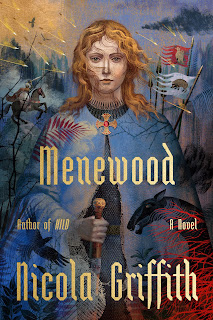
And absolutely stunning cover art by Anna and Elena Balbusso

Hild was unexpected and beautiful. If you haven't read it, it's a fictionalised telling of the early life of Hild(a) of Whitby - a woman born in the 7th century CE to a Deiran royal household (an early British kingdom based in the north-east, around modern York) who went from pagan to Christian to abbess to sainthood, and was the founder of the monastery at Whitby, where the Synod of Whitby (which codified the British approach to the date of Easter, and their alignment with the Roman rather than Celtic churches) was held. Hild details her young life in the royal court of her uncle Edwin, King of Northumbria, and her struggle to find a place there. It casts her as someone particularly capable of reading into the patterns she observes in the world, whether they be in nature or in the actions of people, and who, prompted by her mother, uses this ability to be viewed as a quasi-mystical seer, helping guide the king's actions through a tumultuous period of history, both politically and religiously.

Some of Hild's impact is simply through how unexpected it is - there is a breathtaking level of immersion into the world of 7th century Northumbria, and into the worldview of a particularly astute and thoughtful girl who might live in it. It's a novel you leave somewhat dazed and dazzled, suffering from the whiplash of returning to modernity after a viewpoint so seamlessly portrayed and inhabited. And that can be a difficult thing to follow. The bar has been set high, the setting, the writing, the visuals and immersion are all known, and there's always a risk that, when known, they become that much less impressive.

Luckily, it's been written by Nicola Griffith, and so she's not only avoided this problem entirely, but somehow managed to deliver an even more stunning sequel to an already stunning book.

Menewood is a book about many things - womanhood, motherhood, the price of power, living in an everchanging world, survival, will, and simply the world of 7th century Northumbria. It encompasses a huge portion of life, of a whole worldview of a person, and manages to do so seamlessly, artfully and deftly at every single turn. It takes you through intensely traumatic events, both personal and political, and makes you view them as a human would, in all their detail and cost and chaos, in all the things someone would need to survive them, and what that survival would demand. The story is humanly told, and manages to make comprehensible and engaging a fairly complex and less-known piece of history, in a way that feels genuinely readable, without sacrificing that complexity or the realities of the world for the sake of modern readership.

Which is to say the plot, however predictably based in real historical events, nevertheless manages to suck you in, and remains just as great as its predecessor.

However, the plot is not what I want to talk about, when I think about what makes this book stand out for me, good as it is. There are four strands of the weave I think really demonstrate what a thoroughly skilfully told novel this is, and why it stands out amongst its peers, and it's those I want to highlight instead.

Firstly, and most prominently throughout the story - the worldbuilding.

A thing you quite often see in less well-told historical fiction is the author's need to show off that they know something that doesn't really fit into the story, but it's a neat fact that just had to be crammed in somehow, because they did all this research and so it needs to be put on the page. And then that multiplied across the story, until you are constantly being elbow-nudged about yes, this is a historical work. Griffith manages the opposite of that. 

When you pause to think, to examine a phrase even, you realise just how much work, how much research, how much thinking has gone into crafting 7th century Northumbria in a way the reader can truly be immersed in. On examination, it's there to see. But in the moment of reading, it is invisible, or subtle, or offhand. It's never the focus, but it is absolutely the lens, and when you begin to realise just how much there is of it, you realise what a marvel of a book this is.

Offhand remarks are icebergs of worldbuilding:

Every man in the hall wept openly; most of the women were dry-eyed.

This is a cultural context where the act of showing emotion is read and performed differently than in modern Britain. It's a single line, and the story moves on, but it leaves us with a little nugget of information, and doesn't feel the need to explain it to us. The reader is trusted to draw their conclusions, to think about how a world might look different when this is true, compared to our own.

Then, to take a more overt example - the way Griffith incorporates period language (or period-seeming language) into not just the dialogue, but the text itself. The months are given unfamiliar names - like Hrethmonath - but because the descriptions of the world are always rooted in the physical, in the constant turning of the seasons and the work they demand, it is never unclear when in the year each event takes place. But it stretches deeper than this - plants, animals, places, people, so many things in the world take on names that embed them into setting, and doubly so when Griffith consciously evokes the multilinguality of 7th century Britain. Hild herself speaks several languages, and how she names certain things, and in which tongue, is a subtle insight into how the sociocultural groups of her world interact with it and each other. And of course, which language she chooses to speak, and to whom. There is a constant fluidity to Hild's world, a need to shift modes of thought and communication to suit her environment in a way that many modern Anglophones are quite unfamiliar with, and it is such a good grounding for the realities of the setting. She may speak Anglisc to her uncle, and to his court, and when she wishes to appear formal and full of power, but then she'll shift to British to speak to her family, or when she thinks about a bird in the sky, how its flight tells her the frost will come early this year.

Which leads us on to our second strand - Hild's gaze, and the natural world that shapes and informs it at every turn, and the language used to describe it all so vividly.

As a modern, metropolitan reader, my connection with the natural world is tenuous at best. I can name wildflowers and trees, I am happy walking in a forest along clear trails, and I enjoy being in boats and seeing wildlife. I even like camping. But that's... the extent of it. I can enjoy it, but my knowledge of the natural world around me is superficial at best, and limited by the constraints the modern world imposes on the natural.

Hild, by contrast, is written as someone who not only lives in a world much closer to the natural than the one I see, but reads it as easily as living in it. Like so:

The rain started at Beal, and the oaks on either bank stood bare and mournful. The scent of spring dirt struck a chord and, just like that, between one bend of the river and another, she was inside the scents and sounds of home. Elmet, where she was born and where she belonged. This was the heart of home, the place that sang to her in her dreams, where she could name the dirt between her fingers, greet the give of grass under her feet, know the flirr and flit of feathers between the trees. But surrounding the lift in her heart, holding in check the rising joy under her breastbone, she felt watchful. There were no bright cuts of recent pruning. On an inside curve of the river a bittern, nesting in a reed bed, boomed at them. She had never seen a bittern so close to this usually busy stretch of river. And the river itself ran very clear.

At so many points in the story, the world turns on her familiarity with the details that seem small to us but are all part of the pattern for her - a bird out of place, a river running clean, trees unpruned. Hild is meant to be remarkable in her affinity for finding these patterns, it is part of her character, but the way Griffith weaves it into the text makes it so believable, so bounded by the life her character would have led that of course someone like Hild could be like this. It's not miraculous, except in how it is used, filtered through Hild's intelligence and thoughtfulness into something sharp and useful. It is simply someone accustomed to a different world and its rhythms, attuned to it, and reading it.

But even beyond that, the way she reads it, constantly imbued with admiration, with beauty and crystal clarity, makes it an incredibly immersive world - and worldview - to inhabit. Griffith draws on the mores of old English poetry in her use of alliteration and repetition, but gives it all a beauty apparent to the modern reader. There are so many charming phrases littered through the book that I felt the need to jot down while reading - gleaming and glittering in the glorious gear of war - and when these are turned to nature, Hild's dearest love that underpins all, and paired with a deft ear for the onomatopeia of wild things, they become almost holy, and wholly present for the reader.

Don't let this fool you into thinking it's a tranquil, pastoral book, though. Just like its predecessor, Menewood is a story that turns on the inherent chaos and instability of the world in which Hild lives. At the time - and this is something Griffith takes great pains to make plain in Menewood particularly - so much of the stability of the world was invested in the king. Not the institute of kingship, not the apparatus of governance, but a single man and his personal relationship with power and those around him. When he dies, the world is tipped to chaos and a new king must make it all anew - or not. Menewood is, in part, a story of the fragility of that world, and the awareness of those who live in it of how precarious it all can be. And this is the third part of what the book does so well - it makes you truly see this, without ever bludgeoning you over the head with it. Griffith eschews long tracts of exposition, but the information comes through all the same. We see the growing hunger of those outside and apart from the throne of Edwin king, we see Hild's growing awareness of what might come, of what she might prevent, and what suffering it might bring her. She lives in a world poised on the edge of the precipice, and she must seek to have those she loves survive it, even if she cannot stop it.

But - and this is the fourth part, and perhaps the most subtle but satisfying - it's also a book full of awareness of change that's coming, that will wipe away much of that chaos. Underpinning all of the rest of the book - quietly, constantly - is the knowledge of the waxing and waning of religious change coming to Hild and her people, and all that the growth of Christianity brings with it. Because for Hild, it brings writing. It brings agreements of the "boc" - things written down that endure beyond the rise and fall of one man as king, so long as the church survives to hold men to them. We, the reader, know how the story ultimately ends. Christianity adopted, Hild an abbess. This is history. But Griffith manages to make that inevitabilty dynamic nonetheless, makes it feel less than certain. And the way she showcases the different ways the people in that world approached and related to their faith or faiths, what it meant to them, what it meant to kings, what it meant to politics, is as clever as it is subtle, integrated as it is with the far more overt parts of the story. People convert, but they don't always understand. Sometimes they're forced. Sometimes they shift back to their old religion. Their faith may tie them together with allies, or they may be enemies regardless of it. And Griffith makes us truly see that, truly be situated in a world of such changing forces on all sides, but where just ahead, on the horizon, visible to someone with a mind for pattern and prediction like Hild, we see too the growing spectre of the sort of change that changes everything.

And part of that is our proximity to Hild's own faith, which is an interesting mix of the devout and the pragmatic. It's a tragedy of history that most people see people in the past as either stupid or mystical geniuses, but never in between, as people capable of the same sort of thought (and lack thereof) as we are now. But in Hild, in her faith, we see someone grappling with such a relatable struggle, in an alien context, and Griffith has managed to find that perfect medium of humanity without denying its historical context.

Menewood is a fantastic sequel to Hild. It's rare for a second book in a trilogy to eclipse the first, or even equal it, but it feels like Griffith has done just that here. It's a novel full of paradox - present, relatable humanity against a true immersion in a historical context; a lens of the natural world used to make plain the most human of problems; an intimate character portrait and a wideview lens on the politics of a whole kingdom - but it never falters, drawing it all together into a seamless whole with an ease and grace that belies how truly deep it feels, when you pause to scratch the surface. It is a book about a strange, singular woman, and her view on the world around her, and it is a marvel.

---

The Math

Highlights: beautiful language, amazing historical worldbuilding, a character you cannot help but love to inhabit

Nerd Coefficient: 10/10

Reference: Nicola Griffith, Menewood, [Farrar, Straus & Giroux Inc, 2023]

POSTED BY: Roseanna Pendlebury, the humble servant of a very loud cat. @chloroform_tea

Wednesday, October 11, 2023

Review: Kakistocracy

It's about rule by the worst, but it's written by the best

In the introduction to the anthology Down These Strange Streets, George R. R. Martin defined urban fantasy as the confluence of the hard-boiled detective story and the horror story. That, to some degree, shows why it is such a fertile subgenre, as it has license to draw from multiple literary traditions. One of them, of course, is the common wise-cracking, straight-talking detective. In the newer works of Alex Shvartsman, we have another great supernatural sleuth: Conrad Brent. Brent has now had his second foray in a planned trilogy, the first being 2022’s The Middling Affliction, which I previously reviewed for Warped Factor. That second foray is 2023’s Kakistocracy, published by Caezik.

The word ‘Kakistocracy’ means, literally, ‘rule by the worst people.’ Various real governments notwithstanding, the book examines multiple cases of such a situation, earthly and otherwise. James Madison, fourth president of the United States, said, ‘If men were angels, no government would be necessary. If angels were to govern men, neither external nor internal controls on government would be necessary,’ and Kakistocracy is an examination of that proposition in a way that only a fantasy novel can: with a literal government of angels (as well as demons and other creatures).

New York has just elected a populist real estate mogul with funny hair as mayor who hates those who can use magic, and intends to suppress the Watch, the quasi-government entity that defends the city from supernatural threats, also the employer of Conrad Brent. Conrad also has the misfortune of being assigned to hash out a real estate deal between Heaven and Hell, as well as prevent an invasion of the human realm by forces from another plane via a process that Shvartsman calls ‘rap battles with memories.’ It is a novel that is dense with plot threads, and yet Shvartsman succeeds in never letting it feel convoluted. It’s a circus juggling act with flaming torches of a plot, and yet, in the manner of a Timothy Zahn, all these simultaneous things keep moving along.

Shvartsman won my heart with Conrad Brent in the first book, and he doesn’t disappoint here in the character department. Conrad is striking as a male urban fantasy protagonist with a heart that has not yet succumbed to cynicism. There is goodness in him, and he believes in goodness, and in saving life and preventing conflict. He is given a deft foil in another character, who has begun to see the benefits of kindness rather than the naked self-interest so common in this genre. You also get some other great characters, although to give away too much would ruin the fun (one of them involves a house).

Shvartsman writes some of the best action scenes I’ve ever read, partially because his prose is just that good and partially because he never sinks into letting his action be meaningless. It’s also action with plenty of pyrotechnics, with some very creative use of magic in the proceedings. In this regard, he reminds me of the best of the authors Warhammer 40,000 has to offer, particularly Dan Abnett and Graham McNeill.

A more understated, but all the more potent, aspect of Kakistocracy is the setting: a living, breathing New York. Shvartsman knows what Stan Lee did, that a real city feels more vivid, more vibrant than a fictional city, and his New York leaps off the page, with both glory and grime, as big cities do. It feels more true-to-life that way.

Kakistocracy is one hell of a ride through both this realm and the next, with an engrossing plot and an all-too-real (and hysterically funny) protagonist as your narrator. Best of all, it is a book with so much heart undergirding the plot like the scaffolding of a sturdy building. Read The Middling Affliction first, then dive right into Kakistocracy—you won’t regret it.

Highlights: wonderful main character, great action, great supernatural stuff.

Nerd Coefficient: 9/10.

POSTED BY: Alex Wallace, alternate history buff who reads more than is healthy.

Microreview: Spring's Arcana by Lilith Saintcrow

Lilith Saintcrow brings her own unique ideas to an American Gods sort of universe, where a sheltered young woman is much more than she appears or even realizes.

Nat Drozdova has a problem she knows about, which ties to a problem she doesn't know she has yet. Her imperious, overbearing mother is dying, and Nat, devoted daughter, is willing to go to great lengths to save or help her. Even as she has a real love/hate relationship with her mother and wants to be out on her own and free, she is intensely loyal. Nat is loyal enough to go to a mysterious building owned by a powerful woman with esoteric powers.  Nat soon finds that her ability to talk to cats and that things aren't quite what they seem (no matter what her mother has told her) is far more true than she ever imagined.

This is the story of Spring's Arcana, first in a duology by Lilith Saintcrow.

I might as well come out front and discuss the gigantic elephant in the room, and at length, because many people reading this book in addition to myself are going to see it right away too. A young person, in America, finds themselves dealing with a host of the embodiments of esoteric powers, who jockey for power, influence, and a piece of the American pie, as it were. A novel that winds up being a road trip across America, meeting more such powers, places and the protagonist getting a sense of who they are, and who they want to be. So yes, Neil Gaiman's American Gods has to be part of the genre conversation of this book, absolutely.

But the book is not a clone of American Gods. While Spring's Arcana, like American Gods, is intimately interested in the American experience of divinities here, it's in a fundamentally different way. Where Gaiman's world is of old gods jostling with and against the new, American gods, Saintcrow explores these questions in a different way. There is sharpness, and commentary on the immigrant experience in Saintcrow's work. Questions of native born and imported powers and principalities are explored, I do wonder if such questions will be explored even more as Nat continues her journey into America in the second book.

The other way I thought about this book, and even more than American Gods, even, is the roleplaying game, Scion. It's one of my favorite verses, even if the system itself is something that is clunky and unappealing to me. I've lost my tolerance for that immense complexity of White Wolf games and really just go for the setting and characters and possibilities. In Scion, you play a child of a God. Maybe you knew you were special, maybe you had no idea why weird things kept happening around you. Maybe you are biologically a child of a god, and maybe a shard of divinity got put into you (à la the RPG Nobilis). Either way, congratulations, you are now part of a wider and larger world, and you have a Destiny, whether you run toward it or try and run from it. 

So I kept thinking of Nat's story in the latter framework. Sure, she could talk to cats and weird things kept happening growing up, but her mother said it was nonsense and foolishness. But when Nat uses a business card to meet someone who might be the Russian goddess of winter and winds up learning about the supernatural universe that really exists, I kept thinking of this as an initiation for a young Scion. She gets paired up with Dmitri, again, Russian or Slavic, and what he is the power of becomes clear to the reader, and he introduces her to the world she never knew. Even as Nat just wants to make her mother all better, she is caught in a whirlwind of people who know more about her and what she is than what she knows. It's a bit of a puzzle for the reader to figure out who Nat is, and who her mother is. We as the reader get enough information (especially from Dimitri's point of view, who knows more than he thinks to the reader, but enough leaks through to pick up clues) before Nat figures out who and what she is, who her mother is, and what her quest actually means in esoteric as well as real terms. 

I am sure that you can find other parallels as well to other works. The book is rich that way, from the start aware that it is in conversation with other books and literary references abound.

Above and beyond the plot and worldbuilding setup, however, where the novel really shines is where my previous readings of Saintcrow's work has really shone, and that is in character and in the line by line writing. There is a very palpable feel to the way she describes characters, locales and situations that is wonderfully immersive. I may be two decades removed from New York, but her description of Nat making her way through a winter in NYC brought back to me the feel of a New York City winter in memorable detail. Her cross country adventure, a party given for beings such as herself, the mirror-maze of a jumped up sorcerer, all of these locales and more are vivid and memorable. 

So, too, the characters.  Nat makes for a young, engaging protagonist with contradictions, flaws, and a lot of heart to root for. Once the reader (ahead of Nat) figures out what is happening to her and what must happen (and if you are clever, what her mother really wants), I felt for Nat and her story deeply.  Even though he is a murderous little fink, I came to respect Dmitri, our other POV character. His fate is tied to Nat's throughout the book, and he is our "inside man" to the esoteric world of sorcerers, powers and principalities that Nat knows nothing about. (That phrase and indeed the book's title makes me think of tarot, and it is clear that tarot also was a taproot for this book as well). Briefly seen characters like "New York Jay" not only show Saintcrow's ability to create characters on the fly, but also, as per the worldbuilding above, show the range of possibilities for the aforementioned powers and principalities. 

The novel ends with the road trip to find what Nat needs only partially done but with her getting a real sense of who and what she is, a natural stopping point. A map at the beginning of the book suggests that Nat's journey really has only just begun, and going from New York City to the plains of South Dakota is really just the beginning for Nat, and for the reader. I am quite interested in continuing Nat's journey.

--

The Math

Highlights: Fascinating, esoteric, Hidden World, excellent writing, of characters and of locales, places and events

Nerd Coefficient: Score 8/10

Reference: Saintcrow, Lilith, Spring's Arcana, [Tor Books, 2023]

POSTED BY: Paul Weimer. Ubiquitous in Shadow, but I’m just this guy, you know? @princejvstin.

Tuesday, October 10, 2023

Microreview [Video Game]: Marvel's Spider-Man Remastered by Insomniac Games

A Thwipping good time.


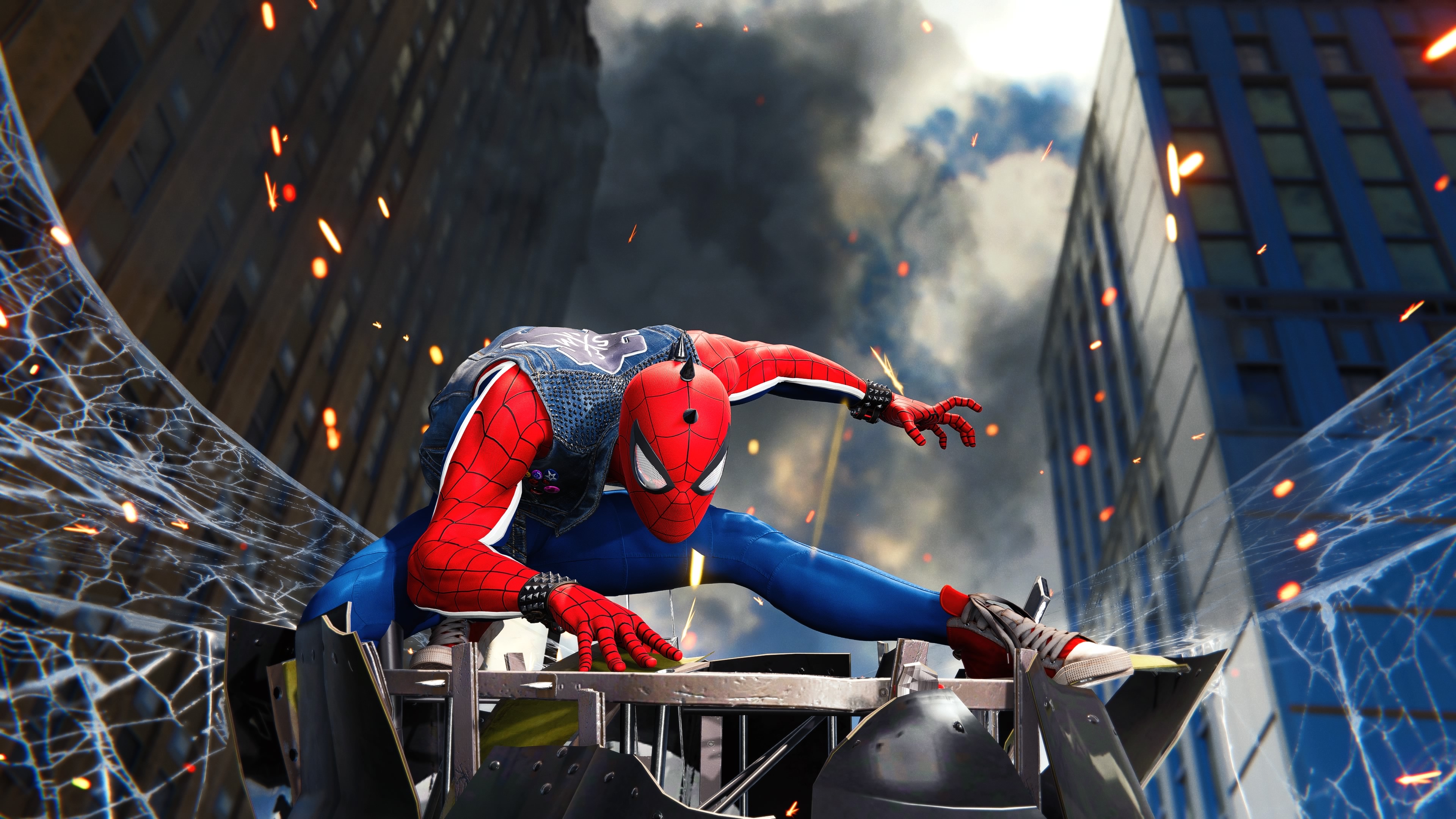
It took the impending release of Marvel’s Spider-Man 2 to make me realize that I hadn’t played the original in five years. The original release was my favorite game in the superhero genre and I was delighted to brush up on the story while also getting into the downloadable story content that I never got a chance to try. With a fresh coat of paint and new content to explore, I was excited to pick up the controller and give it another go.

Marvel’s Spider-Man
games, developed by Insomniac Games, provide one of the two best superhero offerings on the market now (the other being the Batman Arkham games, of course). While Rocksteady’s Batman games have more grit to them, Insomniac’s Spider-Man follows a more balanced path, much in line with the superhero himself. And, thank the comic book heavens, we don’t have to watch Uncle Ben die for the hundredth time. Marvel’s Spider-Man takes place eight years after Peter’s initial meeting with a radioactive spider, and the story is all the better for it.

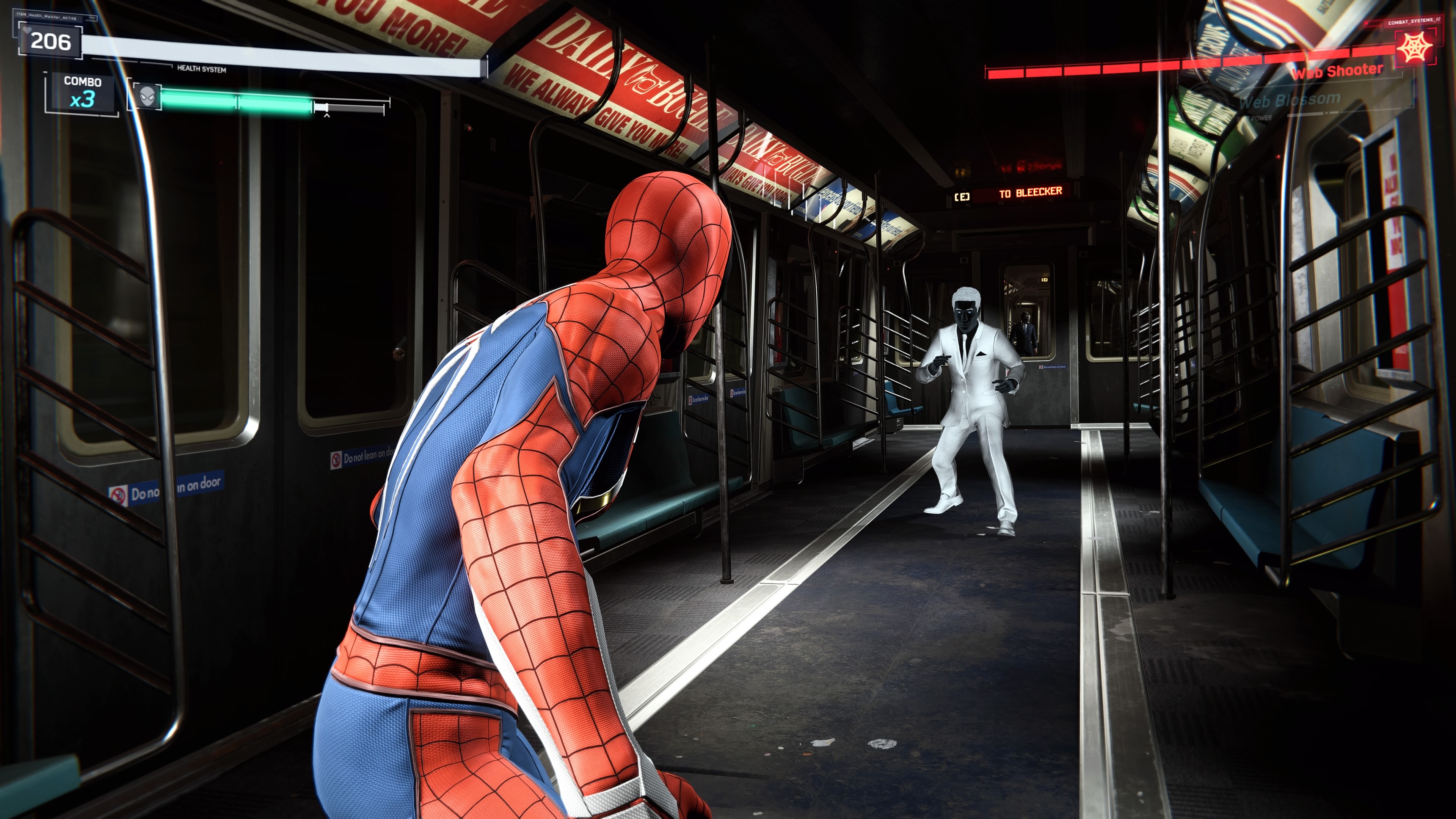
Spider-Man is tasked with taking down Mister Negative (Martin Li) who is causing chaos around New York. Peter is playing the part of a genius lab partner with a man named Otto Octavius. All the while Norman Osborn hides his secrets as he runs for reelection. Personalities and superpowers clash in a tightly threaded superhero tale. While some things are inevitable due to the history of the comics, others leave the door open for interpretation. All the while J. Jonah Jameson critiques Spidey’s every action from his aggressively fueled podcast.

Crafting a narrative that walks the fine line between the comic relief of Spider-Man and the seriousness of the predicaments in the main story is something that Insomniac handles well. There are moments here and there that come across as tawdry, but when the punches need to land, they hit hard. Both tense and tender moments between MJ and Peter and handled with punctilious effort, while Aunt May keeps Peter honest. All of the main players feel true to themselves and don’t bend to serve the narrative. Despite all the chaos that surrounds our heroes, they are the stars of the show.


The weakest gameplay segments occur when the perspective shifts from Spider-Man to MJ or Miles. They aren’t bad per se, but the juxtaposition between someone who can do it all and someone who can temporarily hack a machine to make a distracting noise is rather tame by comparison. Despite this, the Miles/Rhino scene has its moments, and it's nice to get to know the other characters a bit better.

Marvel’s Spider-Man
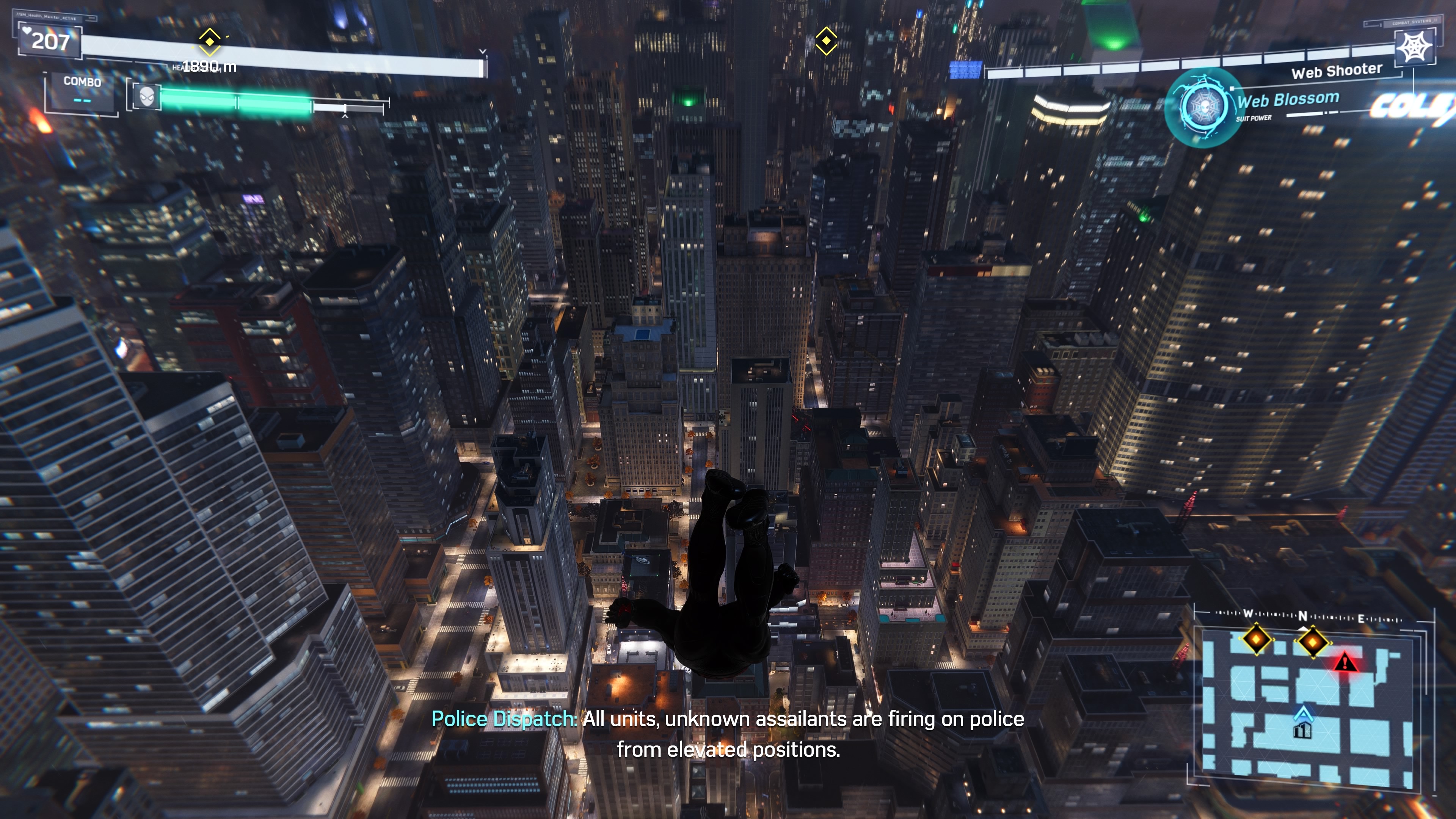
has achieved something that no other game matches; traversal mechanics. Now, I’m not saying it’s not fun to get around in other games, but this game does it better (and with style). Going around Manhattan at high speed, then nose-diving to increase momentum, only to swing back up and release at the right time to increase velocity even further deserves a proper chef’s kiss. Swinging between narrow alleys, missing oncoming subways by a mere foot, pulling off a perfect point launch… all these things and more add to the excitement of moving around New York City. With the remastered version of this game, you can fast-travel to any point on the map in less than two seconds, but I barely used the option. Instead, I opted to swing almost everywhere I went. I can think of no other game where I forewent fast travel to enjoy a game’s traversal mechanics.

In addition to his web-slinging, Spider-Man can pack a punch. Insomniac once again brings the hero to life with an enjoyable combat system reminiscent of the modern Batman’s Arkham games (which in turn is inspired by the old Spider-Man 2 game on PS2). I feel that the combat system makes more sense for Spider-Man as the incoming attack indicator looks like his Spidey-sense is activating. A mix of standard hits, web attacks, launch attacks, aerial combos, dodges, and gadget attacks make up the bulk of Spider-Man’s combat options. When used together, the combat is frenetic and riveting. Taking notes from their other quirky franchises (Ratchet & Clank, Sunset Overdrive, etc.), Insomniac gave Spidey some cool tools with which he could dispatch enemies either in the middle of combat or stealthily. One of these seemed a bit farfetched (gravity well, yes you), but all the gadgets are useful and fun and very much blend Insomniac’s DNA with Spider-Man’s.


Marvel’s Spider-Man
’s approach to the open world follows in the footsteps of Ubisoft’s finest; find a tower, and unlock part of the map. It’s all basic and uninspired but takes up very little time to reveal the entire map. Once you have visibility of the whole map, you are free to look for Pete’s old backpacks (which are great for finding out what he’s been up to these last eight years), take pictures of monuments and buildings, along with other activities. As the game progresses other options will be open to the player. Taking down enemy strongholds, beefy side-missions, chasing down escaped pigeons… I’m still not sure how I felt about this last one, but at least it was fun. At any given time, a crime will occur and it’s up to Manhattan’s friendly neighborhood Spider-Man to tackle the situation. They can range from a car chase to a kidnapping to breaking up a drug deal. The downloadable content adds an extra range of crimes to dive into.

Speaking of the downloadable content, this was my first experience with the additional story. Entitled The City that Never Sleeps, this DLC follows a three-part arc that sees Spider-Man attempt to take down the mob boss Hammerhead who is trying to fill the vacuum left by Fisk and Li. The overall storyline was enjoyable, even if it dips a bit in the middle. It adds extra story development for Yuri Watanabe and her inevitable turn to vigilante justice. Though I liked the overall story, the character changes happen a bit too quickly, especially in Yuri’s case. A decent extra tidbit to pad onto the game, though not quite as great as the main game.

It must be noted that as a remastered version of 2018’s Marvel’s Spider-Man, visual fidelity has increased. The bells and whistles that the PS5 grants are immediately recognizable. Nearly instant load times, ray-traced reflections, higher frame rates and quicker movement are all included in this build. The game looks a bit better, but the original game looked great already. The switch in character model for Peter (also available in an update for the original version of the game) was an interesting choice and I’m not sure whether it was necessary, but the model looks good and all animations in the game are fantastic. It’s not the biggest overhaul I’ve seen in a remaster, but it’s definitely the best version of a great game.

By the end of Spider-Man, I had run the full gamut of gamer emotions. I laughed, teared up, felt tense, excited, worried. Spider-Man manages to tell a great story within the confines of a superhero suit. And in the end, tasks our hero with being greater not just by doing difficult things, but by having to make difficult choices as well. In Marvel’s Spider-Man, Insomniac has created my favorite superhero game and one of my favorite all-time action games.


[Though I didn’t review the Marvel’s Spider-Man: Miles Morales expansion here, it’s worth noting that many of the mechanics are similar and even improved upon. The story is separate and exclusively follows Miles as he comes to terms with being Spider-Man and what that means to him. If you haven’t played either, they’re both worth the price of admission.]

--

The Math

Objective Assessment: 8.5/10

Bonus: +.5 JJJ. +1 for creating my favorite traversal mechanics.

Penalties: -1 for Ubisoft cut and paste open world exploration.

Nerd Coefficient: 9/10

Posted by: Joe DelFranco - Fiction writer and lover of most things video games. On most days you can find him writing at his favorite spot in the little state of Rhode Island.