Tuesday, September 26, 2023

Microreview: Sordidez by E. G. Condé

Sordidez address community survival in the face of empire and the climate crisis, offering a future centering Indigenous power and queer resilience.

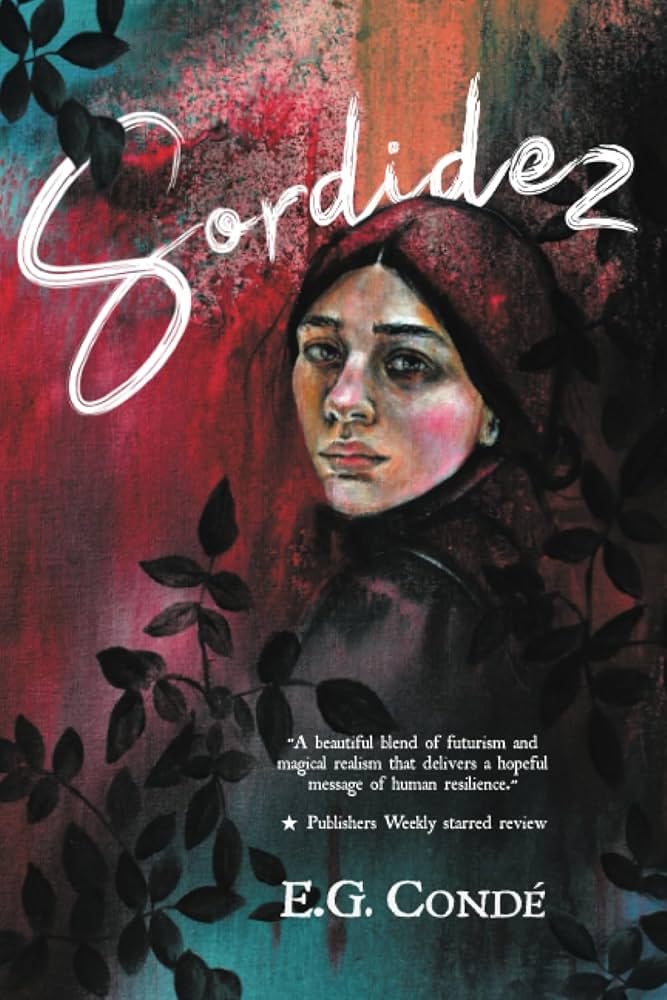
a book cover with dark colors featuring an androgynous person. The title Sordidez is scrawled in white cursive over the top of the picture.

E. G. Condé’s novella Sordidez is an important intervention in climate fiction and speculative fiction because of the focus on Indigenous reclamation and critique of empire, particularly around Puerto Rico. Through multiple narrators, Condé unravels a complex story of Indigenous resistance, colonialism, climate weapons, dictators, and queer power. 

The novella begins and ends with Vero, a trans man who is a leader in his community while simultaneously disregarded and hated for being trans. When a superstorm destroys the community in Puerto Rico, Vero and his family (both blood and found), design different technology and alternate ways of living to survive the aftermath. 

Part of that aftermath is the abandonment of Puerto Rico by the U.S. Empire to China, and subsequently to a one-world government called the United Nations Parliament. Resources are only handed out to those who assimilate, and Vero and his community resist. One aspect the novella does well is not to hand-wave away the difficulty of that resistance. One member of the community is eventually given over to the settlers because of the lack of insulin. Additionally, Condé doesn’t shy away from depicting the violent tactics empires use to put down Indigenous resistance. 

Through the different voices and narrators, the empires are revealed for their lies. Only those who assimilate have access to the protection, services, and food available in climate-controlled areas, as Doña Margarita discovers. She works among refugees and those impacted by the androvirus, a virus that caused memories to be forgotten. Doña Margarita is largely left alone to her work among the refugees until the U.N. Parliament discovers she has seen the Loba Roja, a Mayan leader working to help the people and violently force out the U.N. It is only then that Doña Margarita is brought to the Green Zone, under the guise of protecting her and those she cares for from rejuvenating rains, that she is questioned against her will. She witnesses the plenty that is available to those who assimilate. 

Through the different depictions of empire, Condé demonstrates how people are stripped of their sovereignty. Climate change plays a role through the superstorm Teddy that destroys Puerto Rico at the beginning of the novella (which mirrors Hurricane Maria in 2017), but also through technology, such as the “hydrophage,” which was supposed to help capture water but turned out to be hydrophobic and deployed as a weapon. Similarly, while the U.N. Parliament claimed to be helping restore the land from the hydrophage's desertification, instead the drones were spreading chemicals that were potentially harmful. Condé demonstrates the different tools of empire, from familiar forms of violence to the new technologies that will emerge in response to climate change. As SFF writers continue to imagine alternate futures, Condé demonstrates the value in imagining these visions of imperialism in order to form resistance.

Importantly, the novella ends on Taíno power. Without giving away too many spoilers, one of my favorite sections was at the end as Condé creates a world of Taínofuturism combining technology, Indigenous practice, and community protection. Vero thrives when he embraces this future and takes on his leadership role not in a sense of hierarchy but as a guide and protector of his community.

Condé does a great job handling the form and weaving together the multiple viewpoints. More linear plots cannot always capture the complexity of empire and climate change. While this novella may not be for all readers, Condé’s structure emphasizes these complexities while still creating a satisfying reading experience for each character. These characters come together in the end to create an alternate vision of the future that foregrounds the Taíno community.

Condé’s vision of the near-future recognizes the ways imperialism will fluctuate in response to climate change and what that could mean for colonized communities. It can open pathways for resistance, like Vero’s community after the storm. It can also open pathways for dictators, renewed imperial violence, and climate weapons. What I appreciated so much about this novella was the response that Condé imagines as blooming from occupations. As Vero says near the end of the novella: “I will show them that our myths live on in us.” I look forward to reading more of Condé’s #Taínofuturism.


Posted by: Phoebe Wagner is an author, editor, and academic writing and living at the intersection of speculative fiction and ecology.   

Monday, September 25, 2023

Review: The Road to Neverwinter by Jaleigh Johnson

It turns out you can have a lot of fun this many levels of adaptation in. Who knew?

It’s a novel based on a movie which is itself based on a tabletop role-playing game. In reading this book, we are three layers into the adaptation-mania that is cultural production under late-stage capitalism. I got this on a roll of the dice from a library, mostly because I had liked Dungeons and Dragons: Honor Among Thieves, and to my great joy I found that it was actually quite good, and that under the swashbuckling heroics and magic we all love from D&D there’s some really smart stuff in it.

Dungeons and Dragons: Honor Among Thieves: the Road to Neverwinter (another curse of cultural production under late-stage capitalism: SO. MANY. COLONS.) is written by Jaleigh Johnson, an author I didn’t have any experience of. Well, whatever she did before, it prepared her well for this, in the way I understood why Lucasfilm chose Timothy Zahn to save Star Wars after reading his Conquerors trilogy (a series I love).

The Road to Neverwinter is a prequel to Honor Among Thieves, detailing how the merry band of misfits that had broken up by the start of the film got together in the first place. As you may suspect, it’s a heist, and plot-wise there’s nothing groundbreaking (but it must be said that D&D codified a lot of these tropes, so they’re everywhere). The author more than makes up for that in how well she captures the voices of the film characters; you can imagine Chris Pine and Michelle Rodriguez and Hugh Grant saying all their lines, and it helps you get in that goofy fun mood the way the movie did. Even better, Johnson totally sells you on the notion that these people could make an adventuring team (someone should make a movie about that). She also has the knack of humor, and I guffawed several times. It’s good for the soul.

What really struck me about this book is that Johnson understood that she’s writing a novel adaptation of a film adaptation of a tabletop game, and that therefore there is plenty to play with in terms of the ways people create fictions. Firstly, there’s the frame story of Edgin recounting the story to his daughter Kira (about nine years old at the time), who was involved in several of those events and wants them told a certain way, which has all sorts of implications for modern fandom (and perhaps throwing a little shade at some fans). Beyond that, it gets rather spoilery to discuss it in depth, but there are several layers of representation and performance and adaptation and whatnot that add a clever subtext to the whole thing.

And, of course, there’s the certain je ne sais quoi that I can’t put any other way than ‘feels like a D&D game.’ The film had it, and this book has it too. Johnson does a good job of making the world feel like a D&D game while still working as a novel, and there are several personal interactions that feel joky in the way that players who know each other are. That isn’t usually how you write pseudo-medieval fantasy, but here it helped with the vibe. The whole thing feels a bit wacky and improvised, and I mean that in a positive way.

The Road to Neverwinter felt like warm soup when you have a cold; in a world this dreary, you need something filling and wholesome and warm. It’s a fantasy romp in the proudest tradition of D&D and a good thing for when your RPG group isn’t in session if you have the hankering for it. It rounds all this off with a self-awareness that enhances proceedings rather than encumbers them, and it complements the film like hand in glove. If you enjoyed the film, you’ll enjoy this.

--

The Math

Highlights: witty dialogue, subtle but clever meta-weirdness.

Nerd Coefficient: 8/10.

POSTED BY: Alex Wallace, alternate history buff who reads more than is healthy.

Friday, September 22, 2023

Recap — Ahsoka Episode 6: Far, Far Away

 Episode 6 really delivers the goods as we meet Thrawn in the flesh for the very first time!


We open in purrgil hyperspace, with Ahsoka and Huyang telling old tales. Huyang's skill as a storyteller, we learn, is why our beloved franchise begins with the infamous preamble "A long time ago, in a galaxy far, far away." Spoken, of course, on the way to a faraway galaxy ensconced in the maw of a space whale.


We're Off to See the Witches

Sabine awakens in a holding cell, encountering Baylan and shouting that they had a deal — she'd give up the map if he'd agree to take her to Ezra. 

It's not quite that easy, though — he knows that she can still be of use when it comes to her obsession for finding Bridger. 

The Eye of Sion exits hyperspace above the planet Peridia (and not, in fact, "Druidia" from Spaceballs, which is 100% what I heard watching for episode for the first time Tuesday night without subtitles).

It's the ancient homeworld of Elsbeth's ancestors, the Dathomiri Nightsisters. Encircling the planet isn't a ring of dust or ice like Saturn, but rather of MOTHERFREAKING PURRGIL BONES. This is a VERY metal moment in Star Wars, and I'm here for it. It seems the purrgil are not unlike our salmon, and return home to pass away, crushed into bone dust around an ancient planet.

The Nightsisters harnessed the purrgil, hopping between galaxies like the badasses they are. We're only like 5 minutes in and this episode is already incredible. 

When Shall We Three Meet Again?


Our bad guys fly a brilliant gold shuttle reminiscent of yet another Spaceballs reference (Lonestar's Winnebago!) down to the surface of the planet to rendezvous with none other than Night Sisters! 

Seeing them in live-action is INCREDIBLE — so creepy, so eerily voiced. This, we find out, is how Elsbeth manufactured the map/McGuffin device so central to the show's plot. She heard their call across the galaxy and it worked! I loved loved loved this scene. The sisters are giving Bene Gesserit in the best possible way. 

Elsbeth knows there's an ulterior motive — Thrawn has summoned them. He chose well to ally with these witches. They notice the reek of Jedi — not just Baylan and Shin (who seems utterly shocked by the existence of more than one witch) but also Sabine, their prisoner. 

Insight into Our Dark(?) Jedi

As the witches leave, we're left for a scene with just Baylan and Shin. Finally, we get more insight into who these people are, and what they're all about. I've been referring to them as dark Jedi throughout these recaps, but I wasn't sure. Turns out, they're just mercenaries! 


Baylan is a former Jedi, having been raised the traditional way in the temple. We learn of his trauma, of watching Order 66 unfold before him. 

But unlike traditional Sith masters and apprentices, their relationship doesn't seem to be one of obeisance and blind subservience. He listens to Shin, and provides guidance, but doesn't demand blind obedience. He's fatherly and kind, not unlike Anakin and Ahsoka, as he listens to her questions and criticisms. 

I don't think he's a dark Jedi or a Sith, but I do believe he's trying to live outside the stark strictures of history. He mentions the rising and falling and the repeating natures of it all — he wants to break free of it. In this way, he's similar to Ahsoka's stature outside the order. Using the Force, but in pathways yet unforged. 

A Meeting 33 Years in the Making

Thrawn. THRAWN! First introduced in May 1991 by Timothy Zahn, and beloved by Star Wars fans throughout the intervening years. Once relegated to Legends status, our lord and savior Dave Filoni resurrected Thrawn into canon in Rebels — and here in this episode, we shall meet our Admiral in the flesh, played by his voice actor Lars Mikkelson. 

Ever one to make a grand entrance, Thrawn descends upon the scene in his Star Destroyer — a mightily imposing scene that had me guessing at how precise their sublight engines and repulsor lifts were. As Elsbeth, the Nighsisters, Baylan, and Shin meet step to meet him, we're presented with an awesome display of might.

Lining the floor of the hangar, we see a legion of stormtroopers, their masks cracked and repaired, their bodies lined with red stripes signifying we know not what. We get an up close and personal glimpse of Enoch, Thrawn's number one, his stormtrooper looking for all the world like a Party City Mardi Gras mask — but in a badass way, of course. 

The music is blaring, the Thrawn theme is echoing, and we're here, folks. We're here. We're meeting Grand Admiral Thrawn in the flesh, and it was so worth it. 

He's so blue. And his eyes are so menacingly red. Thrawn has been in exile for 10 years — that's an incredible amount of time! And it accounts for his slightly dirty uniform, as well as his stormtroopers' cracked visages. These soldiers are called night troopers, which is interesting. They've been living without support or reinforcement for a decade, no wonder things are in disrepair. 

What has this man been doing?!?! I have SO many questions, mainly from a supply chain point of view. The quartermaster in me really wants to know how he's been feeding these troops, keeping his Star Destroyer in fuel. 

A Kink in the Bad Guys' Plan

Our Bene Gesserit admit to Thrawn that there's a loose thread — the presence of Sabine, a familiar name to Thrawn as he knew her and Ezra back on Lothal. 

Thrawn greets Sabine, and thanks her for the part she played in freeing him from exile. Oof, that burns! Yes, it's technically her fault that Elsbeth & co could find Thrawn because she didn't destroy the Nightsister map. But it's complicated! 


Thrawn agrees to let Sabine go after Ezra, but of course she's going to be tracked. She mounts a howler (like a wolf horse) and traipses off into the brush of the planet, warned by Enoch to be wary of nomads. 

She gets ambushed within seconds (hey, she was warned!) but manages to impressively defend herself against a handful of natives. Her scanning equipment gets destroyed though, so she's in a pretty bad spot. 

Ready to Meet Your New Favorite Star Wars Creatures?

Lost and confused, Sabine stumbles across what can only be described as Peaky Blinders Hermit Crabs. They're called Noti and I'm obsessed. 

Like Leia befriending the Ewoks on Endor, she earns their trust and notices one wearing a rebel insignia — they must know where Ezra is!


I LOVED these little creatures. They really help capture that old Star Wars magic of strange and beautiful sentient beings. 

The creatures bring Sabine to their encampment, and we finally get the reunion we've been waiting for. Ezra is there, looking for all the world like Moses. He's been living among the Noti, we assume, and it's adorable.


It was a little hilarious that they didn't dive into the details of her arrival or her (lack of a) plan for getting off Peridia. But after missing each other for 10 years, sometimes you just want to have a moment of pleasure. He's NOT going to be happy when he learns she completely made his self-sacrifice moot in a moment of weakness. 


Bokken Promises

Tracking Sabine, Baylan and Shin find remnants of her scuffle. Shin asks after this Ezra, and we learn from Baylan about a type of Jedi called Bokken — ones trained after the fall of the temple. So Ezra, obviously, but also Luke! She asks if she's one, and Baylan replies no. He's training her to be something more than a Jedi. More clues! I remain fascinated.


Another Problem for Thrawn

Thrawn is told by the Nightsisters that the thread of fate has spoken — a Jedi is on the way via purrgil. He's understandably pissed, and immediately guesses that it's Ahsoka. He's been burned before by these space whales, so he charges his crew to eliminate it with prejudice. Little does he know that an entire pod is on the way. 


______________________________________________________

The Math

Baseline score: 9


Bonuses: +100 Thrawn's live-action debut was perfection.

Penalties: 0 I can think of none. This episode had me absolutely giddy.

Nerd coefficient: +5 This is the first piece of Star Wars content in years that really captured the old-school magic. Nerds everywhere, rejoice.

Gonk droid count: Zero!


POSTED BY: Haley Zapal, NoaF contributor and lawyer-turned-copywriter living in Atlanta, Georgia. A co-host of Hugo-nominated podcast Hugo, Girl!, she posts on Instagram as @cestlahaley. She loves nautical fiction, Vidalia onions, and growing corn and giving them pun names like Anacorn Skywalker. 

Thursday, September 21, 2023

Review: The Equalizer 3

Can a movie this bloody be beautiful? I guess so

My mother asked me what the movie I was going to see last Sunday was about. I told her The Equalizer 3 is about “Denzel Washington killing people for two hours.” She chuckled and said it was in character for him. In a way, that pithy description I used was accurate (I have also described the John Wick movies as “Keanu Reeves killing people for two hours” and I don’t think I’m wrong there either), but in some ways it undersells what’s going on in this film.

You get the distinct impression that Robert McCall, played by Washington, is just so sick and tired of this shit. He is a man who has seen shit, heinous shit, and you can see it in how he walks, how he talks, how he carries himself, how he looks at others. This is a man who feels the crushing weight of the last two movies, and you can’t blame him for wanting to get away from it all. The best line in the film is McCall talking to his enemies about how he had learned something about war and death and violence, but only here, in this town across the ocean, has he begun to learn about peace.

That town is on Sicily, land of scenic aerial shots of the coastline, as well as the mafia. Both feature prominently here; would an Equalizer movie set in Italy have any other villain? This town of Altamonte (not real, to my understanding, although there’s an Altomonte in Calabria, the toe of the Italian boot) isn’t just houses and churches (although you get plenty of those); you get to know the townsfolk, the cafes, the community events (there a parade sequence near the end that is magnificent in its pageantry).

Here the film plays with the stereotype of much of Mediterranean Europe that Americans have, of peace and beauty and joy and no suffering. That, of course, is the thin patina overlying the violence that exists here, the tentacles of organized crime that sneak into every nook and cranny, the fear that the beauty distracts from. Italy is a country with a relatively recent history of political violence, and before that, it was invaded (sunny Spain, with similar stereotypes, had a fascist dictator who held power til the 1970s and came to power in a bitter civil war; Portugal and Greece are quite similar). Indeed, how McCall ends up in Altamonte has its unsavory aspects. It makes the violence more hitting, more painful, as you come to love Altamonte; indeed part of me wanted to move there, how joyful and loving it seemed.

That’s where the pacing is so good: there is less violence in this film than in more fantastical shoot-em-ups, and much time spent developing Washington’s character and the town of Altamonte. Particularly, the relationship between him and Enzo (played by Remo Girone), the doctor who took him in, has many depths and nuances, and you feel an almost paternal quality from Enzo toward McCall. To the viewer's satisfaction, the violence avoids the risk of becoming meaningless, and this violence is very, very bloody, all blood spilled due to cruelty in Mediterranean Arcadia.

It took some rumination to phrase what impressed me the most about this film: it’s that it successfully persuades you that a man who drove a pistol through a mobster’s head and shot bullets through the back of his skull at other mobsters is, at his core, a good man. Director Antoine Fuqua and writer Richard Wenk don’t fall into the temptation to turn McCall into a man we love to hate; he is a good man who, because of his station, has had to do awful things. He has fought monsters for so long, but has miraculously avoided becoming a monster himself. It is a remarkable achievement. It’s what I imagine many soldiers end up like after they've fought for just causes. The good fight is not clean, even when it's fought to cleanse evil. It's not a situation I would wish on anyone, but if it has to happen, you better have the likes of Robert McCall at your disposal.

A side note (but not a complaint): much of the film is in Italian with English subtitles. I like this approach more than just rendering everything in English (Sisu, a recent Finnish action film I otherwise liked, took me out of the experience a bit by having dialogue in English rather than Finnish when the setting is clearly Finland). As fortune had it, I am doing Duolingo in Italian right now, and I noticed a few interesting bits of the language. There’s a bit where an Italian policeman refers disparagingly to an American CIA agent played by Dakota Fanning; the subtitles render the word ‘woman’ (‘donna’ in Italian) but he says the word ‘ragazza,’ literally ‘girl’ as taught to me by Duolingo, but Google Translate says it can also mean ‘lass,’ ‘gal,’ ‘girlfriend,’ ‘missy,’ ‘maid,’ and Google results suggest other translations, all denoting youth and more often than not a degree of dismissal (and, let’s be blunt, misogyny). His tone certainly gives that impression. Also, I like how the Italians say ‘CIA’ phonetically, sounding like ‘la cha’ in English.

The Equalizer 3 is more than Denzel Washington killing people for two hours, and it delivers it in a thoughtful, beautifully shot, but no less bloody package. I recommend it to all action junkies.

--

The Math

Highlights: Intense depth of character and theme, also graphic violence.

Nerd Coefficient: 9/10

POSTED BY: Alex Wallace, alternate history buff who reads more than is healthy.

Review: Lavender House by Lev A. C. Rosen

 A 1950s murder mystery that queers all your expectations.

One of the big things about period detective fiction is they all do a great job of crafting a vibe, an atmosphere. Someone calls a woman "doll", and suddenly my mental images of the book shift to black and white, everyone's sitting depressed (or possibly just repressed) at a bar in a fedora or a red dress with a thigh slit and there's smoke in the air and clouds in the sky. It just all comes with the territory.

What's so fascinating about Lavender House is how neatly it overturns some of these expectations, with the tiniest of twists, while still occupying and playing with the same tropes and ideas.

Specifically, we meet our protagonist drinking to forget in a bar, and a beautiful woman sits herself down next to him and asks him to do a job... but she's gay. He's gay. And suddenly the narrative shifts entirely. We've overturned the core relationship dynamic of the noir detective, so where do we go from here? It's a seemingly small thing, yet one that not only changes the content of the story - which is unsurprising - but also the entire feeling of the setting, of the type of book. It takes all of my issues with a certain sort of historical detective story and makes me re-examine them entirely, and I find that, when that landscape of attraction is changed, so too is the feel of the whole world.

And on this bedrock of delightful uncertainty sits Lavender House. In some ways, it's a standard murder mystery - rich family, house out in the countryside, a whodunnit, secrets behind closed doors, some upstairs/downstairs drama, learning about the detective's life as he learns about the lives of the victim and suspects, clues slowly seeping out until the answer becomes clear, a red herring or two. All the good stuff. If we just examine it as a murder mystery, we find a very competently built plot, with some compelling characters you find yourself doubting - but not wanting to doubt - and a substantial setting that leaves plenty of scope for the petty grievances and betrayals and heartbreaks that are the necessary backdrop to any investigation. Which isn't to play it down - as a murder mystery it is very well done - just not really outside the scope of the normal. I could pick up any number of books about dead rich people in the UK, the US or anywhere else, and find something that does just a good job of puzzle and clue and reveal as this does.

What I'd be much less likely to find is one that does all the peripherals quite so well as this. And it's in the peripherals that I found most of my joy in reading Lavender House.

Firstly, of course, it's a book about queerness in 1950s San Francisco. And that's already interesting - it's managing the balance really well of the terrible state of culture and law for queer people at the time with acknowledging that they were nonetheless there, and there was culture and life and joy to be found amid the awfulness. And in that dual reality - of hardship and of joy - is the divide between our protagonist and those he encounters.

Which is the second thing - Rosen does a frankly amazing job when it comes to characterisation. Every single person we see in any significant detail, and particularly Andy, our detective, and the residents of Lavender House itself, feels rounded, full and human. Some of this is par for the course for a good mystery, because you need to understand the people who might have done the murder to try to piece together the clues (hopefully just before the detective solves it on the page, so you can feel smug). But Rosen takes it that step further, and where some stories might have a house full of the haughty rich, where motives are understood intellectually, but emotionally speaking it's just a puzzle, he manages to make them all genuinely sympathetic, at least for a time. At several points in the story, I cared about who had done the murder less for the challenge of solving it and more because I was really invested in these characters I cared about not having done it please and thank you. And this I find rare, and wonderful, especially in the murder mystery genre.

Because here's the thing - and this is far bigger than can be grappled with in a single review about a single book - murder stories need to be humanised. There's a lot of terrible, grisly, cold and emotionless discussion of murders, rendering them only puzzles to be solved and obsessed over, whether in or out of fiction. And then in some cases, we push it so far in that murder becomes "cosy" - a soft, comforting genre of story where death is just a necessary premise, and the human cost is hidden in the setup, likely off page. It's not even really important except as a motive force for the plot. But if we want a story that feels real, that feels human, then that human cost needs to weigh on the page too. We need to feel like the dead were people, whose ties reach out into those who remain in the story, and critically that the murderers are people too. That complexity is the antithesis of the Scooby-Doo style mask-off reveal, where the moment the truth is known the culprit drops their own façade of humanity to become a cackling, amoral villain, but the crux of why these stories are so interesting. They're all people, doing people things for people reasons. And they feel more people when we understand them, not just logically but emotionally, especially when we don't agree with them. A senseless murder is no good story at all.

And this, Rosen has grasped fully. When we are at that point in the story where we still don't know who it might be, it is incredibly easy to care about so many of the characters, so easy to see where their insecurities, uncertainties and grudges come from. We feel like anyone could have done it, and if they did, we'd see why they were pushed to that point.

Of course, our detective gets exactly the same treatment, but from a very different angle. We meet him at a low point in his life - as we open the very first page, he is contemplating suicide because of what has happened to his career in the police - and watch him build himself back up through the course of solving the murder. We watch him begin to care about the suspects, just as we do. We also see that he, like them, is far from perfect, and has done many things we may judge, may not condone, but nonetheless understand.

And herein lies the third thing Rosen has done so well - and again is found so rarely. He genuinely interrogates the structures within which we find our characters (and their general archetypes). For Andy, our detective, this means getting to grips with the moral weight of being a gay man, in an anti-gay world, in a world where the law gleefully and regularly commits violence against queer characters. He has his reasons - of course he does - but those are never used as a carte blanche for the choices he's made or the ramifications they may have had. He has to face up to the fact that he was complicit in the system that has hurt and killed people like him. He has to face up to the fact that there may be no forgiveness from some quarters for that. And he has to face up to the fact that he might still be there, might never have pulled himself out of that complicity, but for circumstances conspiring. There are no simple answers to his moral situation. And nor are there for our - however beloved - suspects. Because they too are complicit in their own injustices. This is a small, sheltered house whose safety is bought by financial security. They have made freedom - each in their own way - to be themselves, but their is always a cost. Whether in bribes to the police for absence of scrutiny, or lip service to societal norms, or in aggressively playing the part of heteronormativity outside the confines of their sanctuary, no matter the cost, there is always a price to be paid, and there is a mark on each of them for their privilege. We see them for themselves, but we also see them, see the house, through discussions with the servants, who have their own place in the system, their own view of the injustices in the world around them, and whose voices are given the weight they deserve.

Almost everyone in the story is queer. But no one is given a free pass for it. Everyone is scrutinised for the harms they commit by their place in the world, even as we acknowledge their oppressions, and the sympathy we feel for their positions never excuses their privilege. The rich country house isn't merely a setting for the story, but the whole architecture through which to examine the world and the characters. And in this, Rosen has done what makes Lavender House truly stand out from the crowd. Because for all this examination of privilege, this acknowledgment of intersectionality, and this genuine weight to the moral questions of the book, somehow the story never falters in pace, in readability, and in due consideration of the mystery at hand. It is both a genuinely critical, thoughtful story while being a fully engaging murder mystery.

If I had any criticism - though it isn't much - I might say that the reader feels a little too in the dark about who might be the murderer for a little too long. The clues are not always paced quite so well as we'd like. But the ultimate reveal is handled well and smoothly, with sufficient drama, and the ending is satisfying, so with all the rest the story is doing, it feels very easy to forgive.

I have seen this book often likened to Knives Out, and I think the comparison falters when it comes to humour, which is my primary thought about Knives Out. There is a common thread in their examinations of wealth and privilege, but the difference in tone is a stark one. Don't go into this wanting either constant humorous undertones or the savageness that underlies the film's examination of wealth. See instead - as is present in Knives Out, though less prominently - a great deal of human sympathy, human feeling, and a murder mystery dedicated to a critical examination of what that genre truly entails. I can't wait for the next one.

--

The Math

Highlights: Moments of genuine complexity and interest, a compelling cast of characters, a nuanced view of the queer world of 1950s San Francisco

Nerd Coefficient: 8/10

Reference: Lev A C Rosen, Lavender House, [Forge, 2022]

POSTED BY: Roseanna Pendlebury, the humble servant of a very loud cat. @chloroform_tea
Wednesday, September 20, 2023

Review: The Surviving Sky by Kritika H. Rao

A junglepunk fantasy that centers the relationship of a married couple in a strong character-centered way.

In a world where cities, polities (ashrams) float above a dangerous world spanning jungle plagued by earthrages (earthquakes), the relationship between a Senior Architect, one of the central people responsible for keeping the city up and safe, and his wife, a would be archaeologist who believes study of the jungle and its inhabitants is not only a good idea, but necessary, proves to hold the fate of the ashram itself.

This is the story of Kritika H Rao’s The Surviving Sky.

When I first read about this book and its premise, I as a reader and reviewer got excited. Like arctic and polar climes, jungle climes are uncommon as major settings in SFF. For all of the diversity of settings in SFF, I have noticed an inordinate tendency toward various kinds of temperate climes as the norm, with more tropical locations as an exoticized (with all of the negative connotations of that) Other Place. Sometimes this avoids some of the very unpleasant connotations (c.f. The Rainwilds of Robin Hobb’s novels). Portions of the world of Martha Wells’ Raksuraverse also comes to mind, although I’ve always seen that as more temperate than actual jungle.

Stories that center a true jungle landscape and stand alone in exploring that are uncommon. Thoriaya Dyer’s Crossroads of Canopy series, though, comes to mind. And now, we can add The Surviving Sky by Kritika H. Rao to that list. But not in the same way, as we shall see.

The center of the story is the floating sky ashram itself, Nakshar. It floats (for as long as it can) above a continuous jungle landscape that is dangerous at the best of times. The world that Nakshar and its sister cities float above is plagued by “Earthrages” (earthquakes), a violently disruptive and hostile landscape that reminded me of a different fantasy series with an extreme and unfriendly setting of a different sort: The Broken Earth series by N K Jemisin. One can draw a number of parallels between Jemisin’s work and Rao’s here. Jemisin’s lithologically wracked world, with science fantasy magic that is also Earth-aspected, parallels the setup here. Here we have a jungle world under constant stress, a landscape, a world where humans have to struggle against a world that is not friendly to them at all (this in turn can be thought of a metaphor for the climate change alterations to our own planet today).

And like The Broken Earth, the science fantasy magic-technology that the inhabitants use is tied directly to the matter of the world. Here, plants are the basis of science fantasy magitech that the inhabitants use in a very hostile world. Not just the transporting power of trajection which is certainly the most spectacular of the science fantasy plant based powers, healing, truth telling, and other abilities and powers are harnessed by the power of various plants. While the ashram Nakshar may float above the jungle (and the metaphor is not subtle), plants and the plants of the jungle are an everyday necessity for the people who live in the city.

But above the interesting worldbuilding, the world, the plant based science fantasy, the floating cities in the sky, and other strange and wondrous things to be found on this planet. (is it Earth? It’s not exactly clear!) , where this novel is really centered, what it really does and where it’s heart is, is in the characters, and particularly the two viewpoint characters, Iravan and Ahilya.

Let’s start with their relationship status. It is more than a cliché, it is a failure of imagination (or perhaps just realpolitik market trends) that young men and women, often fumbling toward a relationship with each other, is the default norm in a lot of SFF. The reasons why from a literary view are well trod and well understood. The Surviving Sky defies that worn well path through the jungle of its pages by presenting to us a married couple, a couple that has been through some years of marriage, with the joys and also very tempestuous fights and relationship ups and down that that entails. Iravan and Ahilya have not had an easy time of it in their marriage. Rao cleverly funnels that not only into character development and drama, but even makes that part of the plot and and problem.

The two characters each face a central problem, and in the end strong aspects of that problem are to be found in their relationship, and it is in the resolution of those problems with their relationship is the resolution to their problems, and the problem of the ashram. But it is not easy. Iravan, as a young and ambitious senior architect, overworks and finds it difficult to connect to his wife, as much as he loves her, who is interested in very different things. Ahilya craves a relationship with her husband, but their fights have caused issues, secrets, lies and betrayals of trust. But even as her husband tries to hold onto himself and his position, on the edge of being declared an Ecstatic, someone who has gone beyond the limits of what should be possible, to the danger of the community, and thus needs to be dealt with ruthlessly, one of the keys for Iravan to not be judged as Ecstatic and to keep himself whole is material bonds. That is to say, his wife.

I really enjoyed this bit of worldbuilding. In way too many magic systems, and systems of power and authority, magic powers are a ouroboros snake-eating tail justification and power and hierarchy in and of themselves. Or bonds and connections to others (looking at you, Star Wars) are judged to be at best distractions and speedbumps to true power and mastery. The world and science fantasy magic system of The Surviving Sky challenges that. In this world, material bonds, being connected to people, particularly a committed relationship like a marriage, is essential to an Architect not going overboard, becoming an Ecstatic. The material bonds, the relationships the architect has, are essential to their well being and the responsible and safe use of their power.

The revelations in the last act of the book come, I think, perhaps a little too fast and furious for its own good. For a novel that has been so character focused, with the two points of view of this married couple that while they are very different and have a lot of friction, really do love and care about each other, the worldbuilding revelatory drops come a little too sudden, leaden and heavy. I understand that this is the first in the series, and what is revealed by the end of the first book reminds me of the jaw dropper at the end of the first book, again, of The Broken Earth, where what what we, and the characters, thought they knew about the world and its setup is very much not what we thought at the beginning of the book. But it feels a little lumped in the backend and while there is character development and exploration throughout, the last portion of the book feels qualitatively different and I am not sure it is better for it.

That said, with its strong characterization and intriguing world, jungle landscape and science fantasy setup, The Surviving Sky is to my mind a very successful first novel. I look forward to more from the author.


The Math


Highlights:

  • Strong character focus

  • Science fantasy jungle setting

Reference: Rao, Kritika H., The Surviving Sky [Titan Books, 2023]

POSTED BY: Paul Weimer. Ubiquitous in Shadow, but I’m just this guy, you know? @princejvstin.

The Wheel of Time Reread: Lord of Chaos

Welcome back, dear readers, to The Wheel of Time Reread. Today we’re going to talk about Lord of Chaos, the sixth book in the series.

We are almost to the midpoint of the series and the farther we get away from those first books the less I have specific memories of which events happened in which books. Lord of Chaos is Dumai’s Wells, but everything else was a complete mystery - with the caveat that reading the previous book reminds me of what is upcoming in the next, like Nynaeve being the first, possibly in history, to heal stilling. I can tell you the major event in Winter’s Heart and a significant storyline in Knife of Dreams and the Tower of Midnight, and obviously A Memory of Light being the last book, but until I read Lord of Chaos I could not tell you what happened in A Crown of Swords - which is fine because I’m actually hear to talk about Lord of Chaos and not the next two books.

So - before I digress myself into submission let’s move into these charted sections of the map where they may not be dragons but there will be spoilers. You have been warned.

I’m also writing this as the first episodes of Season Two of Amazon’s Wheel of Time adaptation have dropped and I am incredibly pumped and motivated for Wheel of Time content, so I’m feeling good right now. Let’s go!

Lord of Chaos introduces Demandred, who is absolutely not a major character in this book, though it does lead to one of the most significant theories in Wheel of Time fandom until A Memory of Light’s publication and his identity was revealed to be someone we hadn’t seen at all on page and from a land only talked about.

The Demandred intro in the prologue is cool and interesting, though, because it provides a solid glimpse of a Forsaken visiting Shayol Ghul, what that entails, and The Dark One actively speaking. Plus, Shaidar Haren, the Myddraal who is now in charge of all sorts of stuff, including some Forsaken - the Osan’gar and Aran’gar of it all. More to come on that.

Lord of Chaos also introduces Mazrim Taim, who is absolutely not Demandred, visiting Caemlyn to accept amnesty and is immediately put to work testing and training men who wish to learn to channel to build an alternate school / army. I do appreciate the moments where Rand having a bug nuts crazy Lews Therin in his head pushing to the front and everyone, including those with a lot of personal power, pauses and realizes how close to the edge Rand is and thus how close they are as well because if Rand goes, so do they. Even Taim, who has this supreme confidence of being a grown-ass man who has mastered his power, takes a step back to pause. It’s amazing.

Despite how it all worked out in the books, I think Demandred should have been revealed as being Mazrim Taim. Taimendred. It’s the fan theory I mentioned, and if memory serves it is a plot point that fans picking up on really quickly that Robert Jordan may have actually changed it to something much less satisfying than Demandred being from Shara. Apparently there were notes left behind after Jordan passed away that confirmed Taimendred, though perhaps not the author’s reason for the change. Taim has a very strong story arc regardless of also being Demandred, but Taimendred seems like a lost opportunity.

To the Taim of it all, I appreciate that besides the Black Tower school Rand founds for male channelers, he is also founding schools. Places of learning, but also, functionally, libraries - places that consolidate knowledge so that maybe when Rand Breaks the World again something will be saved. It’s a fascinating bit of forward thinking for Rand, which is all the more remarkable when we consider that he’s only 20 years old. Rand is maturing, to a point, with all this “hardening” he is doing and into the leadership role that he has placed himself into. It’s really interesting when we look back to The Eye of the World and the Great Hunt and then forward to Lord of Chaos. For some of the characters it seems like more time has passed than actually has.

Also, In case I forget to write about this when I get to the final book of the series in a few years, I had a moment when I thought about what happens next if they win the Last Battle. Obviously, the focus is Rand being able to fight and win “The Last Battle” whether it is truly final or not. I think that’s why I appreciate Rand trying to build something to last - because once they survive, they have to live. It’s also something I like about the flash forwards in those final books. I’d also really like a short story showing how Rand is living after the end. I assume the answer is similar to that coda to The Hunger Games, which is that he’s dealing with the trauma of surviving and overcoming. It’s not without cost. He’s living quietly, which is why he fakes his own death. I’ve gone far afield, but with some extended Rand chapters, I’m thinking about the future we’re never going to get to read about.
“But I have been thinking. It can’t be the Last Battle. I don’t think it can. Maybe every Age has a Last Battle. Or most of them.”
This has come up in the past with Ishamael claiming to have fought Lews Therin again and again in the turnings of the Wheel, but this hits differently because it’s a regular world thinker working through the idea of what the Wheel of Time truly means - that at some point the seal on Dark One’s prison will be made truly whole and time enough for the Dark One to be forgotten - that this really is an unending cycle, though I suppose how would anyone know? I did really like Herid calling the whole thing about the wheel of time turning and “ages come and go” to be a catechism. It’s a nice self aware touch. Every now and then Robert Jordan has these really nice turns of phrase.

As often happens in this series, there are stretches in Lord of Chaos of what feels like stagnation. As much as I tend to appreciate Nynaeve and Elayne’s overall storyline, their time in Salidar feels like a huge pause - though my consolation we’re building up to what I ultimately know is Egwene being selected as Amyrlin by the rebels in Salidar and I wonder how many of those clues are obvious without hindsight. But everything else about Nynaeve and Elayne is treading water. To be fair, at least *they* also feel like they are treading water - though Nynaeve is getting the lessons from various Aes Sedai to help break her block so she can channel saidar without needing to be angry. And also, though Elayne and Nynaeve discover The Bowl of Winds through the world of dreams, though they don’t know what it is. They just know it is important.
“Gathering every scrap of courage she could find, hoping it was enough, Egwene put the silk dress aside and stood. Strangely, beginning seemed to make going on easier. She still had to look up to meet their eyes, but she did it proudly, head high, and she did not need to force the words at all. “I have toh.” Her stomach was not fluttering any longer. “I ask the favor, that you will help me meet my toh.” Salidar was going to have to wait.
Everything about what I love of Egwene’s storyline comes together here (and shines later in Knife of Dreams) - her maturity and self possession is developed and trained by the Aiel and it has shaped her into the woman who is going to wrest her own power as Amyrlin from those who want to control her as a puppet and who stages such a perfect rebellion in captivity later in the series. Of course, we need to get to and through the bullshit with Egwene and Halima later, which is something that I remember being frustrated by. But that moment when Suian thinks that Egwene would develop into an Amyrlin to make thrones tremble - perfect. She would know.

“This woman has no toh to me” - after Egwene finally confesses her lies to the Wise Ones and accepts the consequences. Just so beautifully done.

I’ve apparently skipped over Dumai’s Wells - which is such an explosive conclusion to this book. Rand is captured and beaten by Red Sisters from the White Tower - which will do nothing for his ability to trust anyone and especially not Aes Sedai, and then rescued by Asha’man from the Black Tower. This is literally explosive and we see a hint of what can happen when the Power is used as a weapon. Hooooooo, when Robert Jordan wants to write action he writes an incredible action scene.

Other smaller notes on the book

*Perrin is back and I immediately sighed because it is told through Faile holding court in Emond’s Field, basically forcing Perrin into being a Lord - though ultimately I don’t mind most of that building of the greater Two Rivers into a growing center of importance not quite in opposition to Andor. I enjoy that as a concept. And then, of course, there is a loooong gap of no Perrin in this book.

*I actively dislike Morgase with the Whitecloaks. One thing that I do appreciate is that communication across distances are difficult and there is a general lack of trust. Morgase knows that she escaped Gaebril, but maybe not that he was a Forsaken. She knows that Rand has taken Caemlyn and Andor, but I don’t believe she knows that he is holding it for Elayne (nor do most people). So now there is this other rebel holding the throne. Connected to this, Elayne doesn’t quite understand what Rand is thinking, and certainly will not take her throne as a gift (that’s a decent future storyline, if I recall correctly).
*Bonus Forsaken - meaning Osan’gar and Aran’gar, the reincarnated Aginor and Balthamel. Aran’gar is hiding in Salidar and leads to the revelation that one of Siuan’s oldest friends is Black Ajah.

*I should spend more time on this, but there’s the holy shit moment where Nynaeve heals stilling. She heals Logain first and freaks out, but it allows for such a great and weird moment when she is immediately whisked away and then Siuan and Leane are brought before her for their own healing. An interesting bit is that Logan is basically back at full power whereas Siuan and Leane are much, much weaker.

*Holy shit Nynaeve healed stilling. This is one of her Crowning Moments of Awesomeness (her second such, thus far). She healed Logain first and freaked out - but such a great / weird moment when she is whisked away and then Siuan and Leane are brought before her - but that Logain is basically at full power where Siuan and Leane are much, much weaker.


Well, that’s it. Thank you for continuing on this journey back through The Wheel of Time with me.

Next up, A Crown of Swords, in which things happen (probably). Plus: The return of the Seanchan, secret societies, Cadsuane, Sea Folk, another bonus Forsaken, and a broken block with a surprise marriage.


Joe Sherry - Co-editor of Nerds of a Feather, Hugo Award Winner. Ignyte Award Finalist. Minnesotan. He / Him