Monday, August 18, 2014

Retro-future Double-Take

I've been on a bit of a retro-future kick recently, and wanted to point you guys at a pair of books that are feeding my dorky obsession.I've been on a bit of a retro-future kick recently, and wanted to point you guys at a pair of books that are feeding my dorky obsession. Sure, I watched and read science fiction as a kid, but I think it was my deep and abiding love for The Jetsons that instilled in me my persistent fascination with the retro-future, or the future of the past, or, less pretentiously, what old, mostly now-dead, folks thought the future would be like while they were driving their lead-fume-spitting automobiles and gleefully testing atomic weaponry upwind of desert communities throughout the southwest. How's that for a run-on sentence?


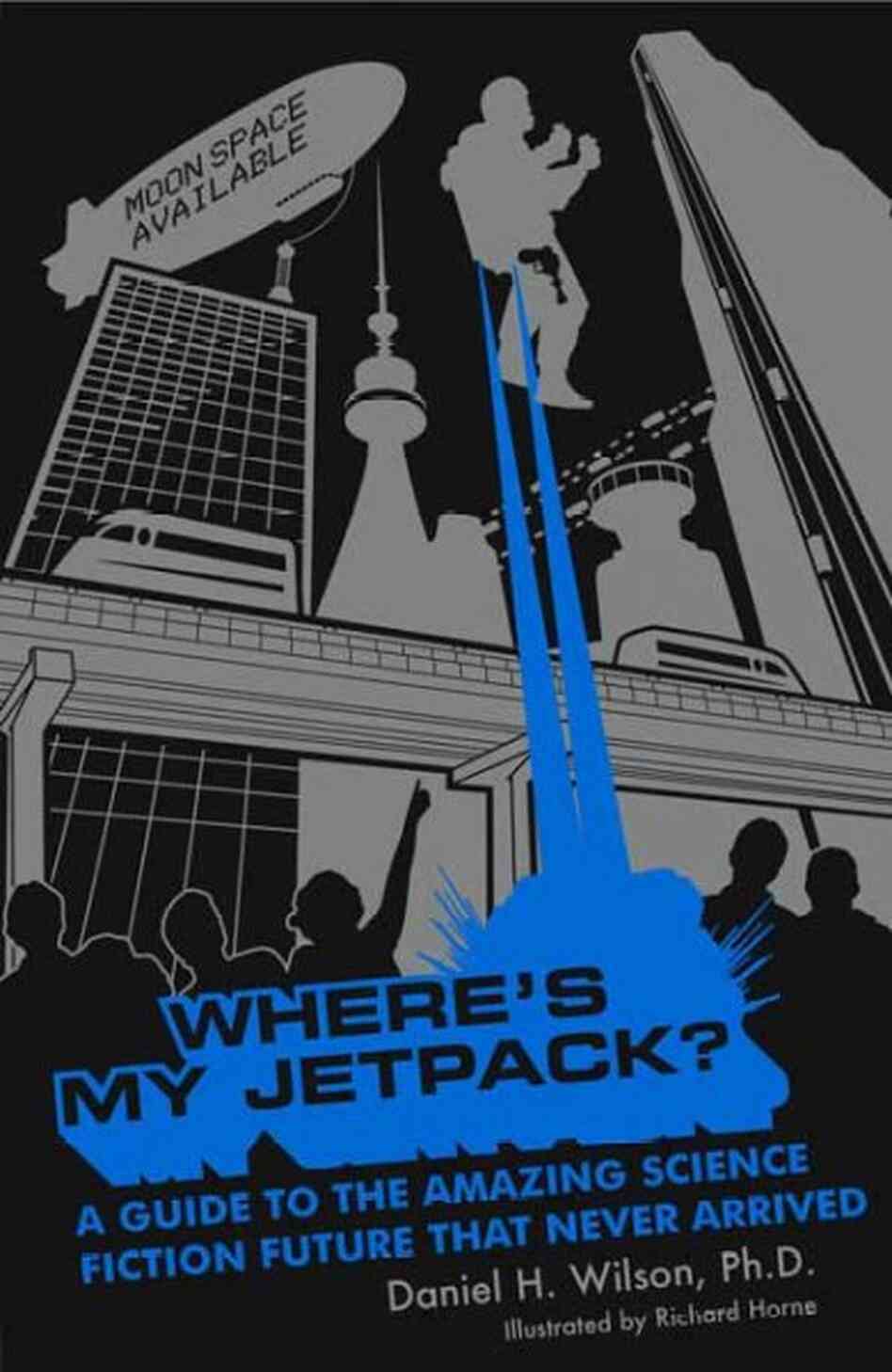
Where's My Jetpack by Daniel H. Wilson

This look at sci-fi mainstays like moon colonies, underwater hotels, robot helpers, flying cars, and the like is a brief, but very fun and surprisingly well-researched look at a wide array of futuristic technologies we were supposed to have by now, and where they're at now. Did you know Dubai is still trying to make the underwater hotel a reality? By now we all know that Google and others are close to perfecting the driverless car, but what about the countless other DARPA projects that still promise to make our world a terrifying technological wasteleand of automation that will one day become sentient and rise up to crush us?

I read this book when it was originally released five or six years ago, and just tackled it again our of a mix of nostalgia (of course) and to see how much of what seemed imminent then actually came to pass now. Driverless cars are one example. Daniel Wilson went on to greater fame as the writer of Robopocalypse, which Steven Spielberg picked up to adapt, but his early non-fiction books like this one, The Mad Scientist Hall of Fame and others are tremendously enjoyable and legitimately enlightening.


The Wonderful Future that Never Was by Gregory Binford and the Editors of Popular Mechanics

Despite an astoundingly bad proofreading job in the introduction, which had me shelve this book for a little while, it turns out to be exactly what is advertised, and a lot of fun. With a little bit of commentary woven throughout by Binford, this book is mostly paragraphs and blurbs taken from the pages of Popular Mechanics magazine since its inception about the world we may potentially live in one day. Many are hysterically wrong (like the synthetic homes stocked with furniture made of plastic, so you can clean your house simply by dousing it with the garden hose), many are eerily accurate, some manage to be both, and others are just cool (like the section on mega cities), providing innovative looks at problems that still persist, and I kinda wish we'd tried out.

One neat feature is that many stories are tagged as "True!," where the editors have pointed something out that actually came to pass, but savvy readers will catch many more that are not labelled as true, but are perhaps more obscure features of our actual daily lives. Take, for instance, the blurb from the 1950s that food may one day be made of sawdust. Laughable, right? Except that a lot of our food is actually made of sawdust now.

Posted by -- Vance K, cult film reviewer and resident Jetsons nerd at Nerds of a Feather since 2012.

Friday, August 15, 2014

AiIP: Do the Evolution

A few months ago, a service called Booktrack launched. I saw it come across the ol' Twitter feed and a few places, but I paid it little mind. If you haven't seen it, the short version is that it adds music, ambient noise and sound effects to the text, so you can read along with music and mood. I dismissed it as a gimmick of sorts, but then I received an email from one of the guys over there, he had read my stuff and asked if I was interested in doing one of my stories on there. I wasn't really interested, until he followed up (points for persistence), and I checked it out and kinda sorta fell in love. The process was way more fun than it has any right to be, and I am really pleased with the result.

This got me thinking about the overall state of publishing - ebooks aren't a revolution anymore; they are the norm, or, at least, part of it. But all the retailers are still selling ebooks like they're physical books. Not that this is any great crime, but between the issues surrounding price fixing, publisher/retailer conflict, lack of any manner of transparency, and to say nothing of the indie, self- and author-publishers that complicate that whole model, there is less room for an antiquated model.

That dude on the right should be holding a book
In short, the medium has evolved, but the method for getting it in customers hands has not. But where can it improve? It's not like it's complicated - you pay for something, you get the thing. So here's my wishlist (that's two Pearl Jam references in one blog post), which I have neither the resources nor the ability to make happen. But hopefully someone can.

1) Ebook bundles. This strikes me as painfully obvious. After all, movies have been doing it for years, but books can't follow suit. Find a way for someone who buys a physical book to be able to download an ebook. Please. Make this happen.

2) Pay what it's worth. Let's call this the New Author Pricing Paradox. That is to say, you're a new author with a good book to sell. You can charge what most publishing houses charge for an ebook, somewhere in the neighborhood of $5-$10. But you're unknown, with no publishing house to back you, so no one is going to spend their hard-earned cash on you (did you know I have a book out? I would love your hard-earned $5). OR you can price it super cheap, $2.99 (why $2.99? That is the least you can charge for a book and still get 70% royalties on Amazon - under $2.99 and you get 30%), but then you're mired in with everyone else who has done the same thing, including your Aunt Mable, the guy down the street who published his 9-11 conspiracy theory as a novel, and at least one third grader (really). Good luck.

But what if it wasn't a set price? What if someone could pay what they thought it was worth? They can download the book for free and hey this is awesome, I'm gonna give this person $10. Or, this is terrible, no money for you. Wouldn't that be better?

It will never happen, but it would make a hell of a lot more sense.

3) Better Bestseller Lists. Let's run with the above idea, and suppose that app exists. Instead of simply number of copies sold, there would be two lists: most downloads, and most money paid. So maybe a ton of people love the book, but can't chip in a ton. That would be reflected on the downloads list. Or maybe a few people really love your book, and that will bring it to people's attention despite lower download numbers. In any case, I see a lot of 'Kindle Bestsellers', which means they made it to #1 in steampunk or something (this is not to take anything away from these authors; just pointing out that bestseller doesn't carry as much weight as it used to, and even those lists are far from perfect).

Those are three things I think would improve digital bookselling (along with my omnipresent wish for integrating with brick-and-mortar stores). What do you think? Please share any ideas you have in the comments. Or, if you happen to be a programmer, feel free to make these a reality.

-DESR

Dean is the author of 3024AD and other stories, engineer, and geek about many things. He lives and writes in the Pacific Northwest. You can listen to him ramble on Twitter and muse on his blog.

Microreview [book]: Blackbirds

The Dead Zone meets No Country For Old Men, plus some Juno thrown in to annoy me


Wendig, Chuck. Blackbirds. Angry Robot Books, 2012.

From the outset, I’ll make it clear that I am a bit ambivalent about Chuck Wendig’s supernatural noir Blackbirds.

Miriam is a psychic of sorts, but a very specific one. She can foresee a person’s death by touching their skin. That’s it. Limited as it is, her gift has allowed Miriam to eke out a meager existence on the road: a chance encounter with a dude who’ll be dead in days can mean easy money, keeping Miriam in booze and cigarettes. (Because the book is part crime fiction, the protagonist must drink and smoke.) She’s been at it for a while until she meets Louis, a goodhearted giant of a truck driving man who’ll be horribly murdered in two weeks’ time. And Miriam will be the cause of his death. If that isn’t bad enough, she becomes entangled with a drifter con man named Ashley who blackmails her into scamming Louis out of his hard earned earnings immediately upon his death. And Ashley’s got some colorful psychopaths after him because of a large metal suitcase he stole. And Miriam, knowing she’ll cause Louis death, spends 200 or so pages working with Ashley—sometimes willingly, sometimes less so—ensuring that the poor bastard will die horribly before the novel ends.

Because of fate. Or because Miriam can be kind of dumb. Because of fate.

Here’s a quick recap of my Blackbirds reading experience: I immediately liked it a few pages in. Then I immediately didn’t after a few more, but I kept on. Then I was annoyed. Then I became intrigued. Then really annoyed. Then the last 75 pages were really good. The ending was great. Then it ended differently, but I had become fully ambivalent by then so I didn’t mind much.

Wendig is clearly a skilled writer. The book is well paced with sharp narration and exposition. The plot’s ambitious are wisely humble—it’s more or less an on the road crime novel with just enough of the unexplained, Miriam’s ability, to make the book not just another on the road crime novel. But, the brisk storytelling is too often weighed down by dialog that is far too clever—Miriam’s penchant for swearing; her Junoesque references, a generation or two out-of-date; her constant need to make a sarcastic comment about everything. While it didn’t entirely ruin the novel, it did annoy me. Ganted, Miriam is not a manic pixie. But she is more or less what nerds—myself included—dreamed of in high school: cute, smart, snarky, kinda punk, with psychic powers. And she talks how nerdy boys in high school imagine cool girls talk: like them but confident.

Miriam’s negligible pixiness cannot offset her agency problem. (Sorry, I’m an academic.) Initially, we’re introduced to Miriam as a protagonist. She drinks, she swears, she gets into fights—and handles herself well. But that’s for the first 50 pages. Thereafter, she’s pretty much either being led around by men or running to them for protection. It’s not until the novel’s conclusion that she actually takes any real action.

While this may superficially appear to be a problem of gender—yet another agentless female character—Miriam’s passivity is actually a philosophical, if not cosmological problem. She has tried in the past to change the future she foresees, to keep alive those who she know will die. And every time, her attempt to prevent a person’s imminent death ends up directly causing it. In a world so unequivocally determined by fate, why not sit back and make snarky comments that never land? I picked up on this quite early—Wendig does nothing to be subtle about Miriam’s cosmic predicament—but I nevertheless wanted her to try. To do something. Anything other than spew snark, smoke cigarettes, or think about wanting to smoke cigarettes. By signaling the dilemma she faced, Wendig seems to want the reader to be frustrated by her actions. He wants us to want her to act. In this, the author is a bit of a tease.

Keep reading. She eventually becomes the protagonist.


The Math
Objective Score: 6/10

Penalties: -1 for frustrating me, the humble reader

Bonuses: +1 for what is perhaps the single funniest chapter of a book ever written; +1 for the nice cover art (a specialty of the good folks at Angry Robot)

Nerd Coefficient: 7/10 That's an ambivalent 7/10

Thursday, August 14, 2014

Thursday Morning Superhero: Gen Con Edition

As you read this I will be either adventuring on the exhibition floor or playing in a ticketed event as I embark on my second Gen Con experience.  Last year was an absolute blast and, with one year under my belt, I feel better prepared to take advantage of all the Gen Con has for us gamers.  For my second dance I will be competing in a Munckin tournament, a Doomtown: Reloaded tournament, and am going to be one of the lucky few playing the Cones of Dunshire of Parks and Rec fame.  Throw in fighting the crowds to pick up exclusives, demo upcoming titles, and bringing home loot for the family, and it is going to be a great four days of gaming.  Today I am going to present the top five games that I am most excited about getting my grubby paws on.  Not all of them are releasing at Gen Con, but I will be able to play them and am looking forward to seeing if they are as good as I hope.  They are presented in no particular order.


1.  Machi Koro from IDW Games and Pandasaurus Games - Machi Koro sounds like it is going to be a streamlined, Catan-style game, that can be played from start to finish in 30 minutes.  In the game, players are assuming the role of a newly appointed mayor who is seeking to upgrade the town to keep the citizens happy.  This is done through the construction of building and dice rolling.  What is intriguing to me is that you are collecting only one resource, money, and that later in the game you can focus on buildings that would require you to roll two dice or only one.  It looks as if it is going to be one of those rare games that is both simple and complex at the same time.  The amazing art doesn't hurt either.


2.  King of New York from Iello - King of Tokyo is possibly my favorite game that currently resides on my gaming shelf.  It is incredibly easy to learn, difficult to master, and combines enough strategy and luck that it is fun for all involved.  When I am introducing a new friend to gaming it is one of the gateway games that I turn to.  King of New York adds new monsters, new abilities, and allows the monsters to invade one of multiple Burroughs in the Big Apple.  I am going to start my Con this year by rushing with the masses to the Iello booth to see the press event and hopefully purchase a copy of my very own.


3. The Battle at Kemble's Cascade by Z-Man Games- They actually found a way to create a tabletop version of a classic arcade shooter.  I want to say more, but the trailer has more impact than anything I can say here.


4. Sheriff of Nottingham by Arcane Wonders - The first title in its Dice Towers Essentials line, the Sheriff of Nottingham seems like it will be loads of fun.  Lately games that are more social and involve bluffing have found the way to our gaming table.  When we have enough people we always break out The Resistance and have been playing a ton of Coup.  Sheriff of Nottingham seems to up the ante on bluffing games as you attempt to smuggle in goods into Nottingham by either bluffing or bribing the Sheriff.  What I am most intrigued by is the fact that the role of the Sheriff changes as the game is played.  Sounds like a lot of fun as players lie, cheat, and bribe their way past the Sheriff.


5.  Samurai Spirit by Funforge Games - All I needed to know about this one is that it is a cooperative samurai game designed by Antoine Bauza.  Can you and your fellow samurai defend the village from the invading bandits?  The more you fight the quicker you unlock your beast abilities, but there is always a cost associated with your choices.  With a competitive 7-year old gamer at home, I am always looking for more co-op games to play with him.  Samurai that turn into beasts sounds right up his alley.

POSTED BY MIKE N. -- comic guy, proudly raising nerdy kids, and Nerds of a Feather contributor since 2012.

Wednesday, August 13, 2014

Out There for iOS

It's Lonely Out There


Buy Out There - Mi Clos Studio from iTunes
 
4X games (eXplore, eXtract, eXpand, eXterminate) have a long and illustrious history on the PC. The paradigmatic examples are probably Civilization and Master of Orion—turn-based empire-building games that ask you to juggle priorities while offering multiple paths to success. Do you emphasize technological advancement, military conquest or resource-procurement? Usually you combine two or more of these things, or concentrate on one for a while before moving to another.

Several developers have managed to port the 4X experience to mobile, touch-based platforms—primarily iOS, but also Android. The platform is quite suitable, operationally speaking, but tablets don’t seem like a great cognitive fit for long and involved games with lots of menus and things to keep track of; tablets seem better suited for the new wave of 4X-inspired games like FTL: Faster than Light (Buy), which emphasize elements or aspects of 4X gaming but tailored to produce a more targeted experience, as well as shorter games that can be played to conclusion between tasks, in waiting rooms or on the go. This is what tablet gaming is made for.

Out There is rooted in the 4X experience. Like FTL, it uses Master of Orion more as inspiration than template, a setting for its taut story of survival against all odds. Both games take place in procedurally-generated galaxies, ensuring that every game played is sufficiently different from the last. And Out There can be just as unforgiving as its predecessor, yet similarly manages to parlay intense difficulty into an addicting, rather than frustrating, experience.

But whereas FTL emphasizes combat and tactical personnel management, Out There is all about resource management. You are a lone spaceman whose ship has drifted far from Earth. You must find a way back, but the galaxy is an inhospitable place. You need fuel (hydrogen and helium) to move, air (oxygen) to breathe and materials (iron) to keep your ship from breaking apart. First and foremost, you’re going to need to find planets to mine for these elements.


Here’s the problem, though: jumping from solar system to solar system and from planet to planet in order to extracting these essential elements costs fuel, oxygen and iron. And the ship you’re given in the beginning is a fairly insubstantial thing, prone to taking big hits every time you approach a fuel-rich gas giant. So you mine rocky planets for iron, which costs fuel and oxygen. Oh, and did I mention that you never really know how much iron a gas-giant will cost you, or how much fuel you’ll find in return? Now you can see the kinds of tough decisions Out There forces you to make, often boiling down to a roll of the dice, as it might in a real survival scenario.

While you can try to make it back to Earth just managing these four elements and skipping everything else, you probably won’t make it that way. And it’s much more fun if you explore. Garden planets give you the chance to fill up on oxygen and encounter the galaxy’s various alien species. Most are friendly, and if you answer their questions appropriately, they may share technology or the omega element, which can be used for fuel, air or material, or to power a number of unique technologies, like wormhole generators (used to instantaneously travel from one black hole to the next) or life seed, which terraforms rocky planets. Along the way you learn to speak their language, which makes subsequent communication easier.


The galaxy’s more exotic elements, like gold, hafnium or cobalt, can be used to produce the useful new technologies you discover along the way, like the shield generator (which lowers the damage your ship takes), solar sail (which lowers the fuel used to travel between systems) or gravitational well generator (which expands the distance you can travel). You will also find derelict ships to take over, randomly placed supply stations to use and various galactic mysteries to engage or avoid, since only some will work to your favor. There are multiple endings, depending on the path you take, and multiple strategies to get you there. Most of the time something will go wrong. But you’ll just pick yourself up and start anew—it’s that kind of game.

Out There is also strikingly beautiful, marked by an appealing comic art visual style and warm ambient electronic soundtrack that amplifies the game’s palpable sense of wonder. It’s more stylized than FTL; ultimately, though, that’s only a small part of why I think it’s the more impressive game.

A bigger part is the lack of violence. That’s not to say I have a problem with violence in video games (a few extreme cases aside). But I’ve been thinking a lot about how much popular art relies on violence; this is especially true of video games, and even more so when specifically considering science fictional video games.

Yet for someone raised on science fiction literature, this imbalance is more than a bit odd—many of the most famous SF stories don’t involve war or combat or the spilling of intestines to be compelling. (Don’t believe me? Read Childhood’s End or Ubik or The Left Hand of Darkness.) Out There presents a taut, compelling and thoroughly addictive tactical strategy game experience that doesn’t rely on violence or the threat of violence in order to be any of those things. I find that incredibly appealing, and while I do still enjoy FTL, I’ll be spending most of my time in Out There’s virtual galaxy for the foreseeable future.


The Math

Baseline Assessment: 9/10

Bonuses: +1 for insanely addictive gameplay and appealing visual and auditory style; +1 for being that rare SF-themed game that doesn't rely on violence to be compelling.

Penalties: -1 for unlike the amplifiers in Spinal Tap, our scale doesn't go up to 11.

Nerd Coefficient: 10/10. "Mind-blowing/life-changing"

Read about our scoring system, and why 10s like this one are so damned rare. 

***

POSTED BY: The G--purveyor of nerdliness, genre fanatic and Nerds of a
Feather founder/administrator (2012).
Tuesday, August 12, 2014

Microreview [book]: I, Zombie, by Hugh Howey

Like Warm Bodies but without the Funny


Buy it here.
 
Howey, Hugh. I, Zombie. Broad Reach Publishing, 2012.

Don't like exceedingly visceral descriptions of death by zombie? Then perhaps you should give this book a miss. I decided to listen to the audio version rather than read this, thinking the vignette style would be perfect for my bit-at-a-time-while-making-dinner (etc.) listening practices, and I'm still not sure whether I was right and the audio format is best suited to the story/structure, or I did the book a disservice and would've liked it (even) more if I'd just read it like a normal person.

Howey presents us with quite a gory series of encounters between zombies and their (mostly) hapless victims, but with a twist that separates this tale from the vast majority of zombie stories out there: it's a zombie-eye perspective. That's right, we see the world filtered through their hunger for braaaains (and all the viscera, as it turns out). Yet that's not all—we are also treated to the horrified observations, via internal monologue, of the people these zombies used to be, aghast at what their bodies are doing.

If I had to choose one song that best characterizes the strange situation these people-yet-zombies are in, it's definitely Metallica's "One" (the know the 'one', right? haha!). That's because they're definitely locked in, *almost* entirely unable to influence their zombie bodies' behavior and certainly powerless to resist the hunger for other humans. This is a curious coincidence for me personally, as the next book I will review here at Nerds of a Feather is Scalzi's "Lock In", about a very different and rather more optimistic version of locked-in syndrome.

Strange as it may sound to say, this might be, despite the gore, Howey's most beautifully written book (so far). Some of the descriptions of what each zombie is doing (and what each former person thinks of these actions) are exquisite, not in the florid, yanking-on-the-heartstrings melodramatic way but with the staccato beauty of Hemingway. And parts of it, where Howey suggests the new reality these people experience being locked inside zombies might not quite be as final and irrevocable as they think, have deliciously chilling implications for human nature: if you were bitten, and then felt a very powerful urge to chomp on the hapless idiot standing next to you, of course the most appealing interpretation of the messy result would be that you had no choice, that you were powerless next to that mighty hunger...but what if, instead of being truly powerless, it was simply very difficult to resist the compulsion to snack on your neighbor—and you chose not to fight it? Howey may be hinting, here, that some of us might experience a rather smoother transition to zombiehood than we might want to believe.

Despite all that recommends it, I ultimately couldn't connect with this particular story (or format) quite as well as Howey's more straightforward sci fi adventure stories like Wool or Sand (both of which we've reviewed here). Perhaps that is because of my slavish desire for a mostly sympathetic or at least tough as nails protagonist with whom I can (in my dreams!) identify, a feature that is certainly missing from this vignette-style panorama of zombiedom. Or perhaps I should've read this rather than listened to it (the endless descriptions of evisceration by teeth did get to me, I'd wager, more by listening to another human being narrating them than they would if I could just scan the page and potentially skip over the gore). Whatever the reason, for this reviewer, at least, I, Zombie, while intriguing and certainly worth reading (listening to!), can't measure up to Howey's best work.

 The Math


Objective assessment: 6/10

Bonuses: +1 for reanimating the zombie genre with an interesting if horrifying speculation on what would happen to people whose bodies are zombified; +1 for the hauntingly beautiful descriptions

Penalties: -1 for the vignette approach (though, admittedly, I can't really think of a better method to tell this sort of story, as any one zombie would have a difficult time sustaining reader/listener interest as a traditional protagonist)

Nerd coefficient: 7/10 "An enjoyable (if gory!) experience, but not without its flaws"

[We use a bell-curve scoring system in which very high or low scores are exceedingly rare, meaning a 7/10, while not earth-shattering, is quite a good score: see here for details.]


Brought to you by Zhaoyun, zompire aficionado and NoaF jedi knight (or at least Paduan apprentice, though in the interests of full disclosure, I've never even been to Padua!) since 2013.

Thursday, August 7, 2014

Thursday Morning Superhero

Now that I have finally resumed life as normal after Comic Con, my mind is reeling with next week's adventure at Gen Con.  While not specifically linked to comics, I did meet Cullen Bunn last year and am looking forward to checking out some games from IDW.  Kill Shakespeare looks to be a promising game and the Chew game will be a must purchase.  Oh yeah, they are also working with a small property that some people like called the X-Files.  In the meantime here is what I read this week and what is worth your time and hard earned money.


Pick of the Week:
Nailbiter #4 -  I was introduced to Joshua Williamson's writing with Ghosted (which you should go buy) and was immediately a fan.  When I heard he had a new horror title with Image I knew that I should check it out.  Nailbiter has been amazing since issue #1, but this issue featured the jaw-dropping moment that solidifies this as one of my favorite series. Nicholas Finch and sheriff Crane literally start to get to the bottom of the mystery as to why 16 serial killers all had roots in this small town.  This issue had me on the edge of my seat as Finch and Crane attempted to dig up the grave of the Book Burner, the serial killer that spawned the Buckaroo Butchers.  It might be premature, but I have already to put together a wish list for what should be included on a nice deluxe hardcover trade of this title.  It really deserves the royal treatment once Williamson finishes the first arc.

The Rest:
The Sixth Gun: Days of the Dead #1 - When you have a book as special as The Sixth Gun, spin-offs provide great insights into the complex characters that Cullen Bunn has created.  I thoroughly enjoyed the Sons of the Gun spin-off that shined light on the holders of the six, and with Days of the Dead providing insight into the Sword of Abraham, the Pinkertons, and the Knights of Solomon.  The only problem I have with this title is that it is over and I'm not sure how long I will have to wait for more background on these mysterious groups.  As usual, Brian Hurt delivers a gorgeous book and Bunn lets readers explore the amazing world he has created with this title.  I am so happy that there is a plan for an ending for the main series, but so many great excuses to return to the world of the six.

Legendary Star Lord #2 - Peter Quill has a past that is likely to catch up to him.  Due to his past indiscretions, Quill is actually a pretty selfless and likable guy.  He may be a little cocky and may not use the most orthodox methods, but Star Lord seems to becoming a staple in the Marvel Universe rapidly.  This series is off to a solid start and I will continue to pick it up as I am intrigued by Quill's past and why he is seeking Thanos.  If you are a fan of the movie, then you will be a fan of this title.

Imperial #1 - Mark McDonald is a guy that most comic book readers can relate too.  He corrects his girlfriend on how comics and graphic novels are different, doesn't like his action figures called dolls, and isn't afraid to wear a baggy hoodie with a monkey on it.  Things change for McDonald when Imperial, the superhero of this tale, selects him to be his successor.  While not the most original concept, Imperial has genuine moments of humor and a cast of likable characters.   Definitely worth checking out.

Big Trouble in Little China #3 - I really want to like this title.  The overall story is good and would be a fitting sequel, but the gags and jokes just fall flat.  If you enjoy fart and pee jokes, then maybe this is the title for you.  I might continue to read this as a fan of the classic John Carpenter film, but can't imagine anyone not familiar with Jack Burton and the Pork-Chop Express would show any real interest in this title.  There is enough to keep me along for another issue, but that is mainly to see the rebirth of the three storms.


POSTED BY MIKE N. -- comic guy, proudly raising nerdy kids, and Nerds of a Feather contributor since 2012.