Seed, by Rob Ziegler [Night Shade Books, 2012]
The Meat
Post-apocalyptic fiction is experiencing a renaissance of sorts lately. True, the Cold War fears of nuclear annihilation, which served as the backdrop for so many of the classics, have receded into history. But we have our own existential "threats" and "bogeymen" now: rapid and irreversible climate change; the collapse of state power, welfare and the global financial system; terrorism; overpopulation; and the rise of autonomous, unregulated and unaccountable corporations. None of these are newcomers to science fiction--they are, in varying combinations, the central preoccupations of John Brunner's Stand on Zanzibar, Octavia Butler's Parable of the Sower/Talents and John Shirley's A Song Called Youth trilogy. But the exact configuration of these fears in the post-911 zeitgeist is arguably quite different from what you find in any of these.
This zeitgeist serves as the starting point for Seed, Rob Ziegler's dazzlingly inventive debut novel for Night Shade Books. Seed takes place in a not-too-distant future United States devastated by anthropomorphic climate change, whose decimated population lives and toils in a state of near-perpetual migration. Massive fluctuations in both daily and seasonal temperatures have turned much of the country into desert, making animal husbandry impossible and killing off most species living in the wild. The only real source of food comes from genetically-modified seeds produced by the mercurial Satori corporation, and distributed by a shell of civilian and military authority--no longer democratic and in the slow process of withering away.
Action begins as one of Satori's seed designers, the clone Pihadassa, decides to leave the living, flesh-and-cartilidge dome that covers much of downtown Denver and serves as the corporation's headquarters. Her motivations are unclear, though we are led to understand that she has reached a point of irreconcilable difference with either the aims or means of Satori. The government, meanwhile, desperately wants her to defect, in the hopes that her bioengineering skills can help return it to former glories. But Pihadassa escapes her would-be captors, and settles with her clone "family" under a new protective dome in rural Kansas. Called "Corn Mother" by the migrants, she becomes a symbol and beacon of hope to which migrants from across the midwest flock.
From this point we are introduced to three perspective characters: Chicano migrant Brood, who travels the southern midwest with his autistic brother Pollo and their surrogate father Hondo; Agent Sienna Doss, a special operative tasked with finding and extracting Pihadassa to Washington; and Sumedha, Pihadassa's partner and Satori's chief remaining Designer. As their narratives begin to converge on Pihadassa's dome in Kansas, Ziegler slowly reveals the truth about Satori and the world it dominates.
Seed owes a great debt to the work of Paolo Bacigalupi, and in particular to his Hugo and Nebula winning 2009 novel The Windup Girl. Indeed, they share many concerns--most clearly with the potentially devastating effects of climate change and vision of a future dominated by private biotechnology corporations. Yet Seed is, in many ways, the better book. Though highly praised by many critics for its inventiveness and compelling drama, others criticized Bacigalupi's exoticizing, at-times ambivalent approach to both its Thai setting and to Emiko, the eponymous "windup girl." While these criticisms are valid, so is the praise. With Seed, Ziegler builds upon the compelling aspects of Bacigalupi's work, yet not only avoids its problems, but manages to invert them.
The thing is, that despite all the horrors and problems of future America (and I won't spoil these for you), Ziegler's debut is, at its heart, a celebration of the rugged, American pioneering spirit, and of American diversity. This last point is one I'd like to dwell on for a second--the Western, and its descendants in post-apocalyptic fiction, are often very white. Seed is very much a post-apocalyptic Western, but one in which none of the perspective characters are actually white. Sure there are white people in the book, many of them, but they are the people our perspective characters interact with, not the main event.
If done poorly, this might raise red flags. But Ziegler has clearly done his research, consulting several people to make sure he portrayed the Chicano characters accurately and with respect. And race, generally speaking, serves mostly as backdrop for Seed, where it helps us understand the details of individual manifestations of our common humanity, but does not slide into lazy stereotyping or determinism. In a genre that often struggles to talk about race and related forms of difference, this strikes me as a very constructive entry into the conversation.
It's also indicative of Ziegler's comfort juggling multiple narrative voices, even when they differ tremendously from one another. The clones are just as convincing as Brood or Doss, and the contrast between the clarity of their geneticist logic, on the one hand, and their struggle to come to grips with the moral implications of their position in the world, on the other, is remarkably well-handled. In some ways, the Sumedha chapters reminded me of the Somni section of Cloud Atlas, if it were marked by greater moral ambiguity. I like ambiguity. And I loved Cloud Atlas.
All that said, Seed is by no means perfect. The vast gulf between narrators and the language they use can be jarring, and as such, Seed lacks the fluidity of Bacigalupi's excellent The Drowned Cities. I also think that, as much as I enjoyed it, there's just too much going on--too many characters, too many unclear situations, too many opaque motivations. There's a realism in that, but one that could have used a sharper focus.
In the end, though, Seed is a captivating debut by a clearly formidable talent. Though some may dismiss it as a Bacigalupi clone, they would be wrong. This is about as good as a debut gets, and I'm already counting the days until his next book comes out. Highly recommended.
The Math
Baseline Assessment: 8/10
Bonuses: +1 for the intense and convincing vision of the future; +1 for great characters with authentic subjectivities ; +1 for managing to talk about race without explicitly talking about race, and saying something interesting too.
Penalties: -1 for jarring perspective shifts; -1 for too much "stuff" at times.
Nerd Coefficient: 9/10. "Very high quality/standout in its category."
- Reviews
- _Book reviews
- _Film and TV Reviews
- _Game Reviews
- _Thursday Morning Superhero
- _Short Fiction Reviews
- Lists
- _New Books Spotlight
- _6 Books Posts
- _We Rank 'Ems
- Features
- _Interviews and Blogtables
- _Talking About Books
- _The Hugo Awards
- _Mini-Projects
- Projects
- _Nerds on Tour (2020)
- _The Hugo Initiative (2019)
- _Feminist Futures (2018)
- _Dystopian Visions (2017)
- Meet the Flock
- Review Policy
- Home
Monday, October 8, 2012
Saturday, October 6, 2012
Why Princess Mononoke Isn't as Good as You Think
The Meat
Mononoke Hime (Princess Mononoke) is perhaps the most popular Miyazaki Hayao movie in the English-speaking world. This is not surprising. Princess Mononoke is an action-packed fantasy, one set against the stage of a clash between man and nature, progress and superstition, trust and betrayal. Princess Mononoke has been so popular in the English-speaking world that, as of April 2013, it will be adapted to the stage in London's New Diorama Theatre. For more information on the stage play adaptation, click here.
But why the popularity? Princess Mononoke is a good movie. But it is by no means great. It would not even make my list of Miyazaki Hayao's top 5 movies (his five best are, in no particular order, Spirited Away, My Neighbor Totoro, Nausicaa of the Valley of the Wind, Porco Rosso, and Raputa: Castle in the Sky. Check out our review of Porco Rosso). Nor is it his best movie on humanity's conflict and trials within an unforgiving, wild, and uncaring natural world. I'll touch more on this below.
Again, let me stress that I do like the movie. After all, Miyazaki does a lot right. First, he constructs a beautiful and engaging world, creates interesting and complex characters, and tells a fine tale of adventure. This is a truly visually inventive film, one that has had an impact far beyond the world of animated movies. Moreover, the main character, Ashitaka, is perhaps the most complex main character in any Miyazaki film. Ashitaka was an Emishi tribesman (a real historical people from northeastern Japan) and a descendant of the royal family, destined to lead his tribe. At the movie's outset, Ashitaka protected his tribe from a rampaging cursed god (tatari-gami), killing the boar-god before it left his village in ruins. But this fight left Ashitaka cursed.
![]() |
| Ashitaka's cursed arm |
The curse took both a spiritual and a physical toll on Ashitaka. To find out the nature of the curse and, hopefully, to discover a cure, Ashitaka was forced to abandon his topknot, his homeland, his tribe, and his claim to tribal leadership (did he leave voluntarily or was he, the cursed man, exiled?). Ashitaka traveled to the southwest, the direction from which the cursed boar-god had come, to learn more. At the same time, his curse exacted a fierce physical toll, leaving him in obvious physical pain.
Ultimately, he finds his answers by wandering into a war waged between humans and nature, which I will not spoil for you. This is not his war, and he doesn't belong on either side of the conflict. Ashitaka is thus a man with no place: his curse forced him to leave his village and his old life, and at the same time, he has no place in this new life, dominated by a conflict between man and nature.
Just as a war is being waged within his own body as the curse spreads, a war between the human town of Tataraba and the true wild (the kind that scared Henry David Thoreau out of his breeches) is threatening the natural world itself, threatening to change it into something tame. This is a story of a human war to tame nature. In the process, something magical and fearsome is lost.
Lady Eboshi is another complex and fantastic character. The head of the town Tataraba, Eboshi is the cause of the war to tame nature. She is a compassionate character towards her human subjects, and is especially nice toward the women, the lepers, and the infirm in the town. In fact, her help and support keeps the lepers alive and cared for. But Eboshi is merciless in the pursuit of her utopian world, a world where man no longer has to fear nature. She would not hesitate to sacrifice her men, her friends, or even herself in the pursuit of this ideal. Strong ideals might lead to a human paradise, but at the expense of something much grander.
![]() |
| Lady Eboshi |
Despite the excellent cast of characters, Princess Mononoke feels overly preachy. Granted, it is not an overtly environmentalist movie, even though Miyazaki is making definite claims of humans taming nature and molding it to their own ends. The trope of man vs. nature is dealt with in a subtle way, where both sides are fighting for their share of the emerging order. But Miyazaki deals with this trope and the complexities of good vs. evil in a much more subtle manner in Nausicaa of the Valley of the Wind. Nausicaa combines a wondrous and dangerous world with a complex story of kingdoms at war, lust for power, fears of and desires for weapons of mass destruction, and a slowly regenerating natural world. Nausicaa encapsulates so much of the human experience that it would be remiss to call it anything other than a masterpiece. Princess Mononoke, however, while good as a standalone movie, feels tame in comparison. Mononoke could never reach the heights of Nausicaa.
Further, the woman named San (who the locals call Princess Mononoke) is too one-dimensional a character. Although human, she lived with the wolf-god clan and fought for the side of the wild, un-tame nature. Perhaps the true irony of Princess Mononoke is the fact that San, a human, could not recognize that she bridged two worlds. The story might have been more effective had she more overtly realized a conflict raging in herself between her love for wild nature and her desire to be a human. But perhaps that would be too perfect a story...
The Math
Objective Quality: 7/10.
Bonuses: +1 for a gorgeous world. +1 for the best main character I've seen in any animated film.
Penalties: -1 for being overly preachy. -1 for a one-dimensional female lead character.
Nerd Coefficient: 7/10 "An enjoyable experience, but not without its flaws"
[See an explanation of our non-inflated scores here]
Bonuses: +1 for a gorgeous world. +1 for the best main character I've seen in any animated film.
Penalties: -1 for being overly preachy. -1 for a one-dimensional female lead character.
Nerd Coefficient: 7/10 "An enjoyable experience, but not without its flaws"
[See an explanation of our non-inflated scores here]
Labels:
anime,
fantasy,
film,
Jemmy,
microreview,
Miyazaki Hayao,
Studio Ghibli
Friday, October 5, 2012
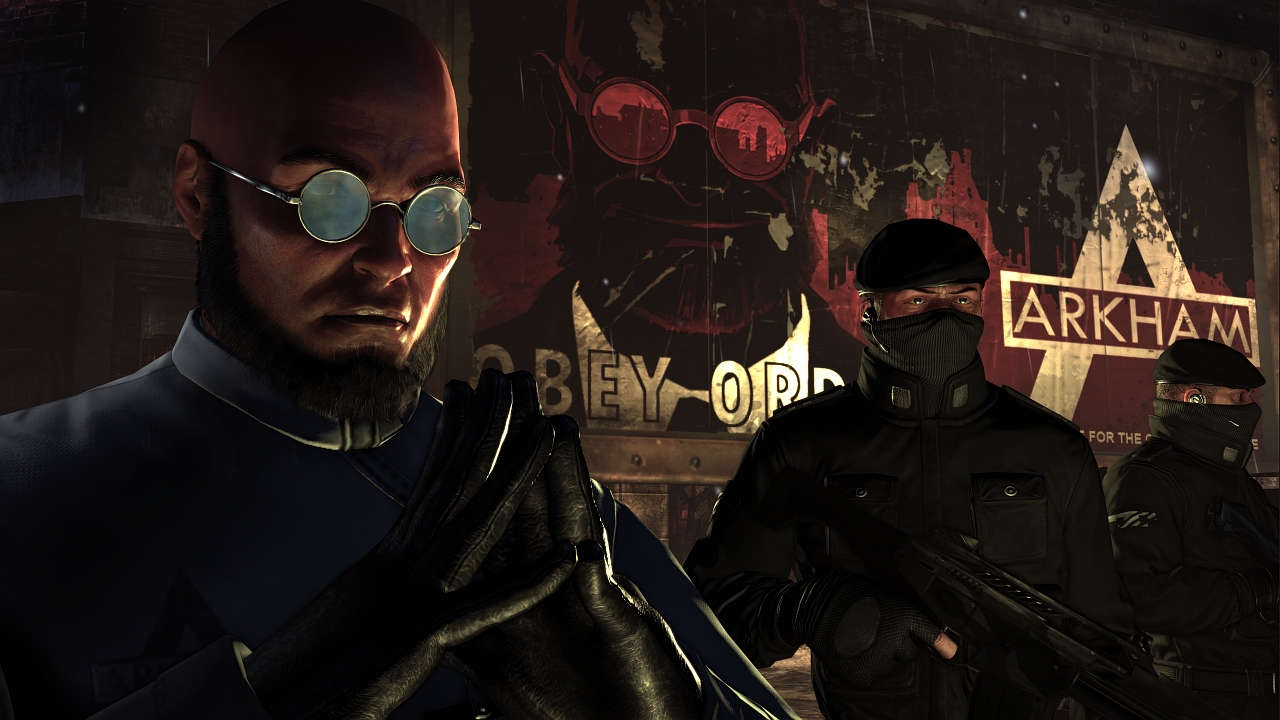
The Dark Knight Returns...to the XBox 360
Batman: Arkham City - Game of the Year Edition
To call Batman: Arkham City the Game of the Year when it came out within a month of Skyrim might be a bit of a stretch, but it is a fantastically constructed masterpiece that certainly deserves to be in the running, if not the all-around winner. The Game of the Year Edition includes two extra story lines that weren't in the original release. There is a Catwoman plotline that runs concurrent to the main campaign. It also includes Harley Quinn's Revenge, an add-on that takes place two weeks after the events of Arkham City. Finally, it includes challenge maps that allow players to take on the persona of Nightwing, the original Robin, Dick Grayson. All in all, the Game of the Year Edition is well worth the sixty bucks I dropped on it and I'm glad I was too busy to buy the game when it first came out, mainly because it's so good I likely would have purchased every last piece of downloadable content (DLC), costing me well over a hundred dollars.
We'll start with the main campaign and work our way through all of the Game of the Year extras.
Who's brilliant idea was this?
Somehow, Dr. Strange has convinced the politicians in Gotham that moving Arkham Asylum to the heart of the city is a good plan. To everyone's surprise that has never read a Batman comic or seen a single movie, things didn't work out so well. Of course, the inmates end up running the asylum and Batman has to straighten things out. The game starts with Bruce Wayne haranguing the politicians who let this nightmare go forward. He is quickly taken down by Strange's security force and spirited away into Arkham. In a not-so-strange twist, Wayne is able to escape from the hapless goons who are guarding him and retrieve his Batgear from Alfred, making the gamer free to soar above the streets of Gotham.
Without giving too much away, I'll say that many of your favorite of Batman's nemeses are here: Two Face, the Joker, Dr. Strange, Penguin, Dr. Freeze, Solomon Grundy, and Ra's and Talia al Ghul. There are two major stories running simultaneously in the game. The first is Dr. Strange's mysterious Protocol 10. The second is the fact that Joker is slowly dying from Titan and he has infected Batman in order to force him to find a cure for them both. Protocal 10 is Strange's misguided plan to become a hero to Gotham. He's gathered all of Gotham's worst under his control so he can murder them, thereby surpassing Batman as the city's greatest crime fighter, nevermind that I'm pretty sure it's illegal for doctors to massacre an entire hospital's worth of patients under their care.
Without giving any more away, you can expect Batman to be his usual dualistic, yet eventually good self. The gameplay is so fun that, much like Skyrim, I found myself simply exploring the sandbox map for hours at a time, gliding and Bat-grappling my way around the open world in a nearly flawless control scheme. The combat system is simple enough that a relative noobie can finish the game without mastering it but deep enough for seasoned fighting game aficionados to enjoy throughout the 25-30 hour campaign. Nothing is more pleasing than flying in out of nowhere, dispatching a bad guy, then grappling away leaving the rest of the goons scratching their heads. They even brought out the classic, if slightly altered, "What are you, Batman?!" It had to be changed due to the character's inability to speak outside of cutscenes.
Catwoman and Harley Quinn's Revenge
One of the major changes from the first Batman: Arkham game is the ability to play from multiple characters' points of view. Not only are you the Dark Knight, but you play as Catwoman, Robin, and Nightwing. The first two get their own stories while the third is just available for challenge maps. Since her 4-part series is smaller than the main campaign, it makes sense that Catwoman can't be leveled up as much as Batman. Still, that was a glaring omission when you were able to spend your points on either character (I didn't drop a single point on Catwoman). When starting Harley Quinn's Revenge as Robin, I was also sorry to discover that he couldn't be improved at all through leveling. They included a bunch of new gadgets for each character which were fun to try out, but after all of Batman's potential improvements, it left these two characters feeling a bit flat.
That said, these two additional story lines didn't feel like add-ons like some of the bad Fallout DLC. What was that one in the snow from WWII all about? Anyway, they felt like they were planned from the initial phases of game development rather than tacked on to make a few extra bucks after a successful release. One reason this is likely true is that the Catwoman scenes are interspersed between Batman portions. You can play them as their own separate story, back-to-back, but the Game of the Year Edition automatically drops them into the game at appropriate points. Harley Quinn's Revenge did have the feel of a re-hash of the final assault on Joker's compound because many of the same enemies were in the same places (I'm looking at you, snipers!) and you're infiltrating the same building. Other than that part, and it only lasted a few minutes, Harley Quinn's Revenge felt like another chapter that was there from the start, designed to be part of the game from Day One.
Like Batman: Arkham Asylum, this game had me completely enthralled while I was playing it, then I pretty much forgot about it a week later. I would chalk this up to a serviceable, if not spectacular story line. It's got to be tough trying to work six boss fights into a plot without making it look like you're trying to cram six boss fights into a plot, so I'll give them a pass. The story was as dark as some of the best Batman work, but it was the gameplay that really made this one shine. There's a reason this won many Game of the Year awards and is the eighth highest ranked XBox game this generation. If you're a Batman fan, or just a fan of well-produced games, give this one a shot. You won't be disappointed on either front.
The Math
Objective score: 9/10
Bonuses: +1 for the combat and movement mechanics. The gadgets were fun, but what I really enjoyed was fighting and maneuvering from rooftop to rooftop undetected.
Penalties: -1 For charging those poor kids for all that DLC. I enjoyed the extras, but I don't think they were worth fifty bucks. Thank you, GotY Edition!
Nerd coefficient: 9/10. "Very high quality/standout in its category."
Bonuses: +1 for the combat and movement mechanics. The gadgets were fun, but what I really enjoyed was fighting and maneuvering from rooftop to rooftop undetected.
Penalties: -1 For charging those poor kids for all that DLC. I enjoyed the extras, but I don't think they were worth fifty bucks. Thank you, GotY Edition!
Nerd coefficient: 9/10. "Very high quality/standout in its category."
Labels:
batman,
comics,
dc,
games,
superheroes,
video games
Thursday, October 4, 2012
Thursday Morning Superhero
I think
there was some sort of debate last night, but the real debate is what comic is
going to be the pick of the week for Thursday Morning Superhero. Avengers
vs. X-Men came to an epic conclusion, which paves the way for Uncanny
Avengers, Harvest continues to be a
surprise hit that has new twists around the corner, and John Layman, the author
of Chew, was given the reigns of the
Batman Detective series. Another
great week of comics is in the books and I wish that I had the income to buy
them all. Let’s get started!
Pick of the Week:
Harvest #3 – A.J. Lieberman has really got
something good going with this book. Dr. Dane is finally taking action and making good for his past
indiscretions. Up against a foe that
seems to have bought all of the right people, Dr. Dane leans on an old client
to give him the support he needs to begin to take down this organ transplant
ring. It was really refreshing to
see Dr. Dane really man-up and begin to take action. He was once a doormat who was recruited because of his
circumstance, and he is now taking matters into his own hands and attempting to
make good. I am guessing it won’t
be an easy road, but one I will enjoy watching him go down.
Runner-up:
Batman Detective Comics #13 – John Layman + Batman = quality book.
Penguin takes the reigns in his
attempt to gain public favor by one-upping Bruce Wayne. He enlists the Ghost Dragons to
assassinate Bruce Wayne and a crime spree to occupy Batman in order to allow
his donation and his namesake be connected with a new children’s wing of hospital. Layman infuses his humor and wit in a
manner that breathes new life into the Detective line. Sharp writing and the return of Penguin
will keep me reading this book as it comes out. Really nice debut for Layman on Batman.
The Not as Good:
Avengers vs. X-Men #12 – I was on board with this series at the beginning, but have since lost interest. I felt I had to finish this arc out and don’t know what to think. Charles Xavier is dead and Cyclops is in prison as society attempts to rebuild with an onset of new mutants. The Uncanny Avengers are born, in what I am sure will be a big hit, but ultimately I am disappointed with this story.
The Rest:
Daredevil End of Days #1 – Brian Michael Bendis tells the tale of Daredevil and his downfall after murdering Kingpin. The book starts out fast and furious with a fight between Bullseye and Daredevil that ends tragically. Ben Urich struggles to tell this story for the nearly defunct Daily Bugle in what should be a great miniseries. The gritty art adds to the dark tale and I am ready for issue #2.
Fatale #8 – Ed Brubaker begins a new arc in this series that is sure to please. Hansel is gaining strength and Josephine continues to impact anyone she comes in contact with. The mystery surrounding her seemingly endless past continue and Hansel grows into a formidable foe. Good series to get behind.
Minimum Carnage #1 – Cullen Bunn takes the reigns of the Carnage line in an interesting tale about the escape of Carnage from prison and his attempt to enter a subatomic universe, the Prometheus pit. Venom and Scarlet Spider are along for the ride, which should be a fun book.
What I missed:
Swamp Thing #13 – Scott Snyder begins to introduce the reader to the rotworld in what seems to be a great book. There is a brewing battle between Green and the Rot that concludes with a Rot-infected Teen Titans? Maybe I should revisit this series.
Non-Humans #1 – A virus has spread on earth that is giving life to inanimate objects, including toys. It is described as Bladerunner meets Toy Story. Maybe I really should pick this book up.
Pick of the Week:
Harvest #3 – A.J. Lieberman has really got
something good going with this book. Dr. Dane is finally taking action and making good for his past
indiscretions. Up against a foe that
seems to have bought all of the right people, Dr. Dane leans on an old client
to give him the support he needs to begin to take down this organ transplant
ring. It was really refreshing to
see Dr. Dane really man-up and begin to take action. He was once a doormat who was recruited because of his
circumstance, and he is now taking matters into his own hands and attempting to
make good. I am guessing it won’t
be an easy road, but one I will enjoy watching him go down.Runner-up:
Batman Detective Comics #13 – John Layman + Batman = quality book.
Penguin takes the reigns in his
attempt to gain public favor by one-upping Bruce Wayne. He enlists the Ghost Dragons to
assassinate Bruce Wayne and a crime spree to occupy Batman in order to allow
his donation and his namesake be connected with a new children’s wing of hospital. Layman infuses his humor and wit in a
manner that breathes new life into the Detective line. Sharp writing and the return of Penguin
will keep me reading this book as it comes out. Really nice debut for Layman on Batman.
The Not as Good:
Avengers vs. X-Men #12 – I was on board with this series at the beginning, but have since lost interest. I felt I had to finish this arc out and don’t know what to think. Charles Xavier is dead and Cyclops is in prison as society attempts to rebuild with an onset of new mutants. The Uncanny Avengers are born, in what I am sure will be a big hit, but ultimately I am disappointed with this story.
The Rest:
Daredevil End of Days #1 – Brian Michael Bendis tells the tale of Daredevil and his downfall after murdering Kingpin. The book starts out fast and furious with a fight between Bullseye and Daredevil that ends tragically. Ben Urich struggles to tell this story for the nearly defunct Daily Bugle in what should be a great miniseries. The gritty art adds to the dark tale and I am ready for issue #2.
Fatale #8 – Ed Brubaker begins a new arc in this series that is sure to please. Hansel is gaining strength and Josephine continues to impact anyone she comes in contact with. The mystery surrounding her seemingly endless past continue and Hansel grows into a formidable foe. Good series to get behind.
Minimum Carnage #1 – Cullen Bunn takes the reigns of the Carnage line in an interesting tale about the escape of Carnage from prison and his attempt to enter a subatomic universe, the Prometheus pit. Venom and Scarlet Spider are along for the ride, which should be a fun book.
What I missed:
Swamp Thing #13 – Scott Snyder begins to introduce the reader to the rotworld in what seems to be a great book. There is a brewing battle between Green and the Rot that concludes with a Rot-infected Teen Titans? Maybe I should revisit this series.
Non-Humans #1 – A virus has spread on earth that is giving life to inanimate objects, including toys. It is described as Bladerunner meets Toy Story. Maybe I really should pick this book up.
Labels:
batman,
comics,
dc,
Image Comics,
marvel
Wednesday, October 3, 2012
Microreview [film]: The Legend of Hell House
The Meat
There is a bright, interesting line, I believe, that can be drawn between Shirley Jackson's influential 1959 novel The Haunting of Hill House and Stephen King's pop culture titan The Shining, and that line goes directly through The Legend of Hell House, and its source material, which was written by Richard Matheson. In fact, I find it very difficult to discuss -- or even really think about -- The Legend of Hell House outside of the context of Shirley Jackson's book, and the 1963 genre movie classic it spawned, The Haunting, directed by the quietly masterful Robert Wise. Despite the overlap with The Haunting, Richard Matheson is a legend of the genre and was a huge influence on Stephen King, so this is a clear spiritual, and possibly even direct, influence on both the literary and film treatment of one of King's best-loved works.
In The Legend of Hell House, almost every element of the earlier Jackson/Wise works is recycled, and then turned up to 11. The basic set-up for both is the psychic investigation of a sprawling, Gothic mansion with a reputation for being haunted, and the four (two men, two women) poor, dumb souls who decide to spend a week in the house to investigate it. Needless to say, things go awry.
For me, The Haunting is still one of the finest horror movies ever made. It evokes a pervasive creepiness, relies on the psychological for its scares, and manages a not inconsiderable amount of them. Despite being made a decade later, after blood found its way into the movies, I found The Legend of Hell House to be a less frightening, and certainly less disturbing, film. That said, it brings in some interesting new additions to the discussion (like deviant, deviant sex!), and starts from a place where paranormal manifestations and occurrences are a given. The question at hand, then, is not whether something weird is going on at the Belasco House, but whether the source of it is a lingering personality (a ghost), or an imbalance in electromagnetic energy that can be scientifically measured and counteracted.
On the whole, an effective-enough film as a bridge between The Haunting and The Shining, though the former exceeds it in humanity and the latter exceeds it in terror.
![]() |
| "Heeeeeeere's....some familiar genre tropes!" |
Objective Quality: 7/10
Bonuses: +1 for Richard Matheson's screenplay from his own book; +1 for the lower third date/time stamp throughout the film that would be reused by Kubrick in The Shining.
Penalties: -1 for hewing so very closely to The Haunting; -1 for the cool at first, then just kind of odd finale (prosthetic legs? wha?!?).
Cult Movie Coefficient: 7/10. An enjoyable experience, but not without its flaws.
[See explanation of our non-inflated scores here.]
Tuesday, October 2, 2012
INTERVIEW: Paul Kincaid--Is SF "Exhausted?" (Part 2)
Today we present part 2 of The G's discussion with SF/F super-critic Paul Kincaid. If you haven't read Part 1 yet, you can access it here.
With regards the “crisis of passion,” I want to refer to some things you said in a recent interview you conducted with Jonathan Strahan and Gary K. Wolfe. Specifically, that writers don’t appear convinced by what they’re doing—“working on a treadmill,” to use your words; that they’ve lost the conviction that the future is understandable; and that many writers are, essentially, producing stories that look like science fiction, rather than stories that are science fiction.
In that podcast, Gary made a point that it is still easier to get a science fiction or fantasy story published than it is any other form of short fiction. I’m not sure I fully agree with Gary, but I do think that the market is part of the picture. In his version there are all these writers out there who are, in effect, performing science fiction as a way into print. They are investing in a set of second-hand tropes and pulling on the gaudy disguise of science fiction in order to act out the part of being a genre writer.
In truth, it’s certainly much more complicated and subtle than that, it always is. But I still get a sense of an awful lot of writers acting out science fiction rather than being fully committed to engaging with the genre.
Now as I’ve said a number of times already, I am not taking a judgmental stance on this, the performance of SF may not always or necessarily be a bad thing. We always used to say that science fiction was a conversation, that writer B would pick up on an effect or an idea from the work of writer A, then watch as writer C took it another stage further. In a sense, this is a performance of science fiction, and it is part of how the genre (any genre) has always worked. Or you might have a writer who wants to pay homage to, or possibly recreate, works of science fiction that inspired her. These are ways of performing SF that are perhaps good, at least neutral.
But there are other stories in which the SF devices are painted on to a paper-thin screen with nothing behind them. We’ve got a rocket ship. What is the rocket ship doing? What is it like to live in a world that has such a rocket ship? I don’t know and I don’t care, but, hey, we’ve got a rocket ship so it must be SF. That is obviously exaggerated for effect, but that is what I mean when I talk about stories that look like SF rather than being SF. And there are a lot of them about.
Most commonly, such stories just feel flimsy, they feel as though there is no genuine intellectual substance behind them. Or you get the stories in which every genre trope in the book is shoveled in, as if the more bits of SF business you squeeze into the story the more science fictional it is. There were some stories I read, in those collections and in others, where I just felt blitzed by an incoherent flood of SF images that could never actually be worked through in a way that made sense. Everything is in the imagery, on the surface of the story, with nothing underneath. The example I picked on in the review was ‘The Copenhagen Interpretation’ by Paul Cornell, though it was far from being the only example.
One of the reasons I picked on the Cornell was that it had already won the BSFA Short Fiction Award, and I wonder whether this knowingness in the use of familiar SF imagery isn’t flattering to the SF reader. I know you recognize all these clever quirks and games, because we’re all friends together here in our little world. There is, certainly, a growing tendency to write SF stories about SF, and they are clearly appreciated by the fans. Among Others by Jo Walton, which won the Hugo Award, is only the most recent example. Now I don’t dislike Among Others, it is well written and there are some aspects of it that I rate very highly indeed (though it is one of those novels that has tended to diminish in retrospect). I was particularly struck by her ideas about magic, which are a development of the ideas explored in her much better novel, Lifelode. But what has earned most attention, and what probably tipped the balance in the Hugo voting, was what I found the most tedious aspect of the book, all that stuff about reading science fiction at an early age. There were, in fact, remarkably few life lessons learned from those SF novels she so carefully enumerates, they do not shape the novel; what they do do is wink broadly at the SF fan reader, we’ve been there, read that, it makes us special together, fans are slans. That is SF as performance, SF as protective colouration; it is not SF as an engagement with or exploration of the world, in the way that the magic in Among Others attempts to be.
You pose an interesting question to Strahan and Wolfe: “is there any other genre that finds so many ways to pat itself on the back?” Why do you think that is, and how does it affect both the products and audience for science fiction and fantasy? How do these “best of” anthologies play into this?
To be honest, I don’t know the answer to the question I posed. I know there are a handful of awards in the crime fiction genre, though I am not aware of any best of the year anthologies. Similarly, there are a few awards for romance fiction, though again I don’t know of any best of the year anthologies. There are more awards in mainstream fiction, possibly as many awards as there are in SF, but year’s best anthologies are sporadic and I think the one regular series that I followed died a good few years ago.
With regards the “crisis of passion,” I want to refer to some things you said in a recent interview you conducted with Jonathan Strahan and Gary K. Wolfe. Specifically, that writers don’t appear convinced by what they’re doing—“working on a treadmill,” to use your words; that they’ve lost the conviction that the future is understandable; and that many writers are, essentially, producing stories that look like science fiction, rather than stories that are science fiction.
In that podcast, Gary made a point that it is still easier to get a science fiction or fantasy story published than it is any other form of short fiction. I’m not sure I fully agree with Gary, but I do think that the market is part of the picture. In his version there are all these writers out there who are, in effect, performing science fiction as a way into print. They are investing in a set of second-hand tropes and pulling on the gaudy disguise of science fiction in order to act out the part of being a genre writer.
In truth, it’s certainly much more complicated and subtle than that, it always is. But I still get a sense of an awful lot of writers acting out science fiction rather than being fully committed to engaging with the genre.
Now as I’ve said a number of times already, I am not taking a judgmental stance on this, the performance of SF may not always or necessarily be a bad thing. We always used to say that science fiction was a conversation, that writer B would pick up on an effect or an idea from the work of writer A, then watch as writer C took it another stage further. In a sense, this is a performance of science fiction, and it is part of how the genre (any genre) has always worked. Or you might have a writer who wants to pay homage to, or possibly recreate, works of science fiction that inspired her. These are ways of performing SF that are perhaps good, at least neutral.
But there are other stories in which the SF devices are painted on to a paper-thin screen with nothing behind them. We’ve got a rocket ship. What is the rocket ship doing? What is it like to live in a world that has such a rocket ship? I don’t know and I don’t care, but, hey, we’ve got a rocket ship so it must be SF. That is obviously exaggerated for effect, but that is what I mean when I talk about stories that look like SF rather than being SF. And there are a lot of them about.
Most commonly, such stories just feel flimsy, they feel as though there is no genuine intellectual substance behind them. Or you get the stories in which every genre trope in the book is shoveled in, as if the more bits of SF business you squeeze into the story the more science fictional it is. There were some stories I read, in those collections and in others, where I just felt blitzed by an incoherent flood of SF images that could never actually be worked through in a way that made sense. Everything is in the imagery, on the surface of the story, with nothing underneath. The example I picked on in the review was ‘The Copenhagen Interpretation’ by Paul Cornell, though it was far from being the only example.
One of the reasons I picked on the Cornell was that it had already won the BSFA Short Fiction Award, and I wonder whether this knowingness in the use of familiar SF imagery isn’t flattering to the SF reader. I know you recognize all these clever quirks and games, because we’re all friends together here in our little world. There is, certainly, a growing tendency to write SF stories about SF, and they are clearly appreciated by the fans. Among Others by Jo Walton, which won the Hugo Award, is only the most recent example. Now I don’t dislike Among Others, it is well written and there are some aspects of it that I rate very highly indeed (though it is one of those novels that has tended to diminish in retrospect). I was particularly struck by her ideas about magic, which are a development of the ideas explored in her much better novel, Lifelode. But what has earned most attention, and what probably tipped the balance in the Hugo voting, was what I found the most tedious aspect of the book, all that stuff about reading science fiction at an early age. There were, in fact, remarkably few life lessons learned from those SF novels she so carefully enumerates, they do not shape the novel; what they do do is wink broadly at the SF fan reader, we’ve been there, read that, it makes us special together, fans are slans. That is SF as performance, SF as protective colouration; it is not SF as an engagement with or exploration of the world, in the way that the magic in Among Others attempts to be.
To be honest, I don’t know the answer to the question I posed. I know there are a handful of awards in the crime fiction genre, though I am not aware of any best of the year anthologies. Similarly, there are a few awards for romance fiction, though again I don’t know of any best of the year anthologies. There are more awards in mainstream fiction, possibly as many awards as there are in SF, but year’s best anthologies are sporadic and I think the one regular series that I followed died a good few years ago.
If we take the three central forms of the fantastic, science fiction, fantasy and horror, there are god knows how many awards, and a few years ago I tried to count up how many year’s best anthologies there were and lost count. Why that might be, I really don’t know, though I can hazard a few guesses.
Possibly, given the size of a genre where we can no longer keep track of the edges, as I proposed a little earlier, it may be that the awards and best of the year collections are a way of keeping track of the genre. But the size issue must affect other genres as well, so that couldn’t be anything more than a partial answer.
Of course, going back to what Gary Wolfe was saying, the fantastic seems to produce many more short stories than any other genre. That may be part of it.
The nature of fandom probably plays a large part in this, also. After all, most of the awards, at least, have emerged out of fandom and many are still primarily popular vote awards. And whatever else we might imagine, I suspect that the best of the year anthologies are also aimed far more at fans than they are at a more general audience.
The reason is probably a mixture of all of these, and several other reasons I haven’t thought of. Though I do strongly suspect that one underlying reason is ghetto mentality, inferiority complex, whatever it is that makes SF fans so susceptible to ‘fans are slans’-type flattery. I realized, when we were talking about it on the podcast, that the explosion in best of the year anthologies, both in terms of their size and their number, came at a time when we might popularly suppose that the ghetto walls had been broken down. From one direction there came the mass popularity of Star Wars, from the other the fact that Thomas Pynchon was shortlisted for a Nebula Award. It was a period when you’d expect SF to be feeling pretty good about itself, but maybe a security blanket had been removed and there was, in a sense, even more reason for us to tell ourselves that we were not only good but distinctive. I don’t know, but I have a feeling that the timing cannot be entirely coincidental.
What’s the effect of all this? Almost certainly there has been a slow but steady homogenization. There are certain writers (Lois McMaster Bujold) who are seen as archetypal Hugo winners, though they don’t exactly sweep the other awards. There are writers who are seen as naturals for the Clarke Award. One of the reasons for the controversy over this year’s Clarke Award was that so many of the books that might be seen as a natural fit for that award had been omitted from the shortlist. There are writers who keep cropping up in best of the year anthologies. I remember noting, in one review, how many times the author of each story had appeared in that particular editor’s previous annual collections, and it was surprising how much regularity there was.
And yet, as I said before, the field is now far too big for us to see the edges. It is a problem, especially when you have critics like me pontificating about the state of SF even though none of us can see the whole of SF. (I console myself that those who attack my views cannot know the whole of SF either.) What we do, all that we can do, is look out for things that catch the eye, that emerge out of the morass. That’s where awards and best of the year volumes come in. These are, through whatever arcane processes, things that have caught the eye, and though they may not be best they are at least representative. They tell us about how different constituencies view the genre at that moment. They demand state-of-the-nation responses, because that’s exactly what they are.
They offer, at best, very partial glimpses of the state of the nation, but it is all we have. So if half a dozen steampunk stories make it into best of the year anthologies, then we see steampunk as the coming thing. If a space opera wins one of the big awards, then we see space opera as the current trend. And authors are only human, they follow trends like the rest of us. So it can be hard to tell if we are seeing a genuine trend or a self-fulfilling prophecy.
Of course, going back to what Gary Wolfe was saying, the fantastic seems to produce many more short stories than any other genre. That may be part of it.
The nature of fandom probably plays a large part in this, also. After all, most of the awards, at least, have emerged out of fandom and many are still primarily popular vote awards. And whatever else we might imagine, I suspect that the best of the year anthologies are also aimed far more at fans than they are at a more general audience.
The reason is probably a mixture of all of these, and several other reasons I haven’t thought of. Though I do strongly suspect that one underlying reason is ghetto mentality, inferiority complex, whatever it is that makes SF fans so susceptible to ‘fans are slans’-type flattery. I realized, when we were talking about it on the podcast, that the explosion in best of the year anthologies, both in terms of their size and their number, came at a time when we might popularly suppose that the ghetto walls had been broken down. From one direction there came the mass popularity of Star Wars, from the other the fact that Thomas Pynchon was shortlisted for a Nebula Award. It was a period when you’d expect SF to be feeling pretty good about itself, but maybe a security blanket had been removed and there was, in a sense, even more reason for us to tell ourselves that we were not only good but distinctive. I don’t know, but I have a feeling that the timing cannot be entirely coincidental.
What’s the effect of all this? Almost certainly there has been a slow but steady homogenization. There are certain writers (Lois McMaster Bujold) who are seen as archetypal Hugo winners, though they don’t exactly sweep the other awards. There are writers who are seen as naturals for the Clarke Award. One of the reasons for the controversy over this year’s Clarke Award was that so many of the books that might be seen as a natural fit for that award had been omitted from the shortlist. There are writers who keep cropping up in best of the year anthologies. I remember noting, in one review, how many times the author of each story had appeared in that particular editor’s previous annual collections, and it was surprising how much regularity there was.
And yet, as I said before, the field is now far too big for us to see the edges. It is a problem, especially when you have critics like me pontificating about the state of SF even though none of us can see the whole of SF. (I console myself that those who attack my views cannot know the whole of SF either.) What we do, all that we can do, is look out for things that catch the eye, that emerge out of the morass. That’s where awards and best of the year volumes come in. These are, through whatever arcane processes, things that have caught the eye, and though they may not be best they are at least representative. They tell us about how different constituencies view the genre at that moment. They demand state-of-the-nation responses, because that’s exactly what they are.
They offer, at best, very partial glimpses of the state of the nation, but it is all we have. So if half a dozen steampunk stories make it into best of the year anthologies, then we see steampunk as the coming thing. If a space opera wins one of the big awards, then we see space opera as the current trend. And authors are only human, they follow trends like the rest of us. So it can be hard to tell if we are seeing a genuine trend or a self-fulfilling prophecy.
So you get the impression that awards and best of the year anthologies are our searchlight into the depths of the genre, while at the same time they are muddying the waters. And yet all that they are really saying is: aren’t we good, aren’t we special, we’ve got so much that is award-worthy, so much that is ‘best’, so much to congratulate ourselves for.
Isn’t this “crisis of passion,” in some ways, a typical problem faced by the arts when expectations become institutionalized, and when institutions themselves—publishers, magazines, awards, even anthologies—become—to paraphrase some sociologist or another—regular, periodic, predictable and self-replicating? Reading your article, it occurred to me that perhaps the surprising thing is that science fiction and fantasy only just reached this kind of institutional malaise in the last 10-15 years. I’ve seen it happen much more quickly with certain forms of popular music, for example.
One of the responses to my essay that I’ve seen in several places is: just another prediction of the imminent death of science fiction. Actually, I anticipated that more people would respond that way. It’s a rather simplistic reading of what I was saying, but in fact talking about the exhaustion of the genre is nothing to do with predicting its death.
I think you are right, this ‘crisis of passion’, as you put it, is by no means unusual to science fiction. I suspect most if not all art forms go through it on a fairly regular basis. I picked up the notion of exhaustion from a famous essay that John Barth wrote about American mainstream fiction in the 1960s. Barth wasn’t talking about the death of fiction, and indeed American mainstream fiction has quite obviously not died. What he was saying, however, was that it was entering a moribund state and needed to reinvent itself, to find a new purpose, a new mode of expression, a new energy, if it was to continue to have any relevance. It was a polemical call to arms, primarily intended to advance postmodern fiction as the savior of literature.
Well okay, I feel that science fiction is approaching such a state and needs to find some new purpose or energy in its turn if it is to continue to have any relevance. My essay was also intended as a polemical call to arms, though without trying to espouse any particular form of salvation.
If such exhaustion is not unusual to science fiction, nor is it original. We’ve gone through such states before. Science fiction, particularly in Britain, was moribund in the late-50s, early-60s, and the New Wave that Michael Moorcock propounded through his editorials in New Worlds was one form of revitalization. Similarly, both cyberpunk (particularly as articulated through Bruce Sterling’s polemical writings) and the British Renaissance were revitalizing movements in a genre that was largely running on the spot.
I think you are right, this ‘crisis of passion’, as you put it, is by no means unusual to science fiction. I suspect most if not all art forms go through it on a fairly regular basis. I picked up the notion of exhaustion from a famous essay that John Barth wrote about American mainstream fiction in the 1960s. Barth wasn’t talking about the death of fiction, and indeed American mainstream fiction has quite obviously not died. What he was saying, however, was that it was entering a moribund state and needed to reinvent itself, to find a new purpose, a new mode of expression, a new energy, if it was to continue to have any relevance. It was a polemical call to arms, primarily intended to advance postmodern fiction as the savior of literature.
Well okay, I feel that science fiction is approaching such a state and needs to find some new purpose or energy in its turn if it is to continue to have any relevance. My essay was also intended as a polemical call to arms, though without trying to espouse any particular form of salvation.
If such exhaustion is not unusual to science fiction, nor is it original. We’ve gone through such states before. Science fiction, particularly in Britain, was moribund in the late-50s, early-60s, and the New Wave that Michael Moorcock propounded through his editorials in New Worlds was one form of revitalization. Similarly, both cyberpunk (particularly as articulated through Bruce Sterling’s polemical writings) and the British Renaissance were revitalizing movements in a genre that was largely running on the spot.
Monday, October 1, 2012
INTERVIEW: Paul Kincaid--Is SF "Exhausted?" (Part 1)
Paul Kincaid is one of the most well respected critical voices in science fiction and fantasy. The author of such books as the Hugo-nominated What It Is We Do When We Read Science Fiction, Kincaid’s writing has also appeared in such outlets as the Times Literary Supplement, New Scientist, New York Review of Science Fiction, Strange Horizons and SFSite. The G was lucky enough to be able to “sit down” with Paul to discuss his recent essay in the Los Angeles Review of Books. Here's Part 1 of their talk...
It’s really quite simple: I was commissioned to write it. Not the polemical aspect of it, but the LA Review of Books approached me to do a review of five year’s best anthologies. As it happened, two of them didn’t show up, so I ended up reviewing those three.
At one point, I came within an ace of turning the commission down. I’ve reviewed best of the year anthologies several times over the last few years, and I felt I was beginning to repeat myself. But almost from the moment I started reading the Dozois I found my argument, and the more I read the more clear and urgent it became to me. It took a long time to write, actually, almost two months, and there were several false starts along the way, but I always knew the shape of my argument.
The central argument of the piece is that science fiction and fantasy have, to use your own words, “reached a state of exhaustion,” where authors appear to have lost “any real conviction about what they are doing.” You seem to view this as the culmination of three distinct but interrelated crises: a crisis of ideas, in the sense that short fiction in SF/F isn’t pushing boundaries like it used to; a crisis of identity, in which the features that set science fiction and fantasy apart from mainstream literary fiction are growing indistinct; and a crisis of conviction, where writers appear to be more going through the motions than producing work of passion. Is this an adequate way of framing the issues at hand?
Yes and no. Yes in the sense that you’ve summed up, rather neatly, three of the strands in my argument. No in the sense that I think I was arguing something subtly different underneath these three things.
Overall, I am not suggesting that any of these is necessarily a bad thing. I view my essay as more descriptive than prescriptive. What I was trying to do was set out two different but interrelated things: how the genre presents itself, and how those of us within the genre choose to regard it.
So, with that in mind, let’s take that first crisis: the crisis of ideas. Within any art form there are individuals or movements that attempt to push the boundaries in various ways. They are concerned with seeing what new can be done, what more can be done with the form. Often, though not always, they are initially viewed with dismay or disdain by aficionados of the art, though in retrospect they are generally viewed as being the innovators who mark an important developmental stage in the history of the form. In music, think of Stravinsky; in art think of the post-Impressionists, or, later, Picasso. What they do may be good or bad (and in science fiction a lot of the so-called innovations of the new wave in the 1960s were, frankly, very bad indeed), but I think they are important for the health of the form.
Alongside this, and by far the majority of the exponents of any art form, there are the traditionalists, concerned to do more of what the form has always done. Some of these can be very good, there can be great artistic achievements that make no effort whatsoever to challenge the nature of the form.
What I found, reading the three books, and it bore out something I had been aware of in previous best of the year volumes I’ve read, was that practically everything belonged in the second camp. Some of it was extremely good, but I wasn’t finding short fiction that was in any way engaged with exploring the possibilities of the genre. (Incidentally, I don’t think this perception holds when it comes to the novel. It may not even hold for the short fiction field as a whole, just for what is being presented as the ‘best’, or at least the most representative examples of the form.)
Now it may be that we, by which I lump together the authors, editors and consumers of such volumes, are all quite happy to see an essentially conservative presentation of the genre. But I wanted to note that that was what I had observed.
You are right, the second crisis, the crisis of identity, is intimately connected with this. Here I must hold up my hand: ever since I began writing about science fiction in the 1970s I have argued for an end to the ghetto. I firmly believe that we should be able to traverse the entire spectrum of literature from the most naturalistic to the most fantastic without any change of gear. I certainly read at least as widely in the mainstream as I do in the genre, I read non-fiction as readily as I read fiction. I happen to believe that the more you read, the more widely you read, the better a reader you become. So in essence I am quite happy if the pigeonholes that box off certain forms of literature are broken up.
But what I was finding here was not the collapse of genre boundaries in this sense. Rather there were two things I noticed. One was the writing of science fiction as though it were fantasy, primarily as a way of escaping the rigor of the former. The other was the avoidance of genre markers; writing stories as though they were fantasy yet which have no element of the fantastic about them. Or perhaps they have something vaguely fantastical in the background, but that is not what the story is about. There is a famous line attributed to Chekov to the effect that if you have a gun hanging on the wall in the first act, it has to be fired in the third act. What he means is that within the construction of a play or a story everything has a purpose. If you are writing a science fiction story, then the science fictional elements need to be intimately connected with what the story is about. If it isn’t, if you write a fantasy story that could as easily be set in a historically definite time and place without any change to the sequence of events, the characterization, the motivation, the consequences or what have you, then it really isn’t a fantasy, it’s actually some sort of failed historical romance.
Now that is not a judgement about how good or bad the story might be. I was specifically referring to the story by K.J. Parker, which I happen to think, as a work of fiction, was a fine piece of work. But it did not read as fantasy to me, I could not see why it had been written as fantasy, and I could not see why it had been published as fantasy.
As to the third crisis, the crisis of confidence, this, too, is intimately connected with the others. By a lack of confidence I meant that very few of the writers seemed to be intellectually exploring the world of their creation as though it were fresh. All too often they felt like off-the-shelf futures, reoccupations of scenarios, settings, perspectives that long-time readers of science fiction are already familiar with. Now when I say this I do not, I cannot, ascribe motive to the authors in question, all I am talking about is the effect upon me as a reader. But it certainly felt like a retreat into safe territory.
All of these three crises are aspects of the same thing, a sense that the SF and fantasy short fiction that we see represented in these volumes is no longer a place for daring, or even, really, for novelty. Now that may be a fault (if you want to see it as a fault) of the authors, it may be a fault of the selection criteria of the particular editors (or the SFWA voters in the case of the Nebulas), or it may be a consequence of my great age and long history of reading in the genre. Whatever, I felt myself unsurprised and therefore unsatisfied by the vast majority of the stories I read. (It is not the same case within the novel, which is something we may come back to later in the interview.)
The inevitable consequence of that lack of surprise, the fact that the stories do not upset our worldview, make us rethink and reconsider our perceptions of the world, is that you question why supposedly knowledgeable members of the SFWA and vastly experienced editors with a matchless knowledge of the field, should choose these works as representative of the very best that the genre has achieved in the last year. What does that mean for our perceptions of and expectations of the genre? Science fiction is a genre that makes a fetish of novelty, the new, the ‘novum’, is actually a fundamental part of one of the most famous definitions of the genre. Yet here it is the conservative that is being raised up. Is that a good thing?
Some authors—Neal Stephenson in science fiction, Elizabeth Bear in fantasy—have been publicly lamenting science fiction and fantasy’s pessimistic turn (pejoratively referred to in fantasy as “grimdark”). You wrote a blog piece in 2009 where you noted much the same thing. Do you, like Stephenson, feel that science fiction needs a “new positivism” or “new progressivism?” Or are golden age nostalgic movements and reinventions of the wheel part of the problem?
Before I get around to answering this question, I have noticed a number of people who have misinterpreted what I said. When I spoke about confidence in the future, I was talking about confidence in the creation and understanding of that future. I was, emphatically, not calling for a return to optimism. When writers like George R. Stewart or Carolyn See or the young Stephen Baxter destroyed the world in their fictions, they did so with absolute confidence. They believed in the world they were describing, and therefore we the readers did too.
To be perfectly honest, given the state of the world today, I would think there is a far greater likelihood that contemporary science fiction will be pessimistic rather than optimistic. And since I hold, with J.G. Ballard, that science fiction is primarily a way of writing about the present, then I think that has to be a good thing. One of the trends I have noticed in American science fiction recently has been the emergence of the catastrophe story, by which I mean not the abrupt discontinuity of nuclear annihilation that you used to find in so much American SF of the 1950s and 60s, but the slow, steady running down of the sort of comfortable existence we’ve become used to. That is very much what British writers of the 50s and 60s wrote, but American SF never went that way. Until now. Now we get things like Soft Apocalypse by Will McIntosh (a woefully under-appreciated novel) or the best of the stories in Maureen McHugh’s After the Apocalypse. In many ways, this is a recapitulation of something very old in genre terms, but its application to the contemporary American experience is very new. I think it might be saying something very interesting about declining American confidence. But they are examples of writing positively, convincingly, with total self belief, about the negative.
One of McHugh’s stories was in one of the collections, but it stuck out from the rest. That sort of conviction about the world of one’s creation does seem to be lacking in so much short fiction. In McHugh’s story, I could see what was happening; I’m not even sure that some of the authors of the other stories could see what was going on in their own work. Anyway, that is by way of a diversion, but it maybe explains how I was using the word confidence.
By which you can probably guess that I see no need for a ‘new positivism’ or ‘new progressivism’ (actually, those are two very different things. By ‘positivism’ may we be thinking of the logical positivism of the Vienna Circle, a philosophy of science that proved inadequate as an account of what science actually does? By ‘progressivism’ may we be thinking of what I suppose we might consider the old fashioned communist left? I’m all for science fiction espousing the ideas of the political left, I’m just not sure that’s what Stephenson intended.)
The final sentence of your question, however, is very interesting. The so-called ‘radical hard SF’ that emerged in the 1990s, the reinventions of the new hard SF and the new space opera, were exciting movements, at least for a while. They found life in the most jaded of SF traditions, and they were instrumental in creating what became known as the British Renaissance. So it is perhaps dangerous to dismiss such movements out of hand. In fact, I suspect that every so often it is necessary to reinvent the wheel.
The problem may lie, however, with how often the wheel is reinvented, how slavishly the old forms are recreated. The iPhone was a radical reinvention of the whole idea of the mobile phone; the latest generation of the iPhone is a few cosmetic tweaks. The New Wave was a reinvention of science fiction that made Britain the centre of some of the most exciting work in the genre; by the 1970s British science fiction was in the doldrums. So reinventions of the genre, returns to our roots, are movements that can bring innovation into the genre, but within a very short time they become a new conservatism. I think that may well be where the genre is right now. These things are never clear except in retrospect, and there are always individual radical voices who go their own way regardless of the general trend, but that’s how it feels to me at the moment.
Let me begin by saying we’re thrilled to have you with us today, and to get the chance to talk in a bit more depth about your recent LA Review article [“The Widening Gyre,” 9/3/2012], in which you look at three yearly anthologies of short fiction: Gardner Dozois's The Year's Best Science Fiction: Twenty-Ninth Annual Collection, Richard Horton's The Year's Best Science Fiction and Fantasy: 2012 Edition and Nebula Awards Showcase 2012. I was really blown away by the article, as were most people who read it. Could you just walk us through the genesis of this project? How did you decide to take this up?
At one point, I came within an ace of turning the commission down. I’ve reviewed best of the year anthologies several times over the last few years, and I felt I was beginning to repeat myself. But almost from the moment I started reading the Dozois I found my argument, and the more I read the more clear and urgent it became to me. It took a long time to write, actually, almost two months, and there were several false starts along the way, but I always knew the shape of my argument.
The central argument of the piece is that science fiction and fantasy have, to use your own words, “reached a state of exhaustion,” where authors appear to have lost “any real conviction about what they are doing.” You seem to view this as the culmination of three distinct but interrelated crises: a crisis of ideas, in the sense that short fiction in SF/F isn’t pushing boundaries like it used to; a crisis of identity, in which the features that set science fiction and fantasy apart from mainstream literary fiction are growing indistinct; and a crisis of conviction, where writers appear to be more going through the motions than producing work of passion. Is this an adequate way of framing the issues at hand?
Yes and no. Yes in the sense that you’ve summed up, rather neatly, three of the strands in my argument. No in the sense that I think I was arguing something subtly different underneath these three things.
Overall, I am not suggesting that any of these is necessarily a bad thing. I view my essay as more descriptive than prescriptive. What I was trying to do was set out two different but interrelated things: how the genre presents itself, and how those of us within the genre choose to regard it.
So, with that in mind, let’s take that first crisis: the crisis of ideas. Within any art form there are individuals or movements that attempt to push the boundaries in various ways. They are concerned with seeing what new can be done, what more can be done with the form. Often, though not always, they are initially viewed with dismay or disdain by aficionados of the art, though in retrospect they are generally viewed as being the innovators who mark an important developmental stage in the history of the form. In music, think of Stravinsky; in art think of the post-Impressionists, or, later, Picasso. What they do may be good or bad (and in science fiction a lot of the so-called innovations of the new wave in the 1960s were, frankly, very bad indeed), but I think they are important for the health of the form.
Alongside this, and by far the majority of the exponents of any art form, there are the traditionalists, concerned to do more of what the form has always done. Some of these can be very good, there can be great artistic achievements that make no effort whatsoever to challenge the nature of the form.
What I found, reading the three books, and it bore out something I had been aware of in previous best of the year volumes I’ve read, was that practically everything belonged in the second camp. Some of it was extremely good, but I wasn’t finding short fiction that was in any way engaged with exploring the possibilities of the genre. (Incidentally, I don’t think this perception holds when it comes to the novel. It may not even hold for the short fiction field as a whole, just for what is being presented as the ‘best’, or at least the most representative examples of the form.)
Now it may be that we, by which I lump together the authors, editors and consumers of such volumes, are all quite happy to see an essentially conservative presentation of the genre. But I wanted to note that that was what I had observed.
You are right, the second crisis, the crisis of identity, is intimately connected with this. Here I must hold up my hand: ever since I began writing about science fiction in the 1970s I have argued for an end to the ghetto. I firmly believe that we should be able to traverse the entire spectrum of literature from the most naturalistic to the most fantastic without any change of gear. I certainly read at least as widely in the mainstream as I do in the genre, I read non-fiction as readily as I read fiction. I happen to believe that the more you read, the more widely you read, the better a reader you become. So in essence I am quite happy if the pigeonholes that box off certain forms of literature are broken up.
But what I was finding here was not the collapse of genre boundaries in this sense. Rather there were two things I noticed. One was the writing of science fiction as though it were fantasy, primarily as a way of escaping the rigor of the former. The other was the avoidance of genre markers; writing stories as though they were fantasy yet which have no element of the fantastic about them. Or perhaps they have something vaguely fantastical in the background, but that is not what the story is about. There is a famous line attributed to Chekov to the effect that if you have a gun hanging on the wall in the first act, it has to be fired in the third act. What he means is that within the construction of a play or a story everything has a purpose. If you are writing a science fiction story, then the science fictional elements need to be intimately connected with what the story is about. If it isn’t, if you write a fantasy story that could as easily be set in a historically definite time and place without any change to the sequence of events, the characterization, the motivation, the consequences or what have you, then it really isn’t a fantasy, it’s actually some sort of failed historical romance.
Now that is not a judgement about how good or bad the story might be. I was specifically referring to the story by K.J. Parker, which I happen to think, as a work of fiction, was a fine piece of work. But it did not read as fantasy to me, I could not see why it had been written as fantasy, and I could not see why it had been published as fantasy.
As to the third crisis, the crisis of confidence, this, too, is intimately connected with the others. By a lack of confidence I meant that very few of the writers seemed to be intellectually exploring the world of their creation as though it were fresh. All too often they felt like off-the-shelf futures, reoccupations of scenarios, settings, perspectives that long-time readers of science fiction are already familiar with. Now when I say this I do not, I cannot, ascribe motive to the authors in question, all I am talking about is the effect upon me as a reader. But it certainly felt like a retreat into safe territory.
All of these three crises are aspects of the same thing, a sense that the SF and fantasy short fiction that we see represented in these volumes is no longer a place for daring, or even, really, for novelty. Now that may be a fault (if you want to see it as a fault) of the authors, it may be a fault of the selection criteria of the particular editors (or the SFWA voters in the case of the Nebulas), or it may be a consequence of my great age and long history of reading in the genre. Whatever, I felt myself unsurprised and therefore unsatisfied by the vast majority of the stories I read. (It is not the same case within the novel, which is something we may come back to later in the interview.)
The inevitable consequence of that lack of surprise, the fact that the stories do not upset our worldview, make us rethink and reconsider our perceptions of the world, is that you question why supposedly knowledgeable members of the SFWA and vastly experienced editors with a matchless knowledge of the field, should choose these works as representative of the very best that the genre has achieved in the last year. What does that mean for our perceptions of and expectations of the genre? Science fiction is a genre that makes a fetish of novelty, the new, the ‘novum’, is actually a fundamental part of one of the most famous definitions of the genre. Yet here it is the conservative that is being raised up. Is that a good thing?
Some authors—Neal Stephenson in science fiction, Elizabeth Bear in fantasy—have been publicly lamenting science fiction and fantasy’s pessimistic turn (pejoratively referred to in fantasy as “grimdark”). You wrote a blog piece in 2009 where you noted much the same thing. Do you, like Stephenson, feel that science fiction needs a “new positivism” or “new progressivism?” Or are golden age nostalgic movements and reinventions of the wheel part of the problem?
To be perfectly honest, given the state of the world today, I would think there is a far greater likelihood that contemporary science fiction will be pessimistic rather than optimistic. And since I hold, with J.G. Ballard, that science fiction is primarily a way of writing about the present, then I think that has to be a good thing. One of the trends I have noticed in American science fiction recently has been the emergence of the catastrophe story, by which I mean not the abrupt discontinuity of nuclear annihilation that you used to find in so much American SF of the 1950s and 60s, but the slow, steady running down of the sort of comfortable existence we’ve become used to. That is very much what British writers of the 50s and 60s wrote, but American SF never went that way. Until now. Now we get things like Soft Apocalypse by Will McIntosh (a woefully under-appreciated novel) or the best of the stories in Maureen McHugh’s After the Apocalypse. In many ways, this is a recapitulation of something very old in genre terms, but its application to the contemporary American experience is very new. I think it might be saying something very interesting about declining American confidence. But they are examples of writing positively, convincingly, with total self belief, about the negative.
One of McHugh’s stories was in one of the collections, but it stuck out from the rest. That sort of conviction about the world of one’s creation does seem to be lacking in so much short fiction. In McHugh’s story, I could see what was happening; I’m not even sure that some of the authors of the other stories could see what was going on in their own work. Anyway, that is by way of a diversion, but it maybe explains how I was using the word confidence.
By which you can probably guess that I see no need for a ‘new positivism’ or ‘new progressivism’ (actually, those are two very different things. By ‘positivism’ may we be thinking of the logical positivism of the Vienna Circle, a philosophy of science that proved inadequate as an account of what science actually does? By ‘progressivism’ may we be thinking of what I suppose we might consider the old fashioned communist left? I’m all for science fiction espousing the ideas of the political left, I’m just not sure that’s what Stephenson intended.)
The final sentence of your question, however, is very interesting. The so-called ‘radical hard SF’ that emerged in the 1990s, the reinventions of the new hard SF and the new space opera, were exciting movements, at least for a while. They found life in the most jaded of SF traditions, and they were instrumental in creating what became known as the British Renaissance. So it is perhaps dangerous to dismiss such movements out of hand. In fact, I suspect that every so often it is necessary to reinvent the wheel.
The problem may lie, however, with how often the wheel is reinvented, how slavishly the old forms are recreated. The iPhone was a radical reinvention of the whole idea of the mobile phone; the latest generation of the iPhone is a few cosmetic tweaks. The New Wave was a reinvention of science fiction that made Britain the centre of some of the most exciting work in the genre; by the 1970s British science fiction was in the doldrums. So reinventions of the genre, returns to our roots, are movements that can bring innovation into the genre, but within a very short time they become a new conservatism. I think that may well be where the genre is right now. These things are never clear except in retrospect, and there are always individual radical voices who go their own way regardless of the general trend, but that’s how it feels to me at the moment.
Labels:
awards,
books,
criticism,
fantasy,
interview,
Paul Kincaid,
science fiction
Subscribe to:
Posts (Atom)