Monday, April 19, 2021

Microreview [book]: The Galaxy and the Ground Within by Becky Chambers

The final Wayfarers novel is the opposite of a big finale number, and that's more than OK


I'll level with you, dear readers: somehow I haven't written a full length book review in a month, and I forgot how reviews start. So I'm just going to start by going "what IS reviewing?" and then follow up with "why have I had some books on my review pile for over a month without writing about them" and then we'll see where we go from there. One such book is The Galaxy, and the Ground Within, the last in Becky Chambers' Hugo Award winning Wayfarers series of spacefaring novels starring people who, despite the challenges of the world they live in, choose to be fundamentally kind and generous with each other and see where that gets them. In another series, I'd have gone into a final instalment expecting something on a grander scale than the lead-up: a big budget finale episode of a book featuring More! of Everything! with high stakes and happy tied-up plots for everyone involved. This being the Wayfarers, I went in with no such expectations and it's a good thing I didn't, because in scale this is the smallest of the Wayfarers books: a tiny, isolated story in a small part of the galaxy, featuring a few transient characters who intersect for a few days and then go their separate ways once more. It defies all concepts of what a finale should be, and I have had no idea how to write about it, or, really, how I feel about it. 

The book takes place on Gora, a planet whose economy is entirely built around being a rest stop for people passing through its various space gates to other parts of the galaxy. As Gora itself is an airless rock, those rest stops all take the form of various domes on the planet's surface, where travellers come down for the kind of hospitality experience one would expect at a transit hotel: a clean room, a decent meal, some supplies for their ship and maybe a weird souvenir from the gift shop. One such generic rest stop is owned by Laru (think the Mystics from Dark Crystal but fuzzier) Ouloo and her child Tupo, and on what is supposed to be a completely average day they have three guests arrive: Pei, an Aeluon on her way to visit her partner (Ashby of The Long Way to a Small Angry Planet),  Roveg, an insect-like Quelin trying to keep a mysterious urgent appointment, and Speaker, an Akarak whose role within her otherwise insular species is to interact and trade with outsiders. Unfortunately for all, this very average day is disrupted by a disaster that takes out much of the satellite network around Gora, leaving everyone stranded in the rest stop with nothing to do but rely on each other and wait for better news.

With the inciting incident set up, The Galaxy, and the Ground Within proceeds to do absolutely nothing to invoke any significant tension for the majority of its remaining length. Nothing bad happens to any of the characters or in their immediate vicinity as a result of the disaster, and the satellites are fixed offscreen with some cheerful official network updates serving as interludes between sections. Instead, the substance of the book revolves around the way these aliens interact with each other: from endless snacks (you will not forget that Ouloo is in the hospitality industry for a single second!) to dance parties to heartfelt conversations with teenagers about following their passions, the book lets these five aliens tell the story of why they have found themselves in this transit point, and where they're going next. The shared strand among the adults is that all are in some way exiled or distant from their species' expectations and communities. Pei, as readers of A Long Way to a Small Angry Planet will know, is from a species which considers inter-species romance a taboo and reproduction a responsibility, but wants to arrange her life in a very different way. Roveg's species are notoriously xenophobic and only those exiled are free to travel, meaning that his existence among the group means that he has been ostracised from his family and home for reasons that are explored through the book. Perhaps the book's most interesting strand is that involving Speaker and her species, the Akarak, methane-breathers whose planet was terraformed out of being habitable and who have never been offered just reparations or acknowledgement by a galaxy which continues to find them too inconvenient to accommodate. Because the Wayfarers books don't deal at the scale of political change, Speaker's story gets the least satisfying resolution of the lot, but it's an interesting wrinkle to add to the other background injustices and legacies which form the backdrop of Chambers' otherwise rather benign galaxy.

So yes, there's a reason for everyone to stay in one place and get to know each other longer than they otherwise would, and they eat some interesting snacks and have a dance party and tell stories, and then a bad accident does happen (as a result of the different forms of life support the different species need to survive) and everyone is kind of sobered and made to consider what they Really Want after this as a result of the accident, and then things are resolved with no lasting consequences and everyone goes off to live a slightly better version of the life they would have lived anyway. Which is to say, there's a way in which reading The Galaxy, and the Ground Within is a rather underwhelming experience. Becky Chambers has written enough books at this point (and I have read them) that it's obnoxious to go into them expecting something to happen in the traditional sense, but even by that metric, there's not much going on here: just a small story in a small corner of the galaxy, where individuals come up against overwhelming cultural dilemmas and encourage each other to solve them through some combination of being true to oneself and making good art. 

And yet, you know what? It works. It works because the idea of solving problems through individual empathy, while not a replacement for science fiction that grapples with wider systemic change, is just as radical an idea to explore, and it's also an extremely enjoyable wish fulfilment fantasy. It's hard to put into words what Chambers pulls off, and I can't shake the feeling that it would be even better in a video game or another interactive medium where gentle, character-driven exploration can feel more natural - but Chambers definitely pulls off the intended effect here, and I greatly enjoyed the experience of reading this book even as the "how" of its engaging me kind of didn't make sense.

The Galaxy and the Ground Within won't win over anyone who doesn't already like what Chambers does, and it's not your average series finale. But, as confused as my poor rusty reviewer brain might be, I can't imagine this series going out any other way.

The Math

Baseline Score: 6/10

Bonuses: +1 An entertaining cast of aliens with (mostly) fun interspecies shenanigans; +1 Nails the "transit hotel that is trying really hard to be the best it can be" feeling; +1 balances the conflict of focusing on small scale stories involving intractable-at-that-level political problems 

Penalties: -1 Despite the above bonus, I did want more for Speaker...

Nerd Coefficient: 8/10

Adri, Nerds of a Feather co-editor, is a semi-aquatic migratory mammal most often found in the UK. She has many opinions about SFF books, and is also partial to gaming, baking, interacting with dogs, and Asian-style karaoke. Find her on Twitter at @adrijjy

Reference: Chambers, Becky. The Galaxy and the Ground Within [Hodder & Staughton, 2021]


Thursday, April 15, 2021

Microreview [book]: Machinehood by S. B. Divya

A fascinating look at the world in 2095, where the potential emergence of a true AI threatens to upset a society of designer drugs, moderate artificial intelligences, climate change, and complicated politics. 

Welga Ramirez needs to do one more job. Or more precisely, she is very nearly ready, as soon as the application is approved, to pull up stakes and move off Earth to one of the space stations that has declared independence. It’s a good thing too, because her job as a bodyguard is tearing her body apart. But when an attack by a hitherto unknown terrorist group strikes fear across society, especially given their strong and radical demands regarding artificial sentient life and humans' relationship with it,  Welga really does have one more job, even as her body might not be up to surviving it--to find the source of the titular Machinehood.

This is the core, but only one strand, of the complex and rich world and characters in SB Divya’s Machinehood. Divya’s Machinehood brings together a core of characters connected together across the globe (in ways and parallels that make me think of Malka Older’s Infomocracy novels) as they independently come to terms with the sudden upsetting of the applecart, globally, as well as how it boils down to their individual lives, in a rich matrix of worldbuilding, plot and action.

Let’s start with those characters. Walga Ramirez is our main protagonist, and in a deft bit, we find out only somewhat within why she has such an unusual first name. The “one more mission” trope is an old and well worn one. Walga’s reasons for wanting it to be her last one also marries to  the “doom clock” mechanic of Walga’s dependency and its side effects making her more and more debilitated as time goes on. This helps inform her character and keep her and her plot moving, as a gear that is definitely moving faster than other parts of the plot--because she has to. She also gets the action scenes, the bulk of the thriller plot, something that Divya excels at, and there is a good amount of adrenaline in her story thread.

By comparison, Nithya provides a lot of the human drama, and also a feeder of information, both to Welga in her trying to figure out why her body is going so wrong, and also in her own right in exploring the medical ethics, and extrapolations, and the personal and individual level on how the Machinehood’s threat illuminates, reflects and refracts the issues raised in the novel. If Welga brings the action and thriller elements, Nithya is the one who deep dives into bioethics on a number of levels. We get it in herself, and her relationship with her husband, Luis (Welga’s brother). We get it with her father in law, living in a desertifying Phoenix Arizona, and we get it as she investigates Welga’s issues. In a very real way, Nithya does the heavy lifting of present day worldbuilding even as her sister in law launches the reader through it. 

The third point of view in the novel is one that is not in the same time frame of the others, and that is Josephine Lee. Josephine’s story completes the triad by bringing the history and background to the story. To speak a lot about Josephine would be highly spoilery, suffice it to say, she is far more important to the novel than simply providing a lot of history and background on the political, bioethical and social underpinnings of the world of the year 2095.

And let’s talk about that world that the author brings to life here is a complicated and intriguing one that marries both extrapolation of current trends with a couple of unexpected curveballs to make the world fresh and not entirely predictable in its execution, providing a sense of discovery and revelation for a reader. There is plenty of “If this goes on...” in this worldbuilding regarding how technology, biological, chemical, computational, and engineering play out. Sub orbital ships are background furniture in this world, space stations are trying to be self sufficient and independent. Artificial intelligences are getting better and better if not achieving sentience (or HAVE they?) and are as ubiquitous as cell phones-- and one can be even more dissociated from life without your WAI (a weak AI agent) in 2095 as you would be without a cell phone or the internet today. And yes, Divya in fine fashion at one point does takes Por Que away from Welga, and we get to see how much Welga is dependent on same (and we see that across the spectrum elsewhere as well. 

But it is the unexpected bits where the novel really shines. Having new and interesting political alliances, conflicts and world backdrop in terms of technology and relations that the novel shows the full range of its inventiveness. This is a complicated and complex future, and some of the turns that the future takes between now and 2095 are for the reader to delight in uncovering. These political, technological and social shifts really help bring this novel to life on a science fiction front, and it allows for oblique commentary on the world of today, in that tradition of SF novels speaking to our present. Much like Divya’s previous work of Runtime, this world feels rich enough that I’d love more stories set within it.

One additional clever textual bit is giving the readers pieces of the Manifesto that the Machinehood propagates as part of its demands at the beginning of every chapter. Although we quickly get the gist of their desires and goals in text, together, the Manifesto pieces at the beginning of every chapter allow us an unfiltered viewpoint on their aspirations and goals.

The plotting and the ultimate mystery of what is going on is the third support where this novel shines. There is a fair tension, for characters and readers alike, as to who and what is behind Machinehood and what their ultimate aims really are. There is a level of tension and mystery as to what is going on, and a slow putting together of the clues and information, and of course, false leads, false flags, and people who want to use the Machinehood’s attacks for their own agenda, and see the world through their own worldview. There is a definite realization and working out of how false news and incomplete information can spread and lead to bad decisions on so many levels that is a reflection, like good science fiction, of our time and place. The theme of “people being treated as machines” is particularly resonant and relevant in a world where a major company docks workers for going to the bathroom “on company time”. 

The novels that come to mind as I read Machinehood are a pair of novels that I have mentioned before in relation to each other: LX Beckett’s Gamechanger and Karl Schroeder’s Stealing Worlds. How the world has shaken out is very different in Machinehood from those two novels and each other, but it is the character focused, intriguing deep dives in both novels into the technology of the future and how we and the technology evolves together that make a resonance of a trio of novels that work well together. The bio technology of Machinehood, the use of zips and other enhancements is very different than the virtual worlds of Gamechanger and Stealing Worlds, and yet all three worlds revolve around artificial intelligences (or possibly artificial intelligences) and what it means to be human, and what it means to be human in relation to those other beings. Divya’s jump to full length novels stands proudly tall with them in that regard.


The Math

Baseline Assessment: 7/10

Bonuses: +1 for excellent and inventive worldbuilding

+1 for a strong sense of building and exploring characters in terms of the themes of the novel

Penalties: -1 I was left with a couple of niggling questions about the world afterward that feel more like missed opportunities than anything.

 Nerd Coefficient: 8/10 Well worth your time and attention

 POSTED BY: Paul Weimer. Ubiquitous in Shadow, but I’m just this guy, you know? @princejvstin.

Reference: Divya, S.B. Machinehood [Saga, 2021]


Genre Fight! Horror vs. Sci-Fi In Film: The Silent Film Era


The Criterion Channel bookended 2020 with two genre collections — “Seventies Sci-Fi,” and “‘70s Horror” — one in January, the other timed for Halloween. I watched a ton of those movies. Many of the 70s sci-fi titles were new to me (A Boy and His Dog, Demon Seed, Dark Star) and while some of the 70s horror titles were old favorites (Texas Chainsaw Massacre), I took the opportunity to introduce myself to more George A. Romero non-zombie films.

I found both experiences very interesting, but for different reasons, and it gave me the idea for this series — in which I will attempt to pit horror movies against sci-fi movies for every decade of the 20th century. This will be an entirely subjective undertaking, of course, but I’m going to try to look at both the quality of the films produced in each given decade, as well as the impact those films had more broadly either on the culture or on the evolution of onscreen storytelling.

I know this first installment is a little bit of a fudge, since I’ll be tackling the entire silent film era, which spanned about three decades. But a couple of things make this a more-reasonable grouping than spinning my wheels for three articles before anybody even gets to hear an actor’s voice.

First, the vast majority of films created before 1930 are lost. Martin Scorsese’s Film Foundation estimates that 90 percent of all films made before 1929 are lost, including key works by big stars of the silent era such as Lon Cheney. I’m working with what I’ve got.

Second, the feature film didn’t exist at all until 1906, and didn’t become the prominent type of film program until sometime in the next decade. Short films and serials existed in the same theatrical landscape alongside increasingly ambitious feature offerings focusing on increasingly sweeping spectacles. The breadth of genre content that emerges from the stew of the film industry’s formative early years seems to me like a tasty enough helping to get started with. That was some metaphor!

So that’s the pregame out of the way. Let’s get to it!

Genre Fight! 1900-1929

Sci-Fi: The very earliest days of cinema, roughly from the year 1895 to 1898, revolved around programs that were simply a single shot, lasting only a few seconds. The first film believed to employ more than a single shot, creating actual edits, is thought to have been made in 1898 by English filmmaker Robert W. Paul, who was an acquaintance of George Méliès. In the same year, Méliès began experimenting with camera tricks such as double exposure and reverse-cranking, or running the film backward. In 1902, Méliès created arguably one of the first masterpieces of film, A Voyage to the Moon, which remains a remarkable feat of artistry using a medium that had only existed for seven years. There’s no “science” in A Voyage to the Moon, but it was inspired by a Jules Verne novel, and involves space travel, so I’m putting it in the sci-fi bucket.


Méliès also adapted Verne’s 20,000 Leagues Under the Sea in 1907, but things in the sci-fi arena don’t really get cooking until the 1920s. The most significant achievement of the period is Fritz Lang’s 1927 German masterpiece Metropolis. This is one of the all-time great films, and explores the ideas of the exploitation of workers, underground cities, futuristic paradises of skyscrapers and rapid transit, robots, Messianic revolutions, and more. The image of the robot Maria has become iconic, an enduring image that still informs sci-fi design.

Other notable films of the era were The Lost World from 1925, which featured stop-motion dinosaurs created by animation pioneer Willis O’Brien, who would also animate King Kong, and Russia’s Aelita, which focused on social revolution in a sci-fi setting.

Horror: Before his foray to the moon, Méliès spent the last few years of the 19th century creating a number of what are considered the first horror films, producing at least four horror shorts between 1896 and 1898 that revolved around trick photography. He adapted the story of Faust in 1907, and continued making other horror shorts through the decade.

In the United States at the beginning of the 20th century, Edison Studios was the major player in film content, from one-shot films like 1896’s The Kiss to some of the earliest narrative short films, such as 1902’s The Great Train Robbery. They got into the genre adaptation game with the first adaptation of Mary Shelley’s Frankenstein in 1910. Carl Laemmle — a name that would become synonymous with horror in the 1930s — tackled an early adaptation of Dr. Jekyll and Mr. Hyde in 1917.


Just like in sci-fi, the 1920s really heralded the beginning of horror films as a going concern. In Europe, the German Expressionist design aesthetic that informed Metropolis found one of its earliest and most enduring exemplars in 1920’s The Cabinet of Dr. Caligari. The following year, Victor Sjöström directed The Phantom Carriage in Sweden, a film that would have a profound influence on Ingmar Bergman. And 1922 saw both F.W. Murnau’s Nosferatu and the documentary-ish Danish film Häxan, or Witchcraft Through the Ages. Nosferatu still holds up as a solid adaptation of Bram Stoker’s Dracula, and gave us the iconic, unforgettable images of Count Orlock, which continued inspiring filmmakers like Werner Herzog in 1979’s Nosferatu the Vampyre and the speculative behind-the-scenes film Shadow of the Vampire in 2000. I recommend all of these early 1920s films. By the end of the decade, in 1928, the French adaptation of The Fall of the House of Usher, which borrowed heavily from the German style, arrived on the scene, and is another quality film that still rewards viewing. I liked it so much I turned it into a music video.


In the United States, Lon Cheney emerged in the 1920s as the first huge Hollywood star of the horror genre, with roles in The Hunchback of Notre Dame, The Phantom of the Opera, and The Unknown (directed by Tod Browning, who would soon helm Bela Lugosi’s Dracula), among many other films, including the now-lost London After Midnight. The success of these Universal films paved the way for the much-beloved Universal Monsters films that were to soon follow in the 1930s.

The Winner: Horror

Metropolis is great. A Voyage to the Moon is great. But the sheer volume of standout horror movies from the 1920s that hold up to this day make this is pretty easy call. In the battle of the genres during the period of silent film, horror is the clear winner.

Posted by Vance K — cult film reviewer and co-editor of nerds of a feather, flock together since 2012; silent film nerd since the waning days of the 20th century.

Wednesday, April 14, 2021

The Godzilla vs Kong Roundtable: A Monsterously Good Time


G
: Okay, to start - if you were writing one of those snappy taglines for this film what would it be?

Dean: What if Pacific Rim was… Bad?

Joe: Monster Big Smash, People Dumb

Vance: Inevitable Monster Team-Up, Engage!

G: Here’s mine. Goodbye Rubber Suits, Hello CGI Overload! I admit it’s not very catchy.

Now tell me how you really felt about the movie.

Joe: This might color absolutely everything I’m about to say (and by might, I mean it will): I love disaster movies. I don’t care if it is a big budget smash (San Andreas, 2012) or a made for TV shlocky train wreck (Category 6: Day of Destruction, 10.5), or even friggin Sharknado, they’re all great even when they are not. Godzilla vs Kong is a disaster movie. It doesn’t have anything to say about anything, but it’s really pretty when the monsters are throwing down. As such, I loved it. It gave me most of what I wanted.

Dean: The disaster here is the actual movie, on SO many levels. Obviously, it's a big, dumb action movie - or, it's supposed to be, but it REALLY wants you to think it's smart. The antagonists motivation is some weird xenophobic ideal of keeping humans the dominant species? And since it has to deliver on the actual title of the movie, it forces Godzilla and Kong together in convoluted, stupid ways. Because they are convoluted and stupid, we have to spend a whole bunch of runtime with boring, vapid humans with cookie-cutter issues that set up the title fight (get it?) we are waiting for. But wait! Some people like Kong, and some like Godzilla, so we can't actually have a victor, so here is Mecha-zilla to be the heel and take the L.

Let history remember that this movie literally starts with The Truman Show: Kong.


Vance
: I couldn’t tell if the movie wanted me to think it was smart, or if it was winking at me telling me it knew this was all dumb. It was one of my biggest problems with it.

Joe: Let’s get the most important thing out of the way first: Godzilla won. They had a victor and it was clear. Kong was down, out, and dying. Kong only came back for the final MechaGodzilla fight because it got hit with some magic Hollow Earth core juice. Kong lost.

I won’t argue your boring vapid humans, because the humans in the movie were stupid (and I can’t believe I’m saying that about Kyle Chandler - Clear Eyes, Full Heart - Can’t Lose!). They were stupid and dumb and you’d think that doesn’t matter in a kaiju movie but I’ve started watching the original Godzilla movies and some of the humans are stupid there, but some of the movies are actually saying something and dealing with real tragedy of a monster destroying a city. The first Godzilla was made in the wake of the American atomic bombing of Hiroshima and Nagasaki, and it’s clearly a response.

Godzilla vs Kong is a response to monsters throwing down is awesome (which, it is).

Dean: That is probably my biggest issue with it, is that both the originals of Kong and Godzilla had heart, had something to say, and connected to the world at large. To reference my tagline up there, Pacific Rim does not it-but it doesn't pretend to, and it works because of that self-awareness. This TRIES to, or acts like it is, and it falls completely flat for me because of that (see: like half my content on this site). Also, Kong getting back into the fight via plot armor makes me basically fly into a Hulk-style berserker rage.

Joe: Kong: Skull Island had a LOT of heart.

Dean: I had such high hopes after that movie. It was brilliant.

Vance: Some of my kids are finally old enough to keep up with the subtitles, so they recently saw the original Gojira for the first time, and we talked a lot about the resonance and commentary on the Hiroshima and Nagasaki bombings. But we have loved some of the English-dubbed sequels for many years, especially the ones with King Ghidorah, Ghidorah, the Three-Headed Monster and Invasion of Astro-Monster. Those are dumb, but fun. And the humans are wildly outlandish, which I think gives the movies their particular flavor.

The Godzilla vs. Kong characters included a podcaster. It’s not the same.

Joe: I wonder if our responses to the movie are a matter of expectation. Skull Island was far better than I expected, I liked both previous Godzilla movies, but putting Kong and Godzilla together was about what I expected - dumbness and throwing down. But now that I’m watching the originals in order - yeah, that’s about right for the combo movies.

Look, I just watched Ghidorah, the Three-Headed Monster (1964) and a Mothra caterpillar spat silk in the faces of Godzilla and Rodan, told them to apologize to each other, and pretty much bullied them into teaming up to fight Ghidorah. Dumb is cooked into the franchise.

Vance: One of my favorite moments in that movie, yes.


Joe
: Which isn’t to say that Godzilla vs Kong couldn’t and shouldn’t have been more. There’s no reason why the people couldn’t have been smarter. Of course Apex was a shitty company that was causing Godzilla to attack (on purpose?) - but everything around it could have been way smarter than it was.

G: Parts of it were good, I think - mostly in the second half of the film. But it’s not a good film. For me the question is whether it’s bad bad or good bad. The Toho films, outside the original Gojira (which is a true classic), mostly fall into one of those categories. I mean, a lot of them are basically 80 minutes of boring exposition in a control room followed by 10 minutes of obvious dude in rubber suit stomping on obvious cardboard models. So cranking up the action factor isn’t per se a bad thing.

Guess my problem with the film is more on the production side than anything else. When I was a kid, I watched the original Godzilla vs. King Kong like a dozen times. And each time I’d get upset that Kong triumphs in the end (this being the US version). Each time I hoped that, somehow, Godzilla would win. And now here it is - the moment I’d been waiting for all those years! And all I can think of is…

….why the fuck doesn’t that aircraft carrier tip over, and Kong drown?

Also, what happened to me? As a kid, I could deal with obvious dude in rubber suit stomping on obvious cardboard models. Now I just can’t handle CGI overdesign. It’s ridiculous, and unrealistic. And yes, I know ‘realism’ in a kaiju film is an absurd to demand - but what I really want is a Godzilla who moves like an actual kaiju would move if it was real. Think the T-Rex in Jurassic Park, only better thanks to advancements in CGI. Instead we’ve got two ridiculous looking monsters moving and acting in ridiculous ways because CGI advancements also mean “not limited by actual laws of physics, biology and/or common sense.” Rant over.

Joe: I...liked….the CGI and movement and all of that mess?

Dean: My CGI rant is that ANY effects should be in service of the story. So I can deal with rubber suits and the wires in early SciFi if the story is there. The first moment of terrible CGI came as we saw Kongs Truman Show bubble, and a stupid tree spear, and get introduced to Apex - and all of that is SO DUMB. And not "dumb fun monster fight", DUMB dumb. So the CGI, good or bad, doesn't help or serve anything. Babylon 5 had terrible CGI and is one of the best shows ever.

Also, the ship fight was just SO bad. Godzilla could have drowned him in 10 minutes flat, and then resorts to horror movie levels of logic by NOT MAKING SURE KONG IS DEAD GOD I HATE THIS MOVIE.

Vance: It wasn’t specifically the CGI that kept making me angry, it was the over-design in general. You see dumb over-design in sci-fi stuff all the time, but this was intense. The Hollow Earth vehicles with their weird energy spiral jets were one thing, but the literal hallways of Apex being V-shaped, or diamond shaped...nobody builds walls like that. I don’t care how evil you are, you don’t build walls in a way that jettisons 10,000 years of human architecture just cuz.

This is a very nitpicky gripe, but the converse is one of the things that really sells effective sci-fi. The lived-in look of the original Star Wars was part of the reason why I adored it as a kid. It felt like an actual place that existed somewhere. In Forbidden Planet, the doorways are called out specifically as an anthropological clue to the previous inhabitants of the planet. But when you’re already asking me to believe the Earth is hollow and Kong lives in the Truman Show, just...please...just give me plumb walls.

G: THANK YOU. I was just ranting off screen about how the design in O.G. Star Wars has a sort of realism to it - what you more eloquently call “lived in.” But that’s it. The era of the CGI-diven action movie - which George Lucas helped usher in - is more or less defined by the idea that nothing needs to look lived in. Everything is spectacle.


Vance
: Along the same lines, the whole Hollow Earth aspect really rubbed me wrong. On the one hand, I appreciated the nod back to the early days of sci-fi writings and the tradition of Hollow Earth stories, but between that and the wall of conspiracies around everything...it just felt too close to our actual right now (I’m looking at you, Flat Earthers), without having anything to actually say about it.


Joe: Oh - point of contention, G - Kong also wins in the Japanese version of King Kong vs Godzilla. That was just a weird rumor when the Japanese version wasn’t available in the states. Random trivia for you.

G: Well shows how much I know. Maybe I just wanted there to be a Japanese version where Godzilla wins? I was really into Godzilla as a kid, but there wasn’t much of an internet back then, and I didn’t have access to it anyway.

Joe: Apparently (and according to the internet) - that was the story for decades about Godzilla winning in the Japanese and Kong in the US. But - Godzilla is the heel and the heel loses in those fights. Or is driven away.

G: Yeah he definitely is the heel. Kong is happy on his island until people disturb him. Humans are also to blame for Godzilla, but he’s more proactive about destroying stuff. Kong is more relatable in the end, except that Godzilla also protects children sometimes. Anyway, one thing I did like about Godzilla vs. Kong is that they made Kong more sympathetic. Despite my Team Gojira leanings, I found myself unhappy to see Kong losing. Just let him go live his life, man!

Joe: The humans definitely did Kong dirty. He was incredibly sympathetic - a thinking creature who protects and can learn language.

G: Have to say, I like that they’ve revived Kong as a character. I tried to rewatch the original a few years back - and it is an important, iconic film - but as a kid I never really picked up on how hideously racist it is. Like, even bad for its time. That’s as good a reason for a remake as any - to take something that just doesn’t translate today and re-examine it through a modern lens. Possibly I’m giving the new films too much credit here. But the new Kong films are generally pretty okay - as discussed above, Skull Island is arguably the best of the new Kaiju-verse films.

Joe: I haven’t seen much of Kong. I think I hated the Peter Jackson flick and I haven’t actually seen any of the earlier ones all the way through (except for King Kong vs Godzilla) I’m on a kaiju kick, so I do plan to start with the original 1933 flick and move on from there. I’m...not terribly surprised that it doesn’t hold up, though. I’m more curious how the Jessica Lange version is, to be honest.

G: Okay, let’s talk about what comes next for Godzilla and the Kaiju-verse. We’ve seen Godzilla and Kong, and we’ve seen a lot of the others too - King Ghidora, Rodan, Mothra and Mechagodzilla. So what’s next? If you ask me, there can only be one answer:

Godzilla Junior.


Vance
: They did a good job, I felt, with the MUTOs in the 2014 Godzilla, so they could always cook up some new threat, but with Godzilla Junior just waiting there for a turn in the spotlight? How do you not?

Joe: I’ve got two movies before I get to Son of Godzilla, but you know what? Sure, why the hell not? Otherwise, bring in space based threats. I assume in the new monsterverse everything is terrestrial, even Ghidorah, so something from beyond? Bonus points if they make up a story about how that threat destroyed all life on Mars or Venus.

Also - can I just assume we’re getting Kong: Hollow Earth at some point in the future and be happy about it?

G: Ghidorah is from another planet! At least, sometimes he is. Including King of the Monsters. Ha! Got you back for bursting my “Godzilla won in the Japanese version” bubble.

Joe: Well played. Apparently I forgot the story in King of the Monsters.

Vance: The aliens in the second Ghidorah film from back in the day are very special. And the mysterious princess in the first Ghidorah movie channeling the spirit of a Martian is also...very special. It’s this kind of goofiness that endears those movies to me so much.

Joe: Final question, just to put a final stamp on the whole thing - even granting particular gripes and nit picks, did you like Godzilla vs Kong?

I mean, Dean is notoriously subtle with his feelings….

G: On the first watch, I did not - though I did like King of the Monsters better on watch #2 so I decided to give it another go. And guess what! I enjoyed it a lot more. Guess the difference between “good bad” and “bad bad” is as much about your mindset and expectations as anything else. At first, I couldn’t get over the fact that I wanted a movie they didn’t make. And that fight on the aircraft carrier was just...so, so bad.

On my second watch I was able to appreciate the dumb fun a lot more. The fight in neon Hong Kong is ridiculous in all the right ways - though they missed an opportunity to use Makeup & Vanity Set’s music here (especially since “A Glowing Light, A Promise” is featured elsewhere in the film). That would have been amazing. Mechagodzilla is more or less Ultron, which...meh. But I did like the pacing and mechanics of that fight too.

So my end verdict is...not bad? I’ll probably watch it again sometime, hopefully with my nephew, who’s been Godzilla-obsessed for years.

Vance: In the end, I didn’t. I really wanted to. I liked the 2014 movie very much, and thought King of the Monsters was enjoyable, but I just kept bouncing off of this one.

Joe: Dean - you liked it, right?

Dean: What's not to love? A lot of my rambling on here is dedicated to the fact that I find it far worse to be mediocre than bad, and this fits the bill perfectly. Too full of itself, bloated, with middling execution. I would have loved a great film, that was either 90 minutes of monster smashing, or a high-minded visionary film with a powerful message. Instead, we got a rambling mess that was incoherent without being actually interesting or exciting.

Joe: Well. To leave on a high note - *I* liked it. I’m not going to argue the bloat or the humans being dumber versions of real people, but it was exactly the big budget blockbuster monster smash that I was looking for. And if it eventually sets up Kong: Hollow Earth in five years - I’m all for it.


Tuesday, April 13, 2021

Thank You


The finalists for the 2021 Hugo Awards have been announced and for the fifth time nerds of a feather, flock together is among the shortlisted fanzines. From the moment we were first nominated for a Hugo Award we have not taken a single second of this for granted. We know that we are just one part of an extraordinary community of fans who carry our genre's conversation across blogs, zines, newsletters and social media, and we're incredibly honored to have our contribution recognized in this way.

In spite of 2020, our team continued to put out thoughtful, quality content that not only looked at new works in the SFF realm, both the buzzed-about and the more obscure, but also engaged with some of the most compelling conversations taking place in fandom — and we also expanded! We would not be who we are without the work of Aidan Moher, Andrea Johnson, Dean Richard, Michael Newhouse Bailey, Paul Weimer, Phoebe Wagner, Sean Dowie, and the Spacefaring Kitten. We couldn’t be happier to be in digital cahoots with this team of writers (as well as Arturo Serrano and Elisabeth Moore joining us in 2021), and we are grateful and heartened by this lovely recognition from the Hugo voters.

We would like to give a special thanks to our readers and supporters within the community. Without you, we never make it here - not once, and certainly not for a staggering fifth time. Thank you. Thank you for nominating nerds of a feather, flock together. It means so much more than we can possibly express.

We would also like to congratulate both our co-editor Adri Joy for making the Hugo ballot for a second time this year for her contributions to the ConZealand Fringe in the Related Work Category AND Paul Weimer for now being a two-time Hugo Award finalist as a Fan Writer.
 
-The G, Vance, Joe & Adri

Microreview [game]: Deus Ex: Mankind Divided

The other cyberpunk game


Cyberpunk 2077 launched to great fanfare and...frustration at its myriad bugs and shoddy current-gen console ports. But all is not lost for those who lack a true gaming PC - there is in fact another cyberpunk game that, judging from its sales, you probably haven't played. And it's good! 

Deus Ex: Mankind Divided (2017) is the fourth major release in the venerable series, and a direct sequel to 2011's Human Revolution. The graphics are obviously better, but the gameplay is more or less the same. You play as Adam Jensen, an augmented agent for the United Nations. Your task: to uncover the person or group responsible for a major terrorist attack - and stop them before the strike again.

Mankind Divided takes place in the near future, 2 years after the events of Human Revolution. The world is socially divided into two categories: humans and the augmented, or "augs," who are cybernetically-enhanced humans. You may recall that anti-aug prejudice plays a major role in Human Revolution; now it's far worse - after all, the terrorist attack was essentially a virus that took over people's augmentations and led them to commit violence against the un-augmented. Despite the fact that this was not a conscious decision or choice on the part of the augmented, fear and mistrust has grown exponentially. The result is a form of apartheid, where augs are crowded into ghettos and subject to intense scrutiny and repression by security forces. 

The game is very clearly trying to evoke both the experience of Jews under the earlier phases of Nazism and that of black South Africans under the white Apartheid regime, as well as other recent examples of the same thing. There are no massacres - yet - but there is wholesale repression and mistreatment. The choice of Prague as setting is key here, with the augmented ghetto aptly named "Golem City." 

Within this context, Jensen has to uncover the clues as to who committed the atrocity. Early signs point to the radical Augmented Rights Coalition, or an even more radical splinter of the ARC. But this being a Deus Ex game, you know the real perpetrators are the ones pulling strings from the shadows. The conspiracy angle isn't terrible interesting or well-realized - no surprise there - so it's thankful the game does pretty much everything else well. 

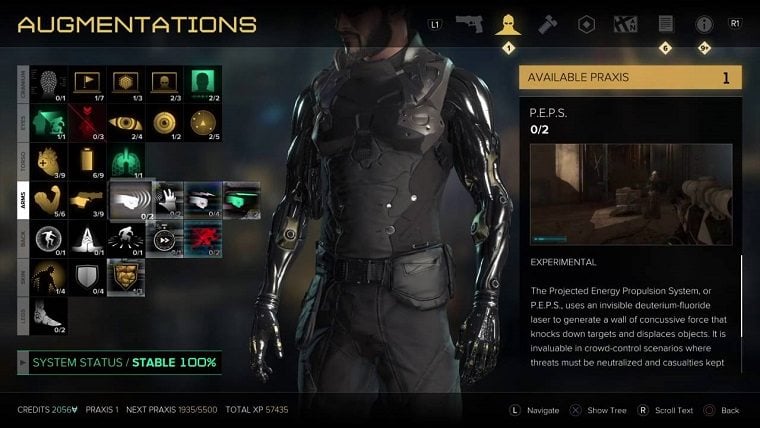
Gameplay is, as I mentioned before, largely unchanged from Human Revolution (though there are a few tweaks). You can decide whether to go with a combat/lethal or a stealth/non-lethal approach. You can also combine the two, though there are specific achievements associated with either and by committing to one it allows for greater deployability. I went with stealth/non-lethal, because that's always my preference in games that have well-developed stealth mechanics. As you level up, you can choose the augmentations that best suit your purposes. I focused on hacking, cloaking and sound suppression first, then branched off into other areas as the game progressed. A combat-focused build could start with armor enhancements, inventory expansion and better targeting. 


Overall I found the stealth mechanics to be very good, though not quite as developed as, say, the Splinter Cell series. The AI is solid - the game is hard but not cheap. And while there certainly was a degree of trial-and-error, I never found the game frustrating or tedious. Nearly all problems have multiple solutions; nearly all destinations can be reached multiple ways. The hacking minigame is also surprisingly enjoyable, the kind of thing that would translate well as a mobile game. And I do really like how Eidos Montreal integrated RPG elements into this framework. It's much smoother than, say, Mass Effect: Andromeda. Augmentation progression has a good pace, and you loot just the right amount of items. Oh, and shops actually sell stuff that's worth buying! 

This is also a game where choices matter, including choices made in conversation. Certain outcomes are only possible if you make the right choices, while others are only possible if you have the social augmentation and use it correctly. I was a bit "meh" on this - in theory, it's great, but in practice the social augmentation is clunky, non-intuitive and poorly explained. So if you want to unlock everything, you probably need to consult a walkthrough. Or play the game twice. 

The best part of Mankind Divided, though, is Prague. This is not a true open world, like in Witcher 3 or Fallout, but a semi-linear/semi-open world, like in Witcher 2 or the Mass Effect series. So don't expect to get truly lost. But the Prague that Eidos Montreal has created is beautiful, easily navigated and immersive. Twice you leave and come back, only to find the context changed significantly. And Prague isn't a place normally associated with cyberpunk (like Hong Kong, Tokyo or New York), so there's a novelty element to it as well. It's interesting to see futurism juxtaposed against the old buildings. 


The story is both here and there. Thematically, it's rich and well-realized...it's just that some of the actual plot points don't make a lot of sense. And the whole "illuminati" conspiracy angle, which was so much fun with the original Deus Ex, now feels equal parts tired and, given current events, more than a touch irresponsible. Luckily Mankind Divided focuses more on the game's social themes, which as noted above are thought provoking. 

All in all this is a very good game, and criminally underrated. Especially recommended for fans of stealth - a genre that's fallen on hard times lately, it seems - and those who like their games smart. 


The Math

Baseline Assessment: 8/10

Bonuses: +1 for grappling with big ideas, mostly successfully; +1 for strong and varied gameplay mechanics; +1 for mood and design

Penalties: -1 for big gaping plot holes; -1 it feels shorter than it should be

Nerd Coefficient: 9/10. "Very high quality/standout in its category."

***

POSTED BY: The G--purveyor of nerdliness, genre fanatic and Nerds of a Feather founder/administrator, since 2012. 


Monday, April 12, 2021

"Pacific Rim: The Black" has an OK story, but it's hard on the eyes

This tale of loneliness and persistence goes to some familiar places and has a few interesting ideas, but the animation looks painfully unfinished

(Confession: I'm not a fan of Pacific Rim. I know most people's reaction to the announcement of the first movie was along the lines of "Hell yeah!", which I get. I know that its aesthetic knows how to push the right buttons. In my case, my reaction was a bewildered "But why?", and the reason is that Pacific Rim is made of pure, distilled nostalgia, and I'm allergic to nostalgia, so I didn't see a need for this movie to exist. I think it's fair to you that I start this review by being open about this position I have. I don't think it's a bad movie. It's just not my thing.)

Pacific Rim: The Black is an animated series that continues the plot after Uprising and pulls a bit more of the curtain of the monstrous alien invaders that have been threatening Earth since the first film. I was skeptic about the viability of any sequel to the original Pacific Rim; like Terminator 2 or Return of the Jedi, it raises the obvious question "But they already won, and the movie said it's final, so what's there to tell next?" To my surprise, Uprising did have something to add to the story, and the direction in which it chose to expand its monster lore has room for further intrigue.

To my bigger surprise, what The Black adds to this setting has good potential. But its ideas tend to stay at the "potential" phase and don't enter much into the "execution" one. I realized this when I noticed it only had seven episodes of less than thirty minutes each, and I wondered why it wasn't a full-length movie instead. The answer is that The Black doesn't tell a complete story in this season. It's designed to set up several future plot developments, which is fairly normal in any first season, but the actual story gives us so little that one can't avoid feeling shortchanged.

Not that the story even works. Much of it relies on just-so contrivances. In the first episode, Hayley, one of the protagonists, accidentally discovers an entrance to a military facility that was hidden below her community in an oasis in the middle of the desert. She didn't make any particular effort to search for places any of them hadn't walked by in the five years they'd been living there. The all-important secret door was just... there. In the second episode, when Hayley and her brother Taylor leave their giant robot to explore the streets of a city on foot, the monsters they meet are the right size for a chase scene with teenage humans.

Causal logic is not a strength of this show. The premise is that, even after the alien invasion was averted in the first movie (and averted again in the second one), interdimensional rifts are opening again, but this time they're not at the bottom of the Pacific Ocean, but on land, in the Australian desert. We don't get any explanation for this change, and I suspect the only one is that they wanted to tell a road trip type of story this time. The series starts with most of the continent already abandoned and our protagonists cut off from the world after the disappearance of their parents. They don't know whether the coastal cities are safe anymore, but their discovery of a battle robot attracts the attention of a beast that rampages through their oasis, so the only option they have left is to search in the direction their parents went. Inevitably, because this is Australia, the show gets a Mad Max feeling that gets more obvious with the introduction of Shane, the human villain, who commands a private army of pirates/smugglers/survivalists. And then all causal logic is forgotten, because this villain is only capable of making choices that sabotage his own objectives.

The road trip structure serves to showcase the Australian landscape, but the artwork is a mixed bag. The animation can have really spectacular details that are done no favors by the clumsy parts. Hair shines as if it were made of plastic, while metallic surfaces appear dull as leather. The palette of grays is a favorite of the show’s artists, and it puts unnecessary strain on the viewer’s eyes. It’s hard to follow the action on screen when the color of a character’s jacket is almost the same as the wall behind him, or the color of a monster’s body is almost the same as the background night sky. When a basket of potatoes or a shirt are given gray smudges to represent dirt, they look instead like they’re half-transparent and we can see the ground through them. The effect would look cool if it weren’t so distracting and obviously unintended. In a very strange instance in the first episode, a female character’s breasts are foregrounded in profile while she’s talking to another character in the background, and the gray on her shirt gives it precisely this transparent look that completely ruins an already ill-advised shot. Other scenes use the lighting on surfaces to create the impression of depth, but with so few gradations that the screen is filled with large, ugly blotches of gray. Gray next to gray. Gray over grayer. Green or red so desaturated they may as well be gray.

This lackluster handling of color is even more jarring in combat scenes. When fighting titans hit the ground in the first episode, the rendering of the wisps of dust looks like a datamoshing glitch. Low contrast + shaky cam = a very confused and dizzy viewer. This gets especially disappointing when one notices the beautiful variety of landscapes. The second episode achieves an amazingly detailed ruined city with delicate dust effects, and the third has water splashes that move as if by real physics. But then a giant salamander rises from the water, its vaguely brownish belly nearly indistinguishable from the rocks next to it, and all the visual charm is gone. The amount of work that was put into the scenery is wasted on the featureless blandness of the creatures that have to move in it. This really hurts. When the clouds are painted with so much care that you can tell apart the cirrus fractus from the cirrus spissatus, you know these artists know how to draw well. They just don’t do it consistently. The fourth episode revisits the sandy landscape of the first, and there’s that glitchy dust again, only to be followed by a jump cut to the ruined city and its perfectly rendered dust, as if the teams in charge of animating different settings had not been in communication with one another. The big, climactic explosion in the fourth episode looks childish, while the fifth has a long scene with expertly done layers of fire and smoke that puts it to shame.

Although the plot won't earn any awards, it does have valuable things to say about generational disillusionment. Our protagonists owe their lives to their parents' sacrifice, but have had to survive on their own for years, and now that they're learning to give themselves the protection that their parents should have provided, they're starting to appreciate the difficulty of the task. In direct opposition to this strained but loving relationship, Mei is a child soldier with a long abusive history under her surrogate father, the heartless Shane, who later we learn has been manipulating her to make her stay with him. To add a strong touch of tension to this theme of painful parenthood, the last episode reveals that the aliens now understand enough about human relationships that they've sent one of their own to infiltrate Earth in the guise of a fragile child, weaponizing our protective instincts against us.

My comparison with Mad Max brings another angle to the worldbuilding: starting from Mad Max 2, political regimes and borders have vanished to the point that the movie may as well take place on another planet. In contrast, the events of Pacific Rim happen in the very near future, and it's impossible to ignore the real-world associations that come to mind as a consequence of the decision to set The Black in what the characters still call Australia. The producers should have been aware that any story that features loss of land and orphanhood and is set in Australia is going to evoke the historical context of the violent displacement and systematic child kidnapping done to Aboriginal peoples, but The Black doesn't include any explicitly identified Aboriginal characters who could have provided a fuller exploration of that inevitable theme. And don't get me started on the problems with a story about refugees in Australia that doesn't acknowledge Nauru.

So, the Pacific Rim franchise has never had the most robust worldbuilding. But it knows how to hit the emotional mark. The need for telepathic connection between two pilots was one of the most out there elements about the movies, in that a credible in-universe justification was never given, but it was a powerful symbolic statement about the value of emotional vulnerability and mutual support in the face of danger. In the setting of Pacific Rim, shutting off your feelings gets you killed, but exposing them to the wrong person leaves scars. Shane exploits this mental connection to edit Mei’s memories and keep her under his control, and it's the protagonists' willingness to be open with each other that helps them win the day. The fact that no one in Shane's private army is capable of such honesty is an effective shorthand for who these people are and why even without Shane we shouldn't root for them.

A full assessment of what The Black brings to the table will have to wait until it actually completes an arc at some point in the future. For now, the mysteries it presents are good enough. There's a weird religious cult that seems to worship the giant monsters, and we still don't know what happened to the protagonists' parents. But the makers of the show are going to have to work hard to improve the quality of the animation. I'm sure those who truly enjoy the giant fights of Pacific Rim would appreciate being able to tell what's going on in the screen.

The Math

Baseline Assessment: 7/10

Bonuses: +2 for beautiful scenery, +1 for a continuous thread through the theme of parenthood issues, +1 for a creative twist on the franchise mythos.

Penalties: −2 for inconsistent visual quality, −1 for too much uncanny valley, −1 for a flat villain, −2 for ignoring the questions raised by the choice of setting.

Nerd Coefficient: 5/10

POSTED BY: Arturo Serrano, multiclass Trekkie/Whovian/Moonie, accumulating experience points for still more obsessions.