Showing posts with label cosy science fiction. Show all posts

Wednesday, August 30, 2023

Microreview: Mooncop

Tom Gauld has more up his sleeve than just funny cartoons

Without me even realizing it, Tom Gauld had become a part of my internet. I recognized, instinctively, a very particular art style with dotted eyes, pointy noses, and oftentimes a distinct lack of mouths. I savored this comic, about how the ‘respectable’ literary establishment views our genres, and this one about the limits of ‘write what you know.’ I had never really put a name to him, however (the fate of so many artists, musicians, writers, and other creatives) as his work slid in and out of feeds until I had found his book Mooncop in a local library.

Mooncop is a slim volume; I read it in a single sitting, and I think most people could do it in a rather short amount of time. It is, in a sense, exactly what it says on the tin, being about a policeman on a lunar colony sometime in the not-too-distant future. Even the title feels like Gauld, in some way, with a bluntness that only obscures the greater depths of the work with a seeming irreverence towards standard titles.

The plot is rather simple, but laden with subtleties in a way that is frankly masterful. It concerns the titular lunar law enforcement officer as he makes his rounds through what is clearly something of a ghost town, visiting diners and doing quotidian beat tasks that are generally not the sort of thing that fictional police officers do. It’s not exciting, far from it, but it has something very compelling about it, especially as it becomes clear that this little town on the Moon is changing, and not for the better.

Gauld’s art lingers on scenic moonscapes, reminiscent of any number of painters’ depictions of the American West, but with a distinct lack of cacti. These panels, with Mooncop’s police rover in the foreground, a mere fraction of the scene, break up the dialogue often. The end result is this overwhelming feeling of quiet, of solitude, of isolation. It is a feeling that is so fitting for the cold of outer space, a place where nobody can hear you scream (but Mooncop will probably hear the report on his radio). The sheer scope of the moonscape emboldens the whole enterprise, doing with pictures what Kim Stanley Robinson loves to do with his prose, be it of Mars or of the High Sierra of California. Gauld’s art makes all this cozy, rather than threatening; I never thought a place with no breathable air could feel like a blanket in its own strange way, but he did it.

What is threatening in Mooncop is the impermanence of all things. The world that this extraterrestrial policeman has clearly come to love in a reserved, quotidian way is coming to an end, and as loath as he is to say it, he is in pain. All these silences that Gauld uses provide not just calm, but distress. You get the feeling that he’s ruminating on things, like we do when we are trying to fall asleep and our melatonin hasn’t kicked in yet.

Mooncop is what I’d imagine the experience of a retreat at a monastery feels like, in comic book form. It reminded me of the Buddhist doctrine of anatta, of non-self, of the conditioned nature and impermanence of all things and all situations. It’s about Mooncop’s attachment to his home and to his community, and how that, like everything else, is bound to end. Mooncop has to grapple with this as he is set to lose everything he loves, and he does so in a way that is painfully real to anyone who has lost anything (and I believe that is everyone, on whatever celestial body they may be on).

Mooncop is about the necessity of serenity and stillness in a world that demands so much attention and energy. It is a profoundly meditative experience, something I had never encountered in a comic book, or in any book, really. It is living proof that this internet jokester has far more in him than jokes, than mere silliness, and has something actually quite profound to say about the human experience. It’s an engrossing read.

Highlights: The ability to be so vast and yet so intimate.

Nerd Coefficient: 9/10.

POSTED BY: Alex Wallace, alternate history buff who reads more than is healthy.

Reference: Gauld, Tom. Mooncop [Drawn and Quarterly. 2016].

Monday, January 17, 2022

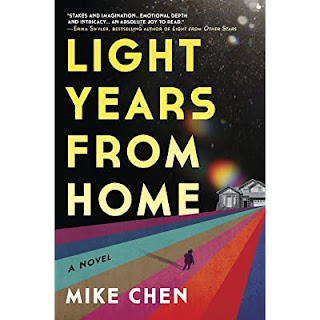
Microreview [Book]: Light Years From Home by Mike Chen

A novel that miraculously bridges people even when they feel light years away.

In these times of 2022, it almost feels like contentment was never something that was available. Any memories of such an opportunity feels stretched back to such a bygone era that when I think of it, it’s distant and scrambled. In Light Years From Home, a family is brought something that seemed unattainable for over a decade: the arrival of a long missing family member. The memories of getting to that point aren’t clear in some characters’ cases, but despite how scrambled it is, it’s miraculous. The story showcases the family coming together in a way that feels messy through difficult circumstances but absolutely clean in its heartfelt humanity. Memories can be scrambled, emotions can peak and sink from the unreliability of human actions, but what makes Light Years From Home such a powerful book is that the mundane yet miraculous instance of finding hope after an expanse of hopelessness is always in the cards, no matter how much time has passed to make it seem like an unattainable wisp.

15 years ago, Jakob was abducted by aliens. His two sisters have different approaches to dealing with the disappearance. Kass dismisses the prospect and assumes he wasn’t abducted but just left as the unreliable person he was. Evie thinks otherwise, devoting her time to studying extraterrestrial life, trying to solve the mystery of her missing brother. Meanwhile, the parents are left in mental shambles. There doesn’t seem to be any developments concerning it for a while until at the start of the novel, Jakob arrives on Earth with a special mission. That mission embroils his sisters in it through incisive developments. 


The characterization is where the story really shines. Whether it’s Evie’s ardent hope that what she’s dedicated her life to is a reality, Kassie’s fed-upness of her family, or the portrayal of Jakob who’s portrayed as making so much growth even though some of him is initially under a veil of mystery. It all works so well. Character arcs move at a pace that makes it so no one feels stuck in a rut. Just about everything feels like their choices align with their personality, making the plot move organically.


One thing to note is that as organic as the developments are, Light Years From Home definitely favors the exploration of familial bonds and human emotions over a rollicking plot. There are seeds for an explosive story here, but Mike Chen holds back, and it mostly worked for this reviewer. Although, there were some times when the vibrancy of the characters wasn’t enough to buoy some slower sections scattered throughout. Despite holding my engagement for the vast majority of the plot, I think it’s worth mentioning that this could very likely be lacking in speculative and action-packed elements to those in search of it.


Despite having a short supply of speculative elements, Light Years From Home is still imaginative through the way it’s able to carry its proceedings through an original voice and some brilliant plot points. It’s a novel full of love with a tenderness that might seem light years from our home. But the more I read about the familiar and cutting specificity of the characters, the more I realized that such a tenderness is still here–it just seems scrambled and distorted. Jakob goes on an interstellar journey, through many light years, surprising you with its direction but ultimately landing at a place that seems new until you realize it’s home.


The Math

Baseline Score: 8/10

Bonuses: +1 For its top-notch emotional intelligence.

Negatives: -1 For some slower and less imaginative chapters scattered sparingly.

Nerd Coefficient: 8/10

POSTED BY: Sean Dowie - Screenwriter, stand-up comedian, lover of all books that make him nod his head and say, "Neat!

Chen, Mike. Light Years From Home [MIRA, 2022].

Monday, April 19, 2021

Microreview [book]: The Galaxy and the Ground Within by Becky Chambers

The final Wayfarers novel is the opposite of a big finale number, and that's more than OK


I'll level with you, dear readers: somehow I haven't written a full length book review in a month, and I forgot how reviews start. So I'm just going to start by going "what IS reviewing?" and then follow up with "why have I had some books on my review pile for over a month without writing about them" and then we'll see where we go from there. One such book is The Galaxy, and the Ground Within, the last in Becky Chambers' Hugo Award winning Wayfarers series of spacefaring novels starring people who, despite the challenges of the world they live in, choose to be fundamentally kind and generous with each other and see where that gets them. In another series, I'd have gone into a final instalment expecting something on a grander scale than the lead-up: a big budget finale episode of a book featuring More! of Everything! with high stakes and happy tied-up plots for everyone involved. This being the Wayfarers, I went in with no such expectations and it's a good thing I didn't, because in scale this is the smallest of the Wayfarers books: a tiny, isolated story in a small part of the galaxy, featuring a few transient characters who intersect for a few days and then go their separate ways once more. It defies all concepts of what a finale should be, and I have had no idea how to write about it, or, really, how I feel about it. 

The book takes place on Gora, a planet whose economy is entirely built around being a rest stop for people passing through its various space gates to other parts of the galaxy. As Gora itself is an airless rock, those rest stops all take the form of various domes on the planet's surface, where travellers come down for the kind of hospitality experience one would expect at a transit hotel: a clean room, a decent meal, some supplies for their ship and maybe a weird souvenir from the gift shop. One such generic rest stop is owned by Laru (think the Mystics from Dark Crystal but fuzzier) Ouloo and her child Tupo, and on what is supposed to be a completely average day they have three guests arrive: Pei, an Aeluon on her way to visit her partner (Ashby of The Long Way to a Small Angry Planet),  Roveg, an insect-like Quelin trying to keep a mysterious urgent appointment, and Speaker, an Akarak whose role within her otherwise insular species is to interact and trade with outsiders. Unfortunately for all, this very average day is disrupted by a disaster that takes out much of the satellite network around Gora, leaving everyone stranded in the rest stop with nothing to do but rely on each other and wait for better news.

With the inciting incident set up, The Galaxy, and the Ground Within proceeds to do absolutely nothing to invoke any significant tension for the majority of its remaining length. Nothing bad happens to any of the characters or in their immediate vicinity as a result of the disaster, and the satellites are fixed offscreen with some cheerful official network updates serving as interludes between sections. Instead, the substance of the book revolves around the way these aliens interact with each other: from endless snacks (you will not forget that Ouloo is in the hospitality industry for a single second!) to dance parties to heartfelt conversations with teenagers about following their passions, the book lets these five aliens tell the story of why they have found themselves in this transit point, and where they're going next. The shared strand among the adults is that all are in some way exiled or distant from their species' expectations and communities. Pei, as readers of A Long Way to a Small Angry Planet will know, is from a species which considers inter-species romance a taboo and reproduction a responsibility, but wants to arrange her life in a very different way. Roveg's species are notoriously xenophobic and only those exiled are free to travel, meaning that his existence among the group means that he has been ostracised from his family and home for reasons that are explored through the book. Perhaps the book's most interesting strand is that involving Speaker and her species, the Akarak, methane-breathers whose planet was terraformed out of being habitable and who have never been offered just reparations or acknowledgement by a galaxy which continues to find them too inconvenient to accommodate. Because the Wayfarers books don't deal at the scale of political change, Speaker's story gets the least satisfying resolution of the lot, but it's an interesting wrinkle to add to the other background injustices and legacies which form the backdrop of Chambers' otherwise rather benign galaxy.

So yes, there's a reason for everyone to stay in one place and get to know each other longer than they otherwise would, and they eat some interesting snacks and have a dance party and tell stories, and then a bad accident does happen (as a result of the different forms of life support the different species need to survive) and everyone is kind of sobered and made to consider what they Really Want after this as a result of the accident, and then things are resolved with no lasting consequences and everyone goes off to live a slightly better version of the life they would have lived anyway. Which is to say, there's a way in which reading The Galaxy, and the Ground Within is a rather underwhelming experience. Becky Chambers has written enough books at this point (and I have read them) that it's obnoxious to go into them expecting something to happen in the traditional sense, but even by that metric, there's not much going on here: just a small story in a small corner of the galaxy, where individuals come up against overwhelming cultural dilemmas and encourage each other to solve them through some combination of being true to oneself and making good art. 

And yet, you know what? It works. It works because the idea of solving problems through individual empathy, while not a replacement for science fiction that grapples with wider systemic change, is just as radical an idea to explore, and it's also an extremely enjoyable wish fulfilment fantasy. It's hard to put into words what Chambers pulls off, and I can't shake the feeling that it would be even better in a video game or another interactive medium where gentle, character-driven exploration can feel more natural - but Chambers definitely pulls off the intended effect here, and I greatly enjoyed the experience of reading this book even as the "how" of its engaging me kind of didn't make sense.

The Galaxy and the Ground Within won't win over anyone who doesn't already like what Chambers does, and it's not your average series finale. But, as confused as my poor rusty reviewer brain might be, I can't imagine this series going out any other way.

The Math

Baseline Score: 6/10

Bonuses: +1 An entertaining cast of aliens with (mostly) fun interspecies shenanigans; +1 Nails the "transit hotel that is trying really hard to be the best it can be" feeling; +1 balances the conflict of focusing on small scale stories involving intractable-at-that-level political problems 

Penalties: -1 Despite the above bonus, I did want more for Speaker...

Nerd Coefficient: 8/10

Adri, Nerds of a Feather co-editor, is a semi-aquatic migratory mammal most often found in the UK. She has many opinions about SFF books, and is also partial to gaming, baking, interacting with dogs, and Asian-style karaoke. Find her on Twitter at @adrijjy

Reference: Chambers, Becky. The Galaxy and the Ground Within [Hodder & Staughton, 2021]