Showing posts with label isekai. Show all posts

Wednesday, July 15, 2026

Film Review: OBEX

A charming tribute to the early era of video gaming

During cicada season in 1980s Baltimore, computing enthusiast and ASCII artist Conor, a loner who avoids leaving his house and whose only friend is his rescue dog, buys a new video game that promises an advanced immersive experience. After what seems at first to be a disappointing test run, it gradually becomes clear that the type of immersion he’s getting is of a rather extreme kind: the game’s villain starts invading his TV screens, his printer, his backyard and his dreams. The plot of the game blends into his life, capturing his neighbor, his dog, his childhood memories and his secret fears. Maybe it no longer matters whether he can make it back to reality, as long as he gets a happy ending?

Albert Birney’s independent film OBEX is full of what video game reviewer Aidan Moher affectionately likes to call “hot CRT action.” Conor’s life is experienced through screens, from the morning variety/news show that presides over his breakfasts to his home office computer to the karaoke list he uses to sing himself to sleep. In a nice bit of foreshadowing, we’re shown what he does for a living: he turns people’s family photos into ASCII art that he painstakingly types by hand with fearsomely timed precision. He digitizes dozens of people every day, not unlike what the video game will do to him.

In fact, there’s an even cleverer form of foreshadowing in the first act. The events in the movie coincide with the periodic emergence of adult cicadas from their years-long undergroun hibernation, and Conor watches on the TV a chef who suggests ways to cook cicadas. Conor notes the cosmic joke that it must be to spend that many years in quiet solitude and end up eaten on screen. That description, it turns out, also applies to Conor, who has set for himself a simple and steady routine of working at home until he gets trapped by a video game.

I was too young to know what it was like to live through the first years of the home computer, but OBEX succeeds at giving me the feeling that it captures that era faithfully and lovingly. The retro computer graphics are made with admirable attention to detail. Also, it’s a genius choice of sound design that the mating call of cicadas is echoed by the noise of TV static and the screech of a dot matrix printer. Writer/director Birney gives an endearing performance as Conor, establishing the character’s effortless likeability as a harmless weirdo. The choice to film in black and white brings to mind elements of Pi, another story of obsessive computing, as well as Pleasantville, another inexplicable journey into audiovisual media.

Inside the game, the quest is straightforward: there’s a demon lord terrorizing the kingdom, and the player is the chosen hero who shall slay him. To make matters more personal, the demon kidnaps Conor’s dog (or so it would seem; the ending retroactively blurs the line between the real world and the game world). What began as a paranoid psychological thriller becomes a horror chase, with human-sized cicadas, murderous skeletons and lots of squirting blood. The final battle between Conor and the demon is exactly as adorably cheesy as one might expect.

Alas, I preferred the first half of the movie, when the scenes are restricted to Conor’s house, to the second half, when he’s thrown into the world of the game and has to walk through a forest to find the villain’s lair. Birney displays far more expertise in camera placement and shot composition when he has to film in a set than in exterior shots. The causal sequence of events is also more solid during the first half as opposed to the almost freeform plotting of the fantasy quest. After Conor enters the game, he gains a sidekick who has a TV screen instead of a head, which means we never see the actor’s expressions. This forces Birney to carry the emotional weight of those scenes all on his own, which strains the enjoyability of the second half of the story.

OBEX manages to both push the right nostalgic buttons and have something to say about present-day computing. We think nothing of watching screens, but recently it’s the screens that are watching us. Are you on camera right now? Don’t take any risks. Smile.

Nerd Coefficient: 7/10.

POSTED BY: Arturo Serrano, multiclass Trekkie/Whovian/Moonie/Miraculer, accumulating experience points for still more obsessions.

Thursday, June 18, 2026

Book Review: This Kingdom Will Not Kill Me

Ilona Andrews expands their fantasy and romance talents into the burgeoning realm of isekai in English

Isekai. Portal fiction. The very Japanese origin of the word suggests it is relatively new, even exotic, but it is a tradition that taps into a small but active stream in English SFF while using the enthusiasm of its Japanese taproot for basic concepts. Ilona Andrews’s This Kingdom Will Not Kill Me is the latest iteration of isekai fiction in a mainstream English language format.

Online encyclopedias define isekai as a genre of Japanese manga, anime, light novel, video game, etc. It has characters who go into a different world. But that’s not quite right, since you might be thinking: What’s the difference between isekai and portal fantasy? Portal fantasy does all of that too. One can think of portal fantasy as a bigger umbrella category than isekai. Portal fantasy covers any time characters go from one universe to another, usually from our world to a fantasy-based world.¹ Examples are numerous, and the concept goes back at least to the pulp era of science fiction.

Isekai is a more specific form of portal fantasy. There are some strains and varieties, but the main thrust is that the protagonist is transported to another world. Sometimes they have to die in order to get resurrected into this new world.² A lot of the time, unlike some portal fantasy, they wind up getting powers and abilities, even godlike ones, by the act of transferring across to the new world.³

Some isekai have an explicitly roleplaying element to them. The protagonist finds themself inside of a roleplaying game, or a piece of fiction, sometimes one that they know quite well.⁴ This knowledge can itself be a superpower, but the thrust is, the character has been transported into a new world that can run on rules that can be manipulated.⁵ There are even subsets of this where the protagonist finds themself in the role of a specific character from the book/property whose world they are now in. There is a sub-sub-genre of this where the protagonist finds themself specifically in the body of a villain… a villainess in fact, and has to figure out how to avoid the sticky end that inevitably awaits them.⁶

So let’s get to This Kingdom Will Not Kill Me and see how this fits into isekai. Our protagonist is Maggie. Maggie has fallen into the world of her favorite fantasy series, one that has never been finished. She is in the city of Kair Toren, and she knows the plot of the two books by heart. She is immersed fully in the world of the books. The problem is, she is absolutely penniless. She is not in the body of a villainess or anyone else, and she knows that the world is in for a rough time. And so she decides that, in addition to survival, her goal is to stop the tragedy that the book unfolds.

Maggie does have a superpower, one that she does not expect. She dies early in the book… and then she is resurrected. This is not like Django Wexler’s How to Become the Dark Lord and Die Trying. The world itself does not reset; the world keeps going on, and the resurrections are painful and take time. Maggie herself thinks about the gruesomeness of this, and whether she could come back from, for example, being torn to pieces. So she uses her extensive knowledge of the books and tries to bootstrap herself out of poverty and try to derail the beginnings of the plots that will consume Kair Toren in fire and blood. Along the way she makes some friends and gets wrapped up in intrigue and adventure. She also discovers a secondary superpower that is subtle but important: although she has read the book many times, she discovers that she can quote from the book, chapter and verse as it were. It gives an interesting metatextual twist to things. It also means that at points she doesn’t know some facts, because even the braided multiple POVs of the book don’t cover everything, so she is forced to guess and deduce some things about the plot and people around her because they were not in the book.⁷ As far as telling her companions what she is, she does not tell anyone that she is from the world outside the story. She is genre-aware enough to realize the problems of that. As it is, her ability as a seer means she has to try and keep her head down to avoid entities who might want to grab her for information.

And then there is the romance. This is an Ilona Andrews novel, and romance is a common subgenre in the novels they write. So there is no surprise that Unresolved Sexual Tension is shot through the book, especially when Maggie realizes that one of her companions and friends is not who she thought they were, and is instead someone far more dangerous and compelling. Given that the character in question is, according to the book, destined to marry someone else, this provides narrative tension as well.

And that is the real heart of this book and what it tries to do, and what it is in the isekai subgenre. Maggie knows the book by heart and even better than she should given that secondary superpower. What she finds is a conservation of narrative working against her. She does indeed try to stop the tragic events of the book, including even the “pebble” that rolls downhill to start the avalanche of war and rebellion and conflict, but at every turn, the narrative tries to assert itself and put the story “back on track” despite her efforts. It’s a fascinating use of metatext here, as Maggie tries to defy what happens in the books, only to be resisted and have to find a different approach or fight a new problem.

The story ends on a cliffhanger, with a situation seemingly resolved, but then, out of nowhere, the problem arises anew and puts our protagonist in peril. But that, too, is a narrative convention (and our protagonist knows it), which suggests to me that she is still trapped in a narrative structure that keeps wanting to assert itself despite her efforts. So this is not a novel that is going to satisfy if you are looking for the one-and-done approach. Instead, we have a series, and we still have a whole set of unresolved mysteries, and of course, peril for the protagonist. The novel stays entirely in Maggie’s point of view, which is an interesting commentary and choice given that she is in a world of multiple POV epic fantasy. I like that tension for the reader, and wonder if she will keep up that for the inevitable sequel.

Highlights:

  • Isekai, in a English language SFF mode.
  • Yes, this is a kissing book. Or at least slow-burn would-be kissing.
  • Interesting metatextual elements.

Reference: Andrews, Ilona. This Kingdom Will Not Kill Me [Tor, 2026].

¹ A notable exception to this is Lawrence Watt-Evans’s Out of This World and sequels, where there is portal travel from our world to a fantasy world, *and* to a space opera world. The space opera world may have a touch of science fantasy to it since it's not a rigorous “the net is up” sort of hard SF universe.

² That bit doesn’t seem to yet be popular in mainstream English versions of Isekai. However, the far out of print Through the Ice by Piers Anthony and Robert Kornwise (1992) does use this, having its young protagonist fall through ice and then get resurrected into a fantasy world. I thought it very strange at the time I read it, not knowing at all of isekai in any form. But in Japanese isekai, it would be bog-standard. Did Kornwise and Anthony read isekai at that point, or invent it independently?

³ The first time I came across that in mainstream English form was Dave Duncan’s The Great Game series, which explicitly has as its worldbuilding that if you transfer to another realm, you basically have it in you to be a god in that realm. The protagonist goes from 1914 England to a realm where he has the potential to gain prodigious power… but the gods already there have very mixed ideas about someone else joining their pantheon (especially the God of Death). The author’s foreword, 10 years after the fact, doesn’t mention isekai as an inspiration at all. But, again, by Japanese framing, bog-standard isekai.

⁴ And showing that this is old in English language SFF, I present to you The Incompleat Enchanter ‘verse of Fletcher Pratt and L Sprague de Camp. Harold Shea and his friends find that portal magic, and magic in general, is based on verse, and they wind up in a variety of worlds that they know—Norse myth, the Roland cycle, The Faerie Queene and other worlds that they recognize. There is even some directed targeting at one point, seeking a world with a magician powerful enough to handle a problem, and picking it based on their reading. Also a bit of Duncan here, as, except for portal magic, the protagonists seem unable to do spells with verse in our world… but in other worlds, they are indeed magicians with verse.

⁵ LitRPG enters the chat at this point, as well as its outgrowths and parallels. Being thrust into the world of a game is much older than that in mainstream English SFF, however. One can look to the 1980s and the Dungeons and Dragons cartoon, which runs on this premise. Or Joel Rosenberg’s Guardians of the Flame novels, which have the characters transported into an RPG world. Although it is not a videogame, Django Wexler’s How to Become the Dark Lord and Die Trying has a protagonist who was brought across, portal fantasy style, but every time she dies, the world resets. Wexler is extensively deep into anime and manga, as seen in other books of his, and he is definitely channeling isekai tropes throughout.

⁶ And this is where Sarah Rees Brennan’s Long Live Evil comes into the chat, because it runs right on this chassis in a mainstream English language form. Main character Rae is dying and makes a magical bargain… and winds up in the world of the books… but she is not the superfan; her sister is. So she doesn’t know everything, but she does know that she is Lady Rahela, and that in that role, she is due to die the next day.

⁷ And what of the book and its actual world? As revealed by Maggie and what we see, Kair Toren is a high-magic epic fantasy world with lots of intrigue, and yes, lots of blood. Think Martin’s Westeros or Elliott’s Wendar, but with the magic turned on to high. The two fictional novels have lots of PoV characters, extensive worldbuilding and backstory, and are exactly the kind of thick doorstoppers that someone could read and reread extensively and obsessively.

POSTED BY: Paul Weimer. Ubiquitous in Shadow, but I'm just this guy, you know? @princejvstin.

Monday, February 21, 2022

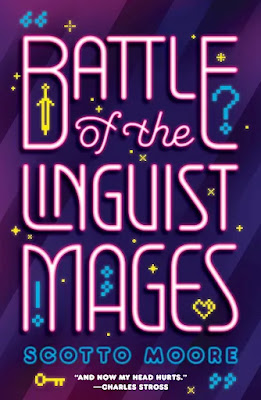
Microreview: Battle of the Linguist Mages by Scotto Moore

This is the most fascinating concept I've seen in years, but its style is not for everyone

Some titles are an insta-buy. One cannot see a novel called Battle of the Linguist Mages and not buy it. So it has that going for it. However, this novel is very specifically geared toward its own inimitable combination of tastes. You'll need to sustain a high tolerance for a bright neon nightclub aesthetic and extensive speculations on theoretical linguistics and an RPG-style narrative structure with quests and milestones and leveling up and trippy journeys to extradimensional battlefields made of pure abstraction and perennially snarky dialogue that goes out of its way to make every electronic music pun English will allow and nobly principled anarchist rebel fighters who never stop reminding you how so very nobly principled anarchist rebel fighters they are.

It starts great, don't get me wrong. But unless you're inured to the taste this book requires, it can quickly become too much.

Our protagonist is Isobel Bailie, an Extremely Online young woman who prides herself in crushing the leaderboard at the MMORPG Sparkle Dungeon. She slays rainbows; she battles bejeweled assassins; she rules benevolently over the dance floor that is her domain. But the musical spellcasting system in this videogame is secretly the training grounds for an ethically contortionist ad agency that has discovered a way to weaponize the building blocks of language. You just give them some time and, with enough cleverly phrased messages, they can take over the world.

To me, it makes every sense that the shady corporation in a punk rebellion story with wordplay-based combat happens to be an ad agency. As the holder of a business degree and half a communications degree, I can definitely confirm that marketing is the Dark Side of rhetoric. So when our heroine is recruited by this company as a junior project manager, it doesn't take long for her to be embroiled in a breakneck political conspiracy with vast repercussions for the whole cosmos.

To give you just an example: in a fairly early scene, we learn that the punctuation marks are an incorporeal alien species that has lived in the human mind since before civilization. And that's not the half of how weird this book gets from there.

To quote Illidan Stormrage: you are not prepared.

The early chapters show us Isobel learning to use a repertoire of difficult magic words that twist human perception and thereby alter reality. But her rise in the world of corporate verbal manipulation and subliminal political campaigning is thwarted by an independent faction that has devised its own magic words and opposes what it sees as humankind's bondage to an alien intelligence. With lightning pacing, Isobel's adventure takes her from our world to the realms of tangible thoughts and written code. When language is your weapon, anything you can describe in the source code of reality can be spoken into existence. Soon the limits between what is real and what is merely imaginable are blurred with indelible glitter.

The concept is so mindblowing that I didn't mind the sheer length of infodump this novel threw at me. I was so fascinated by the possibilities of its magic system that I ate up every scene of exposition. I must warn, however, that Isobel's first-person narration takes a good amount of getting used to. The prose here must be commended for producing the most convincingly girly girl I've seen emerge from the pen of a male author, but her inner monologue is supersaturated with pop culture references and deflecting irony and genre-savviness and multiple meta-layers of internet lingo and, for some reason, strongly opinionated remarks on dance subgenres. If that's your jam, you'll absolutely fall in love with Battle of the Linguist Mages. As for me, I had to take frequent breaks to breathe. I'll say this for Scotto Moore: he succeeds at making Isobel's voice an intense presence throughout the book. I just felt it turn too intense at times. Maybe I'm old.

Battle of the Linguist Mages is, quite appropriately, built on metaphor. The cosmic enemies of our brave anticapitalist warriors are, in one corner, an uncaring force of insatiable consumption, and in the other corner, a self-proclaimed lord who feeds on the strength of the masses. The plot presents interesting scenarios about the human cost of hoarding power in too few hands and the inherently corrupting effect of tools of dominance. But Moore can't resist the impulse to turn his world-ending scenario into material for joke after joke after joke until it's hard to believe in the threat anymore.

Even the last chapter, which is written in the strongest voice of the book, ends too quickly. This is a common pattern here. Once Isobel becomes a being of bits and ideas, her invincibility comes off as cartoonish, and there's no longer any reason to fear for her. At the end of the novel's repeated succession of, frankly, low-tension battles with no real losses, the truly epic climax promises a resounding bang, and instead deflates without even a moment to savor the heroine's victory. This would have been easy to fix by writing more transitional material, but instead the impression that remains in my mind is that of a gorgeous multicolored soap bubble that pops, and that's it.


The Math

Baseline Assessment: 8/10.

Bonuses: +1 for a brilliant and original concept, +1 for devoting an entire chapter to a poetic first-person description of the existential confusion of teleportation.

Penalties: −1 for tonal inconsistency, especially its often misplaced sense of humor, −1 for battles that resolve too neatly and never really convey a sense of danger, −1 because Isobel's rivals turn to her side too easily. As a pacifist, I'll applaud any heroine who makes allies out of her enemies, but the way those conversations are written lacks sufficient tension to make each change of mind land with the weight it calls for.

Nerd Coefficient: 7/10.

POSTED BY: Arturo Serrano, multiclass Trekkie/Whovian/Moonie/Miraculer, accumulating experience points for still more obsessions.

Reference: Moore, Scotto. Battle of the Linguist Mages [Tom Doherty, 2022].