A wild adventure that works for super-fans as well as newcomers seeking a break from the ordinary
One Piece is one of the traditional “Big 3” anime, along with Naruto and Bleach. Unlike Naruto, which leans heavily into intense character development, or Bleach, which deals with psychological and moral concepts, One Piece is more of an in-your-face anime with particularly bizarre characters and settings, as well as an irreverent attitude for just about everything. Eiichiro Oda’s One Piece manga has a record-breaking 500 million volumes in print. The anime adaptation began in 1999, and has over a thousand episodes and millions of loyal fans who can’t wait to see what will happen next in the twenty-four-year-old series. However, live action adaptations of anime (or any animated stories) are often difficult to execute because elements that work in animation often don’t translate well to live action. As a result, even hardcore fans of One Piece were unsure of what to expect from this new version of the story.
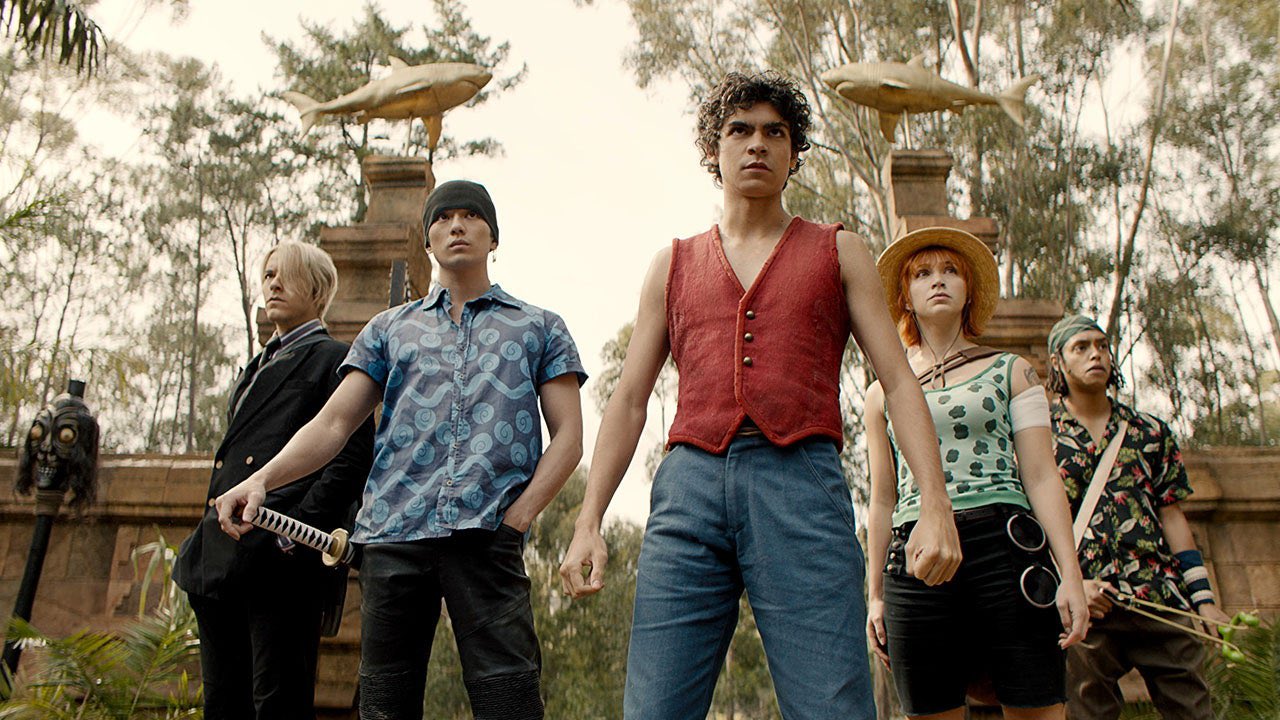
Fortunately, the One Piece live action series has managed to navigate the source material’s wild visuals and storytelling to create a show that will appeal to long-time fans as well as those with ambivalent feelings about the story and those who are completely new to it. Netflix’s adaptation of the One Piece manga is an ambitious and surreal journey through Oda’s world of wonder and mystery. Each storyline provides new takes on the classic journey of the iconic rubber pirate and his band of deadly misfits. A notable part of this show is the diversity of its characters, enhancing the feeling of immersion as the crew travels throughout the world. This is especially evident in the show’s main cast, which consists of actors from several different countries, all bringing their own style of acting to the show.
Summary: Luffy (Iñaki Godoy) is an enthusiastic adolescent boy in pursuit of his dream to become a pirate and to ultimately become the “king” of the pirates. To do this, he must find a hidden treasure known as the One Piece. The Marines are a multi-national government military force designed to maintain law and order. As such, they fight against, arrest, and execute pirates. Through various acts of kindness or heroism, Luffy gradually assembles a rag-tag but loyal crew to join him on his hunt for the One Piece, which is hidden in a dangerous place known as the Grand Line. Among his crew are Zoro (Mackenyu), a fierce and cynical swordfighter and former pirate hunter; Nami (Emily Rudd), a cartographer and navigator with a tragic past; Usopp (Jacob Romero), a shipbuilder with a knack for exaggeration; and Sanji (Taz Skylar), a suave chef who is talented at both cooking and fighting. Luffy calls his crew the Straw Hat Pirates in honor of the straw hat he wears—a gift from Luffy’s childhood mentor and protector, the pirate captain Shanks (Peter Gadiot). In his initial search for a map of the Grand Line, Luffy is opposed by fearsome Marine Vice-Admiral Garp (Vincent Regan), who has an unexpected connection to Luffy. He must also deal with the cruel pirate captain Arlong (McKinley Belcher, III) and bizarre pirate captain Buggy the Clown, fantastically played by Jeff Ward. Luffy is also befriended by Koby (Morgan Davies), a captive boy he rescues and who later joins the Marines.
Despite being a live action series, One Piece retains the fantastical elements from the anime and manga. Characters communicate through giant snail-phones (yes, actual giant snails). Luffy’s main superpower is his stretchy, rubber body acquired by eating a devil-fruit, which also steals his ability to survive in water (a bit of a problem for a career pirate). Buggy the Clown can pull off parts of his body and use them as weapons. The story’s main antagonist, Arlong, is a fishman with a sawfish face. The show leans into the fantastical characters while maintaining a dark undertone. This creates a balanced level of tension because the audience is never quite sure what will happen next—something that seems comic or campy may quickly turn violent or dark. Still, the show does tone down some of the over-the-top elements from the anime: Usopp has a normal face, Nami wears normal clothes (not bikini tops), Sanji is charming and flirtatious but not obnoxious. The least toned-down character is Luffy. Iñaki Godoy’s loud, childish, energetic portrayal of the main character is actually consistent with the source material, but is harder to pull off in a live action format.
Like Naruto in Naruto Shippuden, Luffy functions as the center around which other, more complex, characters orbit. He is the connecting point for Zoro, Nami, Usopp, and Sanji, all of whom have interesting backstories (played by five outstanding child actors) that lead them to join Luffy’s hunt for the One Piece. From cynical Zoro and Nami to lighthearted Usopp and Sanji, the characters take us on an adventure that feels like a journey through a grown-up version of The Wizard of Oz or The Neverending Story. ‘Grown-up’ is a key word because One Piece has significant elements of violence and oppression.
Long-time, hard core fans of One Piece should be aware that the live action series is based on the early episodes of the show and condenses or skips some storylines. After all, this is an adaptation. Many of the characters and stories are reimagined for the live action screen but still retain the spirit of the narrative.
The show emphasizes classic themes such as sacrifice, grief, and loyalty as seen in the backstories of the five main characters, each of whom has suffered a personal loss or has had someone make a profound sacrifice for them. The concept of morality is also explored through the different episodes. Nami is a cynical thief with a surprising motivation. Luffy explains that he is going to be a different kind of pirate from the violent marauders others have been. Idealistic Koby discovers the Marines have some very bad elements. Additionally, Koby’s relationship with the fierce Vice-Admiral Garp is contrasted with Luffy’s relationship to Garp as the show depicts the pressure of outside expectations versus individual determination. Koby also becomes a representative for the viewers, calling out absurdities that other characters take for granted.
Despite its flaws, the One Piece live action series will appeal to long-time fans or those who were unsure about the anime, as well as those who know nothing about Luffy and the Straw Hat Pirates. When you are ready for a break from the ordinary, One Piece may be just the wild adventure you need.
Nerd Coefficient: 8/10.
Highlights
• Wild visual effects and excellent acting
• Uneven delivery of both of the above
• Well done updates while maintaining the spirit of the source materials
• Works for both fans and newcomers
POSTED BY: Ann Michelle Harris (with help from Chris Jordan) – Multitasking, fiction writing Trekkie currently dreaming of her next beach vacation.


