Showing posts with label anti-colonialism. Show all posts

Thursday, November 7, 2024

TV Review: Nautilus

You can humanize Nemo, but you can't Disneyfy colonialism

A character like Captain Nemo is challenging to write, all the more so in a prequel. Originally conceived by author Jules Verne as a Polish noble on a vendetta against the Russian Empire (which would have made the novel damaging to French foreign relations), upon publication he became an Indian noble on a vendetta against the British Empire. By the time we meet him in 20,000 Leagues Under the Seas, he's a jaded misanthrope, self-banished from civilization, who in his burning hatred for tyrants has ended up creating his own little tyranny. The wonderful ship he commands is not a symbol of human progress, but a weapon of mass destruction (and eventual self-destruction). How do you turn such a character into a hero, when many in the audience already know who he's going to become in the novel?

One thing you can do is break free from the novel. The new TV series Nautilus, produced by Disney and then absurdly abandoned by Disney before being rescued by Amazon, rewrites Nemo as a revolutionary fighter who leads a rebellion of slaves and steals the Nautilus just before the East India Company can use it to take over world trade. This version of Nemo keeps the rough outline of the backstory Verne gave him: the British killed his family and stole his lands, so now he's an enemy of the British. Some (not enough) layers of complexity are added to that characterization. Verne's Nemo was fueled by raw spite; this Nemo begins headed in that direction, but is steered toward a gentler, more honest reckoning with his grief through his interaction with his crew. He may have a yearning for the abyss, but he comes to realize that he must not drag others down with him. Still, the character isn't written with the depth a lead role needs. Even after doing the hard work of earning the goodwill of his Designated Love Interest, in the last episode he makes a crucial choice against her wishes that reveals he hasn't paid attention to what she's been going through. So the most charitable description of his arc is from "total jerk" to "not a total jerk, but still very close."

A slightly better treatment is given to Nemo's crewmates. They don't even get names in the novel. In an adaptation that focuses so much on the theme of toppling hierarchies, that needed to be fixed. Alas, the cast we get is a mixed bag. Their use as comic relief is excessive, although it gradually lessens toward the middle of the season. One character in particular spends several episodes being nothing but comic relief, and not in an endearing way but in an annoying way, which later in the series detracts from the expected impact when his fortunes change for the worse.

This mishandling of tone is a major flaw of the series. It wants to be a sincere narrative of rebellion against cruelty, but it also wants to sand away its rough edges with the trademark Disney aesthetic. The result is an incongruity: a cutesy romp through colonies ravaged by famine and massacre; a kid-friendly, bloodless adventure where our heroes routinely face and barely escape the world's most brutally rapacious institution and end each episode with a goodhearted laugh. Disney wants to have it both ways, and fails at both. The way our heroes finally prevail against the East India Company, cleverly beating capitalists at their own game, relies on so many artistic licenses about the workings of a stock market that the fact it succeeds feels almost cartoonish.

The bright spots must be celebrated, though. Thierry Frémont's character is a great addition to Vernean lore as the engineer who designed the Nautilus. He's the voice of reason that tempers Nemo's effervescent passion, and making this character French is a nice homage to Verne as the titular submarine's actual creator. Céline Menville, one of the precious few women in the show, shines as a multiclass fugitive/bodyguard/chaperone/assassin with a mysterious past. Cameron Cuffe expertly channels the perennial detestability of aristocracy. Damien Garvey eats up each of his scenes with a gloating smirk of pure evil. Richard E. Grant has a fun cameo as a puppet ruler with skeletons in the closet. And Luke Arnold carries half of the show's emotional load in an incredibly complex role as Nemo's childhood friend who grew up to repay betrayal with betrayal.

Did you notice the key problem with the preceding paragraph? Most of the show's best-written roles are given to the white actors. Although Nautilus (the ship), and therefore Nautilus (the show), has a laudably diverse cast, reflecting the extent of the British Empire's depredation of the whole world, the script wastes some very talented actors by not giving their characters enough material to work with. This is one of the recurring consequences of the impractically short seasons of today's TV. The most that the script does to distinguish the members of Nemo's crew is to give each of them a couple lines of sad backstory; beyond that, their personalities may as well be interchangeable (the only exceptions, proving the rule, are the aforementioned characters reserved for the position of comic relief). In one episode, Nemo is berated for not knowing his crew on a personal level, but neither does the audience.

Nautilus is a great concept stretched thin by the pull of incompatible demands. In trying to bundle the grim realities of anti-colonial struggle in the same package with the childlike awe of exploring wonderful landscapes, it ends up much like the Avatar movies, doing a disservice to its own intended message.


Nerd Coefficient: 6/10.

POSTED BY: Arturo Serrano, multiclass Trekkie/Whovian/Moonie/Miraculer, accumulating experience points for still more obsessions.

Wednesday, November 6, 2024

Review: The Scholar and the Last Faerie Door, by H. G. Parry

 A familiar remix of familiar ideas, with not quite enough of anything fresh or novel

I follow a lot of writers on social media, and one particular message that they often promulgate goes something like this:

Don’t be afraid to do something that’s been done before. Tropes are tools, not poison! Even if [other writer] did it first, YOU haven’t done it yet! The fact that it’s YOURS is all we need to make it special and new. Give us YOUR take on [trope]. Every new voice is valuable.

I’ve always enjoyed this perspective. It’s so fundamentally encouraging to shy new writers, an open-armed invitation to join a club, not to self-reject one’s work just because it doesn’t feel fresh. New voices are always fresh, even if they are offering familiar old stories. (If nothing else, the endless parade of retellings of myths and fairy tales is evidence enough of SFF’s (excessively?) high tolerance for familiarity.)

The problem is that, sometimes, even a new voice telling an old story is not enough to make that story fresh. And such was the impression I got from The Scholar and the Last Faerie Door. The scholar in question is one Clover Hill, a young woman who has grown up on a farm in northern England in the early 20th century, and had her life reasonably well planned out, in unthreatening but not terribly exciting detail. Then WWI hits, and her brother comes back from the front lines terribly damagednot, as so many young men were, by the shells and the gas and the guns and bayonets, but because there was a supernatural element to the carnage. As Clover learns from her brother's comrade who brings him home, our world is overlaid with a world of magic, hidden but mighty, governed by old families who derive their power from intricate deals struck with the world of faerie next door.

One such magic-user was on the front lines of the fighting, and in all the carnage summoned a faerie. Something went wrong: the faerie was not contained, and a hideous curse struck down as many or more soldiers as any human-made weapon. Clover’s brother is unusual only because he mostly survived. But only mostly; he is not well, and he will not recover without help. So through perseverance and connections Clover manages to force her way into a spot at the school where all magic-users are trained, determined to learn the skills she needs to save her brother.

The  problem, though, is that the world of magic-dom was spooked by this catastrophic release of uncontrolled faerie magic, and so the teaching of faerie magic has been banned. All doors to faerie are closed and locked. Clover has no hope of learning to save her brother, unless she can find her own way to an open faerie doorwhich, if you’ve paid attention to the title of the book, is not an impossible task.

If you’ve spent much time reading fantasy books in the last 20 years, you’ll recognize a lot of these elements. A non-magical outsider goes to magic school where she must fight for a place among an entrenched magical aristocracy who don’t want her there. Harry Potter, anyone? Babel?  She finds a home and a core cohort of friends (The Secret History), but learns that there are dark secrets and hidden evils, and to save what she loves, she must destroy it (Scholomance). There’s even a tree that beats up people who get too close to the restricted section of the library. There is a Whomping Willow, for dog’s sake. The faeries, too, with their binding bargains peppered with dangerous loopholes, whose otherworldly weirdness is beyond human comprehension, give a lot of Jonathan Strange and Mr. Norrell vibes, mixed with Lords and Ladies by Sir Terry Pratchett, or Lud in the Mist by Hope Mirrlees.

And, in principle, I’d be all over this. I’ve written before how I love me some faerie bargains. And this particular trope is freshened by being intertwined with another trope, in which faerie land becomes a metaphor for colonisation (hello, Under The Pendulum Sun!). Unfortunately, ‘Colonialism Bad Actually’ is a very low-hanging bit of low-hanging fruit to signal who the baddies are in your story—especially if those baddies in question have already been signalled to be baddies by being wildly misogynistic (snoooore).

And furthermore, using colonialism for faeries strikes me as problematic. One element that makes faeries (in general) work really well (for me) is their inhuman blue-and-orange morality. The idea that there are these sentient creatures whose values and morals are so wildly askew from human understandings of virtue is really, really compelling in fantasy storytelling. But if these creatures are also metaphorically equated with colonised people, we’re left with a deeply unfortunate implication that colonised people are inhuman and incomprehensible. To be fair, perhaps Parry picked up on this, because she eventually gives the faerie antagonists an entirely humanly comprehensible motivation for their actions, but in doing that, she betrays the blue-and-orange morality that makes faeries so compelling as a plot device in the first place. So we’re left with the worst of both worlds: colonised people are still incomprehensibly inhuman and other, and they don’t even have a satisfyingly weird value system.

The plot itself is fine. The pacing is good, and Parry decides to do a time-jump in the middle, rather than use the structural device of back-and-forth intertwining timelines, which I appreciated. Mixing timelines has always been rather frustrating to me, since one is always less interesting than the other. I find the secondary characters quite well drawn, too, with compelling motivations, and the development and collapse of that sparkling cohort of best friends in school felt very real. I had one group of friends in high school that I’ve fallen out of touch with; and another in college who I likewise haven’t spoken to in decades. The collapse of these close-knit bonds that feel unbreakable in youth, and the awkward groping back together after a decade of separation, landed very precisely in my feels, exactly as Parry intended. But for all that, the plot itself didn’t feel very exciting. There are some developments that could have led to very fun twists, and didn’t; and Clover’s angst about her desire to pursue this new life among the patriarchal upper-class colonisers felt forced and in places inconsistent. And I’d already seen the same thing done much more effectively in Babel.

I guess that’s the thing. This book had a lot of familiar elements in it, but the way they were combined didn’t make them into anything fresh or new. It was not more than the sum of its parts. It was exactly the sum of its parts—and each of its parts could also be found doing its bit more effectively in a different book. If you want faeries, (re)read Susanna Clarke and Terry Pratchett; if you want dark academia, (re)read Donna Tartt; or go for R. F. Kuang if you want it mixed with magic and colonialism. And if you want to read something by H. G. Parry that is genuinely fresh and novel, allow me to recommend The Unlikely Escape of Uriah Heep.


Highlights

Nerd coefficient: 6/10, still enjoyable, but the flaws are hard to ignore

  • Faerie bargains

  • Secret magic school

  • Colonialism is Bad, Actually

CLARA COHEN lives in Scotland in a creaky old building with pipes for gas lighting still lurking under her floorboards. She is an experimental linguist by profession, and calligrapher and Islamic geometric artist by vocation. During figure skating season she does blather on a bit about figure skating. She is on Mastodon at wandering.shop/@ergative.

References:

Clarke, Susanna. Jonathan Strange and Mr Norrell [Tor 2006].

Kuang, R. F. Babel [Harper Voyager, 2022].

Mirrlees, Hope. Lud in the Mist [Knopf, 1927/Orien Publishing Co, 2018].

Ng, Jeanette. Under the Pendulum Sun [Angry Robot, 2017].

Novik, Naomi. A Deadly Education [Scholomance 1] [Del Ray, 2020].

Novik, Naomi. The Last Graduate [Scholomance 2] [Del Ray, 2021].

Novik, Naomi. The Golden Enclaves [Scholomance 3] [Del Ray, 2022].

Parry, H. G. The Scholar and the Last Faerie Door [Orbit, 2024].

Parry, H. G. The Unlikely Escape of Uriah Heep [Orbit, 2019].

Pratchett, Terry. Lords and Ladies [Harper Collins, 1992 / Harper 2013].

Tartt, Donna. The Secret History [Knopf, 1992].

Monday, September 16, 2024

Review: Shigidi and the Brass Head of Obalufon

Nigerian spirits do a heist at the British Museum, but struggle to deliver on the promises of that brilliant conceit

cover of Shigidi
Cover illustration by Jim Tierny

This book is a welcome breath of fresh air into the pantheon of stories about gods and humans. No longer are we revisiting the familiar names from Norse mythology and Greek mythology, perpetually retold and reused and recycled, with genuinely fresh takes few and far between. Instead, Wole Talabi is presenting us with a pantheon that many Western readers, or readers from the Global North, will find unfamiliar: that of the orishas, or the divine spirits from Yoruba mythology. The titular Shigidi is a very minor orisha, whose responsibilities involve sitting on a sleeper’s chest to engender nightmares, and eventually suffocate the life out of the victim.

It’s not a very nice job, and Shigidi’s physical form matches that valence: he is small, squat, and ugly. But he doesn’t really have any control over it. He works for the Orisha Spirit Company—has, in fact, been created solely for the position he now holds—and he must navigate the familiar corporate challenges of unfriendly supervisors, reductions in human prayers which cut into the company’s bottom line, and competitors in the field who have their own plans for the victim he’s been sent to nightmare-suffocate. One such competitor is a succubus, Nneoma, but after a heated exchange of views they decide to team up and go freelance. This puts the team in the perfect position to take a job from Shigidi’s erstwhile boss: namely, to make their way into the British Museum and retrieve the titular MacGuffin, the Brass Head of Obalufon.

So: we have an erotic (because succubus) heist, featuring Yoruba gods stealing back their cultural artifacts from the British Museum, with a bonus commentary on modern corporate drudgery. This is so awesome on so many levels. The opportunities to do brilliant things with this narrative conceit are boundless.

And so many of them were missed.

I really, really don’t want to write the rest of this review. I wanted this book to be so much better than it was. It could have been so much better than it was. And I think, on the whole, that each missed opportunity is reasonably small, so if you think the conceit sounds awesome, then maybe you should stop reading right now, buy this book, and enjoy it. Maybe you won’t be bothered by the things that bothered me, and that would be ideal.

But if you are curious, or perhaps you’ve already read this book and were dissatisfied, read on, and perhaps what comes next will resonate with you, as I try to articulate why this book disappointed me.

First, the narrative does the thing where the timeline jumps around. So we start in medias res, with Shigidi bleeding out in the back of a cab, his arm ripped off, blood everywhere, monsters chasing them—clearly something has gone badly wrong. Nneoma tells him she loves him. Fade to black. OK, cool—I’m engaged, I want to know how they got into such a fix.

But the remainder of the timeline jumping around just didn’t work—to the point that after the second or third hop, I started looking at the copyright page and the acknowledgements to see if I’d somehow missed a Book 1 in this series. Things that hadn’t happened yet were being referred to and briefly summarized, as if I was expected to remember them from a previous book. Then, when those events finally take place, twenty or fifty pages later, they feel redundant and pointless, because I had already gotten that ‘remember when this happened?’ summary earlier in the book.

One case in point is the events surrounding Shigidi and Nneoma’s decision to team up and go freelance. We hear about that as a done deal from the past, before the narrative jumps backward and shows us how it happened. In principle, this could be useful for elaborating on another component of the narrative—not the specific plot-based events, perhaps, but certainly the character arc surrounding Shigidi and Nneoma’s relationship. A continuing thread involves Shigidi trying to get Nneoma to admit to loving him, which she is unwilling to do for backstory reasons. This plays out in various conversations, one of which, infuriatingly, takes place during an extremely time-constrained heist. Priorities, people! But the point is: the whole question around Nneoma's admission of love doesn’t matter. We already know that Nneoma’s going to eventually say that she loves him. It happened on page 3! It was resolved before we knew it was important! So there’s no tension or uncertainty surrounding that plot arc, which means all the jumping forward and backward serves no purpose, except to make me wonder whether I picked up Book 2 by mistake.

Next, let’s talk about Shigidi himself. He’s created to be a small, ugly, minor god, and physically he is small and ugly. He doesn’t like his job, he doesn’t like his appearance; he’s miserable in all aspects of his life. There is such richness here to explore, from divine work-life balance; self-perception (what is ‘ugly’ when you are divine?); body-image and views of beauty. For example, one component of Shigidi’s ‘ugliness’ is scarification marks. Scarification, Wikipedia tells us, is the act of scratching or cutting patterns into one’s skin, after which follow-up treatment, such as repeated irritation, or packing clay or ash into the wound, ensures that the healing process leaves visible scars in the pattern of the original wounds. It is a deliberate, culturally significant procedure in many parts of the world, and if you click through to the Wikipedia entry, you can see that the results of this undoubtedly painful procedure can, in fact, be quite beautiful. To be sure, Westerners don’t particularly care for the practice, and so Christian missionaries in Africa spoke against the procedure, and colonial governments straight-out criminalized it. So, in sum, scarification and its relationship to beauty—especially in the context of orishas—raises some very deep questions! Why does Shigidi consider his own scarification ugly? What is his relationship with the culture whose patterns are etched into his body, that he thinks so poorly of them? What is beauty to an orisha, and why do specifically Western human beauty standards apply to him?

We never find out. Shigidi is ugly, doesn’t like being ugly, and pretty much the first thing he does after meeting Nneoma is allow her to remake his body into something super hot and muscled and glistening and abs-full. Through the power of sex-magic, to be sure, because Nneoma is a succubus, so there’s a certain amount of orgasmic potency to his transformation. That’s fine, I guess. Talabi wanted to write an erotic thriller, and this is one way to do that. But by doing that, he disregards all of the really interesting issues implied in Shigidi’s self-image as a corporate drudge. Shigidi was ugly. That lasted less than 40 pages. Then he becomes hot. Next.

OK, next: let’s talk a bit about Shigidi’s status as a corporate drone. This was so promising. I love the idea of a pantheon of gods operating according to bureaucratic norms. The idea of audits of prayer-income, overbearing supervisors, board meetings devolving into chaos as gods try to smite each other—it’s delightful.

But in this book it doesn’t quite work with the cosmology of the spirit world. Because it seems that the Orisha Spirit Company has been in existence for a long time. Shigidi was created to fill a role in that company; he was literally created to be a worker drone. Since records of Shigidi predate human corporate bureaucracy, and the Orisha Spirit Company predates Shigidi, then that means that the gods decided to organize themselves according to a human cultural construct before human culture constructed it. Or, conceivably, humans got the ideas of corporate infrastructure from the gods—which is again, a delightful world-building conceit—but if so, then shouldn’t the idea of board meetings and progress reports have originated in Nigeria? (I mean, maybe they did! People with business degrees, please weigh in! But my impression is that the daily grind was imported to, not exported from, West Africa.) There are ways of making the whole corporate-gods shtick really sing, but this book doesn’t do it. It just invokes the idea as kind of a gag, and ignores all the world-building implications.

Moving on from Shigidi and his employers, let’s discuss Nneoma. As I've mentioned, she’s a succubus. I’m not a huge fan of the phenomenon of succubi (especially in the absence of incubi), because I think they’re based in a deeply misogynistic perspective that sexuality in women is inherently dangerous and bad; and also that men cannot be expected to control their sexual appetites. But I went to a panel at Worldcon in which Wole Talabi made a really interesting case for Nneoma: in the same way that Shigidi must kill people for the Orisha Spirit Company, because that was the role he was created to fill, Nneoma must kill people (through sex) because that is how she is designed to live. It’s not her fault; her deadliness to mortals is also not something she enjoys. Rather, it’s a necessity. So for different reasons, these two represent a complicated relation with mortals, in which malice and deadliness are entirely disconnected. That was neat. I was on board with that.

But this book doesn’t follow through on any of those promises. Because Nneoma, as written, absolutely loves fucking people to death, and also enjoys engendering pointless jealousy in men too, just for kicks. And, remember, Shigidi is an ugly miserable corporate drone for less than 40 pages before he gets orgasmically turned into a thirst machine and sets up as a freelancer. And even though I can’t complain about a book being super sex-oriented when one of its characters is a literal succubus, I can complain when the erotic bits are so clunkily written that they’re not even hot.

Clunkily written? Oh, yes. Let’s talk about the writing style. It’s, as I implied, clunky. For example, after descriptions of women’s nipples in a nightclub we get, ‘Shadowy people-shapes gyrated sensually against each other.’ Sensually?  Oh, good, thanks for specifying. Do the sexually attractive sexy people do sex sexily together? Or this: ‘Her flowing red dress was loose and flowed over her body’s [sic] where it encountered her curves.’ The typo I can forgive, but the repetition of ‘flowing’ and ‘flowed’ is a real clanger. (Don’t worry—it’s not all male gaze. We get lots of descriptions of Shigidi’s muscles too.)

And then there’s this approach to prepositions: ‘… the words of a man with whom he was completely in love with and for whom, in the moments when they lay together, he’d sworn he would do anything for.’

‘With whom he was in love with’? ‘For whom...he would do anything for?’ Yikes. I myself think there’s absolutely nothing wrong with preposition stranding (‘who(m) he was in love with’), but if you’re going for the more self-consciously formal pied-piping construction (‘with whom he was in love’), you’ve got to remember to leave out the final preposition. Getting smacked with that kind of sloppiness in the face, twice in quick succession, really ate up a lot of my goodwill about the writing style.

I recognize that a lot of these problems are specific to me. Writing style is an incredibly personal judgment, and if Talabi’s style works for you, then you’ll probably enjoy the eroticism as well. And although I really wanted the book to dig into the corporate commentary and the world-building, perhaps you’re on board more for the British Museum heist—which, as far as heists go, is lively and fast-paced (except for the bit where Shigidi and Nneoma pause to talk about their feelings, despite the inconveniently brief window of opportunity rapidly closing around them).  And there are some stunning images evoked in this book as scenes dissolve into other scenes.

I think this book achieves a lot of what it set out to do. But the things that it could have done and didn’t do unfortunately happened to be exactly the things that I was most interested in; and so I put it down feeling annoyed and disappointed. But that was me. Maybe you’ll be different.


Highlights

Nerd coefficient: 6/10, still enjoyable, but the flaws are hard to ignore

  • Brilliant conceit
  • Heisting the British museum
  • Clunky writing
  • Full of missed opportunities to explore things that Clara, specifically, wanted to see explored
  • Disappointingly traditional use of succubus as main character

Reference: Talabi, Wole. Shigidi and the Brass Head of Obalufon [Gollancz 2023/Daw 2023].

CLARA COHEN lives in Scotland in a creaky old building with pipes for gas lighting still lurking under her floorboards. She is an experimental linguist by profession, and calligrapher and Islamic geometric artist by vocation. During figure skating season she does blather on a bit about figure skating. She is on Mastodon at wandering.shop/@ergative.

Thursday, April 25, 2024

Review: Rebel Moon Part 2: Forgettable Boogaloo

In contrast with the ubiquitous fanfare surrounding the launch of Rebel Moon Part 1 last year, its sequel has come and gone almost unnoticed

Last year, Zack Snyder seemed pretty convinced that his space opera riff on Seven Samurai was going to become an instant classic. The intensity of the marketing reflected that expectation: it was made at a volume and intensity to match that of the movie itself. Such high hopes weren't rewarded: Rebel Moon Part 1 turned out to be an unbearable cacophony of hyperviolence in blurry sepia, exactly what could have been predicted of a project where Snyder had free rein to pull his favorite toys out of the box.

What would have been harder to predict was how much room there still remained for Snyder to out-Snyder himself in Rebel Moon Part 2. With even more gratuitous slow motion, misplaced flashbacks, confused politics, impossibly sculpted abs, unintentionally funny battle cries, and suffocating grandiosity, Part 2 dulls the senses via relentless overstimulation. I noticed, to my horror, that I was witnessing gory death after gory death after gory death—and yet I was feeling nothing. Mayhem erupted on my screen with the chaotic viscerality of putting a gremlin in a blender and it left no impression on me. This is the kind of ultra-derivative art that relies on borrowing the prestige of its influences and doesn't bother trying to appeal to the viewer on is own merits.

There was plenty of material in this story with which to make some powerful statement, if only Snyder had wanted to. Taking the plot of Seven Samurai and replacing the wandering bandits with a galactic dictatorship changes completely the dynamics of the conflict. This isn't a mercenary skirmish in a lawless land; it's now a peasant revolt against the official authorities. Is Snyder subtly equating a rigidly hierarchical government composed of space fascists with a loose band of outlaws? I'm kidding. Snyder doesn't do subtle. Rebel Moon doesn't have space fascists because it has something to say about fascism; it has them because it's what Star Wars did and Rebel Moon wants to be one of the cool kids. It doesn't burn entire minutes of runtime in loving close-ups of wheat harvesting because it's interested in the perspective of vulnerable farmers; it does it because it gives Snyder an excuse to point the camera at sweaty muscles. Rebel Moon takes no stance on its own themes. It's content to let you provide the missing message by remembering it from the movies it alludes to.

In terms of characterization, the team of heroes at the center of Rebel Moon don't get more than the quickest coat of paint to technically make them no longer two-dimensional. As if drawing from a D&D campaign, each of these characters' backgrounds can be summarized as "goons raided my village." To make the whole affair even more unimaginative, the two prominent women in the team, Kora and Nemesis, have a dead child in their respective tragic pasts, possibly revealing a limit to Snyder's ability to imagine women's motivations.

The figuratively moustache-twirling admiral who lands on Kora's village to steal the harvest is even less impactful this time. If in the first movie he was a blank slate whose function in the story was to look generically evil and serve as the vicarious target for the audience's frustrations with neofascism, now he's a bland rehash of his one-hit act. Whereas his first death was at least a satisfying punch-the-Nazi (with a laser gun) moment, the sequel's supposedly climactic showdown feels like a tedious formality before his mandatory second offing. A bloody fistfight in the lopsided deck of an exploding spaceship, with heavy machinery and discount lightsabers flying around, sounds like a set piece impossible to make look boring, but you shouldn't underestimate Snyder's talent for filling the screen with flashy blasts that carry no meaning.

The emotional beats that punctuate the third act repeat a few tropes Snyder can't seem to move on from: the last-minute ally who shows up to prevent someone's imminent death, the hero who deals the killing blow at the cost of his own life. Snyder has found his formula and is comfortable recycling it. He's so confident in the awesomeness of Rebel Moon that he ends Part 2 with the promise of a Part 3 that we can already bet will repeat the same filmmaking tics. But enough is enough. There are only so many ways you can make the screen explode while having nothing to say. Maybe Snyder needs to go back to filming established properties, or find collaborators less willing to go along with his obsessions, but this period of unrestrained self-indulgence needs to stop.


Nerd Coefficient: 2/10.

POSTED BY: Arturo Serrano, multiclass Trekkie/Whovian/Moonie/Miraculer, accumulating experience points for still more obsessions.

Tuesday, December 26, 2023

Rebel Moon is the most Snyder that Snyder has ever been

Lucasfilm dodged a glowing, blurry, vaguely yellowish, excessively slowed-down bullet

One could summarize Rebel Moon as "the Zack Snyder of Star Wars," which would sound mean-spirited if it weren't its literal description. Conceived originally as Snyder's pitch for Lucasfilm and eventually rescued by Netflix, Rebel Moon files off the Star Wars serial numbers just enough to prevent lawsuits from the Mouse. As you would expect, it tells the story of a loosely assembled team of impromptu freedom fighters who rise up against a brutal interstellar empire. A tale as old as time, and one that Lucasfilm has kept profitable for nine movies and I forget how many TV shows. But Snyder's version of this formula, stripped of its identifiable markers for legal reasons, becomes a nameless, featureless collection of plot beats and cool poses. If there was ever a time when the infamous itch for canceling everything at Netflix could be used for good, it's now. There's no need for a Rebel Moon Part 2, or for all the multimedia spinoffs Snyder is reportedly preparing. This is not the galaxy you're looking for.

As I've written here before, I'm a fan of neither Star Wars nor Zack Snyder. Their missteps are plain to see to me. But even I was unprepared for the combination of the more generic, people-pleasing bits of the former with the more self-indulgent excesses of the latter. To put it in perspective: the production of the Barbie movie caused a brief scarcity of pink paint. Now that Rebel Moon is available on Netflix, has anyone checked on the world's supply of sepia pixels?

In theory, it should have been fascinating to watch a director's rendition of Star Wars without its distinctive visual identity. It would be a look behind the curtain, a dissection of the inner machinery that makes Star Wars go. Such a unique opportunity would help prove the case that a great portion of the transgenerational appeal of Star Wars has relied more on its art design than on its plotting. What is Star Wars without the double sunsets, the Stormtrooper armors, the outlandish hairstyles, the lightsabers? What is that story actually saying? You won't get that from Snyder's version. Instead of revealing the interior of a story without all the style getting in the way, Rebel Moon is nothing but style. Even worse, being only the first half of a planned duology, it hyperfocuses on character introductions. Far too many introductions, in fact. In a manner that brings to mind the first Suicide Squad movie, each of these heroes gets exactly one scene to look awesome and then dutifully retreats into the background, because this may be an ensemble cast, but the script only really cares for two characters.

Our protagonist, a Mysterious Lady of Mystery trying to keep a low profile in a remote rural planet but unable to keep in check her resting side-eye face, is, of course, more closely connected to the evil empire than she's let on. When a warship pays a visit to demand grain and the soldiers start getting dirty ideas about the local women, she is forced to blow her cover and singlehandedly wallops an entire squad while looking fabulous doing it. Then she runs away with her Designated Romantic Interest, but only because he knows the right people who know the right people who can help them amass forces for when the empire strikes back retaliates. This is the point when the plot turns into a succession of recruitment quests that go on for too long, don't serve to reveal their characters, and don't advance the story. We do get a handful of poster-worthy shots, which is what Snyder actually cares about. Instead of dramatizing the deep human questions that form the substance of the great epics, Rebel Moon is content with just looking epic.

Because filming 300 somehow didn't give Snyder his fill of rock-hard abs in desaturated slow motion, the fight scenes in Rebel Moon double down on all his filmmaking vices. You know how it goes: gory carnage filmed as if it were ballet, smoke and flying debris covering each shot you're trying to watch, and primal screams galore. The scenes that are not fights don't let the viewer have much of a breather, given Snyder's signature obsession with characters musing on a worthy way to die.

A story that consciously inserts itself in the tradition of Star Wars is expected to have something to say about empires. Episodes 4-6 showed how empires are less invincible than they make themselves appear in propaganda; episodes 1-3 showed how dangerously easy it is for a free society to degenerate into an empire; and episodes 7-9 showed how the shadow of the imperial impulse must be fought again in each generation. What say you, Episode Snyder? Empire bad. Empire go pew pew. Goodie need bigger pew pew.

Rebel Moon doesn't have time for its overcrowded cast to explore the themes of domination and exploitation in the context of the 21st century. It resorts to the most elemental trick of shining applause lights on your screen and expecting you to cheer, except these applause lights are full of dynamite. All the characterization that should make you care about these heroes is said to have been reserved for the extended cut, which says enough about Snyder's storytelling priorities. Just thinking of the fact that there is an extended cut makes me shudder with terror. I felt dead inside after spending two hours with this troupe of one-note permascowls, and I can't think of a good reason to add another full hour (and a sequel, and an extended cut of the sequel) to that ordeal.


Nerd Coefficient: 3/10.

POSTED BY: Arturo Serrano, multiclass Trekkie/Whovian/Moonie/Miraculer, accumulating experience points for still more obsessions.

Thursday, August 10, 2023

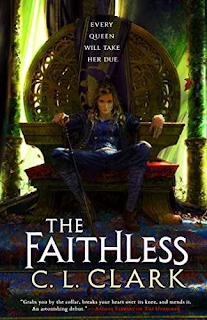
Review: The Faithless by C.L. Clark

We've had Touraine's Arms, now it's time for... Luca's Legs

How do you follow up on the iconic Touraine's Arms cover illustration for The Unbroken? Why, with Luca's Legs of course! And Luca's slouch. Also, Luca's unpleasant little princess smirk. Luca's strained trouser fabric, and its several folds. In this analysis of Luca as portrayed by Tommy Arnold on the cover of The Faithless, I will... wait, uh, remind me what I was doing here again? The text! Yes, I remember now, the text. Of the book. Let's tear our eyes away from the cover for a minute and talk about the insides of The Faithless, the middle volume in C. L. Clark's trilogy about empire, resistance, and extremely handsome ladies. 

(If you're new to this series, and wondering whether The Unbroken will be your thing to start with, I covered that in Strange Horizons so go and check that out instead. I start that one out by talking about Touraine's Arms, so there's a pattern emerging here, and very correctly so in my opinion.)

The Faithless begins in the middle of the political reorganisation that began at the end of The Unbroken. The colonising nation of Balladaire has chosen to pull out of Qazāl and recognise its independence, ending decades of oppressive rule. The treaty for this has been negotiated between Princess Luca, who had gone to govern the colony in a bid to secure her ascension to the throne in place of her regent Uncle, and a new leadership of former rebels. Among those rebels is Touraine: Qazāli by birth, stolen from her home and raised as a soldier by Balladaire, defected after realising that her coloniser superiors will never see her as anything more than a tool, and now the heir to a magical power which she isn't sure how to use. Through the events of The Unbroken, Touraine and Luca are well acquainted, by which I mean "Luca tried to use Touraine as a tool, Touraine had a severe case of divided loyalties and eventually decided not to go with the brainwashing coloniser, in theory Luca has worked her way around to respecting that". Also, they have absolutely scorching sexual chemistry every time they get within 50 metres of each other, and both of them continue to sometimes mistake this for mutual trust and respect. Luca mistakes her horny feelings for respect so much that she requests the Qazāli appoint Touraine as Ambassador to the Balladairan court, and the Qazāli, seeing in this an opportunity to ensure Luca upholds the terms of their treaty, are happy to send Touraine into the lions den. See, Luca has every intention of honouring her treaty, but she's also still not the Queen, and her Uncle is using the political leverage he has gained from her "failure" in Qazāl to force a trial of competence and push her out of the succession entirely.

The events of The Faithless therefore mostly revolve around the Balladairan court, as Luca struggles to build political alliances and ascend the throne and Touraine struggles to gain respect as a representative of a former colony, to improve the lot of Qazāli who have settled in Balladaire, to protect the people in her delegation, and to field the varied requests for help from Luca. One of the more frustrating elements of The Unbroken was the extensive list of bad decisions and reversals from Touraine, even though they made intellectually as a portrayal of a woman stuck between the indoctrination of a colonial upbringing and a birth culture that views her with ambivalence because of her proximity to colonial power. In The Faithless, Touraine's decisions are similarly complex and still lead to Bad Times sometimes, but they come from a foundation of wanting what is best for Qazāl over Balladaire even when she doesn't know how to achieve that in the Balladairan court, and the extent to which helping Luca achieve her ambitions will be good for her own country (and, relatedly, to what extent she's doing it for horny reasons). Luca and Touraine are still far from being on an equal footing in this book, and that imbalance permeates their every interaction. But Touraine's greater confidence in herself, and her clearer recognition of the power imbalance, add a new dynamic to their relationship and, frankly, make it easier to enjoy its progression without being consumed with annoyance over Luca's exploitation. Their relationship is still deeply fucked up - and that's the point - but it's marginally less "Touraine, please just run away, Touraine, no, TOURAINE", and I found that added to my enjoyment of the story.

While it's difficult not to miss Qazāl, and some of the characters who we leave there, Balladaire makes for an equally fascinating setting, full of intriguing side characters both new and returning. First off, the aesthetics are wonderful: Balladaire is French inspired, and Clark kits out her sapphic elites in masculine French court outfits with plenty of mention of sword hilts. While we spend much of our time watching elite political machinations there's also exploration of broader sociopolitical dynamics, including Qazāli migrants who feel oppression in Balladaire is a better situation than economic uncertainty in their own country, and anti-monarchist sentiment among the broader population. One of Luca's plans to gain power involves rediscovering the "lost" magic of Balladaire, whose eradication was part of the country's colonial narrative: magic is uncivilised, science is civilised, therefore scientific Balladaire needs to go to other countries which still have their magic and replace it with good clean scientific thinking (and, of course, harness that magic for their own military use, but that bit's not in the school curriculum). It would be a spoiler to say how this plot thread develops, but the wrinkles this adds to the worldbuilding are so deliciously "oh damn, of course" that I had to scream out loud for a bit after Luca figures it out. The Faithless also spends some time fleshing out Masridān, another region under Balladairan colonial rule whose people are of the same ethnic group as Qazāl, through the eyes of Touraine's former comrade and lover Pruett, who has been sent to build alliances but finds little immediate aid among the city's leadership.

If you liked The Unbroken, I think you're going to be very satisfied with where Clark takes things here, and how well the table is laid for the end of the trilogy (read: how very, very fucked our girls are). I, for one, can't wait to see whose body parts end up provoking thirst on the cover next time.

Posted by: Adri Joy, Nerds of a Feather Senior Co-Editor, @adrijjy on Twitter

Reference: Clark, C.L. The Faithless [Orbit 2023]