Showing posts with label Apex Magazine. Show all posts

Thursday, January 27, 2022

Questing in Shorts, January 2022: Saturation Part 1

This month, I attempted to read all of the short fiction.

Well, no, not all of it all of it, but I decided to get as close as I could to reading all the back issues of the stuff I was subscribed to in 2021. As I didn't read much short fiction at all in the first six months of the year, and I don't tend to get through everything I'm subscribed to, this ended up being 205 stories across 42 issues of Beneath Ceaseless Skies, Augur, Strange Horizons, Apex, Giganotosaurus, Uncanny, Constelacion, Fantasy, Mermaids Monthly, The Future Fire, Fireside, FIYAH, and Anathema Magazine, and a bit of cheeky anthology reading on top.

As with any arbitrarily reading challenge, the first thing I have learned from this intense period of taking in new material is: reading is supposed to be fun, and anything that detracts from that fun by overloading you, causing anxiety or otherwise pulling you away from other priorities is actually not a very good idea. There are no medals for quantity of short stories read, and I can't even say I now feel "well read": what I choose to read is such a tiny proportion of the genre as a whole, and I know I'm missing gems from places like Escape Pod and Podcastle, stuff I've taken "out of rotation" like The Dark and Clarkesworld, all the print magazines I don't have time for, and a whole heap of venues I'm not familiar with at all. I physically can't do much more reading than I do right now, and so it is up to me to accept those gaps, just like I accept that there's plenty of novels that are, by all accounts, amazing, but which I never get to read, because time sucks.

The second thing I have learned is that I'm pretty happy with my "pull" list. I'm sad that Mermaids Monthly is not continuing, so that won't be on my 2022 list, but otherwise I feel like I'm getting a great balance of the stories that I like, told by new-to-me and favourite authors whose work I like being exposed to. I think I have a gap for a science fiction publication focused on big ideas by diverse authors (if you have recommendations, go hit me up on Twitter - Clarkesworld is an option but I want to explore alternatives first). More generally, I'm happy with my reading model of "subscribe to a few things and read most of what they put out", and I rarely find myself reading a story that I just don't like. Sure, I know there's a lot more out there that I'm missing, but... see point 1.

The third thing I have learned is that, WOW, there is a lot of great writing out there. Kind of... too many to write in a single column. So, this is going to be a two-parter! I'm going to cover stories from Apex, Augur and Strange Horizons here, and follow up next week with some of highlights from the Unfettered Hexes anthology, top stories from the rest of the publications I read, and probably a bit more navel gazing too.

Let's go:

Apex Magazine, Issues 123 and 126
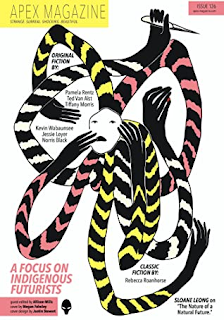

Apex Magazine wins this month's prize for making me cry too much, thanks to some powerful stories in Issue 123 and 126. Issue 123 has "Throw Rug", by Aurelius Raines II, which throws out one of the most powerful final lines I've ever come across: fitting, for a story about a scrawny Black boy taking up wrestling and learning to become a champion, despite the obstacles - including racism - thrown in his path. There's a riff on Samson and Delilah, a ton of exploration of race, masculinity, success and perseverence and a really interesting documentary framing that gives different characters - including the young wrestler himself - space to offer perspectives. The issue also contains "Mishpokhe and Ash" by Sydney Rossman-Reich, the story of a Hungarian Jewish family and the golem their daughter creates, trying to survive the influence of Nazi Germany over their country and create rules for survival in a world that is seeking only their destruction. And "This is the Moment, or One of Them" by Mari Ness really captures that "vaguely dystopian technology but make it wistful" vibe that Apex does so well, featuring someone using a time altering device to try and change past events around a former lover, working out which moment needs to change to keep them safe.

The Indigenous Futurism issue spans from luxury space station resorts with substandard working conditions, to Coyote shenanigans during a St Patrick's Day celebration, but the story that smacked me in the face most effectively was "Marked by Bears" by Jessie Loyer, a story about reparations by humans towards different intelligent animal groups after human society collapses. Somehow, Loyer balances the "red in tooth and claw" aspects of this new accord with some very human meditations on justice and balance. On the one hand, the actions that take place in the story feel monstrous, but on another... it works? Certainly one to read the content warnings for: but if you can handle it, it's thought provoking stuff.

A bonus mention here for "O2 Arena" by Oghenechovwe Donald Ekpeki, originally published in Galaxy's Edge and reprinted in Apex 129. Ekpeki's story (the 2 in "O2" should be subscript, and no, for Londoners, it's not about the Millennium Dome) provides a scathing dystopian future where the speculative elements only serve to underscore existing inequality. It's firmly grounded in Lagos, in a world where climate change has killed off phytoplankton and made the oxygen in the air unbreathable, forcing humanity to rely on filters and gas cylinders or, for the rich, comfortable climate-controlled sealed environments. Its protagonist is a student just about making things work on the edge of wealthy society, but his best friend's illness forces him to seek less savoury methods to put together the oxygen credits that will allow her to survive. While the first person narration occasionally becomes a little too perfect (I struggle on principle when male characters are able to see through patriarchy when their female friends can't, even though I know it does happen), on the whole it's a really powerful look at just how extractive capitalist society can become.

Augur Magazine, Year 4


I like that I can sit down and appreciate Augur's entire 2021 output in one dedicated afternoon. I would like this even more if they offered more reading options than just PDF: yes, this enables some interesting typesetting for a few of the stories ("In the Shadow of the Field" by Anastasia McCray uses it to great effect in issue 4.1), but I struggle to read on a computer screen and it would be nice to at least have the option to read more flexibly on an e-reader, you know?

But we're here to read stories, not whinge about file formats. Augur does a great range of diverse fiction with an emphasis on Canadian authors, and a lot of stories really capitalise on their sense of place, whether that's Canada or further afield. "African Meeting House" by Kate Foster (Issue 4.1) features two Black sisters who move back to their small town, and put the ghosts of their antecedents to rest in the house where they grew up, and the latter is a diaspora story in which a girl buying stuff from a convenience store gets told the story of a mango which turns out to be more relevant to her than she expects. In "The House at the End of the World" by Ashley Deng (Issue 4.1), protagonist Yi and her family have what they need to survive provided to them by their magical house, even as the world falls apart and starves around them: when she disobeys a directive to never go into the attic, Yi figures out the secret behind the house's generosity and her family's code when it comes to maintaining it (it's grim, but not gratuitously so, and I appreciate that.) I also really enjoyed the weird world and the meaty takes on power from L. Chan's "It Takes a Village" (Issue 4.2): in a world where the rich can create sentient dolls, a travelling magistrate with a reputation for dealing with doll-related cases is sent to the village where unwanted ones live to deal with a strange murder case.

Finally, let's talk about "Purgatory is High, Low and Inside me" by Emily Carrasco-Acosta (Issue 4.1), about Mariana, a young woman with diabetes who has to deal with being able to see ghosts when her blood sugar is too low or too high. It's a meditative story, one which delves into the feelings of its protagonist around her life and how precarious being chronically ill can feel, especially when that illness comes with such a weird direct link to death. We follow Mariana as she deals with her gift, and the relationship she builds with another woman, and when that turns out to be impermanent we feel the ache of that loss even as it changes Mariana's perspective on life into something, tentatively, for the better. Really good stuff.

Strange Horizons, May - December 2021
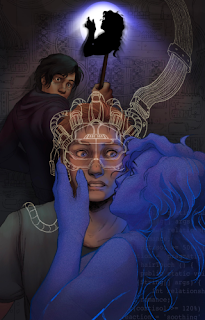
Art for All Us Ghosts: Johnny Anger

While I moan about having to read Augur in PDF, I must also lament not having had an ebook edition of Strange Horizons to read since last May, but this minor inconvenience was no match for my will to read good stories and I have therefore read some more things on my computer. Please send my medal soon, OK? (Also, because I read these in one big glut and did not take good notes of dates, the initial version of this post is not going to include dates - if you're not reading this sentence, it's because I've gone back and edited them in later.)

Anyway, it was fine, because it's Strange Horizons and Strange Horizons does some of the best stuff out there. Of particular note was their sexy interactive fiction special, Strange Lusts, featuring two hypertext games by Natalia Theodoridou and Anna Anthropy. "Pockets", a game about post apocalyptic survival centring a queer couple, is excellent, but "Heat from Fire" by Anna Anthropy is something else: a super steamy choose-your-own-tentacle adventure (I think the tentacles are optional but I did not feel the need to explore the no tentacle branch) featuring a trans witch alienated by her TERF-y coven and seeing comfort by summoning (and sexting) a very hot lady-shaped version of Asmodeus. It's sexy and it's also a really fantastic story about belonging and what gets treated as transgressive. Like all hypertext fictions, playing through more than once is encouraged.

Moving on from the sexy stuff, Kola Heyward Rotimi's "An Exploration of Nichole Otieno's Early Filmography" blew me away with its travelogue-as-academic-text framing and its take on colonialism and academia and how one studies something that resists the idea of permanence. I'm really into travelogue stories at the moment and this is really, really good. Also amazing? "The Constellations are Unrecognisable Here" by Andrew Joseph White, set on a medical spaceship that picks up survivors in decimated colonies in the aftermath of a galactic war. Amavon is a trans boy, trying to deal with the aftermath of terrible injuries and trauma as well as trying to convince his caseworker to approve top surgery; while travelling, he builds a relationship with Jenea, another trans survivor and burn victim, and the two end up affecting each other in an intense and not entirely healthy way. White's story tackles really difficult stuff in a light touch, generous way, and I found myself really rooting for both kids even as Amavon, in particular, makes some painful decisions. And there's some great anti-capitalist stories: "Thread Count", by Cynthia Gomez, is about a mysterious spate of deaths among the Fortune 500 rich list, in ways which turn out to be powerfully tied to the exploitation that made their fortunes. And then there's "All Us Ghosts" by B. Plade, whose protagonist Jules is a gig worker for a company that allows parents to invent and control all of their young adult children's social connections through virtual university. Jules divides his time between being every adult friend and girlfriend that rich kid Cam has ever had, dealing with his actual IRL crush on Cam, and campaigning for greater rights for the workers who have to take on this kind of labour; when the streams cross and Cam becomes involved in activism against the company, the gulf between the exploitation Cam perceives and the exploitation Jules has lived through throws the entire clusterfuck of a system into relief.

Also, I can't talk about Strange Horizons without talking about the highlights of its sister publication Samovar: the undisputed highlight of the two issues I read was "Ensign", by Soyeon Jeong, with its take on spacefaring indenture. The colonists of the planet where the story is set are bound to a deal made by their grandparents' generation, which says that they can choose whether to stay on the world, even as its infrastructure starts to crumble and life begins to get harder, or they can sign up to be relocated when the company that settled the planet needs them elsewhere: whether that be in the next week or in 40 years' time. Hajeong and Yuna are partners, but when it comes time for each of them to set their decision in stone by their 30th birthday, the gap between what each of them wants becomes an enormous strain on their family, and Hajeong, as the one who wants to stay behind, tries to live with her partner's inexplicable choice and the uncertainty it brings to their life together.

POSTED BY: Adri, Nerds of a Feather co-editor, is a semi-aquatic migratory mammal most often found in the UK. She has many opinions about SFF books, and is also partial to gaming, baking, interacting with dogs, and Asian-style karaoke. Find her on Twitter at @adrijjy


Friday, July 9, 2021

Short Fiction Round Up: June 2021

Finals season is back for German grad school (please don't ask me how our semesters work, I don't understand it either, I'm just suffering at this point) but despite that, I have some excellent recs coming your way! Second-world fantasies dominate our selection this month, though there's a touch of horror and a touch of literary fiction to add some variety. Enjoy!

The Lay of Lilyfinger by GV Anderson (Tor.com)
Anderson’s newest fantasy novelette about a scaled musician, her apprentice, and a complex and culturally fraught song was genuinely the standout in my June reading. Anderson’s deft touch with complex and layered situations is perfect. The humanity that each and every character in this densely populated novelette shows is perfect. Both these elements combine into a very enjoyable meditation on art, colonization, and memory. Highly recommended, especially for people who loved the complicated worldbuilding of RB Lemberg’s Four Profound Weaves. 

All This Darkness by Jennifer Donahue (Apex)
Written in the third person plural, this Donahue story follows an amorphous group of children of coal miners as they slowly get drawn in by the mountain. As someone currently living in Germany’s mining area, it’s unsurprising that this story hooked me in. The plot is creepy, the writing is stunning, and the imagery is haunting. I think about this first line every time I walk by my decommissioned coal mines now: “Nobody ever says we have coal in our veins; they don’t have to.” Chills!

Thirteen of the Secrets in My Purse by Rachel Swirsky (Uncanny)
The skill with which Swirsky weaves this small flash piece together is unmistakable: the lipstick, wallet and keys, the three things first mentioned, begin to affect the narrator: the tension rises quickly, until the end feels like a deeply satisfying relief.   

Hassan the Executioner Walks Out of Jawasar for the Last Time by RK Duncan (Beneath Ceaseless Skies)
I love stories that play with structure, and that’s exactly what this second-world fantasy story by Duncan does: it begins at the end. The story opens with powerful sorceress and authoritarian ruler Lamia dying, and tells the story of her closest friend, Hassan, leaving the city. The setting is rich and well-described – the desert city’s newly emancipated criminals as well as its angry and oppressed occupants are happy to turn on Hassan, and as her fends them off with his slowly failing magic powers, Hassan reflects on how much of the city's anger is deserved.  

All The Ophelias In My Flat by N Theodoridou (Silvia Magazine)
Theodoridou’s literary flash piece about dozens of versions of Ophelia coexisting in a single apartment and trying to move forward with their life is heartbreaking, beautifully written, and wonderfully stylistic. Again, I don’t want to say too much about it and dull it’s effects, so all I will say is read it and weep.


POSTED BY: Elisabeth R Moore is a writer, birder and grad student living in Germany. When she's not writing strange stories or cheerful reviews, she can be found crocheting, hiking or biking. She tweets at @willowcabins.

Thursday, June 24, 2021

Questing in Shorts June 2021: The Triumphant Return!

 Yes that's right, Questing in Shorts is BACK, bay-bee!

Put on your dancing shorts and boogie with me

It's been six months, during which time the subscription folder on my e-reader has been relentlessly filling itself up with enticing things. Sadly, since the start of the year my mind has mostly been elsewhere (and by elsewhere I mean "taking on the general capacity and aura of a mossy pond"). I had a few exceptions, mostly to catch up on 2020 stories from Omenana and FIYAH before Hugo nominations ended in March, but on the whole it's not been a good time for me and short fiction.

But! as of the start of this month, I've been feeling the short fiction itch again, and I've spent some time trying to come up with a system that will help me keep track of all the short fiction I read in a way that actually reflects the way I read short fiction (so, not sitting in front of a spreadsheet trying to type things in every ten minutes). After some thought, I decided to give in to the instinct that this was a problem that could only be solved with new stationery.

For once, though, new stationery really has been a gamechanger! Behold, Adri's first 2021 short fiction review notebook, courtesy of Whirling World on Etsy:


I decided to pick up a few pre-formatted review notebooks, but as they're set up for books I quickly realised that I'd need to change a lot of things to make this work for short stories. I printed out a set of form stickers to go in the middle of the page so I could quickly write in double the number of reviews, and wrote in the publication instead of a "finished date". I completely ignored the formatting of the TBR pages at the front to just put in a big ol' list of magazines (limited to things I have ebooks of, with apologies to Baffling Magazine and Omenana, both of which I read online - I needed to fix the folder backlog first!)

An incomplete list of things

I also gamified things for myself: after finishing a magazine, I rolled an eight-sided dice (because my e-reader shows eight documents per page) and read the corresponding magazine from the first page of the folder. This meant I mostly read things that I'd added more recently, but it kept me interested, and picking things randomly confirmed that I'm really happy with my current subscriptions: nothing ever came up that I was disappointed to have to read next.

And I filled this whole notebook! With 61 stories, from Apex Magazine, Strange Horizons, Giganotosaurus, Beneath Ceaseless Skies, Mermaids Monthly, The Future Fire and Anathema. The whims of the dice I didn't read any Uncanny or FIYAH despite having a couple of issues of each, nor did I get to the first issue of Constelacíon, so those are on the list for next time. but needless to say there's still plenty of stuff within these 61 stories to talk about...


Mermaids Monthly

A new publication to this column, Mermaids Monthly was set up by Julia Rios and Meg Frank with a simple, one-year mission: to publish content about mermaids. This month, I read their March, April and May issues, and I did indeed get a lot of delightful mermaid art, comics ("Fat Mermaid In: Wardrobe Malfunction" is a great piece from the May issue), poetry and of course short fiction, covering everything from surrealist slipstream to survivalist horror and everything in between.

A lot of Mermaids Monthly's content is flash fiction, which combines with the art and poetry to create a big, slippery mash-up blend of mermaid and siren myth where individual pieces feel subsumed into the whole experience. That's not to say that each piece doesn't stand on its own merits, of course - everything is really good! - but that Mermaids Monthly really benefits from being read as a single publication from start to finish, leaning into the thematic coherence and letting the different interpretations work together.

That said, there are some stand-outs, and as a longer-short fan it was longer stories that really caught my attention. In April, "A Minnow, Or Perhaps a Colossal Squid" by C.S.E. Cooney and Carlos Hernandez is a story about a magical world where debtors are transformed into fish while their debts are being repaid, and it alternates between Estrella, a caseworker charged with doing this magic, and a naturalist studying deep-sea sirens whose debts allow her to pursue her research in unexpected ways. The split perspective between Estrella's present on Mariposa, and the research notes of Ven. Damiana Cardosa y Fuentes, provides a great mix of worldbuilding and the sirens themselves are excellent (you'd expect no less from Mermaids Monthly, of course). In May, "The Incident at Veniaminov" is the story of an indigenous community visited by a cruise ship with a sinister agenda, in which Mathilda Zeller weaves together questions about identity with an action packed story (involving cannibalism) with excellent results.


Apex Magazine

Also new to my subscription folder is Apex Magazine, back off hiatus this year and publishing some magnificent things. I read issue 122 (March-April), which is full of stories that riff off of themes of survival, vengeance and memorialisation in one way or another. "Black Box of the Terraworms" was a weird highlight for me: the story of a strange terraforming intelligence as it battles the "gods" of a planet it is trying to make habitable to humans. The way the terraformer's objectives change as it takes on the perspective of the gods makes this a really interesting ride, combining a science fictional concept with a creation-myth story structure to brilliant effect. Elsewhere, I am a sucker for a documentary-style story and Sam Miller's "A Love that Burns Hot Enough to Last: Deleted Scenes from a Documentary" hit all my buttons in that regard, giving a range of testimonials about the life of Ti, a singer with the ability to channel magic through her songs. Ti's story - which, we know from the start, has a tragic ending - is offered up alongside the story of one of her fans, Brent, a closeted soldier who goes to one of her military concerts and is caught up in her magic. Brent's life, we learn, is changed for the better by being able to come out and build a life with his boyfriend as a result of their concert experiences; but Ti's magic can't alter the challenges of her own life and her own inability to follow her desires.

Finally, this issue of Apex includes an interactive piece by Sabrina Vourvoulias which is highly worth checking out. "Las Girlfriends Guide to Subversive Eating" is set in a magical version of Philadelphia, and offers up a fictional culinary tour of the city where food is not just a guide to the history and diversity of the city, but a way for migrants and activists to offer each other the magic they need to survive, be that through mushroom-based cuisine that can heal ailments, tamales woven with spells for keeping ICE away and paperwork rolling smoothly, or gardens which encourage younger generations to engage with the heritage of their ancestor's homelands. The formatting is fun, and the break-up of text between different pages means it doesn't feel hard on the eyes, and while the technology doesn't quite hit full intuitiveness every time (the lack of "back" buttons at the bottom of each food stop makes scrolling back up a bit of a faff) it's still a great vehicle for a powerful, engaging piece of urban fantasy.

Art by Sunmi for "The Chicken House"

Strange Horizons

Right as I started clearing my backlog, Strange Horizons dropped four months of ebooks on Patreon collecting their editions from February to May, and I ended up reading the entire set, including April's Samovar, the Palestinian special issue and the trans/nonbinary special issue. This is, quite simply, too much Strange Horizons to summarise in a couple of paragraphs, but if you're diving in on the recommendation of this column in particular, those special issues are where I'd start: the Palestine special issue brings 3 stories and 6 pieces of poetry as well as an excellent roundtable. "PALESTINE IS A FUTURISM: THE DREAM" is a brilliant piece of all-caps fury/joy riffing off capitalist exploitation and extractive industries and imagining something still strange and affected by their presence, but somehow newer and more pure. "Queer Arab Dictionary" is also an amazing piece, its stanzas looking at current and future language and envisioning how a gendered language might be reenvisioned or pushed beyond the binary. When it comes to short stories, I loved the deeply wry, satirical "A Day in the Life of Anmar 20X1" by Abdulla Moaswes, in which the future President of Palestine attempts to curate his dream palace, and his tenure's success, as his land literally constricts around him.

May's Trans special issue also has lots of good poetry (I liked "Luna" by Alexander Te Pohe), as well as some fun stories. "Women Want Me, Fish Fear Me" by Paris Green is the story of a sex worker in a world where many people have animal genes transferred into them to increase their potential for particular careers. Green's protagonist has had fish genes transferred, but remains multiply marginalised with no other options available. The story unfolds in snatches of perspective, centring on an interaction with one particular client, and while the nuances are beyond my critical capacity as a cis reader, the detail and atmosphere is extraordinary and makes this well worth the experience. "A Welling Up" by Natalia Theodoridou and "The Chicken House" by Jenny Fried are also excellent - I enjoyed the latter, in particular, for its trans take on the Baba Yaga myth.

Other highlights:

After a year off from subscribing, I'm rediscovering exactly why enjoy Beneath Ceaseless Skies' brand of "adventure fantasy". The story that took my breath away this time was "Concerto for Winds and Resistance" by Cara Masten DiGirolamo, which tells the story of a city under repressive rule from the perspective of four members of a wind orchestra and the curious, magical piece their new conductor puts in front of them. On the subject of favourite city stories, "The City, My Love" by Alexandra Seidel (The Future Fire 57) covers centuries or development and migration from the perspective of a city and the humans it loves within it

"Just Enough Rain", by P.H. Lee, is available on Giganotosaurus (it's their May story) and I loved its matter-of-fact religious exploration and its hilarious romance, and the mother-daughter relationship at its heart. I also want to mention "A Remembered Kind of Dream" by Rei Rosenquist, one of very few short stories from 2021 I read at the start of this year: it's a post-apocalyptic queer found family story that's got that perfect combination of biopunk and hopelessness and human grit and I'm glad it's stuck with me to make it into this column.

Finally, Anathema brings its usual blend of heartbreak and hope to Issue 12 after an issue off (though their December showcase is, of course, very much worth your time). This time, there's more of the latter than the former: "Cirque Mécanique" broke my heart most successfully, but "Lady Fortune" and "To Rise, Blown Open" put it together again.

From the Bookshelves:

My lack of short fiction reading has stretched to anthologies and collections, but I did finally get through Never Have I Ever by Isabel Yap, which is a showcase from an outstanding short fiction writer. The stories that draw on modern Filipino events and culture are my favourites: Asphalt, River, Mother, Child, the story of an afterlife where innocent victims of Duterte's war on drugs have found themselves stuck, is powerful and brilliant in its characters and the way it presents their journey, and "Have you heard the one about Anamaria Marquez" is a creepy take on schoolyard rumour. There's also a new novella in this collection: "A Spell for Foolish Hearts" is about a mostly-closeted witch who starts to fall in love with a beautiful man at his workplace, with adorable and very supernaturally satisfying results. I had high expectations for this collection and it certainly didn't disappoint, and I feel like I've left this collection with even more love for Isabel Yap's storytelling than I had before.


Posted by: Adri, Nerds of a Feather co-editor, is a semi-aquatic migratory mammal most often found in the UK. She has many opinions about SFF books, and is also partial to gaming, baking, interacting with dogs, and Asian-style karaoke. Find her on Twitter at @adrijjy