Showing posts with label Stephenie Meyer. Show all posts

Wednesday, February 22, 2017

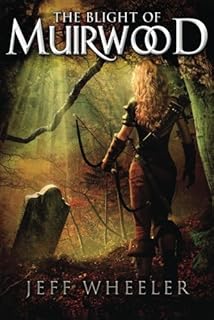
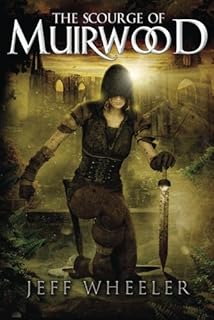
Microreview [books]: The (original) Muirwood trilogy, by Jeff Wheeler

Beats the pants (most of the way) off of expectations, but—ironically—insists in a prudish way that everyone’s pants stay on


Buy them here.

Former computer guy at Intel becomes full-time—and self-published!—writer, you say? What is he writing, instruction manuals? Ha ha, but it turns out the joke was on me: Wheeler writes with uncommon, almost lyrical beauty at times, and his decision to hang this 'romantasy' (romance fantasy, though romance is a pretty integral part of fantasy as a genre so perhaps this is one portmanteau too far, even for me) on the formidable shoulders of heroine Lia, a teenaged sorcerer-priestess (witch?), was a brilliant one. He adds a fair bit of interesting, if somewhat undeveloped, social commentary and critique in to his world-building as well: Lia is a Wretched (i.e., a bastard), so we can immediately predict one of her Monomythic quests will be to discover the identity of her parents. She is strong in the “medium” (i.e., quasi-intelligent fate/magic which responds to strength of belief/faith), and uses this and all her many other talents to kick some major butt.

The original trilogy unfolds skillfully and Wheeler does a good job of sustaining reader interest throughout, even if the extreme youth of Lia and her beau (the former barely a teenager when she falls for him, the latter borderline creepy given he’s four years older) is hard to swallow. The only serious fault of this series (aside from a(n un)healthy dose of Mormon church-inspired prissy morality which is enough to make notorious “no sex before marriage” Stephenie Meyer look like a sex-crazed lunatic!) is that it’s quite predictable: there was literally a 100% chance that “foundling who turns out to be an incredibly powerful sorceress and warrior, in unrequited-but-sort-of-or-actually-totally-requited love with a boy who has sworn his heart to a mysterious missing princess” will turn out to be—you guessed it—said princess, not the thoroughly inferior girl everyone thinks is the princess. About twenty pages in, the entire trajectory of the trilogy was already taking shape in my mind, and sure enough, after that point there weren’t many surprises.

If a story lacks unexpected twists and turns—if its entire scope is easily guessable within the first few minutes of picking it up—can it really be worth reading? Happily, the answer is a resounding yes! Ralph Waldo Emerson or some uppity idiot like that once said “Life’s not about the destination, it’s about the journey”, and it holds true here. Despite the priggishness, despite the fact that the true enemies turn out to be all women, lascivious Satanist-like succubi-priestesses (mostly patterned on French women, for some reason) whose greatest weapon is their seductive power over men (!), and even though we know practically everything that Lia will face once we catch a glimpse of her story beginning to unfold (basically, will she be Mary, or Eve: a virgin heroine or a ‘whore of Babylon’ type figure—a choice, needless to say, that from a narratological standpoint is no choice at all), it’s still quite enjoyable to watch Lia struggle to find her way, and navigate the heady perils of teenage romance while juggling the fate of all creation!

Gee, I wonder if this warrior-priestess who can do friggin' anything might be that lost princess everyone is talking about? Nah, it's probably just a coincidence.

So while it loses a few points for predictability and major pruditude, this story earns full marks for entertainment value, and nearly full marks for the technical side, as Wheeler writes quite well—even the agape-themed dialogue is fairly believable. I mean, who doesn’t want to read a story about a teenaged polymath warrior-sorceress saving the world? Plus, romance!


The Math:


Objective assessment: 8/10

Bonuses: +1 for making Lia so awesome/faultless it’s borderline ridiculous, +1 for exceeding expectations in nearly all ways, including high entertainment value despite penalty #1 below

Penalties: -1 for being so thoroughly predictable, -1 for priggitude (to the point of treating women who allow someone to kiss them on the cheek after a dance as the epitome of evil) -1 for treating being female as more likely than men to lead to great corruption and suffering (hey Wheeler: read a history book! Men tend to suck at peace, human rights, etc. soooo much more than women)

Nerd coefficient: 7/10 “An enjoyable experience, but not without its flaws”


[I think in this case our scoring system is very accurate indeed: this book is well above average yet not quite an ‘I was blown away’-level book, which as you see here is just what a 7/10 is meant to convey!]

This review is the work of Zhaoyun, a romantasy-lover since forever and NOAF contributor since 2013.

Friday, August 5, 2016

Microreview [book]: Summerlong, by Peter S. Beagle

 A remarkably moving, indeed captivating retelling of the Persephone myth—set near Seattle.  Or, “move over, Stephenie Meyer: there’s a new paranormal group in town!”


Beagle, Peter S. Summerlong. Tachyon, (Sept) 2016.

Buy it here starting next month.

By almost any measure, this book sounds boring. It stars Abe, a scholar retiree—the sort of person for whom ‘puttering’ is the verb of choice, in other words—and his longtime girlfriend, flight attendant Joanna “Del” Delvecchio (along with her desperate-to-love-somebody daughter Lily), and is set near Seattle in the present day. For the first 20% or so, there’s basically nothing out of the ordinary at all; it’s just two older people quietly ‘puttering’ their way through life. If you are thinking “ugh, reading about a 66-year old man and his attempts at banter? Pass”, then join the club, because so different, so unlikely were Abe and Del as heroes that I almost put the book down after the first few dozen pages; it just seemed like the story, while certainly well written and effective at building empathy in the reader for Abe and Del’s various incredibly minor predicaments, didn’t seem to be ‘going anywhere.’
           
Boy, am I glad I kept reading! Lioness (I feel no compunction in revealing that she is in fact Persephone, as this is patently obvious almost immediately after her first appearance) bursts onto the scene, and their ordinary lives, like the rising sun burning through a cloudy Seattle morning. Everyone loves her—how could one fail to love the personification of spring? As it turns out, even Hades loves her, and he soon comes calling, a bit like the husband from Sleeping with the Enemy (but way less awful, luckily!).

They should dig this guy up to play Hades if this book ever hits the silver screen!

Still, a story that is technically quite skillfully written doesn’t necessarily have much emotional valence, and just setting the Hades-Persephone myth in modern Seattle probably wouldn't by itself contribute much to the tale’s emotional impact…so now, after finishing the book, I’m still at a loss to explain why the story affected me so powerfully.

No fewer than five times, I found myself actually weeping (not sniffling or a little misty-eyed, mind you), and reached for the Kleenex. To clarify (without spoiling the story), nothing earth-shattering or particularly melodramatic happens; the Olympian additions to the cast notwithstanding, the main drama remains squarely focused on the relationship between Abe and Del, and Del and Lily too, and the effect the gods’ presence has on each. What in this sounds likely to require Kleenex? I just can’t explain it any other way than to say that Beagle lived up to his reputation as one of the doyens of fantasy literature, endowing this quiet, even uneventful tale with such lyrical beauty that I have tears in my eyes just recalling it now, as I write this.

Beagle’s prose is undeniably brilliant, but in an unassuming, unpretentious way. His dialogue is good, but almost archaic (or simply outdated) at times, perhaps as a result of hanging the story around two such unusually aged protagonists. So it’s not as though I was blinking back tears at the poignancy of any specific description or line of dialogue. I am left grasping at straws, and must resort to saying, simply, Beagle’s “storytelling ability” allowed him to convert what to rights should be a boring tale into an emotionally riveting one. In any case, bravo, Mr. Beagle: you’ve won over a new fan!

 
The Math:


Objective assessment: 8/10

Bonuses: +1 for bringing that certain ineffable “je ne sais quoi” (yes, I actually said that)

Penalties: -1 for altogether too much ‘puttering’ around in the first few dozen pages, before Lioness makes her transformative appearance

Nerd coefficient: 8/10 “Well worth your time and attention”


[At NOAF, an 8/10 is something to be very proud of; see details of our scoring system here.]


Reviewed by Zhaoyun, regular contributor at Nerds of a Feather since 2013 and connoisseur of magic realism, indeed any fantasy or science fiction tale that can move readers to tears.

Tuesday, July 19, 2016

Microreview [book]: Mimi and Ky: the Beginning by Yves Corbiere

The best kind of debut novel: already better than most, and hinting at further greatness to come!

Corbiere, Yves. Mimi and Ky: The Beginning. Amazon: 2016.
Buy it here.

Short and sweet, Mimi and Ky was thoroughly engrossing, if not quite from page one, then at least from when things started to get magical. Mimi, at first, seemed on the surface to be quite an unlikely character upon which to hang the sturdy mantle of hero(ine), but her TV series and her celebutante lifestyle notwithstanding, what the reader eventually discovers in her is an unexpected depth--and that, in the end, is what justifies her magical (in more ways than one) boyfriend-to-be Ky's interest in her.

Based partly on the author's own debilitating experiences of suddenly becoming sick, that feeling of being betrayed by one's own body, Mimi's high-profile life quickly falls apart when her health abandons her. It is in watching Mimi suffer that we forget about her empty life and start to empathize. Trial by suffering--it breaks most, but tempers some, and Mimi is certainly one of the latter, rising to the occasion again and again with her own special brand of courage.

Romances between a magical man and an 'ordinary' woman are not new, of course, but not all such stories really sell the central conceit: the idea that a person of extraordinary power would fall for someone who seemingly possesses none at all. I'm happy to report that Mimi and Ky manages to convince on that score, thanks to Mimi's evolution as a person (in fact, in a cruel way, perhaps the illness she suffers is actually the best thing that has happened to her, because it forces her into a painful yet, as it turns out, all too necessary refinement). 

It's written with something that I'd call "unpretentious flair", by which I mean it is skillfully, but not ostentatiously or floridly, written. One somewhat inconsistent portion was the dialogue, which ranges from snappy to a tad clumsy, but it won't distract too much from the engaging story.

Mimi and Ky sets up the multi-world mythology quite well, having a sort of 'magical anthropology' feel to it given the interactions with different groups, not all of them of this earth. It also ends on a decidedly unfinished note, the seeds sown for at least one sequel, possibly many. I, for one, hope it's 'many'!


The Math:

Objective assessment: 7/10

Bonuses: +1 for developing a 'magical anthropology' approach, and +1 for creating a more believable magical man<-->ordinary woman romance than most (here's looking at you, Meyer!)

Penalties: -1 for moments where the dialogue felt a bit awkward

Nerd coefficient: 8/10 "well worth your time and attention"

[Actually, an 8/10 is very high for us; see details of our no-tolerance policy on grade inflation here.]

This review brought to you by Zhaoyun, lover of unlikely romances between magical and ordinary people since time immemorial and stalwart reviewer at NOAF since 2013.