Showing posts with label Robert Heinlein. Show all posts

Monday, November 4, 2019

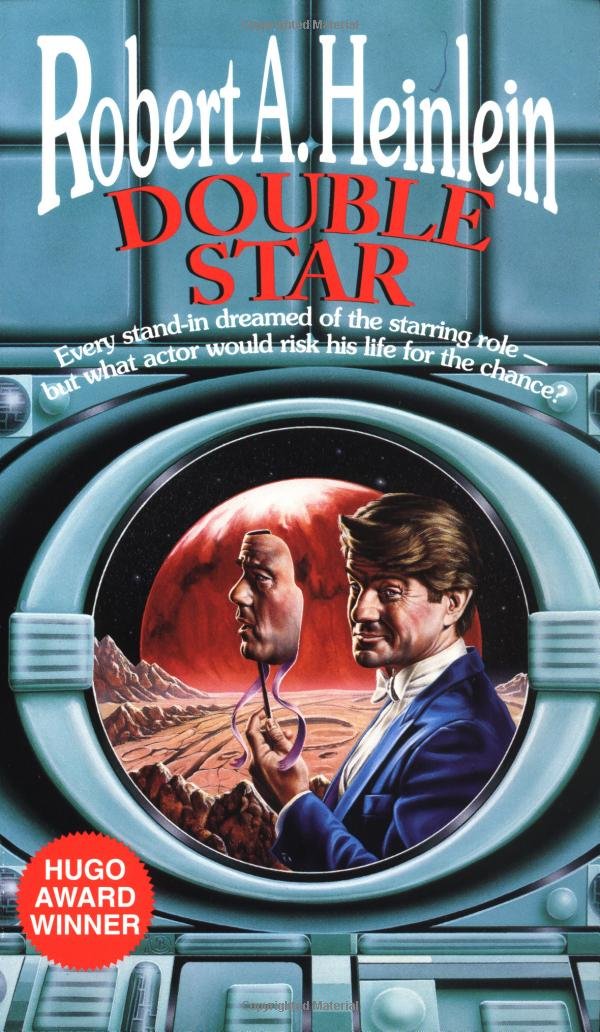
The Hugo Initiative: Double Star (1956, Best Novel)

Image result for double star heinlein

Dossier: Heinlein, Robert A. Double Star [Doubleday, 1956]

Filetype: Dossier

Executive Summary: Lorenzo Smythe is a washed up actor drowning his sorrows at a bar on earth, when he is approached by a group of spacemen with a mysterious proposition: can he commit to a mysterious impersonation, on Mars, for a handsome reward? Lorenzo says yes, and not even an immediate attack by a group of Martians in the bar makes him change his mind from the course that he's on. It's only when he discovers that the impersonation is of the leader of the Expansionist Party, Bonforte, who has been mysteriously kidnapped, that it starts to dawn on him that he might have committed himself to something that's going to take a bit more than confident monologuing about greasepaint to pull off - but Lorenzo is a Hero with an ego, and once he's in, he's in for the long haul. Getting acquainted with the small group of co-conspirators (including one woman, Penny, whose high-powered professionalism is regularly compromised by her romantic feelings towards her current boss which then makes it impossible not to also start fancying Lorenzo's impersonation)


The world Lorenzo inhabits is one where humans have spread out to the various planets in the solar system, and have encountered alien life on many, but where Earth remains the sole centre of political power and aliens are variously disenfranchised and marginalised, subject to human expansion and colonisation of their homes. Lorenzo himself has a specific, irrational hatred of Martians which the plot deploys some weird hypnosis pseudo-science to solve; Bonforte's more progressive party has been working to expand rights to aliens, particularly the Martians, and they stand in opposition to the more human-centric party currently in power.


As Lorenzo continues with his mostly successful impersonation, the real Bonforte is found in extremely poor health, having been deliberately administered with a drug overdose by his kidnappers (who the gang are relatively sure are some of his political rivals). This prolongs his tenure as an impersonator through the election campaign, and  as he continues to become more and more comfortable in the role, Lorenzo starts taking on more of the decisionmaking about how Bonforte "should" behave, almost invariably with successful, convincing results. Explorations of an interplanetary constitutional-monarchy-with-parliamentary-democracy ensue, complete with a significant political falling-out with the speechwriter and some close encounters with the Dutch Monarchy which apparently is now earth's entire government, and its up to Lorenzo to protect his ruse, bring the process to a close and work out what on earth he's going to do with his life after Bonforte returns.


Legacy: Ah, Heinlein. The author of whom I have heard it said most often, by people of my generation, that "maybe I should read him because he's historically important but... I don't want to?" Beloved by many who grew up with his books, Heinlein's decades-long career spanning both adult and "juvenile" (what we would now likely call YA) works makes his legacy in mid-20th century SF and the subsequent development of the genre near impossible to summarise. For a 21st century reader, however, the well-documented lack of three-dimensional female characters and the inevitable dating of plots and technology in his fairly extensive work means that Heinlein is inevitably less relevant to current genre conversations, and I've never read anything that genuinely engage with the question of where in his works to start for those embedded in the modern traditions. What I did have was a resolution to read some Heinlein for this project, and a memory of Rachel, from the Booktube channel Kalanadi, mentioning Double Star as a recommended read in her wrap-up of the Hugo and Nebula Award winners a couple of years ago.

Double Star is the first of Heinlein's four (non-retro - not that I would know if there's any retro ones) novel wins, and it's probably the least well known. The ballot for that year was rediscovered in 2017, and included Leigh Brackett's The Long Tomorrow, Isaac Asimov's The End of Eternity, and novels from previously-unknown-to-me authors C.M.  Kornbluth and Eric Frank Russell (who are both likely to remain unknown to me). It seems to have resurfaced in the public consciousness in the 2000s when a cover of the book was plagiarised by a Turner Prize nominee in one of their artworks, but otherwise it doesn't make the regular rounds of people's favourite Heinleins (Rachel's video is the only mention I've seen); nor has it more generally permeated the genre consciousness in the way of, say, Starship Troopers. Alas, it has also not given rise to a more general genre convention of making "constitutional monarchy run by the Dutch" into the dominant governing structure of Earth.

In Retrospect: So, how did I find Double Star as my first experience reading Heinlein? For the most part, this is a highly readable, entertaining adventure, which works through the various episodes of Lorenzo's impersonation in a lighthearted style which nevertheless maintains the pressure on Lorenzo keeping up the impersonation, despite relatively loosely sketched consequences for the Expansionist party's failure. The fact that the premise of disguise is carried out entirely in the form of makeup and the studying of mannerisms, rather than having any science fictional technology to shoulder that part of the narrative, certainly spins Double Star in a very different direction to how I'd imagine a story of impersonation and identity to be taken today, but its sort of charming despite being the most dated aspect of the story.


What I found fascinating about Lorenzo is the extent to which he resembles the protagonist of a particular kind of modern YA novel, both in terms of his inner life and in the way the narrative treats him. From early scenes where he casually goes off on a description about his own attractiveness for the benefit of the audience, to the relatively passive and almost accidental way in which he exercises his ability to take on the role of Bonforte (not to mention the presence of an abusive parental figure with whom he has a complicated personal and professional relationship), the only difference between Lorenzo and a modern YA fantasy ingenue seems to be the extent of his ego - there's no modesty here, although the talents he values and the talents other people value in him are clearly quite different. Moreover, Heinlein has no compunction of allowing Lorenzo be tactically ignorant and free of personal connections whenever the narrative requires him to be, generally for the benefit of delivering exposition. The result is a character who is simultaneously the kind of really unpleasant dude you'd go out of your way to avoid at a party, and a surprisingly enjoyable narrative voice. Whether this was the authorial intent, or we are supposed to have a straight reading of Lorenzo's self-belief, is unclear, but the result was entertaining all the same. Likewise, the supporting cast are relatively thin but all quite entertaining in their own ways - particularly Bonforte's beleagured speech writer. The unfortunate but unsurprising exception is Penny, the novel's sole female character, who is characterised entirely in terms of her relationship and feelings about the dudes around her.


The other big surprise here is that the science fictional narrative hinges very much on questions not of "hard" science, but of the social sciences, and specifically questions about politics and enfranchisement and political reform and the role of leadership in political movements. Double Star posits a world where a two-party parliamentary system has been transposed into the solar system, but where the mechanisms of that system operate on a pendulum of slow reform followed by backlash, against a backdrop of voters who are more or (in many cases, including Lorenzo) less interested in their workings. There's nothing here that's desperately new, but the fact is that with the exception of a relatively swift "hypnosis therapy" scene at the start of the book, and the presence of interstellar travel, this is quite definitely a book about those soft squishy non-sciences: how sentient beings organise themselves and the cultural implications behind those things.


Double Star isn't a particularly chewy book; its almost cosy conception of global constitutional monarchy feels so safe that I'm not sure if it ever would have been, and more recent fiction is likely to give a reader much more to think about when it comes to what makes up our identities and what it takes to change, either as a person or as a political entity. What Double Star is, over 60 years after its publication, is pretty good fun. If you want to try a Heinlein, this might not be the one that shows you what all the fuss is about, but it'll probably keep you entertained - if you can stomach the terrible female characterisation, at least.


Analytics

For its time: 3.5/5
Read today: 3.5/5.
Gernsback Quotient: 7/10


POSTED BY: Adri is a semi-aquatic migratory mammal most often found in the UK. She has many opinions about SFF books, and is also partial to gaming, baking, interacting with dogs, and Asian-style karaoke. Find her on Twitter at @adrijjy.

Friday, April 12, 2019

Microreview [book]: The Pleasant Profession of Robert A. Heinlein, by Farah Mendlesohn

The Pleasant Profession of Robert A. Heinlein By Farah Mendlesohn proves to be an essential volume of genre criticism about one of the giants of the field.


Heinlein was among the earliest science fiction I tried to read, when my age was barely in double digits, back in the early 1980’s. After my introduction to science fiction, I took to reading my 7 year older brother’s works. The cover with a guy seated with a kilt, surrounded by beautiful women--well, it attracted me quite frankly, and so the first Heinlein I tried to read was not one of his juveniles, not his short fiction, but rather, Time Enough for Love. I didn’t quite understand all of it, even as the premise on the back cover of that edition was completely wrong (Lazarus Long does NOT become his own ancestor!). It took me a couple of years to try again with Heinlein, going to his short stories first, and then as his work got reissued in the late 80’s, his novels. I also read my first piece of real genre criticism, Alexei Panshin’s Heinlein in Dimension, which covered his work until the late 60’s. I wondered if anyone had done similar criticism of Heinlein’s work after that (I Will Fear No Evil and subsequent books) but found nothing. Once I had finished reading Heinlein, I had let him lay fallow for a long time, with a couple of audiobooks re-reads as my only exposure to him. I had mostly moved on.

And so now years later, my interest in Heinlein reawakened with scholarship and thought about the man and his work, to point, the latest work of Heinlein scholarship, Farah Mendlesohn The Pleasant Profession of Robert A Heinlein. The title itself is a play on the Heinlein story “The Unpleasant Profession of Jonathan Hoag”. The book was crowdsourced to its publication, and a list of supporters is at the back of the book.

The question is in this day and age if there is a place for Heinlein criticism, even given the supporters who backed the book. Has the field moved on from him so much that his worth is not worth discussing? The author very clearly thinks otherwise and lays out her arguments in the book.

The book opens up with a short biography of Heinlein, which for me extended and fleshed out the story of Heinlein I had gotten from Alec Nevala-Lee’s Astounding: John W. Campbell, Isaac Asimov, Robert A. Heinlein, L. Ron Hubbard, and the Golden Age of Science Fiction². For the first time, the pieces I had, from Heinlein himself, from that book and others are now fused together to give me a better view of the man and his story. How his life influenced his fiction is very meticulously laid down¹. I personally learned a fair amount of about Heinlein's life. This biography provides a solid grounding for the reader in Heinlein's life story and prepares the reader for the rest of the book.

The real meat of the book, though, comes in the subsequent chapters. The author handles her analysis of Heinlein’s work by theme. Heinlein’s Narrative Arc, Technique, Rhetoric, Racism and more are the framework for her to explore Heinlein’s oeuvre multiple times from multiple points of view. There is even a chapter on Heinlein’s relationship with cats, and I did not quite realize the scope of cats in Heinlein’s fiction before reading this book. This does mean that a single work of Heinlein's, like Farnham’s Freehold, for instance, is discussed in detail in the chapter best suited to it, and elsewhere in the book at all. This thematic approach allows the author to discuss the writer’s oeuvre as a holistic whole with each section, rather than rabbit-holing down the stories and novels in succession. I found the index at the back of the book helpful, and the text itself signposts when the author intends to discuss a book in greater depth elsewhere in the work.

The author provides a nuanced and well argued point of view (and giving credit in footnotes where appropriate to people who have influenced her thinking on particular matters) and the book has made me reevaluate significant aspects of Heinlein’s work and his oeuvre for myself. In a world where Heinlein’s work has become a touchstone of divisiveness, Mendlesohn lays out what she thinks of it all, the good, the bad, the nuanced, and the ugly in Heinlein’s work.

As she says herself in the preface:
“The purpose of this book is to tease out what I find fascinating about Heinlein, good, bad and reprehensible, and to understand his work as a close-to-fifty-year-long argument with himself and those he admired.”
I maintain that Mendelsohn has accomplished this in spades. The Pleasant Profession of Robert A Heinlein is the most detailed and comprehensive look at the man and his work that exists today. Sometimes that detail goes a tad long on length, but any genre reader or critic who wants to grapple with Heinlein’s work would stand very well to read Farah’s work. Just like the aforementioned Heinlein in Dimension, this is a crucial piece of Heinlein scholarship that also makes the case that reading Heinlein can be and still is worthwhile. That’s no mean feat.


¹ The book is meticulously footnoted as well. Some of them are rather funny and I found reading all of them worthwhile.

² Dey Street Books, 2018.

³ The full list is Biography, Heinlein's Narrative Arc, Technique, Rhetoric, Heinlein and Civic Society, Heinlein and the Civic Revolution, Racism, Anti-Racism and the Construction of Civic Society, The Right Ordering of Self, Heinlein's Gendered Self and the Epilogue, The Cat Who Walked Through Genres (itself a play on The Cat Who Walked Through Walls). There are also appendices.


---
The Math


Baseline Assessment: 8/10

Bonuses: +1 for meticulous analysis in a well reasoned point of view.

+1 for being cogent enough to persuade a skeptical reader like me about some aspects of Heinlein's work.

Penalties: -1 for maybe just a little too much overwhelming detail.

Nerd Coefficient: 9/10: very high quality/standout in its category. Very nearly a 10.


Reference: Mendlesohn, Farah, The Pleasant Profession of Robert A. Heinlein, Unbound, 2019]


POSTED BY: Paul Weimer. Ubiquitous in Shadow, but I’m just this guy, you know? @princejvstin.

Monday, September 23, 2013

Celebrating Banned Books Week

Here at Nerds of a Feather, we're especially big nerds about reading. For most of the contributors, I think it is fair to say that the printed word and the deeply personal effects certain books have had on our lives have shaped who we are and what we are now doing with those lives. But it is also a sad fact that if a book has something important to say that challenges the status quo — especially when it comes to race, sexuality, gender relations, or if it deigns to use "bad" words — somebody somewhere has tried to ban it.

And they have too often succeeded.

I wanted to write a post to call attention to Banned Books Week (www.bannedbooksweek.org) which is going on right now. Book banning is, sadly, not a thing of the past, however. There are still those who crusade against writers and against people's right to read certain writers. Me, I say read everything you can and make up your own mind. Here is my tribute to some of the books that have landed on the chopping block of people who are trying to keep impressionable children from reading things that will make them better critical thinkers and less malleable by those who would prefer that with "banners flying and with drums beating we'll be marching backward, backward through the glorious ages." (Inherit the Wind)

Leave in the Comments section below anything you'd like to say about controversial or banned books that have influenced you.

The Great American Novel
Whatever your personal nominee for "The Great American Novel" might be, you would find many allies if you chose To Kill a Mockingbird, The Great Gatsby, or The Grapes of Wrath. All of them are essential reading for anyone seeking to understand the United States and its struggles in the 20th century. The Grapes of Wrath was the earliest profound experience I ever had with a book. I probably read it for the first time when I was 12, and the world was immediately and forever changed for me.

Advocates for Conscience
Two of the books that most influenced me and made me feel through their staggering emotional impact the real power of what writing can do were also pulled from schools because of concerns that teens might read in print words that they say out loud daily — Catch-22 and Slaughterhouse-Five. That World War II is popularly regarded as the last "noble" war is partially because people like Kurt Vonnegut, who witnessed how ignoble human beings murdering each other en masse really looks up close, wrote books like these in that war's aftermath. Their lessons have permeated the culture ever since, changing how we perceive the very essence of wars. As the saying goes, nobody wins a war.

Advocates for Racial Harmony
The lesson of books like Richard Wright's Native Son and Ralph Ellison's inimitable Invisible Man are that there are unnecessary societal barriers placed between people of different races that are detrimental to all of us. It's an ugly problem with ugly ramifications, but writers who call attention to it have routinely been shouted down by people who would rather make denials and claim that these problems have been left in the past, and often they couch their objections to these works in terms of explicit language or mentions of sexuality.

Advocates for the Possible
Notable sci-fi writers like Ray Bradbury, Robert Heinlein, and the above-mentioned Kurt Vonnegut have come under attack repeatedly, again usually for language. The greatest irony probably belongs to the repeated challenges to Bradbury's anti-book banning novel Fahrenheit 451, which has been allowed in some classrooms only in a bowdlerized version.

And Finally, Advocates for Innocence
Maurice Sendak had a way of communicating the primal relationship to reality that most children have that has not been matched. But one time he drew a penis on a little boy (little boys do have penises, much to the chagrin, I'm sure, of people who got In the Night Kitchen banned), and he had the audacity to write a book where an angry little boy didn't know how to deal with his feelings and dreamt of running away to someplace where he could be in charge (Where the Wild Things Are). I proudly read my children books by Maurice Sendak, and it gives me endless pleasure to imagine them one day doing the same for their children.
And finally, a picture of an adorable kid wearing an
"I Read Banned Books" shirt.

Wednesday, February 27, 2013

Microreview [book]: Orphans of the Sky by Robert Heinlein


I often romanticize the notion of sitting down on a lazy Sunday with a classic SF novel I bought for under $2 at a used bookstore. Several attempts to go through with this, though, have foundered on an iceberg of hack writing, outdated social norms and the naive optimism about science, technology and "progress" that permeates so much pre-New Wave SF. So it was with some trepidation that I began Orphans of the Sky, a novel structured as two novellas by Robert Heinlein, an author I know primarily (and not positively) from the militarist novel Starship Troopers to the more interesting, but tediously smug Stranger in a Strange Land.

Orphans of the Sky tells the story of Hugh Hoyland, an illiterate peasant living on a generation starship whose inhabitants have long-since forgotten the purpose of their voyage (or even that they are on a voyage). The "crew" live on the high-weight decks of the ship, and are organized into a highly stratified and rigidly patriarchal society dominated by "scientists," who are really priests of a sort, and whose religious texts are the ship's technical manuals. The lower-weight decks are the home of "the muties," a group named either for their descent from the plotters of a long-ago mutiny or for the frequency of genetic mutations among them (which don't exist among the crew because they commit infanticide whenever a mutation occurs).

Hugh, being an intelligent young person, is promoted to the position of scientist, and quickly falls in with a group of hyper-rationalists that want to supplant the more superstitious officers ahead of them and then wipe out the muties. Before the plan can be realized, though, Hugh is taken captive by Bobo, a short, none too bright but fierce mutie, and Joe-Jim Gregory, his two-headed dilettante master. In captivity, High comes to learn of the ship's real nature, and its mission to reach the star system of Far Centaurus. He returns to the high-weight decks to "convert" the ship's officers, setting off a complex chain of political events that result in a crisis the ship has not seen since the days of the original mutiny.

So How Was it?

Perhaps it was the depressed expectations, but I actually enjoyed Orphans of the Sky a lot more than I expected to. It is written in the hack style, but it's fairly efficient and clean and thus perfectly suitable to that idle Sunday. It's unfortunate that Heinlein switches between third-person restrictive and third-person omniscient, especially as the latter appears directly addressed to an audience of Earth-bound contemporaries to the central characters, who presumably would never hear of their story. I found this annoying.

Then there's the whole "dated social norms" thing. I'd imagine that if someone were to write the character of Bobo today, they would not describe him as a "pinhead dwarf moron." This is partially mitigated by the fact that Bobo is possibly the most relatable and likable character in the book, but only partially. And gender relations in the book, for that matter, are positively neolithic. Heinlein does provide an explanation for this--the crew live in a highly-stratified priest society, and severe oppression of women is an integral part of its power structure, as it was for many historical analogues. But even as Hugh and his associates grow enlightened about many things, they never even consider the women except as an afterthought. And over in mutie country, whose residents are meant to be wildling-style "free folk," there's really only one woman--and she's an old crone who makes knives for everyone else and appears in exactly one scene. Maybe there's a touch of realism there, given how long it's taken/is taking real actual human societies to treat women as equal citizens, but the sausage-fest dynamic is seriously dated and seriously corny.

If you can give Heinlein a "that was then/this is now" pass, or can rationalize the misogyny in Orphans of the Sky as the intellectually justified function of the societies he is describing, then you'll probably find the rest of the book to be an enjoyable and at times thought provoking adventure story. I particularly liked how he resisted making either the crew or the muties "the good society"--actually, they are both terribly unfair. And there's a relatively interesting take on post-revolutionary politics that, while not quite up to Animal Farm standards, is still more subtle and nuanced than most Cold War-era parables about communism.

In the end, though, while this did satisfy my urge for a quickly-digestable SF classic, the good stuff isn't good enough for me to look past all the frustrating anachronisms.

The Math

Baseline Assessment: 6/10.

Bonuses: +1 for it only cost $1.75 and I bought it at my favorite SF specialist second-hand bookshop; +1 for being a solid all-around adventure story that had some intelligence and thoughtfulness to it.

Penalties: -1 for the distracting switches to third-person omniscient; -1 for the near total absence of women characters; -1 for not even giving them a tiny modicum of subjectivity when they do appear.

Nerd Coefficient: 5/10. "Average" or "Mediocre." Take your pick.

Wednesday, December 5, 2012

50s Sci-Fi: X Minus One

From the far horizons of the unknown come transcribed tales of new dimensions in time and space. These are stories of the future; adventures in which you'll live in a million could-be years on a thousand may-be worlds.

These are the words that kicked off each episode of X Minus One, a sci-fi radio series that ran on NBC from 1955-1958. I like old-timey radio shows, but everything I'd ever come across had been mostly mysteries or dramas, things like Orson Welles' Mercury productions, The Many Lives of Harry Lime, a series of "prequels" to The Third Man, Suspense!, which would sometimes land guest stars like Peter Lorre, and The Shadow, which was just kinda bad.

But it wasn't until recently I came across the 50s sci-fi goldmine that is X Minus One. Like most of these old radio shows, there are some clunkers -- and it'll take a smarter man than me to figure out the 1950s fixation on creepy dolls -- but there are also dramatized short stories from Ray Bradbury, Robert Heinlein, Philip K. Dick, and Theodore Sturgen, among others. This is vintage, present-at-the-creation type stuff, here, before these guys were really famous, let alone legends. The shows were co-sponsored by sci-fi pulps like Galaxy Science Fiction and Astounding Science Fiction, and drew from all of the writers that were being published prominently there.

What these radio shows really do is plug you directly into the zeitgeist of the time. We can watch classic sci-fi movies now and recognize the markers of Cold War paranoia, the fixation with the brand-new space race, and the ignorance of what lay beyond our atmosphere, but it's not the same.  Listening to several of these shows, you begin to realize how dominated they are by tales of invasion, and how every single plot -- from brainwashing our kids out from underneath us to staging a ticker-tape parade down 5th Avenue -- to take over the world is really just a plot for the dirty Commies to take over the Good Ol' US of A.

But setting aside the anthropological interest, these things are just pulpy fun. And you can't top hearing vintage commercials for Pabst Blue Ribbon right after the secretly embedded Venusians just killed the secretly embedded Martians and we're wondering how the private eye who found them is going to get out of *this* fix...

You can find X Minus One episodes on the Internet Archive (link embedded below) or as podcasts through iTunes. I imagine you can find them on CDs still, too, but that might be a little too much retro for one person to handle all at once.

HTML5 Player:


Flash Player: