Showing posts with label Ada Palmer. Show all posts

Thursday, April 30, 2026

The Imaginary Singular Project: A Review of Trace Elements by Jo Walton and Ada Palmer

 A view on SFF that gets a little too tangled in its own specific perspective

Back in April last year, I reviewed Colourfields: Writing About Writing About Science Fiction by Paul Kincaid. While I had a lot to get to grips with in my reading of it, one of the things I uncomplicatedly appreciated was its stance on the "project" of science fiction, the idea of the singular whole of the thing. Or, specifically, the absence of such a monolith. Kincaid constantly comes back to the idea of the multiplicity of the genre, and that multiplicity, the titular colourfield, is important. And I concur; every person's path into the genre - both genres, because this applies just as truly to Fantasy - and their context, their reading habits, their tastes, their friends' tastes, their location in the world, all of it, feeds into what SFF looks like for them. We are all of us overlapping genre sets, growing and shifting through time.

I came back to this thought often while reading Trace Elements: Conversations on the Project of Science Fiction and Fantasy (hereafter simply Trace Elements) by Jo Walton and Ada Palmer. Like Kincaid, their volume is drawn from a selection of previously published pieces from different venues (though augmented with some new essays for this publication). But, unlike Kincaid, this variety is not particularly reflected in the way they approach genre. I have two overarching thoughts, upon completion of the book, and the first is a sort of estrangement from the science fiction that they seem to be implying throughout the work exists as a singular, coherent beast. It is at once familiar and unfamiliar to me, and, more importantly, as the second thought, never tackled up front. I'll get into a lot more meat of discussing the content, but truly, the core of my argument is that the whole of this thing, this product of years of reading and writing about SFF, sits atop a pile of assumptions that implied to me a singular way of performing a genre I wholeheartedly believe is anything but single. When that implication is conveyed, as it is here, with casual authority, with easy certainty, and never once given pause or thought or the interrogation it needs as a foundational assumption of this type of work... nothing built upon it can stand quite aright either.

To step back slightly, Trace Elements is a collection of essays, predominantly drawn from their previous work in a number of venues of genre discussion, like Reactor (tor.com as was), Strange Horizons and more. These are supplemented with some essays new for the piece, along with some of the authors' poetry. The essays cover a broad swathe of topics, but they all circle around foundational questions about the nature, value, purpose and process of science fiction and fantasy, with some side quests into associated topics along the way, as well as some more personal pieces about the authors and their life experiences. It's a fairly wide-ranging set of subject matter, and one that is divided up into sections, starting at the front with the more big, general pieces and then progressing into the more specific, niche or intimate towards the end.

As per the title, these are conversations on the project of science fiction and fantasy. Who are those conversations with, though? Between the authors, certainly, but many of these pieces were published individually, by only one of them, in another place not intended for collection in this book. Who were they addressing, in those pieces then? And to what extent was it a true conversation, with the understanding of a response, possible disagreement, the collective development of an evolving understanding? I find this important too, when considering the tone of the piece. The majority of the essays are written in a declarative, definitive tone of voice, and convey a sense of certainty about the subject matter. The author(s) have the answer, and they'll tell it to you. There is very little hedging to be found here, not much doubt, and rarely a pause to talk through assumptions as though they are personal ones, things which could be matters of opinion, or only one of a variety of options on how to look at things. This is a common tone to find in pop non-fiction, so I'm not surprised to find it here, but I do think, when collecting your work under the label of conversation, it is something that ought to be questioned. Some of these posts were in venues that had open comment sections, but some were not. The new pieces, crafted only for a book, have no such openness. The other half of the conversation has been removed (unlike Walton's previous work drawn from her posts, in which some of the comments in response are retained, preserving that sense of back and forth), or never opened in the first place. What is a conversation without its other half? A lecture. But a lecture can still leave an open space for an imagined interlocutor, someone to ask the right questions, know and not know the right pieces of information, and for whom the premises must be clarified or grappled with, but no such interlocutor lives here either.

If this is a conversation, then, it's a conversation with oneself, in a quiet room. With an imagined audience whose agreement is certain. They hold the right premises, they occupy the same position, in the SFFnal ecosphere, but lack the knowledge that the authors can provide. That's a very specific audience indeed.

This is, for me, exemplified by the use nearly-universally in the book of "we". Not "I", and certainly not a pseudo-academic passive (something that Palmer gets into in one of the personal essays in fact, talking about the absence of the first person in academic writing). Now, this is a book by two authors, so naturally any appeal to personal experiences will default to the plural. But it seems, at times, more than that. There's the we of the personal, yes, but the pieces often, to my mind, strayed into the we of the crowd, the group that draws the reader in and says, you are with us on this point, we are a community of one mind. It's a perfectly normal writing tactic for creating that kind of shared sense of understanding. But it is a flawed one when the reader doesn't agree, and doesn't occupy that same position (as I often did not). Any tool that crafts community in that way naturally imposes a border that excludes everyone else. And, lest you think I'm pinning an awful lot on a pronoun that could simply be a reflection of a multi-authored book, I did go hunt down some of the original blog posts that fed into it and did, indeed, find the plural-of-community lurking there too. For example, this piece from 2010 in Reactor by Jo Walton, from which the following while talking about techniques for worldbuilding (which is included in the book reworked somewhat, though still with the crowd-we):

Because there’s a lot of information to get across and you don’t want to stop the story more than you can help, we have techniques for doing it. We have signals for what you can take for granted, we have signals for what’s important. We’re used to seeing people’s names and placenames and product-names as information. We know what needs to be explained and what doesn’t. In exactly the same way as Trollope didn’t explain that a hansom cab was a horse-drawn vehicle for hire on the streets of London that would take you about the city but not out into the countryside, and Byatt doesn’t explain that the Northern Line is an underground railroad running north south through London and dug in the early twentieth century, SF characters casually hail pedicabs and ornithopters and tip when they get out.

She slips between I and we (and occasional third person) throughout the essay, but when the plural comes up there are conclusions to be drawn from it who the audience is expected to be, and how they interact with fiction - "we" here are frequent SFF readers who have the genre-reading protocols she expects of them. Which is fine, singly. That is probably a very reasonable assumption. But those reasonable assumptions keep on piling up, until eventually there is a quite specific intersection of the person who fits into all of those "we". They have a specific background of reading, a specific history with genre, a specific set of touchstone books they have read, and a specific set of opinions about genre more broadly. Every slice of that cuts out another chunk of the potential audience from that community of we. I say this, of course, because I certainly felt myself not a part of it.

It doesn't help, structurally, that the opening essays (new for the volume) are by far the most didactic and positional, the ones most likely to include or exclude on opinion. The authors lay down some groundwork in "Integral to the Plot: the Author-Reader Contract" and "The Science Fiction Conversation: Imprint SF" which set the scene for what they envision genre to be, which is then bolstered by "Genre Pacing and Protocols, or What Is Genre?" which draws from Walton's linked essay above and 2018 Goodreads posts. These opening, generalising sections were where, predominantly, they lost me. It became clear that the SFF they envisaged was from a certain place (majority US), a certain time (a fairly wide span that peters out slightly before I came into the majority of my adult reading) and a certain opinion ("imprint SFF" is a distinct thing with a singular identity, whose authors' relationship with the existing corpus of work can be intuited by the reader and their relationship with it judged accordingly), none of which I occupy. And it's not that I need to see myself in this kind of work, but that the work speaks as if I am, throwing up a distorted mirror when I'd have been perfectly happy with a window into somewhere else. It's those assumptions again.

But not just assumptions. There are moments where the text comes out and does, in fact, dismiss positions outside of its own. One example stood out most to me, when discussing the history of SF publishing, and the difference between the markets in different countries. They write:

Canny British writers who understood the realities of the US market wrote short books, but less savvy ones wrote books at whatever length and had them published in Britain, but they could not break the US market. Christopher Priest and Keith Roberts had US hardcover releases of their 1970s science fiction books, but not paperbacks.

Now, I never met Christopher Priest, but my understanding of his character from those who have, from his writing and the stories about him... does not, let us say, particularly support this dismissal of his awareness of the field. There's no sense, in this little aside, that perhaps there might exist authors who, for whatever their own reasons, could value something more than breaking the US market. Maybe they felt the length they published at was more critical than the sales they might garner in another market. Maybe they just didn't care. I don't know. But I'm open to the possibility that people can have approached something in different ways, with their opinions shaped by their own particular perspectives. They may well have been just as savvy as anyone trying to break the US market, but with entirely different priorities. The writing here, as throughout the book, excludes such possibilities. Alternative approaches are simply "less savvy".

When the authors progress of out the general and into the specific, things do improve. The highpoint, for me, of the volume are Ada Palmer's essays about writing with chronic pain, and the following section "Writing/Realizing Disability + Power". These essays are deeply personal, bedded into her own experience of her work and her life, and are incredibly moving for that intimacy. They acknowledge throughout the uniqueness of the perspective being given, and that uniqueness is its value. No one else could write about this as Palmer does. Likewise, Walton's piece on how her first book was published. They both shine because they are so intensely from and about the perspective of their authors. 

There are also chapters that delve into specific topics, though I found flaws that rhymed with my overarching concerns in these too. It is difficult, in a single chapter, to capture the whole of, for instance, Japanese fiction norms post WW2, or the scope of genre romance or the history of publishing across the whole of time. Generalisations naturally arise. Those generalisations are given mixed treatment, sometimes highlighted (though only briefly, in the main) and sometimes skimmed over as authoritative. The one I found most frustrating is a chapter that begins in broad terms about translated fiction that talks about the difference between Japanese SFF and horror and western perspectives and assumptions. Both "western" and "Anglophone" are used as terms in the opening, but the essay proceeds to limit itself only to comparisons with the US, and to talking about fiction in terms of US, Christian-influenced ideas about Providence. The comparison is still interesting, still useful, and I still learnt plenty from it. But by conflating Anglophone/Western and the US, it tells on itself. Had Palmer written "US" throughout, I would not have batted an eye. But she did not. She speaks in authoritative, general tones and I, in reading, have my mind caught on "but this isn't general". And that knowledge when I do spot the holes and issues makes me wary of the chapters where my knowledge is insufficient to do likewise. I don't know enough about genre romance to judge whether the piece by Jo Walton is 100% accurate in its sweeping claims or not, but because I can spot holes and assumptions elsewhere, I cannot help but think there must be some lurking here too. And so those skips over complexity undermine the whole. I find I cannot trust the casual authority of the authors, because they seem unable to acknowledge specificity when needed.

There is a sense, throughout the whole piece, that there are clear answers available in all things genre. We can make a single story out of the history of anime, we can make a single truth in how to read genre, in who writes it and how. Leaving aside my own feelings on this ("bollocks" is the word I used frequently in my notes), this is undermined even by the text itself. Walton and Palmer at various points cite authors as examples of people who do and do not write from within genre or knowing genre (Ishiguro was the one who stands out), only to later put the same author in a different pot. Of course, these essays are drawn from two authors writing across a wide span of time, maybe they changed their minds? Or differed in opinion? But I don't know. No notice is ever drawn to these discrepencies, and, well... they collected all this for a single work. People are going to sit down and read it cover to cover. They're going to spot them. The text marks out that the pieces have been edited and changed to become this single work... I feel like that effort needed to continue into taking about of things like this. Individually small, but with large implications when taken into account alongside the sweeping claims about genre.

And then, as my final criticism, because I have made such a focus on highlighting the specific and the personal - my own specific and personal. I was, when this book was announced, very excited to read it. I have come to find I really enjoy non-fiction on speculative subjects, and this seemed a potentially substantial entry into the genre, not least because of its enthusiastic marketing which declared:

Now, in Trace Elements, Walton and Palmer have come together to write a book-length and supremely entertaining look at modern science fiction and fantasy, at how our genre is written and how it is read, that will join nonfiction works like Ursula K. Le Guin’s The Language of the Night, Samuel R. Delany’s The Jewel-Hinged Jaw, and Understanding Comics by Scott McCloud on the short shelf of titles essential to all readers of our genre.

While one can never hold an author to account for effulgent marketing copy over which they have no control, it is the context through which I came to this book, that was to be "essential to all readers of our genre". And I am disappointed by how very small that "all" seems to be understood to be, how specific is "our", throughout the work. I am not in them. I don't have the right opinions (and the possibility of alternative takes seems to be consistently precluded by the way the authors discuss their topics); I haven't read the right things; I am not in the right place. I find the book, for the most part, to be casually, unthinkingly exclusionary of people who do not fit into a rather traditionally-shaped mould of what an SFF reader might be - updated to move past the limitations of gender, race and sexuality of the truly old-school, but preserving a certain sort of understanding of the shape of the genre that I do not think holds true any longer, nor has for much of my own lifetime. 

For a work which includes a chapter - taken from a 2021 essay by Palmer in Uncanny magazine - on the necessity of expanding our empathy sphere, I find it strangely lacking in awareness of quite how far that sphere needs to be extended.

My experience with the book was predominantly one of argument. I took eleven pages of notes as I read, wanting to mark my disagreement with this or that statement, this or that assumption. There was no space assumed for conversation, but I made my own one anyway, because it made me cross. Had there been a comment section, I would undoubtedly be in it with questions.

And so, my conclusion is that this work is interesting in conception, but flawed in execution. Through lack of interrogation of assumptions and position, Walton and Palmer make sweeping statements that snag on the complexity of reality, that represent only a single view of the many that make up SFF today while never quite acknowledging that truth. If it is a conversation on the project of science fiction and fantasy, the project has its tightly drawn boundaries, and the conversation assumes only a certain sort of interlocutor.

I am, of course, not asking for the authors to step away from their selves, the space and place they occupy in the genre ecosystem. No one can. But I think it is critical, when talking in the sort of general, authoritative tones that they take in this volume to be ever conscious of it. To know that your own view is a shimmering, ephemeral thing, intangible to anyone else who seeks to grasp it, but also a vital one. Work like this is intensely valuable when it acknowledges its vantage point, and ties itself to its own specifics and positionality. There is nothing more useful than being able to see the world - whatever world - through the eyes of someone standing somewhere you have not, and cannot. But its value is severely undermined when universality is assumed, and specificity is never interrogated. No single one of us can say we have a clear grasp of the whole of the thing, when it comes to genre, because I firmly believe there is no single whole of the thing. 

The unquestioned universality to which both authors speak throughout this volume dooms it to incompleteness. In a time of ever-blurring genre boundaries, ever-shifting sub-genres and a growing scope of what it might mean to be a fan of SFF, it is vital to grapple with what science fiction, and whose, you are talking about, and to remember that there are always others out there, across the porous, increasingly traversible borders into the wider vista. 

--

The Math

Highlights: 

Nerd Coefficient: 4/10

Reference: Ada Palmer, Jo Walton, Trace Elements: Conversations on the Project of Science Fiction and Fantasy, [Tor Books, 2026].

POSTED BY: Roseanna Pendlebury, the humble servant of a very loud cat. @chloroformtea.bsky.social

Monday, November 8, 2021

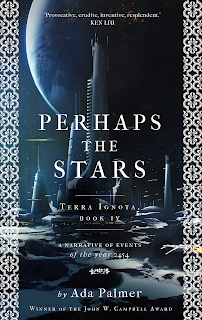
Microreview [book]: Perhaps the Stars by Ada Palmer

Far future Earth can have a little divine intervention, as a treat


It is a vast duty placed before me, dear reader, to convey the substance of Science Fiction and Fantasy Novels, these vessels of prose encompassing both the fantastic and the mundane, in a way which captures and reflects the essence with which their tenacious authors, with Muses' blessing and Sisyphus' patience, infused their creations. How shall your humble reviewer, fallible and distractible, presume encapsulate texts which, in their own turn, must be but a finite representation of the vast possibilities of the human imagination? This task becomes particularly acute when faced with a text of such length and densitude as Ada Palmer's "Perhaps the Stars", one which demands attention to every small detail and fleeting name which crosses its pages, and which synthesises its cogitations upon the future of our species with elements of both classical history and divine musing, creating a novel whose complexity would make even demiurgic Homer squint upon their poet's throne and go "u wot, mate?"

Or, something like that. Perhaps the Stars is the culmination of Ada Palmer's Terra Ignota series, a four book "record" of events set 450 years in earth's future. The world of Terra Ignota is one where flying cars make it possible to get halfway across the world in a couple of hours; where geographic nations are mostly obsolete and humans have instead organised themselves into "hives" which regulate and shape their members in vastly different ways. Events in our near future and this Earth's comparatively-distant past have led to public displays of both gender and religion taboo: religious needs are dealt with quietly, through a system of counsellors and "reservations", and they/them pronouns are enforced in polite society. This being the fourth book in what is, at its core, a political epic, things have gone disastrously wrong by this point: so wrong, in fact, that humanity has been plunged into its first war in centuries. There's not much point in me going into the factors that led to that war, because if you haven't read the first three books, Perhaps the Stars might as well be written in a lost ancient script for all the sense you're likely to get out of it. What is important to know about this series is that that conflict, and all of its subsequent effects, involve two broad sets of forces. The first is the mish-mash of political, social and ethical questions created by this particular future, with all of its technologies and factions. Almost all of Palmer's characters struggle with the concept of "the greater good", particularly in the context of a war that their recent history has rendered practically unthinkable, and it's this dilemma, and the way that some characters' answers to it are beyond the pale for others (and vice versa) that really drives the events of Perhaps the Stars forward.

The second element is about what happens when humans interact with divinity. Terra Ignota has two on-page divine characters: Bridger, the child of the Saneer-Weeksboth bash' (think big extended chosen family unit), who is able to conduct miracles that bring inanimate objects to life and bend reality to their will, and Jehovah/J.E.D.D Mason, the adopted or actual child of basically all the current world leaders (long story, one of the weirdest aspects of the series) and who is by this point confirmed as a divine visitor being hosted by the Creator of our own universe. These two characters shift the story in particular, unexpected ways (Earth can have little a divine intervention, as a treat), and they also shape and are shaped by the series' primary chronicler: Mycroft Canner, a repentant mass murderer still inexplicably plugged in to global leadership and reverent upholder of the Greco-Roman Classics (and some early modern Europeans). Mycroft's constant invocations to Greek Gods, comparisons to Caesar, in-text dialogues with the ghost of Thomas Hobbes and other narrative quirks take the new Gods in Palmer's universe and weave mythology around them, putting them into the canon in a way that is deliberately archaic but... makes sense. Sort of. If you're up for this sort of thing. The divine influence on the story itself is equal parts maddening and intriguing, turning some problems from intractable to trivial with the snap of a finger (or the use of a magical resurrection potion that a kid drew on paper a few years ago), but also exposing cracks in the logic of human characters and their morality which ultimately helps drive things forward in unexpected, intriguing ways.

Keen eyed readers will note that one of those two factors is a science fiction staple: knotty, far-reaching political problems in future worlds? Sign me up! And one of them is, in 2021, extremely fucking niche. The Terra Ignota series is extremely upfront about that niche-ness - the acknowledgements and authors note of Too Like the Lightning explicitly state that this is a book seeking to join the Great Conversation, positioning itself in a canon with classical and early modern political philosophy - and on a technical level, that absolutely succeeds. There's some weird notes here and there, and the biases Mycroft himself brings into the text take some getting used to (side note: people who noped out of Too Like the Lightning because of its handling of the in-universe Gender Bullshit and are considering retrying it will find that while the series as a whole moves on, there's still a moment where Mycroft's co-chronicler documenting the genitalia (known and presumed) of everyone in high political office in order to prove that people with vaginas can pilot warships too! A moment of pure 25th century #girlboss energy that just... wasn't needed.) but Terra Ignota knows what it's trying to do, and by Zeus it does it. Perhaps the Stars is very long - the UK edition is nearly 600 pages to previous book The Will To Battle's 350, and the text is smaller - but its ups and downs, and the way the chronicle varies depending on who is narrating and what circumstances they find themselves in (for example, there's a deliberately unfinished chapter halfway through which lends a lot of power to the one that follows it), feels really well thought through. The first moves of this future war include individuals cutting off the instantaneous communication and transportation that characters take for granted, deliberately hampering the technologies with which the war is fought, and the story really sells that mildly contrived set of circumstances. An anachronistic narrative meshes with an anachronistic war, and it all just kind of works. Even the writing style, which gets very florid especially in chapter openings, is actually 99% interesting and readable once you're into it.

The question, then, is whether this very technically accomplished and very strange book is going to work for you, dear Reader. To answer that, I need to answer the question "was this technically accomplished and very strange book good for me?" and I have absolutely no idea. Reading this book was a lot of work, an effort that put significant amounts of other reading on hold as I struggled to focus through what it was trying to tell me. The political payoff, and the philosophical questions behind them, were well worth that investment: questions around the value of human life, and sacrifice, and at what cost a "short war" would come, and the trade-off between happiness and ambition, all were presented in a way that I think I'm going to be thinking about for a long time. Did I need that packaged in a classical-early-modern-mishmash with literal Gods and random greek hero reincarnations running around? Probably not, and what really holds me back from loving Perhaps The Stars is the fact that those Gods and classical allegories seem to pull the focus away from developing characters and just letting them breathe. Many characters from earlier in the series, especially the Saneer Weeksbooth bash' members, have vanishingly little screentime in what is, I remind you, a really very long book, and while I understand that part of this was their becoming less relevant to a war that focused on other actors, there's an awful lot of time spent building up the stakes for other characters based on their mythological roles more than any hard-won connection. Divine intervention, and Mycroft's own status as a creature favoured by Gods, also leads to tragedy which I can't forgive Palmer for, taking away a particular character at a moment when I felt they deserved self-actualisation. Mycroft is an interesting character, but I can't think of a more infuriating choice for "the one who gets divine plot armour at everyone else's expense" - and somehow the presence of actual gods here makes that feel even more unfair.

So, as the curtain closes on the War of 2454, I find myself facing another battle: do I recommend this book, and this series? Ultimately, I have to leave the choice to you, dear Reader: do you embark on a journey that takes far future political speculation and mashes it up with European history and philosophy in an unusual, intriguing and very particular way? Does the payoff of a philosophically dense science fiction series sound fun? Because if it does, and you have some time on your hands, and you accept that sometimes the character lists will be convoluted, and the main narrator will be kind of a dick, and untranslated Latin will occasionally appear on the page as if it belongs in a 21st century English novel, then this series is absolutely one to experience. If early modern and Enlightenment thinking intrigue you, and you want to see science fiction take that mode of thinking on, then oh boy do I have the book series for you. Perhaps the Stars is a culmination of a series that, more than most, needs a particular kind of reader: if this is you, you're going to like how this goes.

The Math

No, there is no math. I'm not scoring this one out of 10. It's... look... you just have to experience it, and then tell me what you think. (Then subtract 1 from the score for that ridiculous Lean In feminism page.)

 Adri, Nerds of a Feather co-editor, is a semi-aquatic migratory mammal most often found in the UK. She has many opinions about SFF books, and is also partial to gaming, baking, interacting with dogs, and Asian-style karaoke. Find her on Twitter at @adrijjy

Reference: Palmer, Ada. Perhaps the Stars [Tor/Head of Zeus, 2021]

Wednesday, June 28, 2017

Reading the Hugos: Novel

Welcome back to our ongoing series of Reading the Hugos: 2017 Edition! Today we take a look at the six finalists for Best Novel. This time around, two of the finalists were also on my nominating ballot. All the Birds in the Sky and The Obelisk Gate were standout novels of 2016. They were also the only two finalists I had read prior to the announcement of the final ballot, so this was a category of discovery for me - which is unlike last year when I had four of the five finalists on my nominating ballot. Let's get to work, shall we?


All the Birds in the Sky, by Charlie Jane Anders (Tor Books)
A Closed and Common Orbit, by Becky Chambers (Hodder & Stoughton)
Death’s End, by Cixin Liu (Tor Books)
Ninefox Gambit, by Yoon Ha Lee (Solaris Books)
The Obelisk Gate, by N. K. Jemisin (Orbit Books)
Too Like the Lightning, by Ada Palmer (Tor Books)


Too Like the Lightning: I tried, folks.  I tried. Except for Death's End, this was the finalist I was more concerned about reading. Something about the futuristic utopia written with stylistic flourishes harkening back to the 1800's (despite being set in the 2400's) just didn't work for me. I know I gave up on the book too soon, but three chapters / 40 pages seemed to be enough to know that I didn't care enough to even to the central mystery / conceit / story of Too Like the Lightning. Reading other reviews suggest that there is richness to be found, if only I take the time to push through.

Perhaps I will try again in the future (after all, my reading of This-Census Taker changed on a second go-round), especially if this happens to win the Hugo Award. Though, given how other awards have shaken out so far this year, this seems somewhat unlikely. I do subscribe to the idea that sometimes we come to a book at the wrong time to appreciate or enjoy the work and coming to it again at a different time results in a different and stronger appreciation. Hopefully that'll happen here, otherwise this is just a miss for me.


No Award: This is where I normally put my standard disclaimer about the two ways that I use No Award on my ballot (see my coverage of Novelette for an example) and in using that, I acknowledge that I generally don't consider a work that isn't to my taste inherently to be below No Award. I think I also have a third way to use No Award. Though I consider the general quality of Palmer's fiction to be strong enough to be above No Award, if I elect to not finish a novel / story / work because of disinterest and it generally not working for me, I probably shouldn't consider the work worthy of a Hugo Award. Though, I do think there is a better than reasonable chance I would rank this higher on my ballot if I gave it a second go. But life is too short to read books that I don't care about.


Death's End: Out of the six finalists, Death's End was the novel I least looked forward to reading. While I appreciated the ideas in 2015's Hugo Award winning novel The Three-Body Problem, I found the execution wanting. I was interested enough to give The Dark Forest a shot, but I wasn't impressed. The Dark Forest was terrible and I was done with the series until this nomination.

Some of my criticisms of the series remain. So much of the story is presented in a heavy handed and blunt manner and most of the characters read as cardboard sketches of better written characters. Despite this, I enjoyed Death's End far more than I expected I would. I loved Cixin Liu's imagination and vision of the far future. The concepts of how humanity might be able to hide from galactic threats, how they respond and fail to respond, and what that looks like over hundreds and thousands of years - it's all fascinating.

One thing that Cixin Liu does very well here is continually jump forward in time so that we don't spend too long in any one era and get bogged down by the clunk. We keep pushing forward with the ideas and I was fairly well hooked. I still think that I enjoyed this novel more than it merits, but I was pleasantly surprised by how well Liu closed off the series.


A Closed and Common Orbit: I thought I knew what I was getting into because even knowing that A Closed and Common Orbit was a side story spun off from the delightful A Long Way to a Small, Angry Planet, I had made the assumption (after avoiding reading other reviews) that this novel would be more of the same. That's not a criticism because I wanted more of the same. I wanted more of the sort of Firefly-esque adventure of the Wayfarer. This is not that.

What A Closed and Common Orbit is is a tighter and much more condensed story focused on two contained storylines. First, that of Lovelace (the ship's AI from the first book) now down on a planet and having the opportunity to inhabit a body and pass as human, and all of the physical and emotional challenges that may incur. And yes, I did say emotional. Second, that of Jane 23, a small girl raised by AI in an uncompromising existence. A Closed and Common Orbit shows the development and improvement of Chambers as a writer and she nails the payoff.


All the Birds in the Sky: Only when it comes to reading for an award does initially encountering a novel in April pose a problem. It has now been more than twelve months since I read All the Birds in the Sky and I am comparing that memory against novels I reading for the first time just this month. Luckily, my love for All the Birds in the Sky stands strong.

To fully quote my nanoreview published back in April: "Publishing does not seem to have the thing the film industry does where the movies expected to contend for awards are most often released in the last quarter of the year, even just in a couple of select theaters so as to qualify for that year's Academy Awards. Seldom does a movie premiere in January and manage to be recognized by the Academy the following year. Even so, there is still a tendency to say in reference to a novel, "we'll still be talking about this at the end of the year when it comes to awards or best of lists" All the Birds in the Sky is that sort of novel, published in January and putting a stamp on the entire year that it must be considered as one of the year's best. It's about magic versus technology, about growing up, about alienation and finding someone or something to connect with, about optimism amidst growing despair. All the Birds in the Sky is wonderful."

Happily, my nanoreview was prescient. We are still talking about All the Birds in the Sky. It is currently a finalist for the Nebula, Hugo, and Locus Award for Best Fantasy Novel. Reading a novel "about optimism amidst growing despair" this year can be a cathartic and wonderful experience.


Ninefox Gambit: It was a near thing, whether or not I was going to finish Ninefox Gambit after the opening several chapters. It's not that the novel is necessarily a slow burn, but the idea of military science fiction built around mathematical equations was a tough sell and it took some time for me to settle in as a reader. Once I did, everything fell into place - even when I could not grasp how anything worked. The technology is based around math combined with a need for consensus. The movements of the soldiers are part of the equation, and if everyone isn't doing exactly what they are supposed to do for a particular formation, it all falls apart. There is an argument to be made about how that is also representative of actual military action, but Yoon takes the level of discipline required to a different level - to the point that even ritual actions performed during personal time will build to that mathematical consensus. It's math as magic, because a strong enough formulation can alter reality.

But here's the cool thing, because the math is so tightly controlled as a "calendar" by those in power, anyone opposed are guilty of heresy and are marked for extermination. But that heresy, that opposition to the calendar also results in what is called "calendrical rot" - the lack of consensus with the math of the ruling party causes technological and magical breakdown. Oh, and Ninefox Gambit is chock full of all sorts of violence and plotting and betrayal and includes a four hundred year dead general. It's a difficult novel to wrap one's head around and if not for all the praise from readers I respect and the multiple award nominations, I might not have given Ninefox Gambit the initial commitment I required to really engage and appreciate it. Once I did, damn. This was fantastic and a standout novel for sure.


The Obelisk Gate: When the novel I picked as my favorite / the best novel of 2016 is also a finalist for the Hugo Award it should come as no surprise that it is also my top pick for the Hugo Award. Jemisin brings the world breaking cataclysm of The Fifth Season to the forefront. We get hints (and sometimes flat out told) how bad things will get, but what choice does anyone have but to try to survive?

To quote my review: "The Obelisk Gate is not specifically a story about family, but then Jemisin is not telling a story of just one thing. She's weaving a rich and brilliant tapestry that pulls from family and destruction and loss and hope and love and disappointment and oppression and earth magic and everything else that can be mixed in with individual threads forming larger weaves and all coming together into something far greater and far more beautiful than a description of any individual thread could get across."

Also, "There is so much going on in The Obelisk Gate and Jemisin has so many balls in the air that a lesser writer would have begun to drop them by now. Not Jemisin. She is fully in control of The Obelisk Gate. Epic fantasy does not get better than this."

My ballot
1. The Obelisk Gate
2. Ninefox Gambit
3. All the Birds in the Sky
4. A Closed and Common Orbit
5. Death's End
6. No Award


Our previous coverage:
Novella 
Novelette
Short Story
Graphic Story
Fancast


POSTED BY: Joe Sherry - Co-editor of Nerds of a Feather, 2017 Hugo Award Finalist for Best Fanzine. Writer / Editor of the mostly defunct Adventures in Reading since 2004. Minnesotan. 

Thursday, April 28, 2016

New Books Spotlight

Welcome to another edition of the New Books Spotlight, where each month or so we curate a selection of 6 forthcoming books we find notable, interesting, and intriguing. It gives us the opportunity to shine a brief spotlight on some stuff we're itching to get our hands on.

What are you looking forward to? Anything you want to argue with us about? Is there something we should consider spotlighting in the future? Let us know in the comments!


Cover Design by Jaya Miceli

DeLillo, Don. Zero K [Scribner, 2016]

Publisher's Blurb

The wisest, richest, funniest, and most moving novel in years from Don DeLillo, one of the great American novelists of our time—an ode to language, at the heart of our humanity, a meditation on death, and an embrace of life.

Jeffrey Lockhart’s father, Ross, is a billionaire in his sixties, with a younger wife, Artis Martineau, whose health is failing. Ross is the primary investor in a remote and secret compound where death is exquisitely controlled and bodies are preserved until a future time when biomedical advances and new technologies can return them to a life of transcendent promise. Jeff joins Ross and Artis at the compound to say “an uncertain farewell” to her as she surrenders her body.

“We are born without choosing to be. Should we have to die in the same manner? Isn’t it a human glory to refuse to accept a certain fate?”

These are the questions that haunt the novel and its memorable characters, and it is Ross Lockhart, most particularly, who feels a deep need to enter another dimension and awake to a new world. For his son, this is indefensible. Jeff, the book’s narrator, is committed to living, to experiencing “the mingled astonishments of our time, here, on earth.”

Don DeLillo’s seductive, spectacularly observed and brilliant new novel weighs the darkness of the world—terrorism, floods, fires, famine, plague—against the beauty and humanity of everyday life; love, awe, “the intimate touch of earth and sun.”

Zero K is glorious. 
Why We Want It: New DeLillo. If, somehow, that isn't enough to explain why we're excited that there is a new novel from the author or White Noise, Underworld, End Zone, and Falling Man, I'm not sure what to do.


Cover Artist: Unknown


Hill, Joe. The Fireman [William Morrow, 2016]
Publisher's Blurb
From the award-winning, New York Times bestselling author of NOS4A2 and Heart-Shaped Box comes a chilling novel about a worldwide pandemic of spontaneous combustion that threatens to reduce civilization to ashes and a band of improbable heroes who battle to save it, led by one powerful and enigmatic man known as the Fireman.

The fireman is coming. Stay cool.

No one knows exactly when it began or where it originated. A terrifying new plague is spreading like wildfire across the country, striking cities one by one: Boston, Detroit, Seattle. The doctors call it Draco Incendia Trychophyton. To everyone else it’s Dragonscale, a highly contagious, deadly spore that marks its hosts with beautiful black and gold marks across their bodies—before causing them to burst into flames. Millions are infected; blazes erupt everywhere. There is no antidote. No one is safe.

Harper Grayson, a compassionate, dedicated nurse as pragmatic as Mary Poppins, treated hundreds of infected patients before her hospital burned to the ground. Now she’s discovered the telltale gold-flecked marks on her skin. When the outbreak first began, she and her husband, Jakob, had made a pact: they would take matters into their own hands if they became infected. To Jakob’s dismay, Harper wants to live—at least until the fetus she is carrying comes to term. At the hospital, she witnessed infected mothers give birth to healthy babies and believes hers will be fine too. . . if she can live long enough to deliver the child.

Convinced that his do-gooding wife has made him sick, Jakob becomes unhinged, and eventually abandons her as their placid New England community collapses in terror. The chaos gives rise to ruthless Cremation Squads—armed, self-appointed posses roaming the streets and woods to exterminate those who they believe carry the spore. But Harper isn’t as alone as she fears: a mysterious and compelling stranger she briefly met at the hospital, a man in a dirty yellow fire fighter’s jacket, carrying a hooked iron bar, straddles the abyss between insanity and death. Known as The Fireman, he strolls the ruins of New Hampshire, a madman afflicted with Dragonscale who has learned to control the fire within himself, using it as a shield to protect the hunted . . . and as a weapon to avenge the wronged.

In the desperate season to come, as the world burns out of control, Harper must learn the Fireman’s secrets before her life—and that of her unborn child—goes up in smoke. 
Why We Want It: Joe Hill is a master at telling a gripping story that refuses to let go (hence, the gripping) and as good as everything he has published so far has been, The Fireman sounds like it could be his best novel yet. Joe Hill is not to be missed.


Cover Design In House at Saga

Howard, Kat. Roses and Rot [Saga, 2016]
Publisher's Blurb
Imogen and her sister Marin escape their cruel mother to attend a prestigious artists’ retreat, but soon learn that living in a fairy tale requires sacrifices, whether it be art or love in this haunting debut novel from “a remarkable young writer” (Neil Gaiman).

What would you sacrifice for everything you ever dreamed of?

Imogen has grown up reading fairy tales about mothers who die and make way for cruel stepmothers. As a child, she used to lie in bed wishing that her life would become one of these tragic fairy tales because she couldn’t imagine how a stepmother could be worse than her mother now. As adults, Imogen and her sister Marin are accepted to an elite post-grad arts program—Imogen as a writer and Marin as a dancer. Soon enough, though, they realize that there’s more to the school than meets the eye. Imogen might be living in the fairy tale she’s dreamed about as a child, but it’s one that will pit her against Marin if she decides to escape her past to find her heart’s desire
Why We Want It: Howard has dazzled with her short fiction in recent years. Roses and Rot is her first novel and I want to know more about how this post-grad school works and how it impacts Imogen's dreams and the sacrifice of family.


Cover Design by Will Staehle

Older, Malka. Infomacracy [Tor.com Publishing, 2016]
Publisher's Blurb
It's been twenty years and two election cycles since Information, a powerful search engine monopoly, pioneered the switch from warring nation-states to global micro-democracy. The corporate coalition party Heritage has won the last two elections. With another election on the horizon, the Supermajority is in tight contention, and everything's on the line.

With power comes corruption. For Ken, this is his chance to do right by the idealistic Policy1st party and get a steady job in the big leagues. For Domaine, the election represents another staging ground in his ongoing struggle against the pax democratica. For Mishima, a dangerous Information operative, the whole situation is a puzzle: how do you keep the wheels running on the biggest political experiment of all time, when so many have so much to gain?

Infomocracy is Malka Older's debut novel.
Why We Want It: After reading Malka Older's story "Tear Tracks", we knew she was a writer to watch. Older's debut novel comes across as eerily prescient for a future where information is the true political power.


Cover Art by Victor Mosquera

Palmer, Ada. Too Like the Lightning [Tor, 2016]
Publisher's Blurb
Mycroft Canner is a convict. For his crimes he is required, as is the custom of the 25th century, to wander the world being as useful as he can to all he meets. Carlyle Foster is a sensayer--a spiritual counselor in a world that has outlawed the public practice of religion, but which also knows that the inner lives of humans cannot be wished away.

The world into which Mycroft and Carlyle have been born is as strange to our 21st-century eyes as ours would be to a native of the 1500s. It is a hard-won utopia built on technologically-generated abundance, and also on complex and mandatory systems of labeling all public writing and speech. What seem to us normal gender distinctions are now distinctly taboo in most social situations. And most of the world's population is affiliated with globe-girdling clans of the like-minded, whose endless economic and cultural competition is carefully managed by central planners of inestimable subtlety. To us it seems like a mad combination of heaven and hell. To them, it seems like normal life.

And in this world, Mycroft and Carlyle have stumbled on the wild card that may destabilize the system: the boy Bridger, who can effortlessly make his wishes come true. Who can, it would seem, bring inanimate objects to life...
Why We Want It: A far future novel of bringing down a utopian society? Sign us up!


Cover Art by Dominic Harmon

Reynolds, Alastair. Beyond the Aquila Rift: The Best of Alastair Reynolds [Subterranean Press, 2016]
Publisher's Blurb
The Guardian called Alastair Reynolds’ work “a turbulent, wildly entertaining ride” and The Times acclaimed him as “the mastersinger of space opera”. With a career stretching back more than 25 years and across fourteen novels, including the classic ‘Revelation Space’ series, the bestselling ‘Poseidon’s Children’ series, Century Rain, Pushing Ice, and most recently The Medusa Chronicles (with Stephen Baxter), Reynolds has established himself as one of the best and most beloved writers of hard science fiction and space opera working today.

A brilliant novelist, he has also been recognized as one of our best writers of short fiction. His short stories have been nominated for the Hugo, British Fantasy, British Science Fiction, Theodore Sturgeon Memorial, Locus, Italia, Seiun, and Sidewise Awards, and have won the Seiun and Sidewise Awards.

The very best of his more than sixty published short stories are gathered in Beyond the Aquila Rift: The Best of Alastair Reynolds, a sweeping 250,000 word career retrospective which features the very best stories from the ‘Revelation Space’ universe like “Galactic North”, “Great Wall of Mars”, “Weather”, “Diamond Dogs”, and “The Last Log of the Lachrymosa” alongside thrilling hard science fiction stories like Hugo Award nominee “Troika”, “Thousandth Night”, and “The Star Surgeon’s Apprentice”. Spanning more than fifteen years, the book also collects more recent stories like environmental SF tale “The Water Thief”, powerful and moving YA “The Old Man and the Martian Sea” and the brilliant “In Babelsberg”.

Beyond the Aquila Rift: The Best of Alastair Reynolds has something for every reader of science fiction, and easily meets the challenge of delivering stories that are the hardest of hard science fiction and great entertainment.
Why We Want It: Alastair Reynolds is one of the modern masters of science fiction and space opera, and Beyond the Aquila Rift is a massive collection of his excellent and sometimes underrated short fiction. This is a must read, especially if you only know Reynolds from his novel length fiction.


POSTED BY: Joe Sherry - Writer / Editor at Adventures in Reading since 2004, Nerds of a Feather contributor since 2015. Minnesotan.