Wednesday, April 6, 2016

Microreview [book]: A Borrowed Man by Gene Wolfe

Almost Human


E.A. Smithe is a reclone; he was an author but he died. The library system brought him back to life, as well as many other authors, poets, and artists, and they loan him out to people for any variety of reasons. Collette Coldbrook needs him to help her solve a mystery; her brother and father have recently died under strange circumstances, and her most relevant piece of evidence involves one of Smithe's books. 

A Borrowed Man deftly blends a futuristic setting with a noir style. Collette and Smithe are pursued from the start by unknown individuals who may have been involved in the Coldbrook family deaths, or may be trying to collect on her father's debts. Smithe isn't treated like a "full human" because he's a reclone, so the story has a lot of elements of "what makes a man?" blended in with the central mystery surrounding the Coldbrook family. Complicating the story, Smithe was recloned from a point before he wrote the novel Collette has in her possession, so he doesn't particularly know its significance either. When I started it, the story sank its hooks in deep. 

But halfway through, it loses the plot. The story is told from the perspective of Smithe looking back at the events of the past, so when a significant character goes away, we (the readers) lose a valuable point of view. Without them, Smithe is almost robotic in his behavior. His programming takes over and he starts doing things that take us away from the mystery. It eventually gets back on track, but there's a strong feeling of lost momentum. The conclusion is satisfactory, but it has a lot of knots and a fair amount of handwaving.

I spent a lot of the second half of the book scratching my head. I couldn't tell where we were going or why. The strong start convinced me to see it through to the end, but it shouldn't have nearly lost me in the first place. It's a net positive, but barely.

The Math

Baseline Assessment: 6/10

Bonuses: +1 intriguing story and core mystery

Penalties: -1 throws the whole story off the rails halfway through

Nerd Coefficient: 6/10 (still enjoyable, but the flaws are hard to ignore)

***

POSTED BY: brian, sci-fi/fantasy/video game dork and contributor since 2014

Reference: Wolfe, Gene A Borrowed Man [Tor, 2015]  

STRANGER THAN FICTION (ish): The Orphan Master's Son, by Adam Johnson

Johnson, Adam. The Orphan Master's Son. Random House: 2012.

Okay, technically this book is fiction, or at least fictionalized. But it’s got a haunting amount of truthiness, all the same. From the accounts of abductions of Japanese by North Korean agents to the exploration of how to survive in a totalitarian regime, it all feels plenty real. So perhaps I should dub it “As Strange As the Truth”, because even though individual characters were invented for this book, and the author writes plenty of speeches for Kim Jong Il despite having no way on earth to verify if the Dear Leader ever actually uttered something like that, those speeches sound all too plausible, and the characters heartrendingly vivid as they suffer.

It’s the best treatment, fictional(ized) or otherwise, of North Korea ever, in my opinion, and also, apparently, in the opinion of the people who were handing out the Pulitzer Prize in 2013. But does it really belong in this series, which is supposed to be devoted to factual, non-fiction writing whose content is so bizarre it reads like fiction? My answer is an emphatic yes, and here’s why.

I don’t know of a single factual account of everyday life in contemporary North Korea, and while any such book would doubtless be stranger, indeed, than fiction, the absence of credible information makes any such reportage nigh impossible. Instead, with so little hard data about what life is actually like day to day in North Korea, fiction is the only option left. But rather than taking the literary low road and focusing on only the upper echelon of decision-makers, Johnson took the opposite tack, filling his account with ordinary characters so realistic their suffering cannot fail but to batter the reader with punishing waves of empathy.

How has Johnson managed this miracle? Everyone knows “those North Koreans” are all brainwashed idiots, blind to the reality of their horrible state, and anyone with such a condescending attitude, when witnessing the plight of the North Koreans, can only experience the ugliest emotion of all: pity. What Johnson does is build empathy for the ordinary North Koreans from the bottom up, so that when we witness Park Jun Do (i.e., John Doe) caught in the merciless horns of an impossible dilemma, we wince, not in patronizing pity, but in genuine commiseration. Johnson has made the reality of totalitarian life visible, and while he certainly doesn’t condone such a system of government, he has managed to humanize its internal victims.

Tim O’Brien wrote once about the proverbial soldier falling on a grenade to save a battalion, and used this unlikely idea to meditate about stories and truth. If all we mean by ‘truth’ is ‘factual accuracy’, then we are forced to admit this sort of story is probably not true; it would be more accurate to say that in most cases, the soldier gets shredded but his sacrifice isn’t enough to save the people around him, and in a few cases the grenade doesn’t explode at all, and so forth. But what if we have a wider definition of ‘truth’—a definition that emphasizes emotional bonds more than factual accuracy? In that case, the soldier who successfully absorbed the explosion of a grenade and thereby saved his fellow soldiers’ lives might be even truer than the more accurate story of his sacrifice having been meaningless.

It is in this sense that The Orphan Master’s Son, I believe, belongs in the Stranger than Fiction camp after all. It’s possible that not a single incident covered by the book happened in quite the way it was described, that many, perhaps all of the details in the book are in some sense inaccurate, but do we really read non-fiction only for ‘facts’? Not at all—we read to quench a thirst for something more than that. There is no meaningful difference, to my mind, between fact and fiction, provided of course that a sort of “O’Brien truth” lies at the heart of the fictional endeavor to tell its readers something true.


That’s what Johnson is doing: showing us one way of understanding the plight of the North Koreans, and empathizing with them. And yet, he’s hardly an apologist for the regime; the book won’t make any readers think any better of North Korea as a place/idea/system of government. If anything, their revulsion for the existence of this horrible place/idea/government is bound to increase a great deal…yet without causing readers to transfer that disgust to the people trapped within the thing called North Korea. In truth, it’s precisely because the reader begins to empathize with those people that the horrors of the regime become intolerable: Johnson has managed to create an emotional connection that supersedes the clinical, rather disinterested and almost knee-jerk judgment of North Korea as a ‘bad place’. Paradoxical, isn’t it? By spelling out in such detail why the place is so bad, Johnson arouses in all of us a strange melancholy, a fellow suffering that cannot end so long as the place remains. It turns out O’Brien was right: we readers rightly prefer, not the version of a story that is most accurate and meticulously, carefully constructed (which rarely moves us), but rather the one in which some glimpse of a deeper truth is possible. Emancipate yourself from the prison of facts, and break through to the truth!

Scientific analysis:
Strange factor: 9/10
Factual factor: 3/10
Awesomeness: 8/10


On behalf of Nerds of a Feather (and fellow-feathered nerds), Zhaoyun has been searching through fact and fiction for truthiness in all its forms, and reporting the results here, since 2013.

Tuesday, April 5, 2016

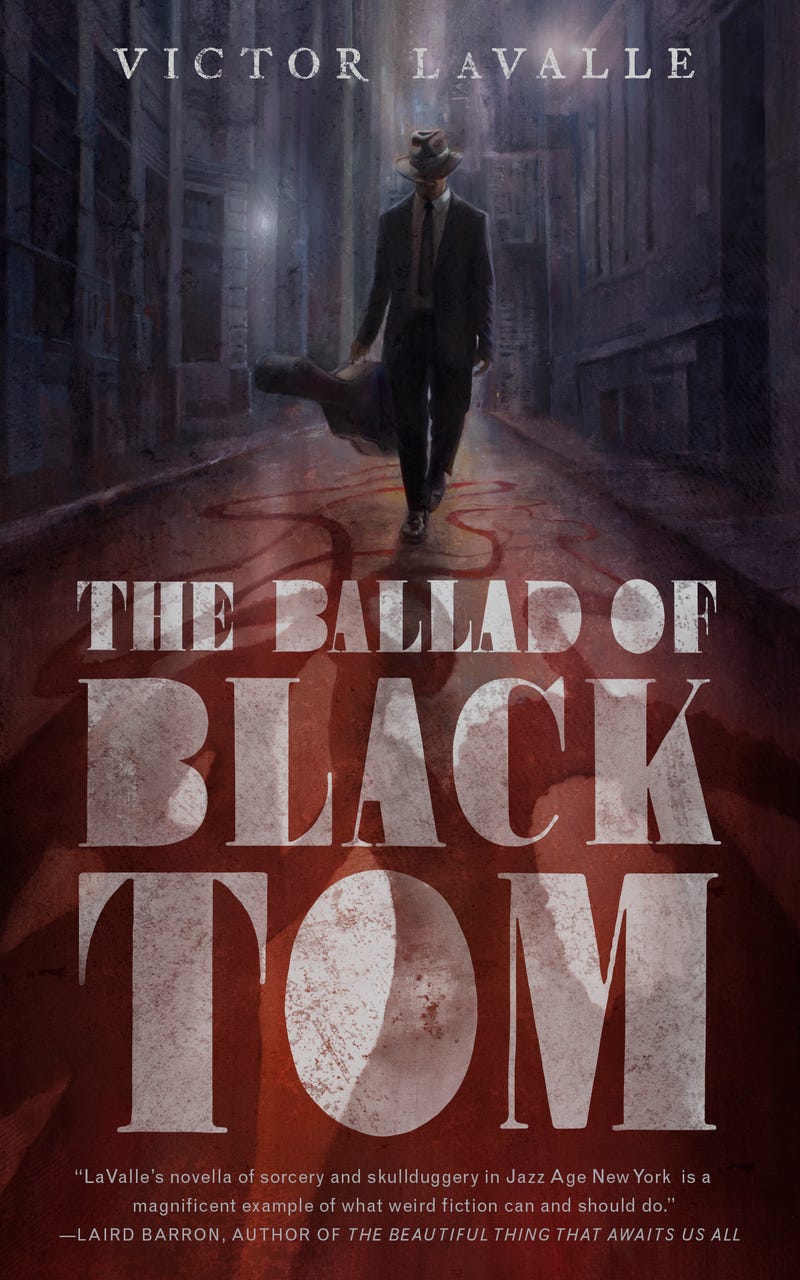
Microreview [book]: The Ballad of Black Tom by Victor LaValle

Magic proves dangerous, but not as dangerous as other people.


I should preface this review by stating that I may be coming to this review with some bias. Victor LaValle is one of my absolute favorite authors: his work is constantly exciting, exquisitely written, and expectation defying. I also have long been fascinated by the work of H.P. Lovecraft, finding him equal parts compelling in his creation of truly unfathomable cosmic horror, uncomfortable, and infuriating. Thus, when I heard about LaValle’s reimagining of Lovecraft’s world, in the novella The Ballad of Black Tom, I was hooked before the book even was published.


LaValle’s book centers on the character of Black Tom (I know, shocking, what with the title and all). The novella gives us Tom’s, really Charles Thomas Tester’s, backstory. He’s a good son and, arguably, a good person when the novella begins—even if his money-making means are a bit, well…Ominous.
           
The speculative elements of the story are woven in seamlessly, at first feeling like an organic part of the fabric of the world and then slowly opening up in a more and more horrific manner. Tom is a character who we not only feel deep sympathy for, but whose story (to try not to give anything way) hinges on the injustice and brutality of the system built around him. LaValle has taken a character of nightmares and made him into a deeply human and tragic figure.

LaValle’s writing is compelling, compulsively readable (I read the book in one sitting and then reread it, again in one sitting, a few days later), and beautifully constructed. One of the most brilliant qualities of the writing here is the evocation of place, so smoothly and beautifully done throughout the book: “Harlem. Only away for a night, but he’d missed the company. The bodies close to his on the street, boys running through traffic before the streetlights turned, on their way to school and daring each other to be bold.” The streets of Harlem, Flushing, and Red Hook come thoroughly alive in LaValle’s hands.

If the book has a flaw, it’s its brevity. This feels like a wonderful short story and less like a novella. Maybe, I’m just greedy, but I wanted to be in this world, to see its horror and beauty spun out in more and more pages. 

The Math

Baseline Assessment: 8/10

Bonuses: +1 for tackling the legacy of Lovecraft in such an amazing manner

Penalties: -1 for feeling short (yes, my greed wins out and I minus a point for this!)

Nerd Coefficient: 8/10 “well worth your time and attention.”


***

POSTED BY: Chloe, speculative fiction fan in all forms, monster theorist, and Nerds of a Feather blogger since 2016.

Monday, April 4, 2016

Best Cinematic Comic Adaptation Tournament: And the Winner Is...

No surprises, right?

Captain America: The Winter Soldier never really had a serious challenge from any of the films it faced. We can all speculate what might've happened if Tim Burton's Batman hadn't ridden a wave of (misplaced) BvS: Dawn of Justice excitement to a win over Akira, but I'm personally not going to quibble with this result.


And now we all wait for another month to see if Captain America: Civil War can top its predecessor, or will be a huge disappointment like Avengers: Age of Ultron.

The tournament rounds are here, here, here, here, here, and here if you want to see how the voting went down.

What do you think we should do for next year's March Madness tournament? Never too early to start planning...

Microreview [book]: A Canticle for Leibowitz by Walter M. Miller, Jr.

A disheartening look at humanity, and the perfect Cold War zeitgeist book


Published in 1960, A Canticle for Leibowitz is one of the books credited with forcing the mainstream press to begin taking speculative fiction seriously. Upon publication, even if it wasn't reviewed terribly positively, it was at least reviewed in some heavyweight publications that normally wouldn't touch sci-fi with a ten-meter cattle prod. In the five-plus decades since, it has continued to make appearances on prominent lists of the Greatest Sci-Fi Books ever.

To cut to the chase, reading it with fresh eyes today, it's not the pinnacle of the genre. It is, however, an engaging cornerstone of Cold War science fiction.

Over the last year, and for no particular reason apart from random chance, my reading list has included On the Beach by Nevil Shute and The Man Who Fell to Earth by Walter Tevis. I realized in reading A Canticle for Leibowitz, however, that these three books together give a profound, eerie, and usually moving picture of the Cold War-era zeitgeist. Tevis' book is about an alien that comes to Earth in an effort to save his own people, but falls victim to crushing alcoholism due in part to his realization that the planet cannot help but do itself in with its rapidly proliferating nuclear weapons. On the Beach is a haunting, unshakable portrait of the post-war world, where the few Australian survivors of the nuclear wars wait for the fallout clouds to come far enough South to poison and eventually kill them all.

Walter Miller's book begins several hundred years after the wars. Or, "The Flame Deluge," as the book's inhabitants refer to it. After the wars, there were few unaffected humans left, but those that remained rebelled against all knowledge, as too much knowledge had caused their destruction. The cities were all flattened, the books burned, literacy made verboten, and the outlands became dotted with tribes of murderous mutants. Seemingly the only thing that survived the transition from industrialized, nuclear-capable society to the new dark ages was the Catholic church. A Canticle for Leibowitz, like a medieval painting, presents a triptych of tales that cover some 1800 years of future history.

The first story concerns a young novice who stumbles across a fallout shelter that likely belonged to "the blessed Leibowitz." The cosmic joke here is that Leibowitz was probably a low-level electrical technician in Bell Labs or General Electric who probably worked on government contracts (and happened to be Jewish, to boot), but after 600 years he is on the doorstep of beatification. The second story takes place in essentially the second Middle Ages, when mankind has only just rediscovered science, and the monks of the Order of Leibowitz, who have been keeping the sacred documents (basic science texts and blueprints) for 1200 years, unwittingly hold the keys to scientific knowledge that predates The Flame Deluge. The final story, set some 1800 years after the nuclear decimation of the Earth, presents a futuristic setting that finds mankind capable of space travel, but on the verge of another nuclear conflict. History repeating, no less.

As grim as it may be to think that we'd annihilate the entire human race out of hubris and then do it again (...and again...and again...and again...), Miller's reminder is a prescient one. When the United States is currently locked into a presidential race that is echoing the worst rhetoric of the last 100 years of institutionalized mistakes, it is a chilling, and motivating, reminder about where we were as a nation just a half century ago. This is the best of what science fiction does. Through the lens of a fantastic world, it shines a light on our own. Walter Miller's book did that in 1960, and it continues to do it today.

Some of the prose, and some of the insights, are truly eloquent. That said, the book comes across as pretty solidly dated. There are, by my count, three women in the book. One of the things that the efforts of so many writers over the last few generations have shown us is that if we limit our storytelling to one group of people, or one gender, we're necessarily missing part of the story. So when I read the book today, I felt like there were a lot of good ideas that went into the world-building, and that the book presented a lot of philosophically and historically interesting notions, but I keenly felt aware that I was only getting part of the story. As much as I admired the noble intentions of the Brothers of Leibowitz, I found myself wondering often about the sisters outside of the abbey walls, and how they were navigating this post-apocalyptic future. And why did we return to a solid patriarchy? If we burned the books and plans and literacy that nearly wiped us out the first time, why did we not burn the patriarchy? The answer is probably because Walter Miller took it for granted. That's not intended as a knock on him, given the time he was writing and all that, but as a reader I was keenly aware of the fact that I was looking at "history" through the eyes of a bunch of white guys, and that there was a lot more going on in this world that I simply wasn't hearing about because those people's experiences were just out of frame.

On the whole, the book was keenly observed, and a solid, early example of thoughtful world-building, but not as emotionally resonant as the other two books I now consider the Cold War Zeitgeist Trilogy, and by virtue of the things it left out, it simply couldn't be, today, as pointed an examination of the human condition as it seemed evident it was intended to be.

The Math

Bonuses: +1 for managing the hand-off between three different tales in an emotionally continuous way; +1 for being such a precise barometer of the Cold War zeitgeist

Penalties: -1 for feeling dated in the very essence in the story it was telling

Nerd Coefficient: 7/10. It's still pretty good, but don't necessarily defer to every Best Sci-Fi poll you read online.

Posted by Vance K -- cult film reviewer, Cold War aficionado, occasional book reviewer, and co-editor of nerds of a feather, flock together, since 2012.

Reference:
Miller, Walter M. A Canticle for Leibowitz [EOS, 1996 (Reprint)].

Friday, April 1, 2016

NERD MUSIC Weekend Mixtape: Superhero Themed

Mikey's Superhero Themed Mixtape (4.1.16)

As the comics blogger for the site it seemed appropriate that I would share a Superhero themed mixtape with the crowd.  While not all of these are as overt as "I am Superman" by REM, I feel that they all invoke feelings of super powers.  Whether it is from finding revenge in the belly of a whale or pride in your nerd dungeon, these songs include some of my favorite lines of all-time.

"I break it up like it was horcruxes" - M.C. Chris

"I may look like Clark Kent, but I'm no Superman" - The Impossibles

"Always, will your mother will watch over you as you avenge this wicked deed" - The Decemberists

"She's got to be strong to fight them so she's taking lots of vitamins" - The Flaming Lips

"Who came up with Person Man? Degraded man, Person Man" - They Might Be Giants


Also, if you don't think Neville is a hero, get off my lawn!

POSTED BY MIKE N. aka Victor Domashev -- comic guy, proudly raising nerdy kids, and Nerds of a Feather contributor since 2012.   

Microreview [video game]: John Romero's Daikatana by Ion Storm

The Time-hopping Classic


Daikatana is mediocre at its very best. There is simply no better way to put it. The level design is uninspired. The sounds are mostly weak and inappropriate. The flow of the game is choppy. The texture work is busy and looks as though entirely too much detail was crammed into resolutions far too small.

For a good indicator of how the entire game plays out, look no further than the very first level. It stands out as an example of almost everything wrong with this game. It takes place in a futuristic swamp, not exactly the most exciting place ever. It is painted in primarily two colors; green and gray. The first enemies you fight are (and I'm not joking) robotic mosquitoes, robotic frogs, and robotic alligators. They all behave in the same manner; hop, fly, or crawl directly at you and attempt to make a melee attack. Your first weapon is the ion blaster; an ugly green and gray pistol that looks like it's a bundle of tubes and wires all taped together. Shots from the ion blaster ricochet off of walls and explode in water for no particular purpose. Since you spend some time in the water because you are in a swamp, it is quite a surprise to be burned by your own weapon when you attempt to fight something there. You are left to fight alligators and frogs in water with your fists. There is one path through the level from beginning to end and it is not particularly interesting or exciting. This tepid start is how the entire game plays out.

Off to a great start here. The whole first episode looks like this.
Early in the game you are cursed with two AI companions. Had these companions any semblance of intelligence, they may have been useful. As they stand, they are walking liabilities. They get stuck in terrain, they get stuck in doors, they fall way behind so that when you are trying to exit a level, you waste time waiting on them to catch up. They can wield weapons but since they are often far behind you, they either do not get to the firefight in time to contribute in any meaningful capacity, or they end up shooting you in the back. Babysitting them is a miserable experience.

Is that supposed to be a minotaur?
There is an experience point system in which you can level up your amount of damage per attack, speed of fire, speed of movement, jumping ability, and total health. Of these, the only one of any real use is increasing jumping ability. It is the only one that has any tangible benefits as it allows you to access some secret areas that you would not otherwise be able to reach. If you use the Daikatana, it takes your experience points to level itself up. Increasing the level of the Daikatana is not really useful. It attacks faster and does more damage, but it begins to glow and spark and these effects end up taking up more screen real estate than they're worth. The Daikatana is useless in any ranged fight and most of the enemies in the game are melee focused, so you can put yourself at a tactical advantage by using whatever your period specific pistol is and leaving the Daikatana alone.

As I described the ion blaster, so many of the other weapons in the game tend to bite you just as often as they do your enemies. The C4 launcher in the first episode is absolutely crippling to yourself more than Mishima's forces. It fires sticky proximity mines that explode in a large radius if anything comes near them, including yourself and other prox mines. Since enemies are often too dumb to follow you once you're out of sight, it is impossible to use this weapon to set any traps and it becomes a dangerously unhelpful grenade launcher. In the second episode, you get the hammer of Hades. It does healthy amounts of damage when charged, but places that damage right below your feet so you feel its power also. It'll even nuke your AI sidekicks if they get too close, which send you straight to the game over screen. The weapons in episode three are not particularly good or bad, and, in a surprising turn, the guns in episode four are actually fun to use. Episode four, however, contains one of the most personally dangerous weapons in the entire game; the metamaser. It is a thrown proximity turret that shoots out lasers at anything that comes near it, including you! However, its range is so great, and there are basically no encounters with anything more than one or two enemies at a time, and it explodes violently after a short period of time. It is far more dangerous than useful.

The writing is worse than most video games, which is saying a lot.
The level design can only be described as painful. As in the first level, there is typically only one path and it is rarely an interesting one. Platforming abounds and it is about as fun as pulling teeth. In episode two, there is an inordinately large area through which five runes are hidden. The player is rarely pointed in the direction of each rune and it becomes a long and boring game of hide and seek. While most levels took me only twenty minutes at most to complete, I spent over an hour on this area alone, and that does not include time lost due to deaths. At the end of episode four, there is a series of instant death platforming sections that serve only to drive the player insane. It is unfathomable to believe that someone at some point in time thought that these areas were a good idea, or even fun.

Story in this game comes only through long and boring cutscenes. Even though you carry two AI companions with you through most of the game, they rarely speak to each other or contribute anything to say about what is going on in the game. All meaningful dialog is contained within cutscenes that run too long. Thankfully they are skippable at any time.

If you skip all of the cutscenes, you miss gold like this.
There is no avoiding it; Daikatana was not a good game when it was released, and it does not get better with age. If you are feeling nostalgic, as I was, watch a playthrough on Youtube. Do not play it. This game is far more trouble than it is worth.

The Math

Baseline Assessment: 2/10

Bonuses: +1 there's a lot to play!

Penalties: -1 none of it is good

Nerd Coefficient: 2/10 (really really bad)

***

POSTED BY: brian, sci-fi/fantasy/video game dork and contributor since 2014

Reference: Ion Storm. John Romero's Daikatana [Eidos Interactive, 2000]