Wednesday, August 13, 2014

Out There for iOS

It's Lonely Out There


Buy Out There - Mi Clos Studio from iTunes
 
4X games (eXplore, eXtract, eXpand, eXterminate) have a long and illustrious history on the PC. The paradigmatic examples are probably Civilization and Master of Orion—turn-based empire-building games that ask you to juggle priorities while offering multiple paths to success. Do you emphasize technological advancement, military conquest or resource-procurement? Usually you combine two or more of these things, or concentrate on one for a while before moving to another.

Several developers have managed to port the 4X experience to mobile, touch-based platforms—primarily iOS, but also Android. The platform is quite suitable, operationally speaking, but tablets don’t seem like a great cognitive fit for long and involved games with lots of menus and things to keep track of; tablets seem better suited for the new wave of 4X-inspired games like FTL: Faster than Light (Buy), which emphasize elements or aspects of 4X gaming but tailored to produce a more targeted experience, as well as shorter games that can be played to conclusion between tasks, in waiting rooms or on the go. This is what tablet gaming is made for.

Out There is rooted in the 4X experience. Like FTL, it uses Master of Orion more as inspiration than template, a setting for its taut story of survival against all odds. Both games take place in procedurally-generated galaxies, ensuring that every game played is sufficiently different from the last. And Out There can be just as unforgiving as its predecessor, yet similarly manages to parlay intense difficulty into an addicting, rather than frustrating, experience.

But whereas FTL emphasizes combat and tactical personnel management, Out There is all about resource management. You are a lone spaceman whose ship has drifted far from Earth. You must find a way back, but the galaxy is an inhospitable place. You need fuel (hydrogen and helium) to move, air (oxygen) to breathe and materials (iron) to keep your ship from breaking apart. First and foremost, you’re going to need to find planets to mine for these elements.


Here’s the problem, though: jumping from solar system to solar system and from planet to planet in order to extracting these essential elements costs fuel, oxygen and iron. And the ship you’re given in the beginning is a fairly insubstantial thing, prone to taking big hits every time you approach a fuel-rich gas giant. So you mine rocky planets for iron, which costs fuel and oxygen. Oh, and did I mention that you never really know how much iron a gas-giant will cost you, or how much fuel you’ll find in return? Now you can see the kinds of tough decisions Out There forces you to make, often boiling down to a roll of the dice, as it might in a real survival scenario.

While you can try to make it back to Earth just managing these four elements and skipping everything else, you probably won’t make it that way. And it’s much more fun if you explore. Garden planets give you the chance to fill up on oxygen and encounter the galaxy’s various alien species. Most are friendly, and if you answer their questions appropriately, they may share technology or the omega element, which can be used for fuel, air or material, or to power a number of unique technologies, like wormhole generators (used to instantaneously travel from one black hole to the next) or life seed, which terraforms rocky planets. Along the way you learn to speak their language, which makes subsequent communication easier.


The galaxy’s more exotic elements, like gold, hafnium or cobalt, can be used to produce the useful new technologies you discover along the way, like the shield generator (which lowers the damage your ship takes), solar sail (which lowers the fuel used to travel between systems) or gravitational well generator (which expands the distance you can travel). You will also find derelict ships to take over, randomly placed supply stations to use and various galactic mysteries to engage or avoid, since only some will work to your favor. There are multiple endings, depending on the path you take, and multiple strategies to get you there. Most of the time something will go wrong. But you’ll just pick yourself up and start anew—it’s that kind of game.

Out There is also strikingly beautiful, marked by an appealing comic art visual style and warm ambient electronic soundtrack that amplifies the game’s palpable sense of wonder. It’s more stylized than FTL; ultimately, though, that’s only a small part of why I think it’s the more impressive game.

A bigger part is the lack of violence. That’s not to say I have a problem with violence in video games (a few extreme cases aside). But I’ve been thinking a lot about how much popular art relies on violence; this is especially true of video games, and even more so when specifically considering science fictional video games.

Yet for someone raised on science fiction literature, this imbalance is more than a bit odd—many of the most famous SF stories don’t involve war or combat or the spilling of intestines to be compelling. (Don’t believe me? Read Childhood’s End or Ubik or The Left Hand of Darkness.) Out There presents a taut, compelling and thoroughly addictive tactical strategy game experience that doesn’t rely on violence or the threat of violence in order to be any of those things. I find that incredibly appealing, and while I do still enjoy FTL, I’ll be spending most of my time in Out There’s virtual galaxy for the foreseeable future.


The Math

Baseline Assessment: 9/10

Bonuses: +1 for insanely addictive gameplay and appealing visual and auditory style; +1 for being that rare SF-themed game that doesn't rely on violence to be compelling.

Penalties: -1 for unlike the amplifiers in Spinal Tap, our scale doesn't go up to 11.

Nerd Coefficient: 10/10. "Mind-blowing/life-changing"

Read about our scoring system, and why 10s like this one are so damned rare. 

***

POSTED BY: The G--purveyor of nerdliness, genre fanatic and Nerds of a
Feather founder/administrator (2012).

Tuesday, August 12, 2014

Microreview [book]: I, Zombie, by Hugh Howey

Like Warm Bodies but without the Funny


Buy it here.
 
Howey, Hugh. I, Zombie. Broad Reach Publishing, 2012.

Don't like exceedingly visceral descriptions of death by zombie? Then perhaps you should give this book a miss. I decided to listen to the audio version rather than read this, thinking the vignette style would be perfect for my bit-at-a-time-while-making-dinner (etc.) listening practices, and I'm still not sure whether I was right and the audio format is best suited to the story/structure, or I did the book a disservice and would've liked it (even) more if I'd just read it like a normal person.

Howey presents us with quite a gory series of encounters between zombies and their (mostly) hapless victims, but with a twist that separates this tale from the vast majority of zombie stories out there: it's a zombie-eye perspective. That's right, we see the world filtered through their hunger for braaaains (and all the viscera, as it turns out). Yet that's not all—we are also treated to the horrified observations, via internal monologue, of the people these zombies used to be, aghast at what their bodies are doing.

If I had to choose one song that best characterizes the strange situation these people-yet-zombies are in, it's definitely Metallica's "One" (the know the 'one', right? haha!). That's because they're definitely locked in, *almost* entirely unable to influence their zombie bodies' behavior and certainly powerless to resist the hunger for other humans. This is a curious coincidence for me personally, as the next book I will review here at Nerds of a Feather is Scalzi's "Lock In", about a very different and rather more optimistic version of locked-in syndrome.

Strange as it may sound to say, this might be, despite the gore, Howey's most beautifully written book (so far). Some of the descriptions of what each zombie is doing (and what each former person thinks of these actions) are exquisite, not in the florid, yanking-on-the-heartstrings melodramatic way but with the staccato beauty of Hemingway. And parts of it, where Howey suggests the new reality these people experience being locked inside zombies might not quite be as final and irrevocable as they think, have deliciously chilling implications for human nature: if you were bitten, and then felt a very powerful urge to chomp on the hapless idiot standing next to you, of course the most appealing interpretation of the messy result would be that you had no choice, that you were powerless next to that mighty hunger...but what if, instead of being truly powerless, it was simply very difficult to resist the compulsion to snack on your neighbor—and you chose not to fight it? Howey may be hinting, here, that some of us might experience a rather smoother transition to zombiehood than we might want to believe.

Despite all that recommends it, I ultimately couldn't connect with this particular story (or format) quite as well as Howey's more straightforward sci fi adventure stories like Wool or Sand (both of which we've reviewed here). Perhaps that is because of my slavish desire for a mostly sympathetic or at least tough as nails protagonist with whom I can (in my dreams!) identify, a feature that is certainly missing from this vignette-style panorama of zombiedom. Or perhaps I should've read this rather than listened to it (the endless descriptions of evisceration by teeth did get to me, I'd wager, more by listening to another human being narrating them than they would if I could just scan the page and potentially skip over the gore). Whatever the reason, for this reviewer, at least, I, Zombie, while intriguing and certainly worth reading (listening to!), can't measure up to Howey's best work.

 The Math


Objective assessment: 6/10

Bonuses: +1 for reanimating the zombie genre with an interesting if horrifying speculation on what would happen to people whose bodies are zombified; +1 for the hauntingly beautiful descriptions

Penalties: -1 for the vignette approach (though, admittedly, I can't really think of a better method to tell this sort of story, as any one zombie would have a difficult time sustaining reader/listener interest as a traditional protagonist)

Nerd coefficient: 7/10 "An enjoyable (if gory!) experience, but not without its flaws"

[We use a bell-curve scoring system in which very high or low scores are exceedingly rare, meaning a 7/10, while not earth-shattering, is quite a good score: see here for details.]


Brought to you by Zhaoyun, zompire aficionado and NoaF jedi knight (or at least Paduan apprentice, though in the interests of full disclosure, I've never even been to Padua!) since 2013.

Thursday, August 7, 2014

Thursday Morning Superhero

Now that I have finally resumed life as normal after Comic Con, my mind is reeling with next week's adventure at Gen Con.  While not specifically linked to comics, I did meet Cullen Bunn last year and am looking forward to checking out some games from IDW.  Kill Shakespeare looks to be a promising game and the Chew game will be a must purchase.  Oh yeah, they are also working with a small property that some people like called the X-Files.  In the meantime here is what I read this week and what is worth your time and hard earned money.


Pick of the Week:
Nailbiter #4 -  I was introduced to Joshua Williamson's writing with Ghosted (which you should go buy) and was immediately a fan.  When I heard he had a new horror title with Image I knew that I should check it out.  Nailbiter has been amazing since issue #1, but this issue featured the jaw-dropping moment that solidifies this as one of my favorite series. Nicholas Finch and sheriff Crane literally start to get to the bottom of the mystery as to why 16 serial killers all had roots in this small town.  This issue had me on the edge of my seat as Finch and Crane attempted to dig up the grave of the Book Burner, the serial killer that spawned the Buckaroo Butchers.  It might be premature, but I have already to put together a wish list for what should be included on a nice deluxe hardcover trade of this title.  It really deserves the royal treatment once Williamson finishes the first arc.

The Rest:
The Sixth Gun: Days of the Dead #1 - When you have a book as special as The Sixth Gun, spin-offs provide great insights into the complex characters that Cullen Bunn has created.  I thoroughly enjoyed the Sons of the Gun spin-off that shined light on the holders of the six, and with Days of the Dead providing insight into the Sword of Abraham, the Pinkertons, and the Knights of Solomon.  The only problem I have with this title is that it is over and I'm not sure how long I will have to wait for more background on these mysterious groups.  As usual, Brian Hurt delivers a gorgeous book and Bunn lets readers explore the amazing world he has created with this title.  I am so happy that there is a plan for an ending for the main series, but so many great excuses to return to the world of the six.

Legendary Star Lord #2 - Peter Quill has a past that is likely to catch up to him.  Due to his past indiscretions, Quill is actually a pretty selfless and likable guy.  He may be a little cocky and may not use the most orthodox methods, but Star Lord seems to becoming a staple in the Marvel Universe rapidly.  This series is off to a solid start and I will continue to pick it up as I am intrigued by Quill's past and why he is seeking Thanos.  If you are a fan of the movie, then you will be a fan of this title.

Imperial #1 - Mark McDonald is a guy that most comic book readers can relate too.  He corrects his girlfriend on how comics and graphic novels are different, doesn't like his action figures called dolls, and isn't afraid to wear a baggy hoodie with a monkey on it.  Things change for McDonald when Imperial, the superhero of this tale, selects him to be his successor.  While not the most original concept, Imperial has genuine moments of humor and a cast of likable characters.   Definitely worth checking out.

Big Trouble in Little China #3 - I really want to like this title.  The overall story is good and would be a fitting sequel, but the gags and jokes just fall flat.  If you enjoy fart and pee jokes, then maybe this is the title for you.  I might continue to read this as a fan of the classic John Carpenter film, but can't imagine anyone not familiar with Jack Burton and the Pork-Chop Express would show any real interest in this title.  There is enough to keep me along for another issue, but that is mainly to see the rebirth of the three storms.


POSTED BY MIKE N. -- comic guy, proudly raising nerdy kids, and Nerds of a Feather contributor since 2012.

Wednesday, August 6, 2014

Microreview [book]: Sand, by Hugh Howey

Wool for Scuba Diving Enthusiasts!


Howey, Hugh. Sand.  Broad Reach Publishing, 2014.

Buy the e-book omnibus (when did that word stop meaning just 'bus', anyway?) edition here.

You know when you're diving, and as you sink slowly down, you feel the pressure start to build, and build, until even just 25 meters down or so, you feel a glimmer of understanding of the essential fragility of human life? Well (Hugh Howey asks), what if you could do the same thing in sand?

Meet the eponymous story. The decidedly post-apocalyptic (probably nuclear holocaust in the distant-ish past?) setting of Colorado is covered in mighty dunes, drowned in a dry ocean of sand. The pre-cataclysm world is still reachable, though, to those who have mastered the art of sand-diving, which sounds more or less like scuba diving plus some sophisticated technological telekinesis (divers 'tell' the sand to move with a thought via their special diving suits, and voila! Move it does). And (especially metal) artifacts buried under hundreds of meters of sand are beyond price (which is just a fancy way of saying they're worth a lot) in the crappy new world, which is why divers risk running out of air mid-dive and asphyxiating in the middle of a sand dune, or otherwise expiring during the tremendously dangerous course of a dive.

If this is all sounding awesome...it is, let me assure you. Howey has spun together a mesmerizing tale here, one that contains many of the elements that made the Wool series so riveting. Beyond the obvious similarities like the setting in post-apocalyptic America, there is also the sense that the main characters, as in Wool, tremble on the edge of mind-blowing discoveries about the nature of their world, and might have the tools to remake that world to be more just and equitable. (Man, it's getting hard to say anything else without dropping a tornado of spoilers all over you, dear reader!)

Naturally, there are plenty of important differences to Howey's other work. First of all, this particular story is all about a family, one that has experienced especially harsh swings of fortune from giddy heights to dismal lows, and thus one that (to paraphrase Rick!) is like every other family, only more so. Each of the siblings, as well as certain other family members, seems critically important to this still inchoate quest to right the world's wrongs (though methodologically they take less a Gandhi so much as a (for those of you who know UHF!) "Gandhi 2" approach!), and I'm quite certain we'll be hearing more about each of them in the (by this reader, at least) eagerly anticipated sequels.

As sci fi goes, Sand feels more far-fetched than Wool, in the sense that I can totally believe a) someone might someday build (assuming they haven't already!) some huge silos to save people in the event of a cataclysm, and b) that said cataclysm might someday happen, whereas with Sand, it's harder to speculate what the scientific explanation could be for why the old world's covered in hundreds of meters of sand, or the pseudo-mystical mechanism of the sand-diving suits. Does this greater difficulty in suspending disbelief negatively impact one's enjoyment of the story? Not really—after all, sand-diving is such a cool idea I'm prepared to let Howey run with the concept, however wacky, and that's partly because (in this ever-more-complicated metaphor) Howey is such a good runner! Stylistically, that is, Howey only appears to be getting even better, with great dialogue, and sporadically wonderful descriptions (sometimes of a strange and lyrical beauty, like Tolkien pared down to Hemingway-level pithiness).

So, the bottom line: is Sand worth reading? Absolutely, for anyone who has the slightest interest in post-apocalyptic fiction (and quite a wide range of others, I would imagine!). Is Sand better than Wool? Not quite, but perhaps that's just the first bite is sweetest problem: if you find a great bakery (or wherever) and sink your teeth into a fantastic cake (or whatever), better than practically anything you've ever tasted in all of cake-dom, even if the next cake from that same place is just as good or even better, how can it really compete with that first endorphin rush?

The Math:

Objective assessment: 8/10

Bonuses: +1 for scintillating storytelling and an intriguing (if improbable-sounding) premise

Penalties: -1 for the improbable-soundingness of it all

Nerd coefficient: 8/10 "Well worth your time and attention"


[I know what you're thinking: "Only an 8?" But as you can see here, an 8 at Nerds of a Feather is like a 10/10 most other places; we only go to 9 for a tiny handful of mind-blowing masterpieces, and to 10 practically never (our 10 corresponds perfectly, in fact, to Spinal Tap's 11!]

The opinions elucidated herein are solely those of Zhaoyun, sf/f nerd-junkie extraordinaire and Opinionator at Nerds of a Feather since 2013, and should not be taken to reflect the views of Nerds of a Feather's megacorporation owner (everybody's got some (corporate)body, am I right?) or its fat-cat investors, or indeed anyone else in the entire world except those rare few with the same taste as yours truly.

Tuesday, August 5, 2014

Microreview [comic]: Heir to the Empire by Zahn, Barron, Vatine and Blanchard

A comic adaptation of the "true" Episode VII


With the impending death of the Star Wars Expanded Universe, it felt appropriate to dip back in one last time and see if the prospect of absence can make the heart grow fonder. See, in my experience, most Star Wars novelizations and comic adaptations range from mediocre to objectively terrible. But back in the 1990s, a certain science fiction writer named Timothy Zahn actually penned three novels that were a lightsaber cut above. So I figured to give Heir to the Empire a re-read. Only this time I'd be reading the 1995 comic adaptation for the first time! I have i09's Rob Bricken to thank for the idea:

After the cartoons of the '80s and toyline died done, there was nothing Star Wars until Timothy Zahn's 1991 book Heir to the Empire, which rekindled interest in the movies and helped get us to where we are today. The story was about an imperial admiral named Thrawn who led the remnants of the Empire against the new Republic; it wasn't perfect, but it introduced a bunch of characters who became EU mainstays — and more importantly, it felt like the movies (sometimes, a little too much). For the best experience, read the trilogy on graphic novel — it's a Star Wars story that needs to be seen, not just read.

At the time I thought: "okay, Rob, I'll see it and read it!" But now that the seeing and the reading are done, how was it? The answer: cool and 90s and fun and very much not perfect, but still probably the best skeleton left in the Expanded Universe lichtyard.

Heir to the Empire tells the story of Luke, Leia, Han, Chewbacca and the rest some time after the events portrayed in Return of the Jedi. The New Republic is now the preeminent polity in that galaxy far, far away--though it's short on institutions and is apparently governed by an executive council consisting of Leia, Admiral Akbar, Mon Mothma and some smarmy dude whose name I can't remember. And the remnants of the Empire are still out there, licking their chops. 

Enter Grand Admiral Thrawn, a blue-skinned genius with a temperament more like Grand Moff Tarkin than Darth Vader or Emperor Palpatine. He'll use violence when it's functional and won't lose sleep about it, but he's neither a true believer in the Dark Side nor the kind of egomaniac prone to making rash or impetuous decisions. Like a good chess player, he knows the value of a good feint and is always planning several moves in advance. That's what makes him so dangerous--that and the fact that he's found these lizard-like creatures, called Ysalamiri, that are Force-deflective. So when he sets a trap for our heroes, things quickly go from bad to worse...

Heir to the Empire sits on its perch atop the pile of Expanded Universe fodder because it manages to capture everything you love about Star Wars (assuming that you, as a rational being, do at least secretly love it) while introducing new characters and situations that feel as if they fit right in. In fact, Heir to the Empire is everything The Phantom Menace should have been but wasn't: high on action, intrigue and characterization; and low on racist caricatures and kids who can't act for shit. And nearly all the new characters have depth and complexity: Thrawn and his trusty sidekick Captain Gilad Pellaeon, former Imperial assassin Mara Jade, who has it out for Luke; the roguish smuggler king Talon Karrde; and Jedi Master Joruus C'Baoth, whose motivations are always more than a little opaque.

Perfect, though, it is not, and the comic adaptation unfortunately amplifies some of its issues with pacing and combat (Imperials remain largely cannon-fodder, despite possessing better armor, training and weaponry). But in general this slice of 1990s Dark Horse goodness amps up the cinematic qualities of the original novel. In a good way. So if anticipation for Episode VII has you jonesing for some Star Wars, the comic adaptation of Heir to the Empire can give you the fix you need.

The Math

Baseline Assessment: 7/10

Bonuses: +1 for Expanded Universe content that doesn't actually suck; +1 for being oh-so-much-better than the execrable prequels. 

Penalties: -1 for the Expanded Universe is dead!; -1 for yeah but the prequels became movies and now this never will.

Nerd Coefficient: 7/10. "A mostly enjoyable experience."


***

POSTED BY: The G--purveyor of nerdliness, genre fanatic and Nerds of a
Feather founder/administrator (2012).


Monday, August 4, 2014

Comic Con from Afar: Third Annual Lamentation

I try to go to cons that are nearby me in Minneapolis. (Here's me with Lou Ferrigno and me in a TARDIS at the Wizard World con this year!) But I've never had the pleasure of attending the mommacon, the San Diego Comic Con. But I hang out on Tumblr a lot. So -

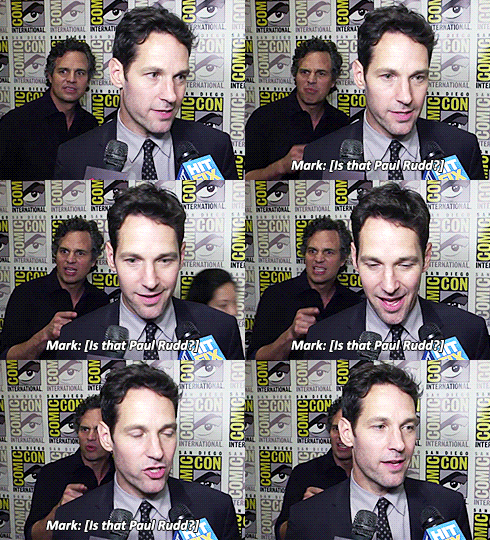
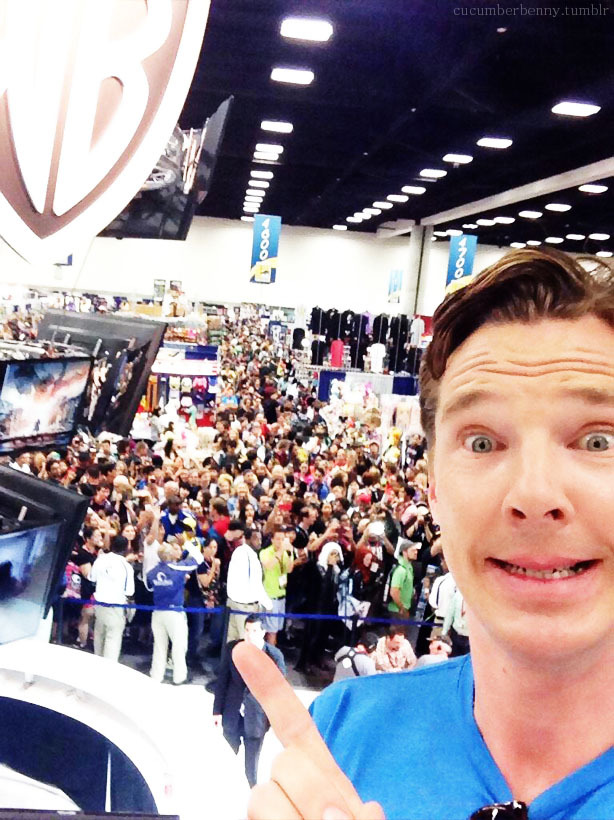
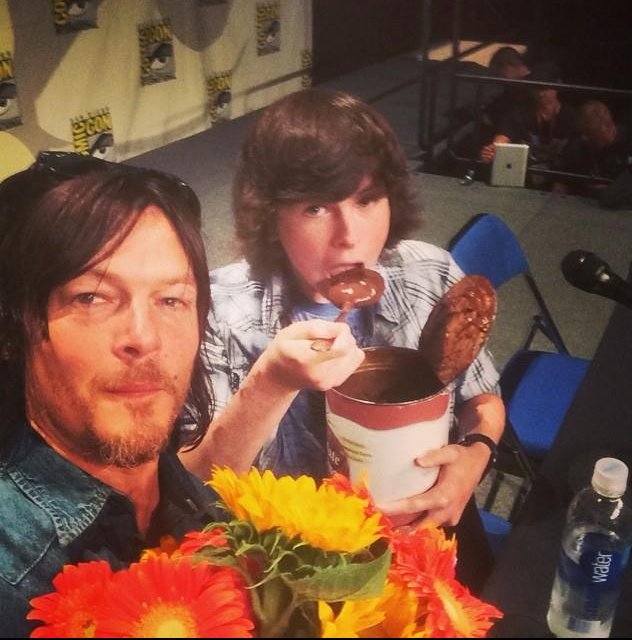
Welcome to the Third Annual Nerds-of-a-Feather Comic Con from Afar post, wherein one dorkly gal gathers up some cool stuff that makes her sit up and geek out from #SDCC14. This is a totally totally biased list of things I love.

ALL MARVEL, ALL THE TIME
I saw Guardians of the Galaxy last night, and it. was. freaking. fantastic. (though my sister-in-law disagreed: “Heroes in space? That’s just not believable”). So it was doubly awesome to hear that Guardians 2 is already a thing that's happening.

Some Avengers 2: Age of Ultron footage was shown, which I would give my left nut to see. Scarlet Witch and Quicksilver! They can’t call them mutants, since that would impinge on Fox’s licensing of the X-Men - even though both characters were in X-Men: Days of Future Past. You can catch a glimpse of them in this lovely retrospective from Marvel (but it's just the same brief moment from the end of Winter Soldier) :


Ant-Man too had a teaser shown, even though they haven’t even started filming.

The big panel ended with this delicious dish - Josh Brolin (Thanos) wearing the Infinity Gauntlet!!


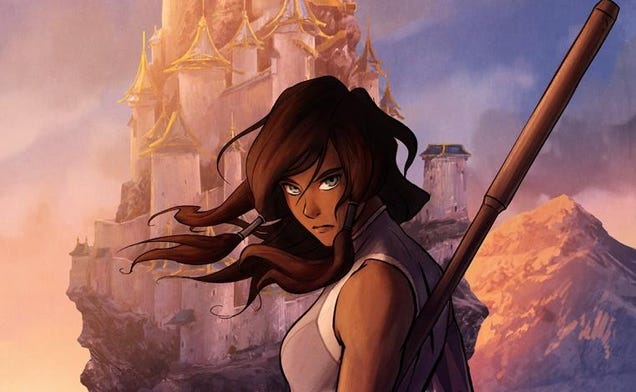
LEGEND OF KORRA


Nick announced that Korra was moving off-air into digital-only the day before the Korra SDCC panel. Thankfully, show creators Konietzko and DiMartino helped me turn down my worry. We’ll still get all of Book Four.

WARCRAFT
The World of Warcraft movie still has more than a year of post-production, but they showed a bit of footage. Director Duncan Jones, said "We really want to make this an origin story. We want to show how the world of Azeroth falls into conflict between orcs and humans.” Well, I’ve only got one thing to say to that… For the Horde!

OTHER WONDERFUL THINGS


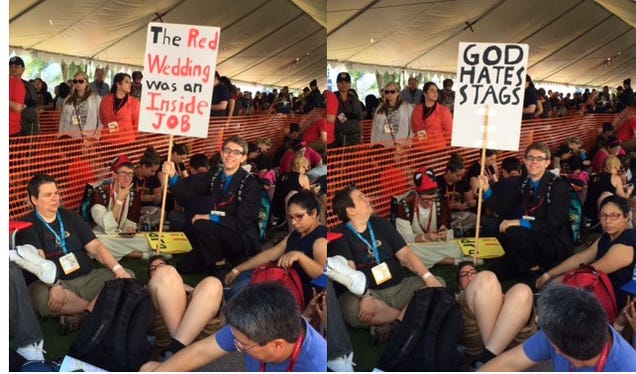
Of course there’s tons more stuff - Sam Raimi made more promises (this time an Evil Dead series!!), WarGames is getting remade, Firefly Online is still not here (but still using the Papyrus font), Jack Black is doing R.L. Stine’s Goosebumps movie, Mockingjay blah blah blah - but we gotta wrap up with the cosplay.

Friday, August 1, 2014

Image Expo 2014

Before the madness that is preview night and the chaos that is over 100,000 fans taking over San Diego, Image Comics held a press conference that solidified why it is a force that the big two should reckon with.  Eric Stephenson laid out very clearly why Image comics is thriving in a time when other publishers are seeing numbers fall.  He said, "[c]hange is absolutely integral to our future. Standing still didn't work for comics in the 1960s, and it's not going to work now."


Stephenson was not shy about poking fun at the big two publishers claiming that comics are creator-driven, as opposed to creator owned.  Through a brief documentary about the history of Image Comics, it is clear that comics that are truly creator-owned allow the creators to see their full vision come to life.  Editors don't have the final say, creators do.  Given this attitude, here are the three projects that I am most excited for.

Tokyo Ghosts - Rick Remender and Sean Murphy
Sean Murphy, in my opinion, is one of the best artists to grace the pages of this medium.  Seeing the brief glimpses at that art in this title is enough to get me excited, but Remender painted a picture that this title drew from titles such as Lobo and Judge Dredd.  It was a great way to open up the press conference and I look forward to this title dropping early next year.


Valhalla Mad - Joe Casey and Paul Mayberry
Inspired from a single panel from classic Jack Kirby Thor, Valhalla Mad is, according to Casey, "Gods coming to Earth, having fun, doing a little drinking." Casey poked fun and stated that Thor would not be turned into a women and lamented writing in the faux Shakespearean style that one associates with Thor.  This sounds like it is going to be one of the most enjoyable and entertaining series of 2015.


Intersect - Ray Fawkes
This title, that Fawkes is writing as painting, is said to be so out there that only Image Comics would publish it.  According to Image, "[b]odies shift and merge, warring with themselves. Blood rains from the skies. A child’s song is translated into toxic, thought-destroying whispers. Everything is changing. Everything is wrong. This is the world of Intersect."  Fawkes described it as if "Twin Peaks happened within the Black Lodge."  Sounds like an intriguing and trippy series.


What was clear through the announcement is that Image has built its business on one thing.  If you trust creative people and allow them to create, you will be successful.  Given the amazing titles, not limited to, but including Saga, Walking Dead, Revival, Outcast, Chew, East of West, and so forth, I think that it is doing something right and comics fans are the real winners.

POSTED BY MIKE N. -- comic guy, proudly raising nerdy kids, and Nerds of a Feather contributor since 2012.