Tuesday, January 25, 2022

Blaseball Mondays: Short Circuit Finale Time!

Hello! It's the final Blaseball short circuit! People who read this column and keep up with Blaseball will notice that there was a circuit back in December that I didn't cover: somehow, I missed the start of the season and then couldn't find my way back in between day job priorities and other day job stuff.

The nice thing about short circuits is that I don't feel I've missed too much by being out of action for what turned out to be a somewhat uneventful two-week season. There was winter weather! And a really drawn out game schedule! There were some Peanut shenanigans, but the Peanut was mostly well behaved and apart from remaking the Ohio Worms in its image, nobody had anything particularly horrible happen to them. And congratulations to [goes to look it up] The Canada Moist Talkers for taking home an icy victory! Someday soon the Blaseball community is going to wake from hibernation and immortalise the winners of its first two-week season as the fine team of well deserving players that they are. Were. They're gone now.

Credit to @clip_ny for the screenshot

But enough about what happened before. Let's talk about what's happening now. This circuit is another two week long season, but where the theme last time was ice and peanuts, this time we are enjoying a big ol' party! The divisions have been renamed (Uptempo has bop and jam subdivisions, Downtempo has dirge and ballad), the regular season matches have been interspersed with special prize games, where two teams get to duke it out for a fancy item while playing in glitter weather, which occasionally awards prizes of its own. Having a period every few hours where your own team probably isn't playing, but there's something to watch and bet on, is a nice way to break up the hours and make breaks from the splort a little bit easier, even when things are tense and exciting.

According to the very elaborate short circuit calendar, there's plenty more planned, including daily elections for "squid gifts": that's right, Blaseball's chilled out squid god of the underworld, the Monitor, seems to be taking on the role of hypebeing for this party themed adventure, handing out confetti cannons and more fun and/or dangerous stuff throughout the week. And to keep things interesting in the middle of the season, there's a "Fiesta" planned: where the bottom twelve teams will play against each other in a tournament to see who can remain in party time for longest. Party time, for those who are only just picking up Blaseball, was previously a rule that enabled teams that were mathematically eliminated at the end of a season to pick up random stat boosts for their players: in the Expansion Era having a terrible season meant getting to Party Time earlier and potentially turning your mediocrities into superstars for a comeback seasons later. While the eventual effect of this was to inflate player stats to unsustainable levels, its exciting to see Party Time come back as a mid season leveller, paving the way for some really interesting shenanigans next week...

...is what I WOULD say if the Georgias weren't actually kind of good this season. Our current team of randoms are OK at hitting! They are OK at pitching! And, on the "less obvious but actually really important" side, the lineup has some serious defensive skills between them, meaning fewer runs being scored against us and better chances of victory. For this reason, and because we are currently first in the Downtempo Dirge division and tied for wins, I am wishing all midseason fiesta teams a very mediocre party time, with all of my love from under the sea.

Finally, that two week schedule contains some of the most exciting words in Blaseball: redacted ones. While we have some idea how the next few days are going to go, next week's adventures include the random awarding of [blank] to the winner of the midseason tournament, followed by regular games to allow the holder of [blank] to defend it against other lower-placed teams, as well as a whole entire [blank] Tuesday event, some tantalising "however, [blank]" shenanigans in the Postseason, and... whatever is going to happen at the end of the season. Nothing bad has ever come from uncovering a redacted word in this game, and I sure am excited to learn what these ones are while we pursue victory. Shenanigans will be had, and they will probably be annoying: what else do we watch Blaseball for?


Fiesta! Go see the reasonable-sized original at https://thegameband.medium.com


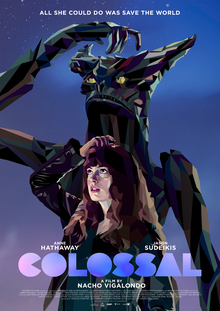
Microreview [Film]: Colossal

A singular, underappreciated gem. 

Whenever I tell people that one of my favorite films of the 2010s is Colossal, they usually don’t know what it is or laugh at me. Not so different from how I suppose the giant monster within the film would be reacted to in real life. Its hulking size might be imposing, but its low-budget, wacky CGI makes it so you can’t help but disdain or smile at its awkward hilarity. The film’s tonal shifts are jarring but in a way that I found engagingly – not unenjoyably - abrasive. The plot falls apart under scrutiny but soars if you join the film’s wavelength. Its themes don’t have a thread extending through the whole film—it’s more like threads end, more threads come in, and old threads reappear in a distorted form – but all those threads are emotionally impacting, despite their disparate length and attention. Colossal might not be an objective masterpiece, but it has so much warmth and charming conviction to be original that watching it feels like the giant monster within the film is giving you a friendly hug.

Gloria (Anne Hathaway) is an unemployed writer dealing with alcoholism. After her boyfriend (Dan Stevens) who owns their place breaks up with her, she returns to her hometown in Mainhead, New Hampshire. At Mainhead, she reunites with old friends, including Oscar (Jason Sudeikis). Things are going all right until she starts to believe with evidence that a giant monster occasionally appearing and causing destruction in Seoul is tied to her.

Every character here is a mess, but for the most part, those flaws underscore humanity rather than depravity. The villain is a very pointed exception. For a while, the antagonist appears to be Gloria herself. It’s a lighthearted first half where the stakes aren’t dire, and the tone is something of relaxing lunacy.  But as Gloria deals with her own baggage, she’s tossed something far worse. The reveal of that antagonist is where the rug is pulled from under the viewer and the dramatic elements become more prevalent than the comedic.

A tonal shift so extreme could’ve been bungled, but because the film’s dealing with very eccentric elements early on, the reception for Colossal going almost off the rails wasn’t the crash into awfulness for me that it would’ve been in films that started more conventionally. By introducing a gleeful cavalcade of eccentricities, the film opens the doors to big narrative swings that would’ve been a foul rather than a home run in other cases.

I love Colossal. I love its characters—both the half-baked and fully-formed. Its over-the-top climax. Its valiant ending that quickly turns pessimistic. I love that its twists and turns are so special that I would never think of spoiling it for anyone. I especially love its monster’s design. It might get laughs and jeers from the audience but it bounces off like the bullets that are ineffective against it. For all of Colossal’s ridicule, it’s a film unabashedly itself. It’s so confident that you might mistake its resolved stature for a giant.

The Math

Baseline Assessment: 7/10.

Bonuses: +1 For an unforgettable climax
                +1 For an underrated Jason Sudeikis performance.

Penalties: −1 For not fully utilizing a couple members of its talented supporting cast

Nerd Coefficient: 8/10

POSTED BY: Sean Dowie - Screenwriter, stand-up comedian, lover of all books that make him nod his head and say, "Neat!

Monday, January 24, 2022

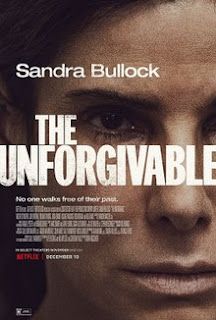
Microreview [film]: The Unforgivable

 Not "Unforgiven" like the Metallica song, or the Clint Eastwood classic. FYI.


This may be slightly different fare than we usually cover here, but I nerd out over thrillers, so I reserve the right to cover them. Plus, it's set in Seattle, where I live, so I feel a certain obligation to.

Smart-aleck comments aside, The Unforgivable comes in with a fairly unique premise: We follow Ruth (Sandra Bullock) as she is released from prison following a 20-year stint for killing a Sherriff when she refused to vacate her foreclosed-upon family home. Her sister, who had been in her care, is 5 at the time of the shooting, and has since been adopted into a Nice, Loving Home(tm). She has a comfortable life, is a piano prodigy, and has no memory of her big sister.

The two sons of the murdered Sherriff find out of her release, and begin plotting their revenge because she is "walking free with no consequences", and for the things that are actually pretty good about this movie, it's sentences like that which make it fall sort of flat to me. 

Because, as we follow Ruth - struggling to get a job, connect with people, and generally have a life after losing 20 years of it in prison - she definitely has consequences, so the whole revenge plot (which is central to The Twist, so I won't spoil it) seems hollow.

Which is then my second problem with this movie - it severely lacks for sympathetic characters. Ruth obviously garners our sympathy, if nothing else by being the protagonist and looking generally sad, but that goodwill is erased by her generally unhinged efforts to get in touch with her sister, and manipulation of people in order to do so. And when we flashback to the day of the murder, she is clearly in over her head taking care of her much younger sister in the wake of her parents deaths, but that doesn't make killing someone a sympathetic act. Maybe that's the "unforgivable" part, but I would have liked someone who is a major player in this movie to be more likeable.

All of which would probably land better if the time we spent with things that are trying to make us feel sorry for her addressed, say, the effect the American prison system has on people and leads people right back in, instead of a couple on-the-nose comments about it, after which we never hear about it again.

Lastly (I am realizing I didn't like this movie as much as I thought I did), characters just... disappear for really long stretches. The brothers are just... not there for a while, and then, oh hey, they're trying to kill her. It also seems like they forgot they cast Jon Bernthal, because he shows up, seems like he is going to be a major part of the story, and then disappears. I expected him to pop back up like a lot of other characters, but nope, he's gone.

Finding something nice to say, though: The casting was great (even if they forgot about Bernthal). Vincent D'onofrio and Viola Davis are excellent as always. I am always torn about Sandra Bollock (especially since this is like the third or fourth film where she plays this type of character), but she fit the role well.

My absolute favorite part is when they are driving into Seattle at the start of the film, and then it starts to rain, so you REALLY know it's Seattle, and then it never rains again for the entire movie. Also, there is no way you can get from Seattle to Snohomish on bus and get back in time for your shift.


The Math:

Baseline Assessment: 6/10. I didn't hate it, even though I ragged on it quite a bit.

Bonuses: +1 for an excellent, tight cast

Penalties: -1 for overall clunky pacing, -1 for the twist being way too predicable (you probably figured it out just from reading this)

Overall: 5/10. That feels about right.

Dean is the author of the 3024AD series of science fiction stories (which should be on YOUR summer reading list). You can read his other ramblings and musings on a variety of topics (mostly writing) on his blog. When not holed up in his office writing, he can be found watching or playing sports, or in his natural habitat of a bookstore. 

Thursday, January 20, 2022

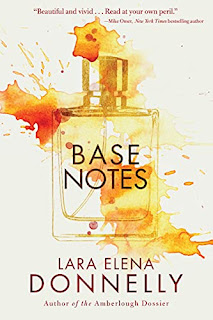
Microreview [book]: Base Notes, by Lara Elena Donnelly

Lara Elena Donnelly’s Base Notes takes the author's penchant for strongly realized characters and settings and turns them loose in an underground world of a parfumier who carries a very deadly secret as to the power and success of his product.


Vic is a parfumier like no other. He truly has a nose for scents, and a honed natural talent for crafting and making scents come to life. Some of his creations, however, those for a specific clientele, are extremely special, for they can evoke for a wearer, and a specific wearer at that, a full sensorial memory of a time and event. To make those scents however, requires raw materials of a sort that requires Vic to be something more than a parfumier: a murderer.  Now, as a powerful and rich former client asks Vic for an even more complicated creation, the garrote around Vic and his business, and his secrets, slowly tightens.


Vic’s story is told in Lara Elena Donnelly’s Base Notes.


Readers of Donnelly’s Amberlough novels have come to expect strong and vivid characterization, and deep and vivid language in evoking a sense of place for them to inhabit. Readers who are looking for spare, clean, “invisible” prose are readers who, I find, don’t take to Donnelly’s vividly imagined worlds. Her word choice, structure and style are immediately visible on the page. For readers who want that immersion into language and want to engage with it, I am happy to report that her talents from the Amberlough Dossier are on full display here.  Here, though, the author goes for a memoir, a memory, a recollection by our narrator, the author, Vic. 


In this way, Base Notes keeps that high sensory writing and marries it to a very personal first person perspective. Given Vic’s profession as a parfumier, it means that the book is full of olfactory, smell based sensory data first and foremost. In a world and genre where sight is a primary sense, hearing perhaps secondary and other senses often get short shrift by writers, a book where we are immersed in this main character’s mind and perceptions means that smell is as important as any other sense in how Vic perceives a scene, and the author’s skill translates to that page wonderfully. This is a book that immerses you in every scene that Vic inhabits, and scent is the first and primary sense that the author uses to do that. 


Vic himself is a fascinating character, for being a horrible human being. The author runs a really thin tightrope here. We spend every moment of the book in Vic’s head, so how do you make a preternaturally good parfumier, who is also a remorseless murderer, into a character that we can understand, even sympathize with, and then watch with horror as the inexorable results of his actions drive him past his own (already messed up) boundaries and beyond even the moral event horizons that were already sociopathic into worse territory?  It’s difficult. The sensory detail does help. Being immersed into Vic’s world and only gently being told of how he gets his special perfumes done helps. We also see Vic himself fumbling through a relationship of sorts, as events bring him into the circles of Giovanni, his barber, and Jane and Beau, a couple whom he forges a friendship with, and in the case of Jane, something more. We feel his pain and anguish as he himself tries to work out being, for lack of a better word, human with them. The story of his relationship with his former mentor, Jonathan (Vic is bisexual, it should be noted) is one that slowly emerges from its base notes as the story unfolds, and part of the mystery of the story is just how that relationship went so very wrong--and how it formed the Vic Fowler of today. 


The plot, then, you will not be surprised is strongly character-focused, setting up the main character in an ever tightening situation, and every step of Vic’s descent (not that he was a good man at all when the novel starts) is inexorable and inevitable. I guessed early on once all the main characters on stage how things were going to go, but it is the how and the why and the clockwork beats that kept me turning pages. This is not a novel of redemption of a terrible person, and while the author humanizes Vic at first, as things turn darker and darker, the window of sympathizing with Vic turns to horror and for me, a turning away from sympathizing with him. It’s a high wire tightrope act--make it clear that Vic is a terrible person, early on, really get into his head and make us understand him, understand his boundaries and his circumscribed world. And then when we see him transgress those, when events inexorably force him to cross the boundary of an ever shrinking circle of action, then for me, it then becomes a fascination to see how and why it will end. 


What this means is, that, like any SFF novel, but in harsh and strong relief, that this is not the novel for everyone, or for every moment. (If I personally was in one of my low periods, this novel would not have worked for me at all). This is a novel about a parfumier so singularly minded on his craft, so driven that he has not only have committed murder in the past, not only have the apparatus to deal with such murderers, but coerces others into such a life as well. 


Beyond the sensory and story of Vic, the novel does not lean heavily on theme, but theme definitely drives the narrative. This is a novel that looks at modern “late stage capitalism” and how it drives Vic, and how Vic uses the drive to manipulate and move others. The phrase “Eat the rich” does get invoked here.  Mind, Vic is a terrible person who does terrible things, and drives and manipulates and offers openings to other people to do terrible things. But, you can see the social forces goading and driving him, and other, to consider those acts. And more than consider the acts. Vic’s own rather terrible living situation encapsulates the problems of housing in America today, for example.


If such a protagonist as Vic and a story is something you might find favor with reading, Base Notes is a story that can enthrall you with its writing. Although the story is very different, there is a movie that I kept mentally flashing back to as I read this book, and that is Perfume: The Story of a Murderer. Some of the aspects are similar (strange ways of getting scents, preternatural senses, a science fictional element) but the story is very different in how it plays out that it can be thought of as a companion piece rather than aping it. Or, to use the tools of the book and movie themselves, there are elements in the “Scents” of both the movie and the book that have familiarity, but the resulting perfumes are different and do different things, but close enough that those who enjoy one will definitely enjoy the other. 


The Math

Baseline Assessment: 6/10

Bonuses : +1 for a very vivid and immersively written sensory experience of the first focused on smell that is rara avis. 

+1 for tight and inexorable plotting and a story that slowly constricts around the main character and drives him to an inexorability that keeps you turning pages.

Penalties: -1 This is a novel whose main character and his actions are *definitely* not for all readers. Caveat Lector!

Nerd Coefficient: 7/10 

 POSTED BY: Paul Weimer. Ubiquitous in Shadow, but I’m just this guy, you know? @princejvstin.

Reference: Donnelly, Lara Elena. Base Notes [Thomas and Mercer, 2022]

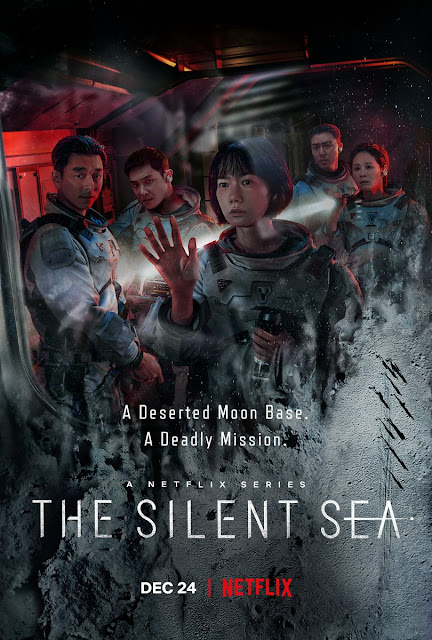
'The Silent Sea' is a cautionary parable about infinite greed

This space survival thriller about a mysteriously deserted lunar station hides an effective thought experiment about economics

Conservation of mass is the fundamental principle of chemistry. Evolution by natural selection is the fundamental principle of biology. That each thing is identical to itself is the fundamental principle of logic. If such basic facts are not taken into account, everything else stops making sense.

Likewise, in economics the fundamental principle is scarcity. It means that resources are not infinite. Even our access to sunlight is limited by our technological capabilities, the position of Earth, and the amount of fuel in the Sun. Every resource has a limit. No matter your political persuasion, your ethical guidelines, your partisan agenda or your pet cause, every single theory of economics has to deal with the solid fact that there just isn't enough to satisfy all desires. This is why all economic problems have to do with choice: resources are not infinite, so we have to choose. How we choose and who does the choosing is where economic schools differ, but the underlying principle remains; it's almost like it's written in the laws of nature.

So what would happen if there actually were an infinite resource?

Now that would be a violation of the laws of nature.

It would be an aberration. Something monstrous.

Countless works of utopian science fiction have imagined a post-scarcity society, where production is not constrained by availability of raw materials and our basic physical needs are permanently covered—in a sense, all post-scarcity theories are in themselves science fiction. We can imagine, as in Star Trek, a society that has moved beyond such preoccupations.

Or we can, as in the new Korean Netflix miniseries The Silent Sea, ask the hard questions about what such a state of affairs would actually entail.

The Silent Sea tells the story of a government-led mission to retrieve a suspiciously unexplained piece of laboratory equipment from an abandoned lunar station. The astronauts recruited for the trip come from a future Earth where water has become so precious that access to it has become the criterion of social stratification. The once blue planet now looks deserted from space, and the seas have become as dry as those on the Moon.

What our heroes find on the Moon, however, could change everything: there's an impossible new form of water that reproduces upon contact with living tissue. If brought to Earth, it would solve the climate crisis and the political volatility forever. It would effectively provide infinite amounts of water. What's not to love?

Well, there's only so much water the human body can take. Infinite water will kill you. If you bring that to Earth, you're going to kill everyone.

The gruesome image of sick bodies bending over and vomiting gallons upon gallons of water brings to mind the curses of dark fairy tales, which makes sense, because this is a fairy tale, of the sort that were spun in antiquity to teach universal moral principles, for example, that greed can hurt and you should be responsible with what you have. Think King Midas, and multiply it by everyone who has ever wanted something.

The inconceivable scale of the monstrosity is subtly explored at a more personal level early in the series. One of the astronauts, Dr. Song Ji-an, has received government compensation for her sister's death. She's now a gold-class citizen, meaning she has the legal right to infinite water. She's been taken out of the queue, out of the rules of allocation. By every school of economics, she's an aberration.

The series treats her undeserved new status with the appropriate disgust. People are on the brink of rioting over the unfairness of water distribution, and here she's being given the royal treatment. The incongruity of the situation is not lost on her: she has the thing everyone on the planet wants the most, but it doesn't satisfy her. It's futile as compensation for the loss of her sister. There's no compensating for human life. The value of human life does not lend itself to that kind of calculation. Now that's something truly infinite.

Economic inequality and the myriad wrong ways to deal with it appear to have become a staple of Korean drama. We've had, in quick succession, Parasite, Space Sweepers, Squid Game, and now The Silent Sea. It's doubtlessly an everyday concern for Koreans, who are now becoming painfully familiar with the American paradox of immense national wealth and heartbreaking individual poverty. What The Silent Sea has to say about that topic is that illusions of abundance are not the solution to the crisis of inequality, and even if we could have everything, it would solve nothing.

Who could even live with infinite water? Well, this dark fairy tale comes with its own angry spirit: Luna, the unnatural child, the only survivor of an assembly line of clones expended in the hope of controlling infinite water. Those clones are the embodiment of the sacrifice of entire generations for the dream of ever-increasing resources. Even if you found a way to reliably obtain ever-increasing wealth, producing it would require you to defile nature and defile humanity. Luna's tortured life is what results from following that imperative. So no, that's not the solution either.

Because the series ends with Luna nowhere to be found, humanity will not be transformed into her, and the self-replicating water from the Moon will not save Earth. This is fitting with the theme of the story: Luna is an impossible creature. We'd all need to become impossible creatures in order to both create infinite wealth and make any use of it. Having everything is equivalent to needing nothing: once we reached that hypothetical state, we might as well throw away our physical protections and walk, like Luna, in the vacuum of space. That's not going to happen.

So let's recap: you can't satisfy every single desire, and if you did, the human cost would be unacceptable, and if you paid it, you'd have to make everyone pay it, and if everyone did, we'd no longer have a world.

The lesson is the same as in the tales of old. Greed can hurt. You need to be responsible. We need to abandon the illusion that we're going to solve inequality by finding a magical source of endless riches. The only way is to distribute better.


The Math

Baseline Assessment: 8/10.

Bonuses: +1 for great visual effects.

Penalties: −1 because the dialogue overexplains the plot, −1 for some flat characterizations.

Nerd Coefficient: 7/10.

POSTED BY: Arturo Serrano, multiclass Trekkie/Whovian/Moonie/Miraculer, accumulating experience points for still more obsessions.

Wednesday, January 19, 2022

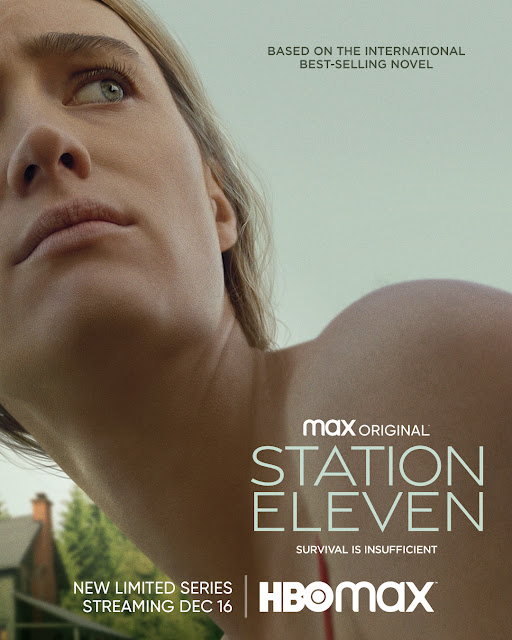
In 'Station Eleven,' you don't give up just because the world has ended

You'd think lethal virus stories are in bad taste these days, but Station Eleven is the triumphant cathartic release we didn't know we needed

Station Eleven, the miniseries adaptation of the 2014 novel by Emily St. John Mandel, follows the lives of a handful of survivors of a global pandemic that ended civilization. That sounds exactly like the last thing we'd want to see on TV during a real global pandemic that might, perhaps, really end civilization. But what this story has to offer is completely different from your standard post-apocalyptic drama. Except for news reports in the background of a scene, we don't see the masses out of control, fighting over scraps and forming unstable factions, or the desperate horror of watching passersby drop like flies. The incalculable toll of death is implied.

What this story is interested in showing is how life persists after so much death. Showrunner Patrick Somerville famously pitched the series as “a postapocalyptic show about joy.” We follow Kirsten, a young actress randomly paired with a stranger who shelters her during the first weeks of the pandemic, and whose sudden brush with tragedy makes her so hypervigilant that she casually carries a knife with her at all times. We follow Clark, a gentle but bitter middle-aged man who ends up leading a community of survivors permanently stranded at an airport, and whose unlikely ascent to power eventually changes him from conservator to conservative. We follow Tyler, a neglected child of self-absorbed parents, whose repeated experiences of rejection and mistreatment mold him into an emotionally stunted manchild with a vendetta against the past. What connects their journeys is how they were touched by the death of narcissist womanizer and movie star Arthur, as well as the graphic novel Station Eleven, self-published by Arthur's ex-wife Miranda. In particular, the twin trajectories of Kirsten and Tyler will be shaped by their drastically differing readings of the same text.

You don't need the backdrop of a lethal pandemic to tell a story about the power of stories. In fact, Mandel's original intention wasn't even to write a novel about the end of the world; she just liked the image of wandering actors bringing joy to village after village. You may as well remove the whole pandemic plot from Station Eleven and see it for what lies at its core: the double-edged power of performance. Both Kirsten and Tyler have been deeply moved by a story, and both will reenact it at key moments of their lives. However, Kirsten uses performance as a balm (at one point a spectator remarks that the troupe of actors brought "new life" to their town), while Tyler uses performance as a weapon. As for Clark, his fear of things decaying makes him keep them stuck in place, where he continues to tell stories about them but doesn't let the story around them move forward.

To explore this theme it doesn't really matter that the plot happens in a setting where almost everyone is dead, because those who are left alive still face the same old question of how to live. What should we do about the things that time takes from us? Make beauty from them, like Kirsten? Lock them inside a display case, like Clark? Or burn them, like Tyler? This is not a story about finding meaning after the apocalypse; it's a story about finding meaning, period. The trappings of world-ending catastrophe are only there to enhance the emotional content, to make the implicit explicit.

This is why it doesn't feel distracting when the plot of Station Eleven jumps between time periods. The path of things from A to B can find more useful routes than a straight line. It doesn't feel like a different world when we see the scenes before the mass death. It's all the same story. It's always the same story. That the world has ended does not change the fundamental questions of life.

However, the path of things from novel to TV series did meet with some bumps. The character of Tyler is made much more ambiguous in the adaptation, but without the benefit of added nuance. Whereas he was unmistakably a monster in the novel, here he is given a tentative chance of redemption. This defuses the tension that sustained the story before it's given a proper answer. Once Kirsten and Tyler realize that their lives have been shaped by their love for the same book, the main conflict of the series becomes about which relationship to art (and which relationship to the dear deceased Art) will prevail. Kirsten takes a page from Hamlet and orchestrates a session of psychodrama where Tyler's moment of growth is to achieve the basic human decency of not slitting Clark's throat. In a way, this fits with their characterizations: once again, Kirsten gets to use performance to heal things, Tyler uses it to break things, while Clark stands still and describes the way things were. That works; that's who they are. However, in proportion to the significance of the conflict, it's rather anticlimactic. We spent plenty of time following Miranda's determination to preserve her artistic integrity and create her masterpiece, the only part of her that survives the death of all things, and the way in which the rival interpretations of her work are left not-quite-resolved leaves a deflated feel.

The actual resolution comes later, when Kirsten reunites with her old friend and rescuer Jeevan, and he says he's happy that his family will get to meet her in person, because for years all they've known of her are his stories, and this time they'll see the real her.

In this beautifully shot, movingly acted, sharply written, captivatingly edited, epically scored version of Station Eleven, that is the final victory over oblivion: the moment when a story comes alive.


The Math

Baseline Assessment: 9/10.

Bonuses: +1 for Dan Romer's soundtrack, +1 for the power duo of Hiro Murai and Christian Sprenger, who together bring a flawless sense for shot composition.

Penalties: −3 for watering down Tyler's villainy.

Nerd Coefficient: 8/10.

POSTED BY: Arturo Serrano, multiclass Trekkie/Whovian/Moonie/Miraculer, accumulating experience points for still more obsessions.

Tuesday, January 18, 2022

Nanoreviews: Grievers, A Master of Djinn

Grievers by adrienne maree brown [AK Press, 2021]

Grievers is a short novel (or long novella?), kicking off a new fiction line from publisher AK Press - whose non fiction I always find super engaging (and I'm always here for a fellow adri!) And it's a tough, slow heartbreak of a book that demands a lot from its reader: the ability to watch a young woman go through tragedy and loss over and over again, the need to respect her decisions, and above all the ability to engage with the novel's perspective on Detroit, in all its complex facets. It is also a pandemic novel, and although the dynamics of its pandemic are pretty different to our present reality (it's unexplained and invariably fatal), the way in which the disease disproportionately hits marginalised communities - in the novel's case, specifically Black people - is very familiar.

The pandemic in Grievers is grief, or something that looks like it: an illness with no known contagion mechanisms, that only affects Black people in Detroit, which sends them without warning, in the middle of ordinary activity, into a catatonic, pain-stricken state. Dune, a queer mixed-race Black woman, has to live through her mother becoming patient zero of this new disease, and without health insurance she is forced to discharge her mother from the hospital early and try to take care of her at home - eventually burning her in a backyard cremation ceremony. From that initial loss, we follow Dune through an increasingly desperate existence as the illness takes over Detroit, and everyone with the means to do so leaves the city. Taking up the activism of her mother and grandparents, Dune begins to chronicle and map out some of the pandemic's effects, while caring for her very ill grandmother and facing the realities of survival. The trauma is relentless, but it doesn't feel voyeuristic or exaggerated; this is a bleak book, but it knows exactly what its doing. Similarly, Dune's decision to stay in Detroit despite the crushing loneliness and threat of illness feels natural to her character, even as we might not understand it as readers. There aren't any answers here - the closing scene is a barely flickering candle against the darkness of the book's premise - but this is a novel with a lot to say regardless, and definitely one to engage with for those looking for outstanding political speculative fiction. I'm going to be watching AK Press' fiction with great interest.


A Master of Djinn by P. Djeli Clark [Tor Books (US)/Orbit (UK), 2021]

I was expecting a delight going into this novel and Clark's first full-length foray into the "Dead Djinn" universe does not disappoint. Set in an alternate steampunk-y Cairo where djinn and other magic was unleashed in the human world a few decades ago (turning the tide of colonialism and catapulting Egypt into a powerful independent nation in the process), we follow Special Investigator Fatma of The Ministry of Alchemy, Enchantments and Supernatural Entities as she and her new partner - and some returning friends and Fatma's awesome, mysteriously powerful girlfriend Siti - try to unravel the mysterious murder of a group of British cultists, and the rise of an individual claiming to be Al-Jahiz, the sorcerer who unleashed magic in the first place.

Regular genre readers will know Fatma from the Tor.com story "A Dead Djinn in Cairo", and A Master of Djinn is very much a direct sequel to that story, to the point where several character beats and items will feel very two-dimensional to readers who haven't experienced that story (it's short and free, and I don't understand why Tor didn't include it in at least the US edition of the book!) Taken as a sequel rather than a series starter in its own right, A Master of Djinn blends its police procedural elements, its magical worldbuilding, and its character work in very satisfying ways, deepening the relationship between Fatma and Siti, giving Fatma a new foil in Hadia, her butt-kicking hijabi partner who gets to call her out on a whole lot of internalised sexist "I work alone" nonsense, and really exploring how the shadow of Western imperialism still looms over this version of Egypt even as the balance of power has shifted away from Europe. Figuring out the mystery a couple of chapters before Fatma was satisfying, but didn't dampen the fun of the climactic chapters. Excellent stuff. 

POSTED BY: Adri, Nerds of a Feather co-editor, is a semi-aquatic migratory mammal most often found in the UK. She has many opinions about SFF books, and is also partial to gaming, baking, interacting with dogs, and Asian-style karaoke. Find her on Twitter at @adrijjy