Showing posts with label dark. Show all posts

Wednesday, March 13, 2024

Review: Tanglewood by Knicky L. Abbott

A smoothly, deliciously prosey story that deftly captures the interior life of its characters, taking no prisoners with its confrontation of a bigotry that hurts its believer even as she harms those around her.


Barbados in the 1840s. A rich estate. A black man working as a groundskeeper. A cursed woman hiding in the nearby wilderness. The loathing she holds in her heart, for herself and for the world that put her in this situation. The lingering threads of the choices that left her cursed in the first place. This is Tanglewood's story. At its heart, though, this is a story of white resentment against their black neighbours, and the horrible alchemy of oppression that makes success a zero-sum game, turning their own hardship into fuel for a bigotry that cannot be reasoned with.

The story follows Aoife, born to a white Irish indentured family, cursed, living alone in the wilderness, trapped in her own misery and her own thoughts, forever looping back and back on her suffering. We are deeply embedded within her POV, within her way of thinking, and this, Abbott has managed to capture beautifully. It is a novella with a crystalline sharpness in its lens of human despair - the interiority of the characters, and Aoife particularly, comes across so emotively on every page. But what Abbott does best is in her abstraction of that. She is so good at turning incredibly vivid and visceral introspection into metaphorical language, giving a potent and immediately graspable insight into the mind of a character. She makes the intangible, illegible insides of someone else's mind comprehensible, while maintaining their individuality, their voice. For example:

It was as if the forest of my humanity had been slashed and burnt, so that the fields of my penitence could be cultivated.

and

Like the earth around my childhood home, the soil of me was poor, not good for growing much else but coarse grass and hard lessons.

Aoife's despair, her misery, is so well crafted on the page, the sentence-level, word-by-word care is evident in every sentence. But that is not her only angle, and nor is she the only character. Because this is also a story of a growing infatuation, and again, this is where Abbott's prose shines - again bringing that deftness of craft across in really giving us the emotional sense, the heady rush of a growing emotional connection to someone, that feeling of falling head over heels, that obsession as Aoife experiences it.

Because we also follow John Jack, the groundskeeper at Tanglewood Manor, a black man, born a slave but now living free and working for pay, who finds himself travelling to the gully where Aoife lives, returning again and again, becoming entranced, despite the strangeness of her curse and herself, despite not knowing what and who led her to be here, as she is. We see this place and its beauty through his eyes too, and while what they see is nearly the same, it is the way they see it, the way their minds process and feel, and our insight into it that colours the story, and slowly draws us in to the crux of the matter, casting back into the years to Aoife's cursing... while also being heavily grounded in the now, and their growing feelings for each other.

Despite the page time for it being incredibly short, Tanglewood has some incredibly well-written... I don't know what to call it. It's not smut. Is it romance? Not really. It's certainly not erotica. Let's just say... intimacy. Whatever it is, in the same way as she has written the rest of the story, Abbott fully embeds us into the emotional perspectives of her characters as they grow closer, and finally come to the... ahem... climax of their affections. And by narrating it through the lens of that emotion, again with that evocative, abstracting prose, just a few lines of sexual encounter are rendered breathless and gut-wrenchingly real, and somehow far more charged than any amount of physical mechanics would have been in the same page space. And it's precisely because she puts us in those characters' headspace, lets us feel their wanting, and words it in such a way that it clicks into a familiar alignment if we are someone who has ever wanted in that way. It's absolutely deliciously done.

But, despite the good, there is also the bad. And it wouldn't be a gothic story without a great deal of the bad, even if we weren't dealing with curses. The latter half of the book, once we've met and become grounded in these two characters is where we really start to dig into the truth of what happened to Aoife, and where the themes that have been seeded throughout the early part begin to bloom. And it is here that we really see the benefit of that embedding into character headspace and that emotional resonance - because Abbott is really digging into the racism of the white working class, how their own oppression becomes a nearly unstoppable fuel in the fire of anti-blackness. We have seen the life that the white Irish in this place live, through Aoife's memories. We know their lot is hard. We sympathise with them. There is no part of the story that does not acknowledge that hardship. But while doing so, it bluntly lays out how they in turn hate and harm the black people around them as if it is the natural result of their predicament, and how insidious, how unshiftable and how self-justifying that perspective is.

By the time we reach the critical moments, where all the themes are confronted and the resolution plays out, the writing is very much on the wall. It is not an unsubtle story, but it is a blunt one. That's a hard needle to thread, but Abbott does it incredibly well, delivering an ending that, once read, feels like the only natural outcome to the story, a terrible, gothic inevitability, even if you maybe thought earlier things might lead elsewhere. What needs to be confronted is confronted, with nuance and thoughtfulness, but without sparing the sharpness it needs. The reader must sit with it, and see things for what they are, in this 1840s world of wealth, privilege and oppression, of narrow worldviews and bitter consequences for those in positions unable to fight back, and the nastiness of where the lens of blame turns, when it cannot confront its true architect. 

This is a very slim novella - only 95 pages - but it packs a huge quantity in, without ever feeling like it skimps or rushes. It leads us emotions first through a complex tangle of love and betrayal and oppression and bigotry, and delivers the ending that story absolutely needed to hit home the conclusion the whole narrative has been building too. It is a sad, inevitable, truly gothic story, and it is incredibly well done.

--

The Math

Highlights: beautiful prose, amazing immersion in character perspectives and emotions, precision wielding of both bluntness and subtlety

Nerd Coefficient: 9/10

Reference: Abbott, Knicky L., Tanglewood, [Luna, 2024]

POSTED BY: Roseanna Pendlebury, the humble servant of a very loud cat. @chloroformtea.bsky.social

Monday, February 26, 2024

Review: The Butcher of the Forest by Premee Mohamed

 A creepy fairytale story with its eye on more than the just magic, mystery and missing children.


When the cover of a book has animals with their skulls out on it, I feel like the audience is probably well-primed for the kinda gross - or at the very least rather unsettling - events that are about to unfold. Because - spoilers - this is not a story about a happy fun man who has a meat-and-sundries shop in an enchanting woodland paradise. These woods are creepy. So do go into it with that in mind.

That being said, Mohamed has managed to do the thing I always appreciate when authors do - she's stayed on the near side of the horror line - it's going to leave you feeling a bit ill at ease, but it never fully breaks out into the full on scary, the "guess it's time for the nightmares", actually horror-horror. And, because I am a great coward to the very depths of my soul, this is perfect for me. I want some horrible skull-creatures, I want nastiness... but only up to a point. The Butcher of the Forest takes me a fair way towards the edge of that line, but never threatens to step across it.

What it does do is give us a very good fairytale feeling story of a journey into a wood that might also be another wood, in another place, or no place at all, inhabited by creatures that aren't totally within the human scope of understanding, at least in the traditional sense. Unless you're Veris, our protagonist. Veris went into the wood a long time ago to fetch back a child that had disappeared there, something no one else had managed to do, because Veris Knows things. Not big, grand magics, but just enough to give her the wisdom and sense to get in and get out with what she came for. Much good though it may have done her. Now, many years later, she's been asked - well, not exactly asked but we'll come back to that - to go and do it all again, to fetch back another two children lost to the dangers of the North Forest, a Forest no one in the village goes into, and in which any lost children are simply considered dead. The North Forest is not to be messed with.

But when the two children lost in there are the children of the Tyrant? The Tyrant who knows you successfully made that trip once before? Well, sometimes heroism isn't a choice you get to make for yourself. Sometimes someone has decided your heroics are their due, and there's not much you can really do about that.

Which brings us to the core of what's so good about The Butcher of the Forest as a story - it's a story that understands the place a person may be forced to occupy, in the sort of world that so many fantasy stories like to draw on. Because Veris lives in a village - a land - occupied by the Tyrant. His name isn't ironic. And through her musings on her own past, and the events of the story as we witness them, we see a much better appreciation of what that might mean than I have come to expect of pseudo-medieval fantasy. Not so much in the understanding that social hierarchies exist, which is often covered perfectly well, but in the understanding of the layerings of explicit and implicit in the power dynamics that fuel them, and critically, in the legacy of what it took to get the world to that place.

Veris remembers the war that brought the Tyrant to power here. Veris remembers the cost - especially to her personally. The cost to her family and her body. Mohamed is perfectly blunt in what that conquest will have meant, and keeps on meaning, in the family that is a woman in her forties, her aunt in her 70s and her grandfather pushing 100 forming a household together, with the obvious gaping wounds of missing family members. And so, when Veris is picked up with some lack of courtesy at an inhospitable hours and pushed to her knees before the tyrant, there is no question of dramatic resistance. This power is a power to be suffered through and survived, if you can. It asks too much but you have to obey nonetheless.

Seeing that just written plainly on the page, in every act and choice of the heroine was just... kinda powerful. And just as grim as any horrible skull creature the woods had to offer.

And it gets better, because the children Veris is being sent in to rescue are the Tyrant's own. This man who has done such harm to her people, who threatens her family so she'll do this thing for him that no one else has done. A lot of the story has an undercurrent to it of Veris' torn emotions - her hatred of this man, her knowledge of what he has done... against the as-yet innocent of his children. They may well grow up to be their own monsters, they may well already be being shaped into them, but as yet... as yet? They're innocent. They are not the owners of their father's crimes. But they are part of the system as it is. They are its inheritors. They are an intrinsic part of a system that is anything but innocent itself. There is nothing but complexity to their place in relation to Veris in this world.

So it is this constant musing on that tension that underlies the whole of Veris' story in this book. She finds herself caught between the poles of resentment and understanding, as well as the past and the present, as her trip into the dangerous lands inside the North Forest naturally summon memories of her last trip.

The narrative threads through these moments of the past delicately, with a measured pace, so it takes much of the story to fully understand the story that came before, and its full significance. The moment when every piece finally clicks into place does not feel like a revelation, merely a moment of satisfied understanding, because those foundations have been so carefully built as we went the whole way along.

But this tension, this satisfying weaving of opposing points, would not work nearly so well were not Veris such a good character to infest the point of view of. She's already a rare thing in being a heroine in her 40s - I do love to see a fully adult women still being allowed to be the focus of a story - but she's also just someone with a relatable pragmatism, as well as a realistic backstory, in that she truly feels like she has one. There are not many pages for this story to unfold across, but Mohamed dedicates enough page space within them to give Veris the very real sense of being a whole person, a person with a life that has happened before this, and for whom that past has real effects, writ both large and small, on how she interacts with the present. It feels relevant to her words, her actions, her choices throughout, and makes her feel so beautifully realised, especially alongside her pragmatism, her wisdom to know which are the battles she cannot fight and must resign herself to suffer through. There's a weariness to those decisions, the sense of a big sigh just being held back, that does a great deal of work in making me like her.

Is she a heroine though? It's a question I came away from finishing this wondering, and not to Veris' detriment. But it is simply that, unlike so many stories, she has ended up in this role through no agency of her own. It's a story that has happened to her, even as she is the one suffering it. Does that make her more the heroine than in stories where the protagonist's chose their battles? Or less? I don't know. But that lingering pondering... that too is a joy of the book.

Which leads me onto the ending... which I won't spoil. But I can say, without spoilers, that when you get there, you realise quite what the scope of this story is, and that, in one framing, it could merely be the prelude to another, different story. I kind of hope that story never gets written though. I enjoy that this exists as that prelude, and that there's a big wide gulf of potentiality hovering around the ending at what the "and then?" could be. It is forever left as an exercise of the reader to wonder and to dream it. Mohamed has left us a framework, and we can find our own answers within it, if we want to spend the time doing so (I certainly have).

All in all, The Butcher of the Forest is a wonderful novella that gives us a great (creepy - did I mention creepy?) story, but with a real meat of thoughtfulness under the skin, that sometimes peeps through the gaping wounds to give us a glimpse of what lies beneath. It's got the nastiness that fairytales often have, as well as a very offhand, pragmatic approach to magic that is unwilling to explain it because it simply does not need an explanation. When the horrible skull creature is coming after you, you don't have time to wonder exactly how it works, after all. The wondering is saved for the important things - how fucked up the world is under the bootheel of a tyrant, and the lingering horrors of one's own existence. Just how I like it.

--

The Math

Highlights: over 40s women allowed to have adventures (even if they don't personally want them), political musings, creepy horrible skull creatures

Nerd Coefficient: 8/10

Reference: Premee Mohamed, The Butcher of the Forest, [Tor 2024]

POSTED BY: Roseanna Pendlebury, the humble servant of a very loud cat. @chloroformtea.bsky.social
Tuesday, January 25, 2022

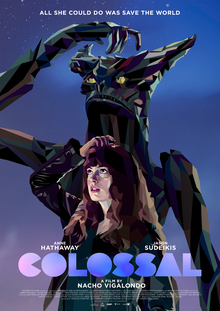
Microreview [Film]: Colossal

A singular, underappreciated gem. 

Whenever I tell people that one of my favorite films of the 2010s is Colossal, they usually don’t know what it is or laugh at me. Not so different from how I suppose the giant monster within the film would be reacted to in real life. Its hulking size might be imposing, but its low-budget, wacky CGI makes it so you can’t help but disdain or smile at its awkward hilarity. The film’s tonal shifts are jarring but in a way that I found engagingly – not unenjoyably - abrasive. The plot falls apart under scrutiny but soars if you join the film’s wavelength. Its themes don’t have a thread extending through the whole film—it’s more like threads end, more threads come in, and old threads reappear in a distorted form – but all those threads are emotionally impacting, despite their disparate length and attention. Colossal might not be an objective masterpiece, but it has so much warmth and charming conviction to be original that watching it feels like the giant monster within the film is giving you a friendly hug.

Gloria (Anne Hathaway) is an unemployed writer dealing with alcoholism. After her boyfriend (Dan Stevens) who owns their place breaks up with her, she returns to her hometown in Mainhead, New Hampshire. At Mainhead, she reunites with old friends, including Oscar (Jason Sudeikis). Things are going all right until she starts to believe with evidence that a giant monster occasionally appearing and causing destruction in Seoul is tied to her.

Every character here is a mess, but for the most part, those flaws underscore humanity rather than depravity. The villain is a very pointed exception. For a while, the antagonist appears to be Gloria herself. It’s a lighthearted first half where the stakes aren’t dire, and the tone is something of relaxing lunacy.  But as Gloria deals with her own baggage, she’s tossed something far worse. The reveal of that antagonist is where the rug is pulled from under the viewer and the dramatic elements become more prevalent than the comedic.

A tonal shift so extreme could’ve been bungled, but because the film’s dealing with very eccentric elements early on, the reception for Colossal going almost off the rails wasn’t the crash into awfulness for me that it would’ve been in films that started more conventionally. By introducing a gleeful cavalcade of eccentricities, the film opens the doors to big narrative swings that would’ve been a foul rather than a home run in other cases.

I love Colossal. I love its characters—both the half-baked and fully-formed. Its over-the-top climax. Its valiant ending that quickly turns pessimistic. I love that its twists and turns are so special that I would never think of spoiling it for anyone. I especially love its monster’s design. It might get laughs and jeers from the audience but it bounces off like the bullets that are ineffective against it. For all of Colossal’s ridicule, it’s a film unabashedly itself. It’s so confident that you might mistake its resolved stature for a giant.

The Math

Baseline Assessment: 7/10.

Bonuses: +1 For an unforgettable climax
                +1 For an underrated Jason Sudeikis performance.

Penalties: −1 For not fully utilizing a couple members of its talented supporting cast

Nerd Coefficient: 8/10

POSTED BY: Sean Dowie - Screenwriter, stand-up comedian, lover of all books that make him nod his head and say, "Neat!