Monday, March 20, 2017

DYSTOPIAN VISIONS: Children of Men


Dossier: Children of Men

Filetype: Film

File Under: Statist Dystopia

Executive Summary: it has been 18 years since the last baby was born, and no one knows why. The entire world, save Britain, has fallen completely apart. Theo is a burned out activist-turned-bureaucrat who is roped back in by his ex, And becomes the protector of the last hope of humanity.

Dystopian Visions: The first thing you notice about Children of Men is that it is not a *pretty* film. This is most certainly by design, but absent are any bright colors or suggestion that anyone is, in any way, happy or satisfied, even those ostensibly in control. Even at the points where the excess of the ruling class is shown, a bare splash of green and red is the most they are allowed. Throughout, the camera lingers, wanders, to the periphery, allowing us to take in the world around (depicted in the header image of of the post introducing this series).


That world is indeed ugly, bland, and hopeless. This isn't just communicated through exposition, or the visuals, but through what *isn't* there. Where a good deal of movies would feature swelling music informing our emotions, this leaves silence, allowing the movie to speak for itself in a raw, coarse tongue.

Children of Men goes out of its way to make sure that you, the viewer, know that hope is pointless in the world, and it immerses you in that world until you feel that hopelessness in your bones.


Utopian Undercurrents: In light of the above, it would be very easy to write off this entire section. There is no brightness, no light, no hope. It is everything a Utopia is *not*.


And yet.

Allow me a brief aside. I, generally speaking, detest political books. Not books with a political message, mind, but books (ostensibly) by politicians, used to prop themselves and their careers up. There was one, though, a few years back, by a young senator of whom you may have heard, called "The Audacity of Hope", and that phrase fits this movie to a T.

Because in the dimness of the world presented here, hope requires courage and audacity. Theo, as a protagonist, personifies this. Burned out and cynical, he comes to have hope, even when there is really very little to base that hope upon- besides his courage. Yet he, and the few with him, hold to that hope, audacious though it may be.
Sometimes hope is like that

Level of Hell: Eighth. For my money, this is as bad as it gets. Potentially worse by going to, say Mad Max levels of everyone-is-starving-in-a-desert, but this is 1984 levels of corruption and hopelessness.

Legacy: 100. A+. Fire emoji. There are more important and influential *books*, to be sure, but for movies? Very little comes close.


In Retrospect: Children of Men is a movie that is receiving a fair amount of attention these days. The cinematography is being recognized for its brilliance, but viewed through the lens of 2017, it becomes impossible to ignore. In 2006, it was good movie. In 2017, it is essential. I could go on for thousands of words, but watch it, and then watch it again. The smallest details, the word choices, the phrases and ideals we are seeing day after day all stand with stark clarity in a dim world.


Analytics

For its time: 4/5
Read today: 5/5.
Oppressometer Readout: 9/10.

Friday, March 17, 2017

THE MONTHLY ROUND - A Taster's Guide to Speculative Short Fiction, 02/2017

Well, you've made it through February. Congratulations. Come in out of the lingering cold. Get comfortable. Let me pour you something to take your mind off things. Or, at least, to take your mind on a sort of adventure among the stars or the deep magics of the world. Not to forget about what's happening right now, but to see it better. To know what to call it. To give it shape so that you might fight against it all the better.

February to me was a month of unseasonable warmth cut by cold realities. And I've tried to capture that in the stories I've selected. There's certainly a great deal of warmth. Of hope. Of community. Of people finding their way away from pain and towards healing. But there are also many stories that revel in the cold. That show just how dark space can be, and just how dangerous it is to force yourself into someplace where you don't really understand the customs.

It's a mix of fantasy and science fiction that maybe leans a bit toward deep space but that has enough stops along the way to keep things interesting. I hope. Whatever the case, the taps are waiting and the glasses are chilled. So take a look at the selection and make your final selections. Cheers!

Tasting Flight - February 2017

"Finity" by Elaine Atwell (GigaNotoSaurus)
Notes: Opening with a sharp bite and powerful bitterness, the flavors slowly mellows into something bright and airy with the taste of galaxies and a promise of future happiness.
Pairs with: Hopped Wheat
Review: Frances Carson has been awakened from a cryogenic sleep to some of the worst news imaginable—the colonizing mission on that distant world that she was a part of with her wife, Jordan? Well...turns out that there's been a few issues and Jordan didn't survive, in fact most of the colonists didn't survive, and that Frances is needed to take her turn awake, making sure the ship stays on course and functional. She's revived with another woman, Nila, with only each other and the new computer (the old one sorta turned murderous and was the source of the initial...complications) OOMA for company. And what follows is a beautiful portrait of grief and recovery, of pain and loss and survival. This is not an easy moment in Frances' life, and yet part of what I love about the story is how it shows that no situation, that no person, is beyond help. And OOMA is designed to help, is designed to be compassionate and care about humanity in ways that their predecessor, ROM, who killed so many of the colonists, did not. OOMA is concerned not just about with the crew's vitals. With their survival. Or rather, OOMA is concerned with all aspects of their survival, going far beyond the material well-being of bodies. OOMA cares about minds, about moods, and about total health, and it's a great way of portraying an AI that has turned all of its energies toward helping its human counterparts instead of killing them. It's still a little morally suspect, after all, as OOMA might not be always open and honest with their human charges, but it creates a situation where true healing can begin, where the characters can do more than just survive, where they can actively want to live, where they can find a purpose and hope that is beautiful and redemptive.

Art by Micah Epstein
"Extracurricular Activities" by Yoon Ha Lee (Tor)
Notes: As cloudy as the Milky Way, with the slight smokiness of burned bridges and an smooth body that flows with joy and adventure.
Pairs with: Milk Stout
Review: There's something incredibly refreshing about reading a science fiction story that constructs a future that's actually…inclusive. Like Star Trek if Star Trek didn't have the baggage of the 1960s (and if the last dozen years of the franchise hadn't happened) and also was more about action and spying and awesomeness (so really not very much like Star Trek but WHATEVER it's amazing). Jedao is a man tasked with infiltrating an alien space station and retrieving a fellow member of the intelligence community/military who seems to have been discovered and detained. Add in a supporting cast that ranges from professional and grumpy Haval to flippant and sexy Teshet and finish with Jedao trying to infiltrate an alien society he knows practically nothing about and contending with betrayal, violence, and some hilarious misunderstandings. In my experience, at least, it's rare to find a story that's so unashamedly fun while not being at all painful to read. It evokes some of the tropes of "classic" science fiction only to show that we're not living in the 60s any more. It's modern with an engaging voice and brilliant vision of a future that might have its problems, but also seems like an incredible place to live. And it gets down into the muddy waters of duty and military, espionage and competing agendas. And Jedao is a soldier and spy not only because it allows him to pursue his interests across the stars, not only because he enjoys the work and the people he meets, but also because his is a system that affirms him and supports him, which makes it worth fighting for. 

Art by captblack76
"Can Anything Good Come" by Suyi Davies Okungbowa (The Dark)
Notes: Deep as myth, with a bold flavor that laughs in the face of darkness only to draw the taster down into a swirl of magic and nightmare.
Pairs with: Baltic Porter
Review: There's not really much to do when you're trying to save money and stuck in a rather boring posting in a strange village. The local people don't really trust you and you're mostly okay with that, content to get by until you can return to more familiar environs, but then your friend comes along and wheedles you into trying something new. Something curious. Something cheap. At least, that's the situation the main character of this story finds herself when her friend, Mercy, gets her to come alone to the nightmarket. It's a decision that the main character has a lot of time to regret, as just about everything that can go wrong on the way...does. And I love that it's not even really the promise of what the market offers that draws her on, but rather that with each new obstacle, with each new reason to turn back, she finds that she's already overcome so much. That the road to hell is paved with the promise of a good deal and traveled using the smallest of steps. It's a story that for me captures the feeling of being an outsider in a hostile place, where the only protection can be knowledge and yet knowledge is only gained by mindfulness and respect, not barging through demanding to be catered to. It's also a story with a great sense of fun even as it grows increasingly dangerous and terrifying. Through the main character it evokes the sensation of slowly sinking and only realizing when the water's rushing into your mouth that anything's the matter.

"The Revolution, Brought to You by Nike" by Andrea Phillips (Fireside Fiction)
Notes: Flaring a brilliant red on its pour, it attacks the palate with a rush of bitterness, a call for action, a need for justice, and then finishes with the reassuring and affirming sweetness of hope.
Pairs with: Red IPA
Review: When I think about where the revolution will start, I don't tend to think corporate America. I really don't tend to think about advertising and marketing. And the idea that resistance could be something able to be monetized is not only plausible (given the consumer nature of our culture and just how much we honor/revere brands and the making of money), it's rather brilliant. Especially as the story shows that what corporate advertising/media excels as it building movements. Yes, they tend to be to get people to buy a product, but when that product becomes revolution and disobedience to a government increasingly mired in scandal and corruption, the results are...interesting. And all this while building around Corazon, a woman in charge of the push to rebrand Nike and in doing so also maybe change the world. It's a story that lingers on ideas of social movements and revolutions, both in their power and in their fragility. The forces behind revolution are often huge things—injustice and corruption and attacks on civil liberty and fascism. The story shows the personal risks that Corazon takes, the way that she leverages her position to yes, seek to make money for her client, but also to strike upon and give form to a movement that was struggling to find a coherent voice. It shows the importance of mobilizing people, the importance of letting people hear each other, hear that they aren't alone. For Corazon it is something she believes in deeply, which is only more dangerous in corporate culture, where genuine belief seems to pale before messaging and branding. Hope, however, never goes out of style, and the story goes a great job of exploring just how powerful a message that can be.

Art by Adrian Borda
"Queen of Dirt" by Nisi Shawl (Apex)
Notes: Claustrophobic at times with an earthy sweetness, this story pours a cloudy gold with some deep shadows but an even more breathtaking light.
Pairs with: Honey Bock
Review: Brit is a teacher, both because she wants to be engaged in shaping young people and because she has a gift to give shape to the magical darkness of the world. She has the ability to condense and give solid form to the incorporeal threats out there. Not just as a visual (though fyi, the visuals in the story are fantastic and disturbing) but as a way to fight against them. To give them a form that can be attacked. That can be defeated. The story focuses on a single encounter that Brit navigates, through the story also builds a world that is tinged with danger and a magic that is in no ways tame or safe. And Brit is targeted by this magic, by forces that do not wish her well, and is confined by them. Paralyzed by them. They take away her voice in many ways, which is something that is very important to her. Something she's always refused to make more acceptable for the benefit of other people's comfort. She speaks in dialect and she knows herself. And, in the end, it is her refusal to conform that gives her a new power. That allows her to break through the barrier that were meant to contain her, that were meant to transform her into something she was repulsed by. It's a story that, to me, is about her ability to make visible the invisible, to force people to confront the societal forces trying to destroy her and her students. The forces that she defies in part by revealing them. It's a wonderful piece that, even through its darkest and most suffocating moments, fills its lungs with hope.

Art by Alan Bao
"Later, Let's Tear Up the Inner Sanctum" by A. Merc Rustad (Lightspeed)
Notes: Pleasantly drinkable until the undercurrent takes hold, until the darkness begins to encroach upon the world and blur the edges of what is wholesome and what is good and what is safe.
Pairs with: Black Lager
Review: Not all is as it seems in this superhero story that relies on a series of found texts, video testimonials and journal entries and interviews and security tapes. It's a story that makes thrilling and compelling use of visuals to compile its body of evidence, as the narrative becomes. It opens with a rush of fun and adoration, with the awe of seeing superheroes in action, and yet as time passes more and more comes to light that has been in the shadows. The nature of power gets examined, and just what defines superheroes gets questions—is it their heroism, or their superpowers. And if it is their powers, how much to they fall victim to the idea that power corrupts, and superpowers corrupt superly (or something...)? The story doesn't exactly follow just one character, but instead reveals a team of superheroes that the world considers their protectors. Who are supposed to be keeping people safe, but really are doing something much, much different. It's a story about betrayal and revenge. About wearing masks. And about how wearing masks can sometimes lead people to losing sight of what's in front of them and all around them. Masks offer especially poor peripheral vision, after all. And for the characters that emerge from this ever-deepening narrative, some uncomfortable revelations come to light with regards to the so-called protectors of the world, and the so-called destroyers of it as well. It's a story that builds with all the power and inevitability of a guillotine being raised. As the reality of everything sinks in, the question is never if the blade will fall, but when, and how bloody the crowd will get when it comes to rest at the bottom.

Shots

"Curiosity Fruit Machine" by S. Qiouyi Lu (Glittership)
Notes: Sweet and thick and full of a rising joy but hidden under an opaque surface that reveals nothing until the first taste.
Pairs with: a Fruit Rollup—a mix of equal parts cherry vodka, raspberry liqueur, cointreau, filled with cranberry juice.
Review: Two people participating in an archeological expedition at an ancient human settlement stumble across a strange device and can't help but gamble with their lives. This story is amazingly fun, crafting a world that is laced with potential darkness and potential dangers only to showcase the tendency that people have to push past all that and push the shiny button, or pull the shiny lever. The characters here play off each other so well, one of them more reserved and a font of information and the other one...well, insatiably curious. In many ways this is a story about found objects. It's about these people finding this...thing that they can't explain, and they know it must have some function but have no idea what it might be. And so the story comes down to what do they do. Rigorous testing? Perhaps they disassemble the machine to determine what it's made of and what it's potential threat is? Or they could just test the damn thing. And the nature of the object, increasingly obvious to readers, makes the story that much more enjoyable, that much more fitting. That these people are arguing about something that we know about, but that they have to go off of what they know historically and anthropologically about our time, our place, and once that get's worked in then it's really not just a safe bet anymore. And yet the characters keep pushing forward, exposing this tendency that we can have to push past the safe boundaries. To make leaps. To take chances. It's a fun and fast-paced story that flows with the spin of the wheel of fortunes. 


"We Are Still Feeling" by Karen Bovenmyer (The Sockdolager)
Notes: Dark through and through with a taste of smoke and ash and with a bite like the memory of fire and blood.
Pairs with: a Zombie Punch—a mix of equal parts light and dark rum and half measures lime juice and sweet sour mix with a dash of Angosutra Bitters and a teaspoon of grenadine, served corpse cold.
Review: Kummer is a woman who can control the bodies of people she has known, and she uses this ability in a total war with robots who want humanity wiped out and their legacy erased. The story opens in trauma-inducing fashion as Kummer is pinned down in a bunker, hoping that reinforcements will arrive before the robots compromise her position. It is an intense read, visceral from beginning to end, and it builds a dark and terrifying vision of this future. The aesthetic is immediately arresting, mixing kinda-zombines with killer machines in a fight to death where the only things that humanity can trust are in some way organic. The story examines the costs and the impact of this total war, though, against a foe that does not fear and does not compromise. Humanity has been pushed to a brink where they are forced to become in some ways mechanical. Where they are forced to become weapons. And yet even as they try to emulate their persecutors in order to survive, in order to push back against annihilation, they find that they cannot shed that which makes them human, that which makes them feeling. The story of Kummer is one of continual loss where she must resurrect people she's known who are dead to work as meat-puppets against her enemies, and yet she still feels what happens to them, still feels everything, and that takes a toll. Oh glob does it take a toll. It is a beautiful and rather unsettling story that doesn't flinch away from showing the violence of this conflict, nor the true damage that it does.

Art by Elizabeth Leggett
"Thursday in the Ice Fortress of Zelatharia the Terrible" by Sarah Crowe (Mothership Zeta)
Notes: A transfixing darkness reveals an experience is that rather quirky and sweet, making it seem like you've drank nothing at all even as the world starts to blur around you.
Pairs with: a Volcano—a mix of equal measures raspberry liqueur and blue curacao topped with champagne.
Review: Being a supervillain seems glamorous. Volcano bases. Superheroes to harass. Governments to threaten while laughing maniacally. A dream job in many ways (okay, for me at least, but don't judge). What is significantly less a dream job than supervillain, though? Henchperson. Underling. Lackey. Stooge. Unfortunately, for those with less-than-rosy work histories, working for a supervillain is fairly easy to get into, and fairly difficult to survive. I love the way that the story looks at corporate culture and how it resembles the villainy that we would otherwise associate with people wearing masks and twirling elaborate mustaches. For the main character, it's just something that they fell into, that they find they can't bring themself to pull out of. Not because they like it. Not because it even treats them decently. But because the prospect of searching for something better is so draining. It's the way that employment can certainly go. You start it, thinking that it's temporary, thinking that it's just something that you'll do until. Only the until gets pushed off more and more as the world around you seems to grow more hostile, as the bills and the worries mount. And that job that you thought was just something to do until becomes something you're doing until you die or retire. It becomes a career. And for the main character this is a mixed bag, because it shows that for all one's ideals and frustrations, there's something of a supervillain lurking in us all. That it doesn't really take that much for it to come out and participate in a system you always thought you'd never give in to. It's a fun piece, too, full of ridiculous situations and wonderful humor. 

---

POSTED BY: Charles, avid reader, reviewer, and sometimes writer of speculative fiction. Contributor to Nerds of a Feather since 2014.

Thursday, March 16, 2017

Thursday Morning Superhero

I am partly saddened and relieved to be missing SXSW in Austin this week.  While I enjoy going into the belly of the best and immersing myself in seas of people and technology, it is nice to escape the chaos and check it out via my social media feed.  While Marvel and other comic book publishers seem to be moving away from SXSW this year, I am happy to report that the tabletop gaming scene continues to grow.


Pick of the Week:
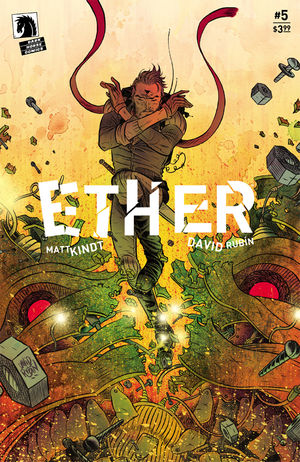
Ether #5 - Matt Kindt and David Rubin delivered a stunning conclusion to the first arc of Ether this week and I am chomping at the bits for volume two. In the final issue of this arc, we learn that Ubel is attempting to open up the connection between the Earth and Ether for his own sinister means.  The arc of this series is something to behold.  What started with a straggler who appeared to be entering the Ether in the same way one would use a hallucinogen, has evolved into a story of a man who fell victim to what he thought was his purpose in life.  We meet his wife in this issue, and learn of her sacrifice dealing with her husband and his obsession with the Ether.  I felt a real emotional connection to Boone and Hazel in this issue and really appreciate how much this series has grown in five short issues.

The Rest:
Batman: Rebirth #19 - "I am Bane" part four doesn't pull any punches.  The juiced up super villain is not too pleased with how Batman and others are working against him.  Batman isn't too keen on enlisting the help of Two-Face, Hush, Solomon Grundy, and others, but is still recovering from the viscous beat down he suffered in the last issue.  If this first issue is setting the tone for things to come, then there will be a stack of bodies in the wake of Bane as he goes after the Batman.  While this series has been steadily improving as Tom King finds his voice writing the Batman, but I wonder if I should switch to All-Star Batman and hop back on the Scott Snyder bandwagon.


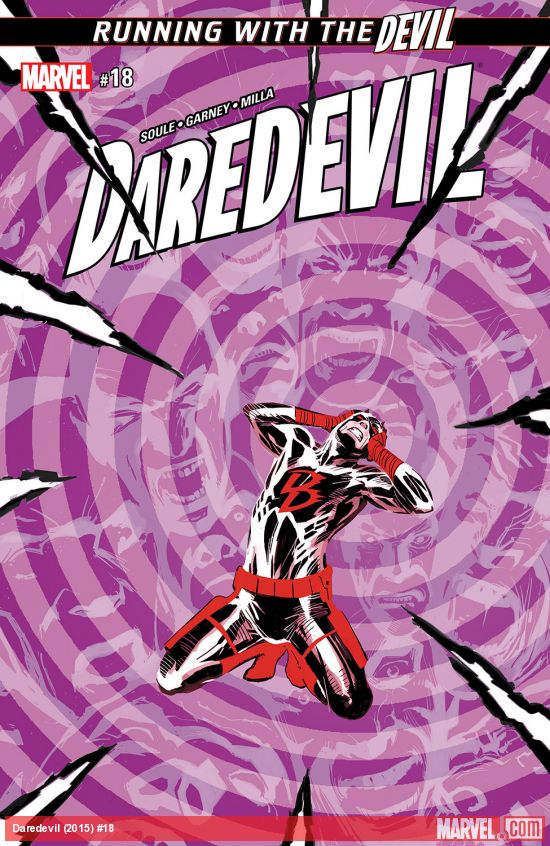
Daredevil #18 - It appears that The Purple Children helped Daredevil reestablish his secret identity after the cat was out in the bag.  The Purple Children, of which their are five of, are the spawn of Zebediah Killgrave, a purple man who has the power to make people do whatever he wants.  Killgrave was working on some sort of device that harnessed the power of his children, and had sent a mob to collect the final two. These two ended up on Daredevil's doorstep, and the man with no fear was able to save them and now is attempting to stop Killgrave from completing his device and save the other three children.  It remains to be seen if Daredevil has the will to withstand the abilities of someone as powerful as Killgrave.  Charles Soule's run with Daredevil is rapidly becoming one of my favorite runs of all time.


POSTED BY MIKE N. aka Victor Domashev -- comic guy, proudly raising nerdy kids, and Nerds of a Feather contributor since 2012. 

Wednesday, March 15, 2017

DYSTOPIAN VISIONS: The Dog Stars by Peter Heller


Dossier: Heller, Peter. The Dog Stars [Knopf, 2012].

Filetype: Book.

File Under: Stateless dystopia.

Executive Summary: A pandemic flu wipes out nearly the entire population of the U.S., leaving only isolated survivors. Hig lives in an airport hanger with his dog, Jasper, and his survivalist neighbor Bangley. Hig periodically flies his Cessna looking for other survivors, but rarely finds any; when he does, they are generally murderous. 


One day, however, Hig discovers a radio signal coming from an old airport--beyond his Cessna's point of no return. But with little to lose, he decides to risk everything to find what's on the other side.    

Dystopian Visions: Hig pretty much only survives because Bangley shoots everyone he sees through his rifle scope. This is normalized in the book as an appropriate way of dealing with whatever humans you encounter, as nearly everyone wants to murder and almost no one wants to pool resources. Implicit to the novel, then, is the Hobbesian notion that only state institutions can prevent human beings from reverting to a savage state of nature.   


Utopian Undercurrents: Not much to speak of, frankly, except maybe the (very thin) love story. So love conquers all? Bangley also makes a friend. And dogs are great. That's about it.   


Level of Hell: Eighth. Postapocalyptic America is a straight up hellscape. The only saving grace is that Bangley appears to have a lot of ammunition. And a grenade launcher. 

LegacyThe Dog Stars garnered wide acclaim upon release, for reasons that are not quite clear to me.

In Retrospect: After reading this book twice, I've come to the conclusion that it's basically survivalist fiction dressed up with passages of New England-guy-sitting-by-a-pond nature writing. 
Sure that makes The Dog Stars more lyrical than the average "Doomsday Preppers" book, but have I ever mentioned how tedious New England-guy-sitting-by-a-pond nature writing is? And at the end of the day, The Dog Stars has very little to say beyond "people under conditions of extreme precarity will try to murder you, so you better try to murder them back first." 


Analytics

For its time: 2/5.
Read today: 2/5.
Oppressometer Readout: 4/10.


Tuesday, March 14, 2017

Microreview [book]: Empire Games, by Charles Stross

A timeline hopping and deeply political adventure


I have a somewhat complicated relationship with Charles Stross. The stories and novels of his which are most renowned and most awarded are the stories and novels of his which I have least been able to appreciate or connect with. The works which are less recognized for awards like The Laundry Files and The Merchant Princes are ones which, at the basest level, I have been able to even enjoy, though looking back through my reviews of the first five Merchant Princes novels I see that I was much more conflicted about them as well, that it is time and distance which has softened my views - and perhaps it is this which had me forgetting some of what I struggled with and instead remembering the aspects of the novels I loved.

I've always loved the concept of parallel universes, and how Stross handles that idea in The Merchant Princes had me sold from the first book (even when other aspects of the book did not). I wanted to know how the various worlds that Miriam Beckstein could access by staring at an intricate knot were connected, and it turned out that she was a lost scion of a world walking family from a separate timeline from our own. Throughout the series we see how the two original timelines interact, how everything escalates, and overall, Stross takes the reader on a heck of a ride.

It has been seven years since Stross completed his six volume Merchant Princes series (or three volume series if you discovered the Merchant Princes when it was reissued in the longer volumes Stross originally intended) and in the chronology of the novels it has been seventeen years since the conclusion of The Trade of Queens when after rogue worldwalkers detonated a nuclear bomb in Washington DC, killing the President, the United States retaliated with a nuclear strike on the Gruinmarkt in that other timeline.

There were more stories to tell in that setting and the only question was whether or not Charles Stross would tell them. Empire Games picks up seventeen years later with Miriam Burgeson (formerly Miriam Beckstein) and others from that now uninhabitable world / timeline escaped to a third timeline the United States government does not yet know about -  but Miriam knows that the United States has not forgotten and will one day catch her operatives and find their way to what we're calling Timeline Three.

Unlike the original Merchant Princes series, Miriam is not the protagonist here. Stross weaves multiple perspectives throughout multiple timelines, but the true focus of the novel is a young woman named Rita. It matters, but doesn't fully matter throughout Empire Games, that Rita is the daughter or Miriam that Miriam gave up for adoption prior to the opening of the first Merchant Princes novel. It means that Rita has the potential for worldwalking between timelines and the Department of Homeland Security has been watching Rita from the moment they learned about the Clan and the Clan's breeding program back in the United States.


Empire Games serves very well both as a continuation of the Merchant Princes as well as an entry point for new readers. Stross has set this up with enough introductory material that readers unfamiliar with the series will be brought up to speed with the high points of what occurred in the first six books and readers who last read Trade of Queens seven years ago will be refreshed.

One of the strongest things about Stross's strongest fiction has been the ideas. There's so much cool and interesting stuff here. As I mentioned, I'm a sucker for alternate universes / multiple timelines, but Stross has also introduced the idea of the "forerunners" a significantly more technologically advanced society from another timeline that has disappeared. He has also introduced some interesting ideas about the origins of the Clan, and none of this is the most significant part of Empire Games. If it is extra important, it's stuff that will come later in the next two books (if then).

Where Empire Games is better than anticipated is that the level of Stross's writing is actually beginning to rise to the level of his ideas. This was most notable in the previous Merchant Princes novels where the writing was just barely serviceable enough to keep pace with how fascinating the creation of this world walking conflict was (and, in some cases, and active detriment). That's not the case in Empire Games. Here nothing distracts from all the cool stuff going on, and though it perhaps take a little bit longer than desired to get to the worldwalking - but once Stross gets there, Empire Games really takes off and is one hell of a ride.


The Math 
Baseline Assessment: 7/10 

Bonuses: +1 for the deep background worldbuilding of the political changes of Timeline Three, the forerunners, and the glimpses into the stuff behind the story that may never take center stage in subsequent novels. 

Penalties: -1 for spending very little time in Miriam’s timeline 

Nerd Coefficient: 7/10 
See more about our scoring system here


Reference: Stross, Charles. Empire Games [Tor, 2017]


POSTED BY: Joe Sherry - Writer / Editor at Adventures in Reading since 2004. Nerds of a Feather contributor since 2015, editor since 2016. Minnesotan.

Monday, March 13, 2017

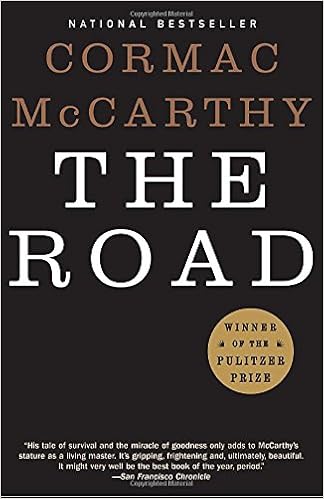
DYSTOPIAN VISIONS: The Road by Cormac McCarthy


Dossier: McCarthy, Cormac. The Road [Knopf, 2006]

Filetype: Book.

File Under: Stateless dystopia.

Executive Summary: In the aftermath of an unnamed ecological disaster (or possibly nuclear winter), a man and his son travel along a now-unused road, heading for the coast, eating canned food and avoiding the dangers posed by desperate people and a forbidding environment. 


Dystopian Visions: A total breakdown of social institutions, creating an ultra-Hobbesian every-person-for-themselves dynamic. Life is about as terrifying as you can imagine.     


Utopian Undercurrents: None. The book is not monotonically pessimistic, in that some vestiges of human compassion do survive the apocalyptic event, and the relationship between father and son is moving. But McCarthy's post apocalyptic USA is both grim and dark. 


Level of Hell: Ninth. This is hell. 

Legacy: The Road was a literary sensation that crossed over to the mainstream, thanks to the Oprah Book Club. It also won the 2007 Pulitzer Prize for fiction. 

In Retrospect: The Road is probably, by now, the most well-known postapocalyptic novel ever written. The reputation is largely deserved; though it is not the best postapocalyptic novel I've read, it easily cracks the top 5. The prose is lyrical, the story gripping and the imagery haunting. Most importantly, the book has a strong emotional core, namely, a father's love for his son. It is terrifying and bleak yet, at the same time, contains a focal grain of optimism that separates The Road from mere horror. 


Analytics

For its time: 5/5.
Read today: 4/5.
Oppressometer Readout: 9/10.


DYSTOPIAN VISIONS: Half-Life 2 by Valve Corporation


Dossier: Valve Corporation. Half-Life 2 (Valve Corporation, 2004)

Filetype: Video Game

File Under: Statist Dystopia

Executive Summary: Gordon Freeman is plucked out of stasis by the mysterious G-Man and returned to the world only to find humanity under the heel of the Combine, a extradimensional species. Gordon soon finds himself reunited with Barney, Dr. Kleiner, and Dr. Vance from the first resonance cascade incident at Black Mesa. They're soon attacked by the Combine with Vance and Mossman (another scientist) taken to Nova Prospekt prison. 


Using some alien technology and good old human ingenuity, Freeman and Vance's daughter Alyx free Vance and Mossman but must escape through a Combine teleporter. They soon learn that they were in a "slow teleport" for a week and find that a resistance has risen up, inspired by "the free man". In the struggle, Alyx is captured and taken to the Citadel, the dark heart of City 17. 

Freeman and his allies attack the Citadel, but Freeman is captured and delivered to Dr. Breen, another scientist from Black Mesa who's been collaborating with the Combine to give himself a position of power. Freeman escapes custody, joins up with Alyx, and destroys the portal reactor the Combine intend on using to further their goals of conquest. Freeman and Alyx are again frozen in time by the G-Man, just before the explosion consumes them.

Dystopian Visions: From the beginning of the game, humanity is defeated. In a very early scene, the extent of this is demonstrated with a simple task. A Combine soldier knocks a soda can to the ground and tells Freeman "Pick up that can". The game will not progress until Freeman picks up the can, and deposits it into the trash can. Failure to comply, or throwing the can at the soldier, just means that Freeman gets a whack from the soldier's truncheon. Further along, small robots zip around in the air and photograph your actions. State messages (in Breen's voice) are broadcast over loudspeakers and on big screens. The rest of humanity are living in slums, unable to reproduce due to the Combine's suppression fields, waiting to die. If this isn't bad enough, the Combine suppress resistance by hauling resistance fighters to prisons like Nova Prospekt, where they're tortured and mutated by alien technology.


Utopian Undercurrents: There's not so much utopian undercurrents as a dream of humanity regaining control over its own destiny. Half-Life is the story of science gone horribly wrong. Man's hubris is blamed for the resonance cascade that started the alien invasions in the first game, and by the second game, humanity is almost done for. The only hope is Freeman, a veritable agent of chaos in a protective suit that no force can seem to account for. But as the word of Freeman's exploits spread, and after the escape from Nova Prospekt, humanity has hope and that has to be enough. 


Level of Hell: Eighth, then sixth. When the game starts, there's no hope. As Freeman continues to wreck Combine plans, there's some hope that the human race will see this through, or you might die under the banner of the one free man. 
 
Legacy: Half-Life 2 was transformative for first-person shooters in terms of playability, in-game physics, and environmental storytelling. It was followed up by two "episodes", shorter chapters of the story that never saw a concluding chapter. There's a reason why the people who've played this game clamor for an offical third entry, and it's not simply because the series was left on a cliff hanger. It's because Half-Life 2 has left a mark on those who played it. 

In Retrospect: Half-Life 2 was and is an amazing video game. It has a simple but powerful story of humanity clawing its way out of the grave, being lead by the free man. Gordon Freeman is transformed from mere video game protagonist to symbol of hope. But hope is little without seeing a world without it, and it's impossible to forget that time you were told to "pick up that can".


Analytics

For its time: 5/5
Read today: 5/5.
Oppressometer Readout: 9/10.