Monday, February 15, 2016

NERD MUSIC: Interview with Makeup & Vanity Set's Matthew Pusti

Today NERD MUSIC is thrilled to present an interview with synthwave artist extraordinaire Matthew Pusti, aka Makeup & Vanity Set! If you missed my profile of Makeup &Vanity Set, trust me--this is some of the most exciting electronic music out there. Please join Matthew and I as we talk music, gear, film and science fiction. -G


Thanks for “sitting down” with me! I’d like to start by asking about the history of Makeup & Vanity Set. What’s your “origin story,” so to speak?

I grew up in Cleveland, Ohio. I started making music with computers in 1996. I started working with synthesizers in 97. I used to get down with lots of mod tracker freeware. Now it's a mixture of lots of things. The ski mask and the name and all of that happened in 2004.

Your sound seemed to undergo a major evolution between the Charles Park III and 88:88, both sonically and conceptually. What was going on at that time?

Charles Park I + II are more thematic records rather than true concepts. I didn't really conceptually tackle an album until I made Never Let Go. Charles Park III and 88:88 ended up feeling like a natural arc to me. They came from different places conceptually, but I felt like I was working to support some thing that I felt like I needed to say with the album as a whole. Every record I make, even with things I'm doing now, it always feels like I'm sort of feeling in the dark when I start producing. I don't have a set way to do things. I just feel it out. If something feels different sonically, it's probably more happenstance to progressing over time instead of some new, learned behavior.

Your latest album, Wilderness, is a conceptually ambitious double album that, to me at least, strongly evokes cyberpunk and other dystopian currents in science fiction. How would you characterize the influence of science fiction on your work?

I feel like I grew up in a weird era where the world was finally starting to realize 'the future.' Like the future that people were dreaming up in the 80s was grittier because the times were grittier. I remember the first time we logged into the internet from home; the idea that the sounds coming out of our modem represented data and information. All of those sounds meant something. As a kid I was obsessed with that. And all of my music is an extension of that. Wilderness certainly was part of that. I don't know if everyone really understood it when it came out. It's sort of like that modem. Mortality has a strange way of distorting reality. I kept thinking about how technology is woven into everything now; wherever you go, everyone is logged into something. We're to that degree where people literally struggle to survive without it. That's interesting to me.

"Turning/Sequence" strongly evokes William Gibson's classic 1984 cyberpunk novel Neuromancer for me. That could just be me projecting, but have you read it? There's a lot of common ground--both thematic and aesthetic--between Neuromancer and Wilderness.

Joey Ciccoline told me to read Neuromancer after I laid out the concept for Wilderness to him for the first time. The first half of the original concept became the basis for his short film, Eidolon. The book certainly had an impact on me as far as the music was concerned. By the time I read it, I had already written out the narrative of the record, so it was less of a direct influence there. Neuromancer is one of those weird things that has influenced so many things, that by proxy it had likely already crept into my work long before I had actually read it. The bigger influence was probably Andrei Tarkovsky, specifically his films Solaris and Stalker. I think that films are probably the biggest influence on my work, more than anything else; even when the work is tied into my actual life experiences, as Charles Park III or Wilderness were, it is always filtered through a the lenses of films that deeply affected me.


Speaking of film, I know that 88:88 also began as the soundtrack to Ciccoline’s short film of the same name. How collaborative was that experience? Did he tell you what he wanted, or did he just give you a video file and say “do whatever you think works?”

A little of both. Joey's really smart. He knows what he wants but he also trusts me enough to let me work. 88:88 was more about us figuring that relationship out more than anything else. In the beginning, he was pretty diplomatic about things but he was definitely willing to let me know what didn't work, and that shaped how dark the score became. The album was directly influenced by the path the film was on.

I’ve got a crazy fan theory, by the way. I noticed that the opener to the album 88:88 (“A Glowing Light, A Promise”) plays over the film’s end credits, and the ending is quite ambiguous—you know it’s just the beginning of a big, untold story. At the same time, the album has a distinctly cosmic feel to it. So I’m thinking that the album is actually telling that story—the story of what comes after the credits roll. Am I crazy?

The album was what I envisioned happening to Val after the film ends, yeah.


So I'm not crazy! Okay--now, Makeup & Vanity Set is often categorized as synthwave, but 88:88 and Wilderness feel pretty different from what other artists in that scene are doing. How would you characterize your relationship to synthwave?

I'm not really sure where I land in all of that. I make music everyday. It's all over the map. In the end, I try to make dark music that means something to me. And hopefully someone else can find something meaningful in it too. Most of the time I feel like I'm the outsider.

What other groups or artists are you into these days?

Dallas Campbell. His last record, City I, was so great. I'm patiently waiting for the new Lazerhawk record. I loved the Tek album from last year--Phaserland is incredible. The Troxum record, Gaia Lesson, that was amazing. I feel like his stuff is pushing boundaries that need to be pushed. The last Gost album was really heavy. I feel like I always gravitate towards the stuff that is

How about your upcoming projects—I’ve listened to some of your works in progress on soundcloud, and have also heard that you are working on a full-length collaboration with singer Jasmin Kaset, who features on two of my favorite Makeup & Vanity set tunes. What can you tell us about this or any other upcoming projects?

I have a 12" coming out on Data Airlines soon. They reached out to me while I was working on Wilderness. It's interesting. It's really digital and harsh. It's a lot more in your face than Wilderness was. It's got a really hard edge to it. Jasmin and I are working on a full-length album together. We've to 6-8 songs for it. They're really great. I wrote a bunch of music for an ARG tied to the video game Soma--and I'm scoring a film that ties into that. And of course the ever-expanding Brigador, a game from Stellar Jockeys. That should be out in April. At this point, there's something like two hours of music in that.


Finally, I need to nerd out here….88:88 and Wilderness have this really distinct, massive sound. What kind of gear/software do you use?

Typically everything is written in Ableton Live and mixed there or in Logic. I tend to sequence albums with Logic. I think my most used software plugins are probably Native Instruments Reaktor and the Arturia V Collection- I don't really lean too hard on the common ones though. I think their ARP 2600 sounds really good. Same for the Oberheim and the Moog Modular. I like stuff that's more complex. All of my musical training was in synthesis, so I probably spend too much time engineering things as opposed to writing and arranging things- that's probably why Wilderness took as long as it did.

Hardware-wise, I use a Moog LP2 almost all of the time. I just bought a Mother-32, which has been really eye opening. I don't have any eurorack modular stuff, so the flexibility involved in that has been really nice. They compliment each other well. I use a Yamaha DX7 quite a bit, as well as a Roland HS-60, which is a consumer-model Juno 60. Mine is a bit beaten up, but it sounds great. I have a DSI Mopho, which gets used in really weird ways but is always super refreshing and really opens up tracks. I started using Elektron gear- the Octatrack and the Analog Rytm- about a year ago and they continue to blow my mind. I bought them thinking they'd be useful live, but they are like little pandora's boxes. There's so much going on inside. The Octatrack especially. I was an MPC guy for years but I don't see how I could go back after using the OT. I have some effects stuff, delays and reverbs. Reverb is a big part of what I do. I've been using a new reverb by Meris Audio called the Mercury7, which almost feels like it was built for my brain. Every synth I put through it just melts into the ether. It's pretty haunting.

Thank you! 


****

Purchase Links

88:88 (Amazon , iTunes)
Wilderness (Amazon , iTunes)

Stream Links

88:88 (Spotify)
Wilderness (Spotify)

Friday, February 12, 2016

THE MONTHLY ROUND - A Taster's Guide to Speculative Short Fiction, 01/2016

Well I've made it. 2016. Which means your faithful storytender has been pouring out smooth story recommendations for over a full year now. And you know what? I don't think I'm in any risk of getting sick of sitting down each month and running down my favorite reads. Every month I find so many wonderful reasons to love reading short SFF, and I am as excited as when I started this to provide a taster's variety pack of stories I hope maybe you'll enjoy as much as me.

Somehow, looking over my choices this month, I see that things get a little...well, not-exactly-happy. Which is to say, there's a lot of disturbing imagery, situations, and worlds built in the stories in this month's flight. But that doesn't mean the stories aren't at turns fun, funny, and incredibly uplifting. So sit back, relax, and prepare your palate for some choice speculative fiction!

Cheers!

Tasting Flight: January 2016

"Godfall" by Sandra M. Odell (GigaNotoSaurus)

When the gods begin dying, falling through holes in the sky and crashing to Earth, a whole industry arises to mine the bodies for their wealth in "Godfall" by Sandra M. Odell, a dark ale if I ever experienced one, deep and nightmarish and yet with hints of sweetness to give weight and balance to the dark.In the story, Tully is an old hand at harvesting the dead, getting in and getting as much as possible and then getting out before the worms descend to eat the dead god and anyone unfortunate or foolish enough to stay behind. There is a great mystery to the story, and a sense of decay, both to the world where the gods are dying and to Tully, living off hopes of a dream that seems to recede before him with each fresh tragedy and horror. Tully's new assistant, though, seems to have plans of his own. And I loved how the story just sells how one of the first reactions to dead gods would be to harvest them, that the world has been so twisted and mercenary that there's nothing strange about hordes of people arriving to strip the bones and marrow. It's a great mix of magic and science and awe and ugliness and there's something very human about it, about Tully's wish for something better even as he pushes himself back into the horrors, even as he has to risk everything for just the chance of breaking the cycle of consumption and exploitation. And the ending! I won't spoil it but the story really delivers on the horror aspects it sets up, and the experience as a whole is dark and deep and bathed in shadows, a dark ale with sweet taste of escape and longing.

Art by Kirsi Salonen
"Angel, Monster, Man" by Sam J. Miller (Nightmare)

About three friends who create a personality to stand in for all those artists lost to AIDS, "Angel, Monster, Man" by Sam J. Miller is an IPA bock, dark elements and deep flavors paired with a bitter brash kick and rolled together into an experience that speaks of loss and regret and things that never were. The composite person that is created, one to be author to an entire lost generation of gay stories, pictures, and ideas, is different for each of his creators, changes based on the needs of those left behind. Called Tom Minniq, this gestalt person takes on a life of his own, overstepping the constraints his creators placed on him. Because what has been lost is greater than any of them, works of art that never got the chance to change people, to inspire people, to honor and to remember those who were lost. The story captures a sadness and a loss and a need for those stories that were never published, the pictures that were burned instead of released, the voices and the lives that were cut short by a disease that seemed almost designed to tear a community apart. The horror of the piece is carefully balanced and executed, Tom neither angel or monster or man but all of them together and more besides, a lie that becomes more real than reality. And the true darkness of the pieces comes not from Tom but from the loss he represents, from the actual tragedy that in the story he memorializes, and the dawning awareness that there is no Tom in our world, that for us those voices are likely silenced forever. I loved the way the three voices compliment and complicate each other, the three very different men that give life to Tom, the three very different directions their lives take. And the fear of sex and the fear of life and the fear of dying that exists for all of them like a knife ready to strike. It's an excellent story and like an IPA bock a singular experience, combining a dark smoothness of a bock beer with the bitter demands of an IPA.

Art by Galen Dara
"Secondhand Bodies" by JY Yang (Lightspeed)

Featuring a future where people can change bodies almost as easily as we change phones, "Secondhand Bodies by JY Yang seems an IPL, the bitter boldness of the IPA hiding its notes under the layer of lager, never quite able to escape what lies beneath. The story takes this idea of switching bodies and shows just how it fits neatly into the current dynamics of power and wealth. The main character, Agatha, is constantly dissatisfied by her body, is constantly made to feel ashamed of it by the men around her, by those who have even more than she does, who have something that she can never posses: the respect and validation that comes with the strict gender roles Agatha cannot gain access to. The story does an excellent job of examining the cross-sections of privilege, gender, race, and wealth. She's constantly yearning for something that she cannot have, that is denied to her simply because of her body, and the bitterness and anger that she feels at that follows with her from body to body, acting as a sort of poison, a corruption that she passes down to those she can abuse and bully. The story takes a critical look at body and provides a dark and resonant reading experience. By the time the ending arrives like a blade through the ribs, the story reveals its complexity, the layers of bitterness and sweeter tones, an IPL to spend some time enjoying.

Art by Xiao Ran
"The Mama Mmiri" by Walter Dinjos (Beneath Ceaseless Skies)

About twins and gods and justice, "The Mama Mmiri" by Walter Dinjos is an Imperial stout, heavy and deep and inescapable, smooth and smoky with a subtle sweetness that makes it go down easy. It's possible that I like this story especially because of it's use of twins and I am a twin, so there is something about the way it builds, the loss that the main character experiences, that really speaks to me. In its way the story is also about the way that religion can be co-opted and used as a tool to oppress those who believe, as in the story the embodiment of the river can be bought by whoever is willing to pay the price, can be used by the wealthy outsider hoping to build a bridge over it, and the price he pays is in the blood of the villagers, the people who have lived with the river, who make their lives along its banks. And there is something terrifying, seeing it play out through the eyes of the main character, a young man who wants his brother back, who wants revenge against the man who destroyed his life. Despite that it's not an overly gloomy tale, is told with a fresh and humorous voice and an easy flow. There are moments of great physical comedy snuck into a piece that is, ultimately, about loss and death and balance. And there is a beating heart to the story, a child's love of his family and lengths he will go to in order to be whole. The story is something of a tragedy, brutal and final, but there is also hope, and like a stout the story left me shaken but ready for more.

"Tower of the Rosewater Goblet" by Nin Harris (Strange Horizons)

Spanning time and slipping between texts with a subtle and powerful ease, "Tower of the Rosewater Goblet" by Nin Harris tastes like a Belgian ale to me, all dust and spice with a feel of being surrounded by books, each one a creation and destruction, each one a tool and a universe waiting to be uncovered. In great metatextual fashion, the story explores story, the power of voice and convention and plagiarism and appropriation and subversion. There are layers here, layers of history and fiction, the character of Erheani as revolutionary and traitor and author and subject, thief and victim, person and idea. And as I work in printing the fact that the story examines the power of the physical word is very interesting to me, the freedom that can come only by being able to control how a story is produced and distributed, that is blunted by having to go through "official channels" and "conventional publishers." Erheani's is both a cautionary tale and an inspiration to act, all while being her own person, not a story but an author. And the story reveals how texts shape reality, shape the past, can be used both for justice and for injustice, for freedom and for oppression, for expression and for erasure. The structure is brilliant and provocative and blends layers of text and subtext, metaphor and meaning. And like a Belgian ale the result is something slightly odd and unexpected, an old tome buried in a forgotten corner that manages to pack a punch and knock the reader back on their heels.

Art by Matt Davis
"The Tomato Thief" by Ursula Vernon (Apex)

About age and generational shifts and the strength to set things right, "The Tomato Thief" by Ursula Vernon is like a Malbec wine to me, dark and dry as a desert but with a rush of flavors and the hint of something red and growing and the sense that some things only get better with age. The story itself focuses on Grandma Harken as she aims to set right some wrongs, starting with solving the mystery of who (or what) has been stealing her damned tomatoes. From there the mystery only deepens though and Harken must strike out, slowly coming to terms with the fact that she's not a young woman any more, and sometimes, despite her pride and despite her skill, the best thing she can do is ask for help. Still, the voice and the flow of the story is great, the setting strange and deep and elegantly rendered. There is the feeling of powers ancient and dangerous being provoked, and Grandma Harken standing there doing the provoking, the aging trickster out for one more adventure, not wanting to see that she's no longer as able to take on the world alone. That said, it's still a story about how age doesn't make you useless, or worthless, and how people still and always deserve to be treated like people. It's a stark story, a woman walking through a dessert, but there is also something comforting about it, a sense of home and purpose and stubborn resolve. Like a Malbec, the flavor is dry and red as blood and nicely balanced, and stands up better and better the more glasses are consumed.

Shots

Art by Dario Bijelac
"America, America" by Okafor Emmanuel Tochukwu (Flash Fiction Online)

Set in Nigeria and featuring a gay main character coming out to his mother, to the ghost of his father, this story is an American Flag, a layering of equal parts blue curacao, cream, and grenadine, something sweet but with a solid edge. Normally when dealing with the idea that America is a disease it is grappling with cultural and military imperialism, but this story features a different kind of American infection. It's an interesting and almost nostalgic piece about freedoms and about love, something that America as an institution has lost sight of over time, especially because America has exported homophobia and intolerance especially in Africa through wealthy religious organizations trying to influence law and opinions abroad. That the main character here found something different in the U.S., something worth taking back to his home, is a call to use the power of America, its influence and its money and its might, to support freedom, the same freedoms that it is starting to protect domestically and should be working to protect aboard. It's a complex story full of ghosts and confessions and betrayals, layered like an American Flag and with an eye toward what that flag is supposed to represent.

Art by Elizabeth Leggett
"You, an Accidental Astronaut" by Sonja Natasha (Mothership Zeta)

Full of fear and unexpected adventures and always a small pang of regret, this story is an Astronaut, a mix of light and dark run with vodka, lemon-lime soda, and pineapple juice, a blast of flavors that capture the feel of adventure but that bring the drinker always back around to something that seems out of reach. The story shows the main character fleeing a relationship out of fear of committing to it, escaping to the stars and falling in with a crew of aliens on a ship that breaks time and space. The pacing is fast, the images grand in scope, the voice vulnerable and accessible. The story is equal parts epic and romantic, about second chances and about growing up, about not letting an opportunity slip away. In many ways the story is about realizing just how brave you are, to be alive, to be able to handle so much, as the narrator is, flying through the depths of space aboard a ship from another world, learning how to fix things that seem impossible, and from that experience realizing that some things are worth trying, are worth sticking around for. The story is fun and fast and full of stars, and like an Astronaut it packs a punch and gets the blood pumping.

"While I Wait" by Layla Al-Bedawi (Fantastic Stories of the Imagination)

A story about the dead and our relationship to them, this one is a Ghost Milk, a mix of gin, sweet and sour mix, tonic, and vodka, strange and opaque but also warm and comforting, a spot of kindness against the cold of winter's reach. The story follows a person haunted, but almost by choice, a person who knows the value of a simple act of kindness. Mood and mystery infuse the story with layers and meaning, hinting at a past that has taught the narrator why such acts are so vital. There is an absence that for them the ghosts help to make up for, the "you" of the story who never quite comes into focus but who stands in for the reader, for a lost child, for a whole world of possibilities. With that uncertainty it becomes more and more clear that the important kindness is not always the one you reserve for those who you know, who are dear to you, but that the most powerful of actions can be to do a kindness to a stranger in need, that one simple act can have a profound impact on someone else. The story lingers on compassion and pain, lack and sustenance, and like a Ghost milk it satisfies with a unique flavor and lingering presence.


--

POSTED BY: Charles, avid reader, reviewer, and sometimes writer of speculative fiction. Contributor to Nerds of a Feather since 2014.

Thursday, February 11, 2016

Hail, Caesar: A Love Letter to a Love Letter to Old Hollywood


I love old Hollywood.

I love it for the movies, of course, but also the bigger-than-life personalities, the amazing contradictions it contained, the fact that it was essentially a stage magician manufacturing illusion, and the behind-the-curtain rigging that made it possible. I'm also fascinated, of course, by the lives it destroyed, and the seedy tabloid underbelly. But to be honest, I grow easily tired of that. Hollywood Babylon was enough; I didn't need Hollywood Babylon II and the rumors of Hollywood Babylon III. But people love to fixate on that. The current podcast You Must Remember This is a perfect example, telling some of the most grim and depressing, little-known stories from days of Hollywood gone by. I felt like I needed to take a shower after listening to the Gloria Grahame episode. I get it, though. After living in LA for over 10 years, and working in and around Hollywood, I recognize that it's an unfair system that pays out rewards at random, and somebody's whim on a Tuesday after a disappointing lunch can ruin somebody else's career or life.

It's easy to be cynical, and it's easy to find, and to tell, the stories that support that position.

It's harder to be what The Coen Brothers' new movie, Hail, Caesar! is: affectionate and funny. This is a movie with very, very low stakes. We're not what you'd call worried about the outcome. It's not full of what you might call narrative rigor. Yet, I found the movie utterly transfixing because it took all the things I love about old Hollywood and amplified them, and it took all the seedy, nasty stuff, and made jokes out of it. In the opening scene, when Josh Brolin's character secrets a starlet out of a bungalow at 5 am on a rainy night and pays hush money to cops, you know that in the real version of that story, the starlet was making porn movies or worse. In this version, she's dressed in some kind of lederhosen and churning butter.


I got a lot of the in-jokes, and the (not so) veiled references to real people, but I felt like for every one I got, five more went past in the background. People will write books about the references hidden in this movie. Hail, Caesar! does with old Hollywood what The Big Lebowski did with 1940s noir pictures. The casting was amazing, as in most everything the Coens do, but so often in their movies they seem to treat their characters with contempt (see Burn After Reading or Intolerable Cruelty), but in their best work they let their weirdos be weirdos and show us how we might love them in spite of everything. In this movie, that may be most true of Alden Erenreich's Hobie Doyle, who comes across at first as an idiotic movie cowboy, but becomes much more as the movie goes on. I've seen movies in the theater in the last couple of years that made me happy, and that I thought were good movies, but I haven't seen anything that made me fall in love with movies themselves as much as this did in a long, long time.

As a film nerd, hands down, Hair, Caesar! is my favorite movie about movies since Ed Wood, and that's high praise, indeed.

Also, check out this great interview with Josh Brolin about the movie.

Thursday Morning Superhero

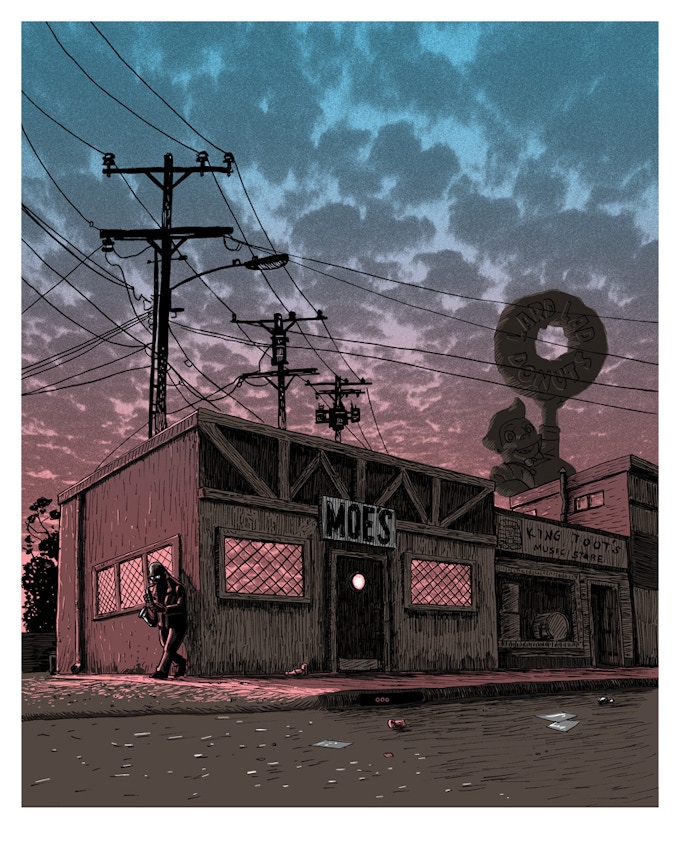
"Amanda Hugginkiss" by Tim Doyle
I don't plan on turning this opening paragraph into my Kickstarter spotlight of the week, but a brilliant artist from my town, Tim Doyle,  has launched a stunning book with the option to buy some of his iconic Unreal Estate prints.  I have a few of his prints up on the walls and they are even more wonderful in person.  His take on pop culture landmarks is well worth checking out here.


Pick of the Week:
Batman Teenage Mutant Ninja Turtles #3 - Let the wave of nostalgia take over and flash back to your child hood when you made this crossover happen with your action figures.  I think we all at some point took toys from two separate lines and created an epic crossover.  That is just what IDW and DC have done and it is a blast.  We are half-way through the mini-series and Shredder has big plans for the portal that bridged the two universes.  His hopes of ruling both cities might be a stretch as, in what Leonardo describes as a "totally awesome team-up", the Dark Knight is fighting alongside the Turtles.   Packed with classic TMNT humor and an all-star cast of Batman characters, this is a must-read series.  I don't want to spoil anything, but if you like the idea of the Penguin being put in his place and assigned to the Foot Clan by Shredder, then you need to go read this series.

The Rest:
Batman #49 - I was hoping for the return of Bruce Wayne as the Batman, but Scott Snyder had a quick trick up his sleeve before giving us the showdown of Batman vs. Bloom that we are all waiting for.  As Bruce Wayne realizes who he is, he isn't prepared for the emotional battle that he has to have with Alfred.  Alfred has lost Bruce in the past, and has no plans of losing him again.  The conversation before the two is incredibly sweet and their relationship has always been one of my favorite aspects of this series.  Mix in a psychedelic trip down memory lane and Batman is back!  It is just a shame we have to wait until the next issue for the epic showdown.


Darth Vader #16 - We are treated to a new arc as Vader opens this issue gifting the corpse of Commander Karbin to the Emperor in an amusing open to "The Shu-Torun War".  I still quite enjoy the back and forth between an arrogant Vader and an Emperor who is still grooming his apprentice who hasn't earned his place yet.  The new arc brings us to the planet of Shu-Torun, where Vader must assist the new leadership to gain control of the rich ores that the planet possesses.   We once again witness the power and how strong of a force Vader is and I look forward to seeing where this arc takes us.


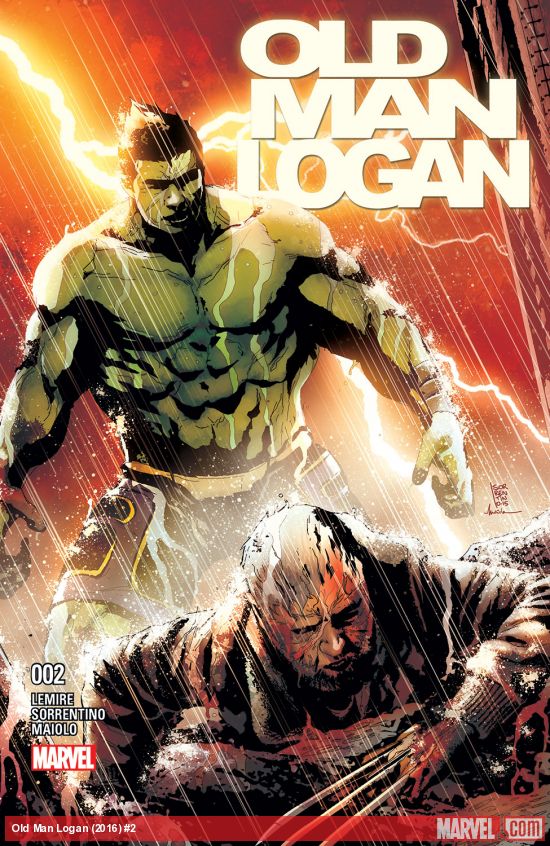
Old Man Logan #2 - After taking out The Black Butcher in his "Back to the Future" quest in the past to set things right in the future, Old Man Logan needs to take down Bruce Banner.  What Logan doesn't realize, and I didn't either due to my lack of interest in the latest event or a twist that is being thrown into this series, but Banner is no longer the Hulk and the heroes that he is seeking may not be who he thinks they are.  It definitely is a nice bit of depth added to this series to make it more than your run-of-the-mill kill the people on my list stories.


POSTED BY MIKE N. aka Victor Domashev -- comic guy, proudly raising nerdy kids, and Nerds of a Feather contributor since 2012.   

Wednesday, February 10, 2016

Microreview [book]: Ruin, by John Gwynne

A healthy dose of grimdark—but how dark is too dark?

Gwynne, John. Ruin. Orbit, 2015.

Everybody knows that Empire Strikes Back is the best of the original Star Wars trilogy—and that’s because, among other reasons, it’s the darkest installment. For the first time, we see the heroes defeated, and even powerless. We witness the price they must pay, and you have to hand it to the filmmakers (see what I did there?): the darker tone really pays off.

In a way, the same situation applies to John Gwynne’s grimdark series about our intrepid heroes Corban and company; the first book, while ominous in tone, was really more about setting the stage for the bad stuff about to happen, while the second book continued that theme, only getting really dark at the very end. With the grim stage well and truly set, we readers knew to expect some serious grimdarkitude, and boy, does Gwynne deliver!

Without spoiling the many wrenching surprises, suffice it to say that there’s death, heartbreak, betrayal and seeming defeat aplenty. For some reason, I was convinced this new series was a trilogy, so I was actually expecting some sort of ‘victory’ for the good guys, but as I read on, by three-quarters through the book I had realized my mistake: it was obvious this was the Empire Strikes Back equivalent, and Luke, so to speak, was definitely going to be losing his metaphorical hand.
I know how Luke feels now, after yet another main(ish) character met a grisly end in the grim war of attrition in Ruin.

This brings me to the only substantial criticism of the book: can a book be too (grim)dark? Ruin is certainly a candidate for “beyond darkest night” dark; pretty much the only ray of light in this ocean of bad news for Corban and co. is that good guy-to-be Veradis might finally be getting ready to take a hard look at the two Bright Star-wannabes, and realize his enduring error from books one thru two. At what point does a story become so grim the grimitude starts detracting from the pleasure of following the characters on their journey? It didn’t quite cross the line for me—yet—but I was so bummed out when I reached the end of the book, I almost wanted to listen to 90s pop music, finally answering the riddle Cusack uttered in High Fidelity, “am I sad because I’m listening to pop music, or am I listening to it because I’m sad?” (the answer, it seems, is the latter).

So my word of totally unsolicited advice to Gwynne is this: how about you lighten up a bit, and have mercy on your readers! We all like Corban, Cywen, et al, and it sucks to see them fighting this relentless war of attrition, in which the casualties are mounting alarmingly quickly. On the other hand, you’ve done what few authors can: succeeded in awakening an actual glimmer of doubt that “the good guys will win in the end”! If that was your plan all along, well done…though considering the toll among the main characters to break down my Hollywood-esque assurance that the good guys will save the day, I’m not sure the reward (a scared, uncertain reader) is worth the price in main characters’ agony!


The Math:


Objective assessment: 7/10

Bonuses: +1 for finally allowing Veradis to see what’s what (more or less)

Penalties: -1 for serious, depression-causing grimitude

Nerd coefficient: 7/10 “An enjoyable if almost shockingly grim experience to read”

  
Warning by Zhaoyun the Surgeon-General of Books*, who has been reviewing books here at Nerds of a Feather for their potential debilitating effects on readers since 2013: reading this book may shake your faith in the ability of the good guys to prevail.


* Note that Zhaoyun is not, in fact, the Surgeon-General, nor a surgeon, nor a general.

Tuesday, February 9, 2016

Rampant Star Wars Speculation

Several weeks ago The G and I gathered our collective thoughts about Star Wars: The Force Awakens in our not quite a review, and as long as that article was, it wasn't the end of the conversation. It never is. It was only the beginning, and if there is one thing we nerds enjoy more than talking about a Star Wars movie, it's speculating about the *next* Star Wars movie. So, what Dean and I would like to bring you today is some speculation on some stuff left unaddressed in The Force Awakens and some ideas about what Star Wars has in store for us in Episode VIII. We only have some 22 months until the next movie comes out. We need to get on this rampant speculation. - Joe


So...about Snoke 

Joe: 
So, what wild theories do you have about Snoke?

Dean: 
I love a mystery! There are so many theories floating around about Snoke, one of them is bound to be right…. right?

I have long held- since we learned of his existence, really- that Snoke is, in fact, Darth Plagueis, former master of Palpatine/Sidious. According to what Palpatine tells Anakin, he was murdered in his sleep by his student, after said student had learned all his secrets. This is [***DIGRESSION ALERT***] one of the things the prequels got so awfully, catastrophically, wrong- it told the wrong damn story. Palpatine as a student, Plagueis teaching him to manipulate things from behind the scenes, Palpatine plotting his murder, and an implied survival by Plagueis would have been far more compelling than the hot-GCI-garbage we got. [***END OF DIGRESSION ALERT***]

But even though we didn’t see all that, it still happened, more or less, and it would make a great bridge between all three trilogies.

But Andy Serkis himself has said, basically, that Snoke is just Snoke. Of course, ol’ J.J. is at the helm, and he is the king of smokescreens- he just dropped a movie in our laps no one had any idea about, and it comes out in two months. He tried and failed with Into Darkness, with the whole Kahn-is-not-Kahn thing. So maybe this is similar and he is just saying it to pull the curtain back later.

For my money, though, Snoke is just that: Snoke. A new character, perhaps with ties to the old ones, but brand new. I think (more on this in a bit) we’ll explore his character and background more in VIII and IX.

Joe: 
The only theory that makes any kind of sense is that Snoke is Darth Plagueis, which has a certain amount of cache for me, though I haven’t read the book from James Luceno to really see how Plagueis could better tie in. Of course, that book is already carrying the Legends banner, so we can’t take too much from it anyway.

As cool as the deep-geek fan service would be if we found out Snoke was Plagueis, it’s boring. We already have to wonder what the hell Snoke has been doing during Palpatine’s rise to power and subsequent downfall, it would be even less plausible that Plagueis would continue to sit in the shadows after his apprentice attempted to murder him. One year on the sidelines after Palpatine, sure, but decades? Nah.

We had better explore Snoke in the next two episodes (which may unfortunately mirror a bit of the Vader / Palpatine story from the original trilogy), but I think Snoke is just Snoke - a dark side user who is emphatically NOT a Sith. How old is Snoke, anyway? I suppose we’ll find out. Wookieepedia states that “Snoke witnessed the rise and eventual fall of the Galactic Empire”, and given that it’s been thirty years since Endor, he’s got some years on him.


Rey’s Parentage:


Joe: 
I know that since they’ve begun to set up that Rey’s parentage matters, we’ve probably already met them. Given Rey’s Force sensitivity and connection to Anakin and Luke’s lightsaber, there is a strong suggestion that Rey is a third generation Skywalker. The only thing I am less interested in than Rey being Luke’s kid is Rey being Kylo Ren’s daughter.

Dean:
I kind of think we haven’t met them- in that we never will. Or, at least, they are not as significant as we imagine them to be. Like Snoke above, there are no shortage of theories as to who her parents are- Skywalker, Solo, Kenobi, or some combination thereof.

I have issues with basically all of them, as follows:

Organa-Solo: Leia and Han were both acutely aware that their son had turned to the dark side, and felt the pain of his failure and betrayal. Even if Rey had been hidden for her protection, no parent would be that invested in Ben’s redemption, but when their daughter shows up they had basically forgotten about her. If she was there kid as well, I am sure we would had a Yoda-esque “there is another” moment, jump cut to Rey, wink at the audience- at the very least.

Also, it would be stupid for them to hide her on Jakku when her parents are, ya know, right there. Even if Kylo is hunting force-sensitives (and is determined to kill his sister), it’s not like he can just use his old house key to come get her. Of all the theories, this is the weakest.

Skywalker: This is tied on the weakness scale, but it gets the edge for being more likely. I am going to be annoyed if this is where it goes, though.

My argument against this is twofold: First, if Luke is trying to re-establish the Jedi order, it makes no sense that he decides to not only go against one of the Jedi Codes most basic tenants, not to mention the very one that led to his father’s downfall, by forming attachments. On the flipside, this could account for Ben’s turning, and Luke feeling like a failure and honoring the age-old Jedi tradition of running away and hiding from your problems (great job, guys! Jedi are stupid).

So while I will allow there could be failure on Luke’s part, point two is: Why didn’t he take her with him? “Here, Rey, you hide on this sucky desert planet, I’m going to camp out on a planet that looks like Minnesota in spring. Love ya!”

Jedi are stupid, so maybe.

Joe:
Hey, Obi-Wan did elect to hide Luke on the friggin planet that Anakin was born / raised on, so let’s not discount the stupid here anyway.

Dean:
Kenobi: Damien G Walter hits a lot of these points against these, but arrives at the theory that she is a Kenobi (I might have supplied him with some of this, since I think it is the most likely). Basically, it goes like this: Obi-Wan and Sabine had an implied relationship in the Clone Wars TV show. If they had a kid ~30 years before the OT, this means that child had Rey in their 40’s or so (possibly with Skywalker). So the math works. It also makes sense as to why she is hidden somewhere other than where he decides to hide (sort of).


What doesn’t work is that Sabine… kind of… dies. And “hey we have a kid” is generally a thing one would mention. Perhaps not- maybe she believed he needed to remain committed to the order, and thus never told him. But he spent a fair amount of time on Mandalore, and we actually see a lot of prominent kids there, and at no point does he go “Hey, you know, Sabine, that kid looks an awful lot like me.”

So who is she? My money- also like Snoke- is that she is brand-new. And maybe we meet her parents, but I believe she is a student of Luke’s, whose parents we don’t really know (maybe they were in the Rebellion or something, a la Poe Dameron), and she survived the slaughter at the temple, as seen in her vision.

The script shows clearly that Luke recognizes her, and why she is there. If she was his former pupil, grown and returned, offering him redemption for his own failure in the form of his old lightsaber and the awakened force, it is much more compelling than any of the other options.

Image Credit: Jason Felix and Dave Stevenson

Joe: 
You know what I like as an idea? Mara Jade. But - still NOT Luke’s kid. I don’t know how much backstory they’d want / need to give for a “hidden wife / lover” for Luke or if they’d really get into Mara Jade being the Emperor’s Hand (and then missing for decades?), but that could give nice fan service for long time readers while presenting something new in the movies. And while I would be somewhat disappointed that she didn’t marry Luke and together they raised Ben Skywalker (not Ben Solo, this still doesn’t make sense because Leia and Han never had the connection with Obi-Wan that Luke did - if anything Ben Solo should be named Bail Solo), I would very much appreciate the nod to the now discarded Expanded Universe. 

Something else that would be interesting: Rey is Boba Fett’s kid.

I have nothing to back support this, just a random idea.

Oh. Back to Mara Jade. Do it like this: She was one of Luke’s students in his New Jedi Academy school thing that he founded after Return of the Jedi. She, with another student (or not, I don’t care), had a daughter. Ben Solo turned, killed that particular class of students, and Luke hid Rey on Jakku rather than take her with him when he ran and hid.

I *like* this idea.


Dean: 
I really like this idea a lot, too. Something that is a nod to the fans, that is not completely shoehorned in to fit, is perfect. Also, I have seen chatter about her being Palpatine’s kid gaining traction. Which… no. Just, no. It would be far too shoehorned. Do what Joe says, people.

Apropos of Boba Fett: I don’t want Boba Fett to come back - and you will not find a bigger Fett fanboy than me, but that’s just it: I want a new Fett. We’ve probably all seen the (excellent- I’m not knocking it) fan trailer, but instead of Boba coming up from the pit, show him in the pit, with his last breath he pushes a button on his wrist, cut to Slave 1 and another Fett clone opens his eyes.


What Happens in Episode VIII

Dean: 
Rocky training montages with lightsabers! And possibly other things. In all seriousness, we know a little more than we think we do:

John Boyega has said it is ‘very dark’. JJ has said he wishes he was directing it. And Rian Johnson likes dark and weird. So, in a word, yum. But what will we see? I turn you over to my good friend, bulleted list. Take it away:
  • The First Order will increase their offensive, despite the loss of Starkiller Base- they still have a fleet, and just wiped out the capital of the Republic. I believe we’ll get a good dose of Hux and Phasma wrecking Republic worlds early. 
  •  The film will start after Rey’s training is in full swing. Early in the film, we will get Luke alluding to his own failure and the events which lead to Rey’s being on Jakku and Ben turning. 
  •  Then we will see Kylo and Snoke. I think this is where we learn who/what Snoke is, and more about his motivations- and what the hell happened to him. Since it has been made clear that Kylo, at the very least, is not Sith, it is possible that Snoke follows a Revanite path. Or, possibly, that he is Plagueis. Either way, I think through this we will get more and more of Snoke’s plan. 
  •  On that note, I think Snoke is going to be the most evil character in Star Wars Canon. While we have seen Han die at his sons hand, there are other kinds of pain- and I fully expect Snoke to explore them in Episode VII. I doubt we will see a major (light side) character die, but I think we will see them suffer- even worse than our heroes did in V. 
  •  I think Finn comes into his own. In Before the Awakening, he is presented as a great stormtrooper, with a lot of martial skill. I think we see him become a leader in the Resistance. He probably meets his family, too. And then they die.  
  • Rey will likely embrace her power- possibly rushing for a rematch with Kylo, this time being beaten, as with Luke and Vader in V. She loses her hand, because that is what happens in Star Wars. 
  •  I have two theories re: Luke. First, Luke become fully realized in this. Luke is my least favorite character ever, because he whines his way through everything and is terrified of failure. By the end of this film, I believe he will confront his former student and throw off his fear and weakness -possibly buoyed by Rey’s strength and confidence (god, I love Rey). I would assume, given how central Kylo is to everything, that he does not die (also because Jedi, like, never kill anyone when they should. Jedi are stupid), but it would be powerful for Luke to have to kill his former student (with Leia looking on)? 
  •  Alternately, in the Luke/Kylo showdown, Luke gives in to anger and kills Kylo, and ends up joining Snoke on the dark side. Seems less likely, but- it’s a thought. Maybe he shouldn’t whine so much. 
  • Either way, I want Leia to get some redemption/revenge in this- She is the opposite of Luke- quietly strong though four films and counting, dealing with the loss of (in order) her homeworld, adoptive parents, father, son, brother, husband, son again. OOOOF. not to mention she got stuffed in a bikini and licked by a Hutt, which is no one’s (rule 34 excepted) idea of a good time. So either in VIII or IX, I want to see her just own, either as a general leading a military victory, or picking up Luke’s saber with a stern “I’ll do it myself”. 
  • I think the film ends on a vague, hopeful note- possibly with the Resistance growing, but the only ones of the heroes left standing are Leia, Rey and Finn.


Joe: 
Hey, look, I can do bullet points, too!

  • What if Starkiller base was just a side project? I know the First Order can’t be *that* big, but what is Snoke is doing his thing and General Hux always wanted his own Death Star, so that’s why it was built. We already know there are factions and possibly clone troopers still in existence, so Starkiller doesn’t to be the whole show. It also shouldn’t come back in Episode IX, either. 
  • This is more for Episode IX, but Luke dies in the end. I know, I know that Han was the big death, but Luke can die heroically in battle. 
  • Please don’t turn Luke. I know they did it in the Dark Empire trilogy with Palpatine’s clone, but let’s not do that. He was strong enough as a young man to resist and to turn Anakin back to the light (which doesn’t excuse his crimes), and even though years and decades of sorrow and pain can cause a man to turn when he wouldn’t as a brash and humbly arrogant young man, don’t turn him. Let Luke and Rey stay.
  • I want to know more about Leia’s Jedi training. Sure, it’s possible that after Endor she told Luke that she doesn’t have time to train (which seems mostly right), she should still have had some less formal training sessions. 
  • I want to know if Kylo Ren just happened to murder Luke’s first / only class or if there are actually more trained force users out in the galaxy trying to do good. I don’t know when young Ben Solo started training, but there are some unanswered questions here about the state of the Jedi and light side force users. 
  • We need to see Leia and Chewbacca’s grief beyond those first moments when she felt and he saw Han’s death. Also, if Chewbacca had a Life Debt to Han, what happens next? Does he have a family back home? (the books say yes, will the movies?) Do we go back to Kashyyk for any reason?


Breaking My Heart with Fan Art: The Solo Family Edition

Image Credit: Orisoni

 
Joe: 
There has been some wonderful fan art coming out of The Force Awakens, and I have to wonder how much of this would have gut punched me if I wasn’t the father of a now one year old boy. The above piece from Orisoni absolutely crushes me in ways I would never have expected, but holding my son I think about who he is going to grow up to be, about raising him to be a good kid and a good man, and about how we don’t really have control on how our kids are going to end up. We can only give our children all the tools and love and support we are capable of and hope that they will make good decisions with those choices.

We don’t know what Ben Solo’s upbringing was actually like, but the thought of my child turning into Kylo Ren is unimaginably painful.

Then, I think about my niece and Tyson Murphy’s Chewbacca / Kylo Ren comic and there I go again (Chewbacca is totally Kylo’s uncle, and it’s a pain that the movie only touches on briefly and directed towards Han and not Kylo, but you know Chewbacca has been grieving all this time, too).


Dean: 
*choking sobs* A thing I have said for a long time is that the best part of Star Wars is what it doesn’t show us- see my love of a character with five lines. Kylo/Ben is a big part of this. We don’t see Ben grow up, but our imaginations take it to dark, heartbreaking places.

As another small aside, Han reaching out to touch Ben’s face as he dies is possibly the most perfect moment in modern film.


POSTED BY:

Joe Sherry - Writer / Editor at Adventures in Reading since 2004, Nerds of a Feather contributor since 2015. Minnesotan.

Dean - Dean is the author of the 3024AD series of science fiction stories (which should be on YOUR summer reading list). You can read his other ramblings and musings on a variety of topics (mostly writing) on his blog. When not holed up in his office tweeting obnoxiously writing, he can be found watching or playing sports, or in his natural habitat of a bookstore. 

Monday, February 8, 2016

Microreview [film]: Ponyo by Miyazaki Hayao


Innocent child's tale, or meditation on the afterlife?


Miyazaki Hayao is the Lord of Animation, one who has had as wide a cultural impact as Walt Disney himself. His movies feature strong male and female characters, interesting storylines, stunning visuals, and fascinating technologies in ways unrivaled by any other modern animator. But that does not mean that all of his movies are created equal. Miyazaki has made the finest animated works of all time in My Neighbor Totoro and Spirited Away. On the other hand, he’s made some comparative duds (like Howl’s Moving Castle or The Wind Rises, both of which are not bad movies by any stretch of the imagination). I have already talked about some of my favorite Miyazaki movies on Nerds of a Feather. Today, I’d like to introduce the movie I am more conflicted about: Ponyo.

WARNING: The following discussion is spoilerific!

Ponyo tells an innocent love story between a fish-girl, Ponyo (or “Brunhilde” as her father refers to her), and a five-year-old boy, Sōsuke. Sōsuke finds Ponyo trapped in a glass jar on a beach. He frees her from the jar, only to cut himself in the process. In thanks, Ponyo licks his hand, healing his wound and initiating changes that allow her to transform into human shape. Thus begins a friendship, or a pure love story as told through the eyes of a child. Ponyo decides that she wants to become human, and the rest of the movie revolves around the adventures she takes with Sōsuke to make her wish a reality.

The most impressive aspect of this movie is its animation. The art is visually arresting. In fact, Ponyo features perhaps the most gorgeous artistry of any Studio Ghibli movie. Roger Ebert stated this perhaps better than I can in his own review of Ponyo:
"The film opens with a spellbinding, wordless sequence beneath the sea, showing floating jellyfish and scampering bottom-dwellers. The pastels of this scene make Ponyo one of the very rare movies where I want to sit in the front row, to drown in it. This is more than 'artistry.' It is art."


Still, in all honesty, I did not like Ponyo much the first time I saw it. The storyline appeared somewhat childish, the narrative and dialogue left important questions unanswered, and the characters acted in head-scratchingly strange ways. Take Sōsuke’s mother. She’s the epitome of a strong woman, one who has little problems taking care of herself, her family, and the community while her husband is away at sea. But whether driving through a tsunami or leaving her five-year-old son at home alone for no apparent reason, she continually chooses to put herself and her child at risk. Every driving scene is particularly cringe-worthy. 

But having a two-year old at home gave me the chance for a second take… then a third… and a fourth… and a fifth… I’m now at least thirty times in. Watching a movie this many times (granted, my attention now wanders more than I care to admit) has given me a different take. I now see quite clearly that Ponyo is much more nuanced and creative than I had originally thought. In addition to being a cute story that is safe for children, it seems likely that Ponyo is Miyazaki’s subtle and veiled meditation on death as he advanced in age.

Take Ponyo's given name, Brunhilde. Some have suggested that Ponyo is a deliberate incantation of the valkyrie Brynhildr, someone who served in some Germanic myths as a harbinger of death. Ponyo herself serves in a similar capacity, bringing a tsunami that wipes out the majority of Sōsuke's village, even reaching the lighthouse where Sōsuke resides. In the wake of that tsunami, Ponyo and Sōsuke may in fact bear witness the passing souls of the now-decimated community. As the two adventurers ride in a toy boat in search of Sōsuke's mother, they run into the whole town in small boats paddling toward the hotel on "the other side." Was this not a reference to crossing the Sanzu River, the Buddhist equivalent to the River Styx? Moreover, later in the film, Ponyo and Sōsuke approach a tunnel that Ponyo obviously does not want to enter. Going into it causes her to revert to her fish form and to fall asleep. Was this tunnel one that leads to the afterlife? Finally some of the people they meet on the other side act in ways that suggest they might no longer be alive (the grannies, for instance!).


I remain conflicted about Ponyo, even after my thirtieth take. On the one hand, it is a cute and innocent story of love shared between two five-year-old children. In this context, it is a great family movie and something my own two-year-old son can watch over and over and over again. On a much deeper and implicit level, however, it may also be Miyazaki's extended musings about life, death, and the promise of what's to come...

The Math

Baseline Assessment: 6/10

Bonuses: +2 for the meticulous, hand-drawn artistry, which remains so much better than the current trend toward CGI.

Penalties: -1 for leaving so many questions unanswered; -1 for Sōsuke's mom and her death wish.

Multiple Views Bonus: +1 for making me think so much more deeply about this film than I had ever intended.

Nerd Coefficient: 7/10 "An enjoyable experience, but not without its flaws"