Monday, October 12, 2015

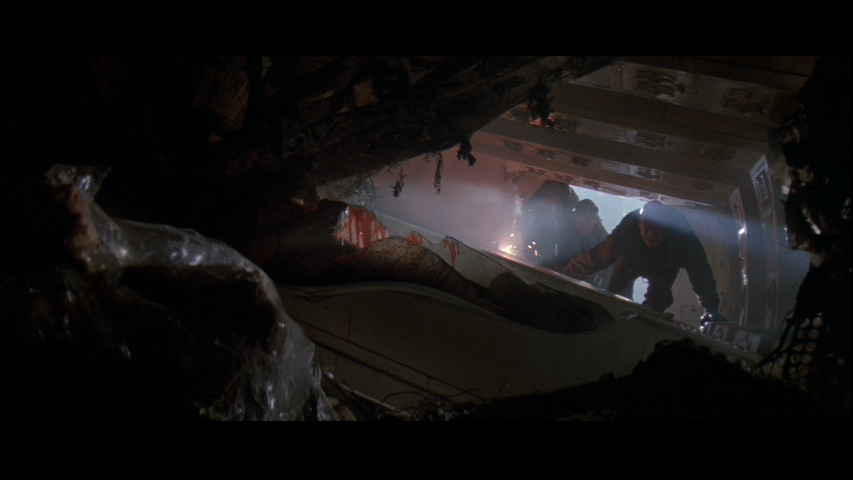
Microreview [video game]: SOMA by Frictional Games

Under the Sea

It's hard to review horror. Horror is pretty subjective because it relies on making a connection with the viewer. It has to have some strings to pull to be effective. I'm not afraid of spiders. A horror game about spiders isn't going to bother me much, but it could be really effective for someone else. Frictional Games has been making horror games for quite a while, and they've really found a formula that works. They don't focus on the horror. It's not the jump scares of Five Nights at Freddy's. There are no monster closets; you'll know something is coming for you even if you don't know what. No, SOMA focuses on dread. They build a sense of dread, and let the dread invoke horror in the player.

In SOMA, you are Simon Jarrett. You've recently been in a bad car accident that killed your friend and left you brain damage and cranial bleeding. In search of help, you allow someone who's explicitly not a doctor to begin an experimental treatment. He'll make a xerox copy of your brain, treat it until he finds something that works, and then apply that treatment to you. The helmet comes down,the brain copying begins. When the helmet comes off, you're in an derelict underwater station.

This raises a lot of questions, none of which I'll provide as they're half of the point of SOMA. I can assure you that most of the answers are unpleasant. You find them in interactions with the other things at the bottom of the sea. There's also no lack of logs and recordings to find. Like previous Frictional Games, SOMA is about exploration of your surroundings. You'll rummage through drawers, and poke around on the workstations still on. It's a lot of Gone Home (which could be said got a lot of its inspiration from previous Frictional Games) with some hide-and-seek. See, there are also things down there with you that don't want you to survive.

Some have said that the monsters are the worst part of SOMA, but (to me), they're necessary to keeping up the tension. You never feel safe in SOMA, or at least you shouldn't. Each of these things has a particular weakness. You'll never kill one, but this weakness makes it easier to bypass them. They're not hard to figure out, and there aren't many of them to begin with. However, you will spend most of the game dreading what comes next.

That's what SOMA nails. Dreading what comes next. You know the answer before you hear it said out loud, and you still don't want to hear it. But it's impossible to put down. The situation continues to get worse and you can't help but see it to the end. It's Frictional's best game, and a new high standard for horror games.

The Math

Baseline Assessment: 8/10

Bonuses: +1 perfect environments, +1 excellent pacing

Penalties: -1 monsters aren't necessarily welcome, even if you like hide-and-seek

Nerd Coefficient: 9/10 (very high quality/standout in its category)

***

POSTED BY: brian, sci-fi/fantasy/video game dork and contributor since 2014

Reference: Frictional Games. SOMA [Frictional Games, 2015] 

Friday, October 9, 2015

Microreview [Book]: Swords and Scoundrels by Julia Knight

The Three Musketeers meets Hugo...


Swords and Scoundrels is a swashbuckling tale about sibling duelists Kacha and Vocho who have been excommunicated from the guild and now make a living as highway-persons. But in a job that almost went wrong, they are faced with a blast from the past, a powerful magician, and large locked chest. Vocho hopes the contents of this chest will win back their favor with the guild, but it ends put putting them right in the middle of a political plot to resurrect the powers of old. 

The imagery created in this story is fantastic. Kacha and Vocho don large, feathered hats, cloaks, rapiers, and pistols. The world created is imaginative and exciting, particularly Reyes, the city that our protagonists hail from. There has always been something magical about clockwork, and Knight brings that alive in Reyes. The city is built on gears and cogs, in worship to the recently reborn Clockwork God, and the city itself literally moves around the famed Guild headquarters, but no one knows or remembers why, since the clockwork is as old as the city and dates back to prehistory. Reyes is a port town, and in a stroll through the docks we are introduced to the many diverse races inhabiting this world. This world building is rich, but it comes at the price of much infodumping, though I mean that in the least pejorative sense of the term. 

And while the world is complex and imaginative, the story is rather lackluster. It holds one of my most hated media conventions, "The Lovers' Ruse." This is the one where the guy has some ulterior motive for dating the girl, like money or info or whatever, but then actually falls in love with her but continues to perpetuate the ruse, and then she finds out and dumps him and we the audience are expected to feel bad for this guy. Swords and Scoundrels takes place after the guy gets “unexpectedly” dumped by Kacha (who was told of his plan to court her for information on the guild) but she spends the majority of the book lamenting about him and how much she loves him anyway because he's the opposite of her brother and barf. We don’t need any more female characters that are still mooning over someone they know has deceived them, tricked them, and used them for personal gain. This is a tired trope.

The story also suffers from long and unnecessary (in my opinion) flashbacks. They come in the form of “interludes” every other chapter or so and tell the story of the main characters as children entering the guild and training. While this is all interesting and could serve as a separate story somewhere else, it just doesn’t fit here. These interludes occur too frequently, are rather dull, and simply are interruptions that do not add much to the plot at hand.

But the world is so exquisite and I would love to see it visually represented. Honestly, I think Disney should make this a movie, but (in a perfect world) nix the lovers' ruse.

The Math

Objective Assessment: 6/10

Bonuses: +1 for overall world building, +1 for Reyes in particular

Penalties: -1 for Kacha’s constant lamenting over Petri, -1 for the interludes

Nerd Coefficient: 6/10 “still enjoyable, but the flaws are hard to ignore”

---
POSTED BY: Tia   Nerds of a Feather contributor since 2014

REFERENCE: Knight, Julia. Swords and Scoundrels [Orbit, 2015]

Thursday, October 8, 2015

Thursday Morning Superhero


It is going to be a bit strange whenever I listen to one of my favorite songs of all-time.  "Erin with an E" by the Impossibles has a great hook, but with Superman changing his secret identity, "I may look like Clark Kent, but I'm no Superman" may not resonate with my kids.  I also don't think changing it to "I may look like Archie Clayton" will have the same impact.  What is a nerdy dad to do?  I guess I will escape in some of the other great titles that dropped this week.  Brian K. Vaughan gifts us with a new series and Jeff Lemire delivers issue #2  his Stand By Me-esque gem, Plutona. 


Pick of the Week:

Plutona #2 -  Jeff Lemire really knows how to tug at my heart strings.  As a father, I find that all of the children and their relationships with their parents really resonate with me.  Plutona is the story of a group of kids who stumble upon a dead body in the woods.  What is odd is how it is the body of the superhero Plutona.  The kids grapple with what to do with the body.  Do they alert authorities and risk the information getting to the super villains?  Do they take pictures of her to sell to various media outlets?  It is fascinating to watch the kids attempt to sort out a situation that nobody ever dreams of being in.  One of my favorite additions is the secondary story that is included at the end of each issue.  Lemire draws the secondary story about Plutona's last mission.  What really draws me in is that a good amount of it is from the perspective of Plutona's daughter.  I'm going to need a box of tissues.  I got something in my eye.

The Rest:
 Paper Girls #1 - Brian K. Vaughan has teamed up with Cliff Chiang to deliver a stunning debut issue this week.  The buzz behind books by Vaughan is real.  When I tried to buy this at my LCS, I was informed someone earlier that day bought all 26 copies the store ordered!  Thankfully I was able to pick up a copy via ComiXology.  I will say that the hype is real.  The premise revolves around a group of four newspaper delivery girls who deliver in the Cleveland suburb of Stony Stream.  During the morning's delivery, the girls stumble upon three mysterious men dressed up as ghosts.  After an altercation, we learn that they are hiding something in a house that is under construction that appears to be some sort of alien pod.  Knowing Vaughan there is a lot more to uncover in this sleepy little town.  I am officially subscribing to The Cleveland Preserver.

Star Wars #10 -  Looks like Luke is going to get his lightsaber training in battle.  Grakkus the Hutt, who has a Jedi museum in his palace, plans on using Luke as a form of entertainment for other smugglers around the galaxy.  The difference is, instead of facing a lion in gladatorial combat, Luke is going to face something much more fierce, and if he survives round one it sounds like Vader will be the main attraction.  I still can't recommend this series enough for Star Wars fans who need something to tide them over until December.  Great stuff.


Action Comics #45 - A lot has happened to Superman since I last picked up one of his comics.  His secret identity is common knowledge, he lost his super powers, and most of Metropolis has turned against him.  This is due to some creature known as the Wrath who orchestrated the whole thing and is the current target of Superman.  What is odd to me, is that in order to continue his investigation of what happened to him, Clark Kent is no more.  Now we deal with Archie Clayton, a delivery boy who works for a company that provides towels and linens for corporations.  Despite not having read a Superman book in quite some time, this was very entertaining and will bring me back for issue #46.


POSTED BY MIKE N. aka Victor Domashev -- comic guy, proudly raising nerdy kids, and Nerds of a Feather contributor since 2012.


Wednesday, October 7, 2015

Announcing...STRANGER THAN FICTION

We here at 'nerds of a feather, flock together' are inveterate tinkerers--part of our commitment to always keepin' it fresh... 


...and in that tradition, we are excited to announce a new review series: STRANGER THAN FICTION!

What's STRANGER THAN FICTION, you ask? The truth, of course! Or, at least, "stuff that happened and was then recorded and/or interpreted for your enlightenment and entertainment."

So yeah--we'll be reviewing nonfiction now. But not just any nonfiction, and not just any kind of review. Rather, we'll be looking at three things:

1. Nonfiction published in a medium we cover (e.g. comics, cult films).

2. Nonfiction about a medium or fictional genre we cover (e.g. books about the history of comics, about the making of cult films, or collections of essays about science fiction and fantasy).

3. Nonfiction that may illuminate, problematize or contextualize how we think about a medium or fictional genre we cover (e.g. books about medieval warfare, astrobiology, police procedures, etc.)

So look out for it, because stuff that happens is often STRANGER THAN FICTION!

Tuesday, October 6, 2015

THE MONTHLY ROUND - A Taster's Guide to Speculative Short Fiction, 09/2015

Welcome back, thirsty travelers. Pull up a chair. Got an ear for the fantastic? A tongue that relishes the steel curve of a spaceship, the crackle of raw magical energy? This month's choices are robust, unflinching, and all about the strength of facing the complicated, the wounded, the misunderstood. About climbing mountains, about not looking away, about facing our pasts so that we can be free to face the future.

The stories this month remind me, each one, why I love speculative short fiction. Because these stories range far and wide. Science fiction that pushes so far into the future of humanity that almost nothing recognizable remains except the core and science fiction that pauses on one moment, no more distant in the future than today, a person facing the infinite wonder of the universe. Fantasy that pushes back into our own distant past to confront monsters and magic and fantasy that pauses on one moment, no more distant in the past than today, a person facing the infinite wonder of the human being.

So sit back and set your worries aside. This Round's on me.

Cheers!

Tasting Flight - September 2015


Art by J. Otto Szatmari
"The Occidental Bride" by Benjanun Sriduangkaew (Clarkesworld #108)

A story about love in the cradle of pain and loss, "The Occidental Bride" by Benjanun Sriduangkaew is a pumpkin porter, that most exotic of Midwestern ales, in some ways a parody of beer and in other ways a rather satisfying experience. And I can think of no better way of capturing the essence of this story, which takes all the tropes and trappings of fetishizing the East, the "Orient," and flipping them, making one of the last Westerners, one of the last Occidentals, into a novelty whose white skin is a mark of wealth for those who possess her but a mark of shame and filth for the woman herself. Kerrtu is a bride, but also a former war criminal sought so that she will flush out former associates of the Mafia. And oh my god I loved that the Mafia was basically in charge of the West like so many texts just throw in the Yakuza as omnipresent in the East. And Heilui, the woman who takes Kerrtu as a bride, is running from her past as well, running away and to something that might work better, where maybe she can forgive herself and be forgiven by those she hurts, including Kerrtu. The story works on levels, on the one hand an incredibly parody of tropes about Asia and on the other hand a very deep story about loss and power and forgiveness. This is not a comedy, for all it is rather funny, but a romance that is played straight (well, queer, but still). It's an amazing story that refuses to release the reader even as it draws them in, and in the end it's a story of recovery and hope. Like a pumpkin ale, there's some part of the experience that is surreal, a meta level where it's almost like the brewer were deconstructing beer itself. On another level, though, the result is oddly pleasant and compelling, sweet and dark and satisfying.

Art by Lauren K. Cannon
"Ten Things to Know About the Ten Questions" by Gwendolyn Kiste (Nightmare #36)

Examining the intersection of depression and sickness, friendship and caring, "Ten Things to Know About the Ten Questions" by Gwendolyn Kiste is a nut brown ale, dark and complex with notes, buried deep within, of something sweet half-remembered. The story focuses on two friends, Vivienne and Tally, who both have scored poorly on the Ten Questions, an examination which is supposed to gauge how likely a person is to disappear. The parallels to suicide are impossible to ignore, and the story does an excellent and powerful job of critiquing how suicide is viewed by society at large, how it is seen as a sin, as a crime, how people with depression are viewed as potential criminals who don't care about pain, who need to be protected from themselves. And...for anyone who has faced depression or known someone facing it, for anyone who has lost someone to suicide, this is...a difficult story. But it is also a delicate and a subtle story, building the relationship of Vivienne and Tally, girls in school who are treated entirely differently just because of how they scored on a test. Who viewed as deviants instead of as people, as things to be caged in order for the school, for parents, for whoever to not have to take responsibility for the pain, to protect them from having to act. It's something that hits strong and doesn't let up, and yes, I cried for this one, because it faces the fact that sometimes there are no good options, there is no escape, and that love means more than a presence. The character work and the setting are chilling but with a spark of warmth and hope, a nut brown ale which goes down like a smoldering fire, the memory of roasting marshmallows and of childhood that cannot be reclaimed.


Art by Craig Shields
"Seven Wonders of a Once and Future World" by Caroline M. Yoachim (Lightspeed #64)

Following Mei, a woman who grows beyond space and time, "Seven Wonders of a Once and Future World" by Caroline M. Yoachim is an IPA bock, a mix of darkness with the bright rebellion of an IPA, an experience that draws the drinking down even as it pushes them forward into new and greater revolutions. The story is told at a ponderous pace, as IPA bocks are best consumed, slow and steady, sinking ever deeper into this universe of cause and effect, time a landscape like space that can be pushed and warped. Mei is willful and wanting to improve on humanity. To become something more. The story reminds me of the pre-reboot Star Trek, about exploration and pushing boundaries and also about becoming something new. The idea that within humanity is a power to transform and create that is beautiful and terrible. And it is. The story moves in fits and starts, across time, with Mei the inventor, Mei the pioneer, Mei the intelligence and power and creator. Wanting to make something to last, to pass on, but never quite able to manage it because what makes human creation beautiful is its fragility, its mortality. The story visits the monuments of humanity, the works that are made to last, but which can't. The wonders that inspire the imagination and the creative spark. And in the end the story embraces mortality and runs with in, a moving tribute to human potential and human failing and human creation. It's haunting and it lingers, dark and heavy, in the gut like a true IPA bock, a burn of possibility that won't quite go out.


Art by Matthew Dow Smith
"The Oiran's Song" by Isabel Yap (Uncanny #6)

Searching and with an eye deconstructing the monstrous, "The Oiran's Song" by Isabel Yap feels like a Sauvignon Blanc to me, dry as tears and with a mouth of winter crispness, with a acidity that feels like blood upon the snow. Akira is a young man taken as a soldier, taken for soldiers, used and abused sexually and made complicit in the abuse of an Oiran, a woman set to serve the soldiers. It's a story about war and about loss and about how those that make the decisions for war can live separate from the horrors of their decisions, how it falls upon the powerless to face the pain, to take the punishment. Akira is a victim in so many ways, and in the Oiran he meets another victim, and yet one much different from himself, one unwilling to accept quietly the situation. Her rage is contrasted to Akira's numbness, his innocence, his hesitation. But even her power, her monstrosity, pales to the landscape. She is the demon in the snow, but war is the winter that birthed her, the map that defines the borders of pain and loss. And war makes victims of everyone, monsters of everyone, and in the end Akira has to face that within himself and within the Oiran and he makes his decision of what to do. It's a difficult story and one that refuses to let the reader flinch away from hard images rendered almost beautiful by the prose. Like a Sauvignon Blanc, it is piercing and compelling, layers of fruit and memory, but also dry, bracing, with a vein of something that is a bit unsettling.


Art by Ekaterina Zagustina
"Mountain" by Liu Cixin, translated by Holger Nahm (Apex #76)

The longest story in the Round this month, "Mountain" by Liu Cixin is a pilsner in a boot glass, poured so high it is a mountain in its own right and requiring a will and technique to reach the finish of. The story follows Feng Fan, a man living at see far away from mountains as punishment for getting four people killed during an expedition to the summit of Everest. He is determined to never attempt a mountain again. Until, of course, an alien vessel visits Earth, as big as the moon, and raises a mountain in the water. Of the water. And so Fan decides that destiny has brought him one last mountain to climb. It's a fascinating story that explores difference and science and discovery and the nature of will. The aliens that Fan meets are, like humans, driven by their curiosity and sense of discovery. They could not be more unlike humans in their physical manifestation, and yet they sail the stars, seeking others who want to climb mountains, who want to push the boundaries of knowledge. The story unfolds as the aliens evolve and grow their understanding, as they accept risk after risk to push back the limits constraining them. The story is complicated by their destructive force, by their ability to obliterate, just as Fan's climbing is complicated by the deaths of his fellows. The story's one failing (in my mind) is in not confronting the importance of consent, but the sense of progress and hope in the story is palpable. Like a pilsner, things fall apart a little bit when pushing too deeply, but there is enough here to get you more than drunk, to draw you higher and higher to the summit of beer mountain, and perhaps send you tumbling back down.

"Bodies Are the Strongest Conductors" by James Robert Herndon (Strange Horizons)

With a sharp metallic tang and a sense of dread, loneliness, and desperation, "Bodies Are the Strongest Conductors" by James Robert Herndon is a red ale, coppery and deceptively sweet, concealing a strength that hits with a sharp punch. The story focuses on two boys with some serious problems. Nicky is suffering from a sort of heavy metal poisoning, where he can't touch metals because they build up in his body. Isolated and needing human contact, his only friend is Lumpy, a boy with an abusive home life who can't really understand a tender touch, who sees violence as love. The relationship the two have is the heart of the story and it is dark and twisted and yet captures so purely their characters, the feeling of being young and different and in some ways incapable of being what another person needs. Because as children the characters are selfish and immature, are cruel and mean and violent. They are the products of what has been done to them, their wounds open and obvious. And because of those wounds they cannot fully heal the other, cannot even really soothe, can only comfort by being another wound close by, a reminder that neither of them are exactly alone, even as they cannot quite bridge the gap between them. It is an unsettling story, uncomfortable and raw and reaching and real. And it offers no real happy endings, just a certain promise. Not of an end to pain. Not even of a release from it. But a certain nearness, a companionship. Like a red ale, there's something sweet there but also the taste of blood, and the two never quite reconcile, even as they provide a memorable drinking experience.


Shots

"The Attic of Memories" by Sunil Patel (Fantastic Stories of the Imagination)

A woman explores the many experiences of the universe in this story, which goes down like a Memory Loss, equal parts peach vodka, rum, apple juice, and gin, with just a squirt of lemon. Jacinda's quest is simple, to go out and bring back powerful experiences to store in her attic. Like collecting photos for an album, she journeys out and returns, again and again. What remains in the attic is a text, a sort of representation of her trips, her adventures. But the text pales in comparison to the living memories inside her, to the way her body reacts to the remembrances, to the past itself as it breathes through her. It's a story about nostalgia and about living life without looking back, without relying on others to show you how to live, where to go. It's about collecting memories, experiences, more than collecting pictures. Because the albums will all forget, will become texts wholly divorced from the feelings that created them, and the most beautiful and powerful experience is the one that can only be felt by one person, in a single mind, looking back on all that was possible, and all that was accomplished. Sweet and strong with a twist, the story leaves the reader a little breathless, but very ready to face a universe of potential.


Art by Dario Bijelac
"The Wedding Gig" by John League (Flash Fiction Online)

This story, about a group of musicians playing a wedding, and also about disease and stigma and scars, is a Wedding Cake, a mix of a teaspoon sugar with equal parts vanilla vodka and hazelnut liqueur. The story unfolds in the wake of a disease that left its mark on the population, physically in the form of scars on those that suffered from it and survived, and mentally and emotionally in the loss of life, the loss of security, the loss of voice. The main character is one such survivor who lives with the scars, who has felt their voice shrink away, their playing not as forceful or free as it used to be. But they're still there, still trying, holding on by a hair's breadth. They hide their scars but feel lesser for them. And then...and then the story does an excellent job of turning the tables on what the scars might be, of what they can be. What results in a story that exalts surviving, that revels in hope and possibility and healing. Not erasing, not taking away the marks the disease left, but allowing for actual healing by confronting the pain and the emptiness left in its wake. Lifting and with a sweet taste of hope, the story is a celebration, a song and a marriage and a story worth reading.

"Homesick" by Debbie Urbanski (Terraform)

About a group of people fleeing Earth and unable, despite everything, to leave it all behind them, this story is a Whiskey Sick Day, a hot drink of cocoa mixed with Irish cream and then spiked with a healthy amount of whiskey. In the story, the refugees from Earth hope for a future free of the terrors they left behind, but their flight haunts them, and in a way that goes deeper than their fears, striking at them in their hopes, in their justifications. Because their children represented for them their new life free from the crushing reality of Earth, and also a forgiveness for what the parents had to do to get away. The story circles around redemption and responsibility but also about trying to bury a past without facing it, without letting it out of the dark. And in the dark it spreads and infects their hopes, worms its way into the minds of their children, filling them with the most dangerous thing of all--curiosity. A curiosity that could undo everything because the adults, the parents, refused to view these new children as people, saw instead a redemption that could never be truly offered. There is a warmth of remembering here, but also a shadow that runs thick, inky, the whiskey that stalks the sweet, opaque depths of the drink, like the shadow that lies over the dreams of the children, a hidden truth that will out, one way or another.

--

POSTED BY: Charles, avid reader, reviewer, and sometimes writer of speculative fiction. Contributor to Nerds of a Feather since 2014.

Monday, October 5, 2015

Microreview [books]: Mother of Eden (and also Dark Eden), by Chris Beckett

Dark Indeed, But Well Worth It Despite the Annoying Repetition of "Do For" to Mean "Kill"

Beckett, Chris. Mother of Eden. Broadway, 2015.

A world without a star is a world without much in the way of light. Not being able to see stuff is tough as crap. Add this to the fact that, true to the ‘Eden’ moniker, the human population of the sunless world begins with just a single woman and a single man, and consequently there’s lots of incest-y, genetic bummers in the population’s future, and you’ve got the recipe for…what turns out to be kind of an awesome story!

First of all, in Dark Eden Beckett takes the idea of linguistic drift and runs with it. The story of the first big change in the human civilization, such as it is, of Eden takes place about 160 years after the first two people arrive, and there are now 500 or so descendants. Complete linguistic isolation from mother Earth has led to interesting changes, as well as tons of harelip (which I’m pretty sure isn’t actually genetic) and clubfeet and whatnot. Their community—one big family—has grown to the point there’s no more food nearby, yet they cling to harmony (not a single murder), and to the mythical promise that Earth will come rescue them.

Enter intrepid John Redlantern. Everything changes, because of his brave, restless spirit, his unquenchable thirst to make things better. He probably sounds like kind of a great hero, right? And he is—but he’s also a villain, and therein lies the brilliance of Beckett’s idea. All readers will instantly sympathize with John, only for Beckett, later on, to reveal the heavy price relentless innovators like him extract from everyone else. Their thirst to be remembered as heroes has them doing all sorts of dastardly deeds, John and other men “who want the story to be all about them.” He and others like him quickly wreak the Edenic vibe (and bring more of a Cain-ish feel, if you get my meaning).

Fast-forward again another six or so generations, and the human population has exploded and spread throughout Eden. They’re all still technically one family, but split into two major factions descended literally and ideologically from the two main hero-villains in Dark Eden. The two main groups, somewhat isolated, and all the minor groups have begun to develop their own peculiar way of speaking English, and are constantly making fun of each other’s stupid accents. All sorts of bad stuff going on now, and this time around the story’s centered around a woman, a sort of second Eve (or, in the parlance of the series, (An)Gela), who has to chart her own way, between the two hard, merciless male centers of the world.

I’m barely clinging to the cliff after the cliff-hanger ending, by which I mean that I’m quite interested in how Beckett chooses to return to Eden in volume three, and how far things have drifted this time. That’s not to say there aren’t false notes along the way; the second half of Dark Eden dragged a bit, while the merciless world of Mother of Eden made me feel, in a strange way, a little of the anger all freethinking people felt when they saw Alien 3, and how it disposed of the brave heroes of Aliens. 

Thanks for nothing, David Fincher!

Why read a story about a generation like John’s, and begin to like all those people despite their faults, only to skip ahead several generations and find that only their bad qualities have been handed down? But he’s spun a fascinating story, with a fantastic starting premise that keeps getting better, and I’m already looking forward to returning to Eden in book three.


The Math:


Objective Assessment: 7/10

Bonuses: +1 for making John, and others of his personality type, both likeable and detestable

Penalties: -1 for the time-jump, thereby pulling an Alien 3, cheapening the sacrifices made in Aliens (i.e., Dark Eden)

Nerd coefficient: 7/10 “Not without its flaws, but an enjoyable experience to be sure”


See details of our scoring here.

Zhaoyun has been rocking things at Nerds of a Feather since 2013.

Friday, October 2, 2015

Response to Neil Clarke

Neil Clarke recently posted an interesting and provocative piece on the state of the overall short SF/F market. His arguments are definitely worth considering, though I imagine there will be some push back (as there always is when it comes to interesting and provocative arguments).

I'm not going to argue for or against here, but rather add two linked observations about the short fiction market that, I think, help explain the situation Neil observes:


1. The rise in demand isn't for more fiction, but for more fiction markets

I don't have any figures to cite, so caveats about this being an unscientific observation apply. But it strikes me that nearly all the people I can think of who read short fiction magazines are either writers or aspiring writers. The rest are reviewers. Though this is, in part, a function of who I know (and I know a relatively large number of writers, aspiring writers and reviewers), it sharply contrasts with the social profile of long-form readers--few of whom have similar aspirations.

One conclusion to draw is that many people contributing to Kickstarters and buying subscriptions aren't just doing so in order to have more good stuff to read, but to increase the supply of markets that might buy their stuff, and so help them climb what Jonathan McCalmont has called "the vast aspirational ladder" of genre fiction. (And McCalmont also suggests that these new outlets are, by and large, marketing directly to this demographic.)

This is not sustainable.


2. The problem isn't that new pro-paying genre magazines are publishing lower-quality fare, but that there aren't enough of them willing to stake out new territory beyond what established magazines already do (and do well). 

As I've argued before, the pro-paying market is converging on a specific style of story--self-consciously "literary" stories where science fictional or fantastic elements function as literalized metaphors. A lot of stuff written in this style is good--and well represented in various "best of" collections and award shortlists. But it's also quite different from what sells best and is most widely read in the (much larger) long-form market.

You do see more "popular" or "commercial" short SF/F in anthologies (e.g. Rogues, which Tia is reviewing story-by-story). But anthologies like Rogues are generally populated by the already-famous. It's the magazines, by contrast, that are most open to new writers. And so you get this weird dynamic where new writers need to write certain kinds of stories to get into pro-paying magazines who depend on sales to the same writers to keep them afloat financially.  


What the Market Needs

Neil argues that the market would be healthier if there were fewer subpar markets competing for the relatively finite share of quality stories (and readers) that exist. Granted, but, equally, I'd argue that the market also needs more high-quality (and pro-paying) outlets that aren't seeking the same exact kinds of stories that everyone else seems to be. Some are doing just that--Book Smugglers Publishing, for one. But we need more--proportionately more, I think.

Among other things, the short fiction market could really use more outlets for what might variously be called "popular" or "commercial" genre fiction. Note: this isn't some reactionary, anti-elitist missive about the whatevers who are "ruining our science fiction." My tastes run toward the literary, frankly. But I don't see the overall fiction market as healthy--as is, it seems to lock out a lot of approaches to writing that are well-represented in the overall, long-form-dominated market for SF/F, while--as a consequence--restricting readership of short fiction to a relatively small segment of the overall SF/F-reading public.

New outlets that focus on the "popular" side of the market (while still publishing high-quality fare) would be a great way to bring new readers in to short fiction, and would offer something different from what Clarkesworld, Lightspeed, BCS and so forth already do very well. In that sense, they wouldn't dilute the market as much as expand it.