When I retired my undead frost mage (For the Horde!), I vowed to stay away from MMORPGs and other long-form console games for the sake of my grades, my hygiene, and my social life. I’ve been in a long-term, committed relationship with Settlers of Catan for some time now, and my favorite thing is that she always keeps things fresh while respecting the rest of my life.
But I was missing RPGs something fierce, so when some of my old guildmates asked if I’d be up for Dungeons & Dragons, I could only say yes. For most of us, it’s our first time with D&D (DnD), and our first-timer GM has put in a lot of studying to make things run smoothly. It’s a lot of the same guys I played World of Warcraft with back in the day, but we interact and talk a lot more, strategizing and imagining a world out loud. We’ve done four sessions and killed a lot of goblins, with another tonight!
But I’m here to talk up what I presume is the best thing to happen to D&D in the last twenty years: the marriage of Roll20.net and Google Hangouts.
This is just a photoshoot hangout while my GM Phil prepares for our next encounter. Macros across the bottom; macros in action in the chat pane. Like a boss.
It may seem like an oxymoron, but Roll20.net is a virtual tabletop. “Built on a powerful platform of tools, yet elegantly simple, it focuses on enhancing what makes tabletop gaming great: storytelling and camaraderie.” It’s got a library of textures, settings, and monsters so the GM can create maps, layers, and character avatars, but he still has to guide the story and remain flexible when players propose creative tactics, which keeps gaming with Roll20 authentically tabletastic.
You see, the friends I play with are all over the US -- Minnesota, Texas, Seattle -- so we play in front of computers like we did with WoW. But Roll20 and Google Hangouts have made it easy for us to get together, see each other, and talk -- while at the same time facilitating our D&D experience with mapsharing and macros.
Attack and damage rolls are a cinch once you’ve got your macros set up, so our gameplay has accelerated with each session. We can fit in two or three encounters in the same time that our clunky and awkward “Wait -- what’s my roll?” early sessions could only fit one. And I didn’t have to buy any dice! Easy color markers help you keep track of who's bloodied, stealthy, prone, cursed, divine challenged, etc., and in-game playlists and special items add to the mood of the story set up by the GM. (I unrecommend the 3D dice option; it's lagcity.)
Yes, sometimes you crash out and have to rejoin the Hangout, but this is a small sacrifice for the ease of use and general awesomeness that Roll20 enables. Plus it's "system agnostic" and works with tons of different tabletop RPGs. When everyone can see and hear each other, everyone's macros are set up, AND everyone is wearing a mustache with Google Effects, Google Hangouts + Roll20 is pretty much heaven on earth for D&D nerds.
Image Comic’s Rebel
Blood, like a classic EC horror tale, ends with an ironic twist -- but I
can’t tell you about it lest I ruin your reading experience. This presents some
difficulty in reviewing it. What’s worse, Rebel
Blood is a zombie story, the least interesting of horror subgenres. There’s
really nothing much that one can do with it: the dead rise and survivors try to
survive. But artist/co-writer Riley Rossmo and co-writer Alex Link manage to actuallydo something with this tired formula. But I can’t tell you about
it.
Rebel Blood’s plot
is pretty thin: Chuck is a troubled father working a firetower deep in the
forrest. When zombies attack, he makes a mad dash to save his family from
zombies, both human and animal. Then the story takes a turn. The end.
But Rebel Blood is
really an artists’ comic and the story’s thinness gives Rossmo an excuse to
deliver impressive artwork. Rossmo draws inspiration from the history of horror
comics: the influence of Al Feldstein and Bernie Wrightson come through his moody
facial characterization and figures. His art also evokes classic European styles.
But Rossmo offsets this clearness with frantic, expressionistic inking --reminiscent
of Eddie Cambell and Mike Dringenberg -- that, along with his moody colors, give
the artwork a modern look.
Rossmo also deserves kudos for avoiding convention in his
portrayal of zombies. His infected are bloated, almost fluid creatures
sprouting tumors, tentacles, and second faces. Additional points are given for
making zombies out of forest animals. The mere idea of a zombie squirrel terrifies
me for reasons that I can’t altogether explain. (Jumping abilities and sharp
buck teeth.)
Rebel Blood’s
creators focus on the psychology of surviving zombie apocalypse, highlighting
the isolation, alienation, and existential fragmentation following the raising
of the dead. It’s not simply a matter of telling
the reader that our hero is losing his mind, but rather showing it. Rossmo and Link do this through the use of alternating
flashbacks/foreshadowing and time-shifting panels as a narrative device to express
our protagonist’s lunacy.
There are some drawbacks to this fragmented storytelling: the constant jumps in time can get confusing,
especially in the early issues. If I had read this monthly on an issue-by-issue
basis, this lack of sequential clarity might have prevented me from following
the series. Reading it in one sitting, however, allowed me to fully appreciate Rebel Blood’s disjointed narrative
structure.
Nevertheless, Rebel
Blood is still a zombie comic. Haven’t we seen enough of these? The Walking Dead has done in comics what
28 Days Later did for film: They both
made any further zombie tales unnecessary. Need I mention the wretched Crossed series?
This one gets a pass and a recommendation. Like Shawn of the Dead got.
The Math
Objective Score:
7/10
Bonus Points: +1
for Rossmo’s excellent artwork; +1 for an unexpected twist ending
Penalties: -1 for
being a zombie comic
Nerd Coefficient:
8/10. “Well worth your time and attention.”
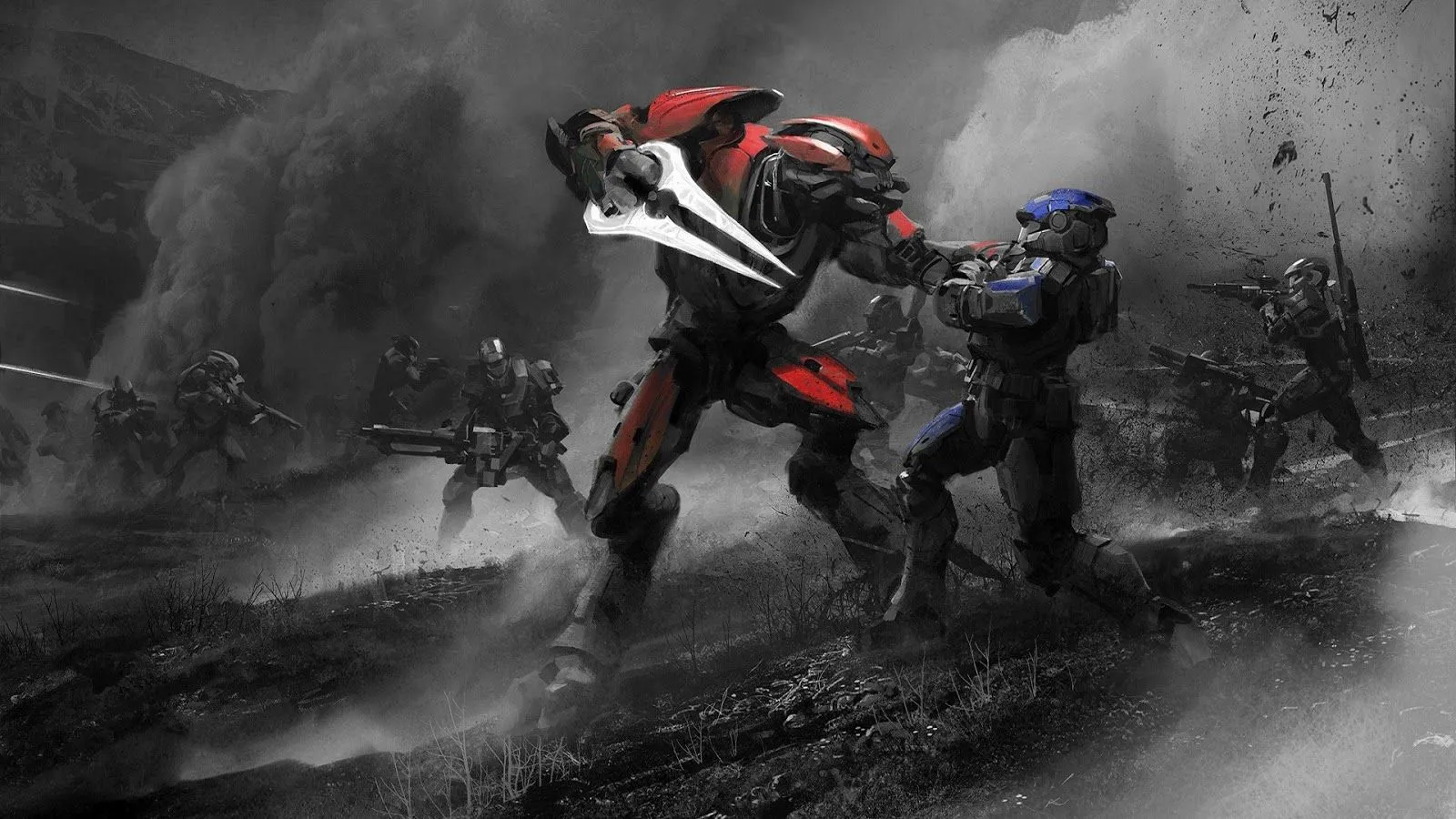
Unfortunately for Bungie, this game isn't an unmitigated failure. It's actually a very solid addition to the Halo universe. There are some pretty big changes that Halo fans may or may not like, but Microsoft isn't going to lose it's founding franchise to mediocrity as many people predicted when Bungie announced they were getting out of the Master Chief game. Before we get too deep into the details, let me say that this review is one big spoiler, so don't read on if you're planning on "saving" yourself for your own Halo campaign.
John Spartan Returns!
The events of Halo 4 take place four years after the events of Halo 3. John, the original Spartan, has been floating in hypersleep along with his AI girlfriend, Cortana. They are awakened when the ship is boarded by Covenant forces. Just as they were wiping the sleep out of their eyes, the ship gets pulled, tractor beam-style, into a nearby planet called Requiem. This planet was once populated by a race called "Forerunners". From what I can tell, these guys are something akin to the Reapers from Mass Effect. Not only that, but they control a race of cybernetic warriors called Promethean Knights (Protheans, anyone?) It is hinted that the Prometheans were a race of humanoids that had been previously wiped out by the Forerunners, just like the Protheans were wiped out by the Reapers in Mass Effect. Are you starting to see a pattern here? The Forerunners created the halos in order to completely wipe out all life in the universe at some point (the flood), and Master Chief just woke one up called The Didact. The reason behind their desire to enact extinction doesn't become clear in this episode, but I would imagine their motivations become known in the next two games. Microsoft Studios has already announced their intentions to make this the first chapter in another Halo trilogy.
Not only did Master Chief just awaken a galactic Orkin man for humankind, but his best friend Cortana, the AI that has been on a chip in his helmet since the beginning, is dying. Just like the replicants in Bladerunner, Artificial Intelligences in the Halo universe have a short shelf life. After seven years, their cognitive abilities start to deteriorate. Cortana is eight. Fortunately for her, Harrison Ford isn't going to put a hole through her chest like he did Daryl Hannah.
They call this deterioration "rampancy," but you can think of it as AI Alzheimer's. She has glitchy symptoms that gradually worsen as the game progresses. Although some humans take part in the action, the main story is about the Forerunners and their plans to kill all mankind with a weapon called the Composer. It is a massive artifact the size of the Empire State Building that has the ability to hit thousands of humans at once with a beam that does pretty much the same thing to them that Blade does to vampires.
Bang Bangs!
The new set of weapons was probably my favorite part of the newest entry in the Halo universe. The Forerunner guns are highly useful, well-designed, and they do something really cool when you reload them. They deny gravity's hold and come apart in your hand, then "magically" re-assemble. That's the best way I can describe it. The only one I didn't care for was the Boltshot. It is the pistol found in Forerunner weapon stashes and it is so under-powered it might as well be called The Tickler. The Supressor is their machine gun and it is slightly under-powered too, but makes up for it with a fire rate that increases the longer you hold down the trigger. The Light Rifle is their version of the sniper and it was my favorite gun in the game. It seemed considerably stronger than the UNSC long-distance rifle. All of the old Covenant weapons are also peppered throughout. There is even one set of Gravity Hammers, although that was hardly enough, in my opinion.
We Must Protect This House!
Halo 4 has several new types of armor. The classics like Camo and Jetpack are here, but several new options give interesting strategic options to the player. Promethean Vision is pretty much the same thing as Bat-Vision from Batman: Arkham City. You are able to see enemy positions through floors, ceilings, and walls. The Light Shield is highly effective defensive armor that covers you head-to-toe from direct frontal attack. I'm not sure if it was my impatience or the game, but it seemed like my regular shield didn't recharge as long as the Light Shield was active. That was mildly annoying because you can't use it like regular cover to allow your personal shield to recover, but it was still very useful when facing five or more enemies with firearms. My favorite new armor type was the Personal Sentry. It is reminiscent of Axton's turret from Borderlands 2, but it flies! I used the sentry both for its offensive capabilities as well as to draw enemy fire so I could grab some cover and recharge my shield. All in all, the weapon and armor additions are fantastic and they were the reason this didn't feel like just another Halo game.
What?! It Wasn't Perfect?
No, it wasn't perfect. The problems I found were minor, but worth mentioning. First of all, there were a couple of continuity issues. As in previous Halo games, the loadouts are already chosen when you start a new chapter, no matter what you were carrying when the last one ended. This only really pissed me off once when I was saving a Binary Rifle for a good 20 minutes. I managed to hang on to the most powerful long-distance weapon for an entire final battle only to have the game take it away and give me a pistol instead. Much less intrusive, but still mildly annoying was the lack of matching weapons in cutscenes to those in the actual game. It was obvious that they didn't bother with this little detail when I was carrying only Forerunner weapons but the Master Chief in the cutscene had a standard UNSC assault rifle.
This is the first time we get to hear Master Chief speak, and I think I would have preferred not to. Part of the character's appeal in previous games was his stoic silence. In this game, the guy won't shut up. In another bit of gameplay, 343 went the same direction as Bungie. The left trigger (L2 on PS3) throws a grenade. In every other first-person shooter on the planet, this button aims down the sights. For some reason, the designers of Halo decided to put that action on the right controller stick, which you have to click in order to zoom in for firing. While you can adjust these in the menus, I'm a lazy gamer, so instead I just wasted grenade after grenade trying to look down the iron sights. The soundtrack didn't blow me away, either. I actually didn't notice it much until the over-the-top hero theme played over the final battle scene. It was mildly annoying in its predictability. Finally, the end cutscene was just awful. I won't ruin it by telling you the substance of the dialogue, but suffice it to say the conversation between Master Chief and Commander Lasky was less necessary and more melodramatic than the last half hour of Lord of the Rings - Return of the King. That said, all of the characters including Thomas Lasky are masterfully rendered. The faces are the best I've ever seen. They put L.A. Noire to shame and it's claim to fame was the facial graphics. Don't take my word for it, take a look for yourself.
In summation, if you're a Halo fan, you need to buy this game. If you're an FPS fan, put down MW3 and Battlefield for a bit and try the original online multiplayer. If you're neither of these things, you can probably live without it.
The Math:
Objective Quality: 8/10
Bonuses: +1 for the fantastic use of light in the design. The combination of color choices and the use of light are what make Halo look and feel different from any other FPS games. Halo uses light the way Dead Space uses darkness: to perfection.
Penalties: -1 for a story that feels part stolen, part a re-tread, and all a bit small-minded. Part of the greatness of Halo is the fact that the fate of mankind hangs in the balance. This game focuses most of its energy on the interplay between Master Chief and Cortana. While their relationship is important, it shouldn't overwhelm the theme of mankind's extinction, but it does throughout.
Nerd Coefficient: 8/10. Well worth your time and attention
The Meat:
Spaceman is your typical NASA genetically created spaceman finds work as a scrapper in post apocalyptic world only to get tangled with a kidnapping of an orphan from the popular reality television show.
We are quickly introduced to Orson, one of the genetically created humans who was created by a NASA scientist to have greater bone mass and flesh density in order to survive the trip to Mars. When the public learned about this NASA was defunded and the surviving Spacement were sent to orphanages across the world.
You quickly learn to feel sympathy for Orson, with his Cro-Magnon like appearance, the squalor he calls his apartment, and his fear of people learning that he is a living genetic experiment. His life is not easy, living on the other side of the fence, driving through flooded cities to collect scrap metal to earn "funs".
One of the unique items of the book that actually made it harder for me to initially get into is the dialog. Humans speak outside of the fence speak a very basic dialect that can be difficult to follow. Instead of saying thinking they say "braining", sleeping is "zeeing", publicity is "pub city", etc. This became frustrating at times and forced me to read the story more carefully. It also distinguished very quickly the educated from the non-educated. In that capacity it was successful, but challenging.
Throughout the story we are given a window into the time Orson and his fellow spacemen spent on Mars. These flashbacks are erie glimpses of the Red Planet and drama that unfolded in space. To me this is where the book truly shines.
As the story unfolds Orson gets caught up in the kidnapping of Tara, an orphan "realtee" star. He saves Tara, but when is caught on tape with her he becomes the prime suspect. With his genetically manufactured body, Orson is extremely strong, and quite the formidable opponent. He leaves a path of destruction in his wake that further paints him as a villain who is to be feared.
Eduardo Risso captures the delicate balance between Orson's tragic side and the sheer terror he is capable of. At the same time you both fear and feel sorry for Orson. The environments are rich and detailed and really add to the suspense and horror of this tale.
The Math:
Objective Quality: 8/10
Bonuses: +1 for the flashbacks on Mars and the story that unfolds on the Red Planet. +1 for the beautifully tragic character of Orson. I really felt sorry for him and found him to be an incredibly complex character.
Penalties: -1 for the dialog being difficult to manage at points.; -1 for not enough time spent on the intriguing backstory. I would have loved to learn more about the early stages of life for Orson and his time in the orphanage back on earth.
Comic Coefficient: 8/10. well worth your time and attention
[See explanation of our non-inflated scores here.]
Another Thursday is upon us and I have my weekly review of the comics I felt like reading. This week featured the end of the first arc of John Layman's Mars Attacks, a new volume of Deadpool from the duo of Gerry Duggan and Brian Posehn, and Harvest build suspense before the next issue wraps up this great series. Without further ado, lets get down to business!
Pick of the Week:
Deadpool #1 - There is a crisis at hand. A group of deceased presidents have been raised from the dead by the Necromancer and S.H.E.I.L.D. doesn't want a public relations nightmare after Captain America is photographed decapitating Harry Truman. This is a case tailor made for Deadpool. Duggan and Posehn deliver the goods and dish out the humor, the buckets of blood, and the over the top violence. The battle between FDR and Deadpool is enough to warrant purchasing this book.
Runner-up:
Harvest #4 - Ben starts his quest to reclaim organs that were sold on the black market and give them to deserving individuals who have been waiting for a transfer. The illegal organ ring is not to keen on this and end up shooting Ben as he escapes. They are hip to his plan and now he is suffering from being shot. I hope something good is planned for the conclusion next book, because things don't look too good right now.
The Not as Good: Fairest #9 - This may be the best looking book in comics right now, but I just haven't been on board for the series. I am a huge fan of Fables and the universe Bill Willingham has created, but I just don't feel that Fairest has the depth and appeal as Fables.
The Rest: Detective Comics #14 - We have Penguin, Poison Ivy, and are teased with Clayface at the end of this issue. Layman has another solid issue under his belt and I will continue to buy this book as long as he is writing it.
Mars Attacks # 5 - The first chapter concludes and Earth is safe...for now. Zar is taken back to Mars where he is promoted and honored in the confusion of his assault on Earth. With his new access to resources and his new title, Zar is biding his time until he can organize another attack. This has been a fun arc to read.
Creator Owned Heroes #6 - Darwyn Cooke is introduced to this ongoing series from Image. With Creator Owned Heroes, you are treated to a series of mini-comics and some insider knowledge about the comic industry. Based on this issue I may have to back track and pick up #1-5.
Before Watchmen: Moloch #1 - I decided to go back and try another Before Watchmen comic and found this title pretty enjoyable. While not the most original origin story, it was entertaining to learn about Moloch as a child and how he became such a demented individual. I will be back for issue #2.
Have you ever seen a movie where a character in a fight realizes he has lost, commits harakiri, but, before dying, has a change of heart and attempts to strangle his opponent with his own steaming intestines?
No? Then you haven't seen Riki-Oh: The Story of Ricky.
TCM Underground screened this Hong Kong martial arts/prison movie the other day, which is stunning, because when I first saw it about ten years ago, its reputation was as literally the most disgusting and violent movie ever made. It turns out that the movie isn't nearly that -- not unless you find Itchy and Scratchy cartoons on The Simpsons legitimately disturbing. Anything by Gaspar Noe, anything that may or may not depict actual cannibalism, anything with graphic depictions of rape or child abuse, Twilight: Breaking Dawn, those are far, far more disturbing films because they appear to depict actual human beings in distress (or, in Twilight's case, actual audience members). Riki-Oh is a live-action cartoon that deposits gallons (what's a larger quantity than a gallon? hectares?) of blood at the audience's feet and says "I dare you not to tell your friends about me."
So if you are a fifteen-year-old boy, or an insatiable fan of Hong Kong action movies, or are high, then you will probably totally dig the following things that happen in Riki-Oh:
Several heads are punched (yes, punched) clean off
Ricky ties his own tendons back together with his teeth after being cut in a knife fight
Several intestines are punctured, either with knives or fists
A dog is kicked in half
At least two people are literally punched in the brain
Razor blades are consumed like candy
Several eyeballs go missing during fights
If right now you're struggling to contain your excitement, let me be very clear that none of this looks and/or feels any more realistic than accidentally spilling ground beef on your kitchen floor while trying to make chile rellenos. But if you're still excited about it, then by all means, hit up your local indie video store and bring this baby back to your dorm room.
The Math
Objective Quality: 4/10
Bonuses: +1 for the sheer inventiveness of finding this many ways to kill and maim in the least realistic ways imaginable; +1 for the evil assistant warden who keeps his breath mints in his glass eye; +1 for the warden himself, who seems to confuse the concepts of "kung fu" and "actually being a giant demon in human form."
Penalties: -1 for, well, most everything else.
Cult Movie Coefficient: 5/10. Problematic, but has redeeming qualities.
[See explanation of our non-inflated scores here.]