Showing posts with label weird western. Show all posts

Monday, May 6, 2024

Review: The Road to Roswell by Connie Willis

A first contact with a place we’ve seen many times before

I think we’re at a point when even making fun of Roswell conspiracy theories is itself a cliche, so tired and worn that little town in New Mexico has become in the years since what is in all likelihood a weather balloon crashed there in 1947 (even if it was several miles out of town and closer to nearby Corona—it becomes almost a supernatural version of Tours/Poitiers or Bull Run/Manassas). It is, most often, a reminder of how far science fiction has come, both in and of itself and within the broader constellation of American culture. It is consigned to the great storage room of our genre’s past, looked at in amusement and wistfulness on occasion, but rarely taken out and displayed to the world in its own right, and never entirely thrown away as we want to keep some sense of the past (I’m tempted to compare this tendency to the Cairo Genizah, although nothing so literally sacred is involved). However, Connie Willis has taken Roswell out for a spin once again, in her 2023 novel The Road to Roswell.

Your protagonist is Francie, a reasonable, normal American thirty-something woman (I’m guessing the age here but it strikes me as plausible) who is going to her friend’s wedding. This friend has had a long string of peculiar boyfriends, many of whom have been conspiracy theorists or other whackos of that general nature. Francie had thought that her friend was finally going to settle down with a normal, well-adjusted man who happened to like the desert, hence the wedding being in that famous town in New Mexico. Hoping against hope that it is mere coincidence that the annual alien festival is in town, she is disappointed to learn that, no, her fiancĂ© is yet another conspiracy theorist. Francie accepts she’ll grin and bear it, eventually, after trying to talk her dear old college friend out of it, but the wedding is in the UFO museum. Francie goes out to her friend’s car to get some festive lighting, and is stunned to find in that car not only the lighting, but an actual, living, honest-to-God alien.

What follows over the next four hundred-ish pages is a delightfully weird, thoroughly entertaining road trip story through the odder side of Americana, blended with 1950s-style alien abduction story, and sprinkled with classic Western films for seasoning. This is a book of many genres, and Willis handles it all dexterously, as if spinning plates on sticks, never dropping them, never even letting them wobble.

Francie is the perfect sort of protagonist for this wacky and wonderful story. She is deeply, profoundly normal—not normal for science fiction fans, normal for the American mainline culture (at least that of the educated class). She isn’t too keyed into all the science fiction tropes that Willis is playing with. Some stories have protagonists who approach the weirdness of their worlds with a certain familiarity, a sort of self-insert for the people who write science fiction. Not so here. Francie only has familiarity with any of this through osmosis, through the most popular, mainstream speculative fiction, and as such sees all this with not exasperation but with genuine bewilderment, not unlike the protagonists of those old 1950s films. In this way, Willis makes all this old stuff new again, and sees how it works.

The vastness of the American West plays a role here. To those of us in cities, such massive expanses feel spectacularly alien (perhaps this is why they have so often been the sets for science fiction movies, then and now). It is here Willis makes both humans and nonhumans feel equally alien to one another. It is this particular juxtaposition of character and setting where a truck stop feels bizarre and the glittering Las Vegas strip feels like something from another planet.

There’s also a large engagement with the Western genre, although in a way that is hard to discuss without ruining the magnificent experience of letting the reader find out for themselves. This alien is being introduced to America, in all its peculiarities and foibles (but nothing much more grave than that, being a relatively light-hearted work), and it is bemused, as many foreigners are. This fish out of water is flung into the frontier mythos, and misinterprets things through that lens, to comical and profound effect. I’m not sure whether Frederick Jackson Turner would be proud, but he would certainly have some thoughts, quite possibly strong ones.

And another point that is hard to discuss without spoiling: the nature of the alien. This is a very interesting creature, on Earth for interesting reasons, and one who learns to communicate in interesting ways. It is this special form of communication that interacts with this panoramic West in ways that drive the plot forward, leaving what may once have been trite feeling fresh and new. This is helped by Willis providing it with interesting characters, Francie foremost but by no means alone, to play off of.

There are only a few defects. One is a relationship between two characters resolving in the end in a way that felt oddly rushed (there’s another such example, which feels out of nowhere, but very in character, so I was fine with it). The other big one is a throwaway reference to Native Americans and their tangential role in the plot (and I mean very tangential) that felt rather othering in that old SF way. One could object to a sanitized portrayal of the American West here, those indigenous to that land most of all, but that runs into problems of tone that I’m not sure could be elegantly squared.

While those missteps should be acknowledged, The Road to Roswell is a fun read. It’s the sort of science fiction that reminds us why we fell in love with the genre in the first place, and more broadly, perhaps more importantly, shows us why our ancestors fell in love with it. This is a novel that unrepentantly dusts off old tropes and takes them for a spin. I encourage you to enjoy the ride.


Nerd Coefficient: 8/10.

POSTED BY: Alex Wallace, alternate history buff who reads more than is healthy.

Reference: Willis, Connie. The Road to Roswell [Del Rey, 2023].

Wednesday, May 3, 2023

Nanoreviews: Unraveller, The Mimicking of Known Successes, Tread of Angels

Unraveller by Frances Hardinge [Macmillan Children's (UK)/Amulet (US)]

Clara's review of Unraveller already covers most of what makes this book so great: Frances Hardinge always brings intriguing magic and thoughtful moral complexity to her particular brand of YA, and her latest is no exception. Set in a world where humans live alongside the otherworldy denizens of the Wilds, Unraveller focuses on Kellan, a boy from a community of weavers who has been cast out after gaining the uncontrollable ability to unravel both fabric and curses, and Nettle, a formerly cursed girl, as they travel the country of Raddith unravelling the various curses that its inhabitants have placed on each other - ranging from mildly inconvenient to the truly horrible. The curses themselves are gifted by the Little Brothers, spider-like fae inhabitants of Raddith who also take a keen interest in ensuring its technology doesn't develop too extensively. When someone is given a "curse egg", they have the ability to lay a curse on someone they feel has wronged them, but the punishment for even having a curse egg - let alone using it - is extremely steep, even before the emotional cost and stigmatisation for the curser is taken into account.

We follow Kellan and Nettle as they try to discover the source of a curse on Kellan, which appears to be making his abilities stronger and more unpredictable. Along the way, Hardinge sketches out the various impacts that living with this particular brand of otherworldly justice has had on Raddith's society, and what, if anything, can be repaired after a curse has come to pass. As tales of fae morality being imposed on humans go, this is a seriously good one, and Kellan and Nettle's mildly prickly friendship forms a wonderful core around which the rest of the narrative unfolds. If you haven't read any Hardinge before, this is a great place to start.

The Mimicking of Known Successes by Malka Older [Tor dot com Publishing, 2023]

It feels appropriate to be talking about this book (again, following one of my Nerds of a Feather colleagues, this time Arturo) at a point when many of the genre fans I know are grappling with the definitions and purpose of "cosy" fiction. Perhaps this will become an essay for another time, if this fan ever gets her proverbial shit together. The Mimicking of Known Successes, billed as cosy Holmesian fiction, divides much of its time between university campuses and windswept train platforms and comfy carriages, but perhaps not in the location you'd expect: this is the human settlement on Jupiter, to which the survivors of humanity fled after Earth became uninhabitable, with habitats floating in the, uh, clouds of our biggest planetary neighbour and connected by a planet-spanning train network. We follow Mossa, an investigator looking for a missing academic, and her ex-girlfriend and classical geographer Pleiti, who Mossa approaches to help with the investigation into her colleague. Together, the two uncover a deeper conspiracy surrounding this disappearance, with implications for Earth's future and the people who get to decide on it.

Part of the cosiness here is aesthetic: Older does a fantastic job of creating a colony that seems comfortable and interesting and dynamic, even as we see characters grapple with the historic loss of Earth and the limitations of their current home. The novella opens in a remote settlement at the end of the railway line which Mossa refers to as a "piece of grit", but it's a piece of grit with a surprisingly nice pub and pleasant residents, not some desperate, impoverished outpost. People are doing OK for themselves, and for each other, on Jupiter, even if some are more OK than others, and it makes for a very different atmosphere than the gritty "everyone is one step away from a cold, unpleasant death" aesthetic that pervades most colonisation stories.

Beyond that, though, The Mimicking of Known Successes provides a perfect mix of personal stakes with wider implications for humanity's future, with Pleiti and Mossa rekindling their relationship and grappling with what this case means for their respective careers while also piecing together the answer to the mystery, and its full stakes. At the heart of those stakes is the academic debate for Earth's future, which is introduced to us as an interdepartmental war between different geography disciplines (finally, geography gets the respect and centrality it deserves!), and effectively revolves whether recolonisation of Earth should take place with full understanding of Earth's former ecosystem and its recreation, or whether humanity should be trying to build something new and adjust as they go along. I would read an entire Mars Trilogy-style doorstopper featuring characters arguing about the ins and outs of terraforming along these lines, but here it's just one strand in a much shorter narrative. Moreover, it's inextricably tied to Pleiti's position as a classicist (the "understand everything first" position) working in an academic institution alongside colleagues who, for various reasons (such as "being men") do not give her views the respect she feels they deserve.

Mimicking of Known Successes has a great ending to its mystery and its romance, but it also leaves the door open for more stories in this world - which we are getting! I, for one, am very excited.


Tread of Angels by Rebecca Roanhorse [Saga (US)/Solaris (UK) 2022]

I haven't seen as much about this Weird Western as I'd expect given that it's Rebecca frickin' Roanhorse, but if you're looking for a diverting adventure into a frontier town of angels and demons (hey, "angels and demons" is a bingo square for Reddit's r/fantasy bingo this year!) you could do much worse than this novella. The setting here is a mining town where the ostracised "Fallen", descendants of rebel angels are put to work mining Divinity (created from the body of Abaddon, because what else would it be) under the watch of the virtuous "Elect". Celeste is a Fallen, but she has been raised by her Elect father and only recently reunited with her sister Mariel, who spent her childhood with the pair's mother. Now Celeste is trying to keep her head down, but when Mariel is accused of murdering one of the settlement's leaders, her sister is given just 24 hours to prove her innocent, aided only by her demon ex-lover Abraxas.

Standing between Celeste and her sister's freedom are an entire town's worth of deep secrets, not least those of her own sister, and most of the action here is about one woman coming up against an entire system which is stacked against her, not least because of the baked-in presumption of moral goodness in the angelic Elect (their leaders are literally called Virtues!) and the stigma against the Fallen. The adventure here is firmly in "satisfyingly tropey" territory, and while the end result is a story that didn't make a huge lasting impression on me, it's certainly an enjoyable read, with depths of worldbuilding that would lend themselves to further stories in this setting. 


POSTED BY: Adri Joy, Nerds of a Feather senior editor, dog owner, aspiring mermaid, having an increasingly weird time about her own biography

Wednesday, September 22, 2021

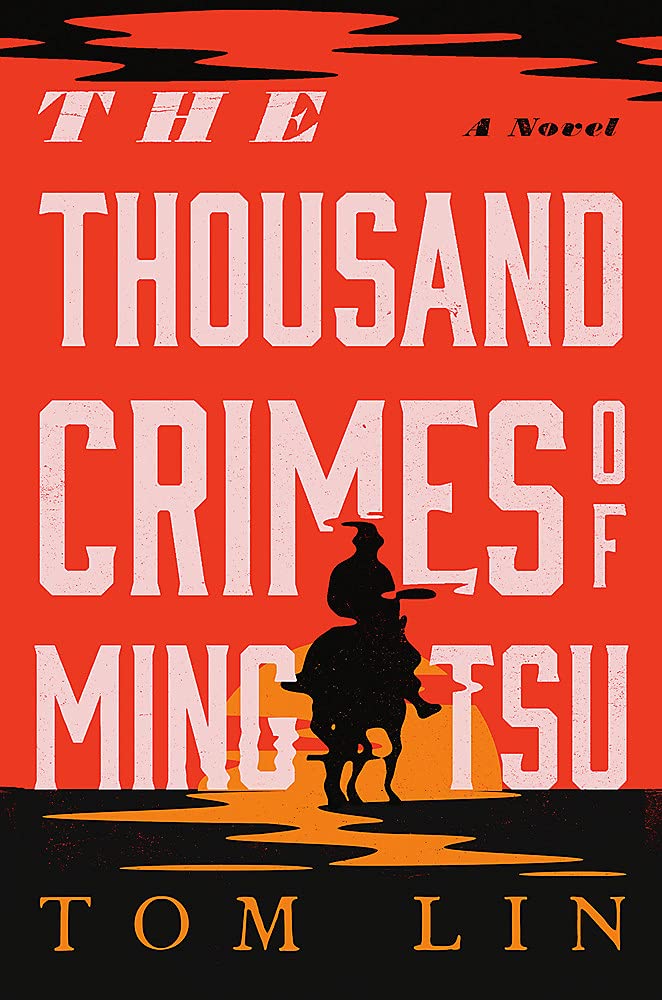
MicroReview [book]: The Thousand Crimes of Ming Tsu by Tom Lin


While you won't find Tom Lin on the SFF shelf, fans of the weird west will enjoy this lyrical read.


I love the genre of westerns in theory, but I've always found them hard to engage with due to their focus on the white male protagonist with plenty of racism and sexism thrown in, including a total lack of interest in engaging with the genocide of Indigenous people. It's hard to flip off all those switches when I sit down to read Cormac McCarthy. I knew I was in a different book when one of the main characters promised not to alter the memories of his friends, but when asked whether one of the white main characters was his friend, he said no white man was a friend of his. 

Set in the desert between Salt Lake City, Utah and Reno, Nevada, this novel has a straightforward premise introduced in the first pages: Ming Tsu has a list of people to kill, and he's very good at ticking names off that list. As the story unfolds, the reason for his revenge spree comes out. Tsu and a white woman had fallen in love and married against her father's wishes. In order to annul the marriage, the father charges Tsu with miscegenation and has him sent to prison. Now, years later, Tsu hunts down those that were involved in sending him to prison in hopes of returning to his wife.

While such a plot is certainly enough to fill the pages of this novel, Tom Lin adds a cast of characters to weird his interpretation of the West. First, Ming Tsu brings a character called the Prophet to ride with him. The Prophet has no memory but a powerful ability: he knows when beings will die, men as well as nonhumans. Freed from linear memory, the Prophet can lyrically describe the past of the landscape as well as how it will all eventually return to a shallow sea. 

The theme of time and memory is consistent throughout the novel. The Prophet informs Tsu he is a "man out of time," who has no clear hour of death. Similarly, the other people of the weird West revolve around time as well. On his way to check names off his list, Tsu and the Prophet join a traveling show of "miracles." The ringmaster, a white man, at first appears ordinary and has collected a traveling group of people with certain tendencies. There's Notah, a Navajo man, who can remove memories. Proteus, a "pagan," who can shape-shift into others. Gomez, a magical gambler. Hazel cannot be burned by fire. Finally, Hunter, a boy who can only speak through telepathy. They make their money traveling the West, demonstrating their miracles for an audience too drunk to realize they are, indeed, real. 

The ringmaster hires Tsu to escort them to Reno, Nevada. Where this novel really shines is the lyrical descriptions Tom Lin includes along their route. Whether it's the Prophet providing history lessons of deep time, or encounters such as a huge sea creature skeleton buried near Pyramid Lake, the desert is hard and spare, but beautiful. Tom Lin's prose truly captures this beauty.  

Additionally, Lin’s choice of protagonist repositions the genre. At its heart, the novel is a lyrical, if not fun, revenge story. That being said, it questions whiteness, what it means to be partnered with whiteness, and the power of whiteness. Throughout the novel, Tsu is juxtaposed to his white counterparts and experiences racism still prominent today: claims that he looks like everyone else, surprise that he can speak English, surprise that he can’t speak Mandarin, racist caricatures, in addition to the motivation for his revenge spree, being charged with miscegenation. In this novel, white people are in power and that isn’t ever a good thing.

Ultimately, this novel questions what has been erased in the West, from the previous inhabitants of the landscape to whole swathes of history. This novel recontextualizes the genre by centering the importance of Chinese immigration and labor in creating the “West,” particularly the railroads that are the center of so many western films and novels. In response, Tom Lin offers Ming Tsu, an epic gunslinger on a quest.   

While Tom Lin addresses the suppressed history of Chinese immigration and labor in the West, other injustices are passed over or used for flavor, such as an attack from an unnamed Native American tribe. Ultimately, this is where the novel falls flat for me. It’s difficult to celebrate the inclusion of other suppressed histories while the Indigenous history of the era is passed over, as is the history Latinx people and Black people. Obviously, Lin couldn’t address all the injustices of the western genre—nor should he—but it’s also troubling when a Native American attack is not contextualized and the only speaking Indigenous characters are “magical.”

Tom Lin's The Thousand Crimes of Ming Tsu is a lyrical yet fast-paced read, telling the story of revenge against white supremacy. While this book includes much needed commentary on silenced history of Chinese immigration and labor in the West, it does so at the cost of other passed over histories. Too many of the diverse characters are quick sketches that can misstep into stereotype even as they question the systemic white supremacy that forces them together. While this book is an enjoyable read, I wish the story hadn't focused on one often glossed-over history at the cost of others.

The Math

Baseline Score: 9/10

Bonuses: +1 lyrical prose

Penalties: -3 Examining white supremacy at the cost of silencing/passing over other histories in the western genre, particularly Indigenous people, Latinx people, disabled people, and women.

Nerd Coefficient: 7/10

Reference: Lin, Tom. The Thousand Crimes of Ming Tsu [Little Brown 2021]

Posted By: Phoebe Wagner is a PhD candidate at University of Nevada, Reno. When not writing or reading, she can be found kayaking at the nearest lake. Follow her at phoebe-wagner.com or on Twitter @pheebs_w.


Tuesday, January 17, 2017

Microreview [books]: Children of the Drought Trilogy by Arianne 'Tex' Thompson


 I have been on a "weird western" reading kick as of late. I can't seem to get enough of them and love reading all the different takes authors have when they are pulling from the same core foundation. Arianne 'Tex' Thompson's Children of the Drought trilogy was recommended to me a few times via the Twitterverse and with the recent release of the final installment, I decided to jump right in for a binge read of all three.

The first book, One Night in Sixes, definitely wastes no time in setting up the main characters, Sil Halfwick and Appaloosa Elim, for a hard journey into Eaden territory, place neither have ever ventured. 

One Night in Sixes takes place over the course of an eventful few days where Elim, while trying to chase down Sil, manages to get himself into a heap of trouble after inadvertently killing a man. Their roles end up in reverse as Elim heads deeper into Eaden territory as part of his atonement and Sil finds himself trying to help Elim. 

I found myself in love with Elim's character as well as the secondary character, Dia, who comes to play a larger role in the next two books. The strength in the trilogy as a whole comes more from Thompson's character building than world building. More than once I found myself a bit confused about the world itself and how things came to be the way they were but I tried to let go of that and focus on the characters and their relationships.
 
 
Medicine for the Dead is the second book in the trilogy and finds Elim still on his journey through a'Krah territory towards the capital city, Atali'Krah. Accompanying the corpse of the man he killed and two a'Krah men tasked with getting them all there safely, Elim soon learns he will face new hardships and learn more about his true history than he ever thought possible.

Some of the world does become more clear in the second book but I came to think of it as background and was more interested in focusing on the characters and what could possibly happen to them next. There are demigods and multiple holy figures at work Elim is often faced with more than a language barrier; he is forced to confront his farm upbringing where he was purchased and raised as a stand-in son for a family far-removed from the native lands were he was birthed and stolen.

This second book deepens the character relationships, my favorite part of the entire trilogy. We are also given a broader look and understanding of the freshwater mereaux race of amphibious people and their relations with people living on both sides of the river.


In the final installment, Dreams of the Eaten, we find our various parties attempting to make their final push towards Atali'Krah. (I am leaving this vague specifically to avoid spoilers). There are trials to be faced at every turn and Elim finds himself nearly spent, of hope, energy, and the will to keep trying.

Elim and Dia, Vuchak and Weisei, Shea and Fours, all these individuals find themselves facing down their own history as they attempt to reconcile all the choices they've made and the people that shared in the consequences. 

Throughout the entire trilogy I felt the hope from each character that they could do better and be more. The heart of each book is found in the characters. However, the world itself could sometimes be a confusing mash-up of the actual history and language and soft shifting towards fantastical elements. 

The Math (for the trilogy as a whole)

Baseline Assessment: 7/10

Bonuses: +1 for wonderful characters

Penalties:  -1 for a somewhat confusing world with a bit too much going on

Nerd Coefficient: 7/10 "Wonderful characters you'll want to spend more time with."

***

POSTED BY: Shana DuBois--extreme bibliophile and seeker of raindrops.

Reference: Thompson, Arianne 'Tex'. Children of the Drought [Solaris, 2014, 2015, 2016]

Our scoring system explained.