Showing posts with label spacemance. Show all posts

Friday, September 22, 2017

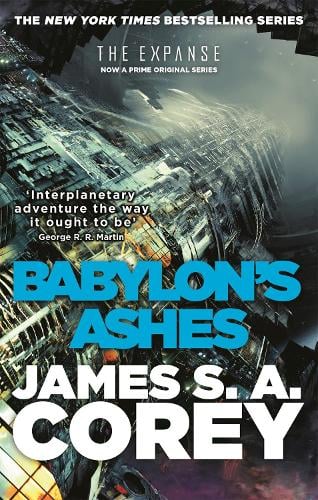
Microreview [book]: Babylon's Ashes (book six of The Expanse), by James S.A. Corey

 A rather anticlimactic conclusion to the Holden/Nagata vs. Inaros saga, with too much Holden and Inaros and not enough Nagata!

Corey, James S.A. Babylon's Ashes. Orbit: 2016.
Buy it here if you wish. 

When The Dark Knight Rises (clumsily!) began building up the villain’s mystique of Bane, we knew two things right away: Batman would fight him twice, and the first time he would be utterly defeated. It is this initial defeat which increases the melodramatic payoff of his eventual victory: we know how tough the enemy is, because we’ve seen it first-hand.
Bane = a worthy adversary; Inaros = an annoying fop
A similar narrative convention is at work in books five (Nemesis Games) and six (Babylon’s Ashes) of The Expanse. Marco Inaros is the Bane of the solar system: he (to hear him retell it) single-handedly rocked (see what I did there?) the inner planets’ equilibrium, nearly destroying Earth. This corresponds to Bane’s initial victory over Batman; so far, so good. But all of this build-up is to increase the melodrama when Batman (or in this case the dynamic duo of Naomi Nagata and Jim Holden) eventually triumphs against this formidable foe. And this is where, in my opinion, Babylon’s Ashes missteps.

It turns out Inaros just isn’t that compelling a villain, and perhaps as a consequence of this, the good guys’ inevitable victory over him isn’t particularly cathartic. In one sense that shouldn’t matter, since of course it’s entirely up to Daniel Abraham and Ty Francks what sort of villain to create, and nothing mandates a “tougher than you can believe” archetype. The problem, as I see it, is that they fell into this narrative trope without having the right sort of villain for it. Inaros is simply a megalomaniac with a flair (sort of) for PR, but his ridiculous behavior and blunders end up alienating many of his erstwhile supporters. This leeches the catharsis right out of the mano y mano confrontation at the end, since in a manner of speaking Inaros has already been beaten, in small ways, numerous times before this.

If the big, bad wolf who wrecked the solar system is nothing more than a navel-gazing fool, it cheapens the hard work the crew of the Roci (et al) have to do to bring him to heel. Indeed, we are left with a somewhat less favorable impression of the super-crew, since defeating a moron like Inaros apparently taxed them to the limit of their abilities! Surely there was something less explosive they could have done to knock out all those rail guns in the ‘slow zone’? I mean, was that really the best plan they could come up with, these brightest minds in the solar system?

Despite Marco Inaros being a nincompoop, the writers chose to focus a bit too much on him and in particular, his thirst for vengeance against Holden, the man who kept humiliating him. Fair enough, to be obsessed with a pissing contest seems in character for the petty Inaros, but why did the writers let him and his quest to destroy Jim Holden dominate the story? A much more compelling storyline, it seems to me, would have been in a more explicit opposition between the methods and worldviews of Nagata and Inaros, since one way of thinking of this book is as a battle for the soul of Filip, their son. Besides, Nagata is a much more interesting character than Holden (of whose earnestness, if we’re all being honest, we’re getting a bit tired, aren’t we?).

Nothing against Alex and Amos, but in general, the male characters of this series just aren’t as compelling as the female ones: the Naomis, Bobbies, Michios, and Clarissas (to say nothing of the indefatigable Avasarala herself!). One humble suggestion for future installments in this probably interminable series: stick with the ladies! (I’m happy to say that their latest novella does precisely this, telling the story of an interesting tweenaged girl growing up on Laconia—stay tuned for my review!)


The Math:

Objective assessment: 7/10

Bonuses: +1 for having such great female characters (but see ‘penalties’ below)

Penalties: -1 for the narrative mismatch between the fop Inaros and his Bane-like mystique, -1 for focusing too much on the boring male characters and too little on the ladies of the system!

Nerd coefficient: 6/10 “Still enjoyable, but the flaws are hard to ignore”


[Does a mere 6/10 seem low to you? Check out our scoring system here, and learn why it’s actually not bad!]


Zhaoyun, who to be honest is more a fan of ‘spacemance’ than of space opera per se, has been inhabiting The Expanse since it burst onto the scene, and has been a regular(ish) contributor at Nerds of a Feather since 2013.

Tuesday, March 8, 2016

Microreview [book]: Beacon 23, by Hugh Howey

An excellent spacemance!
Howey, Hugh. Beacon 23. Broad Reach Publishing: 2015.

Buy the complete novel here (I also recommend the audio-book).

“Spacemance (n): a romance tale cloaked in a robust veneer of space opera.”

Can an ex-jarhead learn to love? I’d say the answer to that, a la Avatar, is a resounding “yes”, and Hugh Howey agrees based on the content of Beacon 23. And more importantly, he crafts a story that works both as romance and as space opera (with hundreds of millions of lives on the line, no less).

I only picked this up to read/review because of my fondness for several, if not quite all, of Howey’s other books, particularly Wool. That is to say, if someone pitched me a “The Notebook…but in space, and without the whole forgetting who the guy is thing!”, I don’t think I’d really have been sold. But Howey works considerable magic into this tale, which might well be his most poetically written yet. It’s an elegant mix of crass interiority and beautiful turns of descriptive phrase, painful honesty about (and from) the unlikely hero and tremendously empathetic passages that one can hardly read without growing a little teary-eyed.

If we’re being honest, I blubbered a bit myself here and there during the story, and was forcefully struck by the beauty of certain passages, and by the powerful recurring metaphor of the space beacon-as-lighthouse, and the mysterious painting showing either a wise person resigned to a terrible fate or a fool with no clue about what is coming. Needless to say, the main character is revealed to be both the wise man and the fool, both worthy of love and desperately in need of it.

But here’s the best aspect of this spacemance: the being both worthy of and in need of love character trait/flaw turns out to be the very quality the Other is trying to find, and the only thing that can, perhaps, bring an end to the cycle of interspecies warfare. To quote another Hugh(ie), it’s the power of love!

I’m sure all that sounds cheesy, but remember how beautifully Howey crafts the story and you’ll begin to understand why it’s such a success. He’s created one of his most compelling characters yet, and arguably his most beautiful and emotionally evocative story. Fortunately or unfortunately, the story is also complete (like the first Matrix movie was complete), and can’t really accommodate a sequel (yes, all you Matrix Reloaded and Revolutions fans, I’m saying what you think I’m saying: those movies were as unnecessary as they were crapitudinous).

In conclusion, if you like beautifully written romantic stories set in space, then it’s safe to say Beacon 23 is for you!

The Math:

Objective assessment: 6/10

Bonuses: +1 for raising the beauty of his writing to a new level, +1 for creating one of his best characters yet

Nerd coefficient: 8/10 “Space + romance = where do I sign up?”

[‘That’s a pretty low score for such an enthusiastic review, isn’t it?’ Answer: ‘no.’]


Zhaoyun has been sniffling through many a spacemance since joining Nerds of a Feather as a regular contributor in 2013.

Friday, November 27, 2015

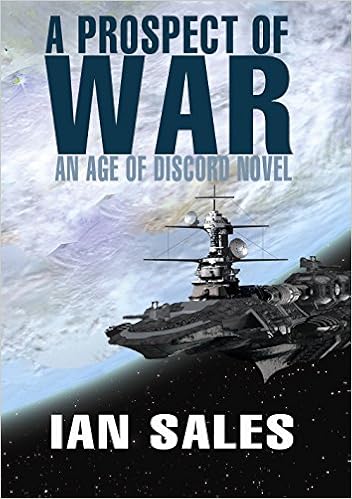
Microreview [book]: A Prospect of War, by Ian Sales

First-rate space opera "spaction"—a new epic adventure begins!

Sales, Ian. A Prospect of War. Tickety Boo Press Ltd., 2015.

Said book can be bought right here!

Best of all, this space opera is way more interesting than real opera, because there’s just a whole lot more going on with a lot less (practically none, really!) full-throated warbling whilst striking dramatic poses on stage. Seriously, how many operas have you seen? Be honest: you secretly (or perhaps openly!) think opera is pretty dumb, right? But I’ll bet most of you totally like the idea of (outer) space, especially when there’s ships blowing up and people getting impaled on swords and everything!

So how did we get the term ‘space opera’? Space is way cooler than opera. But I don’t want to be a complainer, so I’m here with an alternate suggestion: spaction! That’s exactly what A Prospect of War is: major action, involving spaceships and brief stops on planets and conspiracies against an ancient, seemingly stable empire. Plus, Sales took a hint from Frank Herbert’s brilliant innovation to combine spacefaring civilization with swords: the technological explanation is similar, something along the lines of projectile weapons being ineffective against personal shielding gizmos so all high-class people master the sword.

The most interesting innovation Sales brings to the spaction is the seemingly harsh neo-feudal system in place throughout the enormous empire. Society is stratified into the noble class (hardly any), the yeoman class (an elite few), and proles (the 99%).  The difference between the two elite classes is tiny compared to the rigidly enforced gulf between the proles and the higher-ups. That said, among the epic cast of characters, several yeomen-class figures end up impersonating proletarians, with varying degrees of effectiveness (coaching from a linguist helps one yeo(wo)man temporarily shed her haughty aristocratic speech patterns and accent). It’s fascinating to consider a multi-planet empire that has devolved in its social system to a complicated feudal monarchy, and not necessarily implausible either.

However, it seems to me it would be all too easy for people in such a universe to fake it—both ways (assuming they have the means to acquire a suitable costume). Right from the beginning of the story, it’s so tremendously useful for elites to use the giant world of the underclass that despite their classist distaste for the idea, they keep doing it. Obviously the reverse is a lot more destabilizing to the social order, and there are a few offhand comments by characters suggesting (that they believed) any prole who dared attempt such a revolutionary act would be caught instantly (and it’s an offense punishable by death, which would provide a healthy deterrent for most, to be sure!).

This is by way of saying that the sociopolitical system, while interesting on an intellectual level, sounds a couple of gentle pushes from total systemic collapse (and to be fair, this is the first part of a larger series which will certainly explore the weaknesses of the seemingly eternal empire). Aside from this quasi false note, however, the rest of the story and its characters are quite engaging (though Casimir’s journey to maturity was quite a jerky, abrupt roller coaster), and I’m looking forward to the subsequent installments! To Ian Sales, and in honor of Thanksgiving: I'm thankful for A Prospect of War (which sounds pretty weird unless we all understand it's a book title!).


The Math

Objective assessment: 8/10

Bonuses: +1 for rocking the spaction formula

Penalties: -1 for a degree of implausibility in the idea of a neo-feudal space-faring civilization

Nerd coefficient: 8/10 "something pretty awesome this way comes" (see stuff on scoring here).


This message brought to you by Zhaoyun, spaction-lover and reviewer at Nerds of a Feather since 2013. 
Monday, October 5, 2015

Microreview [books]: Mother of Eden (and also Dark Eden), by Chris Beckett

Dark Indeed, But Well Worth It Despite the Annoying Repetition of "Do For" to Mean "Kill"

Beckett, Chris. Mother of Eden. Broadway, 2015.

A world without a star is a world without much in the way of light. Not being able to see stuff is tough as crap. Add this to the fact that, true to the ‘Eden’ moniker, the human population of the sunless world begins with just a single woman and a single man, and consequently there’s lots of incest-y, genetic bummers in the population’s future, and you’ve got the recipe for…what turns out to be kind of an awesome story!

First of all, in Dark Eden Beckett takes the idea of linguistic drift and runs with it. The story of the first big change in the human civilization, such as it is, of Eden takes place about 160 years after the first two people arrive, and there are now 500 or so descendants. Complete linguistic isolation from mother Earth has led to interesting changes, as well as tons of harelip (which I’m pretty sure isn’t actually genetic) and clubfeet and whatnot. Their community—one big family—has grown to the point there’s no more food nearby, yet they cling to harmony (not a single murder), and to the mythical promise that Earth will come rescue them.

Enter intrepid John Redlantern. Everything changes, because of his brave, restless spirit, his unquenchable thirst to make things better. He probably sounds like kind of a great hero, right? And he is—but he’s also a villain, and therein lies the brilliance of Beckett’s idea. All readers will instantly sympathize with John, only for Beckett, later on, to reveal the heavy price relentless innovators like him extract from everyone else. Their thirst to be remembered as heroes has them doing all sorts of dastardly deeds, John and other men “who want the story to be all about them.” He and others like him quickly wreak the Edenic vibe (and bring more of a Cain-ish feel, if you get my meaning).

Fast-forward again another six or so generations, and the human population has exploded and spread throughout Eden. They’re all still technically one family, but split into two major factions descended literally and ideologically from the two main hero-villains in Dark Eden. The two main groups, somewhat isolated, and all the minor groups have begun to develop their own peculiar way of speaking English, and are constantly making fun of each other’s stupid accents. All sorts of bad stuff going on now, and this time around the story’s centered around a woman, a sort of second Eve (or, in the parlance of the series, (An)Gela), who has to chart her own way, between the two hard, merciless male centers of the world.

I’m barely clinging to the cliff after the cliff-hanger ending, by which I mean that I’m quite interested in how Beckett chooses to return to Eden in volume three, and how far things have drifted this time. That’s not to say there aren’t false notes along the way; the second half of Dark Eden dragged a bit, while the merciless world of Mother of Eden made me feel, in a strange way, a little of the anger all freethinking people felt when they saw Alien 3, and how it disposed of the brave heroes of Aliens. 

Thanks for nothing, David Fincher!

Why read a story about a generation like John’s, and begin to like all those people despite their faults, only to skip ahead several generations and find that only their bad qualities have been handed down? But he’s spun a fascinating story, with a fantastic starting premise that keeps getting better, and I’m already looking forward to returning to Eden in book three.


The Math:


Objective Assessment: 7/10

Bonuses: +1 for making John, and others of his personality type, both likeable and detestable

Penalties: -1 for the time-jump, thereby pulling an Alien 3, cheapening the sacrifices made in Aliens (i.e., Dark Eden)

Nerd coefficient: 7/10 “Not without its flaws, but an enjoyable experience to be sure”


See details of our scoring here.

Zhaoyun has been rocking things at Nerds of a Feather since 2013.

Friday, May 8, 2015

Microreview [book]: Abendau's Heir, by Jo Zebedee

A mostly believable, mostly enjoyable, majorly melodramatic spacemance...

Zebedee, Jo. Abendau's HeirTickety Boo Press Ltd, 2015.

Let me ask you this: do you agree with B.F. Skinner, that the human mind is infinitely malleable, a blank slate onto which a skilled behaviorist could write whatever s/he wants? Would you still be you if you'd been raised by someone else—an evil Empress, say? If you answered 'yes' to any of this, then the central conceit of Abendau's Heir will be convincing to you. But recent studies suggest limits to the malleability of the human personality outside the context of deeply traumatic events. Though the scientific literature is by no means conclusive, there are reasons to theorize that the development of one's personality may have more to do with genetics than who raises you or in what sort of environment.

On one level, Abendau's Heir is about an evil telepath Empress who rules a multi-planetary, multi-system Empire (actually more like a coalition of Great Families) and will stop at nothing to recover the child Kare, the product of her union with an (unwilling) resistance leader with psychic gifts. It's a multi-decade tale, with the majority of the exciting stuff occurring when the powerful psychic Kare is between the ages of 17 (the age when, out of options, he joins and eventually rises through the ranks of the resistance army and tries to avoid becoming a political pawn of the Great Families) and 25 (when some other stuff happens).

But that's just the political stuff. It's equally a love story between Kare and Sonly, and many aspects of that love story were appealing to yours truly, what with my sentimental romantic nature.  Who doesn't want to believe that love will conquer all, including some pretty grim stuff?

Certain aspects of the interface between the romantic tale and the political tale didn't quite convince me, however. Characters occasionally make terrible, hare-brained decisions that no one would ever make. I can't go into specifics without giving much of the story away, but just imagine you had the power to heal your best friend's mortal wound, and could do so if you just killed the bad guy everyone hates anyway; would you really choose to preserve the bad guy's life at the cost of your friend's? (And it wouldn't take much effort to kill the bad guy, since you can break bones with a thought!) That's not much of an ethical dilemma—no one on earth would let their friend die so that their enemy could go live in a padded room somewhere, and the only reason to have this sort of scene is to increase the melodrama, the emotional toll on the main characters. It doesn't sit very well with me that characters, who otherwise seemed like rounded individuals with coherent goals and whatnot, would suddenly act like meat-heads in these key, emotionally charged moments. That goes for the bad guys, too—why betray your cause and your own family over such a petty grudge? And if you're the sort of person who is capable of that (i.e., a sociopath at best), why didn't people notice it sooner and cut your arms off, or whatever?

And why is this all about another 'super' man, by the way? Why wasn't this story about Kare's twin sister, Karia? She was way cooler than him, and the only reason I can think of to hang the story on Kare rather than Karia is that some of the "grim stuff" later on would have felt even grimmer if it'd been Karia going through it...speaking of grimness, I had let my guard down and was viscerally shocked to read that stuff. Yikes! Be warned—the story eventually heads in a dark direction and there aren't many rainbows and fluffy bunnies and other nice things. I'm a gentle soul—I wanted more rainbows, fewer tears :)

All that said, it's quite an entertaining story, and for the most part the melodramatic excesses, which force characters into out-of-character craziness, is a minor distraction. My one word of totally unsolicited, impractical advice to the author is: next time, more bunnies!


The Math:


Objective Assessment: 7/10

Bonuses: +1 for creating a believable spacemance (space opera + romance)

Penalties: -1 for a gratuitously high grimness to rainbows ratio, -1 for sacrificing characters on the altar of melodramatic excess

Nerd coefficient: 6/10 "Still enjoyable, but the flaws are hard to ignore"

(Seem mercilessly low? Not at all--as you can see here, we at NOAF endeavor to eliminate grade inflation, one straight-shooting review at a time!) 


Bunny-lover (but not in an icky sexual way!) Zhaoyun has always preferred rainbows to grim stuff and has been saying so here at Nerds of a Feather since 2013.

Friday, January 10, 2014

Microreview [science fiction book]: Fortune's Pawn, by Rachel Bach

The Meat


   This book inspired me to coin a new term: spacemance! Yes, that's right, a quasi-interspecies romantic saga taking place in space. As the only known representative of this new sub-subgenre, Fortune's Pawn was actually pretty great, on both the space/sci fi side and the interstellar romance side of things.
   Despite having caught a terminal case of romance years and years ago (love that won't end until I'm dead, and who knows? Maybe not even then!), I preferred the tough battle armor mercenary side of spunky protagonist Devi Morris's personality to the gushy mushy kissing (etc.) stuff. That isn't to say that the love story between Devi and Rupert is poorly done, per se; it's more a compliment to the space stuff, especially the thought of battle armor being to future combat and gender equality what the Colt revolver was supposed to be between women and men: the great equalizer. It's just plain awesome to have a girl smacking sense into big tough men, and it's a situation that's more believable when we're talking about some amazing combat armor rather than five minutes of karate lessons in the backyard (I'm thinking of you, Buffy/Sarah Michelle Gellar! Try raising your leg more than six inches off the floor when you deliver a "powerful" roundhouse kick next time!).
   Rachel Bach is a talented writer, there's no doubt about it—she spins together a story of a world very different from our own in some important ways, yet it all somehow works. Partly this because she adroitly avoids the exposition trap, i.e. the compulsive need to explain any unfamiliar technology in a ham-handed way; instead, she lets the uses and dangers of each such technology speak for themselves over the course of the story. After all, this isn't hard science fiction: readers would probably be unfazed to learn that this or that technology (hyperdrives, for example) are impossible according to all known laws of physics. That's not really the point.
   Through the first-person narration (which brings us such priceless internal monologue one-liners as "Arguing with him was like arguing with a dead apple tree—fruitless"), we get a very clear idea about the motivations—and desires—of Devi, a great spacemance character if ever there was one. She's got plenty of pluck, and whenever she finds herself in over her head, she just punches someone else into the shape of a flotation device (so to speak).
   The romance side of things is almost a let-down after all that coolness. Stuck on a small space-faring vessel with an ornery captain, his sister-in-law, a meatheaded fellow merc/character foil, a dreamy hippy, a catatonic teenager, Big Bird (because the navigator is literally a large avian), a carnivorous reptilian life form, and a mysterious, dashingly handsome uber-cool cook slash spy type harboring a deadly secret, it doesn't exactly come as a surprise who she picks to fall head over heels over; the surprise is that she goes all gushy in the first place. It feels like she's being subordinated into what the T-101 humorlessly referred to in Terminator 3 as a "human pair bonding". Why can't the story just be about her kicking her enemies into dust?
   And worse yet, why does the man have to be totally more powerful and dangerous, in the end, than the woman? Put differently, why does every romance have to be about a weaker girl and an Edward Cullen type, where it becomes about his awesome self-control in not ripping her to shreds or whatever? I won't deny that it was an exciting pairing—tough girl meets exotic eye candy who is more than he seems—but I would've been totally fine with a spacemance story without the mance, if you see what I mean.
   That said, Fortune's Pawn was a real page-turner and I, for one, am very much looking forward to book two, and a continuation of Devi's adventures!


The Math


Baseline assessment: 7/10

Bonuses: +1 for Devi being one of the most compelling heroines ever, what Ripley would've been if she'd been a professional soldier, +1 for dodging the exposition trap

Penalties: -1 for limiting Devi's coolness by subordinating her into a love affair with a quasi-supernatural man/being who makes her considerable abilities look pitiful in comparison

Nerd coefficient: 8/10 Well worth your time and attention!


Note: don't think of this score as a B-; instead, think of it as showing that Fortune's Pawn is better than 80% of all books! You see, we score on a bell curve, with very few books getting a 2 or 3 and very few an 8 or 9 (and as for 1s and 10s, practically none!).