Showing posts with label roleplaying games. Show all posts

Thursday, June 6, 2024

Review: Girl by Moonlight

A game about courage, companionship, introspection, and lots of warm fuzzy feels

In case the evocative title or the gorgeous cover didn't make it obvious, the TTRPG Girl by Moonlight (based on the Blades in the Dark system) lets you roleplay heroic adventures as a costumed superhero with sparkling magical powers. One would typically call this a magical girl setting, although the term is not meant to be literal:

This text uses 'magical girl' as a shorthand, but your magical girls need not be girls, necessarily. Rather they are people whose identities put them at the margins. They must conceal their true selves, conforming to the world's suffocating expectations even as they work in secret to transform them.

The chaos of teenage emotions is baked into the mechanics: along with the power of Transcendence,  which lets the player character transform into the best version of herself, there's also Eclipse, a condition during which she's vulnerable to her own insecurities. As explained in the introduction to the rulebook, the most important villain for a magical girl is not a specific evil individual, but the pressure of social conformity. This is where the allegory for queer marginalization is made explicit, and where the game director can (and, indeed, is encouraged to) milk all the drama inherent to secret identities. Accordingly, the player characters' most important superpower isn't a ray of burning light, but friendship. Even the Monster of the Week has a heart in need of healing.

As a game focused more on narrative devices than on crunchy math, it offers four playable scenarios, corresponding to four flavors of heroic fantasy:

  • At the Brink of the Abyss is about bright optimism—the text namedrops Sailor Moon for comparison.
  • Beneath a Rotting Sky is about the futile fight against a painful destiny in the mold of Madoka Magica.
  • On a Sea of Stars is a space opera with giant robots and endless angst.
  • In a Maze of Dreams is a surreal dystopia set in the collective hallucination of cyberspace.

Each of these scenarios comes with a list of theme-appropriate superpowers, its own chain of missions, and instructions for the game director to give the setting its distinct flavor.

Campaign preparation is a process of consensus between the game director and the players, from the worldbuilding to the stakes to the choice of tone. Players don't start creating their character concepts until after completion of these steps, in order to ensure that characters will have a firm grounding in the setting of the story and in their shared ties. Also, each player contributes their own secondary characters to flesh out the setting.

To keep the action flowing, the rulebook advises to "start in season two," that is, skip the origin stories and assume the superheroes already know one another. There are 7 PC archetypes, each of which occupies a specific position in the social dynamic of the superhero team: the Enigma (e.g. Zorro), the Guardian (e.g. Optimus Prime), the Harmony (e.g. Captain Planet), the Outsider (e.g. Wolverine), the Stranger (e.g. Entrapta), the Time Traveller (e.g. Sailor Pluto), and the Unlikely Hero (e.g. Madoka). To add depth to these roles, each PC has Promises, which summarize their general feelings about other members of the superhero team and guide how they'll behave toward them during play.

The format of a game session is divided in four phases: Obligation (following the superheroes' mundane lives in their civilian identities), Downtime (exploring who these characters are when they aren't within view of adult authorities), Mission (it's morphin' time!), and Fallout (dealing with the aftermath). This sequence follows a standard narrative arc of escalating tension followed by dénouement, which is the same structure of a superhero TV episode. And just like superhero shows, several game sessions are grouped in a season, with a large-scale plot and a big, dramatic finale.

"Player Agenda" is a fundamentally important section of the rulebook. It describes the designers' recommended style of play, one based on collaborative narration, emotional openness,  normalization of queer perspectives, radical empathy, unattachment to fixed plot points, and rejection of grim nihilism.

PCs' effect on the fictional world is systematized through nine predefined actions: Confess, Forgive, Perceive, Express, Defy, Empathize, Conceal, Flow, Analyze. Often, more than one possible action will seem appropriate to the situation; even if a character has equal scores in two different actions, which would seem to make the choice indifferent, which one is used in the moment will color the story with a distinct emotion and will reflect the character's identity in a particular way. This is a great implementation of the general storytelling principle that character is revealed through choices.

The game uses 6-sided dice to resolve actions, rolling as many dice as the character has points in an attribute, and adjudicating success according to the single highest result (although rolling more than one 6 adds benefits to the success). The difficulty of the task is then determined by negotiation between the director and the player, depending on the PC's degree of control over the situation (there's a scale for that) and how much can be achieved with the selected action (there's another scale). There are ways (including multiple forms of teamwork and boosted morale from intimate bonds) to increase the chances of success, sometimes at the cost of extenuating effort or a future misfortune. An interesting part of these rules is that the game director announces the consequences of a failed attempt before the player  even rolls the dice. This part of the game system has the function of systematizing dramatic stakes—for both limb and heart.

That's all fine and dandy, but the main event of the show is, of course, the transformation into a superhero. In Girl by Moonlight, this is called Transcendence, and it's very explicitly a symbolic representation of the moment a character embraces the full self that ordinary society would prefer to keep suppressed. In mechanical terms, this unlocks better chances of success in action rolls against the supernatural, as well as access to specialized abilities depending on the genre of the story. This state lasts for a fixed number of actions, at the end of which the PC returns to normal. Each PC can use Transcendence only once during the Mission phase of the episode.

The rules give players considerable power to steer the plot, including ways to directly facilitate other players' success despite not being themselves present in the scene, or to avoid negative consequences for their characters, or even to insert a narrative flashback where preparations were made for a specific bad scenario. This dynamic requires a strong trust between director and characters, who are expected to work in consensus to maintain the intended tone of the story. It may sound counterintuitive for superheroes to have so many ways to de-escalate or obviate direct combat, but that's the essence of the magical girl genre. Although this is an adventure game, PC actions are heavily oriented toward interpersonal connection. Yes, you're fighting evil by moonlight, but the whole reason for doing so is the people you care about. Magical girls wear their hearts on their sleeves.


POSTED BY: Arturo Serrano, multiclass Trekkie/Whovian/Moonie/Miraculer, accumulating experience points for still more obsessions.

Monday, May 27, 2024

Let's have a look at Tales of the Valiant, an alternative to D&D 5e

The rules of Tales of the Valiant are backwards-compatible with 5e, but include several improvements both in pure mechanics and in presentation of information

If the repeated blunders from Wizards of the Coast got you tired of Dungeons & Dragons, there are compatible options to pick from. On May 7th, news came out that Kobold Press had released the Reference Document for its upcoming TTRPG Tales of the Valiant (ToV), a backwards-compatible clone that aims to replace D&D 5e. Kobold Press has been working on this project since early last year, after the official D&D publisher, Wizards of the Coast, fired multiple shots at its own foot in its ill-advised attempt to change its licensing terms to gain more control over third-party creations. One consequence of that disaster was the drafting, at Paizo's initiative, of the Open RPG Creative (ORC) license, which is much less aggressive than Wizards of the Coast's own Open Game License (OGL). Another consequence is the ongoing emergence of 5e-compatible game materials by independent publishers. Kobold Press is just the latest publisher to launch its alternative to 5e, so this is a good moment to compare editions and see what new ideas are to be found in ToV and other similar games. As can be expected from a Reference Document, the one just published by Kobold Press contains only the minimal rules to play ToV. But it's detailed enough for the reader to get an idea of what the game is like.

The core mechanic has undergone no change from D&D: characters have the usual six ability scores and modifiers. Rolls can be improved by Luck, which is this game's version of D&D's Inspiration mechanic. In addition to PCs earning Luck points for good ideas or good roleplaying, they also gain a Luck point on any turn in which they fail an attack or save roll. While D&D only lets PCs have one Inspiration at a time, ToV lets PCs accumulate up to 5 Luck points. In D&D, a PC spends their Inspiration to gain advantage on a roll. In ToV, that effect costs 3 Luck points. ToV also lets PCs use fewer (or more) Luck points to instead add a bonus to their roll equal to the number of Luck points spent.

For character creation, ToV introduces a system of Lineages and Heritages instead of D&D's races and subraces. According to the ToV conversion guide, a Lineage refers to biological traits (such as size, speed, and senses) and a Heritage refers to cultural learning (such as languages and proficiencies). In addition to this system, ToV has Backgrounds, which, as in D&D, correspond roughly to the occupation that the PC had before taking up the adventuring life.

  • The Lineages listed in the ToV Reference Document are: Beastkin, Dwarf, Elf, Human, Orc, and Halfling Smallfolk. Alignments no longer exist, and choice of Lineage has no effect on starting ability scores.
  • The Heritages, which, again, must be understood as the circumstances of a character's upbringing, include: Cosmopolitan, Cottage, Diaspora, Grove, Nomadic, Slayer, Stone, Supplicant, and Wildlands.
  • The Reference Document only lists Criminal, Scholar, and Soldier among the available Backgrounds.

Character classes are the area where changes from D&D are most noticeable. Subclass features now have a uniform progression: all characters get them at 3rd, 7th, 11th, and 15th levels.

  • Barbarians get proficiency with herbalism tools. Barbarian Unarmored Defense gives an AC of 13 + Con regardless of Dex. The Fast Movement feature lets Barbarians automatically move up to half their speed upon rolling initiative. Feral Instinct has been moved from 7th to 6th level. Brutal Critical also applies to a natural 19 on the attack roll. Relentless Rage has been moved from 11th to 14th level and is a little riskier to use. Persistent Rage has been moved from 15th to 10th level as an optional feature; 10th-level Barbarians can choose to instead rage instantly when rolling initiative. Indomitable Might has been replaced with a feature that improves Str and Con saves and grants extra damage against objects and structures. In the Berserker subclass, Frenzy no longer causes exhaustion; in fact, 7th-level Berserkers can ignore any exhaustion while raging. Berserkers get proficiency with Intimidation for free. Intimidating Presence is now a bonus action and is harder to resist; it also grants extra damage against frightened enemies. Retaliation can now be used in response to any type of attack, regardless of distance, and even if the enemy misses.
  • Bards lose proficiency with hand crossbows and gain it with all Finesse martial weapons. Tool proficiency has become a little more flexible. Starting equipment no longer includes the option of a longsword, but has wider tool options. Bards know one more cantrip than D&D Bards of equivalent level. The Bardic Inspiration die now increases to a d12 at 14th level instead of 15th. Bard Expertise has been moved from 3rd to 2nd level, and its expansion to more Skills has been moved from 10th to 6th level. The Song of Rest Celebrate Life ability can be used at any time as an action, but heals fewer hit points and has a limit of daily uses. Cutting Words is now a standard feature of all Bards, while Jack of All Trades is exclusive to the Lore subclass. The Countercharm Clarity of Thought ability grants temporary immunity to becoming charmed, but has a limit of daily uses. Font of Inspiration has a new power that lets Bards grant an Inspiration die as a reaction to a failed roll. Magical Secrets has been moved from 10th to 9th level and from 14th to 13th level. At 10th level, Bards get the option to let allies either recycle a failed Inspiration die for later use or apply their Inspiration die to alter damage dealt or received. At 20th level, Bards can regain a few more uses of Bardic Inspiration than in D&D, and this ability can be used on any turn. In the Lore subclass, Bards can grant allies advantage on specific ability checks, have a wider selection of Feats Talents, learn more Rituals and can cast them faster, and keep successful Inspiration die from Peerless Skill.
  • Clerics get the choice at 1st level to either gain one more weapon proficiency or learn one more cantrip; either choice deals extra damage. Channel Divinity gets one extra use at 13th level. Turn Undead Turn the Profane now works against Fiends too. The chance of success of Divine Intervention now progresses more slowly per level. At 10th level, Clerics get the option to get either immunity to disease and poison or resistance to radiant or necrotic damage. At 20th level, Divine Intervention can be used once per day instead of once per week. The list of domain spells for the Life subclass is now even more focused on healing effects. Divine Strike has been removed, but the Life subclass has a new power at 11th level that lets the Preserve Life ability remove diseases, poisons, and some conditions. The War subclass also has a more focused domain spell list. It offers a wider selection of Feats Talents and, instead of adding bonuses to attack rolls, as in D&D, it has powers that give advantage on attacks and increase rolled damage.
  • Druids are no longer forbidden from wearing metal, and their weapon proficiency is expanded to all simple weapons. They know one more cantrip than D&D Druids of equivalent level. They also get a 1st-level healing power and, at 10th level, the choice to either speak with animals permanently or regain a use of Wild Shape once per day. Timeless Body Nature's Grace has been moved from 18th to 17th level and lets Druids survive without food or water. Druids start with fewer uses of Wild Shape than in D&D, but go on to gradually get many more. Wild Shape is limited to a number of known animal forms equal to the Druid's proficiency bonus, and the progression of allowed animal CRs is slower, but at 14th level, animals with a CR of 2 become available. Wild Shape also lets Druids regain expended spell slots instead of transforming. There's no direct analogue to D&D's Moon subclass, but the new Shifter subclass lets Druids choose stronger forms at earlier levels, speak while transformed, make extra unarmed attacks, and gain some elemental powers.
  • Fighters get Second Wind Last Stand at 1st level instead of 2nd. It heals more hit points and can be used more often, but only as a reaction. Fighting Style has been removed. The new Martial Action ability gives Fighters a bonus action in every turn to execute one from a list of combat maneuvers. Action Surge gets more uses at a faster rate than in D&D. Fighters get a third attack at 9th level instead of 11th, and a fourth attack at 17th level instead of 20th. The Indomitable Defiant ability has been moved from 9th to 10th level and no longer needs a reroll; 10th-level Fighters can choose between having this ability or being able to end a condition on themselves. At 20th level, Fighters gain a power that increases damage once per turn. There's no direct analogue to the Battle Master subclass, but the new Weapon Master subclass lets Fighters reroll damage once per turn, execute specialized maneuvers, and score critical hits on natural 19 rolls.
  • Mechanists are a new, non-spellcasting class that resembles the D&D 5e Artificer and the PF 2e Inventor. They get 10 hit points per level (more than either Artificers or Inventors), proficiency with medium armor and martial weapons, and Con and Int saves. They can learn an object's magical properties by touch. With the Shard of Creation ability, they can craft a permanent, transformable piece of magical matter that can turn into a weapon, a shield, or any object of comparable size (the allowed size increases at higher levels). Similar to the D&D Artificer's Infuse Item ability, the Mechanist's Augment ability can be used to add magical effects to objects. Mechanists know fewer effects than Artificers of equivalent level, but can have more enchanted objects at a time. At 10th level, Mechanists get the choice to either make a touched target vulnerable to all damage or heal a touched target; either ability is usable once per day. Similar to the PF Inventor's Armor subclass, the Mechanist's Metallurgist subclass grants the power to create a unique suit of armor with enhanced properties.
  • Monks lose the option of a shortsword as part of their starting equipment, but gain the option of a sling. Unlike Barbarians, Monk Unarmored Defense remains unchanged from D&D. Deflect Missiles has been moved from 3rd to 1st level. Monks start with more Ki Technique Points than in D&D, but the progression slows down to become identical after 9th level. Flurry of Blows allows one attack with a monk weapon in addition to the usual choice of two unarmed attacks. Slow Fall has been moved from 4th to 9th level. Evasion has been moved from 7th to 6th level. Stillness Purity of Mind is now a bonus action and has been moved from 7th to 10th level; Monks can choose between this ability or the standard Purity of Body. Tongue of the Sun and Moon Astral Teachings now costs Ki Technique Points to use. Perfect Self Boundless Technique can now restore Ki Technique Points in any turn. In the Open Hand subclass, the new Focus Intent ability lets Monks alter rolls made by creatures nearby. Wholeness of Body heals fewer hit points, but can be used more often. Tranquility Tranquil Soul now costs Ki Technique Points to use. Quivering Palm costs 4 Ki Technique Points instead of 3 and is less lethal.
  • Paladins no longer prepare spells; now they have a repertoire of known spells with the same progression as Rangers. Divine Sense can be activated more often, without spending any action, and lasts for one minute instead of one round. Lay on Hands is a bonus action if the Paladin uses it on themself. Fighting Style has been removed, but Paladins get a smaller version of Fighters' Martial Action ability. Channel Divinity can be used more often at higher levels. Aura of Courage has been moved from 10th to 9th level. The expansion of Paladin auras has been moved from 18th to 17th level. The Improved Divine Smite Radiant Strikes ability has been moved from 11th to 10th level; Paladins can choose between this ability or using Lay on Hands to let an ally spend a hit dice. At 20th level, Paladins gain a 30-ft aura, usable once per day, that grants resistance to nonmagical damage and automatic success on death saves. In the Devotion subclass, Turn the Unholy Sanctifying Light also works against Aberrations and Fey, is resisted with Charisma instead of Wisdom, and causes blindness instead of fear. The oath spells of this subclass are more focused on protective effects and fewer in number than in D&D. Purity of Spirit has been moved from 15th to 11th level. Holy Nimbus has been moved from 20th to 15th level, now grants advantage on all saves, and deals more damage.
  • Rangers get an option of tool proficiency. Instead of the Favored Enemy, Natural Explorer, and Land's Stride abilities, 1st-level Rangers gain a mode of movement (climbing or swimming) and advantage on all checks to track, and unreduced speed in difficult terrain. Similar to the PF 2e version, ToV Rangers get a 1st-level power that increases damage against an enemy that the Ranger has magically marked as their prey. Fighting Style has been removed, but Rangers get a smaller version of Fighters' Martial Action ability. Primeval Awareness Empowered Mark has been moved from 3rd to 6th level, no longer costs a spell slot to use, has a range of only 60 feet, and can only be used against a marked enemy, but now reveals the enemy's exact location. Instead of an improved mundane hiding ability, Rangers can turn invisible. Feral Senses Keensense has been moved from 18th to 14th level.
  • Rogues have their weapon proficiency redefined as all simple weapons and martial Finesse weapons. At 10th level, Rogues have the choice to either receive even less damage on saves or get a wider selection of Feats Talents. Critical damage increases at 13th and 17th levels. Slippery Mind has been removed. In the Thief subclass, the Supreme Sneak ability has been replaced with Appraising Eye, which lets the Rogue discern the properties of magical items at a glance. With the new Trap Specialist ability, 11th-level Rogues can attempt to disarm a trap (even a magical trap) as a reaction when it's activated.
  • Sorcerers have their weapon proficiency expanded to all simple weapons. They know one fewer cantrip than D&D Sorcerers of equivalent level, but end up with one more spell slot for 6th- and 7th-level spells. Font of Magic has been moved from 2nd to 1st level. Sorcerers learn one more Metamagic option. Careful Spell can now protect more targets. Distant Spell has a longer range. Twinned Spell costs 1 more Sorcery Point. New Metamagic options let the Sorcerer increase a spell's area of effect, change a spell's damage type, cause half damage on a successful save, improve a spell attack roll, avoid losing concentration, or gain temporary hit points. Sorcerous Restoration Sorcerous Renewal has been moved from 20th to 5th level as a scaling ability. At 10th level, Sorcerers get the choice to either add a bonus to ability checks or learn a spell from another spell list. A 14th-level power lets Sorcerers absorb the energy from incoming spell attacks to regain Sorcery Points. At 20th level, Sorcerers can share the effect of ongoing spells with another creature. In the Draconic subclass, a few combat spells are added to the Sorcerer's repertoire depending on the selected lineage. Dragon Wings has been moved from 14th to 11th level. Draconic Presence has been replaced with Draconian Vengeance, a power that makes a target vulnerable to one type of energy damage.
  • Warlocks gain proficiency with medium armor and shields. Warlocks now have a repertoire of known spells with the same progression as Rangers, and regain their spell slots only with a long rest. All Warlocks get Eldritch Blast by default, and its damage progression is faster. The progression of known Invocations is also faster at higher levels. Attack and damage rolls made with Pact of the Blade can use the Warlock's Charisma. The options for Pact of the Chain replace the sprite with the blink dog. At 3rd level, the redesigned Pact Magic ability lets the Warlock cast a few spells per day without expending spell slots. Later abilities include choices to add more known spells beyond the standard number. Mystic Arcanum is now an Invocation that must be selected. Eldritch Master can now be used during a turn of combat without expending an action. In the Fiend subclass, the extra known spells are mostly fire-themed. Dark One's Blessing grants more temporary hit points.
  • Wizards have their weapon proficiency expanded to all simple weapons. Arcane Recovery no longer restricts higher spell slots. The new Magic Sense ability detects magical creatures, items, and effects within 30 feet. Signature Spells Rote Spells has been moved from 20th to 5th level. At 6th level, Wizards can swap some prepared spells with other spells from their spellbook. At 10th level, they can choose to learn either Rituals from other spell lists or spells from other spell lists. The new Spellguard ability grants advantage on saves against spells and resistance against spell damage. Spell Mastery can now be used only once per short rest, and only works with the spells selected as Rote Spells. The new Archmage ability gives Wizards a way to regain expended spell slots. Wizard subclasses don't seem to be tied to the traditional eight schools of magic. The one listed in the Reference Document is the Battle Mage tradition, which is similar to the way the Remaster version of PF 2e themes its Wizard subclasses. However, whereas the PF Battle Magic school just grants some extra known spells per level, the ToV Battle Mage offers a wider selection of Feats Talents, a power to create a magical shield around the Wizard, the option to exclude allies from the area of damaging spells, an ability that redirects the Wizard's failed spell attacks, and improved damage with spells.

ToV has taken several cues from how magic works in Pathfinder 2e. There are now just four spell lists: Arcane (Bards, Sorcerers, Wizards), Divine (Clerics, Paladins), Primordial (Druids, Rangers), and Wyrd (Warlocks). To avoid confusion between character levels and spell levels, the latter have been renamed spell circles. Rituals are now their own category of magic, counted separately from a PC's known spells.

An interesting new system in ToV is Weapon Options. These are combat maneuvers that can be performed with certain weapons. For example, the Hamstring maneuver is available with the sickle and the handaxe, while the Ricochet Shot maneuver is available with the sling. Many of these maneuvers exist in D&D 5e as class options for Fighters, but in ToV they're open to all characters.

Other noteworthy changes from D&D 5e include:

  • The options for light armor add brigandine, described as made of metal-reinforced cloth. Armors are tagged with properties, such as Noisy, which gives Disadvantage on Stealth rolls, or Cumbersome, which require a minimum Strength to wear.
  • The list of tools has been condensed. For example, what D&D classifies as carpenter's tools, mason's tools and woodcarver's tools is handled in ToV as a single set of construction tools.
  • The limit of magic items that can be attuned to a character is now their proficiency bonus instead of a fixed number.
  • ToV adds meticulously detailed rules for PCs who want to socialize, craft, research, train, or work. These rules are more generous than the much briefer ones in D&D 5e; for example, crafting progresses at a rate of 10 instead of 5 gold pieces per day, and training costs 1 gold piece per week instead of per day.

The last area where ToV improves upon D&D is in graphic design. The Conversion Guide mentions monster entries as a topic where special care was put into ease of readability, but the change can be felt all through the Reference Document. Even in the sections where the mechanics of the game remain the same as in D&D, the rules have been reworded for clarity and precision, the formatting of the text helps the eye catch the dependencies between sections and subsections, and the order in which topics are presented follows a more logical criterion of relevance. This is in marked contrast with D&D 5e's notoriously convoluted prose.

As I said above, Tales of the Valiant is not the only creation born from this movement to break away from the restraints of both the official Dungeons & Dragons rules and the licensing ambitions of Wizards of the Coast. Other 5e clones worth checking out are Level Up: Advanced 5e by EN Publishing, Iskandar by M.T. Black Games, and the upcoming project codenamed C7d20 by Cubicle Seven.


POSTED BY: Arturo Serrano, multiclass Trekkie/Whovian/Moonie/Miraculer, accumulating experience points for still more obsessions.

Tuesday, April 9, 2024

Six RPGs with Alan Bahr

Alan Bahr is an award-winning and best-selling roleplaying game designer, known for his company Gallant Knight Games, as well as his work at Osprey Games, Steamforged Games and many other companies.

With the Kickstarter of Siege Perilous now live, today he tells us about Six RPG games that have influenced him.


1 & 2. King Arthur Pendragon / Prince Valiant—Perhaps combining these is cheating a bit, but separating them would feel wrong. Both by Greg Stafford (my polestar in game design), these games both showcase Greg's talent for finding the soul of a genre or mythos and bringing it right to the forefront of a game. I often refer to Greg as "the game designer's designer," for his breadth of talent (as showcased in both these games the strongest) is one that you will appreciate the further you go into game design theory and thought. They have long cast a shadow over Arthurian tabletop gaming.

3. Keltia—A very personal love, Keltia is a French RPG translated to English (and now sadly out of print). Keltia deals with the Arthurian mythos through a more mythstorical lens, rather than one derived from fantastical mythology. The evocative art sells the idea of this setting being dark, with bright lights shining through as the world changes and you are at the forefront of it.

4. Dungeons & Dragons (3.0/3.5)—The game that got me into roleplaying. The pictures, ideas, and hooks throughout that first Player's Handbook fired my young imagination and kept me charging forward. I still go back to my collection of 3.x books and thumb through them, my appreciation growing deeper as the years go on. A perfectly imperfect game, in all the best ways.

5. Aaron Allston's Strike Force—Perhaps the greatest hidden and underappreciated treasure inside gaming, Aaron Allston's Strike Force is revolutionary in putting to paper common (but misunderstood or miscommunicated) game-running practices and campaign structure ideas. While it is deeply tied to superheroic roleplaying, the lessons in the book apply widely across games and campaigns and helped make me a better designer and facilitator.

6. The Quiet Year—Avery Alder's card-mapping game is hugely influential in how I changed my opinion on the physical act of presence in tabletop roleplaying. The careful card-tography (an ill-advised portmanteau of card-based cartography I just invented) creates a uniquely physical act of exploration and storytelling that subtly supports the game through physical interaction and action.

And tell us about your own game:

Siege Perilous is my own entry into my body of game design canon, a game I've been carefully crafting for a long time.

Siege Perilous is a solo and troupe (group) roleplaying game about Arthurian knights questing across England. You will travel through the life of your knight, encountering characters, enemies and NPCs. You will undertake quests, both for your own advancement and that of those you serve alongside and for.

Siege Perilous is about getting older and moving past old scars that still pull at you. It's about loss, discovery, pursuing perfection and failing. It is about romance, battle, conflict, duty, loyalty, love, faith, and death.


Thank you, Alan!

Paul Weimer. Ubiquitous in Shadow, but I’m just this guy, you know? @princejvstin.

Monday, September 25, 2023

Review: The Road to Neverwinter by Jaleigh Johnson

It turns out you can have a lot of fun this many levels of adaptation in. Who knew?

It’s a novel based on a movie which is itself based on a tabletop role-playing game. In reading this book, we are three layers into the adaptation-mania that is cultural production under late-stage capitalism. I got this on a roll of the dice from a library, mostly because I had liked Dungeons and Dragons: Honor Among Thieves, and to my great joy I found that it was actually quite good, and that under the swashbuckling heroics and magic we all love from D&D there’s some really smart stuff in it.

Dungeons and Dragons: Honor Among Thieves: the Road to Neverwinter (another curse of cultural production under late-stage capitalism: SO. MANY. COLONS.) is written by Jaleigh Johnson, an author I didn’t have any experience of. Well, whatever she did before, it prepared her well for this, in the way I understood why Lucasfilm chose Timothy Zahn to save Star Wars after reading his Conquerors trilogy (a series I love).

The Road to Neverwinter is a prequel to Honor Among Thieves, detailing how the merry band of misfits that had broken up by the start of the film got together in the first place. As you may suspect, it’s a heist, and plot-wise there’s nothing groundbreaking (but it must be said that D&D codified a lot of these tropes, so they’re everywhere). The author more than makes up for that in how well she captures the voices of the film characters; you can imagine Chris Pine and Michelle Rodriguez and Hugh Grant saying all their lines, and it helps you get in that goofy fun mood the way the movie did. Even better, Johnson totally sells you on the notion that these people could make an adventuring team (someone should make a movie about that). She also has the knack of humor, and I guffawed several times. It’s good for the soul.

What really struck me about this book is that Johnson understood that she’s writing a novel adaptation of a film adaptation of a tabletop game, and that therefore there is plenty to play with in terms of the ways people create fictions. Firstly, there’s the frame story of Edgin recounting the story to his daughter Kira (about nine years old at the time), who was involved in several of those events and wants them told a certain way, which has all sorts of implications for modern fandom (and perhaps throwing a little shade at some fans). Beyond that, it gets rather spoilery to discuss it in depth, but there are several layers of representation and performance and adaptation and whatnot that add a clever subtext to the whole thing.

And, of course, there’s the certain je ne sais quoi that I can’t put any other way than ‘feels like a D&D game.’ The film had it, and this book has it too. Johnson does a good job of making the world feel like a D&D game while still working as a novel, and there are several personal interactions that feel joky in the way that players who know each other are. That isn’t usually how you write pseudo-medieval fantasy, but here it helped with the vibe. The whole thing feels a bit wacky and improvised, and I mean that in a positive way.

The Road to Neverwinter felt like warm soup when you have a cold; in a world this dreary, you need something filling and wholesome and warm. It’s a fantasy romp in the proudest tradition of D&D and a good thing for when your RPG group isn’t in session if you have the hankering for it. It rounds all this off with a self-awareness that enhances proceedings rather than encumbers them, and it complements the film like hand in glove. If you enjoyed the film, you’ll enjoy this.

--

The Math

Highlights: witty dialogue, subtle but clever meta-weirdness.

Nerd Coefficient: 8/10.

POSTED BY: Alex Wallace, alternate history buff who reads more than is healthy.

Friday, July 14, 2023

6 RPGS with Gareth Hanrahan

Gareth Ryder-Hanrahan is an Irish game designer and novelist who has worked primarily on role-playing games, but in the last few years has been working on novels. Following his Black Iron Legacy (The Gutter Prayer) series, Gareth's new novel starts a new series, The Sword Defiant.

Today he does NOT tell us about his Six Books, but rather, given his deep background in roleplaying games, I have asked him about Six Influential Roleplaying games instead.,

Six Influential Roleplaying Games.

1. Dungeons and Dragons


Arthur C. Clarke had a line that the solar system consists of the Sun, Jupiter and assorted debris. By that metric, the Roleplaying game hobby consists of D&D and assorted debris. Dungeons and Dragons is still the ur-game, the game that looms largest in the public consciousness. It’s as foundational and influential as gravity; indeed, D&D reaches far beyond tabletop roleplaying to shape the fantasy genre, to computer games, to culture in general. Part of D&D’s potency is that the game is itself influenced so reality. The earlier versions of D&D were a hodge-podge of whatever the designers thought was cool (Aragorn, Conan and Rhialto the Marvellous team up to fight Cerberus!) and later editions have continued this tradition, absorbing and distilling the trends of fantasy, boiling them down into archetypes.
 
2. Star Wars

There’s an argument that getting a roleplaying game adaptation is the death knell of a setting. By their nature, roleplaying games need to codify everything, to fill in the gaps and define the rules. They circumscribe the possibilities of a setting; there can be no new stories, only variations on what’s gone before. I’ve worked on a bunch of licensed roleplaying game adaptations, and the argument’s not wholly without merit – a roleplaying game adaption does require you to figure out what other sorts of stories can co-exist with the original inspiration, and what can’t. (For example, in the Tolkien-based One Ring game, set between the Hobbit and The Lord of the Rings, we’ve spent a lot of time teasing out the adventures that might happen in that gap between tales). However, a roleplaying game adaption can take a single story and expand it to a whole universe, creating a solid foundation for other media to build on. Take the Star Wars roleplaying game – when it came out, there was only the original trilogy and a few bits of disjointed ancillary work. It was the Star Wars RPG that built much of the galaxy as it appears today – both the original extended universe of novels and the current television series draw heavily on material that first appeared in the RPG.

3. Call of Cthulhu


Similarly, the Call of Cthulhu roleplaying game codified and categorised Lovecraft’s Cthulhu mythos – and in doing so, influenced generations of game designers, both tabletop and digital. Call of Cthulhu’s other great legacy is in adventure design, taking stories beyond the dungeon and presenting epic interactive stories like Masks of Nyarlathotep.


4. Apocalypse World


A game about surviving and building community in the wake of a worldwide catastrophe. The indie RPG movement and the influence of the Forge produced countless roleplaying games. Apocalypse World, though, stands out not only in its commercial success, but also its mechanical influence. There’s a whole generation of games (two, if you count Forged in the Dark and its successors) built on the Powered by the Apocalypse rules. One of the fascinating things about roleplaying games is that there are few external factors shaping the rules. Computer games are shaped by developments in hardware – more memory, faster processors – and board games are influenced by the availability of components and advances in printing and layout software, but roleplaying games are (mostly) just text and pencils and paper and dice. Physically, Apocalypse World could have been printed in 1974 – but it took nearly fifty years of design and development for the ideas to come together.

5. Critical Role


There has been one critical (ahem) technical shift in roleplaying in the last few years – streaming. Since its inception, a roleplaying game has been an essentially private activity, where the participants are the audience. They’ve been ephemeral, too – it’s very hard to capture the act of playing a game. Transcripts and examples of play existed, but for decades, roleplaying games were usually an oral tradition, where you learned to play from someone else (and they’d learned from someone else, who’d learned from someone else, on and on back through the years). Now, that’s changed, and it’s astounding. The huge growth of D&D in the last few years, the growing accessibility of the hobby, and the shift to online as a major mode of play augurs very well for the future of roleplaying.

6. DIE


In DIE, former roleplayers from our world are magically dragged into a fantasy realm and transformed into heroes. To go home, all they need to do is agree to leave – but everyone needs to say yes. The game was written by Kieron Gillen in parallel with the comic series.

It’s hard to say that DIE’s influential yet, as the rulebook only just came out. But DIE’s certainly interesting. It’s a game that celebrates – wallows in, even – roleplaying’s past, with dungeons and dragons and dice and unlikely monsters, and is fuelled by nostalgia. But it’s about telling new stories, about trauma and regret and change, and the game mechanics draw as much from the indie scene as from D&D.


The Sword Defiant


My new novel, the Sword Defiant, can’t deny its gaming connections. The initial concept – a band of heroes slay the dark lord, then occupy his city of evil – was inspired by a line from Tolkien, but got developed in a scenario for the Hillfolk roleplaying game. There’s as much D&D in its DNA as Tolkien; the Nine heroes are a well-balanced adventuring party, and the vast ever-shifting monster-spawning labyrinth beneath the city is a tribute to all the dungeons I delved in my youth.


Thanks, Gareth!

POSTED BY: Paul Weimer. Ubiquitous in Shadow, but I’m just this guy, you know? @princejvstin.

Wednesday, April 5, 2023

'Dungeons and Dragons: Honor Among Thieves' is just as cheerfully chaotic as your most memorable game sessions

This movie is what you get when your only writing guideline is Rule of Cool

Your average gamer isn't necessarily a professional writer, so an RPG campaign full of clichés is an expected part of the deal. How many times have you created a character whose backstory can be summarized as "marauders burned my village and I had to learn to survive alone"? In keeping with that not so venerable tradition, the D&D movie adaptation Honor Among Thieves draws from la crème de la crème of tired story beats: it starts with a threat of prison rape and soon after reveals that the entire plot rests on a fridged woman (complete with the most generic domestic look and bland under-the-blankets flashback). Not very promising for a fantasy movie produced in this century, but as an adaptation of the game, it's depressingly accurate. Backward storytelling choices aside, Honor Among Thieves is undeniably fun. The action is riveting, the humor is sincere, and the attention to detail is commendable. It will certainly recoup some of the goodwill Hasbro clumsily squandered earlier this year when it tried to squeeze more money out of players and independent game designers.

If each viewer brings their own interpretation to a movie, this death-of-the-author approach applies even moreso to the freeform experience of RPGs. There's a unique appeal to this curious form of interactive improvisational theater with occasional murder and pillaging. Now, the curious thing about adapting D&D to the screen in the era of 5e rules is that the game designers have grown averse to settling on any specific lore. The (very ill-advised) goal of D&D 5e is to be as nondescript as possible, to lend itself to any kind of story, to be all things to all people. In a truly generic system, that design choice can work wonders. In D&D, it detracts from the flavor of the story and punishes the players. Rules alone won't sustain a game that declines to adopt a distinctive identity because, to be brutally honest, 5e is not a terribly well designed system. To be successful, Honor Among Thieves couldn't just be a generic fantasy movie, and definitely couldn't rely too much on game stats.

This need to balance the faithful with the interesting adds difficulties to the adaptation process. As happens with videogame movies, the rules of the fictional world are constrained by very specific expectations that players bring to the viewing experience. The casual viewer of action cinema may not care for the Dificulty Class of item attunement or what it means to give birth to a tiefling, but those are the small details that D&D enthusiasts will be looking for. Can we nitpick this movie with the rules of D&D? Sure we can: the sorcerer's personality has too little Charisma for him to cast any spells; the druid isn't supposed to put on metallic armor; the paladin's ability to detect evil shouldn't be constantly active; the evil wizard casts too many spells per turn of combat; a fiery explosion can't harm a red dragon... but does any of that really matter for your enjoyment of the movie? Absolutely not. (Maybe D&D designers will watch this and finally learn that infinite spell slots don't break the game.) While Honor Among Thieves draws heavily from the geography and fauna of the official Faerûn setting, it isn't written to follow Monster Manual stats. It's written by Rule of Cool. That's what makes it excel above previous, and best forgotten, D&D movies.

One more factor in its favor is the media landscape it's made in. Although the superhero story structure has become exhaustingly ubiquitous these days, it still sells tickets. What this means for a D&D production is that it arrives into a moment in which once obscure geeky obsessions are finally perceived as cool, in which a basic, lazy, predictable Hero's Journey can still sustain an enjoyable blockbuster. Furthermore, where the movie fails to follow the narrative conventions of adventure cinema, RPG fans will know to read those deviations as normal. Plans and backup plans that fail one after another, endless interruptions for backstory infodumps, minor side quests, an ensemble of heroes who just so happen to share compatible motivations, a totally improvised winning strategy... that's just how the game goes. In any other fantasy adventure, those quirks would be marked down as amateur screenwriting mistakes. But they're precisely the quirks that give an RPG campaign that special flavor of constant uncertainty. Where a traditional narrative relies on causal logic and character consistency, RPGs are at the mercy of the dice. Just like when your Dungeon Master allows an action not specified in the manual because your idea is too awesome to care for game balance, Honor Among Thieves gives itself permission to ignore good screenwriting advice and go for what feels cool to do.

The unfortunate result is that you need previous immersion in the specific RPG flavor of collaborative storytelling to fully enjoy the experience. Many viewers will get a sense that the pieces don't quite fit, some cuts are too abrupt, some sequences go by too fast, characterization is implausibly flat, backstory is excessive, choices are too convenient. The thing is, that's exactly how a gaming session is structured: bite-sized chunks of unrelated plot stitched together by authorial fiat. If you're in the niche audience that has been waiting for a decent D&D adaptation for decades, this is finally the movie you were asking for.


Nerd Coefficient: 7/10.

POSTED BY: Arturo Serrano, multiclass Trekkie/Whovian/Moonie/Miraculer, accumulating experience points for still more obsessions.

Tuesday, September 20, 2022

A look back at Ancestry & Culture, an Alternative to Race in 5e

OneD&D still doesn't know how to fix the game's long-standing racism problem, but an independent publisher already offered a solution two years ago

Must all elves know how to shoot bows? Must all dwarves be talented at masonry? Must all halfings have a knack for sneaking where they're not supposed to?

All these are more learned than inherited traits, yet Dungeons & Dragons has consistently failed to acknowledge the difference. It was Tolkien who first popularized the image of elves as ethereal paragons of beauty and orcs as savages basically made of evil, but in the decades since Tolkien, Dungeons & Dragons has reinforced and cemented that bioessentialist paradigm in the popular consciousness.

The current owner of the D&D brand, Wizards of the Coast, has been taking tiny steps toward removing the problematic implications of bioessentialist descriptions of fantasy creatures. Last year, errata files were published that removed default moral alignments from playable characters and some monsters. This change aims to do away with the decades-long trope that certain populations of intelligent beings are innately evil. Of course, attributing one single moral stance to an entire people is not only lazy storytelling, but also an extremely dangerous mindset with real historical consequences. So, for example, sending the heroes to raid an orc encampment just because they're orcs and they must be killed on sight is no longer an acceptable plot point. It's bad enough that Tolkien reinvented orcs as the incarnation of a plethora of Orientalist clichés; we don't need to add on top of it the idea that there's a group of people whom it's always OK to kill.

However, this update to the rules did little to correct the fundamental problem, which is linking behavior to lineage. In the Fifth Edition Player's Handbook, the description of elves still says they "love nature and magic, art and artistry, music and poetry, and the good things of the world," while halflings "are easily moved to pity and hate to see any living thing suffer," and half-orcs "are not evil by nature, but evil does lurk within them." You'd think these behaviors must have a cultural origin, which would make them contingent and malleable, but the manual treats them as fixed elements of their respective heritages.

In a further attempt to separate characters' cultural and biological traits, Wizards of the Coast has recently released playtest material for an overhaul of the Fifth Edition rules. This new project, called OneD&D, consists so far in a revision of the steps for character creation. The proposed update would take into account a character's background in addition to their ancestry (an approach that competitor game Pathfinder has been using since 2019). For example, a character with the Cleric class and the Acolyte background would begin play with different skills and proficiencies compared to another Cleric with the Pilgrim background.

While this system is a move in the right direction, it's definitely not enough, and in some respects it goes backwards. The OneD&D playtest links languages to backgrounds, resulting in absurd assumptions such as all characters with the Farmer background speaking Halfling, or all Hermits speaking Sylvan. It still carries heavy bioessentialist baggage to designate Draconic as the language of nobility or Goblin as the language of warfare. And the core ancestries of the game keep much of the original problem: dwarves are still assumed to be trained in forge tools (presumably from birth), gnomes instinctively know how to magically create a tiny machine, and halflings are born with Stealth proficiency. And when it comes to characters of mixed heritage, the suggested mechanics make no sense, and the text reaches a degree of exoticization you'd expect from a 1980s game.

D&D has a lot of catching up to do. Strangely, it still uses the term "race" to refer to Tolkien's canonical humanoid species. Replacing "race" with literally any other descriptor should be the very first step to keep D&D relevant to future generations of players, and the immediate next step should be to pay attention to the inexcusable missteps that keep occurring and keep damaging the good faith the game has cultivated.

This discussion is by no means new, and fans have been thinking of alternatives faster than Wizards of the Coast can make up its mind. In 2020, independent publisher Arcanist Press saw the problem with D&D "races" and launched an unofficial supplement: Ancestry & Culture, which contains a clearer, more practical set of rules for character creation. The approach is, in a nutshell, what it says in the book's title: each character is born from a certain lineage and is raised in a certain culture, and the two can be freely chosen in any combination. Biological traits are limited to lifespan, size, speed, senses, monstrous body parts, and when aplicable, physical resistance to damage. Cultural traits refer to everything that comes from education and training: languages, weapon proficiencies, ability score increases, and starting cantrips. So, if you want, you can have an elf raised by tieflings, a dragonborn raised by humans, an orc raised by gnomes, and so on. Notably (and rightly), alignment is neither an inherited nor a learned trait. Alignment is a strictly individual matter, unrelated to whichever society your character comes from.

Furthermore, Ancestry & Culture contains remarkably sensible (and sensitive) rules for creating characters born with mixed lineage and/or raised in a multicultural environment. If you've ever wanted to roleplay the child of a halfling and an orc who grew up near a dwarf-gnome border, this supplement is exactly what you need. For an even more granular method of character creation, there's an appendix for you to build your own combination of cultural traits. As unofficial material, it only includes the ancestries enumerated in the Open Gaming License, but, anticipating the players' understandable wish to adapt other ancestries to this system, the author explains how to generalize the application of these principles.

The standard of quality of this supplement received the highest endorsement when it won two ENNIE awards: Best Electronic Book and Best Supplement, in addition to a nomination for Product of the Year. Since the publication of Ancestry & Culture, Arcanist Press has gone on to launch half a dozen other similar rulesets, with a total of over a hundred alternative ancestries to choose from. As a final treat, Ancestry & Culture includes two playable adventures, one centered on protecting a multicultural city, and one about convincing various peoples to cooperate.

So we don't need to wait for Wizards of the Coast to learn its lesson. We're living in the middle of an explosion of creativity in the roleplaying community, and it's evident that players and independent creators have moved on from the outdated mindset the game was created with.


The Math

Baseline Assessment: 8/10.

Bonuses: +1 for beautiful character illustrations that show precisely how the various combinations of bloodline and upbringing can produce wonderfully unique stories.

Nerd Coefficient: 9/10.

POSTED BY: Arturo Serrano, multiclass Trekkie/Whovian/Moonie/Miraculer, accumulating experience points for still more obsessions.

Reference: Marshall, Gwendolyn. Ancestry & Culture: an Alternative to Race in 5e [Arcanist Press, 2020].

Thursday, March 17, 2022

Roll Perception Plus Awareness: Heirs to Heresy

In this edition of Roll Perception Plus Awareness, I reintroduce the column in a new space, and take a look at Heirs to Heresy from Alan Bahr and Osprey Games.

Once upon a time when the Internet was young, there was a place where I built up my skills and techniques as a reviewer, interviewer, Mind Melder, and critic. That place was SF Signal. Among the many things I did there was something I haven’t continued on in other venues such as the Hugo Award Winning Nerds of a Feather here, and that Roll Perception Plus Awareness¹.

Roll Perception Plus Awareness is a column that I did at SF Signal that focused on my passion and love for roleplaying games. I’ve been playing RPGs of various sorts for nearly as long as I’ve been reading science fiction and fantasy, from First Edition Dungeons and Dragons, to, most recently, games like Root the Roleplaying Game. I’ve played and play RPGs in person, in Tabletop Simulator with friends, streaming to viewers, and currently GM  two play by email games. So I am going to bring this experience to you, the reader, with games I buy and read, and games I play at the table. 

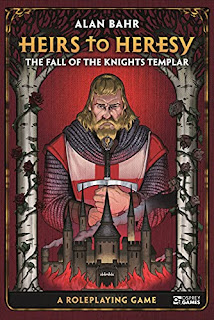
So let me switch into the game for today, and that is Heirs to Heresy: The Fall of the Knights Templar, written by Alan Bahr and published by Osprey Games. It is a hardback book of approximately 190 pages.

The Concept of the game is one that is familiar to conspiracy theorists and the History Channel, as well as a number of movies of varying quality: The Knights Templar. Bahr spends a chapter, after the “What is a roleplaying game and what you need to run this one” giving a potted history of the Knights Templar from their origin in 1099 to the “present day” of the game in 1307. The game generally starts on a fateful Friday the 13th, October 1307. The King of France declares the Templars heretics and traitors to France. Many are captured, others killed. Thirty of them escape the initial attack, surrounded by enemies, unsure of who or what to trust.

As players, you play one of the thirty survivors of this attack. You are entrusted with the fabled (especially on the History channel) Templar treasure, and are to take it to safety. But where is safety in a world where the King of France has turned against you? 

In the RPG Sorcerer, designer Ron Edwards came up with the idea of a “Bang”, an event in an roleplaying game that sets off the action for the character(s). It is an event in the game, often but not always the inciting incident in a campaign or scenario, that the player and character simply cannot ignore. Heirs to Heresy uses the events of October 13, 1307 as the “Bang” for the characters and their players to face. They are deep within hostile territory, with enemies all about, many of their friends, companions, leaders are dead or captured. 

There are three basic questions the GM and players must consider, which provides a variety of axes to play and set up the game and customize to to suit a particular RPG table’s needs and wants. Bahr goes into detail into these choices, so that a gaming group cane come with one of a variety of scenarios and campaigns of varying lengths to suit their taste. 

What kind of treasure do the players carry?  Is it simply gold, jewels and material wealth, or is it a holy relic, or is it something with actual magical power? (You can customize your game to have as much magic as you and the players want. You can play it straight and gritty, or mystical and esoteric, or take a middle ground)

What are the truths of the Templar Order? This is a question more for the GM to come up with and to think about, and for the PCs to discover, uncover, use, or rebel against. Just what was the Templars plan? To form a polity of their own? To continue to amass wealth and power and affect the course of Christian Europe?  To crusade against literal demons and the forces of darkness? Or, are they actually corrupted from within already?

Where are the players going?  They’ve been given a treasure, they need to escape the French assault, but what is their final destination? What is their goal? Like Michael Moorcock’s Tanelorn, Bahr uses a neologism for the ultimate goal and destination of the PCs: “Avallonis”. Depending on the style and nature of the campaign, Avallonis can represent any number of places: England, Portugal, Malta, the remnant of Outremer in the Holy Land, or a city in faerie that the knights must battle to reach the portal to access. Avallonis is, as the book puts it, whatever and wherever the PCs need it to be, a destination informed by the journey.  Depending on the game, Avallonis may be just an aspirational goal, one never actually reached in game, a shining beacon of hope, all alone in the night, but never quite in reach. 

The Mechanics:

Heirs to Heresy uses the full range of standard polyhedral dice, plus uses a “token in a bag” system to handle initiative. The basic test of a skill is rolling 2d10, adding attributes and skills (which generally range from 0 to 4 or 5) versus a difficulty. Trivial tests require a 12, difficult ones require a 20 or higher. A critical success (which provides advancement points) occurs when both dice have the same number, AND the test is successful. Critical successes also allow for additional damage in combat, or a flourish in a non combat situation. Both players and GMs alike can call for skill tests. 

Other PCs can aid tests, if they have enough skill to do so, and if another party is actively trying to stop you, the test instead of being against a set difficulty is against the GM rolling the opposition. Or, if two PCs are in active disagreement with each other, the other player rolls just as the first one does to determine the outcome. 

There are no fumbles in the game, only success, failure, and critical success.  Bahr’s philosophy is that failure should always lead to an interesting and compelling narrative, not stop the flow of the game. 

There are no non-combat stats for opponents in the game. Combat is a different story. Rolls for the opposition are based on the initiative system of tokens,and are dangerous according to whether they are Mobs (Mooks in the Feng Shui parlance), or Fearsome Foes. Both kinds of enemies can have specific qualities as well, such as “Brutal” (do more damage on critical rolls). Keeping the enemies from having out of combat stats means that there aren’t huge stat blocks dominating the book. 

Overall, the combat is relatively straightforward and narratively based. It uses a Fate-like “zones” system to determine placement of PCs and opponents and add some mental narrative crunch to combat. One does not need to use miniatures and a terrain map to run combat in this game, given enough narrative information and imagination on the part of a GM and players, although a running fight by the PCs through a castle could certainly be one where pushing minis on a map might be quite fun indeed. 

The Execution

For a 190 page book, the book is succinct and comprehensive in offering up things to the players and GM alike. Rules for travel, opponents, the “Pursuit Point system” (which is sort of like a doomclock in how much “heat” there is on the PCs at a particular moment).

The book and rules are as inclusive as a story about the Templars can be. There are some limitations made by history--Templars need to be Catholic knights, for example, but it does not insist that Templars need to be white men of deep Catholic faith. If you want a converted Berber woman who is Catholic but mostly secular in her outlook as your Templar Knight...you can do that. The RPG is historically informed and infused, but it is not hidebound to it. 

The rules for esoterica (magic) are a bit firewalled from the rest of the book, because, as mentioned above, you could play a straight gritty game without a hint of Baphomet in it. There are three types of Esoterica, and a campaign run by the GM might have none, or any or all of them in it. Magicks are straight up spells, learned by studying relics. This ranges from a healing spell all the way up to binding angels and demons. It’s made clear that even in a high magic game, magick is dangerous and is a great way to get the Inquisition to want to hunt you even more. Blessings, the second type of magic, holy gifts from saints. The short list of saints, it is pointed out, can be supplemented because of the sheer number of saints in the Catholic Church, even as of 1307 AD. The third kind of esoterica is martial focused, and ranges from striking quickly to Wuxia-adjacent running up of walls. 

That last thought brings up the toolkit aspect of the book. In addition to all of the Templar hooks a GM and players could want to devise, this system could be used for parallel situations, both real and imaginary, to tell stories of a small band under threat, trying to survive or reach a distant, dangerous goal while beset by enemies on all sides. With just a few tweaks, for example, one could do a riff on Xenophon’s The Ten Thousand. There are rules for mass combat in the books, so having a band of Greek Mercenaries try to fight their way out of the Persian Empire, pursued and hunted--Heirs to Heresy could be used as a system for that. Or, say, moving forward in time, a group of Byzantines trying to escape the fall of Constantinople with some holy relics, trying to reach safety in the West, or perhaps a more mystical location. Or, say, a group of Buddhist Monks trying to escape the persecutions of Emperor Taiwu of Northern Wei.

The Verdict on Heirs to Heresy at this time is incomplete as, inevitably in this day and age, I have not yet actually given it a try as GM or as a player. Based on the writing and presentation in the book, and the mechanics as mentioned above, this is a game I definitely way to give a try and see how it runs in practice. My fecund imagination in thinking about this game tells me this is a game I’d love to run or play.  The strong presentation of theme, the excellent nods and moves toward inclusivity and welcoming players of all stripes, and the overall tone of the book are extremely positive for me. In addition there is much that Bahr could do with further books given this foundation.  I imagine an expansion for, say, a Quest for Prester John, easily. There is a solid foundation and chassis here for GMs and players to tell stories.

¹For those wondering how I came up with the column name: In the World of Darkness games, rolling a stat and a skill is the usual way to do something. In the Roleplaying game Exalted, which I have GMed a lot of, in order to “spot something”, you roll a dice poll of your stat Perception and your ability Awareness. 

---

Reference: Heirs to Heresy, Osprey Games

Paul Weimer. Ubiquitous in Shadow, but I’m just this guy, you know? @princejvstin.