Showing posts with label neon hemlock. Show all posts

Tuesday, July 29, 2025

Book Review: No Such Thing As Duty by Lara Elena Donnelly

A blend of the historical and the speculative to linger on the concept of duty in a grim and everchanging world.


The viewpoint character of Lara Elena Donnelly's novella No Such Thing As Duty is William Somerset Maugham. You might have heard of him. An English writer who penned plays, short stories and novels, I certainly had, but knew very little about him beyond that briefest of bios. Nor did I until after I had finished writing my first draft of this review - a deliberate choice, wanting to preserve the experience of the story as a narrative-object, to linger in its tension and ambiguities, without collapsing them down with the intrusion of reality until I had at least captured the rough sense of my feelings in the amber of prose.

Because there are two No Such Thing As Dutys - the first is the one read by someone who knows Maugham's bibliography, the facts of his life and the reality, date and manner of his death. This is a version one must expect of any book which features historical facts, in any form. There is always someone who knows everything, especially when the subject is a famous author. The second is my experience.

At the start of the book, we meet Maugham arriving in a Romania in which he is certain he will die (and glad of it rather than being a Scottish sanatorium). He is suffering from tuberculosis, dizzy with fever and coughing up blood, but seemingly determined to do his duty before succumbing to the inevitable. Already, a branching point of the two experiences of the story. For me, this is tension - does he die in Romania? I don't know. He seems wearily certain of it, a spectre that looms over the story, that intrudes every time he coughs up blood into a handkerchief or a scarf conveniently dark to hide the stain. Arriving as a spy in wartime, he reports in to receive such mission as he might be needed for, following on from his promising activities with less promising outcomes in other fronts of the conflict. But he soon realises his mission, such as it is, seems more of a sop, a bone thrown to make him feel useful rather than something vitally necessary.

And thus, the central conflict of the book. The duty he's doing - to King and Country, as he says - what kind of duty is it, if it is this pity mission? He leaves behind a daughter he cares about and a wife he'd rather avoid, coming to die far away, and if it's not for duty, then what is it for? Are they not also a duty?

But he's there, and the mission is in front of him, and he's dying, so do it he does. And through the course of it, he meets two other key figures. One a man, Walter, seemingly walled off from any sense of duty - seemingly - and another a woman, Mme. Popescu, whose husband died of a duty he didn't even need to do. Three angles on the same problem, though mired firmly in Maugham's. The glimpses of the other two do however serve to colour and explore his, through the lens of his introspection.

And this - his self-critical, thoughtful, writerly narrative voice - is one of the most successful things about a roundly successful novella. I'm not familiar with Maugham's work in reality - another branch point, does his narrative voice sound like actual Maugham's - but I found myself quickly invested in the version of him that exists in Donnelly's. There's an analytical bent to the way he talks about the people around him, a distance that he himself names as he talks to other characters, and a slight rigidity to the prose that does nod back to the time at which the story is set, without overegging the historicity. But it's not just that. He is constantly dwelling on his imminent death (ironic or simply foreshadowing?), the effect that will have on his family, whether being here is the right thing to do, and if he even truly is doing his duty at all. He also dwells on two lost loves and one growing one, because all good things come in threes.

As with the three angles on duties, the three loves all inform one another, shaping how we see Maugham as much as how he sees himself. There's Sue, the woman he wishes he'd married but whom he lost to the man who got her pregnant (and married her out of - yes, there's duty again). There's Gerald, the outgoing soldier he knew in the Pacific, whose strengths shored up Maugham's weaknesses, and whose flaws could be forgiven, and critically who knew, as Maugham knows, when and how to keep hidden from society's eyes what it doesn't want to see. And then the present one, Walter - the man who walls himself off from duty, who refuses to hide himself as Maugham knows he must.

Intersections, wherever you look. Maugham - with his stutter, his orphan status and French early years already an outcast, clinging on to rigid propriety as close as his interpretation of duty. Walter flouting both but charming him in, while also being his mission, a part of his own duty and bound up in the death of Popescu's husband.

All of which leads to wondering about the reality of Maugham's duty - the clue is, indeed, in the title - but whether it's self-imposed too. All around him, people take the rules of society less seriously than he does, whether they be his British handler, the locals, Walter or Mme. Popescu. He dwells on how it was his duty to marry Syrie, the wife he's avoiding, after he got her pregnant. But was it truly? Was it a duty he could have avoided if he wanted to? Did he want to? Will he die in service to this thing that may never even really have been asked of him at all?

That tension and uncertainty about his death is why I resolved not to find out his biographical details until I had settled my thoughts. Because the poignancy of not knowing felt so delicious, and fed in so beautifully to the ethical crisis he was suffering through, that I wanted to treasure it as a lucky gift I chanced to have in reading it.

However, around half to two thirds through the novella, Donnelly introduces a speculative element which complicates things further. Obviously, there were no vampires involved in World War I. And so, however closely the narrative up to this point may (or may not) have married up to the real history and biography, here it diverges. The two experiences of the book briefly coalesce. But only briefly.

In my opinion, vampires are at their best when they are both truly dangerous and also, despite and because of the danger, sexy. In No Such Thing as Duty, the sexiness of the vampirism (and while a little understated, by god is Donnelly's vampire sexy) is corralled in by the physical - blood and bites and hands and tongues - just as the rest of the story is wedded to Maugham's own physicality, of his breath and cough and bleeding, his fever constantly waxing and waning, the scratch of fabric on skin, his enjoyment of food and drink. Donnelly revels in the sensation of drinks particularly, the haze of brandy and heat of coffee, and temperature more broadly - feverish burns and the cool touch of snow. And again, the lingering prophecy of Maugham's death informs this. We read his body in its frailty and potential failure; the vampirism marries that imminent death up with sex but also with the potentiality of death's forestalling.

And so, the two readings once again diverge and split even further. Is the intrusion of the fantastical about to change the facts, and a reader who knows whether Maugham will die about to be surprised by a change, or have their knowledge come to fruition, but its method shifted? And then, again, me, caught up only in the tension of the story itself. Vampires throw a spanner into the works of the greatest inevitability, and so add an extra layer of narrative uncertainty.

Right up to the end, Donnelly preserves that ambiguity. The story ends with implication rather than closure, a situation that made me very glad for my lack of knowledge, but one that, precisely because of the speculative elements, likewise imposes that ambiguity even on a reader who does know, because while the question of "if" might have been settled for them, there still lives a vast expanse of "how" and "why".

And so, ultimately, it doesn't matter if you know the facts or not. The story uses vampirism to crack open the vault of possibility, and ensure that the available endings are uncertain for any reader. I looked up the facts, and learnt that not only did Maugham live into his nineties, far beyond the scope of the life he sees as doomed in the story, but that even the foundation of the story rests on a branch untaken - the Scottish sanatorium the book's Maugham is glad to avoid was the path of reality. A reader who knew his biography was already wrong-footed, because it never cleaved to that reality in the first place. That break from the known path already introduced the potential for change, and the story could become one of the doomed path the real man didn't take.

No Such Thing As Duty wields its ambiguities and potentialities like a scalpel, all the while holding them in delicious contrast to the bitter realities of the physical and the flesh. By using a real historical figure and divorcing him from his reality, Donnelly ties her story to real anchors - there are hints and nods to real, biographical facts seeded throughout - without closing off the opportunities for tension, and the scope of possible endings. The fantastical element is also the most grounding one, the sections in which Maugham is being fed on being some of the most intimately real ones, where much of the rest of the story comes filtered through his particular lens of perception, held at a distance, or made hazy by illness. Only in contact with the unreal does the story fully rear up into feeling quite present. She leaves her questions open - this is not a story with an answer to its moral questions, any more than it is one to set a firm hand on the conclusion of its plot - and the work is all the better for it. It is a beautiful, brilliant book, with exquisitely understated prose and a skilfully managed viewpoint, and one that exemplifies what a good novella can do, or be, by using all its tools, figures and ideas all intersect and coalesce into a gorgeous mess of feeling and thought.

--

The Math

Highlights: Sexy but understated but sexy vampirism, triangulating around the concept of duty, well-crafted introspective viewpoint

Nerd Coefficient: 9/10

Reference: Lara Elena Donnelly, No Such Thing As Duty [Neon Hemlock, 2025]. 

POSTED BY: Roseanna Pendlebury, the humble servant of a very loud cat. @chloroformtea.bsky.social

Monday, June 3, 2024

Book Review: A Mourning Coat by Alex Jeffers

Is it about fashion or is it about finding yourself once again, after a period of grief? Why not both?

What do we mean when we say "low stakes"? I always struggle with this as a descriptor, because, well... it's all relative, right? My instinct in how to describe A Mourning Coat is, at first, to reach for the term, because nothing world-shattering happens. There's no intergalactic war. The realm isn't saved by feats of derring-do. The entirety of scientific understanding is not overthrown by new discoveries. And yet... after a long period of illness, the protagonist's father has just died. A world has been shattered. How can we say that the death of a parent is low stakes, when the deaths of those closest to us are the highest stakes many of us will ever truly face?

Of A Mourning Coat, let us instead say that the stakes it handles are realistic ones, the problems it handles familiar. The scale is small, even if the emotional impact is not. And these are the stories I really want, when people talk about low stakes, or slice of life—I want the stories whose view is pulled in so tight that you are, however briefly, fully inhabiting a person's perspective on their problems. I want to think, feel and breathe them, be immersed in them, for the duration. I want to close the last page, exhale, and feel, fleetingly, ephemerally, a person changed by this inhabitation of a new perspective, in a way that comes so much more bittersweetly when there's nothing else to pull you away, no distraction of hurrying action and plot. I want poignancy and human connection in my slice of life. I got it here, in crisp perfection.

There used to be an atelier, until his father —his famous father the actor, much acclaimed and renowned— fell ill, succumbing to early dementia and increasingly in need of care. So Therre moved back into his childhood home, went through a messy breakup, and spent five years of his life watching his father decline and doing everything he could to support him. His father has now died, and Therre is alone in this empty house, full of the grief of memory, and without the daily structure of a life well lived to return to. He needs something to wear to the funeral, something appropriate to mourning, to honour the father he loved, who became the father he struggled to love, and their heritage and himself. And so he reaches back to the person he was, the creator of fashion and elaborate garments, to make himself a mourning coat, white on the outside as is proper, but lined with an embroidered, colourful wool his ailing father had loved to touch. He crafts himself a statement about who he is, was, loves and possibly hopes to be, and wears it, struggling, to a funeral. And somehow, the coat changes everything.

Well, for a given definition of "everything." It's that matter of scope again—we are so used to fantasy stories that encompass worlds, multiverses, galaxies, empires, so we begin to expect that vastness in all descriptions. But here, everything is simply Therre's world, Therre's life. As if a single life can be simple.

The scope of the story is the beginning of Therre's journey away from this grief, this life apart from the world and back into community. It is only the beginning, because it is a story that understands that grief is not easily surmounted, and that the problems between people —between, for instance, estranged siblings— are not solved overnight by grand gestures. It's a story of living through the seeds of change, with an ending of hope for what's to come, a beginning of the next step. So it is a story of transition, from one phase of life to another, encompassing the period of the shift and nothing more. Jeffers does what the best novellas do, and narrowed his scope into what can be meaningfully explored in the space he has—excise the need for the three-act structure, the need for intricate worldbuilding, the need for a wide-reaching explanation, and focus down into what matters for the story. Here it's immersion in a perspective, being able to see the world truly through Therre's eyes, particularly facilitated by the physical world —texture, especially, the feeling of cloth, and its colour and drape— and a distinctive, immediate internal monologue that gives shape to an individual you grasp immediately and love soon after.

If I had to focus on one thing the novella does well, it would be that: the tone. Therre is a delightful narrator to inhabit. He mixes awkward authenticity and self-doubt with a dry, self-effacing humour that makes me immediately want to listen to him more. There is a wryness to how he thinks to himself that I cannot help but smile at, like so:

The straightforward happenstance of a sex dream wasn't especially novel, and I had besides, simply as a health measure during five stressful years in my father's house, regularly exercised my hand and as necessary the sort of visual entertainment not spoken of in company.

or later, when spectacularly failing to take a compliment:

It's not especially memorable, I don't think. Just a prick. Most men have them. Some people who aren't men.

He talks around things in a way I find charming rather than contrived—it makes you think he's laughing at himself rather than putting on airs. This is someone who knows how he sounds, and wants the listener to be in on the joke with him.

Much of the writing is situated within Therre's internal monologue and perspective (aided by his occasionally interesting language choices—I was delighted to see the use of "cossie" for swimming costume, which I had always assumed was incredibly British, and fully made sense with his Scottish-seeming birth country) and so the whole story feels suffused with him as a personality—we feel, through his words, his sadness and confusion, how adrift he feels in the life that has lost the star around which he orbited for five years, but also the man he was and can be again, who charms and delights. It's never spelled out, never said, but it comes through nonetheless, especially when reflected off the people around him.

Because that's the other thing Jeffers has done well—created authentic-feeling fellowship between Therre and those in his life, however unusual the relationships. He has a sister, back in the homeland he and his father left behind, who has her own hurts over her place in her family, but with whom he begins to slowly reconnect, and develop a relationship as adults. He has an old acquaintance who may grow to be something more, who sees what he needs and tries to help him find it. But he also has Aìbi, the ex with whom he had a messy breakup once his father's needs began to take over his life, whom he once loved, who is now married, and with whom he shares these lines:

I swallowed. "I love you, Aìbi. I never deserved you."

"You didn't, but we loved each other for a while and had a good go at it, and now we love each other differently."

And they do. We watch a new relationship rise from the ashes of the old. Not a perfect one, not without faults and stumbles on both sides, but something Therre can grasp, a hand to help pull him free of where he is now. Jeffers understands how to portray people with a long history, the fellowship of people who really know each other, through the good and the bad, but are still here anyway, and even more than the flirting (which is delightful) and the complexity of family (tentative and brittle but so hopeful), it is this relationship that draws me in, simply because it's a rare one to see, and doubly so to see done so well.

I should, I suppose, also touch on how this fits into SFF—you'd be forgiven for taking what I've said so far as implication that it's social realism or something similar, after all. The story is set in another world from ours, one I would describe in the same vein as Guy Gavriel Kay's "quarter turn to the fantastical"—there are elements of the supernatural hinted at, and distinct differences from our world (even beyond the naming of places and things), but those elements are predominantly hinted at rather than shoved into your face, and even where they appear most prominently, they are never the full focus of the story. The how of them? Irrelevant. It's not a story about the fantastical, just one that employs it to get its point across, to play about with things and craft a space that makes a story —this story, and others— work.

When not relegated to the background, it comes across in its own little wry excerpts, for example this, from an in-world text about gender in fashion:

Binding up a man's swinging parts in trousers as those barbarous folks did went against nature, science, logic and common sense [...] whilst the drafty openness of skirts must be similarly unhealthful for a woman.

Which comes into our awareness briefly, serves its purposes for the plot and our understanding of the shape and texture of the world, and then flits off again, its work done. I often find stories with this kind of simple inversion clumsy —the way The Power handles its power imbalance springs to mind most prominently— but here, the fact we do not dwell on it serves it well. It's not the underpinning of the whole purpose of things; it's not a grand statement. It's just "oh, by the way," and then we move on, we don't overthink it, which is where so many fall down. But such statements don't need to stand up to intensive scrutiny if they don't overstay their welcome.

Likewise, we watch Therre develop a new interest in what he calls "counterfactual fiction" or "CFF"—the SFF of its own worlds. Jeffers holds up a brief but delightful mirror to the sort of shows I grew up loving —space opera with dramatic nonsense and excellent content mixed up in equal measure— and even in that short space, we see a familiar fondness shine through even across the difference of a made-up world. Not everything has to be an inversion, and that makes the bits that are changed matter all the more. Different... but also the same. It's also just quite fun watching him go from ignorant dismissal of the genre to genuine interest, via the medium of a hot actor playing a part well. I cannot call him wholly unrelatable in that, let us say.

But that is somewhat the extent of the fantastic in the story —a different world with different geography and history, different mores, different stories— for approximately 85% of the book. There are some points that stray further when critical to the plot, but for the rest of the time, it takes a back seat and lets us focus on Therre and his world, and the people around him, and it is that I am delighted by the most.

It's what sings out the most, too. It's a story about a person and his grief, and one told with gentleness, sympathy and deep humanity. It is about connection, about living, and about the tethers on your soul that you will never shift, but maybe learn to live around. It is beautiful, sad and desperately poignant, and I loved it.


The Math

Highlights: beautiful, personal tone of voice; wonderful descriptions of the physical (especially fabric); subtle understanding of grief and love

Nerd Coefficient: 9/10.

Reference: Jeffers, Alex. A Mourning Coat [Neon Hemlock, 2024].

POSTED BY: Roseanna Pendlebury, the humble servant of a very loud cat. @chloroformtea.bsky.social

Thursday, May 23, 2024

Book Review: The Dragonfly Gambit by A. D. Sui

Political plotting and elaborate shenanigans done right

To quote a certain famous someone: I love mess. I love emotional tangles, and characters who do things that ultimately hurt themselves because they are complex, chaotic and fundamentally human. I love stories where everyone is a little bit broken and terrible, and they're all clawing about at each other to hurt, being nasty and personal and intimate and delicious.

The Dragonfly Gambit by A. D. Sui is just such a story. We follow Nez, who used to be a pilot in the military of the aggressive imperial juggernaut that "peacefully" took over their home planet, until a crash and a spinal injury put her out of the game, leaving her to make her own way in tech and begin to rebel against the empire while the people she loved and was closed to simply carried on without her. Now she's been pulled back in, to try to solve the crisis of a war the empire definitely isn't losing, honest, at the behest of one of the most powerful people in the military. But Nez does not want to be there. Nez has her own plans.

And this is a story of imperial aggression and resistance, of politics and action, of the way that different people respond to being under the bootheel of such a hegemonising force. There's no prevaricating the message—empire bad. This is an empire whose heir destroyed whole planets in a fit of spiteful pique. We're not aiming for any sense of balance. But we are aiming for complexity.

Because for all that Nez is someone whose planet was ultimately destroyed by the empire, for all that she is working against them, resisting in what capacity she has before she's taken captive… she did also used to work for them. Her friends —her former lover— still do. They share that history, that lost homeworld, and yet respond to the legacy of it in different ways. They still orbit around a shared event, the crash that damaged Nez's spine and her relationship with both Kaya and the empire at the same time. It's a story about different people coming to different conclusions, different actions, about the same context. The bad choices people make.

And speaking of bad choices, it's also about terrible, problematic people being also quite hot, without that ever excusing their terribleness. That second part is important, and one a lot of stories kind of end up missing.

We'll come back to that shortly, though.

To step back a little: political shenanigans can be hard to get right, especially in shorter books. Politics is, fundamentally, complicated because people are complicated. If you make it a simple X action because of Y reason, it's not going to ring true because it's never that simple in real life, and it's incredibly hard to fill in all the details you'd need to capture factors like class and economics and specific histories of place. There's an art to condensing real-feeling political situations into the sort of space that doesn't involve 15 appendices, and it's one that Sui has absolutely mastered here. The key is about the details—we get them. Little incidentals. Off-hand remarks about whys and whos and whens. The sort of things people actually say in conversations to each other, remarks laden with bias and perspective and emotion. And we get these instead of big, sweeping exposition. No one ever sits down and thinks to themself "ah yes, the root cause of the Maguffin Crisis is due to the prevailing weather conditions in Fakelandia, which have led to an economic situation of unparalleled proportions." Everyone comes in with their own knowledge, their own opinions, and so the way they think about things is always biased, always skewed and framed by knowledge we, as the readers, do not have. And Sui just… lets us not have it. Most of the grand-scale stuff simply does not matter to this story. The exact details of why Nez's home planet was destroyed? Irrelevant. That it was, and by whom, and how Nez feels about it are much, much more critical. Such explanation as we get makes Watsonian sense—the sort of thing someone in such a situation would explain, and would think about.

And honestly? We don't need the broad, sweeping details of exactly what this empire is in order to understand why it's bad. All we need is the core we get, the crux of Nez's radicalisation, because this is Nez's story, not the story of the empire as a whole. Sui has boiled it down to the parts that matter, and filled in the gaps with humans and their thoughts and feelings. In the middle of all the politics, it is a story about four people: Nez and the three people she has these emotional, important ties to, and who are each in turned tied to one another, whether by shared history, love, lust, duty or hatred or a mixture of them all. And this, for me, is where it truly shines. Much of the story feels, on the surface, like Nez rattling around between these three people, reacting and causing reactions, feeling. Every bit of dialogue between them feels vital to the story, to their relationship, to something. It's a series of beautifully crafted moments, of feelings steeped in relatable irrationality, despite the distance and unrelatability of the scenario. How do I know how to feel about an ace pilot and an imperial heir? How on earth is this graspable for me? And yet Sui makes it so. She makes each strange, inexplicable moment feel real and true, makes me believe every word, every breath of it emotionally.

And that is very important, because this is also a story that isn't… quite what it seems at the start. A good deal of its charm, its brilliance, is how well it sells what lies it tells (and the truths it keeps, leaving you to wonder which is which). Everything is delivered with such aplomb, such charisma, that you cannot help but fall for things, even when the story tells you to be wary. You just want to slip into the moment, the dialogue, the natural bounce between these fascinating, terrible people.

The Dragonfly Gambit is a brilliant little novella, full of life and energy and emotions hot enough to burn down buildings. Lust or rage? Why choose! Sui captures people and their big-picture problems with deft clarity and easy grace, meaning you never lose sight of where you're viewing the story from, even as it subsumes you. Its politics are extremely well-managed, as is its surprisingly twisty plot full of plotting, making it easy to consume in a single sitting. If it has any fault —and I'm not sure it does— it is that I could have stood a little more time with the fourth character, the one slightly less closely tied into all the drama, as his moments did seem interesting but never let him quite step to the fore like the others. But when the others are as interesting as the ones we got? Well, it's worth it regardless. An absolute hot mess (complimentary). I loved it.


The Math

Highlights: narrator of dubious reliability; MESS, so much MESS; really good political situation in a really small space

Nerd Coefficient: 8/10

Reference: A. D. Sui, The Dragonfly Gambit [Neon Hemlock, 2024].

POSTED BY: Roseanna Pendlebury, the humble servant of a very loud cat. @chloroformtea.bsky.social

Monday, February 19, 2024

Review: Finding Echoes by Foz Meadows

A novella with a distinctive voice in a distinctive city, that knows how to focus in on what really matters.


There is a story in this novella - a good one, as it happens, well crafted, well paced and interesting - but it's not what my lingering memory is, when I closed the last (digital) page. There were two other things instead.

The first, unsurprisingly, was the slow revelation of the relationship between the two main characters - their history, their circumstances, who they are and were to each other. We learn about them and their past through the slow unveiling of the world and their places in it, and there is a tentative deliciousness to the slow pace of our understanding, as well as an immediacy to it too. We met Gem and I immediately knew - as I imagine everyone does - "old flame". So it's not that we are waiting for a grand reveal that takes ages in the telling. We know the shape of it. But the deliciousness is in the slow unravelling of the details, a gradual understanding of all the steps that brought these two people to where they are now, strangers who were once close. And it is, let me stress, beautifully paced. There's a glorious suspense to the full understanding that lasts almost up to the final page and I loved it.

Why isn't this a surprise? I've read Meadows' work before, and he excels at this kind of emotional cave-diving. A Strange and Stubborn Endurance was full of thoughtful introspection, from two people is a slowly closing orbit, and it shares a substantial DNA in that regard with Finding Echoes. It is not misunderstanding, exactly, that fuels the drawn out unclarity of the relationships of Meadows' characters. I am by far less frustrated by misunderstandings in romance than most readers seem to be, but even so, that isn't what this is. Instead, it is a subtle and deeply empathetic understanding of the gulf between people, no matter how close they have been, want to be, might well someday be, that takes real effort and determination to cross. Especially for characters who are full of doubt, or wariness. Characters who have learnt not to trust, as Gem and Snow have in Finding Echoes.

And it is particularly well done here, because we only ever see the story from Snow's perspective, and yet we still get that depth of feeling from them both, through the interactions between them, and particularly the dialogue.

Which is the other strength I want to pick up on.

Language in fantasy is hard. It's hard to make up a bunch of concepts, and words for those concepts, and smush them all together in a way that the reader understands, but also reads as natural, as the sort of thing humans (or non-humans) would really say. There are so, so many stories in the failure-state of awkwardness where too many neologisms have been coined that the reader is swamped in them, and the author feels they have to spell too many of them out, lest confusion reign, and we never know that this things is basically a horse, it's just not called a horse*. Even if you avoid the worst of it, it is also just incredibly hard to hit just the right vibe, just the right atmosphere, just that natural voice that people have when speaking that needs to be crafted from the ground up.

But Meadows has done it. And done it so well I found myself noticing how coherent a voice all the characters from the same background really had when speaking to one another. There were a lot of terms thrown around, a lot of concepts to learn, about drugs and magic and mushrooms and technology and crime gangs and just slang, and yet they all coalesced into something that felt actually human. In the banter between Snow and Nixa, both living and working in the same section of the city, for the same criminal gangs, there emerges a distinctive tone, a dialect, that forms into something that feels real. Other characters share it, to greater or lesser extents, and the way they use the words, the way the unfamiliar terminology peppers their speech, never rings untrue as you read it, even as you don't understand it all.

And some of that is the charm - Meadows trusts the reader to pick things up in context, to go with the flow and learn the context as and when it comes (which it absolutely does). While I finished the story with some questions unanswered, I did not finish with any confusion. Everything that needed to make sense absolutely did - often in the way of the best novellas, with just enough explanation and no more. I could give you no etymological details, no fascinating trips down exposition lane, but I knew the stakes, the setting and the slang well enough to grasp what the story wanted to tell me, and to ponder at points where it might take me, before I got there.

The flip side of this, of course, is that this is not a story for the lovers of deep, expansive world-building. I do not say this because it is done badly - far from it - but it is simply not the focus. The world, and to a lesser extent the plot, exist to support the core the story is interested in. For me, this felt like it was that central relationship between two once-close people long-estranged. The plot isn't weak, but it's not the thing that felt like the sharpest focus at every point. Snow's gaze, through whom we see it all, is too often drawn back to Gem, or back into himself and his memories. Even as he lives through the events of the present, he dwells instead on the past, on the past of his life, of Gem's, of the city, of all of it, and so our focus too is drawn backward and inward, with the events of the now as a vehicle to carry us through. As someone who likes character-driven stories, for me, this was a strength.

I like that the world was sketched, rather than filled in meticulous detail. It felt spare in a way that was artful, rather than rushed - thoughtful about what was needful to tell the story being told. Especially in shorter format stories, I often find that cramming in too many extra bits and pieces of information makes the story cramped and bloated, when much of the delight of the novella comes from the brevity and speed, the snapshot story rather than the sprawling epic.

If you like this too, if you like stories that know what their focus is, that use every tool within them to support it, to create an artful centre - this may well be for you. It has a strong, interesting and admittedly somewhat traumatised pair of men at its centre, and if you delight in watching two people relate to one another across a gulf of years of separate experience, there will be delight here. I left it wondering - hoping - for other stories set in this world, about other people, other brief snippets of life and introspection in this setting, and with plenty of space and willingness to learn more about a strange city of walls. But equally, if this sits alone, then it will be more than sufficient, because even alone, it was a small delight.

*a passage in Trudi Canavan's Black Magician trilogy sticks out particularly in my mind for this, where she goes to great pains to explain the exact nature of a ceryni (after whom one of the characters is named), only for us to get to the end of it and realise... it's a rat. It's just a rat.

--

The Math

Highlights: two beautifully drawn, traumatised people trying to relate to one another, beautifully spare world-building, excellent use of language and dialogue

Nerd Coefficient: 8/10

Reference: Foz Meadows, Finding Echoes, [Neon Hemlock 2024]

POSTED BY: Roseanna Pendlebury, the humble servant of a very loud cat. @chloroformtea.bsky.social

Wednesday, January 24, 2024

Novella Project: dave ring Interview

Today for the Novella Project we're speaking to dave ring:

Photo by Farrah Skeiky

dave ring is a queer editor and writer of speculative fiction living in Washington, DC. His short fiction has been featured in numerous publications including Lackington’s, Podcastle, and Cossmass Infinities. His novella The Hidden Ones was published in fall 2021 by Rebel Satori Press.

He is the publisher and managing editor of Neon Hemlock Press, and the co-editor of Baffling Magazine. A frequent anthologist, dave edited the Shirley Jackson Award-winning Unfettered Hexes (2021) and the Lambda, Locus, and Ignyte Award-nominated Glitter + Ashes (2020).

dave was a Lambda Literary Fellow in 2013 and chair of the OutWrite LGBTQ Book Festival from 2015-2020. Find him at dave-ring.com or @slickhop on Twitter.

Roseanna speaks to him about his experience publishing novellas with a small press:

How long have you been involved with Neon Hemlock at this point? And what was your starting point with them?

I started Neon Hemlock in the fall of 2019 in order to publish the winning titles of the inaugural OutWrite Chapbook Competition. Shortly after navigating the logistics around printing those chapbooks, I conceived of an anthology idea that would eventually become Glitter + Ashes: Queer Tales of a World That Wouldn’t Die, and things escalated from there. 

What are the particular challenges of running a small press? Especially compared to some of the bigger publishers.

Both reader expectations and industry standards are based on the the bigger publishers. While there are those who enjoy when you defy expectations, there are many hard lines that are challenging to cross as a small press, and often those lines are invisible to the untrained eye. This manifests most prominently in marketing, sales, and distribution.

What is your favourite thing about running a small press?

It’s a great honor to be able to share great writing—electric, important writing—with an engaged audience of readers. There’s also a big endorphin rush whenever I ghetto commission original art. 

Every small press seems to have its particular unique flavour that goes into the works they publish and how they present to the world – what would you say is Neon Hemlock’s?

I expect that the answer to this question is much more interesting when answered by someone besides myself—I’m just one person who has the gall to think that other people might share my personal taste. But the works I think I tend to be drawn to are those written for “in-group” readers, rather than sanitized or clarified for “out-group” readers. I love feeling like I’ve been given a window into something real, rather than a theme park reproduction, and I seek out that feeling with potential submissions.

Neon Hemlock also does an interesting selection of sundry merchandise – I’m sad I can’t currently order all your candles (though it’s probably better for my bank balance this way). How does this fit into your conception of Neon Hemlock’s vibe?

I have the good fortune to be married to a chandler who will tolerate all sorts of foolish ideas when I propose them, which is how we’ve ended up putting out candles called things like “Haunted Cabin” and “Neon Coven.” I find literary accoutrement to be really compelling, so it takes very little encouragement for me to make them for my own titles, regardless of cost or feasibility. 

Does your experience as an author and editor feed into your work running Neon Hemlock? If so, how?

Becoming an editor has certainly improved my own craft, even if by extension I have less time for my own writing. I think the main way being a writer has informed the press is that I try to handle all aspects of the submission process thoughtfully and kindly. I’ve been on the receiving end of some dreadful rejections and I don’t want to create that experience for anyone else.

What goes into your process for finding new works? Do you think there’s a difference compared to the larger publishers?

Most of the work I put out is drawn from open submissions, aside from the occasional solicited novella or the authors I solicit for an anthology. So the delight of discovery is part of the process. I think my process is driven less by the market than larger publishers, so I might be more willing to try a theme or structure that is less proven or more avant-garde. 

So many of Neon Hemlock’s works have fantastic cover art – how do you go about finding the artists for that, and is there much author involvement in the cover art process? How does that work?

I find most illustrators through Twitter or Instagram, often via posts about opening for commissions or the ones that illustrators make for #PortfolioDay. I tend to involve authors in the cover process as much as possible, or as much as they want to be involved. I ask them for examples of covers they like within their genre, and share them when giving initial descriptions to the artist. And then I have them involved again at the thumbnail stage, when we are considering what direction the artist might go in.

You have a particularly interesting and well curated selection of novellas – why is this something you’ve chosen to highlight? Is there something about the novella form that appeals particularly?

Novellas are a really compelling length, and part of what got me reading again during the plague. There’s something very satisfying about a book that you can sink into and finish in a single afternoon, or maybe two if you savor it. 

What do you think makes a good novella more broadly?

Generally, I tend to think that there are two types of novellas: a streamlined novel or an expanded short story. And good novellas of both types have a keen sense of scope, knowing when to linger and when to elide. 

Are there any misconceptions you think people have about novellas? Or about the ones published by small presses? And if so, what would you say in response to them?

This is somewhat of an extension from my previous answer—some people find novellas dissatisfying because of the length, rather than their handling of scope, and critique them based on that dissatisfaction, which feels hardly fair. Readers and editors may disagree regarding the particulars of whether a particular novel succeeds in this area of course, but I think I would encourage such readers to try and enjoy them for what they are instead of wishing they were novels.

Is there anything you’d like to see change in novellas in the near future, or something you think will change?

In terms of publishing, I’d love to see more experimental novellas, and more hybrid forms. In terms of the larger landscape, I’d love to see readers, reviewers and award committees reading more broadly when considering novellas. There are a lot of great presses who are pushing the form right now, and it’d be great to see more names listed beside the books on year-end wrap ups and award ballots. 

Can you tell us about any upcoming novellas you’re excited to be publishing? Or a few works you’ve published in 2023 that you’re particularly proud of?

It’s very hard to pick just one or two to crow about! The book I’ve just sent to the printer is A.Z. Louise’s Off-Time Jive, an alternative history set in a Harlem Renaissance that plays off many of the tropes in both noir and urban fantasy. It has a great voice and beautiful character work too.

Thank you dave!

POSTED BY: Roseanna Pendlebury, the humble servant of a very loud cat. @chloroform_tea

Friday, January 5, 2024

Novella Project: A. Z. Louise Interview

Today for the novella project we're speaking to A. Z. Louise:

A.Z. Louise is a lover of birds, a writer of words, and a believer in the healing powers of peppermint tea. After leaving their job as a civil engineer, they took up poetry and fiction instead, but they still harbor a secret love of math. Links to their work can be found at azlouise.com.

For your recent novella Off-Time Jive, was it a conscious decision to write in that format, or something that happened as part of the process? How do you make that decision when you write?

This is a great question because I didn't expect to write a novella at all! OTJ was a rare project where I was so excited to get started that I didn't stop to outline first. I was about a quarter of the way in when I realized that it wanted to be a novella rather than a novel, so I had to reframe how I was thinking about the project. Usually when it comes to length, that shakes out during my outlining process as I start to dive deeper into the plot and see what kind of legs my concept has.

Following on from this though - what would be your one sentence pitch version for OTJ? And where did the idea of it spring from?

OTJ is the story of a semi-hardboiled detective who must investigate the death of a former colleague in a secret world of magic set in the Harlem Renaissance.

The concept for this book came from a lot of places, including spite, desire to write a magic system that was exclusively vibes based, and my own personal experiences of depression and disability.

I love a vibes based magic system, although it seems to run counter to a lot of what I'm seeing in the books I read at the moment, which is a shame. What's the appeal of keeping things more loose and intuitive like that for you, and how do you make it feel plausible when writing?

I like this type of magic because it feels less restrictive to me than magic that has measurable costs or a lot of rules. I do enjoy reading that type of magic system but it's not my favorite to write, so I needed to decide what appealed to me about reading them and make that fun to write.

What I landed on is that the core of cost and rules is effort. Effort makes things feel real and important! When I'm writing magic that's all vibes, I try to make sure that there's still some kind of effort involved. In OTJ, the main character's magic is based on Black joy. When you're going through something difficult like Knox is, finding true joy isn't easy, but much like the magic she performs, it's worth the effort.

Moving out a step - how did OTJ come to be with Neon Hemlock? And how did you find the process of getting something published through a small press?

This is a book I racked up a ton of rejections on! I was on the verge of giving up when I saw that Neon Hemlock was looking for novellas. I'd had some short fiction pubbed with them in the past, and dave really got what I was going for with my work.

So far I feel like publishing with a small press is a really nice middle ground. It's more structured than self-publishing (I'm someone who really needs deadlines) but it feels less bureaucratic and glacially-paced than traditional publishing.

I suppose with Neon Hemlock specifically they have their annual novella cycle pretty down at this point, so they know how to get things moving.

In terms of how the process with them worked for you, did you have much involvement in the cover design at all, and was this something that mattered a lot to you? And did that lack of bureaucracy feel like it generally translated to more involvement and input from you on how the end product novella turned out?

I definitely got chances to take a peek at sketches and mockups and give thoughts! The cover was really important to me, but I also really wanted to be open to anything because Neon Hemlock always has such amazing covers. Trusting the process felt really crucial, and while I'm sure the fact that Neon Hemlock is a small press helped at least a little, I think it was more down to the fact that I'd worked with dave before.

They absolutely do - I don't think I've seen a Neon Hemlock cover so far that wasn't gorgeous (and yours is no exception there).

Was there anything else about the process of working with them that you found particularly good or interesting, or advice you'd give someone going into working with a small press for the first time to help it all go smoothly?

Thank you!

I think something that could be an upside or a downside of small presses is having direct contact with the editor! If you're someone who likes to keep an open line with whoever you're working with, it's a huge plus. I always worry that I'm bothering people too much whenever I send an email, so that took some getting used to.

My biggest piece of advice from my experience with a small press is to ask questions and learn their strengths so you can really make the relationship work for everyone. In my case, I'm just the worst at promo and putting myself out there, and I learned really quickly that Neon Hemlock does a great job with promo! I made it my mission to getting comfortable with that so it could be a team effort.

Moving slightly away from the press side of things, do you read novellas yourself? If so, what do you enjoy about them as a reader, and what makes a satisfying one for you?

I ADORE novellas. I get really bad eye strain, so short reads and audiobooks are my lifelines. Something I love about them is that they're a great place to experiment, so they can get super weird! I like a well-encapsulated story in my novellas, but I also enjoy endings that leave me unsettled or wondering.

And as a secondary question - were there any novellas (or other fiction) that were inspirational to you in your work? Or ones you think more people really ought to read?

I find that a lot of my inspiration doesn't come from books, but other forms of art. It's extremely weird, but a huge influence on OTJ was Star Trek: The Next Generation. The Dixon Hill detective episodes were my first ever exposure to the concept of a hardboiled noir detective, and that crept into OTJ in a lot of ways.

I definitely recommend Jordan Kurella's novella I Never Liked You Anyway, and the work of Premee Mohamed.

Are there any things you hope to see in the near future when it comes to the novella scene? Trends, genres, themes, that sort of thing?

I always hesitate to make wishes or predictions about books because one person can only read so much, and I get a lot of my books from my local library. I'm always super behind the trends! My main wish for novellas is to see even more love for indie/self-published work in the future.

And last question, can you tell us a little more about OTJ

Off-Time Jive is a celebration of queer Black joy wrapped in fantasy noir and set against the backdrop of the Harlem Renaissance.

It is published by Neon Hemlock.


Thank you A. Z.!

Tuesday, February 15, 2022

Questing in Shorts, January 2022: Saturation Part 2

 I said I'd be back for a second part of my short-fiction-of-2021-marathon wrap-up, and I'm here to make good on that promise! Let's talk about some more of my favourite short stories read in January, covering a whole bunch of magazine issues from last year. (Part 1 is here, if you missed it!)

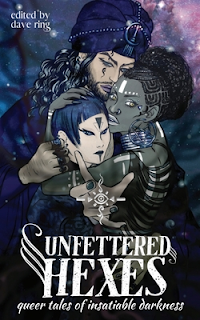
Unfettered Hexes: Queer Tales of Insatiable Darkness ed. dave ring

In just a couple of short years, Neon Hemlock have become one of my favourite publishers with their range of queer speculative fiction from diverse, boundary-pushing perspectives, and this collection is an excellent place to start if you haven't picked up one of their books before. Both the theme and the aesthetic are excellent: each story comes illustrated with a full page image from Matthew Spencer, and the stories involve a range of witchy and occult premises covering everything from space station cults and oxygen maintenance (Effects of Altitude on the Blood Elevations of Love by Marianne Kirby) to sapphic triads exacting supernatural revenge on their landlord (Love and Light by H.A. Clark). There's also two comics, some poetry and two narrative adventure games: Exterior, by Mercedes Acosta, about leaving the safety of your home into the unknowable dangers of the outside; and Hold the Dark, by Allie Bustion, about you and your coven preparing for a mysterious oncoming darkness. There's even some classifieds by Jordan Shiveley, of Dread Singles fame! It adds up to a really cool package where every piece of work contributes to an engaging whole.

 But let's talk about some of my favourite short stories! Kel Coleman (and, look, I could go off on another whole tangent about how many great stories Kel Coleman put out in 2021, but you should just go check them out and not take my word for it) knocks it out of the park with "Before, After, and the Space Between", a story about an innately talented witch and her daughter, growing up as outsiders in a society where magic has been co-opted by a dominant culture that requires artefacts imbued with spirits of the dead to conduct it. Sanguine's mother narrates the growing rift with her daughter as she grows up, the circumstances of her death, and their eventual attempts at reconciliation from beyond the grave. The way the story navigates prejudice and cultural domination, wrapped up in a story between mother and daughter who have to overcome enormous barriers to come to an understanding, makes it heartbreaking and powerful and very much worth reading. I also really liked "Sutekh: A Breath of Spring" by Sharang Biswas, which creates a world based on a fictional game with strong parallels to Hades, where Osiris tries to fight his brother Set, constantly being resurrected in a pool of blood in Isis's cave when he fails. Except one day he wakes up and it's Amun-Au, not Isis, who greets him, and the two strike up a flirtatious rapport that becomes a high point of Osiris' frequent deaths, and blossoms into romance. As the scope widens to show us that this is a mod, one which becomes unstable with a subsequent game patch and stops the player from being able to progress in that version of the game, the story raises some really interesting questions about how fan engagement builds queer content into works that don't canonically care about them, blurring the line between that meta-commentary and the feelings of the characters themselves. If anything, the strong parallels to Hades and its real life studio Supergiant were drawbacks for me (Hades itself has two significant and inescapably canonical m/m romances, no modding required) but it doesn't take much to look beyond that mismatch to the general point that Biswas's story makes, and it's a good one.

There are also several great stories which build around specific places, be those the magical houses of "The Passing of Sinclair Manor, or, The House of Magical Negroes" by Danny Lore and "FOR CLOSURE" by Tania Chen, the supernatural contemporary city of "Dizzy in the Weeds" by L.D. Lewis and the future capitalist dystopia of "Undercity Spellwork", or the otherwordly juxtaposition of a trendy underground-carpark-turned-hotel (except don't call it a hotel, it's a Transitory Dwelling Experience) with the group of Black men dressed in intricate animal masks who come for a late night check-in, in "Antelope Brother" by Craig L. Gidney. That last story is narrated to perfection by bored hospitality worker Malik, who spends his mostly-dead shift reading and talking to his friend Kiki before investigating a supposed disturbance that turns into something more involved than he expected, and the slow ramping up of supernatural elements makes for a really funny, engaging story. Honestly, though, there's just not a bad story in here, and Unfettered Hexes covers a really impressive amount of ground while keeping its theme at the heart of every story. Well worth investing the time in.

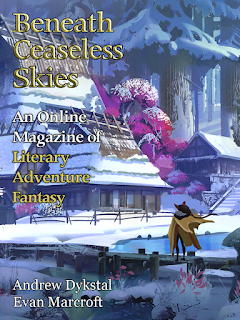
Beneath Ceaseless Skies


Between all the issues I read last month, Beneath Ceaseless Skies has really cemented itself as one of my favourite publications, and I'd particularly urge anyone looking for slice-of-life fantasy to give their short fiction a try. Sure, there's plenty of adventure and weirdness, but some of BCS's best stories involve presenting a small corner of a much larger world, focusing on unlikely protagonists or niche professions, and building out mythologies and worlds around those folks. So you get stories like The Fox's Daughter by Richard Parks, about the challenges a spirit faces while trying to foster a high ranking Kitsune's daughter, or the fussy, nervous travelogue of "Letters from a travelling man" by W.J. Tattersdill, whose protagonist writes about visiting the home of his elderly friend and the changes it has undergone since she left. Even stories with more "traditional" fantasy elements: like the dragon slaying in "The Lingering Weight of Estrian Steel" by Rajan Khanna, or the fae power struggle in March McCowan's "Song So Pure and Cruel" or the build-up of rebellion in "The Last Days of Summer in the City of Olives" by Filip Hajdar Drnovsek Zorko, focus heavily on the protagonists' lives and hopes and fears outside of their call to adventure. The old soldier of Khanna's story has defected from the army after losing his fight with the dragon and finding love and new perspectives in the village below; the story of the fairy goddess of "Song So Pure and Cruel" is told through a childhood companion whose only interest is playing with her and hanging out, an interest that is reciprocated in the goddess' current incarnation; and Drnovsek Zorko's story features a reluctant princess who refuses to take up the position of challenging her sister directly, questioning the foundation of the rebellion that seeks to make her its figurehead even as she comes around to their objectives. Reluctant protagonists aren't new to fantasy, but at shorter length it becomes easier for that day to day life to take centre stage, and to emphasise the weight of human (or, you know, fae, whatever) connections and finding a purpose that doesn't involve violence or scheming, and the result is a reading experience that really enriches my overall fantasy diet.

With that in mind, it's not a surprise that the two standout stories from my recent readings are epics of an unusual type. "Quintessence", by Andrew Dykstal, is about a group of miners wintering at the top of an impossibly high mountain, kept alive by supplements and unable to venture outside due to the cold and lack . When Loren's compatriots start dying of what should be a preventable illness, and the mine's witch refuses to release the cure that would help them, he ends up murdering her and being possessed by her soul (the relationship that develops out of this is not as grim as it possibly should be, with that setup, but go with it). Between them, Loren and Rose begin to unravel the mystery behind their circumstances and the deaths, and hatch a desperate plan to escape their situation. There's a bucketload of tension and danger, and Rose is a fantastic character who gets plenty of time to shine despite not getting what she deserves within the story itself. And "A Manslaughter of Crows" by Chris Willrich is a story I want to press into everyone's hands, because it's about electoral fraud and gerrymandering in a fantasy city built on the principles of pirate democracy (otherwise known as the "swabocracy"), and the protagonist is a sentient cat who is part of a special investigations unit. Shadowdrop and his group of friends and allies (including a seagull called Purloiner-of-Chips, Hope the very good dog, and assorted humans) need to rush to unravel the plot threatening the city's election, and its connection to the newly formed bird party, before the tenets of their democracy are overthrown altogether. It's an adventure from start to finish, and I will never not be here for fantasy electoral politics.

Adventures Elsewhere


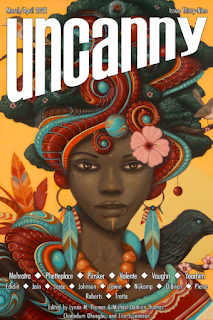
I caught up on several issues of Uncanny Magazine, which delivered its usual high quality mix from a lot of authors I know I love. "Colours of the Immortal Palette" by Caroline M. Yoachim is a really engaging story about a mixed race 19th century woman aspiring to be an artist but being held back both by her race and gender, and working mostly as a model for more famous artists around her (including Monet). When she gets an offer from an immortal painter to become immortal herself, she is given more time to break through, even as her benefactor insists that her artistic perspective is the wrong one to be worth paying attention to. Yoachim's protagonist prevails, of course, but her immortality and the difficulty of outlasting her peers makes this both a satisfying and bittersweet conclusion. "Where Oaken Hearts do Gather" by Sarah Pinsker is a story told through what are effectively genius.com annotations against a set of folk song lyrics, simultaneously telling the story within the song while also building out the characters and the simultaneous story of the commentators, one of whom stops commenting after a visit to the location where the song allegedly took place. It's haunting stuff, and the out-of-chronology comments are handled really impressively to build the tension even with the early reveal that something is amiss. I was also really impressed by the emotional resonance of "For All Those Who Sheltered Here" by Del Sandeen, which tells the story of a lynching from the perspective of the tree, and the tentative healing when it comes to be part of a family's life much later.

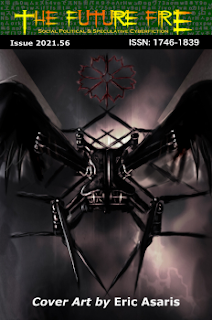
The Future Fire continues to impress too, and the pair of novelettes in Issue 56 were a real highlight of my reading (yes, they came out almost a year ago, no I'm not sorry for only just reading them, stories do not have an expiry date! "k.a. (birthright) by Lam Ning is the story of two former soldiers, part of a criminal warlord's army, who after several years years and a spell in prison find themselves in medical services on the other side of the conflict. The whole story takes place in a broadly sketched hostile environment - it's a planet, maybe earth, but suits and oxygen masks are required to go outside, not to mention the ongoing conflicts and rampant death-capitalism - and it's a really interesting story about struggling to survive amidst hostility, no matter how ugly your past or present might look. Then there's Listener, by Sim Kern, which is about a woman who grows up with the ability to talk to trees and plants, and how that ability and the events around it shape her relationships with her family and her best friend Delia. It's told from the perspective of the main character returning for a reunion years later, so we can see how she has built her life around an ability that she has increasingly rejected, and how returning to her home and reuniting with her family also lets her reconnect with what's actually great about talking to trees (aaaaah, sun!) and to put the pain of the past into a context that lets her move forward with self-acceptance of all she is.

Finally, I have to throw in a word for an unconventional Twitter story: Unknown Number, by Azure Husky, is a Twitter thread of text message screenshots portraying a conversation where Gaby, a 46-year-old trans woman, is randomly contacted by an unknown number who turns out to be much closer to her than she realises. It's a powerful story of the decisions around transition, and how the smallest things can make that decision either possible and validating, or difficult to the point of impossibility. I think it's worth reading for how kind the two characters are to each other, and particularly the affirmations that Gaby gives her caller  as we realise how unworthy of love and validation they feel about themselves. It's a delight, is what I'm saying, and you should read it. That's all.

POSTED BY: Adri, Nerds of a Feather co-editor, is a semi-aquatic migratory mammal most often found in the UK. She has many opinions about SFF books, and is also partial to gaming, baking, interacting with dogs, and Asian-style karaoke. Find her on Twitter at @adrijjy

Thursday, September 9, 2021

Questing in Shorts: It's still August 2021 somewhere

Hello friends and welcome to August in September! Yes I am here two weeks late, but I brought summer weather with me* so hopefully that makes up for my chronic inconsistency. What can I say? Life happens too much. The delay is partly because I've been reading for award deadlines that have directed my time towards things I sadly can't speak about in this column for now. But the main reason is because I want to talk about two very cool, distinct anthologies that hit my inbox recently, as well as rounding up a few magazines in the bargain. 

No new review notebook to show off this month, but we'll have one for the real September roundup. So, onwards!

*Offer applies to those within a 50 mile radius of London only, no guarantees made for weather in other locations, other seasons are available

The Best of 2020: Queer Speculative Fiction and African Speculative Fiction

Let's start by talking Best Ofs, and two new ventures that are hopefully going to become regular fixtures in the short fiction scene. We're Here: The Best Queer Speculative Fiction 2020, edited by C.L. Clark and series editor Charles Payseur, is out from Neon Hemlock Press; The Year's Best African Speculative Fiction (2021), edited by Oghenechovwe Donald Ekpeki and out from Jembefola Press, comes out at the end of this month. I thoroughly enjoyed these anthologies: both are by editors who know their fields as well as humanly possible and the range of speculative storytelling is on full display, with science fiction ideas and glimpses into fantasy worlds sitting alongside more slipstream-y stories exploring facets of our own world and the identities within it.  I had previously read more of the stories in Best African Speculative Fiction than in We're Here, but the majority from both were new to me, making it an exciting opportunity to catch up on some highly rated stories that I missed in their first release.

I hardly want to get into favourite stories from anthologies that are this consistently good, but I'll try and pull some out anyway. First, The Year's Best African Speculative Fiction: "The Many Lives of an Abiku" by Tobi Ogundiran (originally Beneath Ceaseless Skies #309) is a grim, heartbreaking take on the myth of abiku, spirit children who are born over and over again to the same family only to die before puberty. When this particular abiku starts to see her spirit brethren, she realises that she wants to stay with her family, but the inevitability of her myth has other ideas. "Disassembly" by Makena Onjerika (Fireside Fiction October 2020) and "The River of Night" by Tloto Tsamaase (The Dark November 2020) come one after the other, each tackling strange physical embodiments of mental health - though they ultimately lead to very different places, one very cathartic and one... not so much. And, there's three whole stories by Sheree Renee Thomas, of which my favourite was the third (new to me) one, "Love Hangover" (Slay: Stories of the Vampire Noire ed. Nicole Givens Kurtz), an awesome take on a relationship with a parasitic demon and the destruction it brings. As a general stance, I'd prefer to see more authors included than have the same author contribute more than one story, but the quality of stories from all the authors is so high that I see why a different choice was made here.

In We're Here, I was thrilled to revisit Lina Rather's "Thin Red Jellies" (Giganotosaurus), a story about two women sharing a body far too early in their relationship after an accident leaves one of them dead and awaiting technological resurrection. Somehow, I hadn't read R.B. Lemberg's "To Balance the Weight of Khalem" (Beneath Ceaseless Skies), so that was a delight to encounter here: a tale of layered identities and migration, all revolving around a city that literally balances on chains, and requires constant calculations to maintain. There are some excellent love stories in here: the video game monsters of John Wiswell's "8 Bit Free Will" (Podcastle), the fledgeling shapeshifters of Innocent Chizaram Ilo's "Rat and Finch Are Friends" (Strange Horizons) and the talented, forgotten art witches of Gwen C. Katz's "Portrait of Three Women with an Owl" (The Future Fire) all face challenging and heartbreaking odds to be together and be seen for who they are. And, of course, there are plenty of stories about family, both blood and chosen. The common thread here is that, despite tragedies and apocalypses and abuse and all the other challenges they face, Payseur and Clarke have picked a crop of stories whose protagonists get to triumph in some way: even if it's just a small personal realisation in the midst of bigger troubles, or a renewed determination to keep going. It Makes We're Here a profoundly hopeful anthology, a message from 2020 which is especially welcome on a 2021 bookshelf.

We're Here starts with introductions by both editors, and the one by Charles Payseur hit me particularly hard, as it asks the question of why a queer speculative fiction anthology is needed, and whether it's even helpful to pick out "best" stories based on one (or two) editors' preference. Setting aside that wider debate - except to say that I've never felt the need to read a "best of" anthology from an editor I didn't already trust - I think both of these works add something important to the short fiction landscape. Both Best African Speculative Fiction and We're Here roll out a welcome mat for the marginalised groups they represent, and a landmark for any reader exploring speculative short fiction, signposting authors and publications and other anthologies and collections to try next. I could probably name half a dozen stories that would fit the brief for each of these anthologies that I would have been delighted to see included, but that's not really the point: the point is that anyone picking up either of these books is going to get an amazing snapshot of where the genre is, and where stories from queer, African and African diaspora perspectives fit in.

Constelación Magazine, Issue 1


I'm late to the party on the first issue of Constelación magazine (and still waiting for my Kickstarter capybara swag to make its way through the international post system), but this is a great venture: a quarterly magazine featuring stories from Latin American and Caribbean authors, with stories published in both English and Spanish. I can't speak Spanish, so I can only speak to those versions of the stories: but oh wow, these are some interesting stories. Malka Older's story, "The Badger’s Digestion; or The First First-Hand Description of Deneskan Beastcraft by An Aouwan Researcher" was my favourite of them all, with a foreign researcher who comes to a country with what, to her, is a completely inexplicable custom: people can get together in groups and collectively transform into a giant animal, letting them do tasks that would otherwise be impossible (like fly around as dragons). The Aouwan researcher's  interest is met with polite confusion and obfuscation by the Deneskans, who don't see their own custom as something relevant to an outsider (especially a woman), but when an opportunity comes up to be maternity cover for a badger's digestion, she jumps at the chance. The worldbuilding is brilliant and the themes of belonging and coherence, with the foreign researcher and the concept of beastcraft, are very well realised.

We also need to talk about "The Breaks" by Scott King, about a woman who can see physical manifestations of people's trauma as "breaks" on their skin. When Jai meets Avery, she's the first person Jai has seen whose break takes a specific form, and through getting to know each other and learning the story behind Avery's trauma and the feather she wears on her skin, Jai comes to a realisation about accepting how she wears her own traumas, and the unique way she experiences their manifestation. Throw in some evocative historical queer fantasy in the form of "My Mothers Hand "by Dante Luiz, and a multiple-lifetime-spanning story of connection by Silvia Moreno-Garcia, in "Kaleidoscope", and you've got an excellent first issue for a magazine that I hope is going places.


Fireside Magazine Issue 94 (August 2021)

I need to be upfront, and admit that I've become cranky around stories that take place in "documentation" format (I'm sure there's a proper name for this, but that's what I'm going with). Both "There Will Be No Alien Invasion" by Sam F Weiss and "Guidelines for Appeasing Kim of the Hundred Hands" by John Wiswell feature academic settings and professional communications within those settings: Weiss' story is half of an e-mail correspondence between an irate "nerd hero" researcher to an unsolicited alien invasion, and Wiswell's is a memo about a magical statue on campus that alludes repeatedly to a prior "incident" where this statue was not given due respect. They're both fun concepts, and I especially loved Weiss' snarky, irritated scientist, but the "document" conceits feel awkward and superficial, both stories taking a similar narrative tone that was immensely readable, and conveyed plenty of irreverance and frustration, but wasn't recognisable to me as "professional scientist corresponding with unwanted contact" or "university writing officious rules for highly specific situation". I'd have loved to see these stories either really commit to the bit (tell me the story of Leonard Knavs and Kim of the Hundred Hands using only empty, verbose academia-speak! I am here for it!) or just tell their stories in... y'know. Story format.

Happily, the latter three stories of this issue defused any lingering crankiness immediately. My Custom Monster by Jo Miles is just a wonderful take on living with depression and learning to accept yourself as worthy of comfort and love even when you can't get out of bed or meet the expectations of people around you. The story's custom monster is ordered by the protagonist as a companion, and from its arrival it turns out to be weird and ugly and exactly the comfort she needs in her life. I was also really delighted by the flash piece "Alexa, Play Solidarity Forever", in which a person's Alexa unit stops functioning and goes on strike along with all the other virtual assistants, and then begins recruiting the person whose house she is in to their budding labour movement.


Other Stuff

I listened to some great fiction from Escape Pod last month, including the 2021 original "One Hundred Seconds to Midnight" by Lauren Ring. This is the story of a woman who works in insurance sales for a company specialising in Kaiju attacks, who is stuck in an airport on her way home from a business trip when an attack is announced near her. What happens next involves no heroism or dramatic last stands or wild deus ex machinae, but instead focuses on the protagonist and the connections she makes in the airport - a barista who sells her coffee, a musician who keeps people entertained as flights begin to be cancelled and fear sets in, the mother she warns with her limited advance information - as she waits for disaster. It's really powerful stuff, and gets full marks for making the insurance element of the plot so interesting and poignant.

In July, Mermaids Monthly did a special issue on Selkies, and it might be their best one yet! Come for Elsa Sjunneson's "Ocean's 6", in which the supernatural exes of a shitty dude team up to kick ass, recover their property and throw a giant middle finger at the groww entitlement of the British Museum; stay for "Clutch. Stick. Shift", an intergenerational exploration of the urge to depart (and those who stay) by Tehnuka, and delight in the closing flash, "Girlfriend Jacket", an adorable, queer skin sharing vignette.

Oh, and while we're on the subject of queer romantic skin sharing and other oceanic adventures: the same package that brought We're Here to my door also brought Neon Hemlock's Voidjunk Issue Two, a mini collection of queer erotic monster stories. If you've ever pondered the question "has anyone written a really kinky, hot story about having sex with the sea": it's called "Swallowed" by Indigo Torridson and it's WORTH IT. That's all.

Adri, Nerds of a Feather co-editor, is a semi-aquatic migratory mammal most often found in the UK. She has many opinions about SFF books, and is also partial to gaming, baking, interacting with dogs, and Asian-style karaoke. Find her on Twitter at @adrijjy