Showing posts with label dave ring. Show all posts

Wednesday, January 24, 2024

Novella Project: dave ring Interview

Today for the Novella Project we're speaking to dave ring:

Photo by Farrah Skeiky

dave ring is a queer editor and writer of speculative fiction living in Washington, DC. His short fiction has been featured in numerous publications including Lackington’s, Podcastle, and Cossmass Infinities. His novella The Hidden Ones was published in fall 2021 by Rebel Satori Press.

He is the publisher and managing editor of Neon Hemlock Press, and the co-editor of Baffling Magazine. A frequent anthologist, dave edited the Shirley Jackson Award-winning Unfettered Hexes (2021) and the Lambda, Locus, and Ignyte Award-nominated Glitter + Ashes (2020).

dave was a Lambda Literary Fellow in 2013 and chair of the OutWrite LGBTQ Book Festival from 2015-2020. Find him at dave-ring.com or @slickhop on Twitter.

Roseanna speaks to him about his experience publishing novellas with a small press:

How long have you been involved with Neon Hemlock at this point? And what was your starting point with them?

I started Neon Hemlock in the fall of 2019 in order to publish the winning titles of the inaugural OutWrite Chapbook Competition. Shortly after navigating the logistics around printing those chapbooks, I conceived of an anthology idea that would eventually become Glitter + Ashes: Queer Tales of a World That Wouldn’t Die, and things escalated from there. 

What are the particular challenges of running a small press? Especially compared to some of the bigger publishers.

Both reader expectations and industry standards are based on the the bigger publishers. While there are those who enjoy when you defy expectations, there are many hard lines that are challenging to cross as a small press, and often those lines are invisible to the untrained eye. This manifests most prominently in marketing, sales, and distribution.

What is your favourite thing about running a small press?

It’s a great honor to be able to share great writing—electric, important writing—with an engaged audience of readers. There’s also a big endorphin rush whenever I ghetto commission original art. 

Every small press seems to have its particular unique flavour that goes into the works they publish and how they present to the world – what would you say is Neon Hemlock’s?

I expect that the answer to this question is much more interesting when answered by someone besides myself—I’m just one person who has the gall to think that other people might share my personal taste. But the works I think I tend to be drawn to are those written for “in-group” readers, rather than sanitized or clarified for “out-group” readers. I love feeling like I’ve been given a window into something real, rather than a theme park reproduction, and I seek out that feeling with potential submissions.

Neon Hemlock also does an interesting selection of sundry merchandise – I’m sad I can’t currently order all your candles (though it’s probably better for my bank balance this way). How does this fit into your conception of Neon Hemlock’s vibe?

I have the good fortune to be married to a chandler who will tolerate all sorts of foolish ideas when I propose them, which is how we’ve ended up putting out candles called things like “Haunted Cabin” and “Neon Coven.” I find literary accoutrement to be really compelling, so it takes very little encouragement for me to make them for my own titles, regardless of cost or feasibility. 

Does your experience as an author and editor feed into your work running Neon Hemlock? If so, how?

Becoming an editor has certainly improved my own craft, even if by extension I have less time for my own writing. I think the main way being a writer has informed the press is that I try to handle all aspects of the submission process thoughtfully and kindly. I’ve been on the receiving end of some dreadful rejections and I don’t want to create that experience for anyone else.

What goes into your process for finding new works? Do you think there’s a difference compared to the larger publishers?

Most of the work I put out is drawn from open submissions, aside from the occasional solicited novella or the authors I solicit for an anthology. So the delight of discovery is part of the process. I think my process is driven less by the market than larger publishers, so I might be more willing to try a theme or structure that is less proven or more avant-garde. 

So many of Neon Hemlock’s works have fantastic cover art – how do you go about finding the artists for that, and is there much author involvement in the cover art process? How does that work?

I find most illustrators through Twitter or Instagram, often via posts about opening for commissions or the ones that illustrators make for #PortfolioDay. I tend to involve authors in the cover process as much as possible, or as much as they want to be involved. I ask them for examples of covers they like within their genre, and share them when giving initial descriptions to the artist. And then I have them involved again at the thumbnail stage, when we are considering what direction the artist might go in.

You have a particularly interesting and well curated selection of novellas – why is this something you’ve chosen to highlight? Is there something about the novella form that appeals particularly?

Novellas are a really compelling length, and part of what got me reading again during the plague. There’s something very satisfying about a book that you can sink into and finish in a single afternoon, or maybe two if you savor it. 

What do you think makes a good novella more broadly?

Generally, I tend to think that there are two types of novellas: a streamlined novel or an expanded short story. And good novellas of both types have a keen sense of scope, knowing when to linger and when to elide. 

Are there any misconceptions you think people have about novellas? Or about the ones published by small presses? And if so, what would you say in response to them?

This is somewhat of an extension from my previous answer—some people find novellas dissatisfying because of the length, rather than their handling of scope, and critique them based on that dissatisfaction, which feels hardly fair. Readers and editors may disagree regarding the particulars of whether a particular novel succeeds in this area of course, but I think I would encourage such readers to try and enjoy them for what they are instead of wishing they were novels.

Is there anything you’d like to see change in novellas in the near future, or something you think will change?

In terms of publishing, I’d love to see more experimental novellas, and more hybrid forms. In terms of the larger landscape, I’d love to see readers, reviewers and award committees reading more broadly when considering novellas. There are a lot of great presses who are pushing the form right now, and it’d be great to see more names listed beside the books on year-end wrap ups and award ballots. 

Can you tell us about any upcoming novellas you’re excited to be publishing? Or a few works you’ve published in 2023 that you’re particularly proud of?

It’s very hard to pick just one or two to crow about! The book I’ve just sent to the printer is A.Z. Louise’s Off-Time Jive, an alternative history set in a Harlem Renaissance that plays off many of the tropes in both noir and urban fantasy. It has a great voice and beautiful character work too.

Thank you dave!

POSTED BY: Roseanna Pendlebury, the humble servant of a very loud cat. @chloroform_tea

Tuesday, February 15, 2022

Questing in Shorts, January 2022: Saturation Part 2

 I said I'd be back for a second part of my short-fiction-of-2021-marathon wrap-up, and I'm here to make good on that promise! Let's talk about some more of my favourite short stories read in January, covering a whole bunch of magazine issues from last year. (Part 1 is here, if you missed it!)

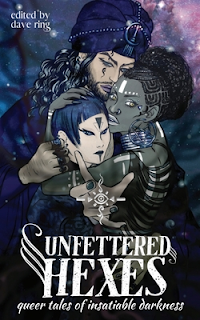
Unfettered Hexes: Queer Tales of Insatiable Darkness ed. dave ring

In just a couple of short years, Neon Hemlock have become one of my favourite publishers with their range of queer speculative fiction from diverse, boundary-pushing perspectives, and this collection is an excellent place to start if you haven't picked up one of their books before. Both the theme and the aesthetic are excellent: each story comes illustrated with a full page image from Matthew Spencer, and the stories involve a range of witchy and occult premises covering everything from space station cults and oxygen maintenance (Effects of Altitude on the Blood Elevations of Love by Marianne Kirby) to sapphic triads exacting supernatural revenge on their landlord (Love and Light by H.A. Clark). There's also two comics, some poetry and two narrative adventure games: Exterior, by Mercedes Acosta, about leaving the safety of your home into the unknowable dangers of the outside; and Hold the Dark, by Allie Bustion, about you and your coven preparing for a mysterious oncoming darkness. There's even some classifieds by Jordan Shiveley, of Dread Singles fame! It adds up to a really cool package where every piece of work contributes to an engaging whole.

 But let's talk about some of my favourite short stories! Kel Coleman (and, look, I could go off on another whole tangent about how many great stories Kel Coleman put out in 2021, but you should just go check them out and not take my word for it) knocks it out of the park with "Before, After, and the Space Between", a story about an innately talented witch and her daughter, growing up as outsiders in a society where magic has been co-opted by a dominant culture that requires artefacts imbued with spirits of the dead to conduct it. Sanguine's mother narrates the growing rift with her daughter as she grows up, the circumstances of her death, and their eventual attempts at reconciliation from beyond the grave. The way the story navigates prejudice and cultural domination, wrapped up in a story between mother and daughter who have to overcome enormous barriers to come to an understanding, makes it heartbreaking and powerful and very much worth reading. I also really liked "Sutekh: A Breath of Spring" by Sharang Biswas, which creates a world based on a fictional game with strong parallels to Hades, where Osiris tries to fight his brother Set, constantly being resurrected in a pool of blood in Isis's cave when he fails. Except one day he wakes up and it's Amun-Au, not Isis, who greets him, and the two strike up a flirtatious rapport that becomes a high point of Osiris' frequent deaths, and blossoms into romance. As the scope widens to show us that this is a mod, one which becomes unstable with a subsequent game patch and stops the player from being able to progress in that version of the game, the story raises some really interesting questions about how fan engagement builds queer content into works that don't canonically care about them, blurring the line between that meta-commentary and the feelings of the characters themselves. If anything, the strong parallels to Hades and its real life studio Supergiant were drawbacks for me (Hades itself has two significant and inescapably canonical m/m romances, no modding required) but it doesn't take much to look beyond that mismatch to the general point that Biswas's story makes, and it's a good one.

There are also several great stories which build around specific places, be those the magical houses of "The Passing of Sinclair Manor, or, The House of Magical Negroes" by Danny Lore and "FOR CLOSURE" by Tania Chen, the supernatural contemporary city of "Dizzy in the Weeds" by L.D. Lewis and the future capitalist dystopia of "Undercity Spellwork", or the otherwordly juxtaposition of a trendy underground-carpark-turned-hotel (except don't call it a hotel, it's a Transitory Dwelling Experience) with the group of Black men dressed in intricate animal masks who come for a late night check-in, in "Antelope Brother" by Craig L. Gidney. That last story is narrated to perfection by bored hospitality worker Malik, who spends his mostly-dead shift reading and talking to his friend Kiki before investigating a supposed disturbance that turns into something more involved than he expected, and the slow ramping up of supernatural elements makes for a really funny, engaging story. Honestly, though, there's just not a bad story in here, and Unfettered Hexes covers a really impressive amount of ground while keeping its theme at the heart of every story. Well worth investing the time in.

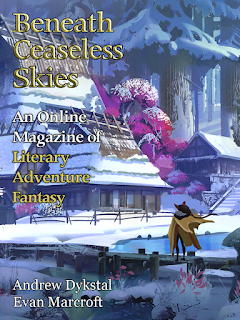
Beneath Ceaseless Skies


Between all the issues I read last month, Beneath Ceaseless Skies has really cemented itself as one of my favourite publications, and I'd particularly urge anyone looking for slice-of-life fantasy to give their short fiction a try. Sure, there's plenty of adventure and weirdness, but some of BCS's best stories involve presenting a small corner of a much larger world, focusing on unlikely protagonists or niche professions, and building out mythologies and worlds around those folks. So you get stories like The Fox's Daughter by Richard Parks, about the challenges a spirit faces while trying to foster a high ranking Kitsune's daughter, or the fussy, nervous travelogue of "Letters from a travelling man" by W.J. Tattersdill, whose protagonist writes about visiting the home of his elderly friend and the changes it has undergone since she left. Even stories with more "traditional" fantasy elements: like the dragon slaying in "The Lingering Weight of Estrian Steel" by Rajan Khanna, or the fae power struggle in March McCowan's "Song So Pure and Cruel" or the build-up of rebellion in "The Last Days of Summer in the City of Olives" by Filip Hajdar Drnovsek Zorko, focus heavily on the protagonists' lives and hopes and fears outside of their call to adventure. The old soldier of Khanna's story has defected from the army after losing his fight with the dragon and finding love and new perspectives in the village below; the story of the fairy goddess of "Song So Pure and Cruel" is told through a childhood companion whose only interest is playing with her and hanging out, an interest that is reciprocated in the goddess' current incarnation; and Drnovsek Zorko's story features a reluctant princess who refuses to take up the position of challenging her sister directly, questioning the foundation of the rebellion that seeks to make her its figurehead even as she comes around to their objectives. Reluctant protagonists aren't new to fantasy, but at shorter length it becomes easier for that day to day life to take centre stage, and to emphasise the weight of human (or, you know, fae, whatever) connections and finding a purpose that doesn't involve violence or scheming, and the result is a reading experience that really enriches my overall fantasy diet.

With that in mind, it's not a surprise that the two standout stories from my recent readings are epics of an unusual type. "Quintessence", by Andrew Dykstal, is about a group of miners wintering at the top of an impossibly high mountain, kept alive by supplements and unable to venture outside due to the cold and lack . When Loren's compatriots start dying of what should be a preventable illness, and the mine's witch refuses to release the cure that would help them, he ends up murdering her and being possessed by her soul (the relationship that develops out of this is not as grim as it possibly should be, with that setup, but go with it). Between them, Loren and Rose begin to unravel the mystery behind their circumstances and the deaths, and hatch a desperate plan to escape their situation. There's a bucketload of tension and danger, and Rose is a fantastic character who gets plenty of time to shine despite not getting what she deserves within the story itself. And "A Manslaughter of Crows" by Chris Willrich is a story I want to press into everyone's hands, because it's about electoral fraud and gerrymandering in a fantasy city built on the principles of pirate democracy (otherwise known as the "swabocracy"), and the protagonist is a sentient cat who is part of a special investigations unit. Shadowdrop and his group of friends and allies (including a seagull called Purloiner-of-Chips, Hope the very good dog, and assorted humans) need to rush to unravel the plot threatening the city's election, and its connection to the newly formed bird party, before the tenets of their democracy are overthrown altogether. It's an adventure from start to finish, and I will never not be here for fantasy electoral politics.

Adventures Elsewhere


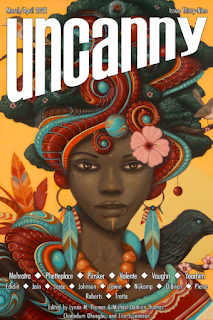
I caught up on several issues of Uncanny Magazine, which delivered its usual high quality mix from a lot of authors I know I love. "Colours of the Immortal Palette" by Caroline M. Yoachim is a really engaging story about a mixed race 19th century woman aspiring to be an artist but being held back both by her race and gender, and working mostly as a model for more famous artists around her (including Monet). When she gets an offer from an immortal painter to become immortal herself, she is given more time to break through, even as her benefactor insists that her artistic perspective is the wrong one to be worth paying attention to. Yoachim's protagonist prevails, of course, but her immortality and the difficulty of outlasting her peers makes this both a satisfying and bittersweet conclusion. "Where Oaken Hearts do Gather" by Sarah Pinsker is a story told through what are effectively genius.com annotations against a set of folk song lyrics, simultaneously telling the story within the song while also building out the characters and the simultaneous story of the commentators, one of whom stops commenting after a visit to the location where the song allegedly took place. It's haunting stuff, and the out-of-chronology comments are handled really impressively to build the tension even with the early reveal that something is amiss. I was also really impressed by the emotional resonance of "For All Those Who Sheltered Here" by Del Sandeen, which tells the story of a lynching from the perspective of the tree, and the tentative healing when it comes to be part of a family's life much later.

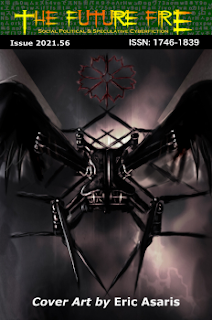
The Future Fire continues to impress too, and the pair of novelettes in Issue 56 were a real highlight of my reading (yes, they came out almost a year ago, no I'm not sorry for only just reading them, stories do not have an expiry date! "k.a. (birthright) by Lam Ning is the story of two former soldiers, part of a criminal warlord's army, who after several years years and a spell in prison find themselves in medical services on the other side of the conflict. The whole story takes place in a broadly sketched hostile environment - it's a planet, maybe earth, but suits and oxygen masks are required to go outside, not to mention the ongoing conflicts and rampant death-capitalism - and it's a really interesting story about struggling to survive amidst hostility, no matter how ugly your past or present might look. Then there's Listener, by Sim Kern, which is about a woman who grows up with the ability to talk to trees and plants, and how that ability and the events around it shape her relationships with her family and her best friend Delia. It's told from the perspective of the main character returning for a reunion years later, so we can see how she has built her life around an ability that she has increasingly rejected, and how returning to her home and reuniting with her family also lets her reconnect with what's actually great about talking to trees (aaaaah, sun!) and to put the pain of the past into a context that lets her move forward with self-acceptance of all she is.

Finally, I have to throw in a word for an unconventional Twitter story: Unknown Number, by Azure Husky, is a Twitter thread of text message screenshots portraying a conversation where Gaby, a 46-year-old trans woman, is randomly contacted by an unknown number who turns out to be much closer to her than she realises. It's a powerful story of the decisions around transition, and how the smallest things can make that decision either possible and validating, or difficult to the point of impossibility. I think it's worth reading for how kind the two characters are to each other, and particularly the affirmations that Gaby gives her caller  as we realise how unworthy of love and validation they feel about themselves. It's a delight, is what I'm saying, and you should read it. That's all.

POSTED BY: Adri, Nerds of a Feather co-editor, is a semi-aquatic migratory mammal most often found in the UK. She has many opinions about SFF books, and is also partial to gaming, baking, interacting with dogs, and Asian-style karaoke. Find her on Twitter at @adrijjy