Showing posts with label Yakuza. Show all posts

Friday, September 9, 2016

Stranger than Fiction: Tokyo Vice, by Jake Adelstein

If this is really what (being a reporter in) Japan is like, I’d rather be cleaning (or living in) a toilet!
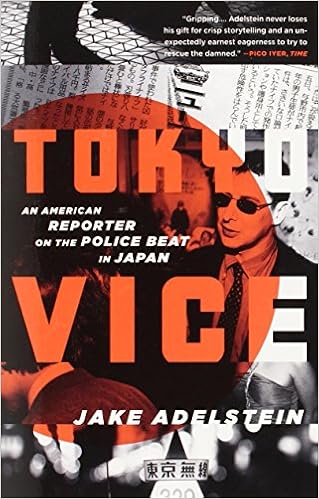
Adelstein, Jake. Tokyo Vice: An American Reporter on the Police Beat in Japan. Vintage Crime: 2010.


People bandy around the phrase ‘stranger than fiction’ a lot (NB: I have no idea if this claim is statistically accurate), but it’s not often that something written and presented as an entirely true story can actually succeed in shocking its readers with its seeming fictionality. Why is that? Because non-fiction writing, like all writing, operates according to narrative conventions, and generally, the things we know belong to the category of non-fiction don’t resemble, in a narrative sense, the things we know are firmly in the category of fiction. Lo and behold, most of the “non-fiction” books that do jolt us with their ‘stranger than fiction’ vibe manage the feat by borrowing liberally from the conventions of whatever genre of fiction writing their true story most closely resembles.

So if someone wishes to write the true story of a mystery or whodunit, consciously or unconsciously (but probably consciously—see below) the would-be author might drift over into the narrative world of mystery (fiction) writing. If done poorly, this raises all sorts of red flags for the reader, because the same markers of fictionality in a straightforward mystery novel are popping up in a supposedly non-fiction story, and that strikes many readers as problematic. If done well, I suppose this narrative drift might simply make the story more of a page-turner. Either way, it’s certainly no surprise authors are tempted to mix literary genres (non-fiction plus a fiction genre or genres), because unless they are in academia, authors want, naturally enough, to sell books, and presumably a non-fiction story that reads like a mystery novel will jump off the shelves a lot faster than a painstakingly factual, dry non-fiction story.

Suppose you had experienced more than most people’s share of interactions with a crime syndicate, and wanted to report those experiences…in the most riveting way possible. Would you:

A)   Limit yourself to a regurgitation of your own notes, in chronological order, of what happened and when, and strive for an objective tone in reporting the events, or
B)    Jazz it up a little, using “caper (fiction) story” narrative tricks to make what happened sound more exciting?

If you chose option (A), congratulations! You’re a career academic, and your books will sell literally dozens of copies. If, however, you chose (B), then you and Jake Adelstein have something in common.

Everything about Tokyo Vice, from its cover and title down to the witty, entertaining first-person narration, feels like a novel. In fact, it’s so novelistic that if someone later comes forward to confess that “Jake Adelstein” was just a literary character s/he invented, and the entire tale was made up, I don’t think I’d be particularly surprised (though I have no reason to believe this or something like it is actually the case, especially since Adelstein managed to publish his work in places like the Washington Post, an impressive feat if imaginary!). In a way, this is a compliment to Adelstein’s writing style, because it really was a page-turner, an in-depth glimpse into the murky world of organized crime—and (at least to me) the even more interesting phenomenon of the inner workings of the police-media love/hate-fest—in Japan over the last two decades.

What about it screams “novel”, then? 1) Bribery, corruption, international conspiracies, the FBI making deals with the Japanese mob in exchange for information, a sort of international black-market organ trade of sorts, at least one dirty cop, a serial killer (possibly more than one depending on whether mob hitmen count!), “hits” on those who get in the yakuza’s way, several physical confrontations from which the intrepid protagonist managed to extricate himself only by violently subduing his attacker, and—it is strongly implied—the revenge killing of one of the protagonist’s closest friends and allies.

All of these elements, however, could have been recounted very dryly and impersonally, but for better or worse (on balance, I think “better”) Adelstein chose a far more engaging approach. First of all, the book isn’t consistently in chronological order, though it certainly moves roughly “in order”, from his early career in Japan up to the end of his Japan-based reportage. Adelstein deserves praise for turning what might have seemed largely rather monotonous work, of relentlessly befriending cops in order to wheedle them into awarding an exclusive to one’s own paper, into a riveting account full of sex, sleaze, drugs, human trafficking, money laundering, and murder. But the question is: did he go too far in sensationalizing the material? If even half of what he’s claiming in his book is indeed true, then the material is plenty sensational all by itself; this reader, at least, wonders whether, say, Adelstein humble-bragging about his “poor” martial arts skills that, nevertheless, proved sufficient to incapacitate a yakuza enforcer/bouncer, etc., really adds substantively to the story he’s telling.

I guess what I’m saying is that the Ivory Tower in me longs for a thicker veneer of objectivity, of dispassionate reporting of “just the facts”, whereas the avid reader in me crows at the deeply personal nature of the tale. Be that as it may, this is a book worth reading, especially for anyone out there who clings to the belief that Japan is utterly safe and pristine. Adelstein’s harrowing account of Kabukicho and its apparently then- (and, perhaps, still today?) rampant human trafficking of non-Japanese women, left me queasy, while the ‘antagonist’ of the book, Tadamasa Goto, would make anyone’s blood boil given the underhanded way he arranged his liver transplant—at UCLA, no less. This much seems clear: Adelstein would probably have a relatively easy time transitioning into writing fictional first-person caper or mystery stories!


Strangeness factor: 7 (on a scale from 1, A.R. Burn’s snooze-worthy History of Greece, to 10, the life story of Roy Sullivan, a guy who shot himself in the head…after being struck by lightning a ridiculous seven times over the course of his life)


This intervention between true stories and fiction was brought to you by Zhaoyun, who loves all tales, whether they’re as genuine and trustworthy as a degree from Trump University or just seem like they’re imaginary, and reviewer on Nerds of a Feather since 2013.  

Wednesday, March 18, 2015

CYBERPUNK REVISITED: Johnny Mnemonic


Dossier – Longo, Robert. Johnny Mnemonic (1995).


Filetype – film (of sorts).

File under – cyberpunk derivative (but also proto-cyberpunk, as it was based on the eponymous 1981 short story by Cyberpunk doyen William Gibson, predating even Neuromancer).

Summary – An utterly unappealing drone stuffs info into his head and then spends the rest of the movie trying to get it out, enlisting the aid of everyone from a bright-eyed street samurai to a bunch of squatters to a smarty-pants dolphin in his quest to not die. Arrayed against him are the Yakuza and their unstoppable secret weapon, Dolph Lundgren. (It all sounded ridiculous back in 1995, and it still does today.)

High-tech – cool ideas like 'wetware' brain datajacks and storage capacity (of a mind-blowing 160 GB, slightly bigger than my crappy smart phone's!) and monofilament whips and virtual reality gloves and visors and so forth are present, but depicted in what passed for mediocre special effects in the mid-90s, making it all feel (and look) like a goofy Shadowrun session gone wrong.
  
Low-life – Director Robert Longo (whose film career didn't exactly blossom after this little gem) does deserve points for the mise en scene (consistent with his 'real' job as a sculptor and painter), as the film was shot mostly at night, and is filled with establishing shots which nicely illustrate just how crappy everyone's life is who is stuck near the garbage heaps of cities like Newark (an analysis which is perhaps true in the real world of 2015!) compared to suit-clad bourgeois stooge Johnny. But the Lo-Teks, a bunch of idiot luddites with a ton of crappy weapons and a combination magic dolphin/microwave emitter, failed to win me over; I was rooting for the Yakuza throughout, since at least they had style.

Dark times – It's standard dystopian fare—mega-corps rule the world, and unless you work for one of them (in which case you're a mega-villain by definition), chances are you're a grimy "Lo-Tek" resistance fighter/casualty living in a literal dump, which is what the world apparently turns into if corporations are allowed to seek profits (anti-capitalist ravings that no one took seriously in 1995, or doubtless more than twelve people would have gone to see it). The film adds the wrinkle of a disease, the Black Shakes, which is brought on by exposure to the now-ubiquitous electronics of the world, but that's silly and in any case everything is reduced to the simplest and most Manichean moral terms imaginable: either a character is a Good Guy (one of the Lo-Teks, or Johnny himself, or 'Jane', etc.) or irremediably Evil (bright-eyed monofilament whip wielding Yakuza assassin, Dolph Lundgren's bizarre Preacher guy, Ralfi). The only character to show any moral complexity is the Yakuza/Pharmakom exec played by, that's right, comedian and gritty crime film director Kitano Takeshi, though his change of heart is stupid and merely involves transforming from Evil into Good.

Legacy – Johnny was without a doubt one of the most high-profile (and high-budget) film adaptations of a cyberpunk story in the 1990s. On the other hand, given its mediocre subject matter and less than mediocre execution, it got exactly the critical and box office reception that it deserved. 

In retrospect – One feels slimy echoes of Michael Crichton's histrionic Rising Sun here. Johnny was made in the mid-nineties, when social anxiety about the impending 'takeover' of the U.S. by Japan wasn't yet recognized to be totally ridiculous. It was a time when people could apparently imagine a dystopian future where soulless Japanese pharmaceutical executives would join forces with heartless Yakuza to crush the world in their iron grip. In fact, I thought that aspect of the story was pretty silly way back when I first saw the film, twenty years (!) ago, and it hasn't aged well.
           
Johnny also suffers from anti-technological fears of ubiquitous electronics that strike the viewer in 2015 as breathtakingly naive. Is there a crippling neurological disorder just around the corner, caused by all our electronic stuff? If so...how come radio waves (i.e., TV, etc.) and all other forms of 'harmful' electronic radiation have consistently (even back in 1995, in fact!) been shown to be utterly without negative effect? You want to know which modern invention is one of the most harmful to human health? The x-ray—which was invented like a gazillion years ago. But even the x-ray isn't so bad, or at least that's what I tell myself when the dentist smilingly zaps me for another one of those stupid panoramic images that nobody uses for anything, bathing my entire skull in short-wave radiation...

I guess what I'm saying is that the most dystopian parts of Johnny are also the weakest parts of the story. The Japanese have not conquered the world (or, if they have, they did a lot better job hiding that fact than the Yakuza thugs do in the movie!), and no terrifying Black Shakes has arisen to doom the most technocratic of us. Incidentally, I've heard the main plot of the film, which concerns said Black Shakes and a certain megacorp too selfish to release its cure, was the most infuriating change from story to film, and alienated many Gibson fans from Johnny. Having never read the story, I didn't need any such fancy justification—Keanu Reeves (it was pretty much his epic "I want ROOM SERVICE!" rant that nailed the coffin shut on Johnny for me) did it for me free of charge. Except for the price of the movie ticket, now that I think about it—curses! You may have won that round back in 1995, Reeves, but the film also delivered your career a nearly lethal blow; I'd call it even.

So there you have it, folks. Johnny failed to win over audiences back in 1995, when its vision of the faraway year of 2021 probably sounded marginally less absurd; it doesn't have a prayer of winning anyone over now! Not all of its problems stem from harmful changes to the original story in the process of film adaptation, however; some of the most ludicrous ideas are right there in Gibson's original vision of the future, like heroin-addicted uber-dolphins. Actually, the film made a small improvement—it eliminated the dolphin's chemical dependency sub-plot, judging it (correctly) to be stupid and irrelevant. No, Gibson: in the future, drug problems won't be so severe they've begun extending to other species, and dolphins can't microwave Dolph Lundgren!


Analytics


For its time: 2/5.
Viewed today: 1/5.
Cybercoefficient: 3/10.


Zhaoyun, no prophet of the future, can nonetheless spot ridiculous predictions and Manichean ethics when they crop up, and since 2013 has been taking great pleasure here at Nerds of a Feather in eviscerating books and films that spew forth such drivel.