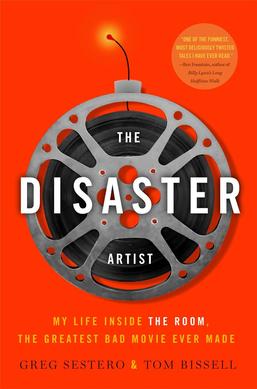
Rises above this reviewer's ambivalence about the movie it chronicles
There is, apparently, a cottage industry of people affiliated with godawful-terrible movies telling the story of their experience making them. Michael Stephenson got in on the game a few years ago with his documentary Best Worst Movie about his involvement with Troll 2, and now Greg Sestero has gotten the story of his involvement in The Room out there. Sestero's story is set to form the basis of a film adaptation starring James Franco. Thankfully, I don't believe anybody is planning a tell-all about Birdemic yet. Despite the claims of people selling the stories of their own particular worst movies, Birdemic, for my money, remains the worst movie. But I've already harvested those fields.
I am deeply ambivalent about The Room, and to be honest, I'm pretty ambivalent about most of Sestero's account of his involvement with it. It has been a real struggle for me to separate my feelings about this particular work from my feelings about this field in general. See, I myself have been involved with some terrible, incompetent productions. I have been through the grind of acting workshops and castings and hunting for an agent and the stop-start pull of trying to get traction for a career in movies. Fully one-third of The Disaster Artist chronicles these activities in the young Greg Sestero's life, as he takes acting workshops in his Bay Area hometown, contemplates a move to LA, finally does move, gets an agent, takes more classes, auditions, questions himself, wonders if his mom's nay-saying was right, and struggles with the reality of having to get a day job that still accommodates increasingly infrequent auditions. To me, this was laborious stuff to get through, because I lived it. There are a million and a half people living it right now within a thirty-mile zone around where I type this, and there have been a million and a half people doing it here every day since Clara Bow put stars in the eyes of would-be it-girls and it-boys all around the country. It is a story that is profoundly unexceptional.
What makes Sestero's story different, though, is a peripheral character who evolves into a central one — the riddle wrapped in a mystery inside an accent that is Tommy Wiseau. Greg meets Tommy in an acting class in San Francisco, as Tommy murders a scene from A Streetcar Named Desire. Tommy's performance is so bizarre and incoherent that Greg asks Tommy to be his scene partner just to try to figure out what makes this odd man tick. It's unclear if Greg has yet, to this day, figured it out, but he's come closer than anybody else. If you don't already know, here's the mystery of The Room: In 2003, Hollywood witnessed the independent theatrical release of an evident ego-service project written, produced, directed, and starring an unknown, unkempt, and vaguely foreign cat named Tommy Wiseau. Wiseau's odd, heavy-lidded face stood twenty feet high, looming over motorists on scenic, heavily trafficked Highland Blvd from a billboard. That billboard stayed there for years and years. So too, the film played at midnight at the Laemmle Sunset 5 theater (across from LA's best deli, Greenblatt's. This point is not open for debate.) for years, and began to attract crowds drawn by word-of-mouth about how awful and bizarre this movie was, and the question of who was this ego-manaical oddball at the center of the whole thing?
Here, then, is the mystery of Tommy Wiseau: How did a man of totally indeterminate age and origin amass a fortune that allowed him to spend millions of dollars making and promoting a totally incomprehensible vanity project with characters, stories, and diseases that magically come and go, never to reappear again? Why did he make the baffling decisions on display in the film? Just, why? Wiseau has always been publicly circumspect regarding the answers to these questions, so The Disaster Artist is as close as we're likely to get to any answers. Where the book excels is in conveying the utter lunacy of the actual production, and the revolving door of cast and crew members trying to get this thing in the can. It also, in spite of everything, makes you feel sympathy for the inscrutable Wiseau.
As the RiffTrax for The Room points out (co-written by past NoaF interviewee Sean Thomason), the water in a fountain featured prominently in one shot is full of the tears of talented filmmakers whose films will never see the light of day as we all ironically watch The Room. In the end, the success of The Room, which is only reinforced by the narrative of The Disaster Artist, is both a testament to and an indictment of the way America awards success to individuals.
The Math
Baseline Assessment: 5/10
Bounses: +1 for the book's alternating narrative structure, which I credit to co-writer Tom Bissell; +1 for Sestero's narration in the audiobook, chiefly his impersonation of Wiseau; +1 for Tommy Wiseau as a character, even if key mysteries remain unanswered
Penalties: -1 for the Sunset Blvd and The Talented Mr. Ripley quotes that kick off each chapter — we get it, we get it, ok?;
Nerd Coefficient: 7/10 (audiobook) (a mostly enjoyable experience); 6/10 (in print) (still enjoyable, but the flaws are hard to ignore)
***
Posted by Vance K — nerds of a feather co-editor and cult film (and attendant baggage) reviewer, and LA-denizen since before the billboard for The Room disappeared from Highland Boulevard.
Reference: Bissell, Tom and Greg Sestero. The Disaster Artist [Simon & Schuster, 2013].
- Reviews
- _Book reviews
- _Film and TV Reviews
- _Game Reviews
- _Thursday Morning Superhero
- _Short Fiction Reviews
- Lists
- _New Books Spotlight
- _6 Books Posts
- _We Rank 'Ems
- Features
- _Interviews and Blogtables
- _Talking About Books
- _The Hugo Awards
- _Mini-Projects
- Projects
- _Nerds on Tour (2020)
- _The Hugo Initiative (2019)
- _Feminist Futures (2018)
- _Dystopian Visions (2017)
- Meet the Flock
- Review Policy
- Home
Showing posts with label RiffTrax. Show all posts
Tuesday, June 16, 2015
Wednesday, January 23, 2013
Interview with RiffTrax writer Sean Thomason
No one did more to raise the profile of terrible and obscure old movies than the crew at Mystery Science Theater 3000, and their current venture, which has broadened its scope to include current Hollywood blockbusters, is called RiffTrax. Behind the funny is a small crew of writers, including Sean Thomason. Sean recently e-sat down with Nerds of a Feather to talk cult movies.
NF: For anybody out there who's not familiar, can you give us a little background on what RiffTrax is and where it came from?
ST: The basic idea is, we make movies funny. A movie plays, and a trio of comedians -- Mike Nelson, Kevin Murphy, and Bill Corbett -- chime in with jokes, riffs, and/or hilarious lines from T.S. Eliot's The Waste Land (usually not that). If the concept sounds similar to Mystery Science Theater 3000 (MST3K), that's because RiffTrax was created by Mike, former host and head writer of that show, and Kevin and Bill voiced the robots. Mike had always had the idea that it would be fun to riff major studio movies of the sort MST3K didn't have access to, and finally, with the internet and mp3s, the technology was there to do it easily. So we do big blockbuster flicks, like the Star Wars prequels or Transformers (pardon, I have to spit on the ground in disgust every time I mention that movie) with an mp3 track that people can download and easily sync up to the DVD at home. We also do older, cheesy Z-grade type movies. Since those are public domain, we're able to provide the video along with the jokes in one downloadable file.
NF: And you guys are doing two special programs in theaters this week and next. Can you talk a little about those?
ST: Yes! These are actually encore presentations of our two most popular live shows to date, Manos: The Hands of Fate, and Plan 9 from Outer Space. They're arguably two of the worst movies of all time, and perfect fodder for us. The way these shows work is that, through a company called Fathom, our guys perform a live riff of a movie in one theater and have it beamed to over 500 movie theaters nationwide. We throw in some bizarre short films and a few other surprises as well. MST3K fans might remember Manos from the show, but we revisited it and wrote a completely new script. Which was fun for me, since I watched that episode back when it originally aired. I think it was a special kind of torture for the other guys to have to return to that movie. That was a lot of fun for me, because I enjoy other people's suffering.
Here's a link to info and tickets for both of these shows, airing one night only on January 24th (Manos) and 31st (Plan 9).
NF: How does the RiffTrax process work? Where do the movie ideas come from, and how many of you are involved in getting these things up on their feet? Do you work in a writer's room environment, or slave away in joyless little cages churning out jokes?
ST: It's basically Thunderdome, but with more flamethrowers and creepy little dudes riding on our backs. But on the days we aren't fighting to the death, we're looking for movies. The ideas generally come from one of us writers -- Mike, Kevin, Bill, myself, or Conor Lastowka -- and then we'll screen it to see if it might work, looking for funny moments and general things that we could dig into. Sometimes we get great suggestions from fans, too, which is nice because we're pretty lazy. It takes a lot of screening to find something that works, because we have pretty specific yet hard-to-define needs. It's very much a "you know it when you see it" thing. Once we find something good, we go off and do the bulk of the actual writing on our own, then bring it all together and make it work as a whole. So it's really a combination of the writer's room thing and the joyless little cage thing you mentioned. And Thunderdome.
NF: One of my favorite things about RiffTrax is that the delivery method and technology you mentioned make it possible to take on not just the public domain films that MST3K was known for, but also the big blockbusters. Do you prefer working on one kind of movie versus the other?
ST: That's a good question, and it really does vary case by case. But on the whole, I enjoy working on the old movies more. With those you're more often dealing with a hilarious level of ineptitude, movies so strange and naively crafted that sometimes it feels like they must've been made by aliens, or ambitious raccoons. The big blockbusters are fun too, but since the craft and production values are obviously much better, the jokes tend to be about the weak story logic and lazy cliches they rely on. Like characters yelling "MOVE, MOVE, MOVE!" or "Talk to me, people." That said, I grew up on superhero comics and Star Wars, so it's fun when I get to dig into that knowledge for a nerdy obscure reference while we're riffing something like Thor. Of course then the other guys call me a geek and make me wedgie myself, but it's worth it.
NF: I want to come back to the question of terrible movies. I did a series over the summer probing the question of what is the worst movie ever made, and of course Plan 9 and Manos figured large in those discussions. What do you think makes the difference between an awesomely bad movie and just an irredeemable rotten egg of movie stink?
ST: It's so hard to define, and it's one of those things we're looking for when we screen stuff. You want movies that are bad, but not so bad they actually crumple your soul and make you wish you had never seen them. You still want the movies to be fun in some demented way. I think a big factor in that is what the filmmakers were going for. It's best when you can tell they really thought they were onto something, they were honestly trying to make something they thought was good, but just didn't know what the hell they were doing. I think Plan 9, Manos, and a more recent favorite of mine, Birdemic, all fall into that category. Nowadays "bad movies" and the whole ironic culture of it has become such a phenomenon that you get people making bad movies on purpose, and to me that's a cynical, unenjoyable exercise. If someone made something really awful on purpose, there's not much we can do with it, and I don't see the point.
NF: Do you generally enjoy movies regarded as terrible, apart from the ease with which they can be made fun of?
ST: I do, thankfully, otherwise I don't think I'd last very long at this. I spend more of my time watching terrible movies than good ones. Even back in high school, my best friend and I would go to the video store and rent the crappiest-looking horror movie we could find. Part of that seed was probably planted by watching MST3K, which is kind of a weird "the circle is now complete" thing. But also I think it's that a really terrible movie can surprise you more than a slick, conventional film. When you're watching something that's totally off the rails, made by people who don't really know how you're "supposed" to make a movie, you get all these odd little moments that you don't get with normal films. And they can grow on you, too. Admittedly, I may have Stockholm Syndrome with it, but at this point I genuinely love watching Birdemic. Every scene is hilarious to me, and there's always some new madness to discover. I feel the same way about Santa and the Ice Cream Bunny, which is such a spectacular mess it barely even counts as a movie.
NF: MST3K was directly responsible for saving some of these movies -- like Manos -- from the ash heap of history. I'm a giant nerd and think these movies are intrinsically valuable, but I'd love to hear a perspective from inside the brain-trust that's both saving them and (justifiably) ridiculing them. Do you think these movies are valuable, and if so why?
ST: Mike and I have talked about this, and we both feel like it's one of the cooler things about this whole project. We get to find and sort of curate these weird cultural artifacts that are mostly forgotten. Sure we're picking on them, but we're also showing them to a wider audience than they would've found otherwise. I think there's a value to them -- maybe not the same value as a classic film like Casablanca or, y'know, Beyond Thunderdome -- but it's still an expression and a record of what people at a certain time and place were thinking, what was going on in pop culture at the time, that you can see in whatever they were trying to accomplish. Plus a lot of them have women in skimpy outfits, and there's no denying the value of that.
NF: Word. But to totally shift gears here, you guys know the folks over at Stone Brewing Company, and I want to mention this because you worked on something that I think is wonderful and not enough people have seen. I know you know what I'm talking about, so can you give us some background about that?
ST: Beer! Beer is a big part of San Diego culture, and we're all craft beer fans. My fellow writer Conor is especially into the whole scene (this is my sly way of calling him a drunk). Our friends at Stone show RiffTrax stuff at their brewery in the summer, and one time Conor and I were there and saw this video they had made with local brewers, celebrating the greatness of craft beer as a movement, taking on the big guys like Budweiser. We totally agree with the sentiment and I love local beer, but we felt like the video was maybe a little...serious, considering we're talking about beer here. So we decided to make our own funny version. We were a little nervous this might destroy our relationship with the guys at Stone, but luckily they dug it and posted it on their own site. It got passed around a lot, and I've even been recognized a couple times by waiters at local restaurants. No free beers yet, though. HINT.
(FYI - Sean is the guy with the *bleeping* mouth on him and the survival knife in the following video: - ed.)
NF: On that note, what would you say that a) your favorite beer is, and b) your favorite nickname for beer? I'm partial to barley pop, but that's just me.
ST: My favorite beer is probably Alpine Duet, an IPA. Alpine is a local brewery and it isn't widely available, but it's fantastic. Ballast Point is another great brewery here, and their Sculpin IPA is hard to beat. Plus it's named after a really ugly-ass fish. My favorite nickname for beer is probably Hungry Hungry Hoppos. See, because it's a pun on "hops"? Okay I just made that up, but now it's my favorite.
Subscribe to:
Posts (Atom)


