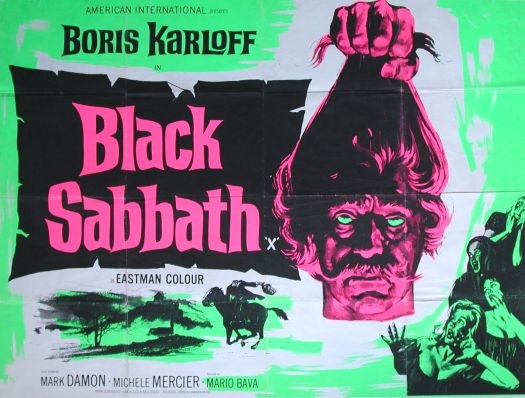
I have a soft spot in my heart for the 1963 Italian horror film
Black Sabbath, directed by Mario Bava and from which the legendary band took its name. I first watched it on my fifteenth birthday, with a group of friends late at night after discovering that our local independent video store (International Video, it was called), had a VHS copy. It's a horror anthology film, with three separate closed-ended vignettes, and while watching it I eerily predicted the ending of one of the segments with a frightening level of detail, down to guessing the name of the "evil" character revealed at the end of the segment. It was creepy. Everybody looked at me funny and I had to swear I'd never seen the movie before. It was one of those odd moments where time seems to swallow its own tail.
I've seen both the American and Italian versions a few times in the intervening years, and a few weeks ago, just before Halloween, I had another urge to re-watch the movie. I was happy to find it on Netflix, and this discovery led me to another one -- the films from an out-of-print DVD series called
The Mario Bava Collection have all found their way onto Netflix. So I've spent the last couple of weeks watching A LOT of Italian horror movies from the 1960s and 70s. It's been a lot of fun.
Mario Bava was a filmmaker who was imminently worthy of a two-volume "collection," but he isn't particularly well-known outside of die-hard genre circles. He was important in the evolution of several genres, so there's certainly a film history kind of appeal to watching his movies, but he was also an original and highly entertaining filmmaker, whose films continue to be evocative and engaging even when completely divorced from any historical significance they may have. He came of age in the Roger Corman horror-movie heyday of the early 1960s, tackling the kind of gothic horror films that were making Vincent Price an icon, and Bava went on to help shape the horror/thriller hybrid
giallo films that came to embody much of Italian cinema in the 1970s and launched the careers of directors like Dario Argento.

Now we come to which of these films are available on Netflix for instant streaming.
Black Sunday (1960) is one of these gothic horror stories, and it's a total standout among its peers. It starts with a witch being burned at the stake and having a mask of the devil nailed to her face (which is badass), and then leaps forward a couple of hundred years, when the witch's spirit grows restless.
Black Sabbath, which I already mentioned, has Boris Karloff as a vampire (or, more specifically, a
wurdulak), and features a genuinely moving and heartbreaking scene where a character has to confront what it costs to be a survivor among so many that have fallen under an all-consuming supernatural curse. One of a number of similar horror triptych films of the same vintage, it ranks among the best. The same year, Bava made
The Girl Who Knew Too Much (1963), which was his last black and white film and is universally regarded as the first
giallo film. It's not a great movie, and hews much more closely to the prototypical Hitchcock thrillers from which is cribs its name than to later (and bloodier)
giallo films, but it has some genuine moments of humor and an interesting premise (a girl who reads too many murder mysteries thinks she witnesses a murder in front of the house she's staying in while visiting Rome), even if the mystery itself is kind of lame.
There are some Netflix gaps here in Bava's filmography, and the available titles pick up at the end of the decade, when Bava had fallen on hard times and was struggling to find distribution for his movies, but still managed to make interesting and visually striking films, even if they struggled at the box office. Bava used color to wonderful effect, and if some of his signature camera moves like zooms (so, so many zooms) and artistically out-of-focus shots lose a little of their appeal, his saturated color palettes never do. Movies like
Hatchet for the Honeymoon (1970) don't necessarily hang together from start to finish, but they are beautiful to look at and have amazing sequences in them, such as a ghost that everybody
except the killer can see. It's great stuff, and Bava would continue to jam non sequitur sequences into his later films, like
Bay of Blood (1971), where he essentially invented the slasher movie ten years before its heyday by sending four horny teenagers to the woods and hacking them to bits in the middle of an entirely different plot about the murder of a wealthy dowager who has remarried and has people after her money. And yes, it is as awesome as it sounds.
After the success of
Bay of Blood and a couple of other early 1970s hits, Bava regained total creative control over his movies and decided to make a surrealist tone-poem of a horror movie in
Lisa and the Devil (1973). Telly Savalas maybe isn't the most convincing evil mastermind you've ever seen (especially if you remember Phil Hartman's parody of Telly on SNL for the "
Player with Yourselves Club"), but the movie remains an engrossing and totally bizarre experience, even 40 years later. To try to piggy-back on the success of
The Exorcist, the American distributor re-cut and re-titled the film
The House of Exorcism, which is nearly unwatchable garbage, though, so stick with the Italian version.
I can't recommend these movies highly enough, and have to say it's one of the most consistent pockets of goodness I've found in Netflix's streaming offerings. There are a few other titles that I watched and haven't mentioned, and a couple more that I didn't get to, but Bava's output was never dull, and his films are uniquely entertaining. Check 'em out.