Cadwell Turnbull returns with book two of The Convergence Saga, balancing social critique with entertainment

Note: This review will contain spoilers for book one, No Gods, No Monsters, which Adri reviewed here.
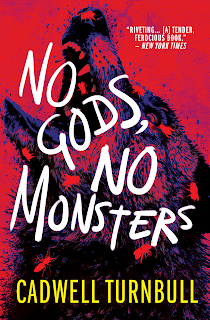
I’d been anxiously waiting to read We Are the Crisis as No Gods, No Monsters was one of my favorite recent reads and a book I recommend to just about everyone. I enjoy urban fantasy, and The Convergence Saga has been a great blend of urban fantasy fun with social critique. Plus the series directly references one of my favorite books of all time, The Dispossessed by Le Guin. Book two, We Are the Crisis, doesn’t disappoint as a sequel. It maintains the same energy and devotion to examining characters while continuing to raise the stakes for the multiverse.
We Are the Crisis starts in 2026, two years after what is called the Boston Massacre—the pro-monster protest that turned violent due to magicked mass shooters. At the end of book one, Ridley, Laina, and Rebecca had agreed to become a pack, and book two starts with Ridley full embracing his “wolf.” Not only are they all werewolves, but they are prepared to fight and have practiced how to protect themselves. The first forty pages open with a tense sequence of the pack being followed and having to fight off a vampire that perfectly plays into the camp of urban fantasy. The fight scene demonstrates how powerful they have become with their wolves and how they have learned to work together. Considering Ridley’s trauma around monster rights at the end of book one, this scene demonstrates how his character has changed and how the wolf has made him a more powerful protecting presence.
The pack is searching for the other wolves that started disappearing after monsters initially revealed themselves. In book one, Rebecca’s pack had shown themselves shifting on the freeway but then slowly shrank to just her and Sarah, until Sarah died at the protest. Now, with her new pack, the three of them search for the lost wolves, who seem to have just… vanished. After the vampire attack, Ridley finally reaches out to Melku for more information, and Melku explains that the secret monster societies are in conflict, which is only aggravated by a monster hate group called the Black Hand, which has an upcoming rally in Boston.
Like the first book, We Are the Crisis follows multiple characters via the disembodied narrator, Cal. Cal’s powers allow him to visit different universes in the multiverse, and throughout the book, Cal learns more about his powers and what he can and can’t do with them. In Cal’s world, there seem to be no “monsters” per se, but things bleed from other universes, such as the god Asha, who visits Cal and his niece Gina in the form of a cat, even when Cal and Gina leave the U.S. Virgin Islands to visit the States for Gina to look at colleges. While Cal struggles with reconnecting with his family and bringing Gina into their lives, the multiverse becomes more dangerous, even for his incorporeal form.
One of my favorite characters, the young Dragon, intersects with a new character in the book, Tez, the Wanderer, a monster who runs a co-op that provides mutual aid for humans and monsters. In book one, co-ops and networks were a theme and part of the characters’ passions, but in book two, those co-ops become a deeper part of the plot as there is a rise in cooperatives at the same time as the monsters reveal themselves. Both humans and monsters work at Tez’s cooperative, but the Black Hand’s violence is directed indiscriminately, and the co-op’s human members suffer as much as the nonhuman. Dragon gets to know Tez because he volunteers at the co-op and the members help him find safe places to stay. A few years older, Dragon is starting to learn how the world works and how hard it is to protect the people he cares about.
As in our world, when revolutionary work is being done and people are uniting, there are always government agents and propaganda trying to stop it. The struggles that the monsters and activists face mirror what revolutionary groups like the Black Panthers have struggled against (and in the acknowledgements, Turnbull mentions how his research on the Black Panthers influenced the book). As in book one, the social critique of the novel about civil rights but also revolutionary organizing is carefully woven into the story. The character of Tez and his mutual aid practices are one area, but also the return character of Sondra, who has stepped away from politics on the U.S. Virgin Islands to start a nonprofit called Solidarity Commonwealth VI, which helps small businesses become worker-owned. Her partner, Matthew, is a senator, and over the course of their relationship, they have in-depth discussions about power, statehood, and revolutionary thinking.
Much like book one, this book focuses on the characters and their developing identities and ideas, which allows for these discussions to feel like part of the story rather than infodumping leftist concepts. One of my favorite parts of book one was the intimacy of the character portraits as Cal observes them in the different worlds. Tez continued this pattern, as did a deep dive into a real occult figure, Marjorie Cameron, whose paintings are referenced in book one. Due to the character focus, Turnbull can deftly weave in the social critiques because they spring from the characters’ lived experiences. I was particularly excited with how the co-ops move from more of a background theme to something central in book two, and I hope this trend continues in the third book.
Turnbull’s Convergence Saga delivers compelling characters, unique structure, and literary lines. On top of that, the way he plays with the urban fantasy genre is a great combination of entertainment and more literary fantasy. On top of that, these books aren’t merely entertainment but also contain social commentary in a manner that doesn’t detract from the plot. I can’t wait to see what Turnbull does with book three!
Reference: Turnbull, Cadwell. We Are the Crisis [Blackstone Publishing, 2023].
POSTED BY: Phoebe Wagner is an author, editor, and academic writing and living at the intersection of speculative fiction and climate change.